Article Contents:
- What is confirmed about NPU-413
- Width 450 mm: what a 90° rotation gives in numbers
- 450 mm needs to be measured in at least three places
- Geometrically, it can be rotated; compositionally, only after checking the pattern
- What to look at on the official drawing
- What the 3D model provides
- Why you cannot decide based only on the symmetrical outer contour
- Why you don't need to invent universal 30, 50, or 100 mm
- NPU in the color of the smooth strip
- NPU contrasting with the smooth strip
- NPU in the color of the slats
- Smooth strip and slats of the same color
- Find a trim with a width of no more than 450 mm in the standard orientation
- Widen the smooth strip
- Switch to a different composition
- Strip between two slat panels without furniture
- A console is standing nearby
- A switch is located nearby
- There is a sconce above
- The strip is located at the doorway
- Mistake 1. Treating 530 × 410 as simply two interchangeable sides
- Mistake 2. Using the design 450 mm instead of the actual minimum width
- Mistake 3. Forgetting that after rotation the height becomes 530 mm
- Mistake 4. Assuming 20 mm is a guaranteed sufficient margin
- Mistake 5. Leaving the NPU at 530 mm wide and adding 40 mm for the rails
- Mistake 6. Trimming the NPU-413 to 450 mm without approval
- Mistake 7. Checking the composition only in close-up
- Mistake 8. Choosing a contrasting color before checking orientation
- Can NPU-413 be considered a vertical overlay after rotating 90°?
- If NPU-413 fits with 20 mm margins, do they need to be strictly equal?
- Can NPU-413 be placed diagonally to get more air?
- What matters more: the drawing or the product photo?
- Can NPU-413 be used without MLDPU-002?
- Will NPU-413 fit if the smooth strip is 450 mm only at the bottom, and 430 mm at the top?
- What to do if you specifically like NPU-413, but the pattern cannot be rotated?
- Can you cut out space in the slat panels for the edges of NPU-413?
- How to tell if NPU-413 is too large for a 450 mm strip?
- Where can I see narrower options?
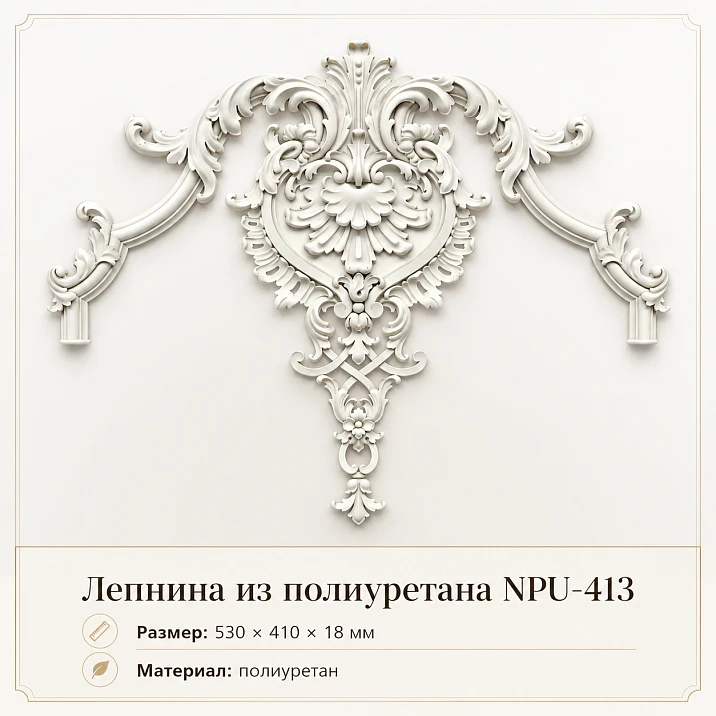
A smooth strip 450 mm wide between two slat zones seems like a suitable place for a large carved overlay. But NPU-413 has an obvious problem: in its standard orientation, its width is 530 mm, meaning it is physically 80 mm wider than the free section.
The buyer's first thought is logical: rotate the decorative overlay 90°. Then the dimensions swap, and it takes up 410 mm in width and 530 mm in height.
Purely geometrically, this works: after rotation, 40 mm remains in the 450 mm strip, that is, 20 mm on each side with precise centering.
But this is exactly where a simple answer "yes, it fits" would be bad advice.
NPU-413 has a specific floral ornament. The STAVROS card shows product drawings and a 3D model, but does not state that the overlay is rotationally symmetric and can be used in any orientation. Therefore, a geometric 90° rotation does not yet prove that the pattern will look correct after rotation.
The correct answer of the article is:
NPU-413 can be considered for a 450 mm strip in a rotated position, because after rotation its width dimension is 410 mm and it physically fits within 450 mm. But you cannot buy the product based only on this calculation. First, you need to check the orientation of the plant pattern against the official drawing, photos, and 3D model, then make a full-size template of 410 × 530 mm and see if the 20 mm side margins between the overlay and the rails are sufficient.
The cost of a mistake is noticeable: the current product card shows 12,870 RUB for one NPU-413. For a single item, the quantity question is simple. The main risk is buying a product that fits the dimensions and getting a decorative composition that looks "lying on its side" after rotation.
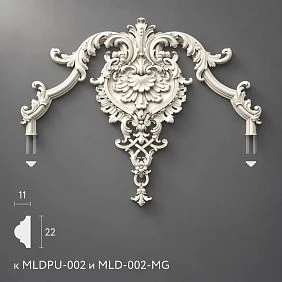
What is confirmed for NPU-413
NPU-413 is a decorative polyurethane overlay. The official STAVROS product card lists one size of 530 × 410 × 18 mm and a current price of 12,870 RUB per piece.
STAVROS catalog filters decode the axes as follows:
-
A — width;
-
B — height;
-
C — thickness.
Therefore, in the standard orientation:
-
width — 530 mm;
-
height — 410 mm;
-
thickness — 18 mm.
| Parameter | NPU-413 |
|---|---|
| Product type | Decorative overlay |
| Material | Polyurethane |
| Width A | 530 мм |
| Height B | 410 мм |
| Thickness C | 18 мм |
| Price | 12,870 RUB/pc. |
| Drawing | is on the card |
| 3D model | is on the card |
After checking the orientation and layout, you can buy a decorative overlay NPU-413 made of polyurethane.
The card also shows among related products the molding MLDPU-002, overlays NPU-412, NPU-399.1, NPU-400.1, and the corner element MLDPU-002U. This is useful for alternative compositions, but does not mean that NPU-413 must only be used together with the molding.
In the FAQ of the NPU-413 card, it is directly described as an overlay for decorating furniture, doors, and walls. Therefore, using it on a smooth wall section is acceptable as a scenario. A separate question of this article is whether it can be rotated relative to its standard width and height.




Width 450 mm: what a 90° rotation gives in numbers
The original strip between the slat panels has a clean width of 450 mm.
In the standard orientation of NPU-413:
530 mm > 450 mm.
Missing:
530 − 450 = 80 mm.
That is, the overlay cannot be entirely on the smooth strip if its standard position in width is maintained.
After rotating 90°, the horizontal dimension becomes equal to the previous height:
410 mm < 450 mm.
remains:
450 − 410 = 40 mm.
With symmetrical installation:
40 / 2 = 20 mm on the left;
40 / 2 = 20 mm on the right.
This is the first positive check: the product physically fits.
But 20 mm is a small visual gap next to a large carved element 18 mm thick and active vertical slats. Therefore, next we need to check not just "fits / doesn't fit," but four more things:
-
whether the clear width is really 450 mm everywhere;
-
does the ornament not have a pronounced top and bottom;
-
is 20 mm of side clearance sufficient;
-
does the new height of 530 mm fit into the selected vertical zone.
It is the fourth point that is often forgotten. After rotation, the width issue is resolved, but the overlay becomes taller.
Our factory also produces:

450 mm needs to be measured in at least three places
If the slat panels are already installed, the figure "450 mm" may be a design value or measured only in the middle.
For a large element, this is not enough.
Measure the clear width of the smooth strip:
-
at the top point of the future NPU-413;
-
in the center;
-
at the bottom point.
Why this matters: the edges of two slat zones may have a slight discrepancy. Even a few millimeters change the already narrow margins on the sides.
For example, if the top is actually 450 mm and the bottom is 442 mm, with an overlay width of 410 mm, the margins will no longer be equal:
442 − 410 = 32 mm, meaning only 16 mm per side when centered on the bottom part.
And if the narrowest point turns out to be 425 mm:
425 − 410 = 15 mm, only 7.5 mm per side.
Physically, the product still fits, but compositionally it almost touches the slats.
Therefore, for ordering, you need to use the minimum actual width, not the average value.
| Minimum width of the smooth strip | Remainder after NPU 410 mm | Margin on each side when centered |
| 410 мм | 0 мм | 0 мм |
| 420 мм | 10 мм | 5 мм |
| 430 мм | 20 мм | 10 мм |
| 440 мм | 30 мм | 15 мм |
| 450 мм | 40 мм | 20 мм |
| 460 мм | 50 мм | 25 мм |
The table does not set a standard for the "correct field." It shows how quickly free space disappears if the actual slats are not perfectly parallel.
Get Consultation
Geometrically, it can be rotated; compositionally — only after checking the pattern.
This is the main section of the article.
A rectangular object can always be rotated 90°. An ornament — not always.
Plant decor often has an internal direction:
-
a base and a top;
-
a heavier lower part;
-
branches that visually "grow" upward;
-
flowers or leaves with a specified orientation;
-
central axis;
-
side branches;
-
compositional center shifted up or down.
If such a pattern is turned sideways, a person may not immediately notice the technical error, but will feel that the decor is positioned unnaturally.
Therefore, in this article one cannot write:
"NPU-413 has 410 mm on the second side, so feel free to place it vertically."
Correct sequence:
size passes → pattern is checked → only then a decision is made.
What to look at on the official drawing
The drawing needs to determine:
-
where the visual top is;
-
where the base of the ornament is;
-
whether there is an explicit vertical axis;
-
whether the left and right edges are the same;
-
does the pattern repeat when rotated;
-
are there elements that start to "grow sideways" after rotation.
What the 3D model provides
The 3D model is useful not only for relief.
Rotate the object as planned on the wall and evaluate it not as a technical detail, but as a finished decorative sign.
If after rotation the eye still perceives the ornament naturally, the idea is viable.
If it is visible that one side was clearly the "top," it is better not to use the geometric placement.
Why you cannot decide only by the symmetrical outer contour
Even if the overall rectangle looks almost symmetrical, the inner leaves and curls may be directional.
Therefore, the paper rectangle 410 × 530 mm only answers the question of dimensions. For the final layout, the real silhouette and pattern of NPU-413 are needed.
Make two layouts, not one.
For this topic, it is especially useful to compare the NPU-413 in two positions.
Layout No. 1 — standard orientation 530 × 410 mm.
It physically extends beyond the 450 mm strip by 80 mm. This needs to be seen with your own eyes: perhaps the very idea of a large horizontal ornament is so much better that it is worth changing the width of the smooth zone if the panels can still be redone.
Layout No. 2 — rotated orientation 410 × 530 mm.
It fits and leaves 20 mm on each side at exactly 450 mm.
Comparing the two layouts answers two questions at once:
-
how much the rotation changes the character of the pattern;
-
what is more important — to preserve the standard composition or to fit into the existing wall opening.
If the slat panels are already finished and cannot be changed, the second option becomes practical.
If the panels are only marked out, it is sometimes more reasonable to widen the smooth strip than to force a large ornament to work in an unnatural orientation.
What does 20 mm of side margin next to slat panels mean?
With an exact pier width of 450 mm, a rotated NPU-413 leaves 20 mm on the left and right.
This is neither "forbiddenly little" nor "guaranteed enough." The product card does not specify a minimum decorative margin around the item.
But for a real composition, 20 mm should be perceived as a tight fit.
Why:
-
The NPU-413 itself is large — 410 × 530 mm in the rotated position;
-
the relief protrudes by 18 mm;
-
on both sides there are active slat surfaces;
-
a narrow light strip around the overlay can visually almost disappear;
-
any deviation of the slats from parallelism becomes noticeable.
If the goal is to make a large central relief that almost fills the smooth insert, this could be the right effect.
If you want NPU-413 to be perceived as a separate overlay with "air" around it, the 20 mm must definitely be checked on a mockup.
Why you don't need to invent universal 30, 50, or 100 mm
The comfortable field depends on:
-
the wall color;
-
the color of the slats;
-
depth of the grooves;
-
the width of the outer lamellas;
-
lighting;
-
the shape of the ornament itself;
-
the viewing distance.
On a light smooth strip between dark slats, 20 mm can outline the contour well.
On a monochrome wall, where the slats and NPU are painted the same color, this gap can almost disappear into the overall light and shadow.
Therefore, the solution is not normalized by a number—it is tested at full scale.
Do not overlap the NPU-413 slats just to maintain the standard orientation.
Another approach is possible: leave the NPU-413 at 530 mm wide and allow it to extend beyond the smooth strip.
If you center 530 mm on a 450 mm strip, the overlay will extend approximately:
(530 − 450) / 2 = 40 mm
toward each slat zone.
In the drawing, this may look striking. In actual installation, problems arise.
First, the smooth wall and the face surface of the slats may be at different levels. The NPU-413 will not have continuous support.
Second, the decorative overlay will begin to physically connect the two finishing systems.
Thirdly, the extreme sections of the relief may hang over the grooves.
Fourthly, future dismantling of the extreme panel will require removing the NPU.
Therefore, for the original scenario, it is better to consider the smooth strip as an independent mounting plane. If the NPU-413 does not fit on it in the standard position, one should not automatically "allow" it to lie on the rails.
An exception is possible only after a separate technical mock-up of a specific rail system, when the planes, support area, and fastening method are known.
After rotation, check the height of 530 mm
Rotation solves the width but changes the vertical dimension.
In the standard orientation, the height of the NPU-413 is 410 mm.
After rotating 90°, the former width — 530 mm — becomes the height in the composition.
If the smooth strip runs from floor to ceiling, this usually does not create a physical problem. But the actual decorative section may be limited:
-
console;
-
by a switch;
-
wall sconce;
-
door casing;
-
a ceiling cornice;
-
baseboard;
-
shelf;
-
niche.
Let's denote the clear height of the decorative zone as H.
Then, with vertical placement of the NPU-413, the free vertical field will be:
H − 530 mm.
If the overlay is centered vertically:
top margin = bottom margin = (H − 530) / 2.
For example, with a zone of 800 mm:
800 − 530 = 270 mm;
270 / 2 = 135 mm at the top and bottom.
With a zone of 600 mm:
600 − 530 = 70 mm;
70 / 2 = 35 mm from top and bottom.
In the second case, the NPU almost fills the rectangle in height.
These calculations address a different question than side margins. Therefore, the height needs to be measured separately, not assuming that "if it fits in width, everything is ready."
Center the NPU-413 or shift it up and down
With a width of 450 mm, the side position is almost predetermined: if symmetry is desired, the NPU-413 with a width of 410 mm leaves only 20 mm on each side.
Vertically, there is significantly more freedom.
Three schemes are possible here.
Geometric center. Suitable for a standalone smooth panel between two identical slat fields.
Shift upward. This can work if there is a console, pouf, narrow dresser, or other item under the panel. The NPU becomes decor above the furniture.
Shift downward. Less common, but may be justified if there is a sconce, room number, sign, or other object above.
Main principle: the shift must be tied to something in the interior.
If NPU-413 is simply "raised by 70 mm because it looked prettier there," with a narrow symmetrical strip, it may look random.
For layout, it is better to measure the distance not from the center of the ornament, which is hard to determine by eye, but from the overall rectangle of 410 × 530 mm in the chosen orientation.
Thickness 18 mm: rotation does not change the projection, but changes the shadow.
The thickness of NPU-413 remains 18 mm in any orientation.
Geometrically, this is simply the third dimension. In a slat composition, it affects perception more strongly.
The slats already provide a series of vertical shadows. NPU-413 creates its own complex shadow along the edges of the plant ornament.
After rotating 90°, it is not the thickness that changes, but the direction of the pattern relative to the light source.
If before rotation the elongated elements of the ornament ran horizontally, after it they may become vertical. Side lighting will begin to highlight leaves, curls, and protrusions differently.
Therefore, the 3D model is needed not only for the question of "where is up." It should be used to understand the terrain.
On the real object, it is useful to make a rigid mockup about 18 mm thick or attach one real sample if it already exists.
Check:
-
frontally;
-
at an angle from the entrance side;
-
with the wall lamp turned on;
-
with evening spotlights;
-
with backlighting of the slats, if provided.
If the rotated NPU-413 looks natural only from the front, and from the side the shadow makes the ornament look strange, this is an argument against rotation.
The slat rhythm and the rotated ornament can enhance or ruin each other.
After rotation, NPU-413 becomes more elongated vertically: 410 mm in width and 530 mm in height.
Formally, this is even logical next to vertical slats. But the coincidence of the general direction does not yet mean harmony.
There are two opposite effects.
Support effect. The vertical dimension of the NPU continues the overall line of the wall, while the plant relief adds complexity within the narrow smooth insert.
Dissolution effect. If the inner lines of the ornament also become strongly vertical, the NPU loses contrast with the slats and looks like another elongated detail.
Therefore, it is useful to compare a photo of the wall with two mockups:
-
NPU-413 in a rotated position;
-
a more compact overlay that fits in the standard orientation.
If the rotated NPU looks like a natural central accent, the solution makes sense.
If it seems that the pattern "stretches" following the slats and loses its own composition, it is better to look for a narrower product.
Color can make 20 mm margins visible or almost eliminate them.
With very tight spacing, color becomes especially important.
NPU in the color of the smooth strip
The calmest option.
The contour of the overlay is read by relief, and the narrow side margins do not turn into separate strips.
This is useful if there are dark or wooden slats on both sides.
NPU contrasts with the smooth strip
Then the size 410 × 530 mm is read very clearly.
Side margins of 20 mm become part of the graphics.
If they are not perfectly identical, the error will be more noticeable.
NPU in the color of the slats
This way, the central overlay can be connected with the surrounding panels.
But if the slats have a natural wood texture, a solid color polyurethane finish does not make it visually the same material.
It is better to perceive this as a color repetition rather than an imitation of wood.
A smooth strip and slats of the same color
The most complex scenario for dense planting.
The transition is determined almost only by shadows. The 18-mm NPU relief and the depth of the slats can visually merge.
In this case, the evening light test is especially important.
The paper template should show not only the dimensions but also the direction of the pattern
A simple cardboard rectangle 410 × 530 mm is useful for the first step.
But it does not answer the main question of the topic — whether this particular ornament can be rotated.
It is better to make a mockup in two layers.
Layer 1 — dimensions. Rectangle 410 × 530 mm.
Layer 2 — drawing. A printed photo or outline of NPU-413 at the same scale.
On the mockup, place a noticeable arrow labeled "factory top" corresponding to the card and 3D model.
After that, physically rotate the sheet by 90°.
This makes it immediately clear that what is happening is not just with a rectangle, but with a plant motif.
If the ornament looks natural after rotation, proceed to the 3D fitting.
If it seems upside down or lying on its side, further calculation of margins is no longer needed: the product fits geometrically, but is compositionally unsuitable.
What exactly should be 450 mm wide: mounting, visible, or between the front edges of the slats?
On a finished slat wall, three different width values can be obtained.
Mounting width — the distance between the bases of two slat blocks.
Visible smooth width — the section of painted wall that actually remains open after installing the outer slats.
The distance between the face protrusions is the gap that a person sees when looking at the wall from the front.
For NPU-413, the most important thing is a real continuous plane that the entire overlay will rest on.
If the decorative strip in the project is specified as 450 mm, but the outermost slat or end profile partially overlaps it, the actual mounting width may be smaller.
For example, according to the layout, there is 450 mm between the slat modules, but on each side there is an end element occupying 8 mm of the smooth plane.
Then the available width is:
450 − 8 − 8 = 434 mm.
NPU-413 with a width of 410 mm still fits after rotation, but the remainder is:
434 − 410 = 24 mm, that is, 12 mm per side with symmetrical placement.
This is a completely different composition than the stated 20 mm.
Therefore, before purchasing, measure the finished clean area, not just the design axis of the panels.
Do not trim NPU-413 to 450 mm without confirming that the product is designed for such modification.
If the standard width of 530 mm does not fit, the idea may arise to remove the extra 80 mm.
With symmetrical trimming, this would mean approximately 40 mm on each side.
For a floral ornament, such an approach is risky.
Allowed:
-
cut off the leaf ending;
-
disrupt the symmetry;
-
expose the internal structure of the product;
-
get two visually "chopped" edges;
-
change the place where the relief should connect with other decor.
The NPU-413 card does not describe it as a blank with extended shoulders for trimming. Therefore, the article does not recommend reducing it to 450 mm as a standard installation method.
If trimming is specifically required, it must be separately agreed with the manufacturer or done only after studying the actual product and processing technology.
For the original task, it is safer to choose among three solutions:
-
keep NPU-413 and check the 90° rotation;
-
choose a narrower overlay;
-
change the width of the smooth strip if the slat finish is not yet completed.
What to do if the NPU-413 pattern cannot be rotated compositionally
This is the most important commercial rejection scenario.
Suppose the drawing and 3D model show that the ornament has an obvious top and bottom. After rotation, it looks wrong.
Then you cannot justify the purchase by saying that "410 mm still fits."
There are several alternatives.
Find an overlay with a width of no more than 450 mm in the standard orientation
For example, in the STAVROS catalog there is an NPU-409 in the size 406 × 298 × 22 mm. Its catalog width of 406 mm is already less than 450 mm, so for installation in such a partition, there is no need to swap the width and height. At the time of checking, the price for this size is 11,700 ₽.
This does not mean that the NPU-409 is automatically better: it has a different pattern, scale, and thickness. But it demonstrates the correct search principle — first choose a product that fits by its official width, if rotating the NPU-413 ruins the ornament.
You can view NPU-409 406 × 298 × 22 mm as an alternative without mandatory rotation.
Expand the smooth strip
If the slat panels are not yet finally installed, the standard width of the NPU-413 requires a minimum of 530 mm of clean surface, excluding the desired clearance on the sides.
That is, compared to 450 mm, you need to add at least:
530 − 450 = 80 mm.
But "exactly 530 mm" will give an edge-to-edge fit. For a decorative field, a visual gap is usually also desired, the size of which is determined by the layout.
If the wall structure allows increasing the smooth insert, this path preserves the original orientation of the ornament.
Go to another composition
If a 450-millimeter strip is too narrow for a large overlay, you don't have to look for "almost the same, but smaller."
Sometimes it's better:
-
leave the strip smooth;
-
use one small overlay;
-
assemble a vertical composition from several small elements;
-
make a frame pattern from molding;
-
move the large NPU-413 to the adjacent wide wall.
This way, the product doesn't become a task that the interior must obey.
When a molding frame is more useful than one large NPU-413
The smooth strip between the rails already resembles a vertical panel.
If the rotation of NPU-413 does not suit the pattern, you can make a different system: a narrow molding around the perimeter and a more compact central decor.
The advantage of the frame is that it emphasizes the 450-millimeter strip itself, rather than trying to fill it almost completely.
The downside is that the clean inner field is reduced. Therefore, it is even more difficult to place a large NPU-413 inside such a frame.
Related to the NPU-413 card MLDPU-002 molding made of polyurethane can be considered only as the basis of another composition, not as a way to make NPU-413 fit.
If the goal is to keep the wall minimalist, the frame may be unnecessary altogether.
At what height to place the rotated NPU-413
Even if the smooth strip runs from floor to ceiling, NPU-413 does not necessarily have to be placed in the geometric center of the entire room height.
The position depends on what is nearby.
A strip between two slat panels without furniture
Centering by the visual zone usually looks logical. But you need to check not only the middle of the wall, but the actual gaze of a person.
A console stands nearby
The overlay becomes decor above the furniture. Then the bottom edge of the NPU should be tied to the top surface of the console, not to an abstract center of the wall.
A switch is located nearby
You don't need to build the composition so that the switch accidentally ends up pressed against the edge of the ornament.
It's better to either place the NPU higher or leave a separate clean zone around the electrical installation device.
There is a sconce above
The sconce and NPU-413 are two accents. Their axes, distance, and shadows need to be checked together.
The strip is located at the doorway.
A person perceives decor in motion and at an angle. A large relief of 18 mm may appear closer and more massive.
In all cases, it is useful to mark not only the center of the NPU, but also the full dimensions of 410 × 530 mm, so that neighboring objects do not fall into the ornamental zone.
Viewing distance: 410 × 530 mm may be larger than it seems in the catalog.
On screen, the NPU-413 looks like a separate carved piece. On a strip 450 mm wide, it takes up almost the entire width.
Share by width:
410 / 450 × 100 ≈ 91,1%.
This is not a "norm" or an indicator of quality. But the number helps to understand the scale: after rotation, the overlay occupies more than nine-tenths of the width of the smooth insert.
That is, we are not talking about a small central decoration, but almost a full horizontal filling of the wall section.
At a distance of 1–1.5 m, such a composition may look very dense.
From 3–4 m, it may be perceived as a solid vertical panel between the slats.
Therefore, take photos:
-
from 50 cm — to control the edges;
-
from the usual passage point;
-
from the farthest place from which the wall is visible.
If NPU-413 looks beautiful only in close-up, and at a normal distance the smooth strip disappears as an independent zone, perhaps a smaller decor is needed.
Light at the edges of slat panels is especially critical with a 20 mm field
Slat panels create shadows along their side edges.
If NPU-413 is only 20 mm from the edge of each slat zone, side light can visually "eat up" these gaps.
For example, the outermost slat casts a shadow into the smooth strip. At the same time, the 18-mm relief of NPU casts its own shadow outward.
Two shadows meet on the narrow field.
During the day, this may be almost unnoticeable.
In the evening, with side lighting — on the contrary, it is very active.
Therefore, for a 450 mm strip, a decision cannot be made only under uniform construction lighting.
Check:
-
main ceiling light;
-
wall sconce;
-
backlighting of the slats;
-
natural light in the morning and evening, if the wall is near a window.
If the free gap disappears into the shadows, the overlay visually begins to touch the slats, even if physically there remains 20 mm between them.
The mounting surface must be flat across the entire 410 × 530 mm footprint.
After rotation, the NPU-413 rests on a fairly large rectangular area.
Before purchasing, check the smooth wall with a straightedge or a long level.
Especially important:
-
whether there is a bump from putty;
-
whether the edges of the slat panels protrude above the smooth area;
-
whether there is a noticeable paint color difference;
-
whether a deformation joint of the finish runs through the area of the future overlay;
-
whether the edge of the NPU falls on the end profile of the panel.
The carved overlay should not be used to correct a crooked wall.
If the base is noticeably uneven, first level the surface. Otherwise, part of the relief may adhere, while another part may hang.
For adhesive mounting, you need to choose a compound compatible with both polyurethane and the specific wall covering. The card confirms the product material, but does not know whether your strip is painted with acrylic paint, enamel, decorative plaster, or another compound.
Central axis of NPU-413 and slat pitch: what to align and what not to need
A narrow strip of 450 mm is located between two regular slat fields, so another trap appears: trying to align each element of the plant pattern with specific slats.
This is not required.
The slats have their own module — the pitch of lamellas and grooves. The NPU-413 has its own ornament. If you start moving the overlay a few millimeters right and left just so that a leaf or curl "hits" the axis of the adjacent slat, you can lose the more important symmetry of the smoothest strip itself.
For the initial scenario, it is more reasonable to set priorities as follows:
-
determine the exact central axis of the smooth zone;
-
place the dimensional mock-up of the NPU-413 on it;
-
check the margins on the left and right;
-
only then see how the ornament interacts with the rhythm of the slats.
If the two slat zones are identical, the central axis of the 450-mm strip is usually a more stable reference than the edge of an individual lamella.
The exception is a project where the entire interior is built on a unified modular grid and the axes of furniture, lighting, and slats must coincide. Then the NPU-413 needs to be checked together with the entire wall layout, rather than moved locally "by eye".
With fields of only 20 mm each, even a shift of 5 mm noticeably changes the balance: on one side 15 mm will remain, on the other — 25 mm. Therefore, any off-center position must have a clear compositional reason.
If the NPU-413 is rotated, the direction of the pattern must be equally meaningful throughout the interior.
Suppose there is another NPU-413 in the room in its standard orientation.
Then the rotated element between the slats will be directly compared with it.
What looked acceptable on its own may start to look like a mistake next to the "correct" orientation.
Therefore, rotation is easier to use if the NPU-413 is the only one on the object.
If identical overlays are repeated:
-
on another wall;
-
on furniture;
-
above the door;
-
in a molding composition,
Need to check whether one rotated version creates a visual conflict.
Sometimes it's better to choose a different SKU for a narrow strip than to use one model in different orientations without a common logic.
Commercial choice: 12,870 ₽ is paid not for "it fits," but for correct orientation and scale
For this topic, the cost arithmetic is simple:
1 × NPU-413 = 12 870 ₽.
Quantity is not the main question. One central element already covers the scenario.
Therefore, the commercial solution looks like this:
| Inspection result | What to do | Cost of NPU-413 |
| Standard orientation of 530 mm does not fit | do not buy without another solution | 0 ₽ |
| After rotation, 410 mm fits, the pattern looks natural | You can order 1 pc. | 12 870 ₽ |
| After rotation, the pattern looks wrong | Look for another article number | 0 ₽ |
| Side margins are too small after actual measurement | Refuse or change the partition wall | 0 ₽ |
| The panels are not yet installed, and the standard orientation is more important | Expand the smooth area | Depends on the finish |
This approach is more useful than regular product advertising.
A person may come to the conclusion "NPU-413 is not suitable for me," and that is also a correct result of the article.
If the check is passed, order NPU-413 530 × 410 × 18 mm it can be done after the position is approved on a real wall.
Why the category "Decor for moldings" does not require making a frame
NPU-413 is in the "Decor for moldings" section at STAVROS. From this, it is easy to draw the wrong conclusion: since the product is there, a molding is necessarily required around it.
The card of NPU-413 itself describes it as an overlay for furniture, doors, and walls. Therefore, single use on a smooth wall strip can be considered separately.
The category rather shows that the product is part of the polyurethane decorative assortment system and can be combined with linear profiles.
If during the mockup it turns out that one large ornament looks too "floating", you can view decor for polyurethane moldings and assemble a more structured composition.
But the frame should not appear just because it is in the catalog. In a 450 mm strip, every additional 20–30 mm of profile reduces the free space.
If slat panels are still being selected, first decide the width of the decorative strip
The article scenario is formulated as an already remaining strip of 450 mm. But some readers will be at the project stage.
In this case, it is better to change the order of decisions.
Not:
choose NPU-413 → then try to fit it between the slats.
But:
choose the composition → determine the orientation of NPU-413 → set the clean width of the smooth zone → then mark the slats.
If NPU-413 must be in its standard orientation, its confirmed width is 530 mm. This means the smooth strip must be wider than 530 mm if visual breathing room is needed.
If rotation is chosen and the pattern allows it, the minimum physical dimension is 410 mm, and the design 450 mm gives 20 mm on each side.
At the project stage, this 80–120 mm difference is easy to account for.
After panel installation, correction already requires dismantling or changing the entire layout.
If the slat finish is still being selected, you can buy slat panels for walls for interior finishing after approval of the central decorative zone.
How to finish the edges of a 450-millimeter strip so that NPU-413 does not look cramped
With side margins of 20 mm, attention automatically shifts to the edges.
It is necessary to decide where the slat system ends.
Options are possible:
-
the outermost full slat;
-
end profile;
-
smooth side strip;
-
shadow gap;
-
just a cleanly finished panel edge.
The more complex the edge finishing, the less visual breathing room remains for NPU.
For example, if the outer slat is wide and contrasting, 20 mm of smooth wall will look very narrow.
If the slat zone ends with a thin shadow line, the same gap can read as neater.
There is no need to add a separate decorative edge just to "frame" the NPU-413. At a width of 450 mm, an extra line easily overloads the transition.
First, check the simplest option:
slats → 20 mm of smooth field → NPU-413 → 20 mm of field → slats.
If it works, nothing needs to be added.
Mistakes that most often lead to incorrect ordering of NPU-413
Mistake 1. Treating 530 × 410 as just two interchangeable sides
Why it happens: a rectangle can physically be rotated.
Consequence: the size fits, but the botanical pattern ends up oriented incorrectly.
Check: drawing and 3D model.
How to avoid: check geometry and composition separately.
Error 2. Using design 450 mm instead of the actual minimum width
Why it occurs: panels were recently in the drawing.
Consequence: after installation, one point of the wall segment becomes narrower.
Check: three measurements along the height.
How to avoid: calculate based on the minimum value.
Error 3. Forgetting that after rotation the height becomes 530 mm
Why it occurs: the task is formulated only through the narrow width.
Consequence: the NPU hits a switch, furniture, or wall lamp.
Check: overall rectangle 410 × 530 mm.
How to avoid: check both axes.
Error 4. Assuming 20 mm is a guaranteed sufficient gap
Why it occurs: the product physically fits.
Consequence: the overlay looks squeezed between the rails.
Check: full-size mockup on the entire wall.
How to avoid: evaluate not only millimeters, but also visual density.
Error 5. Leave the NPU at 530 mm wide and bring 40 mm onto each rail
Why it occurs: the desire to preserve the factory orientation.
Consequence: different mounting planes and conflicting reliefs.
Check: side profile of the wall.
How to avoid: keep the overlay on one flat plane or design such a node separately.
Error 6. Trimming NPU-413 to 450 mm without approval
Why it occurs: only 80 mm is missing.
Consequence: the finished floral ornament is damaged.
Check: study whether trimming is provided for by the design.
How to avoid: do not consider the decorative overlay a universal blank.
Error 7. Checking the composition only in close-up
Why it occurs: the product is shown close up on the card.
Consequence: on a real wall, the NPU looks too large or too dense.
Check: photos from a real distance.
How to avoid: evaluate the entire wall segment together with the battens.
Mistake 8. Choosing a contrasting color before checking the orientation
Why it happens: you want to see the decor brighter.
Consequence: the wrong direction of the pattern becomes even more noticeable.
Check: first, a monochrome mockup.
How to avoid: choose the color after the geometry is approved.
When it's better not to buy NPU-413
This part is important for a decision worth 12,870 ₽.
NPU-413 is not needed if:
-
after rotation, the ornament clearly looks sideways;
-
the actual width is noticeably less than 450 mm;
-
the margins at the edges visually disappear;
-
the new height of 530 mm conflicts with furniture or electrical fixtures;
-
the 18-mm relief is too heavy next to deep slats;
-
a smooth strip on its own already works well as a pause;
-
there is another large decorative center on the wall;
-
the only mounting method is to partially overlap the overlay onto the slats;
-
installation requires trimming the finished pattern without manufacturer confirmation;
-
a rotated NPU conflicts with other NPU-413 units in standard orientation.
In these cases, it is more reasonable to spend money on a different size or leave the strip without a large overlay.
If you need a wider selection, you can You can buy ready-made stucco matching the Baroque style. Calculate the quantity: linear meters of cornices and moldings, number of rosettes, pilasters, consoles, corner elements. Add a ten to fifteen percent allowance for trimming. after selecting elements with an official width of up to 450 mm.
When rotating NPU-413 can be a successful solution
Rotation makes sense if several conditions are met simultaneously.
-
The clean minimum width of the smooth strip is indeed close to 450 mm.
-
After rotation, 410 mm fits without physical contact with the rails.
-
According to the drawing and 3D model, the plant motif looks natural at 90°.
-
The height of 530 mm does not conflict with neighboring objects.
-
Margins of 20 mm look intentional, not accidentally cramped.
-
The 18 mm relief does not overload the narrow wall section.
-
Lighting does not destroy the side margins.
-
On other walls, there is no same NPU-413 positioned so that the rotation begins to be perceived as an error.
-
The full-size mockup is convincing from the main viewing point.
-
One NPU-413 for 12,870 ₽ really improves the wall more than a more compact alternative.
Under these conditions, the rotation is not a "trick to squeeze in the product," but a full-fledged design solution.
Practical algorithm before ordering NPU-413
-
Measure the finished smooth strip at the top, middle, and bottom.
-
Record the minimum width, not the average.
-
Confirm the standard orientation: A = 530 mm in width, B = 410 mm in height, C = 18 mm in thickness.
-
Check the usual position: 530 mm does not fit into 450 mm.
-
Rotate the dimension: 410 mm fits, leaving 40 mm in total.
-
Divide the remainder when centering: 20 mm on each side at exact 450 mm.
-
Check drawing NPU-413.
-
Open the 3D model and determine whether the pattern looks natural after rotation.
-
Make a template 410 × 530 mm with the actual ornament contour.
-
Mark the standard top and physically rotate the mockup.
-
Check the height of 530 mm relative to furniture, switches, sconces, and ceiling elements.
-
Do a volumetric fitting considering the 18 mm relief.
-
Look at it in the evening under working lighting.
-
Compare with a narrower overlay in the standard orientation.
-
Photograph both options from a normal distance.
-
Only after this, make a commercial decision.
If all checks are passed, buy NPU-413 for a smooth strip between rack panels you can already understand exactly how it will be installed.
Decision matrix: rotate NPU-413 or look for another decor
| Condition | Solution |
| Strip 450 mm, NPU at standard width 530 mm | does not fit |
| After rotation, horizontal dimension is 410 mm | physically fits |
| Actual minimum width is less than the design width | recalculate margins |
| The ornament looks natural after rotation based on the 3D model | continue checking |
| The ornament has an obvious top/bottom and the rotation looks incorrect | choose a different product |
| Height 530 mm fits freely | vertical placement is possible |
| 20 mm on each side look too tight | choose a smaller decor |
| The slats cast a deep shadow on the side margins | check another size or color |
| Need to overlap the slats with part of the NPU | better not to use this scheme |
| NPU-409 406 mm fits by official width | compare without rotation |
| The frame is more important than a single ornament | consider a separate molding composition |
| A smooth strip without decor looks better | Do not buy NPU-413 |
Result: 410 mm fits into 450 mm, but the main question is not arithmetic
NPU-413 is a decorative polyurethane trim measuring 530 × 410 × 18 mm. In the STAVROS catalog, A denotes width, B — height, C — thickness.
Therefore, in its standard position, the NPU-413 is indeed 530 mm wide and does not fit into a smooth strip of 450 mm.
After rotating 90°, the horizontal dimension becomes 410 mm.
In a 450 mm strip, after rotation, 40 mm remains in total — 20 mm on each side when centered. This means that geometrically, the rotated NPU-413 fits into such a partition.
But this is not yet the answer "it can be installed."
Before ordering for 12,870 ₽, you need to check:
-
the official drawing;
-
the top and bottom of the ornament;
-
the 3D model;
-
the actual minimum width of the partition;
-
the new height of 530 mm;
-
side margins;
-
the relief of 18 mm;
-
light;
-
general view from a distance.
If the plant motif remains natural after rotation, 20-millimeter margins look deliberate, and 530 mm in height fits freely, rotating the NPU-413 can be a working solution.
If the pattern looks like it is lying on its side, the geometric saving in width does not justify the purchase.
Then it's better to choose a different decor for polyurethane moldings, consider a narrower overlay or change the width of the smooth zone.
For the wall as a whole, you can Buy slatted panels for wall finishing only after the central decorative strip has been coordinated with the selected decor.
FAQ
Can the NPU-413 be considered a vertical overlay after rotating it 90°?
In the project, it can be described as installed vertically, but the official product size does not change: A remains 530 mm, B — 410 mm. Simply in the rotated mounting orientation, side B provides the horizontal projection, and side A provides the vertical one.
If the NPU-413 fits with 20 mm margins, do they need to be kept strictly equal?
Not necessarily in any composition, but with a strip between two identical slat zones, a symmetrical fit is usually the most understandable first option. A deliberate offset is acceptable if it relates to furniture or another object.
Can the NPU-413 be installed diagonally to get more air?
A diagonal position changes the overall projection and requires a separate calculation based on the actual contour, not just the 530 × 410 mm rectangle. Additionally, the plant ornament may look random. For the original narrow wall segment, first check a rotation of exactly 90°.
What is more important: the drawing or the product photo?
They serve different purposes. The drawing is needed for dimensions and shape, the photo for perceiving the ornament, and the 3D model helps assess the relief and orientation. All three are useful for deciding on rotation.
Can the NPU-413 be used without MLDPU-002?
The card shows MLDPU-002 among related products, but the NPU-413 itself is described as an overlay for furniture, doors, and walls. Therefore, a standalone composition can be considered separately. The frame is a different design scenario.
Will the NPU-413 fit if the smooth strip is only 450 mm at the bottom and 430 mm at the top?
You need to calculate based on the narrowest point. At 430 mm and a rotated width of 410 mm, a total of 20 mm will remain, which is about 10 mm on each side when centered. Physically, the product fits, but the visual fit must be checked with a mockup.
What to do if you like the NPU-413 specifically, but the pattern cannot be rotated?
If the slats are not yet installed, you can widen the smooth strip to the standard width of 530 mm and the desired margins. If the finishing is already done, it is better to move the NPU-413 to a wider wall than to use it in a compositionally incorrect position.
Can you cut out space in the slat panels for the edges of NPU-413?
Such a node requires separate design. It connects the overlay with the relief of the panels and complicates installation. For the original task, it is more rational to leave the NPU entirely on a smooth plane.
How can you tell if the NPU-413 is too large for a 450 mm strip?
After rotation, it occupies about 91% of the width of the pier. This means dense filling, but does not provide a ready-made assessment of "good or bad." The decision is made based on the full-size silhouette and the view of the entire wall from a normal distance.
Where can I see narrower options?
In the category Decor for polyurethane moldings You can compare other items. One example is NPU-409 in size 406 × 298 × 22 mm, which by official width already fits into 450 mm without needing to swap A and B.