Article Contents:
- Furniture decor for the woodworker is a system, not a set of beautiful parts
- What the catalog provides
- You should start not with the decor, but with the facade
- What to measure and record
- Example of a facade map
- Identify the main decorative focal point
- The rest is support
- Hierarchy test
- Carved overlays: the most versatile element for a furniture maker
- Price benchmarks
- Features that help build a system
- How to match the overlay size to the facade
- Free field
- Handle
- Depth of Relief
- Light
- Wooden rosette as the central node
- Repeatability
- Overlay or rosette: how to choose
- Molding links individual elements into a system
- What molding does in the system
- About manufacturing
- Molding and profile: when calm linear decor is needed
- How to choose a profile
- Example of a pair
- Capital: more than just a decoration for the upper corner
- Logic of application
- Compatibility
- Bracket: decorative element or part of the structure
- About the load
- Where it is appropriate
- Pilasters and the vertical architecture of furniture
- How the vertical works
- Limitations
- How to assemble a facade from three levels of decor
- Corner elements as a link
- Example of a system on a single door
- Why five beautiful elements can produce a bad facade
- How to diagnose
- Free field
- The “remove half” test
- How to check ornament compatibility
- Where to look for a match
- Collections
- Checking on samples
- The scale of the ornament must match the size of the furniture
- Example
- A unified scale
- Beech or oak for furniture decor
- Single species
- Gluing grade and sanding
- About combining
- Decor matching the facade color or a separate accent
- Recommended finishing sequence
- Does the manufacturer paint it
- First a trial composition, then order the full set
- Samples
- What to keep
- When the test can be skipped
- How to include a decorative system in the specification
- Conditional example for a tall cabinet
- Why all this
- How to buy furniture decor for a product series
- Availability and batches
- About individual orders
- Where to buy furniture decor for a joinery workshop
- Order terms
- What to clarify with the manager
- Workshop questions
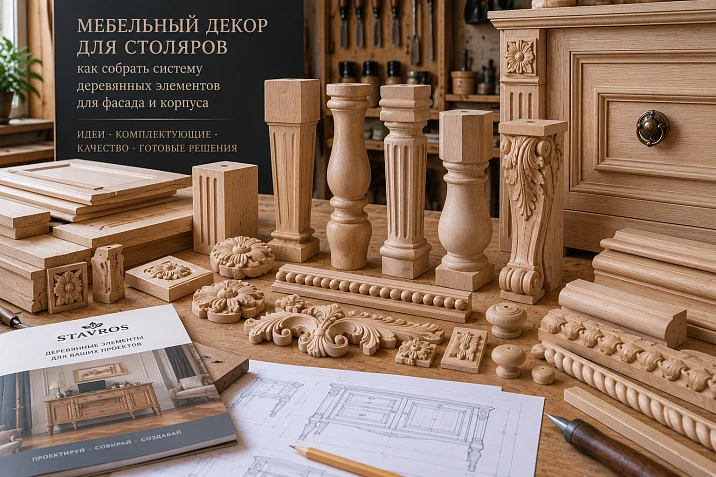
On the craftsman's table lie four beautiful pieces: a carved acanthus overlay, a rosette, a piece of profiled moulding, and a capital. Each one on its own looks great. Place them on a cabinet front, and the composition falls apart: the overlay fights the rosette for the center, the moulding is too active for the frame, and the capital finishes something that isn't there on the front. Beautiful pieces alone don't make decor. Decor appears when the elements have roles.
Furniture decor for the joiner is a system of three levels: the architecture of the front (linear elements and verticals), the main accent (an overlay or rosette), and the completion (corner elements, capitals, finials). It is built from the front, not from the catalog: first the width, height, number of doors, frames, handles, and cornice are known, then one main node is chosen, then the supporting details. Below is a breakdown of how to assemble such a system from ready-made STAVROS elements, how to select sizes and ornament compatibility, how to draw up a specification, and how to purchase decor for a series of products. The general list of workshop components and questions about ordering individual decorative pieces are covered in other materials, while here we discuss only a coordinated system for a single front or carcass.

Furniture decor for the joiner is a system, not a set of beautiful pieces
Bad logic looks like this: you liked an overlay, you liked a rosette, you liked a moulding, so you put everything on one front. The right logic: furniture architecture, the main decorative element, supporting details, linear decor, completion of the composition.
The difference is fundamental. In the first case, the craftsman is assembling a catalog. In the second, he is designing a hierarchy: what is seen first, what second, and what merely supports. When a person looks at a front, the eye does three things: it finds the center, evaluates the frame, and checks whether everything is finished. A decor system must answer all three questions.
The practical consequence for the joiner. Out of dozens of catalog items, four or five are needed per front, and each takes its own place. The other beautiful pieces will wait for another project. This saves both money and time on trial layouts.




What the catalog offers
Section Carved Decor STAVROS brings together overlays (544 items in the list), rosettes, capitals, brackets, pilasters and columns, carved mouldings and trims (78 items), and the section decorative elements assembles rosettes, corner elements, finials, and brackets in three collections: "Classic," "Art Deco," and "Modern." This range makes it possible to build a complete system from products by a single manufacturer, which simplifies matching style and dimensions. Data as of the time of checking; prices are "from" everywhere, check the product page before ordering.
Our factory also produces:
You need to start not with the decor, but with the facade
The carpenter first knows the width and height of the facade, the number of doors, drawers, the frame construction, the position of the handles, the cornice, and the plinth. And only after that is the decor chosen. This sequence sounds obvious, but it is constantly violated: the craftsman sees a beautiful overlay and adjusts the facade to fit it.
Working sequence: facade, working field, axis, decor. The working field is the part of the facade where decor is even possible: excluding the frame, the handle zone, and the edges. The axis is the vertical or center around which the composition is built. Only then is it determined which element will occupy the center and which will be around it.
Get Consultation
What to measure and record
For each facade: outer dimensions, the size of the working field, the position and dimensions of the handle, the width of the frame or molding, the protrusion of the profile above the plane, the distance from the field to the edge. These numbers are needed both for choosing the size of the overlay and for checking compatibility.
Example of a facade map
Cabinet door 396 × 716 mm. Frame made of profile 30 mm wide with a 25 mm offset from the edge. The working field inside the frame is 286 × 606 mm. The handle is on the right at a level of 900 mm from the floor and occupies a strip 60 mm wide. Free field for the central element: approximately 226 mm in width, taking into account the handle zone. The numbers are conditional, but it is precisely such a map that allows you to look for an overlay not "a bit smaller," but, say, up to 200 mm wide.
Identify the main decorative node
There must be a visual priority on one facade. It can be a central overlay, a rosette, an upper capital, a vertical pilaster, or an expressive carved band. Do not make all elements equal: if every detail shouts, none is heard.
The main focal point is chosen according to the logic of the facade. On a single-leaf door, the natural center is the middle of the panel, so a rosette or applique goes there. On a tall cabinet with pilasters, the main focal point is the vertical system, and the applique is secondary. On a long drawer, it is a horizontal carved band. The rule is simple: the main focal point is placed where the eye lands first.
The rest is support
The remaining elements are subordinate to the main one. They repeat its motif in a simplified form, support its scale, and never compete with it. If the central applique has lush acanthus, the corner elements should be calmer, and the linear profile even calmer.
Hierarchy test
Photograph the facade mockup with templates of all the elements and step back three meters. Ask yourself where the eye is drawn. If it goes straight to the center, the hierarchy works. If your gaze darts between three details, remove one or simplify the second.
Carved appliques: the most versatile element for a furniture maker
Appliques are used on cabinets, chests of drawers, kitchens, buffets, display cases, and furniture doors. The section Carved decorative inserts for furniture contains, by description, more than 400 models in beech and oak (the list has 544 items including sets and other types of products). Types: applique, mascaroon, decorative set. Dimensions: A is width, B is height, C is thickness. Collections: Empire, Versailles, Grape, Gothic, Classic, Summer Garden, Modern, Russian Style, Eclectic. Ornaments: geometric, floral, shells, acanthus, vegetal, branch, cartouche, laurel, garlands, animals, woven.
Types by position on the facade.
Central ones are placed on the axis of the facade and make it a focal element. Corner ones work in a framed composition: they give the corner a finished look and conceal joints. Horizontal ones are suitable for a band and drawers. Vertical ones are for narrow tall panels. Paired and mirrored ones (the catalog includes models with mirrored left and right versions) are needed for symmetrical compositions.
Price Benchmarks
Compact overlays start at 950 rubles (N-506), 1,250 (N-372), 1,410 (N-093), 1,750 (N-316), 2,140 (N-106). Large ones and panels from 8,340 (N-276), 10,800 (N-420), 15,480 (N-422). Decor set C-020 from 32,420 rubles (lead time 5–10 days). The range is explained by size and complexity. For a typical cabinet door, a compact overlay is usually enough, while large items are needed for large facades and portals.
Features that help build a system
The section description names three design capabilities that are important specifically for a systematic approach. Modular designer overlays are supplied with connecting elements for convenient joining with the catalog's profiled moldings. Overlays and end caps have a recess on the back that follows the molding profile, allowing the decor to be mounted on top of the profile. There are models with mirrored orientation. All three turn individual parts into a compatible system.
How to match the overlay size to the facade
It is not simply “600 mm facade — 300 mm overlay.” Check six things: free field, frame, handle, distance to the edge, relief depth, and visual scale.
Working algorithm: overlay dimensions, rectangle on the drawing, actual contour, 1:1 template, approval. The A × B dimensions from the product card describe only the bounding box: an S-shaped overlay occupies only part of its rectangle. The actual contour is provided by the template.
Free field
Conditional example. Working field 286 mm wide. An overlay 210 mm wide leaves 38 mm on each side, and the composition breathes. An overlay 260 mm wide will leave 13 mm on each side, and the facade will seem cramped, although formally the part fits. An overlay 300 mm wide will not fit. Of the options acceptable by dimensions, practically not all are suitable.
Handle
Check that the overlay does not conflict with the handle. If the handle is on a vertical line and the overlay is in the center, their zones must not intersect. If necessary, shift the overlay, but then symmetry will be lost: the decision is made on the mockup.
Relief Depth
Thickness C affects installation and appearance. Too high a relief catches on neighboring elements when doors open, while too low a relief gets lost against the frame. Compare the overlay's C with the protrusion of the frame profile.
Light
A relief of a few millimeters almost disappears in diffused light. Assess how the cabinet is lit and choose a relief to match the light.
Wooden rosette as the central node
A rosette is convenient when the composition is built around a central axis. It works in the center of a furniture facade, at the intersection of moldings, in a framed composition, and as a repeating motif on several doors. Section Carved outlets from wood contains round, square, oval, and rectangular options; dimensions A height, B width, C depth. Prices are low: R-055 from 200 rubles ("bestseller"), R-057 from 250, R-084 from 300, R-085 from 330 (all "in stock"), R-082 and R-083 from 2,600 rubles (5–10 days). There are mirrored pairs R-063L/R and R-067L/R. A full breakdown of rosettes is covered in a separate article; here only the rosette's place in the system matters.
A rosette organizes the plane around a single point. If the facade is square or the composition is symmetrical, it works better than an elongated applique. If the field is narrow and tall, the rosette gets lost, and a vertical applique is more suitable.
Repeatability
One rosette per facade across ten facades yields ten identical SKUs. This is the ideal scenario for a series: the price is low, the shape is stable. That is exactly why rosettes are well suited for furniture with several identical doors.
Applique or rosette: how to choose
An applique is needed when a directional composition, an elongated shape, or a horizontal or vertical accent is required. It has an axis and direction: top, bottom, left, right.
A rosette is needed when the composition is centric, the element should work around a single point, and a repeatable module is required. It has no pronounced direction.
| Criterion | Overlay | Rosette |
|---|---|---|
| Composition shape | Elongated, directional | Centric |
| Field | Rectangular, any proportions | Square or nearly square |
| Symmetry | Mirrored pairs, asymmetry | Axial |
| Price (from) | From 950 rubles | From 200 rubles |
| Orientation during installation | Important | Often not critical |
| Best for | Cabinets, buffets, display cases, narrow fields | Doors, framed facades, series |
Practical rule: if in doubt, place paper outlines of both options against the field. Whatever naturally fits the shape of the field is the right choice. Do not place the socket and the rosette in the same center: these are the two main elements, and they compete.
Molding ties individual elements into a system
Here the article becomes stronger than a simple overview of decor. An overlay, rosette, and capital do not by themselves create architecture. A linear element allows you to assemble a frame, run a belt, form a vertical, and connect several decorative points into a single composition.
Section carved molding and baguettes at the time of checking contains 78 items. Product type: molding or trim. Material: solid wood. Collections: Empire, Art Deco, Grape, Gothic, Classic, Modern, Russian Style, Contemporary. Ornaments: geometric, floral, acanthus, bogweed, beads, ionic, braid, vegetal, frieze, laurel. Type: carved or geometric. Filters by sizes A and C. Prices "from": K-034 from 200 rubles ("bestseller", in stock), K-125 from 240, K-105 from 270, K-006 from 380, K-001 from 490, K-016 from 600, K-011 from 710, K-071 from 620, K-005 from 1,010, K-018 from 1,340, K-066 from 2,300, K-104 from 5,420. Check the price unit of measurement (per bar or per meter) in the product card.
What does the moulding do in the system
It defines the frame around the main node, sets the horizontal bands and vertical boundaries. When choosing it, focus on the role: the linear element should not be more active than the main accent. A simple profile around a lush overlay works better than an equally lush one.
About manufacturing
The products are made by 3D milling with manual sanding, dozens of metres per day from beech and oak. A loyalty programme is available for designers and manufacturers. If the required cross-section is not available, the manufacturer can produce items to a drawing, subject to a minimum run. For a single facade this is usually not an option, so choose a profile from the catalogue. Samples of wooden baguettes are sold at 180 roubles each (at the time of checking), which is convenient for a trial layout.
Moulding and profile: when you need calm linear decor
If the carved moulding is too active, use a calmer profile. Section wooden moulding for furniture contains mouldings, cornices, skirting boards and architraves with more restrained cross-sections.
The point of the section is that the linear element does not have to be as complex as the central overlay. Otherwise the elements start to compete. A good technique: a carved overlay in the centre, a smooth or slightly profiled moulding around it, simple corner elements. Then there is one accent, and the rest creates the background.
How to choose a profile
Assess the width of the profile relative to the facade: a narrow profile (about 15–25 mm) forms a thin frame, a wide one (60 mm and more) forms an independent architectural line. Assess the projection: the larger the C, the stronger the shadow. Assess the character: smooth, with a cove, with an ornament. More about choosing a batten and profile for a joinery item is described in the material about a figured wooden rail.
Example of a pair
A compact onlay N-316 (from 1,750 rubles) in the center and a simple-profile molding around the perimeter give a calm classic door. The same onlay with carved acanthus-pattern trim around the perimeter turns the door into an overloaded one. Don't pay for carved trim where a background is needed.
Capital: not just a decoration for the upper corner
A capital should complete a vertical element: a pilaster, post, column, or vertical furniture module. It cannot be placed "on its own" if there is compositionally nothing beneath it to complete. A capital without a pilaster looks glued on.
Section wooden capitals contains, according to the description, more than 60 models (the list has 64 items). Shapes: square, round, rectangular, semicircular. Types: carved and geometric. Prices: KL-007 from 1,950 rubles, KL-004 from 2,050, KL-032 from 2,150, KL-025 from 2,170, KL-014 from 2,670, KL-012 from 16,120. Some items are marked "for PLM pilasters": KL-004.02 (from 2,670), KL-001.02 (from 2,820), KL-014.02.
Application logic
A capital makes sense where there is a vertical. On a tall wardrobe with pilasters on the sides of the facade, it completes each pilaster and connects them to the cornice. On a simple flat facade, a capital is superfluous. Check that its width matches the cross-section of the vertical: a capital overhanging beyond the pilaster looks sloppy.
Compatibility
Check the combination of capital and pilaster by dimensions B and C, not by the series name. The label "for PLM pilasters" is a hint, not a guarantee of compatibility with a specific pilaster.
Bracket: decorative element or part of the structure
The article must clearly distinguish between two cases. Some brackets are used as a decorative element, as a visual support, in furniture portals and under a protruding element. But you cannot automatically promise load-bearing capacity just because a part is called a bracket.
Section Wooden Brackets according to the description, contains more than 60 models (75 items in the list), which can be used to decorate kitchen furniture, cabinets, fireplace and door portals, as well as a holder for a wall-mounted shelf. Each model is available in beech and oak, there are asymmetrical ones with mirror reflection. Prices: KR-038 from 1,130 rubles, KR-044 from 1,330, KR-042 from 1,440, KR-060 from 5,040, KR-062 from 9,800, KR-067 from 4,800, KR-066 from 6,130, KR-065 from 7,150, KR-064 from 10,410. There are ready-made carved shelves PKR-001 from 48,560 rubles.
About the load
The manufacturer describes the bracket as a part that simultaneously bears the load and is part of the visible composition. But for the actual load, a calculation of your structure is needed: the weight of the shelf and items, the method of attachment to the wall or carcass, the material of the base. If the bracket is only a decorative overlay under the cornice, and the load is borne by a hidden structure, honestly call it decorative and don't be alarmed.
Where it is appropriate
Under the cornice of a cabinet, under the protruding countertop of a console, in portals and as a support for a decorative shelf. On a flat facade, a bracket without a function looks unnatural.
Pilasters and vertical furniture architecture
For tall cabinets and bookcases, a pilaster allows you to assemble a vertical system: base, shaft, capital. It supports the cornice, overlays and facade frame.
Section pilasters and columns contains 33 items: bases for pilasters, columns, pilasters, half-columns and connecting rosettes. Prices: RS-001 (connecting rosette) from 500 rubles, BS-009.1 (base) from 840, PLM-014 (pilaster) from 2,210, PLM-016 from 3,030, PLM-018 from 9,740, DD-001 from 16,070, carved column IKN-019 from 24,910, half-column PLM-023 from 31,430. The manufacturer indicates the possibility of ordering custom projects.
How the vertical works
A pilaster divides the facade into fields. Between two pilasters a frame is formed, into which an overlay or a rosette can be placed. Then the pilasters are the architecture level, the overlay is the accent level, and the capitals are the completion level. Everything comes together into a single system.
Limitations
Pilasters add depth to the facade and thickness to the cabinet body on the sides. Check that the doors open without catching, and that the pilaster does not interfere with neighboring modules. For narrow cabinets, pilasters can "eat up" the working width.
How to assemble a facade from three levels of decor
A good practical framework: three levels.
Level 1 — architecture. Profile, molding, pilaster. It sets the structure: frames, bands, verticals.
Level 2 — the main accent. An overlay or a rosette. One element per field.
Level 3 — completion. A capital, a corner element, a small decorative module. It closes the joints and makes the composition complete.
This way the carpenter gets a clear system. For each facade you answer three questions: what is the structure, what is the accent, and what do we complete it with. If there is no answer to some question, you skip that level without filling it with a random detail.
Corner elements as a connector
The decorative elements section offers corner elements for moldings: MLD-027U-2 (from 520 rubles), MLD-001U (from 550), MLD-027U-1 (from 590), MLD-004U (from 960), MLD-002U (from 1,260, 5–10 days), MLD-003U (from 2,140, 5–10 days). According to the section description, a corner element eliminates the need for precise 45-degree miter cutting of the molding and makes the corner of the frame visually complete. For the series this is a significant advantage: a corner element is repeatable, while a hand-cut miter on twenty facades is not.
Example of a system on a single door
Door 396 × 716 mm. Level 1: molding frame. Level 2: rosette R-084 (from 300 rubles) or overlay N-316 (from 1,750). Level 3: four corner elements MLD-027U-2 (from 520 rubles each). Option with rosette: 4 × 520 + 300 = 2,380 rubles excluding molding. Option with overlay and corner MLD-001U: 4 × 550 + 1,750 = 3,950 rubles. For twenty such fronts (ten cabinets with two doors each), we get 47,600 and 79,000 rubles respectively, also excluding molding. Prices are "from" at the time of checking; compatibility of corner elements with a specific molding must be verified against the drawing.
Why five beautiful elements can produce a bad front
A very human situation. Each detail is good, but together the front is heavy. There are usually five problems: different scale of ornament, different stylistic motifs, too little free space, lack of a visual center, and equally active elements.
Principle: decor must have hierarchy. Hierarchy is created by different activity levels of the elements. The center is the most saturated, the frame is calmer, the corners are even calmer, and the background is the quietest.
How to diagnose
Photograph the layout and convert it to black and white. Without color, it is easier to see where the "mass" is concentrated. If several places are equally dark and detailed, then there is competition. Remove or simplify the excess.
Free field
Even the right elements look bad if there is no air between them. Leave a distance between elements comparable to their characteristic size. Guideline: the free space around the main element should be no less than one fifth of its width. This is an author's guideline, not a standard.
The "remove half" test
Remove two of the five elements. If the composition improves, they were unnecessary. If it falls apart, then the right ones were removed.
How to check ornament compatibility
It is not necessary for all elements to be from the same product series. But repetition is desirable: leaf shape, scroll direction, relief character, level of detail, scale.
Example. Acanthus is best supported by elements with a similar plant language, not random geometry. If the central onlay has acanthus, corner elements and moulding with laurel or a plant motif will complement it, while a geometric bead pattern will conflict.
Where to find a match
The catalog allows filtering by ornament type and collection. Onlays offer acanthus, cartouche, laurel, garlands, and plant ornaments. Mouldings offer acanthus, laurel, plant, beads, and braid. Choose elements with a common ornament: the filter helps find matches across different sections.
Collections
The Classic and Empire collections exist in onlays and mouldings, while Art Deco and Modern are available in rosettes, corner elements, and mouldings. Choosing one collection across the whole system simplifies coordination.
Checking with samples
Lay out samples of all elements on a table next to each other and compare relief, detail, and scale. Moulding samples at 180 rubles each allow you to do this inexpensively. For onlays and rosettes, order one piece each.
The scale of the ornament must match the size of the furniture
A large ornament suits a large wardrobe, a portal, and a large sideboard. A small one suits a drawer, a small door, a cabinet, and a narrow frame. This is a compositional principle, not a regulation.
The reason is distance. A large wardrobe is viewed from afar, and a small pattern blends into texture. A small drawer is viewed up close, and a large ornament does not fit and looks coarse. The scale of the ornament should "read" from a typical viewing distance.
Example
An overlay 300 mm wide with a large acanthus on a 1200 mm wide wardrobe looks proportionate. The same overlay on a 500 mm cabinet is overpowering. For a cabinet, take a 120–150 mm overlay with a small pattern.
Unified scale
Within a single composition, keep the pattern scale similar. A large overlay and small beaded molding next to each other create discord. Do not make it absolute: sometimes a contrast of scale is a deliberate technique, but it must be intentional.
Beech or oak for furniture decor
Beech is a dense, non-porous wood that the manufacturer recommends for products under enamel. Choose it if everything will be under enamel, the texture is almost covered, and the decor should blend with the facade. Oak is a dense, porous wood with an expressive texture, often used with a semi-transparent finish. Choose it if the wood remains visible: oil, lacquer, tinting, the material as part of the design.
Single species
Within a system, the species should be the same. Different species under a transparent finish show a noticeable difference. They can be mixed only under opaque enamel.
Glue-up grade and sanding
For an opaque finish, choose "for enamel"; for a semi-transparent one, "for tinting." "Standard" is machine sanding, "Prestige" is detailed hand sanding, in which products do not require additional work. For carved decor, "Prestige" is often justified.
About combining
If the facade is made of MDF under enamel, and the decor is made of beech also under enamel, the differences in materials are not visible. If the facade is made of oak veneer under oil, the decor is made of oak under the same oil. Check on a sample.
Decor in the color of the facade or a separate accent
There are four approaches to color.
Tone-on-tone: the relief works through light and shadow. The decor is visible only by volume, so sufficient relief and good lighting are needed.
Patina: emphasizes the recesses. A dark composition is laid into the relief, while the raised areas remain lighter.
Contrast tinting: the decor reads separately from the facade. It works if a graphic accent is needed.
Natural wood on a painted facade: the material becomes an accent. An oak overlay under oil on a white facade creates a warm contrast.
Recommended finishing sequence
The manufacturer gives the sequence: dust removal after sanding, uniform priming, matting after the primer dries, finishing coating in two layers with interlayer drying. For relief, control for runs and dust in the recesses. Thick enamel clogs fine carving, so the layers should be thin. It is more convenient to finish carved decor on the removed element before installation.
Does the manufacturer paint
The manufacturer paints products when the order amount is from 150,000 rubles, so for small orders plan your own finishing.
First a trial composition, then order the full set
Important B2B procedure: one facade, templates, one copy of the main elements, dry layout, finishing, approval, batch. Skipping steps turns the series into an experiment.
Check on a trial facade: scale, relative positioning, ornament, finish, actual relief depth. Dry layout means the elements are placed on the facade without glue and the appearance is assessed. This takes half an hour and reveals most problems.
Samples
The catalog ships products from one piece, so a sample of any element can be taken without obligations for a production run. Keep the timelines in mind: items in stock are shipped within three business days, the rest are prepared in 5–10 business days. Most products are stored in the warehouse unsanded.
What to keep
Trial facade with finishing as a reference. Photos of the composition. Record of the finishing. For a repeat order, the reference saves a day of work.
When the test can be skipped
If you have already assembled the same composition from the same article numbers and it has been approved, a repeat trial is unnecessary. For a single product, the assembly itself is the trial.
How to document a decorative system in a specification
The entry “decor on facade” is useless. A table by item is needed.
| Code | Article | Type | Position | Quantity |
|---|---|---|---|---|
| DEC-01 | N-316 | Overlay | Center | 1 |
| DEC-02 | R-084 | Rosette | Top | 1 |
| DEC-03 | K-105 | Molding | Frame | Footage |
| DEC-04 | KL-004.02 | Capital | Pilaster top | 2 |
Record the material, finish, project version, status (SAMPLE or APPROVED), and revision separately. For linear mouldings, specify not only the SKU but also the cutting calculation, as in the separate article about slats.
Conditional example for a tall wardrobe
Two pilasters PLM-014 (from 2,210 rubles) come to 4,420 rubles, two capitals KL-004.02 (from 2,670) come to 5,340 rubles, totaling about 9,760 rubles for the vertical system of one wardrobe. The compatibility of the specific capital with the pilaster was not checked in this example: verify B and C.
Why all this matters
Six months later, the client asks for five more identical wardrobes. You open the specification and order the same SKUs. Without a record, you'll have to search for the elements again and risk a mismatch.
How to buy furniture decor for a product series
If a craftsman makes ten identical wardrobes, there's no need to search for the decor again for each one. Record: SKU, position, quantity per item, number of items, total purchase.
| Position | Per product | Products | Purchase |
|---|---|---|---|
| Overlay N-316 | 2 | 10 | 20 |
| Socket R-084 | 2 | 10 | 20 |
| Corner MLD-027U-2 | 8 | 10 | 80 |
| Capital KL-004.02 | 2 | 10 | 20 |
Cost at "from" prices: overlays 20 × 1,750 = 35,000 rubles, rosettes 20 × 300 = 6,000, corner pieces 80 × 520 = 41,600, capitals 20 × 2,670 = 53,400. Total about 136,000 rubles excluding pilasters, moldings, finishing, and installation. The figures are approximate, for order-of-magnitude purposes. Determine the reserve based on risk and record it as a separate line.
Availability and batches
Some items are in stock, some take 5–10 days. Plan your purchase so that the entire set arrives in one shipment and is finished with one system. Parts from different batches may differ in wood color, which is noticeable with transparent finishing.
About custom orders
If the required size is not available, the manufacturer makes custom items subject to a minimum order quantity. For a single series of ten cabinets, such a quantity may be achievable, but the terms need to be clarified before design.
Where to buy furniture decor for a joinery workshop
The purchasing order follows the project: facade map, hierarchy, item codes, samples, batch.
-
wooden decorative elements: rosettes, corner elements, finials, brackets.
-
Carved Decor: general section.
-
carved appliqués for the main accent.
-
carved rosettes for centers and repeating modules.
-
Capitals и pilasters and columns for a vertical system.
-
Brackets for console units.
-
carved molding and baguettes и Wooden profile for furniture for linear architecture.
Order conditions
Purchase is possible from one piece. Contact us to confirm shipping to your destination. and to CIS countries, or pickup from a warehouse in Moscow and St. Petersburg. A loyalty program is available for designers and manufacturers. Before ordering, check the current price and availability in the product card.
What to clarify with the manager
Availability of the complete set in a single delivery, compatibility of capitals and pilasters, compatibility of corner elements with the selected molding, terms of custom manufacturing, and minimum order quantity.
Workshop questions
What furniture decor does a joinery workshop need?
Working set: overlays and rosettes for accents, linear trim and moldings for frames, corner elements, capitals and pilasters for vertical systems. But you should buy not a set, but a system for a specific facade.
How to combine overlays and rosettes on one facade?
Choose one main unit. If the overlay serves as the center, it is better not to place a rosette in the same center. Rosettes are acceptable as a repeating motif in other fields if they are simpler and smaller.
What to choose for the center of the facade: a rosette or an overlay?
Use a rosette for centered compositions and nearly square fields, and an onlay for elongated and directional ones. Verify with paper contours on the layout.
How to choose the size of wooden decor?
Determine the free field minus the frame and handle zone, leave a margin along the edges, and make a 1:1 template with the actual contour. The dimensions A × B × C from the product card describe only the bounding envelope.
Can carved decor and molding be combined?
Yes, but the linear element should be more subdued than the main accent. The catalog includes onlays with a recess for the molding profile and modular onlays with connector elements specifically for this combination.
How to choose a capital for a furniture pilaster?
By dimensions B and C and by style. The label “for PLM pilasters” on some capitals indicates the series, but always verify final compatibility using the size chart.
What to choose: beech or oak?
Beech for enamel and decor that blends with the facade, oak for visible grain under oil, lacquer, and tinting. Within the system, the species must be the same.
How to check decor before installation?
Make 1:1 templates, do a dry layout on a test facade, test the finish, and evaluate under real light. Only after that should you order the batch.
How to put together a decor set for a furniture facade?
Define three levels: architecture (trim, pilasters), main accent (applique or rosette), finishing (corner elements, capitals). Record the item codes, positions, and quantities in a table.
Where to buy ready-made wooden decor for furniture?
In the STAVROS catalog in the sections decorative elements и carved decor elements. Ordering is possible from one piece.
Prices, section compositions, filters, features of appliques, and ordering terms were verified against the STAVROS catalog at the time of preparation. Data on rosettes, capitals, brackets, and pilasters were taken from previous checks of their sections. Calculations are illustrative.