Article Contents:
- Right wooden decor MLD-2U-2.1R: what the letter R means
- Left MLD-2U-2.1L is a separate product, not a second copy of the right one
- MLD-002 and corner elements R/L: first the system, then the quantity
- How many R and L to order for one, two, four, and six frames
- "Four corners" is a bad line in the specification
- How much does a set of corners for one frame cost
- Four facades: 8R + 8L and the budget already changes noticeably
- Carved decor for furniture made of beech or oak: we fix the material for the entire frame
- "Standard" or "Prestige": right and left parts must match in preparation
- MLD-002 is measured in lengths, while R/L is measured in pieces
- Why MLD-002 cannot be calculated only along the frame perimeter
- Buy decor for moldings: selection order within the system
- How to indicate orientation on a facade drawing
- Check one frame before ordering 20–40 corners
- Ten and twelve facades: how an R/L error turns into an expensive rework
- If the frame is asymmetrical: when the R=L rule cannot be applied mechanically
- Receiving at the warehouse: how not to mix R and L after a correct order
- Is a reserve of corner elements needed beyond the calculated quantity
- How to calculate the cost of corners and molding separately
- What to check in the cart before payment
- When it's better not to buy MLD-2U-2.1R/L yet
- Where to buy MLD-2U-2.1R/L and MLD-002
- Questions before ordering MLD-2U-2.1R/L
- What does R mean in MLD-2U-2.1R?
- What does L mean in MLD-2U-2.1L?
- Are they the same size?
- Can I buy four R units and flip two of them?
- How many elements are needed for one frame?
- How many are needed for two facades?
- How many are needed for four facades?
- How much is needed for six frames?
- How much does a set of corners for one frame made of beech "Standard" cost?
- How much does oak "Prestige" cost for one frame?
- Which molding is associated with this system?
- What is the size of MLD-002 now?
- Do I need to choose one material for R, L, and MLD-002?
- Can I mix "Standard" and "Prestige" in one frame?
- What should be the last thing to check before payment?
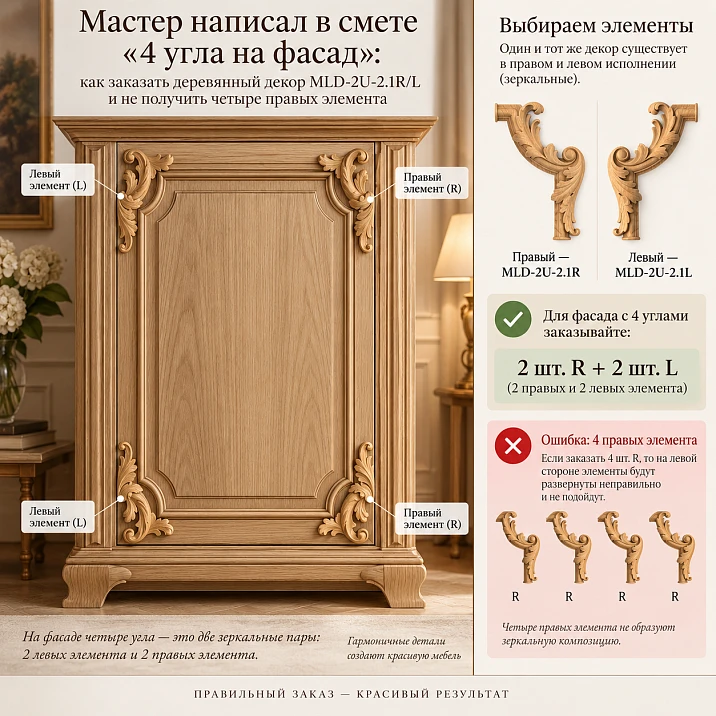
In furniture estimates, a short line often appears: "decorative corner — 4 pcs." For a craftsman who already holds the entire frame in mind, this may be enough. For a purchaser — it is not. He opens the card MLD-2U-2.1R, sees the desired pattern, and out of habit increases the quantity to four. As a result, the order contains four right elements, although for a symmetrical rectangular frame STAVROS specifies a different configuration: 2 right MLD-2U-2.1R + 2 left MLD-2U-2.1L.
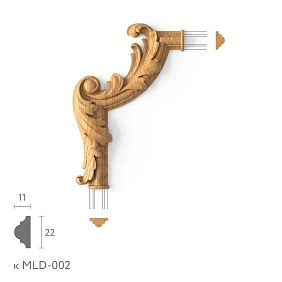
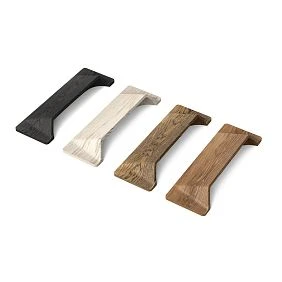
R and L here are not two ways to name one part. These are two independent mirror positions. R = Right, the right element; L = Left, the left element. When viewed from the front, the right ones occupy the upper right and lower right corners, the left ones — the upper left and lower left. The size of each element is the same — 200 × 135 × 20 mm, but the direction of the ornament differs.
Therefore, the correct ordering logic is built not from the phrase "need four corners," but from the frame cell: one frame = 2R + 2L. For four identical furniture fronts, 8R + 8L is already required. For six — 12R + 12L. The material, sanding quality, and finish should also be checked against both cards so that the right and left halves of one composition do not turn out different.
Right wooden decor MLD-2U-2.1R: what the letter R means
MLD-2U-2.1R is a separate right corner decorative element for a molding frame. In the current card, it has one geometry of 200 × 135 × 20 mm and four main price options.
| Material | Sanding | Price as of September 8, 2026 |
|---|---|---|
| Beech | Standard | 1 710 ₽ |
| Beech | Prestige | 2 280 ₽ |
| Oak | Standard | 2 090 ₽ |
| Oak | Prestige | 2 560 ₽ |
The letter R means Right. The manufacturer describes the element as right and directly links it to the mirrored MLD-2U-2.1L. Therefore, in the specification, the word "right" is not redundant — it fixes the orientation of the part just like the article number.
Correct line:
MLD-2U-2.1R / 200 × 135 × 20 mm / beech or oak / Standard or Prestige / quality of lamination / quantity.
If the project has already been approved, corner decorative element MLD-2U-2.1R added to the cart as a separate line, not as a "universal corner."




Left MLD-2U-2.1L is a separate product, not a second copy of the right one
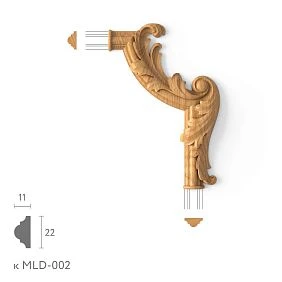
MLD-2U-2.1L has the same dimensions of 200 × 135 × 20 mm, the same beech and oak options, and the same current prices, but the ornament is mirrored to the left.
| Material | Standard | Prestige |
|---|---|---|
| Beech | 1 710 ₽ | 2 280 ₽ |
| Oak | 2 090 ₽ | 2 560 ₽ |
L means Left. The element is intended for left corners of the frame.
The main purchasing mistake is the thought "I'll take four R's and just rotate two of them." For mirrored carved decor, this solution breaks the direction of the ornament. Geometrically, the part may fit in the corner area, but compositionally it is already a different layout.
Therefore corner decorative element MLD-2U-2.1L always checked in the cart as a standalone SKU.
For one frame, there should be two lines:
MLD-2U-2.1R — 2 pcs.
MLD-2U-2.1L — 2 pcs.
Our factory also produces:
MLD-002 and corner elements R/L: first the system, then the quantity
The left card MLD-2U-2.1L directly shows the wooden molding MLD-002 in related products. This is an important hint: corner elements belong not to "any similar molding," but to a specific decorative system.
The current MLD-002 has a cross-section of 22 × 11 mm. For solid wood, lengths of 1000 and 2400 mm are available, among others; there are beech and oak. As of September 8, 2026, the card shows:
| MLD-002 | Price |
|---|---|
| Beech, 22 × 11 × 1000 mm | 460 ₽ |
| Oak, 22 × 11 × 1000 mm | 630 ₽ |
| Beech, 22 × 11 × 2400 mm | 920 ₽ |
| Oak, 22 × 11 × 2400 mm | 1 260 ₽ |
That is, the frame kit consists of at least two different types of products:
molding MLD-002 — counted by lengths;
corner decor MLD-2U-2.1R/L — counted by pieces with orientation.
If the system is not yet assembled, it is reasonable to first buy wooden molding MLD-002, check its profile, and only then fix compatible corner elements.
Get Consultation
How many R and L to order for one, two, four, and six frames
The rule scales linearly: for each rectangular frame cell, two right and two left elements are needed.
| Number of frames | MLD-2U-2.1R | MLD-2U-2.1L | Total corners |
|---|---|---|---|
| 1 | 2 | 2 | 4 |
| 2 | 4 | 4 | 8 |
| 4 | 8 | 8 | 16 |
| 6 | 12 | 12 | 24 |
| 10 | 20 | 20 | 40 |
For the buyer, a simple check appears:
the number of R must equal the number of L, if all frames are symmetrical and equally equipped.
This is a very useful basket test. If the project contains four frames, and the order specifies 16 × R и 0 × L, the error is visible instantly.
But the equality R=L does not cancel the check of the actual number of frames. If one facade contains two frame cells, it requires not four, but eight corner parts: 4R + 4L.
"Four corners" is a bad line in the specification
The phrase "decorative corner — 4 pcs." leaves too much room for error.
It does not specify:
- right or left element;
- exact article number;
- the material;
- Standard or Prestige;
- finish option;
- number of frames;
- connected molding.
Minimally correct specification for one frame:
MLD-2U-2.1R / 200 × 135 × 20 / beech / Prestige / Under enamel / 2 pcs.
MLD-2U-2.1L / 200 × 135 × 20 / beech / Prestige / Under enamel / 2 pcs.
MLD-002 / 22 × 11 × selected length / beech / Prestige / Under enamel / per cutting plan.
Even if some parameters in the project are different, the record structure remains the same.
Such a list can be read by a person who has never seen the facade visualization and still order the correct set.
How much does a set of corners for one frame cost
Since R and L at the time of checking cost the same in the corresponding materials and sanding, one frame always contains four corner elements of equal price.
| Execution | 2R + 2L |
|---|---|
| Beech, Standard | 4 × 1 710 = 6 840 ₽ |
| Beech, Prestige | 4 × 2 280 = 9 120 ₽ |
| Oak, Standard | 4 × 2 090 = 8 360 ₽ |
| Oak, Prestige | 4 × 2 560 = 10 240 ₽ |
This is the price of only four corner elements. MLD-002, delivery, finishing, and installation are calculated separately.
The difference between the minimum and maximum variant of one frame:
10 240 − 6 840 = 3 400 ₽.
For one frame the difference is moderate, but on a series of facades it grows quickly.
Four facades: 8R + 8L and the budget already changes noticeably
If a cabinet has four identical facades and each has one rectangular frame, 16 corner elements are needed.
| Execution | 8R + 8L |
|---|---|
| Beech, Standard | 27 360 ₽ |
| Beech, Prestige | 36 480 ₽ |
| Oak, Standard | 33 440 ₽ |
| Oak, Prestige | 40 960 ₽ |
Checking the cart here should take a few seconds:
R = 8; L = 8; total = 16.
If one item is accidentally set to a quantity of 16, and the second is missing, the order needs to be corrected before payment.
For ten facades the error is even more expensive: instead of 20R + 20L, you might accidentally order 40 identical parts. Therefore, the larger the series, the more important it is to separate mirrored positions in the list.
Carved decor for furniture made of beech or oak: we fix the material for the entire frame
If the buyer wants carved furniture decor for sale for a unified composition, the wood species needs to be set for the whole system at once.
Bad scenario:
- right corners — oak;
- left — beech;
- MLD-002 — accidentally from a different wood species.
Even if everything is painted with opaque enamel, such a mix must be intentional, not arising from what is in stock.
Working approach:
Frame system material: beech.
or
Frame system material: oak.
After that, R, L, and MLD-002 are checked against the overall record.
If the project involves transparent or semi-transparent finishing, material coordination becomes even more important due to the visible wood texture.
"Standard" or "Prestige": right and left parts must match in preparation
Both cards offer "Standard" and "Prestige".
"Standard" — machine sanding. "Prestige" — detailed manual finishing.
For one frame, it is illogical to randomly order:
R — Prestige;
L — Standard.
Technically, these are two available items, but the level of surface preparation will differ. If the entire frame goes through its own painting cycle, the project may deliberately choose "Standard". If higher factory readiness is needed, both sides are taken in "Prestige".
The main rule of this article: parameters of a mirror pair must be checked symmetrically.
In the final checklist, R and L are compared across four fields:
size → material → sanding → quality of re-gluing.
MLD-002 is counted by lengths, and R/L by pieces
Angles and linear moldings cannot be combined into a single unit system.
For the frame:
- MLD-002 is calculated based on the lengths of four sides and the actual attachment scheme to the decor;
- MLD-2U-2.1R/L — based on the number of frame cells.
If a craftsman writes "molding — 8 m, angles — 12 pcs.", the purchaser should also see the R/L layout. For example, 12 angles for three frames is 6R + 6L, not just "any 12".
If an alternative profile or a different length is needed, buy furniture molding it can be from the general category, but the compatibility of the corner decor with the new molding must be checked separately.
Why MLD-002 cannot be calculated only by the frame perimeter
Corner elements occupy part of the frame area. Therefore, a simple calculation "2 × width + 2 × height" describes the overall geometric perimeter, but not necessarily the net length of molding runs.
For production, a drawing and the actual seating of the corner decor are required.
It is especially dangerous to multiply the perimeter by the number of facades before one R/L set is laid out on the facade at a 1:1 scale. In a serial order, an error of a few centimeters on one frame multiplies across dozens of doors.
Correct sequence:
approve frame dimensions → place R/L on the drawing → determine actual MLD-002 segments → create cutting map → order linear molding.
This is a separate calculation from the number of corners.
Buy decor for moldings: selection order within the system
If the project starts not with a ready estimate but with a catalog, it is more logical to go from profile to components:
- select MLD-002;
- open Buy Decor for Moldings;
- find the right MLD-2U-2.1R;
- add the mirrored MLD-2U-2.1L;
- verify size, material, and sanding;
- multiply 2R + 2L by the number of frames;
- Separately count MLD-002 according to the cutting map.
This reduces the risk of accidentally picking a "similar" corner element from another series.
The STAVROS catalog has many corner decorative elements. External similarity is not proof of compatibility with a specific profile.
How to indicate orientation on the facade drawing
It is convenient to write R and L directly on the facade elevation.
For one frame in frontal view:
| Angle | Element |
|---|---|
| Top left | L |
| Bottom left | L |
| Top right | R |
| Bottom right | R |
On the production drawing, this is enough so that the assembler does not try to "flip" identical parts.
If the facade is mirrored relative to another piece of furniture, marking is still done relative to each frontal view, not relative to the room.
Before installation, it is useful to dry-fit each element next to the facade. An orientation error should be detected before applying glue and before the final coating.
Checking one frame before ordering 20–40 corners
For serial furniture, it is useful to first assemble one control frame cell.
It is not necessary to glue the decor right away. It is enough to lay it out on the template:
- 2 × MLD-2U-2.1R;
- 2 × MLD-2U-2.1L;
- MLD-002 segments;
- central decor, if it is present in the project.
At this stage, orientation, proportions, actual lengths of molding runs, and visual rhythm are checked.
If one frame is approved, its specification becomes the reference:
1 frame = 2R + 2L + MLD-002 according to the approved map.
Then the quantity is multiplied by the number of identical facades.
Such control is especially useful when the order has 8, 12, or 20 frame cells: otherwise, one template error is replicated across all the furniture.
Ten and twelve facades: how an R/L error turns into an expensive rework
On one facade, the error is noticeable as four identical corners. In mass-produced furniture, it turns into dozens of incorrectly ordered parts.
For ten identical frames:
20R + 20L = 40 corner elements.
For twelve:
24R + 24L = 48 elements.
If the buyer accidentally sets 40 × R Instead 20 × R + 20 × L, half of the required mirror pair is completely missing. Fixing it means an additional order of L, waiting for production, and the appearance of an extra R surplus.
For beech "Standard", the set of corners for ten frames costs:
40 × 1 710 = 68 400 ₽.
For twelve:
48 × 1 710 = 82 080 ₽.
For the oak "Prestige":
40 × 2,560 = 102,400 ₽ for ten frames;
48 × 2,560 = 122,880 ₽ for twelve.
These amounts apply only to corner pieces and show why the specification cannot be left in the form "corners — 40 pcs.". At this scale, the letter R/L becomes a full-fledged purchasing parameter.
For a serial order, it is useful to add a control formula directly to the table:
R = L = 2 × number of frames.
For example, a project line "12 frames" should automatically yield 24R and 24L. If one of the two columns shows a different number, the list is not ready to be sent for ordering.
If the frame is asymmetric: when the rule R=L cannot be applied mechanically
A basic symmetric rectangular frame requires 2R + 2L. But the project may be non-standard: decor only on two corners, one side of the frame covered by an adjacent element, or a deliberately asymmetric composition.
In such a case, one cannot use the equality R=L just because it is written in the standard calculation.
A facade drawing is needed where each corner element is labeled separately. First, the actually used right and left positions are marked, then they are summed across the entire project.
For example, if the designer uses only the bottom corners and leaves the top of the frame without carved decor, one cell may require 1R + 1L instead of four elements. This is already a different composition and a different order.
The article does not propose this scheme as a replacement for the standard one. It shows the boundary of the rule: 2R + 2L applies specifically to a full symmetric rectangular frame. Any deviation must be visible in the drawing and in the specification.
Warehouse receiving: how not to mix up R and L after a correct order
Even a perfectly placed order can be ruined at the internal warehouse of a furniture workshop.
R and L are identical in dimensions and can be made from the same wood species with the same sanding finish. If the boxes are unpacked and all elements are placed into one container labeled "MLD-2U-2.1 — corners," the picker again loses the key parameter — orientation.
During receiving, it is better to separate immediately:
- MLD-2U-2.1R;
- MLD-2U-2.1L;
- MLD-002.
For a series, it is convenient to use internal labels:
R — right; L — left; project/facade — number.
If for four facades 8R and 8L arrived, they can be sorted into four sets of 2R + 2L. Then the assembly area receives a ready-made frame kit, not a common box of 16 similar parts.
Receiving also includes checking the material and sanding finish. If 8R came in beech "Prestige" and 8L in beech "Standard," the order is quantitatively correct, but the set still does not match a single specification.
Is a surplus of corner elements beyond the calculated quantity needed?
Do not automatically add a "10% buffer" without analyzing the project.
Corner elements are not cut as linear trim, so the buffer logic differs from MLD-002. For a single facade, an extra R/L pair may be too expensive as a reserve. For a large production batch, a buffer may be justified if reordering causes significant production downtime.
It is more useful to ask three questions:
- Is there a risk of part damage during finishing or installation?
- How critical is stopping the batch if one R or L is missing?
- Can a single replacement be ordered quickly without disrupting the schedule?
If a buffer is needed, it is better to calculate it symmetrically. For example, for a large batch, you can decide in advance that the warehouse holds 1 extra R + 1 extra L, rather than two random identical corners.
The key is not to confuse the buffer with the main kit. The list should separately show:
per project: 20R + 20L;
buffer: 1R + 1L;
Total to order: 21R + 21L.
This way the master sees why the actual quantity is greater than the calculated one and does not use the reserve in the first facades by mistake.
How to calculate the cost of corners and molding separately
The frame system has two different economies.
Corner decor is calculated by the number of frames:
cost of corners = number of R × price of R + number of L × price of L.
MLD-002 is calculated according to the cutting map:
cost of linear footage = number of planks of the selected length × price of one plank.
Mixing these calculations into a "price per frame" is only possible after the actual cutting of MLD-002 is already known.
For example, the corner part of one beech frame "Standard" costs 6,840 ₽. But the cost of MLD-002 depends on the dimensions of the frame itself, the selected length of the planks, and the remnants after cutting. Therefore, you cannot add a conditional "four meters of molding" without a drawing and call the result an exact price of the finished decor.
For furniture production, it is better to keep two tables and consolidate them only in the final estimate. Then changing the size of a facade does not force recalculating the quantity of R/L if the number of frames remains the same, and changing the number of facades automatically updates both parts of the project.
What to check in the cart before payment
For one frame:
- MLD-2U-2.1R — 2 pcs.;
- MLD-2U-2.1L — 2 pcs.;
- size of both — 200 × 135 × 20 mm;
- material matches;
- sanding matches;
- finish matches;
- MLD-002 selected in the agreed material;
- the quantity of molding corresponds to the cutting map.
For four frames:
- R — 8;
- L — 8;
- total corners — 16.
For six:
- R — 12;
- L — 12;
- total — 24.
The most useful control line:
R = L = 2 × number of frames.
If the equality does not hold, you need to understand whether this is a deliberate asymmetric composition or a common basket error.
When it is better not to buy MLD-2U-2.1R/L yet
The purchase should be postponed if the estimate still only says "corner — 4 pcs." and no one has separated R/L.
There is no need to place an order for a batch if MLD-002 has not yet been approved or it is planned to replace it with another profile without checking system compatibility.
A stop signal is mixed material or sanding between right and left elements, if the project does not provide for this.
For serial furniture, it is too early to order dozens of corners until one control frame cell has been approved.
And separately: if the project is asymmetric and some frames have a different geometry, the 2R + 2L rule should be checked against the actual composition, not applied mechanically.
Where to buy MLD-2U-2.1R/L and MLD-002
For a ready specification, three product lines are needed:
- MLD-2U-2.1R;
- MLD-2U-2.1L;
- MLD-002.
If the system is still being selected, Buy Decor for Moldings you can from the profile catalog, and buy furniture molding — from the section of linear products.
The key conclusion before payment is very simple:
"4 corners" is not 4 × R.
For one symmetrical rectangular frame:
2R + 2L = 4 corner elements.
For four facades:
8R + 8L = 16 corners.
This is how paired carved decor turns from a beautiful picture into a correct procurement specification.
Questions before ordering MLD-2U-2.1R/L
What does R mean in MLD-2U-2.1R?
R = Right, right mirrored element.
What does L mean in MLD-2U-2.1L?
L = Left, left mirrored element.
Are they the same size?
Yes. Both elements have dimensions of 200 × 135 × 20 mm.
Can I buy four R and flip two of them?
For a standard symmetrical frame, this is an incorrect configuration. Two mirrored positions R and L are needed.
How many elements are needed for one frame?
2 right + 2 left = 4.
How many are needed for two facades?
If each has one frame — 4R + 4L, 8 total.
How many are needed for four facades?
8R + 8L, 16 total.
How much is needed for six frames?
12R + 12L, 24 total.
How much does a set of corners for one frame in beech "Standard" cost?
6,840 RUB as of September 8, 2026 check.
How much does oak "Prestige" cost for one frame?
10,240 RUB for four corner elements as of check.
Which molding is associated with this system?
In the MLD-2U-2.1L card, the wooden molding MLD-002 is listed as a related product.
What is the current size of MLD-002?
The current card shows a profile of 22 × 11 mm; for solid wood, lengths of 1000 and 2400 mm are also available.
Do I need to choose one material for R, L, and MLD-002?
If the project must be uniform in material, yes, this needs to be explicitly recorded in the specification.
Can I mix "Standard" and "Prestige" in one frame?
Technically, the cards offer both options, but for a unified frame, mixing should be deliberate. Usually, it is better to synchronize the parameters of a mirror pair.
What should be checked last before payment?
Part numbers R and L, equal quantity, size, material, sanding, glue joint quality, linkage with MLD-002, and number of frames.