











































































Article Contents:
- Why the reception area is not an interior, but communication
- What signal does an unformed reception area send
- Wooden slats in the reception area: six working scenarios
- Wall behind the administrator's desk: a background with character
- Area with a logo: slats as a professional background
- Side wall at the entrance: first glance
- Partition between the reception and the hall
- Wall in the waiting area
- Pass-through zone: material connectivity
- Stucco decor and moldings in the reception area: six schemes
- Scheme one: slats as background, moldings as frame
- Scheme two: molding frame around the logo
- Scheme three: stucco decor on adjacent walls
- Scheme four: polyurethane moldings in wall color
- Scheme five: wooden moldings matching the slats
- Scheme six: decorative frame around the counter
- Ceiling cornice for the entrance area: status from above
- Why a cornice in a commercial space
- Wooden ceiling cornice for reception
- Polyurethane cornice in ceiling color
- Cornice matching wall color: monolithic upper perimeter
- Thin molding instead of cornice: for compact receptions
- Baseboard for reception area: durability, precision, and style
- MDF baseboard for modern office and salon
- Wooden baseboard for premium reception
- Wide wooden baseboard for hotel and showroom
- Baseboard matching wall color for accent logo zones
- Baseboard selection: table by business type
- Moldings, corners, and bars: technical details that are all visible
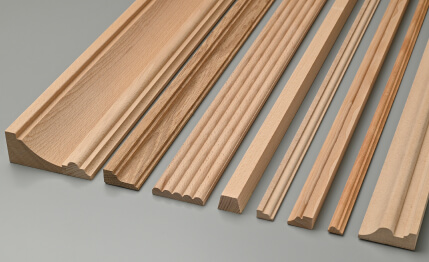
- Wooden corner for slatted walls
- Wooden block as horizontal frame for slatted zone
- Linear products for junctions
- Decorative molding for framing
- Ideas for five types of business
- Beauty salon: warmth, style, and logo
- Clinic: calm and trust
- Office: precision and rigor
- Showroom: material as product
- Hotel: luxury in details
- Reception area design mistakes
- Too busy background behind the logo
- Forgotten baseboard at the counter
- Open ends of slats
- Too massive cornice with a low ceiling
- Mixing several wood shades
- Decor incompatible with the brand style
- No system: each element stands alone
- Beautiful but inconvenient for cleaning
- About the Company STAVROS
- Frequently Asked Questions (FAQ)
A client walks in — and forms a first impression in seven seconds. Not about your product. Not about your services. About your business as a whole. The wall behind the reception desk, the baseboard at the floor, the ceiling transition, the side walls — all of this is read instantly, on a sensory level. And what they see becomes their first — and often main — conclusion about who you are and how much you can be trusted.
Exactly thereforestucco decor for receptionandwooden slats behind the reception desk— it's not a question of aesthetics in the narrow sense. It's a business question. An unformed entrance area is lost trust. A neat, architecturally structured reception area is a silent affirmation: everything here is thought out, and you are in good hands.
In this article — not inspiring abstractions, but concrete practice: which elements work in the reception area, how to combine them, what not to do, and how to get an interior where every material works for your business's reputation.





Why the reception area is not an interior, but communication
Before discussing slats and moldings, you need to understand: the reception is not a room. It is a point of communication between the brand and the person. Here the first contact happens, here the client makes the decision 'ours or theirs', here that intuitive loyalty is formed, which later cannot be bought by any advertising or discounts.
An architecturally designed entrance area — withwooden slats for commercial interior, withmoldings for walls and ceiling, with precise baseboard and cornice — creates an atmosphere that professionals call 'expensive silence'. This is not flashy decor. It is a calm, confident space that conveys: everything here is done right.




What signal does an unformed reception area send
A smooth white wall without a baseboard, without architectural details, with a glued logo — this is a wall that no one thought about. It tells the client: 'We didn't have time.' Or — even worse — 'We don't see the difference.'
The right wall behind the reception desk speaks without words: "We care about every detail." And it is this quality that the client projects onto your services.
Our factory also produces:


Wooden slats in the reception area: six working scenarios
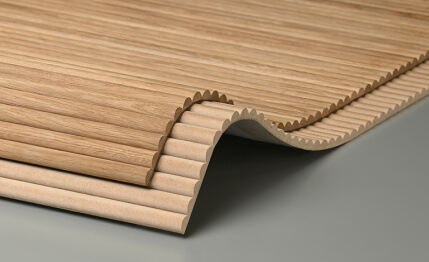
Wooden slats for the reception area — a material that simultaneously works as both a background and an architectural accent. Unlike paint or PVC panels, wood carries natural warmth: it cannot be replicated by imitation. Natural solid oak on the wall behind the counter reads as a sign of quality.
Get Consultation
Wall behind the reception desk: a background with character
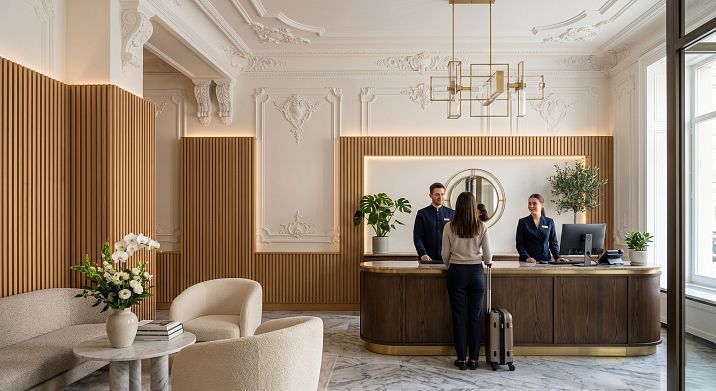
The main plane of the reception area is the wall behind the counter or behind the administrator. It is what every visitor sees.Decor of the wall behind the reception desk with vertical slats is one of the most effective techniques in commercial interior design.
Vertical slats create rhythm, warmth, and depth. In a well-lit space — and the reception area is typically illuminated with directional light — slats provide a play of shadow and light that cannot be achieved on a flat painted surface.
Parameters for selection: slat width 20–40 mm, spacing 30–60 mm. For a strict office interior — a more frequent rhythm. For a warm, cozy salon or boutique — a freer spacing with wide gaps.
Logo zone: slats as a professional background
A logo on a wall requires the right background — not empty, not cluttered, but a structured plane.Wooden planks for decorationunder or around the logo — this is not a random decision. The vertical lines of the wood create an "architectural field" on which the logo reads clearly and significantly.
Combination: slatted background in natural oak shade + three-dimensional metal logo letters. Or: slats painted in the brand color + white logo. There are many options, the principle is one: slats create scale and context for the brand sign.
Side wall at the entrance: first glance
A person entering the room sees not only the wall straight ahead, but also the side planes — left or right. This wall is the second frame of the impression.wooden planks on the wallat the entrance create a warm natural accent, softening the transition from the street into the room. This is especially relevant in clinics, salons, and hotels — where it is important to relieve anxiety and create a sense of calm.
Partition between reception and hall
Where the reception is separated from the main hall by a half-partition or decorative wall,Rafter panelsbecome the main visual element. A slatted partition is a boundary without closure: it divides the space but does not isolate it. Light, air, and gaze pass through the slats, the space remains open.
Wall in the waiting area
The waiting area is a place where the client spends time in silence. Here, they examine the space slowly and attentively. The quality of the material is perceived more acutely here than anywhere else.Decorative wooden stripon the wall of the waiting area is something the eye rests on with pleasure. The natural texture of oak or beech is not irritating, it is calming.
Pass-through area: material connectivity
In offices, clinics, and hotels, corridors lead from the reception area. If slats are present only at the entrance, and beyond that there are smooth walls without details, a feeling of incompleteness arises.vertical wooden slatsas a repeating element in corridor partitions or at the beginning of each branch create a material thread connecting all zones into a single interior.
Stucco decor and moldings in the reception area: six schemes
Stucco decor for the reception areais a subtle tool. It can create a sense of architectural richness, or it can overload a small entrance space. It all depends on the application scheme.
Scheme one: slats as background, moldings as frame
The strongest and most versatile combination for the reception area:Wooden boards in interior as a background element on the central wall + a molding frame around the slatted zone. The frame made ofof polyurethane moldings outlines the slatted panel along its perimeter, giving it the status of a finished architectural object — like a painting in a frame.
This solution works in any business: from a beauty studio to a law firm.
Scheme two: molding frame around the logo
The company or salon logo on the wall behind the reception, framed by a symmetrical molding frame — a classic of commercial interior.Moldings for commercial interiors in this role create an "architectural mat": the logo inside the frame is perceived as a work of art, not as a sticker.
The frame is constructed as follows: a central rectangle around the logo, vertical moldings on the sides, a horizontal belt on top. The entire structure is symmetrical relative to the wall axis. The molding profile width is 40–70 mm depending on the wall scale.
Scheme three: stucco decor on adjacent walls
The wall behind the reception — slats. The side walls —Polyurethane wall decorframe layout. The principle of separation: the main material is on one plane, moldings are on the background ones. The result: a rich, multi-layered interior where each element is in its place.
Scheme four: polyurethane moldings in the color of the wall
Moldings made of polyurethanein the exact color of the wall — a delicate option for modern clinics, premium offices, and minimalist showrooms. The moldings are visible only due to the shadow from the profile: there is relief, but no contrast. This is the "whisper" of architecture — quiet but audible.
Scheme five: wooden moldings matching the slats
Where the slats are natural oak,Decorative wooden moldingsmade from the same oak create a material rhyme between the background and the detail. A wooden frame around the slatted area is a unified natural ensemble.
Scheme six: decorative frame around the counter
Wall and ceiling decorin the form of a frame not only around the logo but also around the entire reception desk — a bolder and more impressive technique. The molding runs along the perimeter of the plane on which the counter stands: on the sides, above, possibly transitioning to the side walls. The counter becomes "inscribed" into the architectural context.
Ceiling cornice for the entrance area: status from above
The upper transition of the wall to the ceiling in the reception area is a detail that is rarely thought through in advance. But it should be. It is the cornice that "closes" the top line and makes the space complete. Without it, the wall ends abruptly, the ceiling begins — and it feels unfinished.
Why a cornice in a commercial space
In a residential interior, the absence of a cornice is a flaw. In a commercial one, it is a sign of poor planning. A client entering an office or salon sees the top line of the walls with peripheral vision. A clean, finished cornice line creates a sense of order and completeness. Its absence creates an unconscious feeling of "something missing."
Wooden ceiling cornice for reception
Wooden ceiling cornicein the reception area with wooden slats creates a vertical material system: slats on the wall — wood. The cornice at the ceiling — the same wood. A single material envelops the space from top to bottom, binding it into a cohesive whole.
Wooden beamsfor commercial spaces are selected considering the room height. With a ceiling of 2.7–3 m — a moderate profile of 50–80 mm. With a ceiling of 3.5 m and above — a more developed, architectural profile.
Polyurethane cornice in the color of the ceiling
polyurethane ceiling decorin white is a standard solution for most commercial spaces. A white cornice on a white ceiling visually disappears while creating a clean architectural transition line. This is delicate and works in any business.
Cornice in wall color: monolithic upper perimeter
In reception areas with branded wall colors — dark green, dark blue, rich terracotta — a cornice in the wall color creates a monolithic upper contour. The ceiling reads separately, the wall as a single color field. This technique works especially well where there is built-in lighting in the cornice — hidden lighting behind a wooden or polyurethane cornice.
Thin molding instead of a cornice: for compact receptions
If the entrance area is small — 15–30 sq. m — a massive cornice will overload it.Moldings for walls and ceilingin the format of a thin ceiling profile (30–50 mm) — a delicate solution that marks the transition without putting pressure on the space.
Baseboard for the reception area: durability, precision, and style
Baseboard for commercial interiorcarries a dual load: decorative and protective. In the reception area, people walk on the baseboard, hit it during cleaning, or accidentally bump it with a chair leg. Therefore, both aesthetics and material durability are important here.
MDF baseboard for a modern office and salon
MDF Skirting Boardis a rational choice for most commercial spaces. The dense structure of MDF withstands mechanical loads, is easy to paint, and does not deform under normal use. Installation is simple, and corner cutting is precise.
White MDF Skirting Boardis a universal option for light entrance areas with white or neutral walls. A clean white bottom line works in any commercial style.
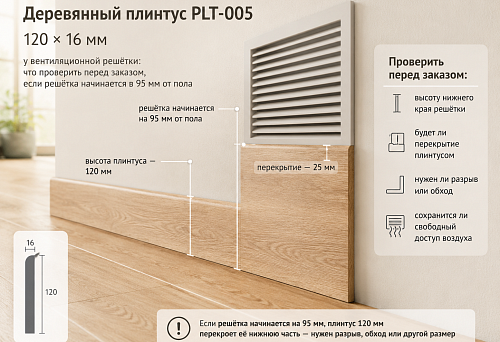
— is a horizontal element that frames the room at the bottom of the walls where the wall meets the floor. Skirting boards perform several functions: they hide the technological gap between the wall and floor covering (necessary for thermal expansion), protect the lower part of the wall from mechanical damage, create visual completion, and may conceal wiring.is for rooms with a branded wall color. A baseboard matching the wall color creates a monolithic lower perimeter that does not distract attention from the counter and logo.
Wooden baseboard for a premium reception area
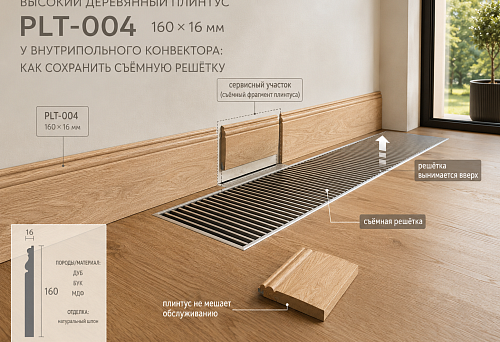
Wooden baseboardOak array — a choice for a premium office, boutique, showroom, or hotel where there are wooden slats, parquet flooring, and wooden furniture. A single wood species running through all elements of the reception area is material consistency at the highest level.
with a classic profile creates a sense of solidity, reliability.In the reception area, it must be properly protected: coated with hard wax, oil, or abrasion-resistant varnish. This is especially important at the entrance, where foot traffic is highest.
Wide wooden baseboard for a hotel and showroom
Wide Wooden Skirting Board— from 80 to 120 mm — for grand entrance areas. In a hotel with high ceilings and a classic interior, a wide oak baseboard at the floor creates a sense of solidity and richness. It is the bottom line that "holds" the entire space.
Baseboard in wall color for accent logo zones
If the main goal is to focus all attention on the logo and the counter, a baseboard in the wall color disappears as a separate element.Paintable MDF Floor Skirting BoardIn the brand color — and the bottom line stops competing with the central element.
Baseboard selection: table by business type
| Room Type | Recommended skirting board |
|---|---|
| Modern office | White MDF baseboard, 60–80 mm |
| Beauty salon | MDF baseboard white or in wall color |
| Clinic | MDF baseboard for painting, light |
| Boutique / showroom | Wooden baseboard, 80 mm |
| Hotel | Wide wooden baseboard, 100–120 mm |
| Logo wall | MDF baseboard matching wall color |
Trim, corners, and strips: technical details that are all visible
In a commercial interior, ends, joints, and corners are areas of high attention. A client waiting at the counter inevitably notices every uncovered end of a slat, every rough joint of a baseboard.wood trim items— это именно та система, которая превращает «почти хорошо» в «безупречно».
Деревянный уголок для реечных стен
Wooden angle закрывает внешние углы, где реечная панель переходит на смежную стену. В зоне ресепшен — особенно при расположении реечной стены на углу помещения или у входного проёма — уголок создаёт чистую вертикальную линию перехода.
Уголок в тон рейкам монтируется на клей или жидкие гвозди. После монтажа — при необходимости — шлифуется и покрывается тем же маслом или лаком, что и рейки.
Деревянный брусок как горизонтальная рамка реечной зоны
Wooden block горизонтально — сверху и снизу реечной зоны — это обязательный элемент аккуратного монтажа. Он закрывает торцы вертикальных реек и придаёт панели законченный, рамочный вид. Без этого торцы реек открыты — и в хорошо освещённой входной зоне это бросается в глаза.
Брусок также выполняет функцию опорной планки при монтаже: рейки крепятся в пазы или к опорному горизонтальному бруску, что обеспечивает точный шаг и ровную вертикаль.
Погонажные изделия для примыканий
Trimming Items в зоне ресепшен закрывают примыкания реечной стены к дверному проёму, к боковой перегородке, к оконному откосу (если он есть). Каждое такое примыкание — потенциальная «прореха» в аккуратности интерьера. Погонаж в тон рейкам делает её невидимой.
Декоративный багет для обрамлений
Wooden baguette — thin profile — is used for framing information panels, boards, mirrors, spaces with certificates or diplomas in the waiting area. It creates a frame without pretension to decorativeness — just a clean visual border.
Ideas for five types of business
Beauty salon: warmth, style, and logo
Polyurethane wall decor frame system around the salon logo.Wooden slats for a beauty salon — on the background wall behind the logo, natural oak. WhiteMDF Skirting Board — 60 mm, clean bottom contour. Light ceiling molding in white. Thin horizontal bar at the top and bottom of the slat zone.
Result: a cozy, warm reception with a clear brand zone. The client feels care even before sitting in the chair.
Clinic: calmness and trust
Decorative wooden moldings frame layout in the color of the wall — delicate relief without aggression.— is a horizontal element that frames the room at the bottom of the walls where the wall meets the floor. Skirting boards perform several functions: they hide the technological gap between the wall and floor covering (necessary for thermal expansion), protect the lower part of the wall from mechanical damage, create visual completion, and may conceal wiring.in light gray or cream — a neutral lower contour. Ceiling cornice in the color of the ceiling. No contrasting accents.
Result: a clean, calm entrance area that creates an atmosphere of professionalism and safety. For the patient, this is more important than any decor.
Office: precision and rigor
Wooden slats for the officein a dark oak shade — behind the company logo on the central wall.White MDF Skirting Board— straight, without unnecessary relief. No molding on the working walls.wooden cornicein the tone of the slats — on top.
Result: an office reception that conveys confidence and competence. Business style without coldness.
Showroom: material as product
In the showroom, the reception itself should be a demonstration of taste.Rafter panelsfrom oak on the main wall,Decorative wooden trimas restraining belts,Wide Wooden Skirting Boardfrom the same material. The ceiling cornice is wooden, with a moderate profile.
Result: a reception desk that showcases the level of products even before the customer enters the hall.
Hotel: luxury in details
stucco decor for walls and ceilingin a classic style — frames, friezes, cornice around the perimeter.Wooden ceiling cornicematching the parquet. Wide wooden baseboard — 100–120 mm, solid oak.Polyurethane Items— for ceiling rosettes and corner elements.
Result: a grand hotel entrance area where every material speaks to the category of the establishment. The guest understands where they have arrived already at the counter.
Mistakes in designing the reception area
Too active background behind the logo
Large stucco, active ornament, rich pattern — all of this creates competition for the logo. Rule: the background behind the logo should be rhythmic (slats), not ornamental. Decor should support the sign, not compete with it.
Forgotten baseboard at the reception desk
The reception desk stands against the wall. Beneath it, there is a space where the baseboard is especially noticeable. If the baseboard does not extend under the desk or breaks off as it approaches it, this is visible. The baseboard should run continuously along the entire perimeter, including the area under the desk.
Open ends of slats
The ends of vertical slats without horizontal limiting strips — at the top and bottom — look like unfinished work. In a commercial space, this is unacceptable. A horizontalWooden block is a mandatory finishing element.
Too massive cornice with a low ceiling
A large overhanging cornice with a ceiling of 2.5–2.6 m visually presses down on the space. In commercial rooms with low ceilings, use a thin molding, not a cornice.
Mixing several wood shades
Slats — light ash. Baseboard — dark walnut. Desk — birch. In a well-lit reception area, this looks like an awkward coincidence of materials, not a design. A single wood species or a single shade is mandatory.
Decor incompatible with the brand style
Dark oak and classic frame molding — in a clinic with a pastel minimalist brand. Or white ornamental moldings — in a strict tech office. The decor style should match the brand style. This is not an interior design issue — it's a communication one.
There is no system: each element stands alone
There are slats. There are moldings. There is baseboard. But they are not connected: different shades, different styles, different profile heights. The reception area is a system. All elements should be chosen as an ensemble: one wood species, one profile style, one color key.
Beautiful, but inconvenient for cleaning
Complex relief moldings in an area that is wet-cleaned daily — a potential problem for dust and moisture accumulation. For high-traffic spaces, choose profiles with minimal horizontal shelves, well-coated with varnish or oil.
About the company STAVROS
For those creating commercial interiors with real requirements — for style, durability, and reputation — STAVROS offers a full range of decorative elements, proven in a variety of settings: from small beauty studios to luxury hotels and showrooms.
In the STAVROS catalog for the reception area, you will find:Wooden planksmade of solid oak and beech with precise profiles and finished surfaces,Rafter panelsfor quick installation on large surfaces,MDF Skirting BoardandWooden baseboardfor the bottom line of any level,wooden corniceandWooden beamsvarious profiles,Decorative wooden moldingsandMoldings made of polyurethanefor frame and architectural solutions.
For working with joints, corners, and junctions —Wooden angle, Wooden blockandwood trim items. For stucco decor —Polyurethane Itemswith factory precision of the profile and an ideal surface for painting.
STAVROS works with both private clients and designers and contractors of commercial interiors. All products are made from certified materials, with precise dimensions and stable geometry.
Installation of moldings in non-standard conditions — including corners and joints in commercial spaces — is detailed in the article aboutinstalling polyurethane moldingsin the STAVROS materials section.
Frequently Asked Questions (FAQ)
Which wooden slats to choose for the wall behind the reception desk?
Oak solid wood slats 25–35 mm wide with a pitch of 35–55 mm are a universal option for most commercial spaces. For a strict corporate interior — a more frequent rhythm, a darker shade. For a warm, cozy space (salon, boutique) — a freer pitch, natural light oak.
How to design a wall with the company logo?
Central frame of moldings around the logo along the axis of symmetry of the wall. Slats are on the same plane or on the background wall. Cornice at the top. Baseboard at the bottom. Horizontal molding belts at a height of 220–240 cm and at a height of 100–120 cm. Everything is symmetrical relative to the center.
Which baseboard to choose for a commercial space with high traffic?
MDF baseboard with a hard enamel or varnish coating. If there are wooden slats and parquet flooring, a wooden baseboard with an oil-varnish coating. The main condition for a commercial space: the baseboard must be protected from mechanical impact.
Is a cornice needed in the reception area?
Yes. The cornice structures the upper transition and creates a sense of architectural completeness. For rooms with a ceiling up to 2.7 m, a thin molding of 30–50 mm. For rooms with a ceiling of 3 m and higher, a full cornice with a profile of 60–100 mm.
How to combine wooden slats and moldings in the reception area?
Slats are on the main wall behind the counter. Moldings are a frame system around the slat area or on adjacent walls. Do not place slats and large moldings on the same plane: this is overload. The principle is one accent element, the rest are background.
How to close the ends of wooden slats in the reception area?
A horizontal bar of the same solid wood — at the top and bottom of the slat area. On external corners, a wooden corner piece matching the slats. At transitions to a doorway or adjacent wall, trim or molding in a matching tone.
Can the same elements be used for a beauty salon and an office?
The material is the same. The style is different. For a showroom: natural light oak, a light cornice, white baseboard, warm shades. For an office: darker oak or slats for painting in a corporate color, a straight cornice, MDF baseboard for painting. The same product — different application scenarios.
Can a wooden baseboard withstand high-intensity use in a commercial space?
Yes, provided the correct coating is applied. A wooden baseboard made of oak, coated with hard wax or parquet varnish with a high degree of protection (wear resistance AC4–AC5), can withstand intensive commercial use for many years.