Article Contents:
- Why a wall with a TV and fireplace should be designed as a single composition
- What placement options are available
- TV above the fireplace
- TV next to the fireplace
- Fireplace in the center, TV to the side
- Electric fireplace under the TV panel
- Bio fireplace in a niche
- Faux fireplace as a decorative portal
- What to choose for wall decor with TV and fireplace
- Moldings for the frame around the zone
- Decorative overlays for accents
- Decor for moldings
- Ready-made kits for the fireplace wall
- How to design a TV above the fireplace
- One common vertical frame
- Portal around the fireplace and separate TV zone
- Moldings in wall color
- Symmetrical side frames
- Decor with sconces on the sides
- How to design a TV next to the fireplace
- Two equal vertical sections
- Central fireplace axis and side TV zone
- Single horizontal molding line
- Frames of different sizes but same style
- Connection with cabinet, shelves, and baseboard
- Which styles suit
- Neoclassical
- Neoclassic Light
- Jatoba
- Versailles Light
- Versailles
- Mistakes when designing a wall with a TV and fireplace
- Fireplace and TV are not connected by a common frame
- Moldings interfere with the screen or furniture
- Too active stucco distracts from the TV
- No symmetry around the fireplace
- Sconces, sockets, and cable outlets are not accounted for
- The decor is too small for a large living room
- The fireplace portal conflicts with the baseboard and cornice
- What to buy for a wall with a TV and fireplace
- Frequently asked questions
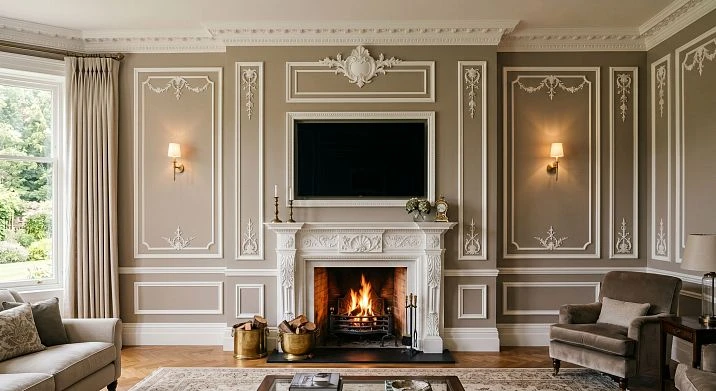
Imagine a living room that has everything: an elegant fireplace as the architectural center of the room, and a modern TV as a focal point for evening hours. Two objects, two elements of different nature — one rooted in classical architecture, the other appearing in homes half a century ago. And now they are both on the same wall. What to do with it?
The answer isstucco decor for a wall with a TV and fireplacemade of polyurethane. This is not just surface decoration. It is an architectural tool that turns two unrelated objects into a single, thoughtful, complete wall composition. Moldings, frames, overlays, ready-made kits — all of this works as a "language" in which the fireplace and TV begin to speak to each other, rather than compete.
Why a wall with a TV and fireplace should be designed as a single composition
The most common mistake when decorating a living room is treating the TV and fireplace as two separate objects. The fireplace gets its own decor, the TV hangs above or next to it on its own — and as a result, the wall looks like a collage of mismatched solutions.
A TV by its nature is a technical object with a rectangular frame, a dark screen, and a neutral character. A fireplace is an architectural object with its own shape, portal, and visual mass. Without a unifying wall composition, they create a visual conflict: the eye doesn't know what to "grab onto" and slides between two unrelated centers.
Wall decor with a TV and fireplacePolyurethane solves this problem through architectural logic: moldings create a single "frame" for the entire wall, within which both the fireplace and the TV occupy their designated places as parts of one system. Frames, vertical lines, symmetrical sections — all of this works to create unity.
Why polyurethane? Because it is a material that:
-
is installed without drilling, using glue, directly over the finish;
-
weighs tens of times less than gypsum counterparts — the wall gets relief without load;
-
is painted with acrylic paint in any color — to match the wall or contrast;
-
is not afraid of heat from the fireplace when the recommended distance is observed (at least 30–40 cm from the heat source);
-
does not deform, does not crack, and requires no special care.




What placement options are available
Before choosing decor, you need to understand what layout situation you are solving. There are several fundamentally different options for placing a TV and a fireplace, and each has its own decorative logic.
Our factory also produces:

TV above the fireplace
The most common option in apartments with electric and bio fireplaces. The fireplace occupies the lower part of the wall, the TV occupies the upper part, directly above the portal. This is a compact, economical solution that, with proper decor, looks very organic.
Decor for the TV zone with a fireplacein this option is built on the principle of a vertical axis: the entire element from floor to ceiling is one architectural zone. Molding frames first surround the fireplace portal, then transition upward to the TV zone, creating a continuous vertical line. The outer perimeter of the entire wall section can also be framed with molding — then both the fireplace and the TV are "inside" one large frame.
Get Consultation
TV next to the fireplace
The fireplace occupies one part of the wall, the TV occupies another, on the same wall but not above the portal. This is a more complex layout situation that requires more careful decor design.
Here, the principle of two equal zones applies:moldings around the TV and fireplacecreate two symmetrical or proportional sections connected by a horizontal line at the same height — typically at the level of the portal cornice or the top mark of the TV.
Fireplace in the center, TV on the side
Formal layout: the fireplace is the absolute center of the wall, the TV is placed on the side, possibly in a niche or on the side part of the same wall plane. The decor is built around the fireplace: a molding composition unfolds symmetrically around the portal, and the TV "fits" into the side section of this symmetry.
On the principles of symmetrical decor — in the articlesymmetric polyurethane wall decor.
Electric fireplace under the TV panel
A modern and very popular solution: an electric fireplace is built into a cabinet or wall niche under a wall-mounted TV. Essentially, this is a single "media complex": screen + hearth in one vertical block.
For such a schemestucco decor for the fireplace TV zoneis mounted as a single frame system: one large vertical frame covers the entire block from floor to ceiling, inside which the TV and fireplace occupy their places. Side vertical moldings can be supplemented with decorative overlays at the level of the dividing zone between the TV and the hearth.
Biofireplace in a niche
A biofireplace in a wall niche is a minimalist, modern option. The niche already creates an architectural context, but moldings enhance it: a frame around the perimeter of the niche "frames" it as an independent architectural object. The TV can be located on the same wall in a separate symmetrical section.
Fake fireplace as a decorative portal
Wall decor with a fake fireplace — a decorative solution without a real hearth. Molding builds a "portal" — an architectural frame in the shape of a classic fireplace surround — inside which there is no fire, but there are candles, decorative logs, and backlighting. A TV is organically placed above such a portal, and the whole scheme works as a single fireplace-TV wall without a real fireplace.
What to choose for wall decor with a TV and fireplace
Moldings for the frame around the area
Moldings for a wall with a TV and fireplace — the foundation of any fireplace-TV composition. All frames are built from linear profiles: the portal perimeter, the TV zone perimeter, vertical sections on the sides, horizontal belt lines.
For a fireplace wall, a profile width of 35–55 mm is recommended — more expressive than in ordinary living spaces. A fireplace is a powerful architectural object, and the moldings around it should have a comparable visual weight. A thin profile next to a fireplace portal will look insubstantial.
Relief height: for classical and neoclassical styles — 12–20 mm. For minimalist ones — 8–12 mm.
Standard slat length is 2 m. For quantity calculation:how to calculate moldings and stucco decor for a wall.
About the principles of working with wall moldings — in the articlepolyurethane wall moldings.
Decorative overlays for accents
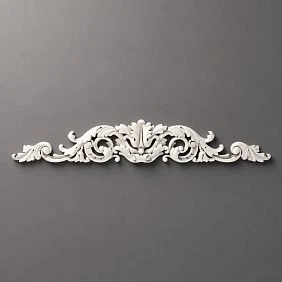
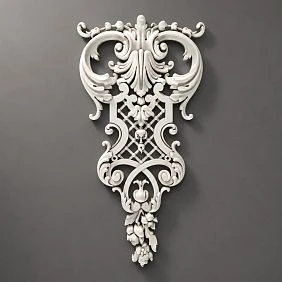
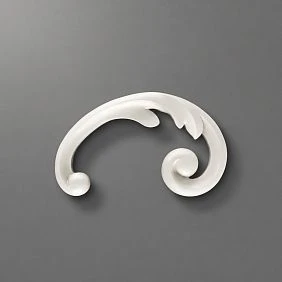
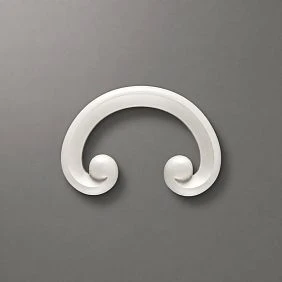
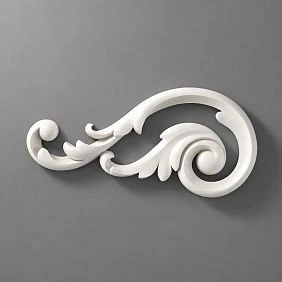
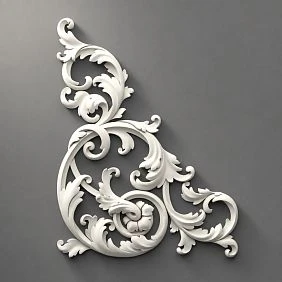
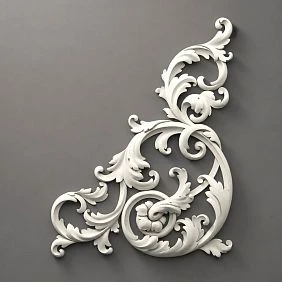
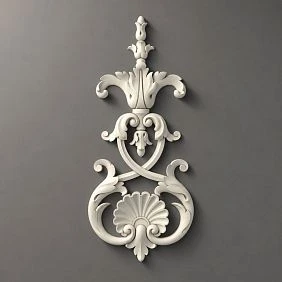
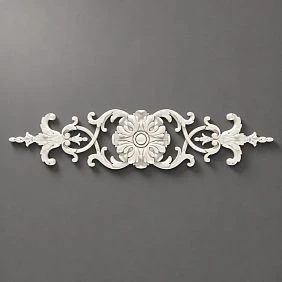
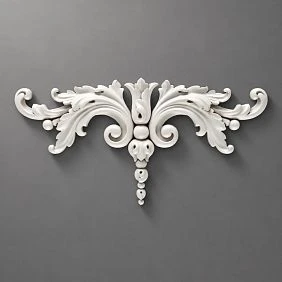
Decorative overlays for a wall with a fireplace — ornamental elements that place accents at key points of the composition. Above the portal (central part of the upper horizontal), on the sides of the fireplace (symmetrical elements), in the corners of frames, at the level of the dividing belt between the fireplace and TV zones.
Decorative elements for the TV zone are placed symmetrically on both sides of the screen: two identical elements at the same height create the feeling of a "frame" around the TV without physical molding along its perimeter. This is a lighter technique that works in modern interiors.
Size of overlays for the fireplace wall: 20–40 cm for large walls (from 3.5 m), 15–25 cm for standard living rooms.
Decor for moldings
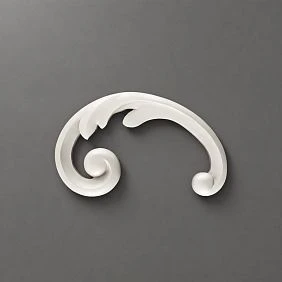
Decor for moldings around the fireplace — corner inserts, decorative connectors — are used where finished, "closed" frame corners are needed. For the fireplace wall, this is especially important: the fireplace portal traditionally has clear, accentuated corners. Corner elements create a professional finish for each frame.
corner elements for frames made of moldings for the fireplace wall, choose from the same collection as the moldings. In classic styles — with ornament (rosette, curl). In neoclassicism and Japandi — geometrically neutral.
Ready-made sets for the fireplace wall
Ready-made wall decor set with TV— the most practical choice for those who want a cohesive result without designing each element themselves. The set includes all necessary parts for one decorative section: moldings, corner inserts, and an overlay.
For a fireplace-TV wall, you will typically need several sets: one for the fireplace area, and one or two for the side sections. For principles, see the articleready-made sets of stucco decor for walls.
How to design a TV above a fireplace
This is the most popular layout in modern apartments — and it has the most well-developed decorative techniques.
One common vertical frame
The cleanest solution: one large frame encompasses both the fireplace and the TV in a single rectangle. The frame can run from the floor (or from the level of the fireplace base) to the ceiling cornice. Inside it — the fireplace in the lower part, the TV in the upper part.
This technique creates a strong architectural vertical: the accent wall is perceived as a single object, not as a "fireplace plus TV." Inside the large frame, you can add an additional division: a horizontal molding belt at the level of the portal's top edge separates the fireplace and TV zones while maintaining their visual unity.
Portal around the fireplace and a separate zone for the TV
A more complex but very expressive layout: the fireplace gets its own molding frame in the form of a classic portal (U-shaped with a horizontal crossbar), and the TV gets a separate rectangular frame above. Both frames are connected by vertical molding lines on the sides.
Important: the distance between the fireplace portal and the TV frame should be equal to or proportional to the width of the molding. This creates rhythm — a sense that everything is "calculated." Details in the articlePolyurethane TV zone decor.
Moldings in the color of the wall
Moldings for the fireplace portalin the color of the wall — a modern solution for those who don't want a "classic look." There is a frame, a portal, structure — but it all reads as architectural relief, not as "palace-style stucco." For minimalist living rooms, apartments in Scandinavian and Japandi styles — this is optimal.
About choosing between decor in the same color and contrasting — in the articlestucco decor in the color of the wall or contrasting.
Symmetrical side frames
On both sides of the vertical fireplace-TV axis, symmetrical vertical frames are mounted — from floor to ceiling or to the cornice. They create an "architectural framing" for the central zone: the fireplace and TV are in the center of a symmetrical system, which gives a sense of a grand, ceremonial space.
If the living room is wide (from 4 m along the decorative wall) — four side frames (two on each side). If moderate (3–3.5 m) — one on each side.
Decor with sconces on the sides
Sconces placed symmetrically on both sides of the fireplace-TV zone are a powerful technique that simultaneously solves decor and lighting tasks.Decor of the fireplace area with sconcesIt is mounted as follows: the overlays on the wall serve as a "base" for the sconces, or molding frames frame the sconce area, creating an architectural context for it.
On the principles of combining moldings with lighting — in the articleStucco wall decor with backlighting.
How to arrange a TV next to a fireplace
This is a more complex task because the two objects are on the same horizontal axis but are not vertically connected.
Two equal vertical sections
The most logical technique: the wall is divided into two equal vertical sections — the fireplace and the TV zone. Each gets its own frame of the same size. Between the sections is a dividing molding. Result: the wall looks like a system of two symmetrical niches, each containing its own object.
This works especially well if the fireplace and TV are of approximately equal visual weight — for example, an electric fireplace built into the wall and a TV in a niche.
Central fireplace axis and side TV zone
If the fireplace is larger and more important in architectural role — it occupies the center of the wall, the TV is placed on the side in a smaller section. The decor is built around the fireplace: a wide portal frame, symmetrical side elements, and the TV zone is integrated into one of the side frames.
This scheme works in large living rooms with a wide wall (from 4.5 m): the fireplace is the architectural center, the TV is a functional element in a decorative context. On working with decor behind the sofa in the context of such living rooms — in the articlepolyurethane wall decor behind the sofa.
Single horizontal molding line
A horizontal belt molding at the same height, running through the entire decorative block — both the fireplace and TV zones — creates a visual "stitching" that connects them into a horizontal system. This is especially important when the fireplace and TV are at different heights: the horizontal line neutralizes this discrepancy.
Frames of different sizes but the same style
If the fireplace and TV require frames of different sizes — this is not a contradiction if the frames are made from the same profile and in the same style. A large frame for the fireplace, a smaller one for the TV — connected by the same molding profile, the same color, the same collection.
Rule: frame sizes may differ, but the ratio of frame width to profile width must be the same. This creates a sense of a "family" of objects, rather than a random set.
Connection with the cabinet, shelves, and baseboard
The fireplace-TV wall does not end at the baseboard level: the cabinet under the TV, shelves next to the fireplace, the floor base — all are part of a single system. The baseboard molding from the same collection as the wall moldings connects the entire vertical volume of the wall into a cohesive whole.
About the principles of a unified decor system — in the articlehow to combine stucco decor with baseboards and cornices.
Which styles are suitable
Neoclassical
Decorating a wall with a TV and fireplace in neoclassical style— a classic choice for living rooms with high ceilings, parquet floors, neutral walls, and a formal character. Wide profiles 40–55 mm, symmetrical frames, ornamental corner inserts, and an overlay above the portal.
In neoclassical style, the fireplace wall is the main architectural statement of the living room. Moldings here are not decor—they are architecture. The TV is integrated into the upper zone of the portal system or into a side symmetry section. White moldings on a warm neutral wall are the canonical option. Tone-on-tone moldings are for a more contemporary interpretation of neoclassicism.
Neoclassic Light
Light neoclassicism for a TV zone with a fireplace— for a modern apartment with a ceiling height of 265–280 cm, where you want architectural character without heavy classicism.
Profiles 20–30 mm, moderate relief, minimal ornamental overlays. One or two frames, a horizontal band, possibly corner inserts. A TV above an electric fireplace in a single frame from the Neoclassic Light collection is a modern, high-quality, cost-effective result.
Neoclassic Light is a versatile collection for 80% of city apartments. It is compatible with any wall color, any type of fireplace (electric, bio-fireplace, faux fireplace), and any TV format.
Japandi
Fireplace wall decor in Japandi style— for those who value silence and geometry. Straight lines, minimal ornament, moldings strictly in the wall tone. A bio-fireplace or electric fireplace is built into a niche, with the TV next to or above it. Frames made of thin Japandi profiles create a laconic geometry without historical connotations.
In a Japandi living room, the fireplace-TV wall is a calm visual anchor. No white contrast, no ornamental overlays. Wood, neutral walls, monochrome molding relief.
Versailles Light
Wall decor with a fireplace in Versailles Light style— for formal living rooms, country houses, apartments with high ceilings, where the fireplace wall should make a grand impression.
Rich ornamental profile, symmetrical overlays above the portal and on the sides, corner elements with classic ornamentation. White moldings on a colored wall (cream, golden, dove gray) — a traditional color scheme.
The TV in such a system is usually hidden in a special niche or behind sliding panels: its technical appearance does not match the grandeur of the Versailles decor.
Versailles
Classic fireplace wall with stucco molding— for large country houses, spacious living rooms with ceilings from 320 cm, formal halls. The Versailles collection is a palace decorative system: wide profiles with rich relief, large overlays, complex corner elements.
The TV in a Versailles-style interior is a hidden element. The screen is hidden in a niche with decorative doors or behind a mirror with a lifting mechanism. The architecture of the wall is more important than functional technical objects.
Mistakes when designing a wall with a TV and fireplace
These mistakes are common — and each one destroys the idea of a unified composition.
The fireplace and TV are not connected by a common frame
Two objects with their own decor, completely unrelated to each other, is the main mistake. Molding around the fireplace in one style, molding around the TV in another, with an empty wall between them. This is not 'different zones', this is chaos.
Solution: a horizontal molding line connecting both zones at the same height. Or a single large frame encompassing both objects. Or a system of identical profiles across the entire wall — even if the frames are of different sizes.
Moldings interfere with the screen or furniture
A molding frame that encroaches on the screen area is unacceptable. The minimum gap between the molding and the edge of the TV is 8–10 cm. For a fireplace portal, the molding must not extend into the firebox or heating element area — a gap of at least 30–40 cm from the heat source.
Too elaborate stucco distracts from the TV
Rich ornamental decor on the wall with the TV creates visual competition: the eye doesn't know whether to look at the screen or the overlays. For walls with a TV — moderate decor, without large central ornaments at screen level. Accents — to the side, above the screen, in the fireplace area.
No symmetry around the fireplace
A fireplace is an architectural object that requires symmetry. One overlay to the left of the portal and an empty wall to the right is a mistake that 'tips over' the entire fireplace area. Symmetry is mandatory: two identical frames or two identical decorative elements on both sides of the fireplace.
Sconces, outlets, and cable outlets are not accounted for
Outlets in the TV area, cable outlets, mounting elements — all of this needs to be planned before installing the moldings. A molding installed over an outlet means dismantling. Sconces on the wall should be 'integrated' into the decorative scheme, not added afterward. Technical issues are resolved before decor — more details in the article.installing polyurethane molding.
The decor is too small for a large living room
A wide wall (4–5 m or more) with thin profiles of 15–18 mm looks unfinished: moldings get lost in the scale of a large space. For spacious living rooms — profile from 35 mm, overlays from 20 cm. The scale of the decor should match the scale of the room.
The fireplace portal conflicts with the baseboard and cornice
The baseboard is in one style, the fireplace portal moldings in another, the cornice in a third. This is a typical mistake of phased renovation. The system should be unified: all molding elements from one collection. About the principles — in the articlehow to combine stucco decor with baseboards and cornices.
What to buy for a wall with a TV and fireplace
A practical checklist for project implementation:
Moldings for a wall with a TV and fireplace:
Profile 35–55 mm for the fireplace area, 25–40 mm for the TV area. Neoclassic collection — for formal living rooms. Neoclassic Light — for modern apartments. Japandi — for minimalist spaces. Standard slat length 2 m.
Decorative overlays for a wall with a fireplace:
Above the portal — a central accent. On the sides of the fireplace — symmetrically. Size: 20–35 cm for wide living rooms, 15–25 cm for standard rooms.
Decor for Molding:
Corner inserts for all frames — from the same collection as the moldings. Mandatory for the fireplace portal: finished corners create a sense of professional work.
Ready-made set of stucco decor:
For the side sections of the fireplace-TV wall. Set by set — symmetrically on both sides of the central zone.
Baseboards and cornices:
From the same collection. The entire perimeter of the living room is in a unified style. This is especially important for a fireplace living room, where the wall with the fireplace is the architectural center of the entire space.
The entire assortmentpolyurethane products for interior— moldings, overlays, decor for moldings, ready-made sets — in the STAVROS catalog.
About fireplace decor from the perspective of a separate wall zone — in the articlepolyurethane decor for the wall with a fireplace. About TV zone decor separately — in the articlePolyurethane TV zone decor. For kitchen-living rooms with a fireplace and TV — in the articlestucco decor for a kitchen-living room.
For accurate material calculation — the articlehow to calculate moldings and stucco decor for a wall.
Step-by-step installation technology is described in the articleinstallation of polyurethane molding.
Frequently Asked Questions
Can you decorate a TV and a fireplace with moldings on the same wall?
Yes — this is exactly the task for which polyurethane moldings are best suited. A single frame system connects both objects into an architectural composition. The moldings are mounted with glue, require no drilling, can be painted any color, and create a permanent decor that lasts as long as the interior itself.
What is better: one common frame or two separate zones?
For a TV above the fireplace — one common vertical frame with an inner horizontal band. For a TV next to the fireplace — two connected sections (a horizontal line or a single profile across the entire wall width). The choice depends on the arrangement of objects.
Which moldings to choose for the fireplace wall?
Profile width 35–55 mm with moderate relief. Collection — depending on style: Neoclassic or Versailles Light for classic living rooms, Neoclassic Light for modern apartments, Japandi for minimalist interiors. All elements from the same collection.
Can polyurethane decor be used near an electric fireplace?
Yes, provided a clearance of at least 30–40 cm from heating elements. Electric fireplaces heat the air, not the wall — so with proper installation, polyurethane is outside the direct heat exposure zone. Important: decor should not be mounted directly above the fireplace ventilation openings.
How not to overload the TV area with stucco?
The rule is simple: moldings should not compete with the screen. Decorative accents — on the sides of the TV and above it, but not at the screen level. Avoid large ornamental overlays in the center of the screen area. Moldings in the wall color solve the 'overload' problem automatically.
Is Versailles Light suitable for a wall with a fireplace?
Yes — especially for formal living rooms with high ceilings, country houses, apartments with classic interiors. Versailles Light implies symmetry, white contrast, and rich relief — all of which are organic for a fireplace wall. For a standard city apartment with a 265 cm ceiling, Neoclassic Light is preferable.
What to buy: moldings, overlays, or a ready-made set?
For the first project — a ready-made set: it contains all necessary elements from one collection, eliminates selection errors. For non-standard schemes — individual moldings with independent design. Overlays — an additional element on top of the frame system, not purchased separately.