


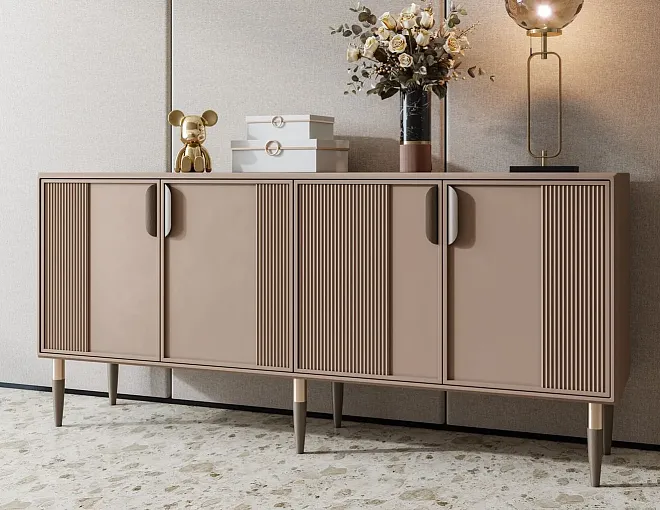


A reception desk in a hotel, salon or business center is often a simple rectangular body with quality cladding, but without distinct articulation of the facade. Two thin horizontal lines of carved wood can change the perception of such furniture without replacing the countertop or reworking the body. However, buying the moulding based only on the total length of the walls is risky. For a facade 1320 mm wide and two side panels of 620 mm each, six solid decorative pieces with a total length of 5.12 m are needed. Three two-meter strips provide six meters of material, but after distributing the pieces, two of them will have only 60 mm left. If this remainder has to be used for pattern matching and preparing the corners, the advantageous purchasing scheme will stop working.
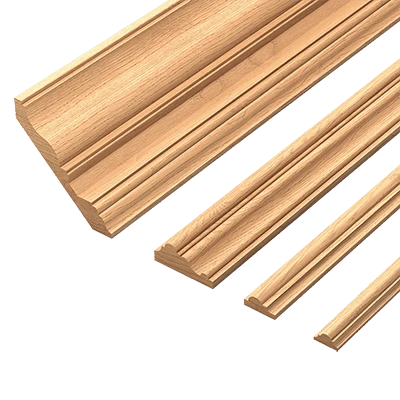
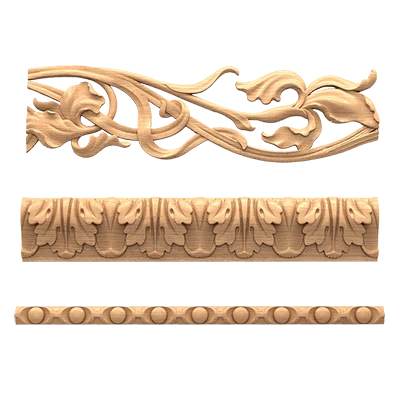
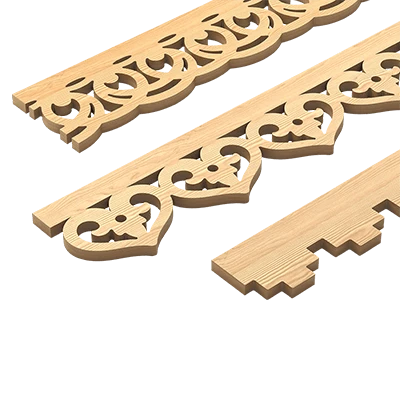
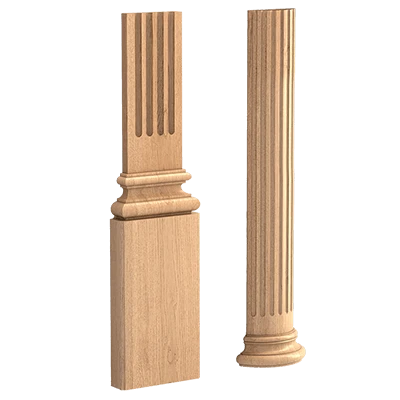
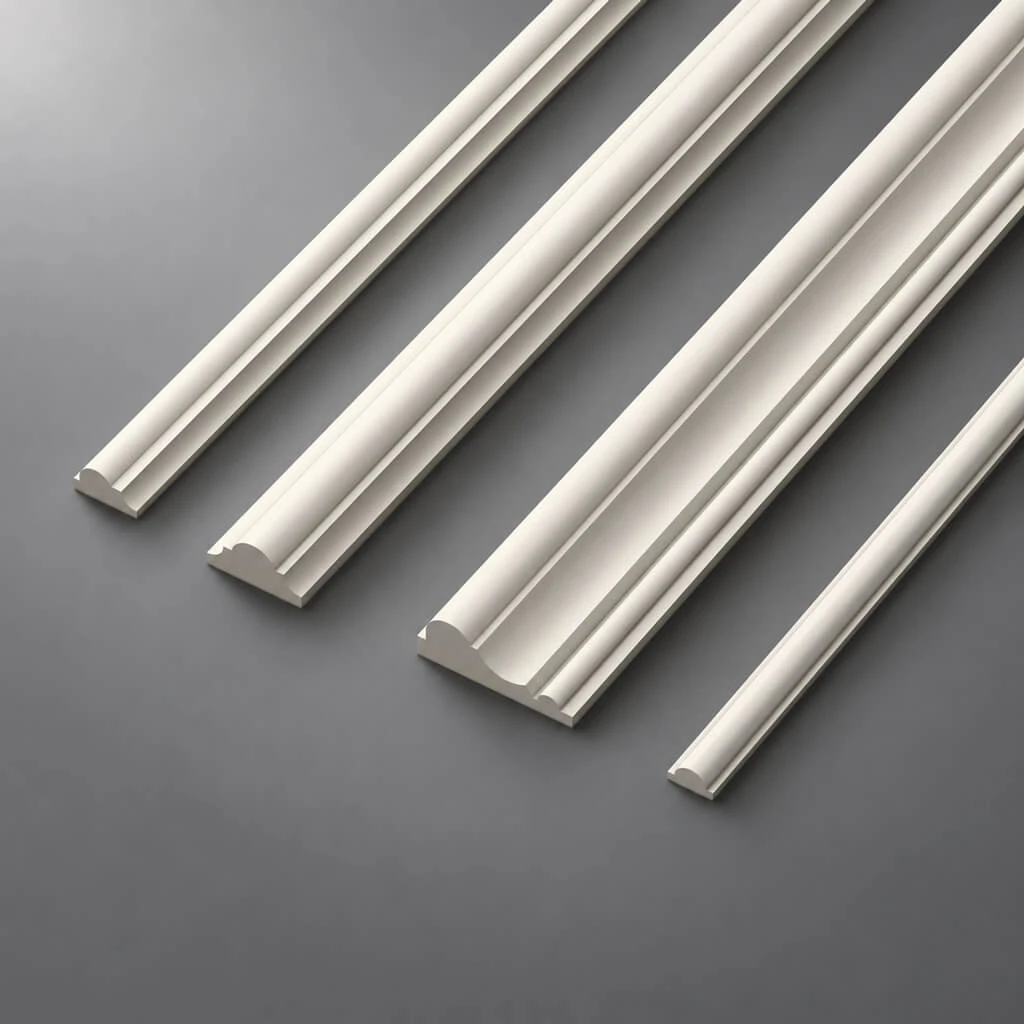
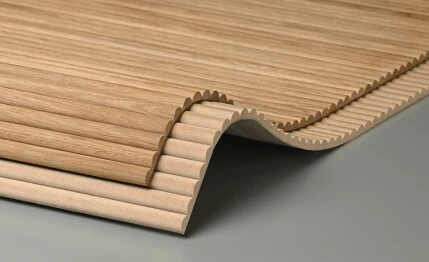
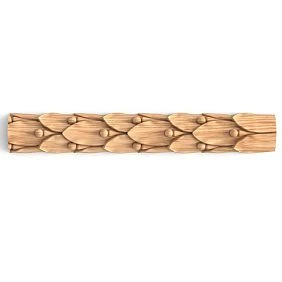
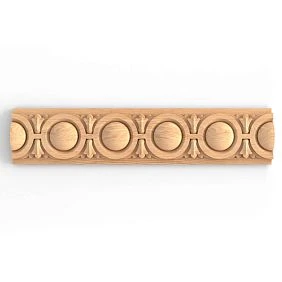
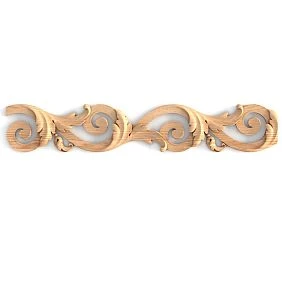
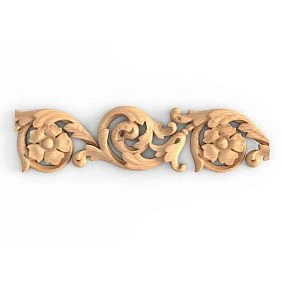
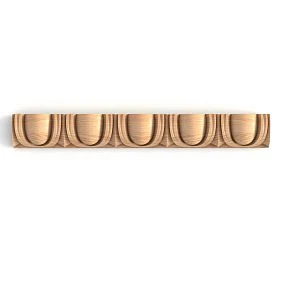
Wooden baguettes made of solid oak or beech are suitable for such a solution, in particular the narrow wave-shaped K-049 and the wider K-095 with extended relief stripes. Both items are presented in the STAVROS catalog; they differ not only in pattern but also in the height of the protrusion above the clad panel. The first model has a cross-section of 15 × 7 mm, the second — 20 × 10 mm. Therefore, the choice affects the shadow line, the junction with the corners and the ability to clean around the protruding parts.
You can calculate the purchase for Taganrog already at the stage of approving the desk drawings. To do this, it is necessary to determine the outer contour, choose the material, find out the wood processing method, and only then draw up a cutting map. In a commercial interior, it is especially important that the decorative strips are solid, do not interfere with furniture maintenance and preserve the agreed pattern on all visible sides.
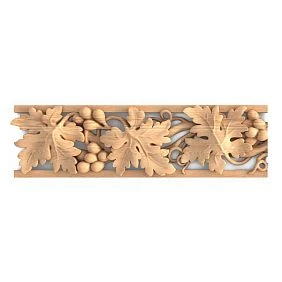
Where to buy wooden baguette in Taganrog for a commercial interior
When choosing decor for a reception desk, it is more convenient to first look not at ready-made frames or wide cornices, but at the catalog of carved moulding. Such products allow you to independently compose an extended decorative composition, select the width of the strip to match the scale of the furniture and order the required number of factory blanks. STAVROS offers Buy wooden picture frame molding in oak and beech with a selection of item number, length, sanding quality and type of joinery blank. For a buyer from Taganrog, this is an opportunity to equip the project remotely, relying on the dimensions of specific profiles rather than on the conventional name of the pattern in the catalog.
The visible decorative part of the desk is often finished according to the furniture maker's individual drawing, even if its body is made according to a standard project. Therefore, it is useful for the property owner to divide the order into two items: furniture with the necessary working functionality and a separate set of applied decor. Then the installation of the strips does not require changing the volume of the drawers, the placement of equipment or the overall shape of the countertop. When repairing existing furniture, separate moulding allows you to refresh the expressiveness of the facade, provided that its base has retained its strength and is suitable for the chosen fastening method.
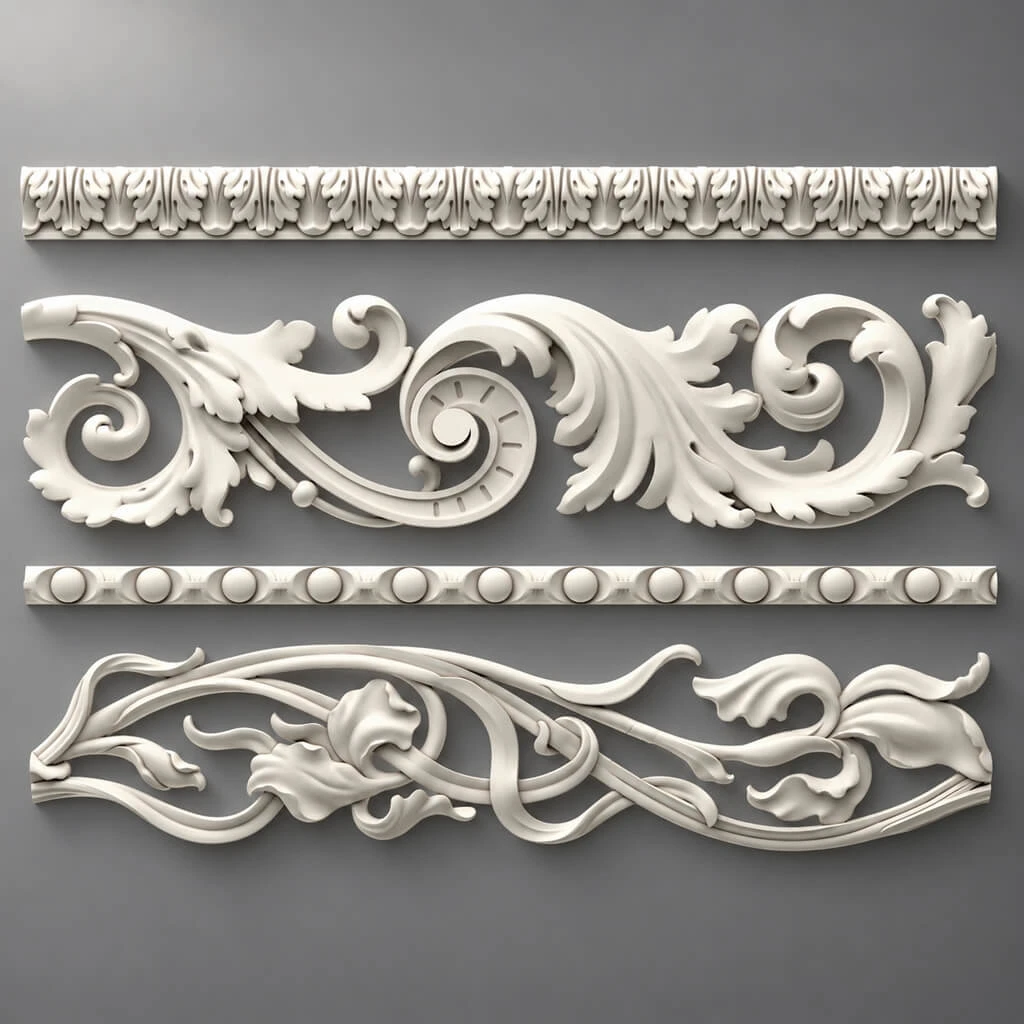
The catalog contains products with different scales of carving: from delicate narrow lines to much more complex ornaments. For a desk that visitors view from a short distance, a large pattern is not always required. On a front more than a meter wide, it is the repetition of details that reads well. An overly wide ornament may begin to compete with the organization's sign, information plates or the expressive pattern of the wooden cladding. At the same time, a completely flat strip painted in the color of the base may disappear in diffused light. Hence the interest in two specific profiles with similar but not identical dimensions.
Before placing an order, it is important to have an idea of where the boundary lies between finishing and furniture construction. Baguette is not a load-bearing corner element, does not reinforce the body and is not intended to hold the countertop. Its place is on a pre-prepared surface. If the desk has loose joints, a damaged edge or requires replacement of the cladding, joinery repair is performed first. Decorative strips are added after these tasks are resolved.
Two horizontal bands: how to turn a rectangular counter into a unified composition
A technique based on two extended lines is especially convenient for objects where the front panel and the side panels are visible to the visitor at the same time. A person does not always approach the counter strictly along the central axis. They see it in perspective, and it is precisely the transition of the horizontal lines across the outer corners that communicates that this is a single piece of furniture rather than several independently decorated panels. For this effect, the decorative bands are placed at coordinated heights and checked against the horizontal of the room.
The upper band is usually associated with the design of the countertop, and the lower one with the composition of the main cladding or the plinth section. This is not a mandatory prescription regarding distances: the dimensions depend on the height of the furniture, the thickness of the overhanging countertop, the placement of decorative frames and the presence of equipment. In one interior, the upper line may be located below a noticeable shadow line; in another, it is more logical to leave more clear space between them. The chosen position should read both in a frontal view and when approaching from the side.
If the counter stands in a beauty salon, a delicate wooden pattern can link it with the display window, mirror frames and the finish of the waiting area. For a small hotel, coordination with the doors, signage and the calm color palette of the lobby is more important. In a business space, decorative lines often serve merely as a way to break up a large panel into proportionate sections. In each of these scenarios, one practical goal remains: to organize the lower part of the interior so that the decor does not compete with the working items on the countertop.
Before buy wooden carved moulding, it is useful to evaluate not only its pattern up close, but also its relationship with the adjacent surfaces. With a cabinet height of, for example, about one meter, a 15 mm wide strip looks completely different from the same profile on the door of a small cabinet. On a large surface it becomes a thin outline, and on close inspection the carving itself becomes apparent. It is precisely this dual perception that distinguishes ornamental baguette from a decorative insert intended primarily for viewing from a distance.
For two bands, it is reasonable to use a single article number if strict repeatability and the most economical layout are required. Different patterns are also possible, but they are better subordinated to a clear hierarchy: for example, the upper line draws the eye, while the lower one supports it without an additional accent. With such a solution, the purchasing calculation changes, because offcuts of different profiles cannot be combined. It is important to resolve this question before discussing the budget, and not after receiving the cost of three strips of a single article number.
Wooden baguette K-049: wave-shaped pattern, fifteen millimeters wide
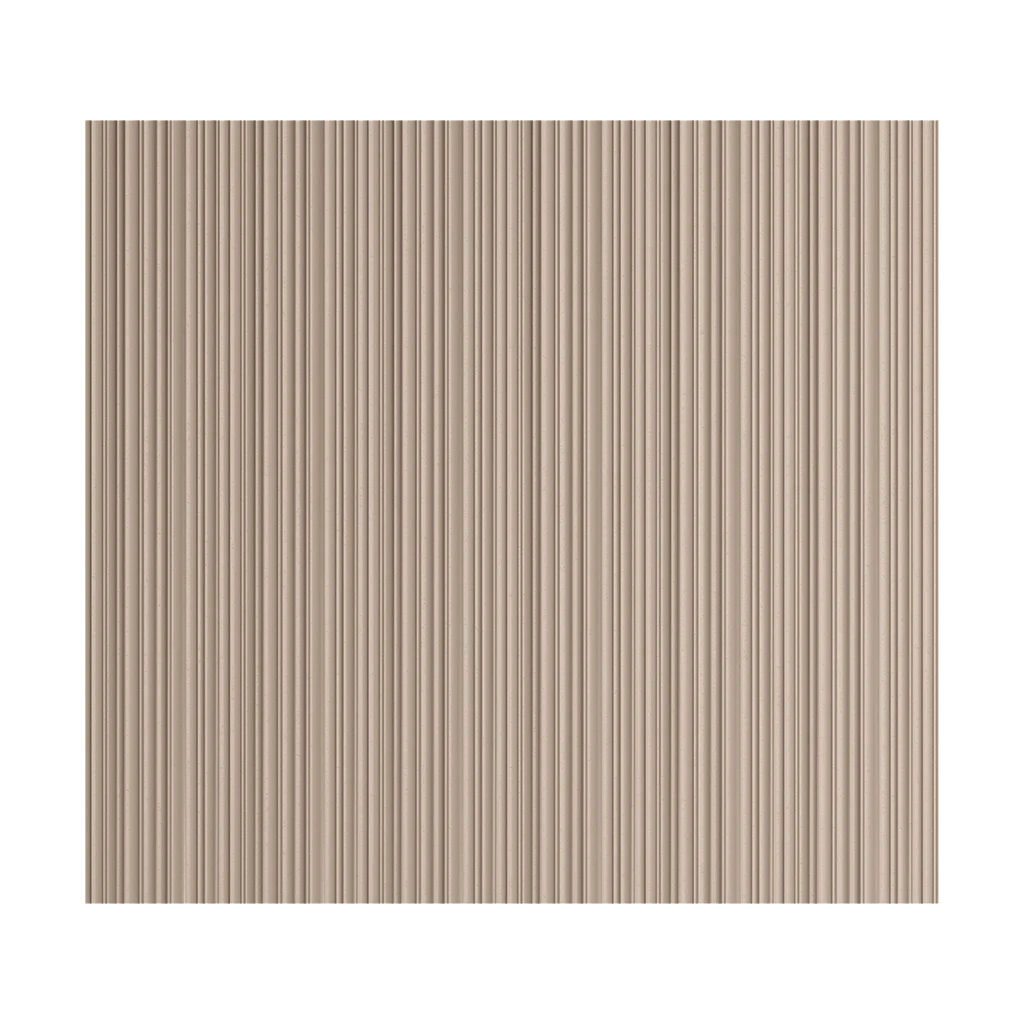
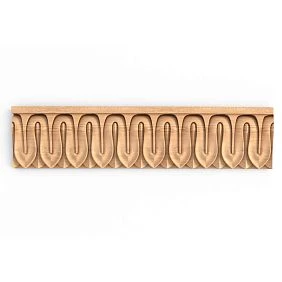
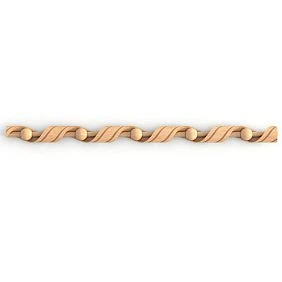
Model K-049 has a face width of 15 mm and a nominal thickness of 7 mm. The product is available in two factory lengths: 300 and 2000 mm. The catalog offers wooden versions in beech and oak, and the surface can be selected with different sanding qualities. Such a wooden wave-shaped baguette creates a repeating relief on a narrow strip, so perception depends on the lighting and the observer's position.
On a faced post, such a moulding is especially interesting as a calm yet noticeable border between the fields. If the central part of the body is made of wood with a pronounced texture, the compact profile does not draw attention away from it. On a painted surface, the pattern can read through light and shadow even when the moulding and the furniture are the same colour. It is enough for the lighting to reveal the irregularities of the front surface rather than turn the whole strip into a solid dark line.
The nominal seven millimetres of thickness must be taken into account as the overall dimension of the product, not as a guaranteed size of its adhesive area. The actual fit depends on the shape of the back side, which is verified against the drawing and a sample. On a flat base, the profile usually does not require a deep rebate if the project specifically provides for surface mounting. But when installing next to a surface-mounted metal plate, a protruding side edge or a furniture door, you need to make sure that the relief does not cross their path of movement.
To buy wooden baguette K-049, select the material, size and finish in the product card. For a calculated project, two-metre blanks are of interest: none of the six provided segments can be obtained from the short 300 mm version without additional joints. A short strip, on the contrary, is convenient to consider as a separate sample for comparing the relief and trying out a finish. Before ordering it, you must verify that it matches the chosen long version in species, quality and pattern.
With an open transition through a corner, the wave requires attention to the cut point. At the end of the strip there may be a protruding part of the ornament, a recess or an intermediate section. If a noticeably different section of the pattern begins on the adjacent side, the joint attracts the eye even when the parts fit tightly. For a long run, this matters more than a small difference in pattern between individual samples laid out on a table. Therefore, the linear footage and the matching of the ornament must be treated as two separate tasks.
K-095 wooden moulding: a pronounced horizontal with a wider relief
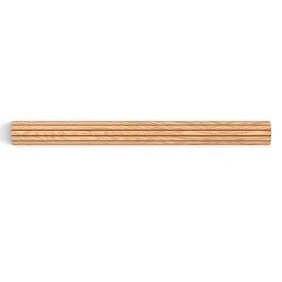
The cross-section size of K-095 is 20 × 10 mm. The factory lengths are the same as for K-049: 300 and 2000 mm. The profile is distinguished by the longitudinal character of its decorative lines. When used on a post, it can form a more distinct band, especially if the body is painted in a calm solid colour or faced with wood without a very active pattern.
Compared with the first option, the front surface is five millimetres wider, and the nominal projection is three millimetres greater. These differences seem small until the profiles are viewed at the scale of two parallel strips running across three sides of the furniture. A wider moulding creates a larger relief area, and the additional thickness can strengthen the shadow under the lower edge. However, the result depends on the direction of light and on how the specific cross-section shape is constructed. The brightness of the shadow band cannot be calculated from the catalogue dimensions alone.
If required buy carved molding K-095, it is worth determining in advance where it will end up relative to the most protruding part of the facing. On a post with wooden outer corner pieces, the moulding can either be brought up to their boundary or continued through the corner after agreeing on the geometry. For a post with straight outer corners, it is logical to check the corner mitre. On a rounded body, a solid rigid strip will not follow the curved surface without a specially developed solution; it cannot be chosen as a universal flexible overlay.
A larger relief also changes the nature of daily care. Where visitors often touch the panel with bags and clothing, the protruding parts require careful assessment. This does not mean that a thicker profile will necessarily prove less durable: the result is influenced by the material, coating, placement and fastening. But it is better to install a trial segment in advance at the level of the intended line and run a hand over the surface, assessing whether it catches clothing or falls in a place of constant contact with cleaning equipment.
For a modern office or counter with sufficiently pronounced proportions, K-095 may stand out more from several meters away. K-049, on the other hand, is appropriate when the main decorative role is played by the texture of the furniture itself. These are two different visual strategies, and the difference in cost should not automatically determine the decision. First, check whether the profile matches the task, then choose the wood species and the available finishing technology.
How to compare 15 and 20 mm profiles on a single panel
To make a decision, it is convenient to draw a small section of the future facade at full scale. On it, mark the boundaries of the upper decorative line, the field between the bands, and the position of the lower strip. If the designer uses only a reduced visualization, a five-millimeter difference in the image may practically disappear. Checking at full scale shows how the width of the baguette combines with the tabletop edge, the distance to the floor, and adjacent furniture details.
| Parameter | K-049 | K-095 |
|---|---|---|
| Nominal width of the face strip | 15 мм | 20 мм |
| Nominal thickness | 7 мм | 10 мм |
| Available factory lengths | 300 and 2000 mm | 300 and 2000 mm |
| Length of two bands on the design post | 5.12 m | 5.12 m |
| Total nominal area of two strips in projection | 768 cm² | 1024 cm² |
| Main visual effect | Fine wavy line | More pronounced longitudinal stripes |
The area in the table is obtained by multiplying the finished length of 5120 mm by the profile width. It refers to a conventional frontal projection, not to the actual surface of the carving, and cannot serve as an accurate calculation of lacquer or primer consumption. Nevertheless, this value helps to understand the scale of the difference: the wider model occupies a third more space in the plane of the visible panels. This matters on furniture where two bands sit next to a wide logo or contrasting doors.
Thickness also affects whether the line can be completed near another component. Imagine a side panel adjoining a niche with a door that, when opened, passes close to the mounting point of the decor. The difference between a protrusion of seven and ten millimetres can be decisive if the available clearance is small. You should check not only the position of the door in the closed state, but also its actual movement. If there is no clearance, neither a more attractive price nor a suitable pattern will fix the structural conflict.
On a stand positioned in the centre of a spacious hall, both sides are perceived in turn. Therefore the sample can be examined at an oblique angle and under several light sources. The appearance of the carved decor changes when light falls along the band: individual areas of the relief begin to cast unequal shadows. If the lighting is built into the upper part of the furniture, it is especially useful to make sure that it does not emphasise irregularities in the base or areas of corner fitting.
If, in addition to the baguette, you need smooth frames or skirting boards, you can separately buy wooden trim from the corresponding category, coordinating it with the selected carved band. What matters here is not a match in nominal width, but the ratio of the actual sections and visible planes. A smooth profile placed next to a carved one can form a calm background; two decorative bands similar in pattern, on the contrary, sometimes create excessive fragmentation.
Oak or beech for the stand: which material to choose for the finish
Choosing a wood species for a small decorative strip begins with the question of finish. If the surface of the strip is painted in an opaque color, the natural wood grain under the enamel will be hidden, but the relief will remain. If the furniture is finished with a transparent or semi-transparent composition, not only the shape of the carving but also the appearance of the fibers on the face surface becomes important. In this case, selecting a species solely from a photograph of a finished interior is unreliable: the shade depends on the lighting, the substrate material, and the composition of the finish.
Oak has a pronounced natural texture. On a narrow profile it manifests differently than on a large smooth countertop: the carving crosses the fibers, and small areas with different grain directions may perceive light differently. With a transparent finish, this can enrich the pattern. If the body is already made with an open oak texture, using a moulding of the same species becomes a logical first option, but it does not yet promise a complete color match. Even individual blanks of the same material can differ in shade.
Beech has a more uniform-looking pattern and is often suitable for finishing with opaque enamel. On such a product, the character of the surface is created mainly by the geometry of the decorative line. If the designer needs a clear light or dark strip that matches the color of adjacent furniture, beech allows the profile shape to be considered separately from the expressive texture of oak. With a transparent coating, it can also look interesting if the shade and pattern of the sample satisfy the customer.
For a commercial project, there is another criterion — the reproducibility of the finish during subsequent repairs. If one of the side parts is damaged after several years of use, it may be difficult to exactly replicate the original tone of naturally aged wood. A retained sample, a record of the applied coating, and a remainder of moulding from the same batch will help reduce this uncertainty. On opaque-painted furniture, it is useful to keep the color code and information about the gloss level. In both cases, this is a matter of finish maintenance, not a promise of an absolute match for future replacements.
It is important for the designer to find out how the joinery blank is made. According to the manufacturer's description, the solid wood may be formed from glued wooden lamellas. Such a product should not automatically be imagined as a part made from a single continuous board without natural wood characteristics. For a narrow strip, the joints between lamellas may become visible with a transparent finish. Therefore, when choosing the material, it is reasonable to additionally agree on the blank category and inspect the surface of the future face area.
Species, surface quality, and lamella selection are three independent order parameters. Paying for more expensive wood does not replace the correct choice of treatment, and ordering hand sanding does not guarantee a match with the tone of existing furniture. When the customer intends to preserve visible wood texture, it is more useful to first agree on a small test area than to make a decision based on a single picture on a screen.
"Standard" and "Prestige" sanding: how to assess the difference before ordering
A carved surface differs from a smooth furniture edge in that its recesses and transitions are harder to treat after installation. On an already fixed strip, it is inconvenient to sand the inner parts of the ornament evenly: it is easy to touch the body cladding, alter the relief contour, or damage the coating of an adjacent area. That is why the quality of the initial surface is of noticeable importance when preparing carved wooden moulding for finishing.
In STAVROS information about materials and wood treatment quality two finishes are distinguished. In the "Standard" category, the blank is milled and sanded by machine. Individual roughness and tool marks may remain on it. "Prestige" involves additional manual processing of relief areas. The customer chooses between a lower purchase cost and more thorough factory surface preparation. These names denote the degree of processing, not varieties of ornament.
The decision should be made taking into account the finisher's work. If the workshop has experience processing fine carving, suitable abrasives and enough time for preparation, the base quality may be reasonable. If, however, the decor must be installed in an already functioning room and a significant part of the preparation must be done off-site, a more thoroughly processed surface can reduce on-site labor. How much time will be saved depends on the condition of the received parts, the coating technology and the skills of the installer; there is no universal norm for the two article numbers.
For one two-meter K-049 strip, the difference between the sanding options at published prices is 480 rubles for beech and 460 rubles for oak. For K-095 — 590 and 480 rubles respectively. For a set of three strips, this is an additional 1440, 1380, 1770 and 1440 rubles. These amounts are useful to compare with the cost of surface preparation in the workshop, including small work on corners after cutting. Even when ordering "Prestige", the finished ends and joints will require inspection, since they will appear during cutting, after factory processing.
The quality of the glue-up is selected separately. The variant for enamel involves a less strict selection of lamellas by natural color, whereas the blank for tinting is assembled taking into account the visible wood pattern. It is easy to confuse these parameters: when choosing the more expensive sanding, the buyer may assume that they have simultaneously received a different grade of blank. In fact, the type of glue-up and the degree of sanding are specified separately. Clarify both characteristics when confirming the order, especially if a semi-transparent coating is planned on the exposed surfaces of the stand.
What dimensions to take before buying carved baguette
The area of the front panel by itself says almost nothing about the amount of material for two bands. Linear dimensions at the location of each strip are needed. For a stand with a perfectly rectangular body, the upper and lower levels will give equal lengths. However, real furniture may have protruding corner overlays, a plinth, stepped cladding or a body that widens toward the top. Therefore, measurement at the height of the future lower band cannot automatically be used for the upper one.
First, three visible planes are marked on the sketch: front, left and right. For each, indicate where the decorative strip begins and ends. If the baguette must be continuous at the outer corner, the measurement point must correspond to the chosen line of the future corner joint. If the ornament stops before the corner piece, the distance to it must be specified. The panel width specified by the furniture maker and the finished length of the decorative piece may differ in these two cases.
The next group of dimensions relates to the vertical placement of the decor. On all three sides, record the finished floor level, the underside of the countertop, the visible plinth, and the lower and upper boundaries of the intended bands. For furniture on adjustable supports, it is useful to first set up the body and only then transfer the horizontal line to the panels. Otherwise, even precisely cut strips may appear visually skewed relative to adjacent furniture. If necessary, shims or support adjustment are performed independently of the decorative work.
It is necessary to check that the cladding is actually flat at the attachment point. A long narrow piece can only follow small features of the base; forcibly pulling a rigid profile to a pronounced wave creates stress and makes tight joining at the corners difficult. A rail placed against the panel helps to see local gaps. If the deviation is significant, the furniture maker first chooses a way to correct the base rather than trying to hide the problem with a decorative strip.
For corners, record the actual geometry, not just a note that the stand is rectangular. A corner may be formed by two panels with different cladding thickness, a protruding end edge or a separate insert. Before cutting, a test joint from short blanks is needed, by which the position of the outer joint point is checked. If the actual angle differs from a right angle, two 45-degree cuts will not necessarily form a tight joint.
Finally, functional elements are noted. These include service doors, removable panels, cable entries, equipment ventilation openings, locks, and fastenings for information plates. The decorative band must not obstruct service access. If the boundary of a removable panel passes through its level, you cannot simply glue one long strip to both parts at once. You will need to relocate the band, design separate segments, or agree on a method for disassembling them. Such an option will change the original parts list.
Practical project: a counter with a 1320 mm front and two side panels
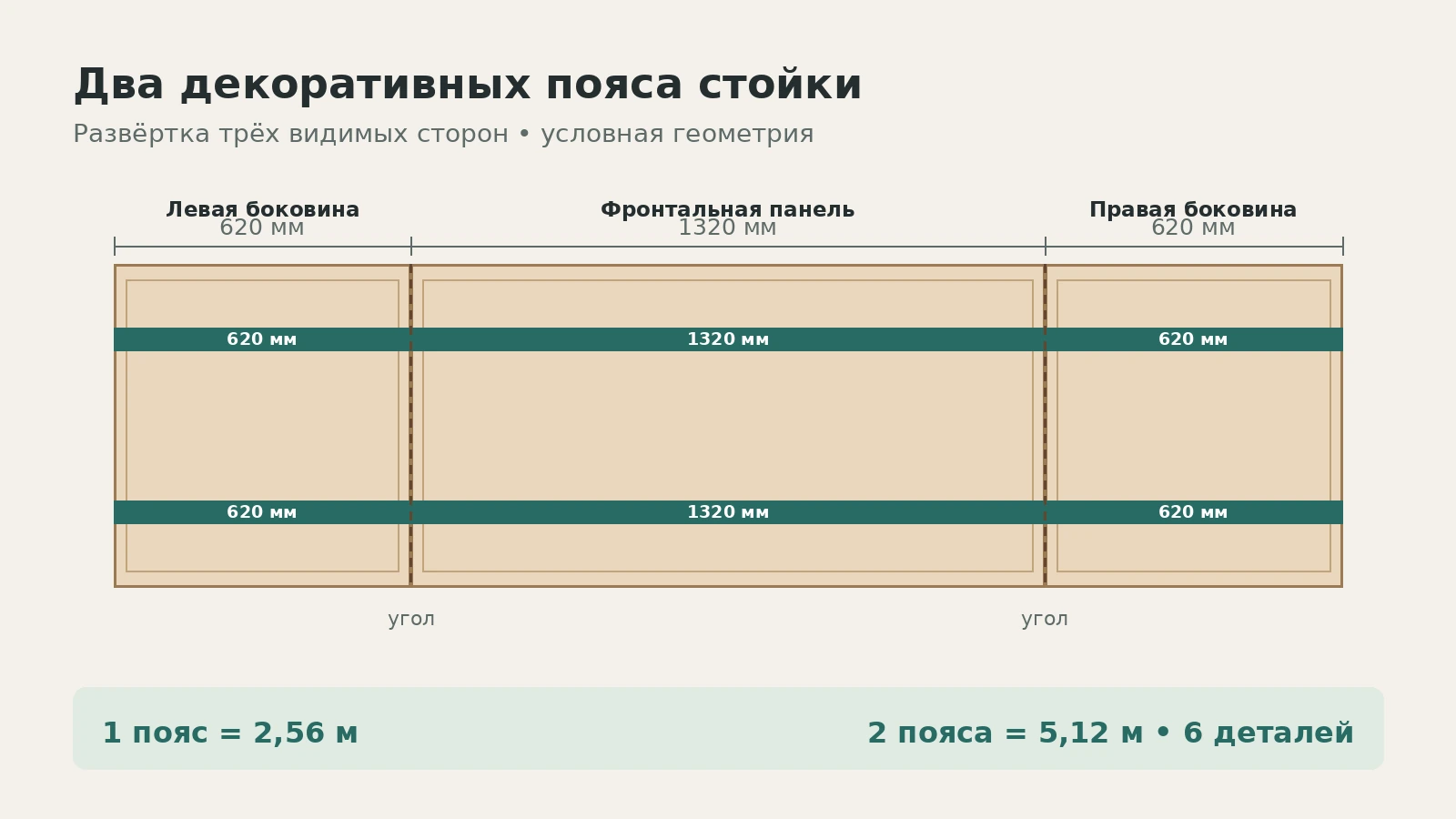
Let us imagine a conventional reception counter in a small commercial space in Taganrog. Its rear side faces the employee and is not included in the decorative calculation. The outer panels are flat, and their boundaries allow two horizontal bands each. We will set the dimensions as finished lengths of the parts along the agreed measurement line, taking into account the future joint. This is a training example of a specification, not a description of a specific completed project.
| Counter section | Length of one part | Number of bands | Finished requirement |
|---|---|---|---|
| Front panel | 1320 мм | 2 | 2640 мм |
| Left side panel | 620 мм | 2 | 1240 мм |
| Right side panel | 620 мм | 2 | 1240 мм |
| TOTAL | — | — | 5120 мм |
One decorative band covers the front and two side sides: 1320 + 620 + 620 = 2560 mm. The second band has the same length, therefore the total is 5120 mm. This is the finished linear meterage of six separate elements. It is not equal to the purchase length, because blanks are produced in certain sizes rather than cut into arbitrary pieces for a finished project.
Two continuous lines on the front panel
The 1320 mm wide facade is the most noticeable at the entrance. It is on this facade that the long decorative strip must maintain a continuous pattern, so the accepted design does not provide for a joint in the middle of the front. Two separate blanks with a finished length of 1320 mm each are required. It is impossible to obtain both from a single two-meter plank: their total length is 2640 mm. The front will require material from at least two long blanks.
When cutting, it is important to mark which end belongs to the left corner and which to the right. With a profiled part that has a directional pattern, simply flipping it over can change the perceived direction of the ornament. An arrow applied to the back side prevents accidental installation of the part in the wrong position. If the two front strips must start at the same phase of the repeating pattern, this is resolved before making the final end cuts.
Four lines on the side panels
The left and right side panels require four segments of 620 mm each. Each side line connects to the corresponding front band and terminates on the administrator's workstation side. The visible part of the end depends on whether the rear end is closed by a furniture side panel. If the part ends openly, the method of finishing the end is agreed in advance; otherwise, after painting, a sharp transition in the relief may be noticeable on it.
On a three-dimensional rack, the two side lines can be made from separate sections of a single plank if their dimensions and pattern direction match. However, the side panels are not automatically interchangeable. Opposite ends require different angular cut directions. It is convenient to immediately assign designations to the left upper, right upper, left lower, and right lower parts. Then, during a trial assembly, each joint can be checked without having to sort through all the segments again.
Bill of materials for six parts: translating the project into a purchasing calculation
The workshop receives a list of finished lengths and the correspondence of parts to the sides of the furniture. If identical profiles are used on all sections, the bill of materials can be reduced to two sizes, but for execution it is useful to retain individual marking. This is especially important with a wavy pattern, where the choice of the initial section of the plank determines the appearance of a specific corner.
| Designation | Installation location | Finished length |
|---|---|---|
| F-T | Front, upper band | 1320 мм |
| F-B | Front, lower rail | 1320 мм |
| L-T | Left side panel, upper rail | 620 мм |
| P-V | Right side panel, upper rail | 620 мм |
| L-B | Left side panel, lower rail | 620 мм |
| R-B | Right side panel, lower rail | 620 мм |
| TOTAL | 6 solid parts | 5120 мм |
When clarifying dimensions, a distinction should be made between the long and short points of a mitre cut. In the project, the lengths for outer corners are already specified along the selected measuring line. If the actual dimensions are taken along the base of the panel, while the finished part is measured along the outer edge, the value may change. The transition between these lines depends on the actual geometry of the profile and the angle. Therefore, the difference in nominal thickness from the product card should not be carried over into the cutting list without a trial joint.
The schedule does not account for additional pieces for closing the ends, auxiliary templates, and incidental losses during fitting. These are accounted for separately if the project requires such parts. The remainder of a long strip is not yet a ready spare element: it may contain a section of the ornament that is unsuitable for a visible joint, or it may be shorter than the shortest required segment. This point becomes significant when choosing between three and four factory strips.
Separate purchase of four strips: a convenient reserve for fitting corners
The simplest method of kitting assumes a separate group of blanks for the front panel and a separate one for the side panels. One long part is cut from each of two strips, and the other two are used for four side segments. If each side blank is allocated for two parts 620 mm long, 760 mm will remain on it before processing. The advantage of this order is that the craftsman does not depend on how successfully the front part is positioned on its original strip.
| 2000 mm strip | Parts | Remainder before cutting |
|---|---|---|
| № 1 | 1320 мм | 680 мм |
| № 2 | 1320 мм | 680 мм |
| № 3 | 620 + 620 mm | 760 мм |
| № 4 | 620 + 620 mm | 760 мм |
| TOTAL | 5120 мм | 2880 мм |
The total purchase length is eight metres. The remainders are large enough that, with a successful distribution of the ornament, part of the material can be used for a trial corner joint, a trial finish, or the preparation of a spare side part. It is only necessary to bear in mind that the calculated remainder decreases after end trimming and each saw cut. Whether the reserve is sufficient specifically for a finished spare part is determined only after the main operations are completed.
This option is appropriate when the customer wants to minimise the risk of a repeat order. For a small volume of moulding, transporting one additional strip later may prove disproportionately expensive relative to the initial saving. At the same time, the surplus should not always be left on site: if the finishing is carried out by a workshop, it is more sensible to agree in advance who stores the spare parts and how they are handed over to the owner. A dry room and protection from mechanical damage are more important than keeping the original factory box.
Separate purchasing will also be needed when choosing different article numbers for two bands. One band consists of one long and two short parts, 2560 mm in total. This is more than the two-metre length, so at least two strips are needed for each article number. If K-049 is used on top and K-095 below, the three-strip kit from a single profile will no longer be applicable. Bands made of different wood species or with different finishes also require independent distribution of blanks.
Joint cutting of three strips: where the saving arises and when it disappears
If both lines are made from the same article number, the same wood species, and the same finish, the blanks can be distributed among the three sides without prior division by facades. Two long parts will occupy two separate planks, but one 620 mm segment can be added to each of them. Then the third plank will remain for the other two side strips. The conditions of such a distribution should be agreed with the craftsman who directly performs the cutting.
| 2000 mm strip | Parts | Remainder before cutting |
|---|---|---|
| № 1 | 1320 + 620 mm | 60 мм |
| № 2 | 1320 + 620 mm | 60 мм |
| № 3 | 620 + 620 mm | 760 мм |
| TOTAL | 5120 мм | 880 мм |
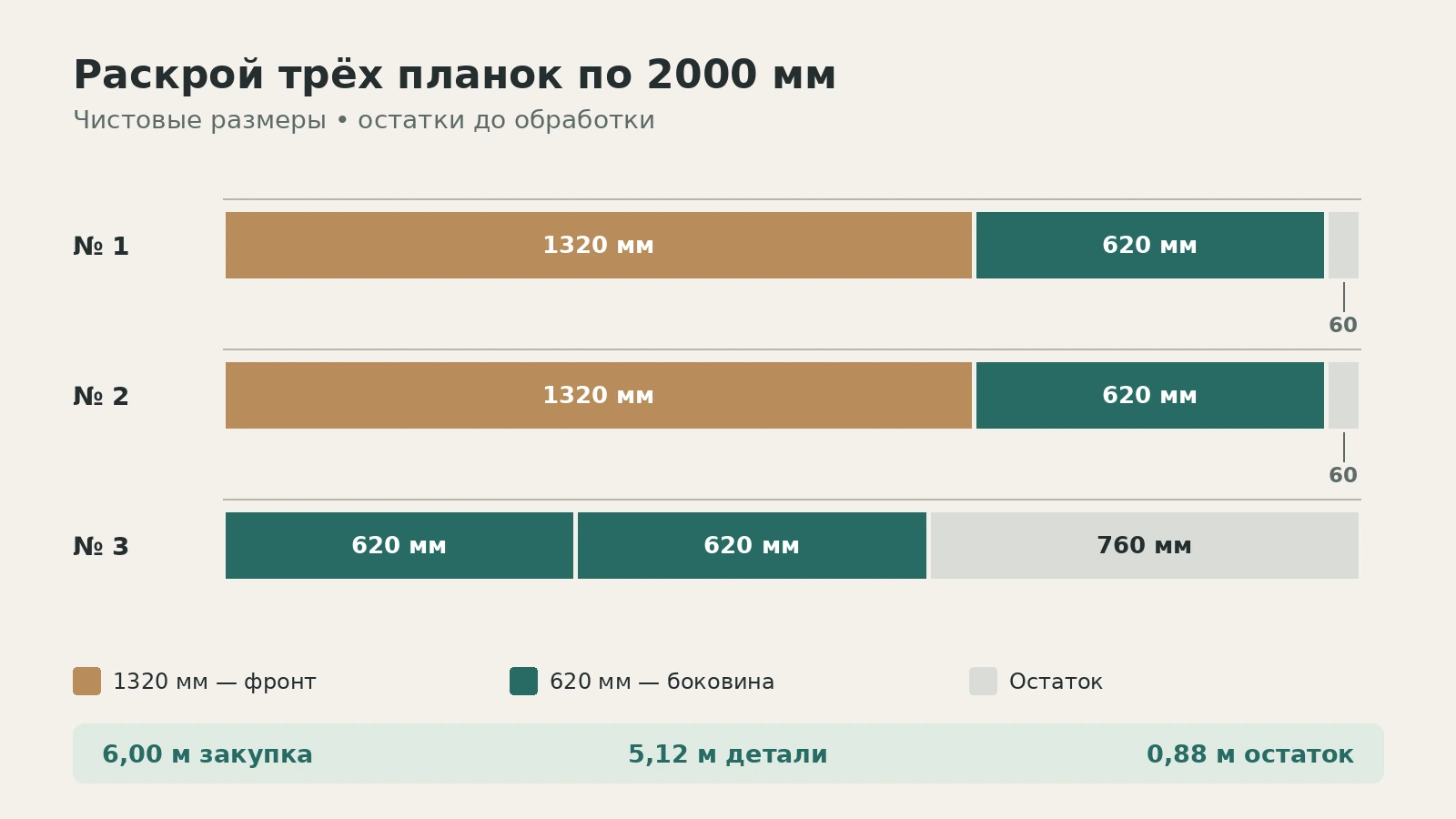
Instead of eight metres, six are purchased, and the total offcut before processing is reduced from 2880 to 880 mm. Geometrically, three strips are the lower limit for purchasing: two blanks of two metres each contain only four metres of material, whereas the finished requirement is 5.12 m. But the arithmetic minimum does not yet guarantee that the decorative task can be fulfilled. The peculiarity of this scheme is that the large total offcut is concentrated mainly on the third blank, while on the first two the material is distributed almost completely.
Suppose the craftsman, for the calculation, chooses a conventional allowance of 5 mm at each end of the future part and separately reserves 4 mm for each of the two cuts within one blank. For a pair of segments of 1320 and 620 mm, this gives 20 mm for end processing and another 8 mm for saw cuts. Of the original 60 mm, 32 mm will remain. If an additional 10 mm must be removed from the factory ends, the free reserve decreases to 22 mm. This is only a demonstration of the accounting method, not a prescription for cutting technology: the actual kerf width, the number of operations and the allowance dimensions depend on the equipment and the specific method of preparing the corners. The craftsman must determine them on his own tool.
Further adjustment of the pattern may require shifting the starting point of the part by a few millimetres or by a noticeable part of the repeating ornament. The pattern pitch K-049 must not be derived from the profile width: these are different parameters. If, on one of the two critical strips, after all mandatory operations there is no room left for a coordinated wave phase, the layout will have to be revised. For a project with an ideal pattern match at both outer corners, a fourth blank may be required.
Sometimes part of the reserve can be preserved through the correct cutting order. First, the original pattern direction is marked on all strips, then sections are chosen for the two longest parts, and only after that are suitable side segments sought. In the reverse sequence, the craftsman risks using up a suitable 620 mm section that could have ensured pattern continuity at the most visible corner. When the front has priority in terms of quality, it should not be assembled from offcuts selected after making less visible parts.
For a buyer who wants Buy wooden molding by the meter, it is useful to convert the linear requirement into whole factory strips in advance. In the cards under consideration, lengths of 300 and 2000 mm are available. Obtaining exactly 5.12 m from the manufacturer in the form of six finished parts by individual cutting cannot be considered a standard option: according to official information, the cut-to-size service is not provided. The order is formed in pieces, and the final processing is performed by the chosen workshop.
For the three-strip variant, it is reasonable to first check the possibility of using the same pattern phase at two levels according to the drawing or the actual blanks. If the appearance of the ornament matters only where each individual line passes through the corner, greater freedom of distribution is possible. If, however, the upper and lower bands must repeat each other down to the smallest details, the requirements become stricter. In this case, the saving of one strip should be regarded as a preliminary result, which is confirmed by the layout of the actual products.
How much does a carved wooden baguette cost in Taganrog: eight configuration options
With the same profile length, the price is determined by the article number, the wood species and the quality of sanding. For comparison, we use the cost of two-metre strips indicated in the official STAVROS product cards as of 25 November 2026. In the card tables, these versions are listed as made to order. The prices refer to the products themselves in the respective versions. Separate terms for splicing, packaging, delivery and work should be agreed upon when forming the final invoice.
| Article number, wood species, sanding | One plank 2000 mm | Three strips | Four strips |
|---|---|---|---|
| K-049, beech, “Standard” | 2 360 ₽ | 7 080 ₽ | 9 440 ₽ |
| K-049, oak, “Standard” | 2 770 ₽ | 8 310 ₽ | 11 080 ₽ |
| K-095, beech, “Standard” | 2 750 ₽ | 8 250 ₽ | 11 000 ₽ |
| K-095, oak, “Standard” | 3 970 ₽ | 11 910 ₽ | 15 880 ₽ |
| K-049, beech, “Prestige” | 2 840 ₽ | 8 520 ₽ | 11 360 ₽ |
| K-049, oak, “Prestige” | 3 230 ₽ | 9 690 ₽ | 12 920 ₽ |
| K-095, beech, “Prestige” | 3 340 ₽ | 10 020 ₽ | 13 360 ₽ |
| K-095, oak, “Prestige” | 4 450 ₽ | 13 350 ₽ | 17 800 ₽ |
The savings from switching from four planks to three equal the cost of one blank, that is, a quarter of the original budget for the products themselves. This should not automatically be considered a saving of a quarter of the entire finishing budget. The costs of cutting, installation, delivery, and painting do not necessarily decrease in the same proportion. More careful alignment of the ornament with a limited reserve may, on the contrary, require additional time from the craftsman.
The difference between the most affordable and the most expensive of the three-strip configurations given is 6,270 rubles. This range shows how important three separate decisions are: the choice of pattern, species, and degree of factory surface preparation. For a post painted in a light color, it is not necessary to buy oak just because the body is in a commercial space. For an open oak texture, on the contrary, switching to beech may disrupt the consistency of the surface pattern. A rational estimate should take into account the finish matching the project, not just the minimum cost of the line.
If the upper rail is made of K-049 and the lower one of K-095, two strips of each article are needed. For example, in beech with "Standard" sanding, such a set will cost 10,220 rubles: two blanks at 2,360 and two at 2,750 rubles. In oak with the same quality, the cost will be 13,480 rubles. The option with different profiles is not necessarily worse, but it no longer allows using leftovers of one article in sections of another. In the estimate, it is important to highlight it as an independent design decision.
A length of 300 mm is provided for a small sample. In standard quality, K-049 costs 350 rubles in beech and 410 rubles in oak; K-095 costs 410 and 600 rubles respectively. Short pieces are suitable for agreeing on the appearance and coating technology, but they do not replace solid elements 620 or 1320 mm long. The cost of the sample can be considered separately, especially if the color needs to be approved in advance by the owner of the premises.
How to match the carved pattern on the outer corners of a post
At the joint of two visible sides, not only the geometric edges of the strips meet, but also the pattern of the face surface. For a smooth rail, the main attention is paid to the tightness of the joint and the matching of the profile. With a wavy baguette, an additional criterion appears: how naturally one section of the ornament continues another. When viewed from the side, even an almost imperceptible gap can be perceived as an abrupt stop of the pattern if the edges end up at different stages of the wave.
First of all, the type of joint is determined. For a rectangular post without separate corner overlays, a miter joint of two parts is often considered. Its geometry depends on the actual angle between the panels. For two planes forming a right angle, paired 45-degree cuts in plan are usually used; verification is performed on samples with the corresponding cross-section. If the angle is not right, if the surface has a radius, or if the baguette is brought to a separate corner element, other solutions will be needed. Measurement cannot be replaced by a theoretical scheme.
Before final cutting, the strips are laid out face up while preserving the direction of the ornament. On each future end, the intended joint location is marked. For K-049, it is useful to find a clearly distinguishable pattern reference point and see where it will end up on the long and side parts after the cuts. For K-095, first of all, the consistency of the longitudinal protrusions, the fit height, and the absence of a step are checked. Information about the specific relief can be clarified using the photo and drawing of the product in the card wooden baguette 20 mm wide. These materials do not replace inspection of the actual blank before cutting.
Sometimes a corner is better emphasized by a deliberate pause in the ornament. For example, if the body has an external vertical wooden insert, the horizontal band on each side can be terminated at its edge. The pattern then does not have to continue literally through the corner. The result is a different composition, but it may be simpler to manufacture and repair. Such a solution requires recalculating lengths and should not be adopted merely to salvage parts that have already been cut incorrectly: when the whole post is viewed, the pause must look intentional.
For a durable result, a noticeable break in the ornament should not be masked with a thick layer of filler. Filling a small gap and restoring the shape of the relief are different operations. Even if the joint can be hidden under opaque paint, a thick layer of finishing material can soften decorative details. Under a transparent coating, differences in color may become visible. Therefore, pattern alignment is carried out during a dry assembly, while there is still an opportunity to replace or adjust the segment.
Preparation and installation of wooden baguette on post panels
Before installation, check the condition of the base, the compatibility of the fastening with the cladding, and whether the weight and shape of the profile match the project. Decorative baguette is intended for finishing, not for holding objects. On visible panels of commercial furniture, it is important to exclude peeling or protruding unattached edges that could catch on visitors' clothing. The installation method is chosen by the installer taking into account the actual panel material and the condition of its coating.
When required Buy an unpainted wooden baguette, the order of finishing preparation is best established before cutting begins. Some of the work is conveniently performed on a workbench, where face recesses, edges and ends are accessible. If an adhesive joint is planned, the mating surface must be prepared taking into account the requirements of the selected adhesive composition: varnish or enamel applied in advance may change adhesion. There is no universal sequence for all bases and coatings. Available on the manufacturer's website are tips on finishing and installing decorative elements, which should be compared with the instructions for specific materials.
During a test coating, one should evaluate not only the color of the flat area but also the accumulation of coating in the recesses. Too generous application can make fine patterns harder to see. For relief surfaces, it is important to take into account the drying time and intercoat processing conditions specified by the coating manufacturer. At a commercial facility, work should be planned so that, before visitors are admitted, the finish has reached the condition stipulated by the technology of the compositions used. One should not rely solely on the absence of tackiness on surface touch.
The marking of the two horizontal bands is carried out from a single agreed level. On the front panel and the side panels, the position of the same profile edge is marked. If one section is aligned to the top edge of the baguette and another to the bottom edge, a step will appear at the corner even with the body correctly set. The parts are first placed dry and their position checked around the entire perimeter. Particular attention is paid to the four outer corner joints: two at each level.
After preparing the joints and test-fitting, fastening is carried out in an order that takes into account access to the ends and the specifics of the selected adhesive composition or mechanical fastening. Reliable contact must be ensured without forcibly bending the narrow wooden strip. If fastening elements are used, their position is determined after checking the thickness of the base and the location of internal mechanisms. Do not blindly drill the cladding near wiring, cable entries or equipment. Traces of installation on the face carving must be minimal and must not impair the strength of the fastening.
Mistakes that increase the cost of finishing
The first mistake involves substituting the purchasing requirement for the finished requirement. The buyer divides the total length by two meters, rounds up, and takes the resulting number as the final set. For a smooth strip this is no longer always correct, and for a relief moulding a pattern requirement arises. The control document should be a cutting map with specific parts and allowances, not just a line with the total linear meters.
The second mistake is purchasing baguette without clarifying the type of lamination. With a semi-transparent finish, the contrast between the lamellae can become noticeable, especially on a front illuminated by directional fixtures. The choice must be agreed with the finisher before ordering, rather than trying to make the surface uniform after applying the coating. If the customer wants a dense opaque color, overpaying solely for a uniform natural texture may not be necessary.
The third mistake consists in trying to hide a movable cladding seam with a decorative strip. When a removable panel is connected by an overlay to a fixed part of the carcass, servicing it becomes impossible without dismantling the decor. Before installation, the purpose of all seams and doors must be determined. In areas with separate access, the decorative profile is designed so as not to obstruct the intended detachable connection.
The fourth mistake is confusing the front and side parts of the same length between the upper and lower bands. If the corner cuts differ in direction, not every segment can be repositioned without disrupting the pattern. Marking on the reverse side and an assembly diagram substantially facilitate control. Before painting, one should make sure that each of the six parts can be confidently matched to its installation location.
Placing an order and delivering wooden moulding to Taganrog
An order can be placed through the product cards or the configuration can be agreed with a STAVROS representative. The specification states the article number, species, factory length, sanding quality, type of lamination, and number of planks. For the rack in question, it is important to state that the purchase is intended for two continuous bands on three sides, and that pattern matching is performed by the craftsman using the cutting map. This will help clarify the order parameters before payment.
The product cards indicate a protective pine backing costing 390 rubles: for K-049 when ordering up to 105 pieces, for K-095 up to 60 pieces. Both calculated sets fall within these conditions. Its purpose is related to preserving long wooden parts during transport. The number of required packages, transport cost, and exact order completion time are clarified based on the actual configuration. For the batch to be delivered to Taganrog, the transport dimensions of two-meter planks should be taken into account. How it is organized delivery of wooden moulding, is described on the manufacturer's website.
Before payment, it is useful to check that the invoice actually specifies two-meter versions and the selected processing quality. The price of a short sample on the page is not the price of a two-meter plank. If the project has a fixed opening date, separately agree on the product readiness date, handover to the carrier, and a time buffer for acceptance, cutting, and finishing. One should not start an installation shift relying only on the average manufacturing time without confirmation of the specific order.
Upon receipt, inspect the packaging, verify the quantity, dimensions, and compliance with the ordered species, then check the condition of the face relief and ends. If damage is found, it is useful to record it before sawing and painting, keeping the marking and packaging until the circumstances are clarified. The wood should be stored in conditions suitable for interior joinery products, and sharp changes in humidity should be avoided. Details are provided in the manufacturer's section "Storage and Operation."
Frequently asked questions about carved molding for commercial furniture
Can carved molding be combined with a protective metal strip near the floor?
Yes, if each element has its own function and is mounted on a suitable base. The metal strip is positioned so that it takes the expected contact with cleaning equipment, while the wooden relief remains above the mechanical impact zone. Adjacent materials must not interfere with each other during maintenance.
Can an LED strip be built directly into this molding?
Carved overlays should not be mistaken for dedicated lighting profiles. A separate structure with the necessary heat dissipation and access to electrical components is provided for the strip. The wooden strip can decoratively coexist with lighting if the distance and heating conditions meet the project requirements.
What should be done if the company logo needs to be relocated after installation?
First, determine how it is attached and whether its fastening runs near the molding. It is better to provide a separate area for the logo and not run fasteners through the carved strip. Then the sign can be replaced without disassembling the horizontal band or disrupting the wood pattern.
Can carved molding be washed with the same product as the countertop?
Only if this is acceptable for the molding's own finish. The countertop finish and the wooden overlay may differ. It is recommended to check the manufacturer's instructions for the finishing compound and first test the acceptable cleaning method on a discreet area, avoiding prolonged wetting of the wood.
Is the same band height required on two adjacent racks in the same hall?
This depends on the interior concept. If the stands form a single visual group, the horizontal lines can be aligned to a common level. If the furniture differs in purpose and height, it is sometimes more natural to subordinate the position of the decor to the proportions of each piece while keeping the same profile and color.
How do I choose the color of the baguette if the room has both daylight and artificial lighting?
A sample coated with the chosen finish is examined directly next to the cladding and with the working lights on. It is especially useful to compare it in daylight and in the evening. A single photo with automatic color correction does not replace such a comparison.
What should be done with the decorative line when replacing the cladding of one panel?
If the profile was attached to the cladding being removed, assess whether it can be dismantled without damaging the thread. When replacing the panel, the contact plane and the position of the end face may change. You cannot simply transfer the old part without checking that the new base aligns with the adjacent corner.
Is such a baguette suitable for a post on an open terrace?
The finishes under consideration are intended for interior use. For outdoor use, a separately confirmed manufacturer solution with suitable materials, adhesive joints, and a coating system is required. Ordinary interior trim should not be transferred to damp outdoor conditions without approval.
Can a non-standard baguette width be ordered for a single post?
The manufacturer considers custom production of non-standard items for volume orders. For a single piece of furniture, it is more practical to check a suitable catalog profile. If the standard sections do not meet the task, agree on the possibility of custom production separately, without assuming the service is necessarily available for a single part.
Should the back side of the post facing the employee be decorated?
No, when it is not visible to visitors, its purpose may be purely functional. For example, the back often contains drawers, removable elements, equipment and open niches. If the space is arranged so that a visitor can walk around the counter, the back side is assessed separately and, if necessary, standalone parts are added to the specification.
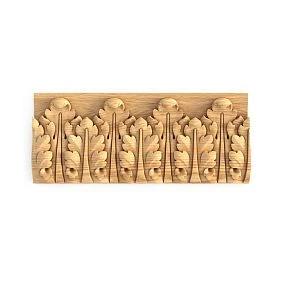
Buy carved wooden baguette STAVROS for the reception desk
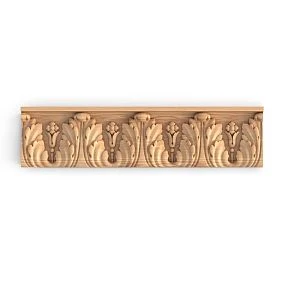
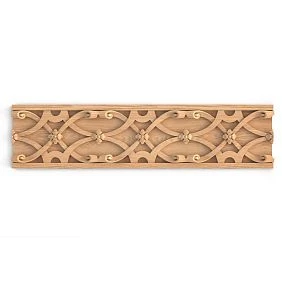
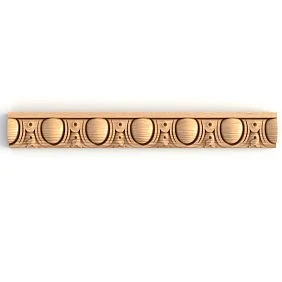
For a hypothetical project with a 1320 mm front and two side panels of 620 mm each, six finished parts with a total length of 5.12 m are required. The compact K-049 produces a delicate wave-like pattern, while K-095 gives a wider relief horizontal. If both bands are made from the same profile, material and finish, a set of three long strips can be considered after checking the pattern, corners and allowances. Four strips create more freedom for fitting and provide an additional reserve.
To place an order, select the required item code in the STAVROS carved wooden baguette catalogue, agree the wood species and processing quality with the finisher, submit the specification and confirm packaging and delivery to Taganrog. This procedure allows you to purchase exactly the material that matches the furniture dimensions and the concept of the commercial interior.