Article Contents:
- ST-026-1 — square tabletop 800×800 for table assembly
- Which tables fit the 800×800 size
- Compact dining table for 2–4 people
- Table for a cafe or waiting area
- Office side table
- Coffee and accent table
- Conference table for two
- MDF, oak veneer or beech veneer: what to choose and why
- MDF: neutral base for opaque finish
- Beech veneer: fine texture for tinting and enamel
- Oak veneer: lively texture for oil and tinting
- Comparison of Options
- How to choose a base for a square tabletop 800×800
- Table base for table STL-026-2
- What to check when choosing a table base
- Other STAVROS tabletops as context
- How ST-026-1 differs from a kitchen countertop
- Kitchen countertop is the work surface of the set
- Why this is important for SEO and for the buyer
- Countertop finishing: enamel, oil, varnish, tinting
- MDF countertop: for enamel and paint
- Oak veneer: for oil and tinting
- Beech veneer: tinting, clear varnish, natural oil
- Test coating — a rule, not a suggestion
- Installing the countertop to the base: rules and details
- Marking
- Fastening unit
- Protection of the underside
- Final check
- Mistakes when choosing a countertop: a real list
- Set: tabletop + base + hardware + finish
- Where to buy square tabletop ST-026-1
- FAQ: answers to questions about ST-026-1
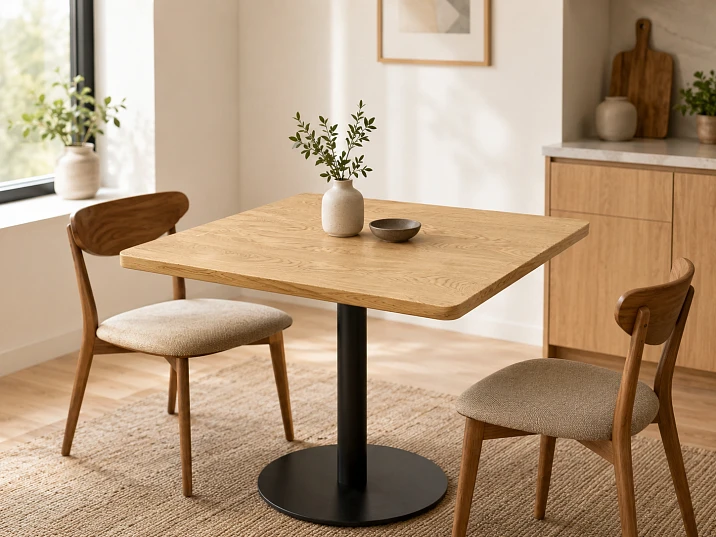
A table starts with its surface. This is an axiom that is often overlooked — because people are used to choosing a table as a whole, as a finished item. But if you are designing furniture for a specific task, working with specific dimensions, want to control the finish and the base — the conversation starts with the tabletop.
Buy square tabletop at STAVROS — it's not a faceless wooden board. It's a specific product: ST-026-1, size 800×800×25 mm, three variants — MDF, MDF with beech veneer, MDF with oak veneer. Each variant solves its own problem. Each requires its own final finish. And each becomes the foundation for a table where you decide what the result will be.
This article is not about "which tabletop to choose in general." It's about a specific square tabletop 800×800, its materials, the bases it works with, and the finish it accepts.
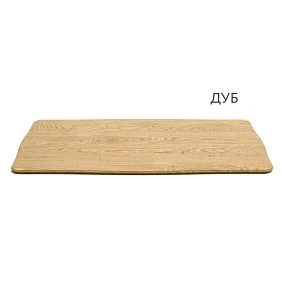
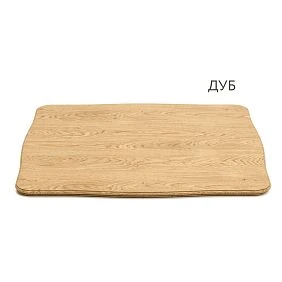
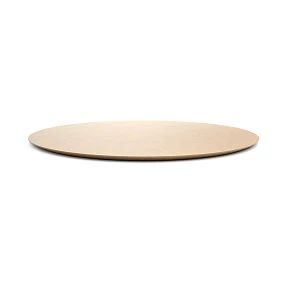
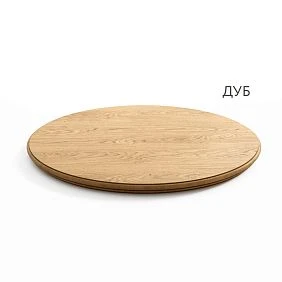
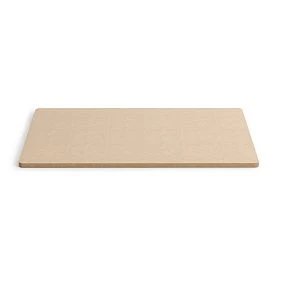
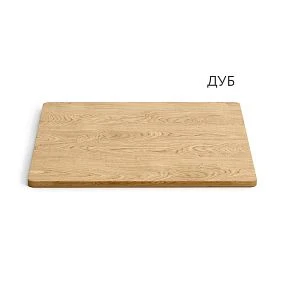
ST-026-1 — square tabletop 800×800 for table assembly
Article ST-026-1 in the STAVROS catalog is Square countertop with precise parameters: 800 mm × 800 mm, thickness 25 mm. Three variants:
-
MDF — board base without veneer, for enamel, lacquer or other opaque finish
-
MDF/beech veneer — MDF with natural beech veneer facing, for tinting or clear lacquer
-
MDF/oak veneer — MDF with natural oak veneer facing, for oil, lacquer or tinting with pronounced texture
This is not a kitchen worktop. Not a sink slab. Not a moisture-resistant board around the cabinet perimeter. This is a furniture tabletop for a table: dining, office, coffee, for a cafe or meeting area.
Key Features:
-
Shape: square, sides equal 800 mm
-
Thickness: 25 mm — sufficient for confident visual weight and stable attachment to the underframe
-
Surface options: three, for different finishing tasks
-
Application: furniture project, assembly of a table with STAVROS underframe
Buy square tabletop in this version — means getting a ready-made base that works with the underframe, accepts the finish and becomes a functional table surface for your interior.




Which tables does the 800×800 size fit?
Eight hundred by eight hundred is not a random number. It is a well-calculated square that works in several scenarios simultaneously. Let's break down each one.
Our factory also produces:
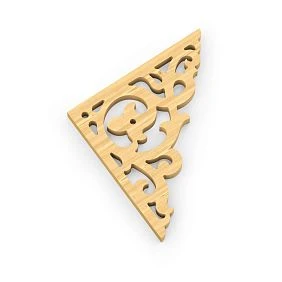
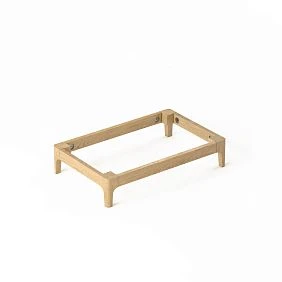
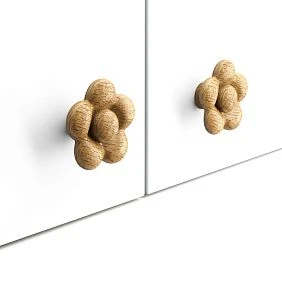
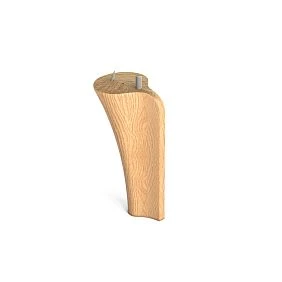
Compact dining table for 2–4 people
A square tabletop 800×800 is a comfortable surface for two and functional for four with the right base. The standard personal space at a table is about 60 cm per person along the length. With a width of 800 mm, there is enough space left for the person sitting opposite.
Buy square tabletop for table for a dining table — the right choice for an apartment with a compact kitchen or living room without a large dining area. The square provides equality: all four sides are equivalent, no one is "at the head."
Get Consultation
Table for a cafe or waiting area
The 800×800 size is a classic "cafe" standard for seating two people at an outdoor or indoor table. In a cafe, coffee shop, reception, or waiting area, such a table creates the right proportion: enough space for drinks and small items, not too bulky.
Office side table
A side table to the main workspace or a separate table in the office for "tête-à-tête" meetings — another scenario for 800×800. In an office, the square shape is perceived as concise and businesslike, without unnecessary decoration.
Coffee and accent table
In the living room or lounge area, 800×800 is a coffee table with sufficient surface area: it can hold books, candles, a tray, a vase. Not too small to go unnoticed, not too large to overwhelm the space.
Conference table for two
In small meeting rooms, designers' offices, studios, and workshops — a square table for two people. Even, symmetrical, without the hierarchy of "the head of the table."
MDF, oak veneer, or beech veneer: what to choose and why
The three versions of ST-026-1 are not "expensive, medium, and cheap." They are three different tools for three different tasks. It is a mistake to think that veneer is automatically "better" than MDF. The rule is different: the material is chosen for the finish, and the finish is chosen for the interior.
MDF: a neutral base for opaque finishes
MDF (medium-density fiberboard) is compressed high-density wood fiber. It has no texture, no pattern, no "character" of the surface. This is precisely its main advantage in certain scenarios.
Buy MDF tabletop — the right choice if:
-
opaque finish is planned: white enamel, colored enamel, primer + paint
-
a perfectly smooth surface is needed without the wood texture showing through the finish
-
interior in Scandinavian, minimalist, or light classic style
-
painting will be done independently or by a professional painter
MDF sands well, accepts primer and paint evenly. Without finishing, it doesn't work — unlike a veneered surface, which is sometimes left under oil. MDF requires a finish, but under the right finish, it is ideal.
Important limitation: MDF is sensitive to moisture. If the tabletop is used in a room with high humidity (kitchen, veranda, summer dining room), special moisture-resistant treatment is needed, or choose another material.
Beech veneer: fine texture for tinting and enamel
Beech/MDF/beech veneer is an MDF base faced with natural beech veneer. Veneer is a thin slice of natural wood glued to the base. The surface acquires the natural texture and color of beech.
Buy solid wood tabletop — in the beech veneer version, it is a working choice when a natural surface is needed, but without a pronounced 'oakiness'. Beech has a fine, almost uniform texture with small pores. Under clear varnish — a neat, intelligent wood appearance. Under tinting — a uniform result without 'spotting'.
Beech veneer is chosen when:
-
a natural surface is needed under clear varnish or oil, but without a pronounced texture
-
tinting in light tones is planned: natural beech, bleached, milky
-
Scandinavian interior, light wood, Japandi, neutral organic
Nuance: beech wood veneer is slightly lighter and "quieter" than oak. If you need a "wooden" surface with a distinct pattern — beech is not for you.
Oak veneer: lively texture for oil and tinting
MDF/oak veneer — an MDF base faced with natural oak veneer. Oak is a species with a well-distinguishable texture: large pores, mirrors (medullary rays), expressive rings. Under a clear coating, this texture fully reveals itself.
Buy a solid oak tabletop in the veneer version — means getting an "oak" surface on a proper furniture base. It is chosen when:
-
a pronounced natural wood texture is important
-
oil finish is planned (Rubio Monocoat, Osmo, Loba and similar) preserving the natural look of the wood
-
tinting in dark tones is needed: walnut, tobacco, brown, graphite
-
interior in natural wood style, loft with organic elements, traditional classic
Comparison of options
| Parameter | MDF | MDF / beech veneer | MDF / oak veneer |
|---|---|---|---|
| Surface | No texture | Fine, fine-pored | Pronounced, with pattern |
| Best finish | Enamel, paint | Varnish, tinting (light) | Oil, varnish, tinting |
| Is the texture visible under the finish | No | Slightly | Brightly |
| Interior style | Minimalism, white classic | Scandinavian, Japandi | Natural wood, classic |
| Vulnerability | Moisture | Scratch the veneer | Requires maintenance |
How to choose a base for a square tabletop 800×800
A tabletop without a base is a shield, not a table. The base is the foundation that determines height, stability, visual character, and compatibility with the finish.
Table base for table STL-026-2
In the STAVROS catalog there is table base STL-026-2 — a furniture frame compatible with the ST-026-1 tabletop. This is a base designed in the same STAVROS furniture component system. Compatibility in size, proportions, and mounting.
Buy a solid wood table top paired with the STL-026-2 table base — this is a ready-made "kit" for a table without extra adjustments.
What to check when choosing a table base
Base width. The table base should not protrude beyond the perimeter of the tabletop and should not be too narrow (otherwise the table will be unstable). For 800×800, the optimal base is from 650 mm at the base.
Table height. The standard height of a dining table is 720–760 mm. Check the height of the table base + the thickness of the tabletop (25 mm) = final table height.
Material of legs and crossbars. If the tabletop is oak veneer, then a table base made of the same wood or painted MDF in a neutral tone creates unity. Chaotic mixing of species and materials is a sign of a poorly thought-out project.
Load. A table for a cafe with intensive use requires a more rigid base than a coffee table in the living room.
Other STAVROS tabletops as context
If size 800×800 is not the only task of your project, it is useful to know about alternatives. The STAVROS catalog includes:
-
Tabletop ST-026-2 — another format from the same series
-
Tabletop ST-027 — the next item in the line
-
Tabletop ST-015 — an option from another STAVROS series
Full range STAVROS tabletops и furniture frames and underframes collected in the relevant sections of the catalog.
How ST-026-1 differs from a kitchen countertop
This is an important discussion because search queries often mix "buy MDF countertop" and "kitchen MDF countertop". Let's break down what is what.
A kitchen countertop is the work surface of the kitchen set
A kitchen countertop is a horizontal surface that is mounted on the kitchen set along its entire perimeter. It:
-
is in daily contact with water and steam
-
must be moisture-resistant or have special edge protection
-
has a standard depth of 600 mm (for cabinets)
-
is often made from laminated chipboard, postforming, acrylic, HPL, or natural stone
Buy MDF tabletop in version ST-026-1 is a completely different item. This is:
-
a tabletop for a table (dining, coffee, office)
-
square format 800×800 mm
-
MDF or veneered MDF material intended for furniture, not kitchen, finishing
-
not designed for constant contact with water without special treatment
If you are looking for a furniture tabletop — ST-026-1 is your choice. If you are looking for a kitchen work surface — that is a different query and a different assortment.
Why this is important for SEO and for the buyer
In the broad cluster "buy MDF tabletop" there are both kitchen and furniture queries. The article clearly distinguishes: ST-026-1 is for a table, not for the kitchen. The buyer will not be disappointed by receiving something they did not expect. This is an honest and correct commercial position.
Tabletop finishing: enamel, oil, varnish, tinting
The ST-026-1 tabletop is supplied without finishing (depending on the option — either bare MDF or natural veneer). This means finishing is your choice and your responsibility. Let's review the options.
MDF tabletop: for enamel and paint
If you have chosen the bare MDF option, the only sensible finish is opaque. The scheme:
-
Surface sanding (P120 → P180)
-
Applying primer on MDF (acrylic or alkyd)
-
Sanding after primer dries (P220)
-
Applying enamel in 2–3 coats with intermediate sanding
-
Final protection: matte or glossy lacquer over enamel if needed
MDF edges are especially porous. They need to be primed twice and separately. An unprimed edge will absorb paint unevenly.
Oak veneer: for oil and tinting
For an oak veneer countertop, the best finish is oil. Why? Because oil works within the veneer structure, does not create a film, does not 'seal' the surface with plastic. The result is a living wood surface with tactile depth.
Rubio Monocoat Oil Plus 2C Pure — a professional choice for work on veneer and solid wood. Applied in one coat, fully covers the surface, easily spot-refreshed if needed. In the STAVROS range, this oil is presented among materials for installation and finishing.
Oak staining is another common finish. Staining oil or water-based stain is applied before the final coating. They provide color while preserving the texture. Oak absorbs stain actively but unevenly: darker areas may occur at the ends and in places where veneer overlaps. A test application on a sample is mandatory.
Beech veneer: staining, clear lacquer, natural oil
Beech under clear lacquer is a neat, calm, "quiet" result. Without pronounced texture, without accents. This is often exactly what is needed for neutral interiors.
Light staining on beech — bleached, milky, Scandinavian — turns out more even than on oak, precisely because of the fine, uniform grain. Beech is ideal under light tones.
Oil works just as well on beech as it does on oak. If you choose colored oil, you can achieve any shade: from natural to smoky gray.
Test application is a rule, not a suggestion
Whichever finish you choose, first apply it to a scrap of the same material. Oak veneer and beech veneer from different batches may behave differently. It is better to see the result on a sample than to face a surprise on the final surface.
Mounting the tabletop to the base: rules and details
The finish is done. The base is ready. Now — mounting. This step seems simple, but this is where mistakes are most often made, which cannot be fixed later.
Marking
Place the tabletop face down on a flat, protected surface. Position the base in the center — symmetrical along both axes. Check symmetry with a tape measure: the distance from the edge of the base to the edge of the tabletop should be the same on each of the four sides.
For a square tabletop 800×800 this is especially important: a square "forgives" errors less than a rectangle. Any offset of 5–10 mm will be visually noticeable.
Fastening unit
Fastening is not just "screwing in screws." Wood and MDF "live": they slightly expand or contract with changes in humidity. Rigid fastening without compensation can lead to cracks in the veneer or deformation of the MDF.
The right approach:
-
Use compensating fastening brackets or "eccentrics" where mobility is needed
-
For MDF — self-tapping screws with pre-drilling, without splitting the material
-
The length of the self-tapping screw should not penetrate the face layer of the tabletop
STAVROS furniture fittings includes fastening elements for installing tabletops and frame structures. Also includes corresponding materials for finishing.
Protection of the underside
The underside of the MDF tabletop needs to be primed or coated with a thin layer of varnish — even if it will never be visible. This is balancing: without treatment from below, the tabletop will absorb moisture from the lower plane and "warp" over time.
Final check
After installation, place a spirit level on the countertop along both diagonals. Perfect horizontality is not just aesthetics. It is a sign of proper installation without distortions.
Mistakes when choosing a countertop: a real list
Over years of working with furniture projects, a list of recurring mistakes accumulates. Let's review them directly.
Mistake 1: Going into kitchen intent.
The query "MDF countertop buy price" often leads to kitchen countertops. ST-026-1 is a furniture countertop for a table. If you need a kitchen work surface, that is a different product and a different query.
Mistake 2: Not considering the size 800×800.
A table 800×800 is a compact square. It will not replace a dining table for 8 people. Check if this size fits your task before ordering.
Mistake 3: Choosing MDF without understanding the finish.
MDF without finishing is not a ready surface. If there is no plan for finishing (paint, primer, enamel), you get "bare" countertops that absorb moisture and wear out. MDF requires a mandatory finish coating.
Mistake 4: Choosing veneer without understanding that it is not solid wood.
Veneer is a thin slice of wood glued onto an MDF base. It is not solid wood. It cannot be sanded deeply, and many layers cannot be removed during restoration. It must be worked with carefully and precisely.
Mistake 5: Not choosing the base in advance.
Buying a tabletop without knowing which base will go with it means postponing half the decision. The base should be chosen at the same time or beforehand to ensure compatibility in size, height, and style.
Mistake 6: Not checking the final table height.
Tabletop thickness of 25 mm plus base height equals table height. If not calculated in advance, you might end up with a table 700 mm high instead of 730 mm. The difference may seem small, but in actual use, it is noticeable.
Mistake 7: Confusing veneer and solid wood.
"Buy solid wood tabletop" and "tabletop with wood veneer" are not the same thing. Solid wood is whole wood without an MDF base. Veneer is a surface covering of natural wood on an MDF base. ST-026-1 is veneer on MDF, not solid wood. This is an honest product description: such a solution has its own advantages—geometric stability, no warping, predictable behavior under finish.
Kit: tabletop + base + hardware + finishing
The right approach to buying ST-026-1 is not to "take one tabletop" but to assemble a complete project kit. What is included:
Tabletop: ST-026-1 in the required version — MDF, beech veneer or oak veneer.
Underframe: STL-026-2 table frame or another base from the section furniture frames and table bases STAVROS.
Fasteners and mounting materials: from the section materials for installation and finishing — brackets, screws, compensators.
Finishing oil: Rubio Monocoat Oil Plus 2C Pure for oak or beech veneer — professional results with a single application.
Hardware: from the section STAVROS furniture fittings — adjustable supports, ties, inserts if necessary.
This approach — a complete order through a single catalog — eliminates the situation where "the tabletop is available, but the underframe doesn't match it in size."
Where to buy a square tabletop ST-026-1
Buy a square tabletop can be done through the stavros.ru website, in the product card ST-026-1 or in the section STAVROS tabletops.
Buy a square tabletop in St. Petersburg — with pickup or delivery within the city. STAVROS is located in St. Petersburg, the showroom is open for visits: here you can personally assess the quality of MDF and veneer, see material options, and discuss project configuration.
Buy a solid wood tabletop in St. Petersburg or with delivery to another region — both options are available through the website. Current prices, availability, and the possibility of consultation — on stavros.ru.
FAQ: answers to questions about ST-026-1
What is the ST-026-1 tabletop?
Square furniture tabletop STAVROS size 800×800×25 mm. Three versions available: MDF, MDF/beech veneer, MDF/oak veneer. Designed for assembling a table with an underframe and finishing.
Which tables is the 800×800 size suitable for?
Compact dining table for 2–4 people, cafe table, coffee table in the living room, side table in the study, conference table for two. The square shape provides equal seating positions on all sides.
How does MDF differ from oak veneer?
MDF is a board material without texture, suitable for opaque finishes (enamel, paint). Oak veneer is natural wood on an MDF base, suitable for oil, varnish, tinting while preserving visible wood grain.
Is this a solid wood tabletop?
No. ST-026-1 has an MDF base with natural veneer facing (in the relevant versions). It is not solid wood. A veneered tabletop has its advantages: stable geometry, less tendency to warp, predictable behavior under finishing.
Can ST-026-1 be used in the kitchen?
No — in the standard configuration. This is a furniture tabletop for a table in a dry room, not a moisture-resistant kitchen work surface.
What should be used to coat oak veneer on the tabletop?
The best option is Rubio Monocoat oil or a similar product. An alternative is a clear alkyd or water-based varnish. For tinting, use stain or tinting oil before the final coating.
Which table base is suitable for ST-026-1?
The STL-026-2 table frame from the STAVROS catalog is a compatible base from the same furniture component system. Check the dimensions of the table base in the product card before ordering.
Where to buy ST-026-1?
On the stavros.ru website in the product card. Contact us to confirm shipping to your destination. Showroom in St. Petersburg with the opportunity to personally evaluate materials and get project consultation.