










































































Article Contents:
- First, let's decide the main thing: does the box need a decorative trim at all
- KPU-080 in numbers: what 35 × 9 × 2000 mm means specifically for the hood
- The key measurement is not the width of the box, but the length of the entire visible line
- Why exactly 2000 mm of decor for a two-meter line is a bad calculation
- How to calculate the quantity of KPU-080 based on two-meter strips
- Example No. 1: hood between two cabinets
- Example No. 2: front side 1000 mm and two sides of 350 mm each
- Example No. 3: box 1200 mm and sides of 450 mm each
- Example No. 4: wide box 1600 mm, side panels 400 mm each
- Front side or three sides: which is better for a finished box
- Front only
- Front and two side panels
- Full closed perimeter
- Do not block the light source itself
- Check the shadow
- Maintain access
- Painted MDF
- Painted drywall
- Veneered or laminated surface
- KPU-080 and smooth molding
- KPU-080 and cornice
- KPU-080 and a separate overlay
- KPU-080 and wooden carved molding
- 1. Measure the height from the cooking surface
- 2. Determine the visible sides
- 3. Measure each length separately
- 4. Add up the lengths
- 5. Check the allowance for cutting
- 6. Calculate the number of planks of 2000 mm
- 7. Make a 35 mm template
- 8. Check the 9 mm protrusion
- 9. Determine the color
- 10. Check the base and select the adhesive
- Can KPU-080 be used for the bottom edge of an already finished hood duct box?
- What is the exact size of KPU-080?
- How much does one KPU-080 strip cost?
- Will one strip be enough for a 900 mm wide hood?
- How to calculate KPU-080 for three sides of the duct box?
- Can I order one strip if the calculation comes out to exactly 2000 mm?
- How much allowance should be added for linear footage?
- Can KPU-080 be installed only on the front part of the box?
- Can polyurethane molding be placed directly above the stove?
- From where should the distance to KPU-080 be measured?
- Will KPU-080 interfere with the range hood filters?
- Can KPU-080 be installed next to built-in lighting?
- What color should be chosen for KPU-080?
- Can the molding be painted in advance?
- How to glue KPU-080 to a painted box?
- Is it necessary to drill the box to install KPU-080?
- Can a corner be made without a joint?
- Where is the best place to position the joint if the facade is wider than one solid fragment?
- What to do if KPU-080 does not fit in width?
- Will KPU-080 suit a modern kitchen?
- Can KPU-080 be combined with other polyurethane elements?
- Is carved molding easy to clean in the kitchen?
- Do I need to buy an extra strip just in case of a mistake?
- What is more profitable: one KPU-080 strip or several small decorative elements?
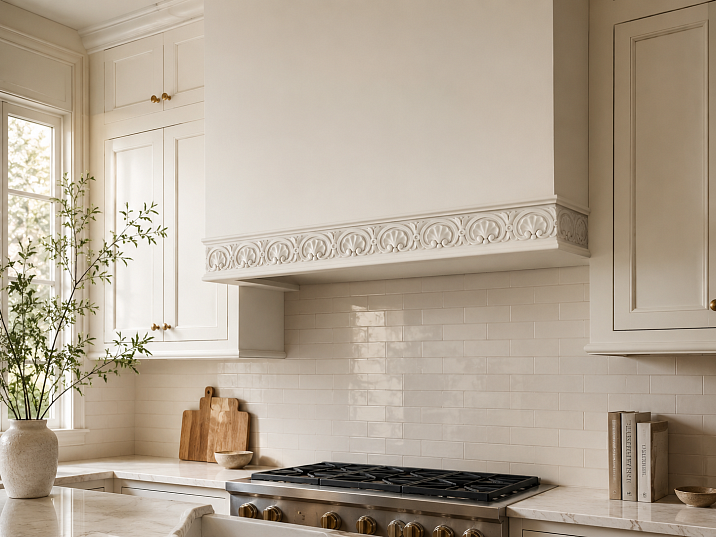
The kitchen hood box is already assembled, painted, and fully performs its function, but the bottom line looks too plain. This is especially noticeable in kitchens with classic facades, panels, cornices, and decorative details: the furniture has relief and character, while the box above the cooking area ends with a plain flat edge. There is no point in redoing the structure for the sake of one decorative belt. A much more interesting path is to add carved polyurethane molding KPU-080 to the finished box and turn its lower edge into a complete ornamental line.
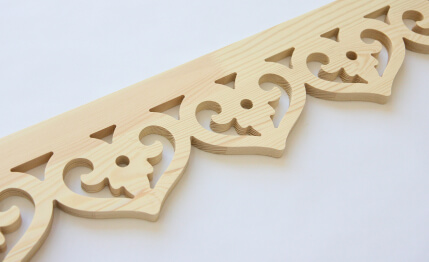
KPU-080 is precisely carved molding, not a molding, not a cornice, and not a separate overlay. The size of one strip is 35 × 9 × 2000 mm. This geometry corresponds well to the task of a horizontal belt: 35 mm provides a readable ornament height, 9 mm creates relief, and the two-meter length allows in many kitchens to cover the front side of the box with one strip or to finish the front and side sides with a minimum number of joints. The price of one KPU-080 strip is currently 7,380 ₽.
But buying molding just because the lower edge of the hood is "asking for decor" is premature. This idea has two different levels. The first is aesthetic: whether a carved band will fit in scale, style, and proportions. The second is practical: how high the box is located above the cooking surface, whether the polyurethane decor will be too close to the heat source, and whether it will block lighting, ventilation elements, removable parts, or access for maintenance.
Therefore, the right question is not "can you glue KPU-080 onto the box," but more precisely: is it worth buying carved molding KPU-080 specifically for the lower edge of your hood, and how many two-meter strips will be needed for a neat finish?
Let's break down this task from measurement to order—without redoing an already finished box and without trying to turn one decorative strip into a new kitchen renovation.

First, we decide the main thing: whether the box needs a decorative band at all
Not every smooth lower edge requires decoration.
In a minimalist modern kitchen, a smooth box can be part of the architecture: a flat white surface, a hidden hood, facades without panels, and no visible hardware. A carved ornament in such a space can look not like an extension of the kitchen, but like a randomly added detail.
A box next to classic furniture is perceived completely differently. If the upper cabinets have paneled facades, a decorative cornice, carved details, or pronounced frame geometry, a plain hood box often falls out of the overall system. It is in the center of the composition, and that is why its incompleteness is more visible than a similar smooth section off to the side.
Here, a narrow carved band can do useful work. It draws a horizontal line along the lower edge and connects the box with the furniture facades. At the same time, it is not necessary to completely cover the box with stucco.
This is fundamental.
A well-designed hood does not have to become the most decorative item in the kitchen. Often, a single strip 35 mm wide is enough for a simple architectural volume to start being perceived as part of the furniture composition.
There is a simple test.
Look at the kitchen from a distance of several meters and mentally extend the top line of the wall cabinets through the box. If the box looks like a separate smooth cube, and the furniture on the sides is significantly richer in details, a decorative band may be justified.
If the box itself already has a shaped cornice, panels, overlays, pilasters, or active trim, another carved line may turn out to be superfluous.
Therefore, the first step to buying KPU-080 is not a tape measure. The first step is to understand what the box lacks: an ornament or just a neat finishing line.
If you need exactly a carved horizontal element, you can consider carved molding KPU-080 35 × 9 × 2000 mm buy already as a specific solution, not as a random decorative purchase.




KPU-080 in numbers: what 35 × 9 × 2000 mm means specifically on a hood
For long-length decor, numbers matter more than photos. The image shows the ornament but does not answer the question of how it will look on a real box.
| KPU-080 parameter | Value | What does this mean for the extractor hood box |
|---|---|---|
| Product type | Carved molding | Forms an extended ornamental band |
| Article number | KPU-080 | Allows ordering a specific model without confusion |
| Material | Polyurethane | Suitable for interior decorative use |
| Size | 35 × 9 × 2000 mm | Band width 35 mm, relief 9 mm, plank length 2 m |
| Length of one plank | 2000 мм | Basis for calculating the quantity |
| Price per plank | 7 380 ₽ | Allows calculating the cost of the required quantity in advance |
| Main task in this article | Lower edge of the extractor hood box | Linear decorative band on the finished structure |
| Critical limitation | Distance from the cooking surface | A box that is too low does not suit such a decor |
The most useful number here is not 2000 mm, although the order is calculated based on it. For the appearance, 35 mm matters more.
Three and a half centimeters is no longer a barely noticeable decorative thread. The ornament is readable. It forms a true frieze belt, but does not turn the box into a massive cornice.
The depth of 9 mm also matters. KPU-080 protrudes relative to the surface, so the line becomes noticeable not only by color, but also by shadow. If kitchen lighting comes from above or from the side, the carved pattern gains additional expressiveness.
The length of 2000 mm determines the cutting economics. This is where the main practical question arises: will only the front part of the box be finished, or should the linear footage wrap around the side panels.
Two kitchens identical in width may require different amounts of KPU-080 simply because in one, the box is built in between cabinets and its sides are not visible, while in another, it protrudes forward and is seen from three sides.
Therefore, slats cannot be counted based on a single facade width.
Our factory also produces:




The key measurement is not the width of the box, but the length of the entire visible line
Let's imagine a box 900 mm wide.
It seems obvious: one 2000 mm long plank is more than enough.
That will be the case if KPU-080 is installed only on the front side.
But suppose the box protrudes forward by 450 mm, both sides are visible, and the carved belt must run from the wall along one side, cross the facade, and return to the wall along the other. Then the total line is already equal to:
450 + 900 + 450 = 1800 mm.
One two-meter plank theoretically covers this size, but only 200 mm of margin remains. You also need to account for trimming the outer corners and the possible need to adjust the pattern at the joints.
Therefore, before order KPU-080 made of polyurethane, you need to determine not only the width of the box, but the route of the ornament.
For a regular three-sided box, the formula is simple:
L = A + B + C,
Where:
-
A — length of the left visible side;
-
B — width of the front part;
-
C — length of the right visible side.
If the sides are equal:
L = B + 2D,
where D — depth of one side.
But the resulting number is only the pure geometric length. Ordering material exactly flush is risky.
Get Consultation
Why exactly 2000 mm of decor for a two-meter line is a bad calculation
There are projects where arithmetic seems to deliberately provoke an error.
For example:
-
box facade — 1200 mm;
-
left side — 400 mm;
-
right side — 400 mm.
Total:
1200 + 400 + 400 = 2000 mm.
It seems one KPU-080 plank fits perfectly. Not a millimeter extra.
In practice, it is precisely such a coincidence that should raise suspicion.
The molding will need to be cut. On external corners, careful fitting will be required. The cut point may need to be shifted relative to the pattern. If the craftsman makes a mistake of even a few millimeters, there will be nothing left to correct.
Moreover, the box is far from always having mathematically perfect corners and absolutely identical sides. A construction size of 400 mm on the drawing and actual 397 or 403 mm is the usual reality of finishing work.
Therefore, a two-meter plank cannot be considered "sufficient" if the total measurement also came out to exactly 2000 mm.
Here, it is wiser to move from pure linear footage to cutting layout.
How to calculate the quantity of KPU-080 based on two-meter planks
Basic formula:
N = L / 2000,
where N is the number of planks before rounding, and L is the total length of the decorative line in millimeters.
The resulting value is rounded up.
But that is not enough. The molding has an ornament, which means there are corners, joints, and a pattern. Therefore, after the basic calculation, you need to check whether there is a working allowance left.
For practical pre-ordering, it is convenient to allow about 15% for trimming and joints, especially if the decorative strip passes through external corners.
Then:
Lorder = L × 1.15.
And the number of strips:
N = Lorder / 2000, rounded up.
This does not mean that the entire stock will necessarily be used. Its purpose is different: not to end up with two sides of the box already glued and a missing short fragment for the third.
If you want to delve deeper into the logic of long-length products, it is useful to read in advance, how to choose polyurethane trim and calculate decorative profile. But for the specific KPU-080, the main thing remains not the room perimeter, but the actual visible line of the box.
Example No. 1: exhaust hood between two cabinets
The box is built into a row of upper cabinets. Only the front surface is visible.
Width — 900 mm.
Required length:
L = 900 mm.
One KPU-080 strip 2000 mm long covers the area with a large margin. The remainder may be useful for a test cut or another suitable decorative area, but planning its use in advance is only worthwhile if the specific dimensions match.
This is the simplest case: one straight fragment, no external corners, minimal risk during cutting.
It is for such a box that buying one strip is especially clear. The price of the decorative solution corresponds to one item — 7,380 ₽, not counting installation and finishing materials.
Example No. 2: front side 1000 mm and two sides of 350 mm each
Total line:
1000 + 350 + 350 = 1700 mm.
One strip 2000 mm long leaves 300 mm.
Formally, that's enough. But here there are already two external corners. Before ordering, you need to decide how the pattern will align and how confident the craftsman is in trimming.
If the layout allows getting the three needed pieces from one plank with neat corners, the second one may not be necessary.
But you can't cut using the principle of "first we'll cut the facade, then we'll see what's left." First, on paper, all three pieces are distributed along the two-meter length, cuts are marked, and only then is the cutting layout transferred to the product.
Example No. 3: a box of 1200 mm and side panels of 450 mm each
We get:
1200 + 450 + 450 = 2100 mm.
One plank is already physically insufficient.
At least two are needed.
And here an interesting commercial point arises. The buyer sometimes tries to reduce costs and decides to finish only the facade, because "two planks are expensive, and almost a whole piece of the second one will remain."
Such a choice is acceptable if the side panels of the box are barely visible.
But if the range hood is located on an open wall and is clearly visible from the side, the break of the carved belt at the front corners looks not like material savings, but like incompleteness.
Therefore, the question of quantity cannot be separated from the point of view.
Example No. 4: wide box 1600 mm, side panels 400 mm each
Overall size:
1600 + 400 + 400 = 2400 mm.
Two strips will be needed.
But here there is an opportunity to place the main joint not on the central front part, but to distribute the cutting so that the front line remains as solid as possible.
For example, one strip can provide a front section of 1600 mm and part of the side, while the second provides the remaining fragments. The specific cutting depends on the pattern and joining method, so it is advisable to plan it before the first cut.
It is on the long front side that the joint is most noticeable. If it can be moved to the side plane, where a person rarely looks directly, the result looks cleaner.
Front side or three sides: which is better for the finished box
This choice determines both the appearance and the material consumption.
Only the facade
The trim runs along the front plane and ends at the edges.
This option works well when the box is tightly sandwiched between cabinets, the sides are not visible, or the furniture itself forms natural vertical boundaries.
Here, KPU-080 works almost like a decorative tape on the furniture facade.
The advantages are obvious:
-
less material consumption;
-
easier cutting;
-
no external corners;
-
easier to maintain a straight horizontal line;
-
easier to replace or repair a section in the future.
But on a separately standing protruding box, such a belt may look cut off.
The facade and two side sides
This is already a real frieze along the lower contour.
The line does not end abruptly at the corner, but wraps around the architectural volume. The box is perceived as more integral.
The price of such a result is two additional corner joints and greater material consumption.
If the kitchen is visible from different points, especially from a combined kitchen-living room, three-sided finishing often looks more convincing.
Full closed perimeter
For a standard wall-mounted box, this is usually not required: the back side rests against the wall.
But if we are talking about an island hood or another free-standing decorative volume, then the full perimeter needs to be calculated. This is a separate scenario where the number of strips quickly increases.
The main rule remains the same: they decorate the visible architectural line, and do not glue molding onto all surfaces just because the product was purchased.
Why is a width of 35 mm especially convenient specifically as a lower belt?
At the lower edge of the hood, there are two extremes.
A too-narrow decorative strip can get lost against the background of a large box.
A too-wide cornice will visually weigh down the bottom and lower the hood.
KPU-080 occupies an intermediate position. A height of 35 mm is noticeable enough for a carved pattern, but the belt does not take up most of the box's facade.
Imagine a box 600 mm high. A 35 mm strip takes up less than a tenth of its visible height. It forms the lower boundary without turning into a separate massive tier.
This works especially interestingly if nearby furniture facades have a frame of comparable visual thickness. Then the carved molding helps connect two different objects through a similar scale of details.
But there is no universal rule that "35 mm suits everyone." If the box is very small, for example, made as a narrow decorative beam, such a belt may turn out to be too active.
Again, a simple paper test helps: cut out a strip 35 mm high and temporarily attach it along the lower edge. Even without an ornament, it will become clear whether the right scale has been chosen.
Nine millimeters of relief: a small number with a big visual effect.
On the drawing, 9 mm looks almost imperceptible.
On a painted vertical surface, this is already real volume.
Light falls on the upper parts of the pattern, shadows appear in the recesses, and the horizontal strip separates from the plane of the box even when painted in one color.
This is an important design technique: it is not necessary to make KPU-080 contrasting for it to be noticeable.
You can paint the trim in the same color as the box itself. The result will be calm, almost architectural. The ornament will show through due to the relief.
In a classic kitchen, this approach often looks more cohesive than a sharp gold or dark edge.
Contrast painting is also possible as a design idea, but it separates the trim from the box more strongly. Then you need to check if there are other details of that color in the kitchen.
If the only dark object in a light kitchen is a carved belt under the hood, it can draw too much attention to itself.
The most important limitation: the distance from the cooking surface
Beauty begins only after safety.
Polyurethane decor should not be thoughtlessly lowered toward the heating zone.
For the scenario in question, it is useful to keep a guideline in mind: do not place polyurethane elements directly above the stove closer than about 60 cm.
If the lower edge of an existing box is below this boundary, adding KPU-080 there is not worth it just for appearance.
But the 60 cm figure should not be turned into a universal permission.
The actual installation of the hood depends on:
-
the type of cooking surface;
-
the design of the hood itself;
-
the requirements of the equipment manufacturer;
-
the location of the air intake part;
-
the features of the box;
-
thermal load;
-
access for maintenance.
If the documentation for a specific hood or cooktop requires a greater distance, that requirement takes priority.
The molding must not force a reduction of the calculated gap, cover the working part of the hood, or disrupt the equipment installation diagram.
In other words, the decor adapts to the appliance, not the appliance to the decor.
How to correctly measure the height to the KPU-080
People often measure the distance to the box itself, although after installing the molding, its lower point may change.
If the KPU-080 is installed directly on a vertical front surface and its lower edge coincides with the bottom plane of the box, the height barely changes.
If you plan to lower the ornament below the existing end or create a decorative overhang, you need to measure exactly to the lowest point of the future decor.
Take the vertical distance:
from the top plane of the cooking surface to the lowest point of the KPU-080.
If in doubt, first stick a 35 mm wide paper strip in the intended position and measure the actual height up to it.
This makes it clear whether the decorative idea is eating up critical space.
Gas and electric cooktop: why you can't copy someone else's project
It's easy to find a beautiful photo of a hood with a carved belt online and replicate it visually.
But the photo doesn't tell you the key details: what equipment is installed, at what height the hood is, and what requirements apply to the specific model.
Therefore, you can't take the distance from someone else's kitchen as a ready-made template.
The same decorative trim may be appropriate on a tall cabinet of one kitchen and completely unsuitable on a low cabinet of another.
This is a case where "exactly like in the photo" is a bad selection principle.
Before purchasing the KPU-080, first confirm the safe geometry of the existing hood. Only then choose the decorative pattern.
Do not block the air intake, grilles, or service elements.
The lower edge of the extractor hood may look like a free decorative surface, but functional parts are sometimes located within this area.
Before installation, check from below and from the side:
-
where the working part of the hood ends;
-
whether there are ventilation slots;
-
where the removable filters are located;
-
how they are removed;
-
whether there are control elements;
-
whether there are lights nearby;
-
whether access to fasteners or service covers is needed.
KPU-080 should not become a beautiful obstacle that has to be removed during every equipment maintenance.
Particular attention is paid to removable filters. If the panel needs to be shifted or tilted to extract them, the 9 mm protruding trim can get in the way.
This is easy to check: before final installation, temporarily attach a template strip and try performing routine hood maintenance.
If the filter is removed freely and doors and panels do not collide with the future trim, you can proceed.
Lighting near KPU-080: the relief should not interfere with light
The work light is often located on the lower part of the hood.
The trim itself may be on the vertical front edge and not physically block the light, but the 9 mm protrusion can still alter the edge of the light beam if the source is too close.
Three things matter here.
Do not block the light source itself
An obvious rule that is sometimes violated due to the desire to run the decorative trim continuously.
If a luminaire, sensor, or button is in the path of the KPU-080, the decorative pattern should be changed rather than cutting chaotic holes in the ornament.
Check the shadow
Temporarily attach a strip about 9 mm thick to the edge and turn on the backlight.
If a sharp unwanted shadow appears on the work surface, the position of the belt should be reconsidered.
Keep access
A recessed luminaire may eventually require maintenance. The molding should not cover the frame, fasteners, or the removal path.
Good decor not only looks great on installation day. It does not interfere with using the kitchen a year later.
Kitchen grease and carved ornament: a beautiful belt will need washing
Here is a question rarely asked before purchase: how convenient is it to maintain carved molding near the range hood?
The kitchen differs from the living room. Even a good range hood does not completely eliminate aerosol grease and steam. On horizontal protrusions and complex relief, dirt is more noticeable than on a smooth vertical wall.
KPU-080 has a carved pattern, so it cannot be judged by photo alone.
The lower it is located to the cooking zone, the higher the requirements for regular maintenance.
There is a practical plus: the molding is offered specifically as polyurethane interior decor, not as an untreated carved wooden slat. But the chosen finish will also affect ease of cleaning.
Before painting, it is worth thinking not only about the color, but also about how practical the surface will be for the kitchen.
Too complex decorative trim requiring careful handling in the hood area can quickly turn a beautiful idea into an annoying maintenance item.
If you want to understand the material's application more broadly, you can look at polyurethane molding for the kitchen and correlate the decorative task with the real conditions of the kitchen space.
Painting to match the box color: the calmest way to integrate KPU-080
Suppose the box is already painted in a warm white.
The buyer sees the embossed molding and starts looking for a separate "decorative" color: gold, bronze, dark patinated shade.
But a separate color is not necessary.
The most architectural way is to paint KPU-080 in the same color as the box.
Then the carved strip does not look like a part glued on later, but like part of the originally designed casing.
Light does the rest of the work. The nine-millimeter relief creates its own shadows, so the pattern remains readable.
This approach is especially good when:
-
kitchen facades are light;
-
the box is already well integrated into the furniture;
-
there is no desire to add a new color;
-
the interior is classic but restrained;
-
The ornament is needed for the form, not for contrast.
If an exact color match is critical, rely on the actual coverage of the existing box, not on the shade name from memory.
Contrasting band: when it is justified
Let's imagine the reverse scenario.
Kitchen facades are light, handles and lights are dark, and the interior already has clear graphic lines. Then a more pronounced trim on the molding can tie the box to these details.
But contrast sharply increases installation requirements.
A light seam on a dark ornament or a pattern shift will be more noticeable.
Additionally, contrast visually increases the height of the band. A 35 mm strip matching the box color reads softer. The same strip in a sharply different color becomes an independent horizontal line.
Therefore, before painting, a template helps again. Take a 35 mm paper strip of the desired color and attach it to the box.
If your eye immediately falls only on it, think about whether this is really the desired effect.
Should molding be painted before installation?
For a ready-made painted box, preliminary finishing is often more convenient.
Carved profile can be thoroughly painted on the workbench without protecting the entire kitchen from accidental drips.
This is especially useful for deep areas of the ornament.
But the final decision depends on the finishing technology and the method of sealing joints. If final treatment of connections is required after installation, part of the painting may still be done on site.
A practical compromise:
-
prepare the main surface of the molding;
-
perform cutting and installation;
-
carefully treat the joints;
-
do local final painting.
The main thing is to check in advance the compatibility of the soil, paint, glue, and the polyurethane itself.
You don't need to start finishing with a random compound just because the same material was left over after painting a wall.
KPU-080 on a box made of MDF, drywall, or another base
The carved molding itself is the same, but the box can be made differently.
This directly affects installation.
Painted MDF
The surface is usually flat enough, which is convenient for a long profile.
The main question is adhesion to a specific paint coating. If it is smooth, weak, or poorly adheres to the base, the glue will actually be attached to the paint layer.
Therefore, you need to check the strength of the coating itself.
Painted drywall
Here, the molding is glued not to the drywall as such, but to the existing finish layer—paint, putty, or primer.
Weak, dusty, or peeling areas must be repaired before installation.
Veneered or laminated surface
Non-porous finishes require particularly careful selection of the mounting adhesive.
The technology used on painted walls cannot be automatically transferred to laminated furniture board.
The general principle is explained in detail in the material molded decoration adhesive: the adhesive must be compatible with both polyurethane and the specific substrate.
Why the frame must be level before installing the trim
A carved molding does not straighten construction geometry.
If the bottom line of the frame has a wave, the applied profile will emphasize that wave.
The problem is especially noticeable on long sections of 1200–1800 mm. The eye reads horizontals well, and even a slight dip in the middle can become noticeable next to the straight lines of cabinets.
Therefore, before ordering, it is useful to attach a long ruler or at least stretch a guide along the future line.
Need to check:
-
whether there are any bulges;
-
whether the height of the left and right edges diverges;
-
whether the side planes protrude equally;
-
whether the outer corners really match in level.
If the geometry of the box is poor, it is corrected first.
KPU-080 should complete the finished shape, not hide a construction error.
Outer corners: the place where the quality of the entire finish is decided
If the molding runs along three sides, two outer corners will appear.
It is on them that it is most often visible whether the decor is professionally executed or assembled hastily.
For a simple smooth batten, it is enough to carefully align the geometry. Carved molding also has a pattern.
You need to get two things at once:
-
an exact line for the corner joint;
-
a visual continuation of the ornament.
Sometimes an ideal match of the repeat in a geometric corner cannot be achieved without a slight shift of the cut point. This needs to be seen before gluing.
That is why a good craftsman does not start with the facade.
First, he lays out a two-meter plank, marks the position of all parts, checks the outer corners, and only then cuts.
A sequence error looks like this:
-
cut the front section strictly to the width of the box;
-
glued it;
-
They started making the side panels from the remainder;
-
It turned out that the pattern in the corner didn't match well;
-
There is no reserve left for a new trim.
Such time savings usually lead to an additional purchase of material.
Joint on the long side: where is the best place to hide it
If the width of the front part exceeds the length of the available solid fragment, a direct joint appears.
The best joint is the one that a person does not notice.
For this, it is important not just to connect the two parts as tightly as possible. The pattern must be taken into account.
If the ornament has a repeat, the connection is placed at a logical point in the repeating motif.
A random cut in the middle of a decorative sheet, curl, or other prominent fragment is perceived as a break.
If it is possible to place the joint on a side that is less often viewed directly, this is often better than putting it in the center of the front.
But sometimes a symmetrical central joint, made according to the pattern, looks neater than two random side connections.
Therefore, the decision is made after a dry layout.
Ornamental frieze: why KPU-080 works specifically as a belt
KPU-080 belongs to carved linear decor. In the STAVROS catalog, it can be found among the options of molding with the "Frieze" ornament.
For a range hood, this is a particularly appropriate logic.
A frieze by nature is perceived as a horizontal decorative strip. The hood body already has a strong horizontal lower boundary. That is, the product is not forced to perform an alien function—its shape matches the architectural task.
This is why KPU-080 is more interesting than a random small overlay placed several times in a row.
Individual overlays would create a sequence of separate spots. The molding forms a continuous belt.
It is precisely this continuity that makes the box visually complete.
How KPU-080 differs from a regular molding
The word "molding" is so familiar that it is often used to refer to any long decorative profile.
But for purchasing, it is better to distinguish between the tasks.
A regular molding is more often perceived as a profile that:
-
assembles frames;
-
divides the wall into fields;
-
frames door or furniture surfaces;
-
creates graphic lines.
KPU-080 is carved trim. Its main effect is related not only to the edge profile, but also to the ornament along its length.
Therefore, for the lower line of a classic hood, it can be more expressive than a smooth molding.
But if the box belongs to a modern kitchen and only needs a thin geometric border without ornament, the carved KPU-080 may turn out to be too decorative. Then it is better buy polyurethane moldings and to choose a calmer linear form.
This is not a question of which product is "better." These are different visual languages.
When it makes sense to look at the entire catalog of moldings, rather than fixating on KPU-080
An article may appeal in a photo, but the specific box dictates its own proportions.
If the width of 35 mm turned out to be too large or the character of the ornament conflicts with the facades, there is no need to force KPU-080 to work at any cost.
Easier Buy polyurethane trim after comparing neighboring models.
Such a transition is especially useful in three situations.
First: the kitchen is very compact, and the 35-millimeter band seems heavy.
Second: the facades have a different carving character, and the patterns start to conflict.
Third: the box is very large, and KPU-080 seems too delicate.
For moldings, not only millimeters matter. The density of the pattern, depth, repetition of the ornament, and how the line looks next to furniture are important.
Therefore, a specific KPU-080 is not chosen in isolation, but in the context of the kitchen.
Classic kitchen: the most obvious scenario
A classic facade is already built on details.
The panel sets the frame, the cornice completes the cabinet from above, the plinth forms the bottom line. If the central hood box remains completely smooth, the visual system is interrupted.
KPU-080 can give it the missing belt.
It works especially neatly when:
-
the color matches the facades or the box;
-
installation height is sufficient;
-
the ornament does not conflict with the existing carving;
-
the cabinet is wider than adjacent cabinets and needs its own finish;
-
the molding runs continuously along visible sides.
It is not necessary to add more overlays, brackets, and cornices to it.
Classics love details, but they love hierarchy even more. One well-chosen belt is better than five elements that compete with each other.
Neoclassicism: keep the ornament, remove the heaviness
For the neoclassical kitchen KPU-080, it can be used differently.
Do not create contrast.
Do not add patina.
Do not create a complex composition around the hood.
Paint the trim along with the box and let the relief work only through light.
Then the decor does not turn the kitchen into a historical stylization. It only adds a soft architectural detail.
This is especially noticeable on wide hoods above the stove of 800–1200 mm, when the box takes a central place, but the surrounding furniture remains fairly calm.
Provence and a decorative kitchen with pronounced furniture finishing
In more decorative kitchens, the hood box is often deliberately made to resemble a furniture portal.
Here, KPU-080 can become the lower belt of a large decorative volume.
However, there is a risk of overload.
If the box already has:
-
a large central overlay;
-
figured side panels;
-
several moldings;
-
Top cornice;
-
contrasting trim,
another carved frieze may turn out to be the last unnecessary detail.
It is useful to do a simple experiment: photograph the box straight on and add a horizontal strip 35 mm wide to the photo in a graphics editor or even on a printout.
If after that the structure becomes more cohesive, the idea works.
If the box starts to resemble a multi-layered decorative cake, stop.
What to buy together with KPU-080 — and what not to buy
A good commercial selection does not mean a long shopping cart.
For a simple box, often only the following are needed:
- required quantity of KPU-080;
- suitable mounting compound;
- materials for treating joints and the selected finish, if they are actually required by your technology.
There is no need to automatically purchase several types of molding just because they are nearby in the catalog.
| What to consider | Why | When really needed | Where to go |
| KPU-080 | Main carved belt | If the size and ornament fit the box | buying carved molding KPU-080 |
| Additional strip KPU-080 | Length allowance and cutting | If one strip is not enough or there is no working allowance | order KPU-080 made of polyurethane |
| Other polyurethane molding | Compare scale and ornament | If KPU-080 does not fit in style or size | Buy polyurethane trim |
| Carved linear decor | Choose an ornamental profile specifically | If an alternative carved belt is needed | Carved polyurethane molding |
| Moldings | A calmer frame or linear finish | If the carved frieze seems too active | buy polyurethane moldings |
| Installation information | Select the gluing technology | For an already painted box | molded decoration adhesive |
| Other polyurethane decor | Develop the design if one belt is truly insufficient | For a more complex composition | You can buy ready-made stucco matching the Baroque style. Calculate the quantity: linear meters of cornices and moldings, number of rosettes, pilasters, consoles, corner elements. Add a ten to fifteen percent allowance for trimming. |
Order is important.
First, KPU-080 is tried as a single line.
Only if it clearly does not fulfill the decorative task does it make sense to expand the composition.
Can KPU-080 be installed on top of an already painted box?
The fact of finished painting does not exclude adhesive mounting.
But the decorative trim will hold as reliably as the top layer of the box itself holds.
Imagine a wall where paint is peeling from the substrate. You can use very strong glue. It will perfectly adhere KPU-080 to the paint — and then the entire assembly will come off together with the paint layer.
Therefore, not only the glue is tested.
The substrate is tested:
- the paint does not peel;
- the surface does not dust;
- there is no grease film on it;
- the lower edge is not covered with silicone residue;
- the box has no loose areas;
- the surface is flat enough for a long profile.
For a kitchen, degreasing is especially important. Upper zones near the cooking surface accumulate dirt unnoticed.
That is why trim cannot be glued "right after wiping with a cloth" without addressing the condition of the surface.
What to glue KPU-080 to a finished box with
The main rule: the mounting compound must be compatible with polyurethane and the material or coating of the box itself.
These are two sides of one connection.
If the frame is painted, compatibility with the paint layer is checked.
If the surface is laminated — with a non-porous coating.
If the base is mineral — the requirements will be different.
Don't take the first universal adhesive just because the packaging says "super strong."
The absence of compounds that could damage polyurethane is checked separately.
A detailed selection is covered in the article what to glue polyurethane molding with.
In a specific project, what matters is not the strongest adhesive overall, but a suitable composition for the pair of materials.
Why level marking is especially important for KPU-080
A single overlay can be shifted by a few millimeters, and the eye won't always notice it immediately.
A two-meter horizontal strip reveals the deviation instantly.
Especially if located near:
- lower lines of wall cabinets;
- horizontal seams of the backsplash;
- top edge of the facades;
- shelves;
- countertop.
All these lines become visual reference points.
Therefore, KPU-080 cannot simply be guided "along the edge of the box" if the edge itself is not verified.
First, a reference horizontal line is marked. Then it is compared with the adjacent furniture.
Sometimes the construction box has a slight skew, while the facades hang strictly level. If the molding follows the skewed edge, it will emphasize the defect.
If you artificially align the profile regardless of the box, a different offset will appear in one place.
It's better to see this geometry before purchasing and decide whether preliminary correction of the box itself is required.
Dry layout before gluing is mandatory
The molding has already been cut.
It seems that all that's left is to glue it.
Don't rush.
Lay out all prepared parts in the correct sequence:
- left side panel;
- facade;
- right side panel.
Check the drawing.
Attach each part without glue.
Look at the outer corners.
Check the beginning and end of the ornament.
If one piece is turned or a joint requires adjustment, this is the last moment when the error can be fixed without messy installation work.
For a long carved element, dry fitting takes a few minutes but saves hours of rework.
What to do with the leftover two-meter strip
After finishing a small box, a significant piece may remain.
Don't automatically look for a place to glue it.
It's more useful to keep the remainder as:
- stock for local repairs;
- color sample;
- training fragment for paint matching;
- area for testing glue;
- material for a future small composition, if it is really needed.
The kitchen does not become better just because all purchased decor is necessarily used.
If 700 mm remains after installing the main line, that is not an argument to add another strip above the cabinet without a design reason.
How not to confuse KPU-080 with similar products
KPU-080 and smooth molding
KPU-080 is bought for the extended carved ornament.
Smooth molding is needed when the main task is a line or a frame.
KPU-080 and cornice
A cornice usually has a more pronounced profile function, often associated with the transition between planes.
In the project under consideration, KPU-080 works as a decorative belt on a single surface.
KPU-080 and a separate overlay
The overlay creates a local focal point.
The molding creates a continuous rhythm along the edge.
KPU-080 and wooden carved molding
This is already a difference in material. The article specifically discusses the polyurethane model KPU-080.
Do not substitute it with a product featuring a similar pattern just because the photos seem close. Dimensions, depth, length, and installation logic may differ.
If you need a strictly linear ornament, it is easier to choose from the category Carved polyurethane molding and compare the confirmed parameters.
KPU-080 or just a painted batten
There is a rational alternative: instead of carved decor, add a plain smooth strip under the box and paint it in the same color.
This solution is cheaper in visual complexity and suits a modern kitchen.
What is lost?
The ornament.
It is this that makes KPU-080 not just an edging, but a decorative frieze.
Therefore, the choice is quite honest:
- if the box only needs a more pronounced border — carving may be redundant;
- if it is necessary to connect the hood with classic facades — a plain batten may turn out to be too simple.
Do not buy KPU-080 just for the sake of using molding. Buy it when you specifically need a carved horizontal motif.
KPU-080 or several separate decorative overlays
Suppose the hood facade is wide and empty.
You can place one central overlay.
You can distribute several small elements.
You can run KPU-080 along the bottom.
These are three different compositional approaches.
A central overlay concentrates attention in the middle.
Several overlays create separate ornamental points.
The trim emphasizes the geometry of the entire box.
If the problem sounds like "the bottom edge looks too simple," it's the molding that answers it most precisely. It works where the problem arises—along the bottom line.
A common mistake: adding KPU-080 just because the box is empty.
Emptiness itself is not a defect.
Sometimes a smooth surface is needed as a pause between decorative facades.
Therefore, it's useful to ask: what exactly will improve after adding the belt?
Good answers:
- the bottom line of the box will connect with furniture cornices;
- the range hood will stop looking like a construction casing;
- the carved motif will echo the character of the facades;
- the large box will get a clear horizontal finish.
Bad answer:
- just want to glue some molding somewhere.
A commercially strong purchase starts not with the desire to buy decor, but with a precisely identified task.
Mistake: not measuring the distance to the stove before ordering
This is no longer an aesthetic, but a practical problem.
You can perfectly calculate two strips, think through the corners and color — and then discover that the existing box is positioned too low for the intended polyurethane belt.
Therefore, the first physical measurement is height.
Not width.
Not depth.
First, they check whether it is even acceptable to consider this material in the chosen area.
If the lower edge is too close to the cooking surface, it is better to abandon the idea of KPU-080 here.
The product can be selected for another part of the kitchen, but safety cannot be compensated by a beautiful ornament.
Error: only measure the width of the facade
For a three-sided box, this almost certainly leads to a shortage of material.
The buyer sees a 1200 mm facade and decides: "a two-meter plank — another 800 mm will remain."
But two side panels of 450 mm each require another 900 mm.
That totals 2100 mm already.
One plank is not enough.
Therefore, measure all visible sides separately and record the values before placing the order.
Error: buying two planks without planning the cutting
The opposite problem — material is bought with a surplus, but it is cut chaotically.
Even two planks of 2000 mm can be ruined by the wrong sequence.
First, a parts map is created:
| Part | Required length | Which plank it is cut from |
| Facade | actual size | Plank 1 |
| Left side panel | actual size | Plank 1 or 2 |
| Right side panel | actual size | Plank 2 |
| Reserve | Remainder | Not consumed in advance |
This is a simple table, but it helps to see the cutting layout before starting work.
Mistake: not accounting for the pattern in the corners
For a smooth profile, a few millimeters can sometimes be compensated with finishing treatment.
For an ornament, the problem remains visual.
If the motif suddenly breaks off in a corner, the eye notices it even after careful painting.
Therefore, a dry layout of the pattern is more important than trying to hide a bad seam later.
Mistake: applying decor in front of the removable filter
A beautiful belt can make routine hood maintenance inconvenient.
Check the filter not visually.
Remove it.
Put it back.
Imagine a KPU-080 with a thickness of 9 mm at the intended point.
If the trajectory intersects, the decorative line needs to be raised or changed.
Error: placing the molding too close to the lighting
The problem may manifest not only in physical contact.
A protruding profile can create an unwanted shadow or complicate replacing the fixture.
Before installation, turn on all working lighting and check the future line with a temporary batten of the appropriate thickness.
Error: choosing color by screen
If KPU-080 must match the box, the phone screen won't help.
There are dozens of white shades.
Cool white looks foreign on a warm milky box.
Better to use the actual coating code, saved paint, or do a test patch.
Error: trying to hide KPU-080 uneven edge
The trim does not mask the wave. It makes it more noticeable.
The long relief profile acts like a ruler.
If the box is crooked, the box is fixed first.
Error: taking one plank when calculating exactly 2000 mm
An exact match means no allowance.
In a long carved product, this is an unjustified risk.
Especially with two external corners.
Error: buying a "similar" profile without checking the size
In the photo, two trims may look almost identical.
But 20 and 35 mm give a completely different scale.
Therefore, for KPU-080, exactly 35 × 9 × 2000 mm is fixed, and the article number is checked before ordering.
When KPU-080 is really worth ordering
The solution seems justified if several conditions are met simultaneously.
The cabinet is already finished, but its lower edge visually looks too plain relative to the kitchen.
The interior allows for carved ornament.
The width of 35 mm fits the scale.
The distance to the cooking surface is safe and complies with technical requirements.
The molding does not overlap the functional parts of the hood.
The base is suitable for adhesive mounting after proper preparation.
The calculation shows a clear number of two-meter planks.
There is a possibility to neatly execute corners and joints.
In such a scenario, buy KPU-080 it can be used not as an experimental part, but as a precisely calculated element of an existing kitchen.
When it is better to refuse KPU-080 on the lower edge
The first case is a too low hood.
The second is that the decor physically interferes with filters, lights, or other working elements.
The third is that a modern box is so laconic that a carved frieze looks foreign.
The fourth is that the surface is heavily soiled, damaged, or has a weak coating, and fixing the base is not planned yet.
The fifth is that the lower edge is noticeably crooked.
The sixth — the tray is already overloaded with decorative details.
The seventh — daily care for the carved relief in a specific area will clearly be inconvenient.
In such situations, it is more useful to abandon a specific idea than to convince yourself that the purchased product must fit.
What to do if you like the KPU-080, but 35 mm is too much
Do not reduce the product by cutting it lengthwise.
Carved molding is designed as a complete decorative form. Attempting to trim part of the width may disrupt the ornament and geometry.
Instead, go to the category and choose a different profile.
You can Buy polyurethane trim with more suitable proportions.
This is much more professional than reworking a finished decorative element to a size for which it was not designed.
What to do if 35 mm, on the contrary, seem too narrow
First, make sure the issue is really about the width.
In a photo without staining, KPU-080 may appear less noticeable than after installation. The nine-millimeter relief and side lighting enhance the pattern.
Make a 35 mm template and look at it from a normal viewing point.
If even a strip of the correct color visually gets lost on a very large box, it's better to compare other models rather than install two rows of KPU-080 one above the other.
A double strip will create a completely different ornament and won't automatically become a "wide KPU-080."
How to understand whether the price matches the result
The price of one plank is 7,380 ₽.
For a small facade, one may be enough.
For a three-sided wide box, two will be needed.
Therefore, the real cost of the decorative idea is determined after measurement.
For example:
- one plank — 7,380 ₽;
- two planks — 14,760 ₽;
- three planks — 22,140 ₽.
This is only the cost of the KPU-080 itself at the specified price, without installation and finishing materials.
Such a calculation should be made before deciding on the design.
If the box requires two planks and the buyer is only willing to spend the cost of one, it is better to immediately consider finishing only the front or choosing a different trim, rather than buying an insufficient quantity and leaving the sides accidentally unfinished.
Why one expensive plank is sometimes more rational than a set of small decor
The cost of a decorative item cannot be judged only by the number of parts.
One continuous carved belt can solve the entire task of the bottom edge.
And a set of cheaper overlays may require:
- precise symmetrical marking;
- several joints;
- longer installation time;
- additional frames;
- more visual solutions.
Therefore, it is not the "price per unit" that is compared, but the cost of the finished scenario.
If one KPU-080 covers the front of the box and makes it complete, there is no need to add several more items just for the feeling of rich finishing.
Full route before ordering KPU-080
To avoid returning to measurements after purchase, it is convenient to go through one short route.
1. Measure the height from the cooking surface
If the zone is too close to the heat source, further calculation of KPU-080 for the lower edge becomes meaningless.
2. Determine the visible sides
Only the facade?
Facade and one side?
Three sides?
3. Measure each length separately
Do not use dimensions from the kitchen project if the cabinet is already assembled. Measure the finished product.
4. Add up the lengths
Get the net footage.
5. Check the allowance for cutting
Especially if there are external corners.
6. Calculate the number of 2000 mm strips
Round up.
7. Make a 35 mm template
Check the scale on the actual box.
8. Check the 9 mm protrusion
Does it interfere with filters, light, and service.
9. Determine the color
Tone-on-tone or contrast.
10. Check the base and select the adhesive
Only after this does the order become technically meaningful.
How to place an order for STAVROS
If the check shows that KPU-080 is suitable, in the card you can buying carved molding KPU-080 with the required number of planks.
Before placing the order, double-check:
- article KPU-080;
- size 35 × 9 × 2000 mm;
- number of planks;
- total length of the decorative line;
- allowance for cutting;
- finishing method;
- mounting base.
If after measuring it becomes clear that the model does not fit in scale, it is better to open the category and Buy polyurethane trim of a different size or pattern.
If you need not a carved belt, but a more neutral geometry, you can go to the category where they are presented Moldings made of polyurethane.
This route saves not only money. It protects the finished kitchen from random decisions.
FAQ: answers to popular questions about KPU-080 on the kitchen hood box
Can KPU-080 be used for the lower edge of an already finished hood box?
Yes, such a scenario is possible if the installation location fits the distance from the cooking surface, the linear footage does not interfere with the operation and maintenance of the hood, and the surface of the box allows for reliable mounting. KPU-080 has a linear shape and is suitable specifically for creating an extended decorative belt.
What is the exact size of KPU-080?
The size of the carved molding KPU-080 is 35 × 9 × 2000 mm. Before ordering, it is important to consider all three values: 35 mm determines the visual height of the belt, 9 mm — the relief, 2000 mm — the length of one strip and the calculation of the quantity.
How much does one strip of KPU-080 cost?
The current product card shows a price of 7,380 ₽ per strip. If the project requires two or more strips, the total cost of the molding itself is calculated by multiplying the price by the quantity.
Will one strip be enough for a hood 900 mm wide?
If the molding is installed only on the front side with a width of 900 mm, one two-meter strip is sufficient. If the decor should extend to the side panels, add the length of both visible sides to 900 mm and check the allowance for cutting.
How to calculate KPU-080 for three sides of a box?
Add the width of the facade and the length of the two side panels. For example, with a facade of 1000 mm and side panels of 350 mm each, the total line will be 1700 mm. Then you need to estimate the allowance for external corners, trimming, and pattern matching.
Can I order one strip if the calculation comes out to exactly 2000 mm?
Such an order is risky. With a total length of exactly 2000 mm, there will be no allowance for trimming and corner adjustments. For carved molding, especially with multiple joints, it is better to calculate the material with a working allowance.
What allowance should be set for molding?
For a preliminary calculation of long-length decor, it is reasonable to aim for about 15% allowance, especially with corners and joints. But the final cutting should be done based on actual dimensions and the KPU-080 pattern.
Can KPU-080 be installed only on the front part of the box?
Yes. This is especially appropriate when the side panels are hidden by cabinets or barely visible. On a separately protruding box, open ends of the belt should be evaluated more carefully: sometimes a three-sided line looks significantly more cohesive.
Can polyurethane molding be placed directly above the stove?
Polyurethane decor should not be lowered directly into the high-temperature zone. For the interior application in question, a distance of about 60 cm or more is targeted, but the requirements of the specific range hood and cooktop manufacturer take priority. If the appliance requires a larger gap, it cannot be reduced for the sake of a decorative band.
Where should the distance to KPU-080 be measured from?
From the top plane of the cooktop to the lowest point of the future decorative element. If the molding is planned to be lowered below the existing edge of the box, measure precisely to the new lower edge.
Will KPU-080 interfere with the range hood filters?
This depends on the design of the specific range hood. Before installation, remove and install the filters with a temporary template or a strip about 9 mm thick in the intended molding area. If the trajectory intersects, the position of the decor needs to be changed.
Can KPU-080 be installed next to built-in lighting?
Yes, if the profile does not cover the light fixture, does not block access to it, and does not create unwanted shadows. It is better to check this before final gluing.
What color should be chosen for KPU-080?
The calmest option is the color of the box itself. Then the molding is perceived as part of its architecture, and the carved pattern is read through relief and shadows. A contrasting color makes sense if it is supported by other kitchen details.
Can the molding be painted in advance?
Pre-painting may be convenient for a finished kitchen, as the relief is easier to work with on a workbench. However, after installation, local finishing of joints may be required. Specific materials must be compatible with polyurethane.
How to glue KPU-080 to a painted cabinet?
First, check the strength of the coating itself, clean the surface, and select an adhesive compatible with polyurethane and the specific painted substrate. A weak paint layer cannot be compensated for with a stronger adhesive.
Do I need to drill the cabinet to install KPU-080?
The installation method is determined by the substrate and the chosen technology. For decorative polyurethane moldings, adhesive installation is usually considered, but the surface condition should be checked in advance. Avoid adding mechanical fasteners on visible carved parts unless necessary.
Can I make a corner without a joint?
The molding is straight, so a connection will be required when transitioning from the front to the side. The quality of the result depends on precise cutting and alignment of the pattern.
Where is the best place to position the joint if the facade is wider than one whole piece?
If possible, try to move the joint to a less visible area or align it with a logical pattern repeat. A random cut in the center of a prominent motif will be more noticeable than a well-planned connection.
What to do if KPU-080 does not fit in width?
There is no need to longitudinally trim the finished carved profile to reduce its size. Better to choose another model in the category where it is possible Buy polyurethane trim of the required proportions.
Will KPU-080 suit a modern kitchen?
It may work as a single decorative accent, but its carved character needs to be pre-tested against minimalist facades. If you only want to emphasize the lower geometry of the cabinet without ornament, a calm molding may be more appropriate.
Can KPU-080 be combined with other polyurethane elements?
Yes, but they should be added according to the task. If one lower frieze already completes the cabinet, additional overlays and frames are not necessary. For a more developed composition, you can Buy Polyurethane Molded Decoration after a general fitting of the entire scheme.
Is carved molding easy to clean in the kitchen?
The relief requires more careful maintenance than a smooth surface, because kitchen dirt can accumulate on protrusions and in recesses. Therefore, the location, height above the stove, and finish treatment have practical significance.
Do I need to buy an extra strip just in case of an error?
This depends on the cutting layout. If one plank covers the project with a large remainder, a separate reserve may not be needed. If the calculation is close to 2000 mm, there are several corners, or precise fitting of the ornament is required, the allowance becomes significantly more valuable.
What is more profitable: one KPU-080 strip or several small decorative elements?
They solve different tasks. KPU-080 forms a continuous bottom line. Small overlays create separate ornamental points. If the issue is specifically the plain bottom edge of the hood, the linear molding addresses the task more precisely.
Decision before purchase: five answers after which everything becomes clear
Is it worth finishing the bottom edge of a ready-made KPU-080 box?
The answer is yes, if five checks are passed.
First is height. The future polyurethane belt is at a safe distance from the cooking surface and does not contradict the requirements of the installed equipment.
Second is function. The molding does not cover the air intake, filters, lights, controls, or service areas of the hood.
Third is scale. A strip 35 mm wide truly suits the box and adjacent furniture.
Fourth is calculation. You know the length of the facade, both visible sides, and the exact number of 2000 mm strips with a reasonable margin.
Fifth is style. The carved belt continues the kitchen's language, rather than appearing on it as a separate decoration without connection to the facades.
If at least one answer raises doubt, it's too early to buy the molding. Another measurement or a paper mock-up is much cheaper than a wrong order.
If all five conditions are met, KPU-080 becomes a very precise way to refine an already finished hood. The box doesn't need to be disassembled. There's no need to redesign the furniture. One linear element adds exactly what the lower edge was missing—a relief, finished belt.
In the card, you can buying carved molding KPU-080 measuring 35 × 9 × 2000 mm at the confirmed price of 7,380 ₽ per strip. If after a mock-up it becomes clear that a different scale or pattern character is needed, it's better to go to the category and choose Carved polyurethane molding with suitable proportions.
STAVROS in such a project is useful not just as a place to buy a single decorative strip. The catalog allows you to go from a real interior task to a specific product: compare moldings, check dimensions, select the right quantity, and tie the decor to an existing kitchen. When the hood has been installed for a long time and all renovations are finished, this approach is especially valuable: not to redo what's done for the sake of decoration, but to precisely add one detail where it truly completes the interior.