Article Contents:
- Why the circle is not just a shape, but an architectural classic
- Round rosette: what makes it universal
- When to choose a round ceiling rosette
- How to choose the diameter: the main parameter of a round rosette
- Diameter and chandelier
- Diameter and room area
- Diameter and ceiling height
- Smooth or embossed: how to choose the character of the rosette
- Smooth round rosette
- Rosette with moderate relief
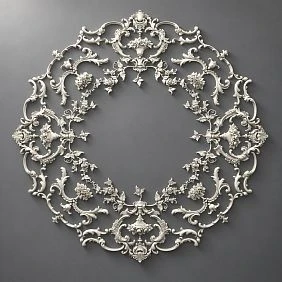
- Relief rosette with rich ornament
- Which ornament style to choose
- Acanthus ornament
- Laurel wreath
- Meander
- Ionic and bead-and-reel
- Floral medallion
- Geometric modern ornament
- Round rosette for different chandelier types: detailed breakdown
- Crystal chandelier
- Modern pendant chandelier
- Classic arm chandelier
- Art Deco chandelier
- LED ceiling light (flush mount)
- How to combine a round ceiling medallion with crown molding
- Round medallion in the center of a molding frame
- Multiple circles: a system of medallions
- Round medallion and perimeter cornice
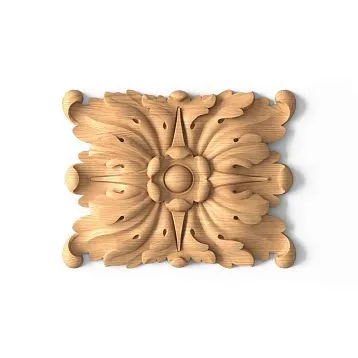
- Corner elements and decorative overlays
- Round medallion for different rooms: how to choose the right one
- Living Room
- Bedroom
- Children's room
- Hall
- Office
- Entry Hall
- What to check before purchase
- Installing a round ceiling rosette: step by step
- Step one: marking the center
- Step two: dry fitting
- Step three: applying adhesive
- Step four: installation
- Step five: sealant
- Step six: painting
- Painting a round ceiling rosette: three techniques
- What to buy together with a round ceiling rosette
- Minimum installation kit
- Extended kit for ceiling system
- Polyurethane vs. plaster: why choose polyurethane
- Five interior scenarios: a round rosette in action
- Common mistakes when choosing a round ceiling rosette
- Frequently Asked Questions
- About the Company STAVROS
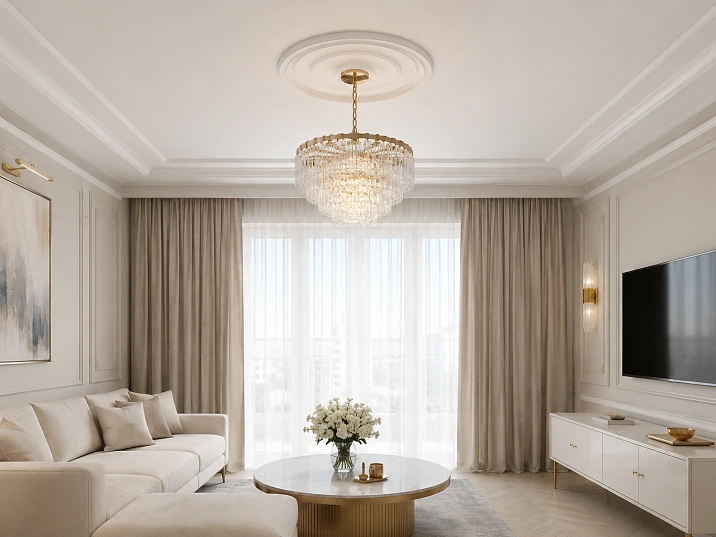
A round polyurethane ceiling rosette is a universal way to frame a chandelier: the right diameter, relief, and painting help assemble the ceiling center, connect the light fixture with the molding, and make the interior complete without unnecessary complexity. It needs no special justification — this shape works. It works in classic and neoclassical styles, in living rooms and bedrooms, with crystal chandeliers and minimalist pendants. But even such a universal solution requires precise selection: diameter, relief, style, ceiling height. Choosing 'any round one' means risking the result. Choosing the right one means getting a ceiling that lives.
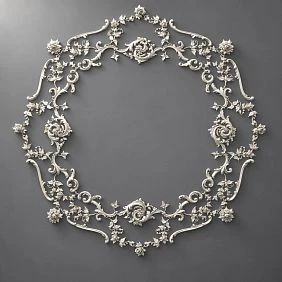
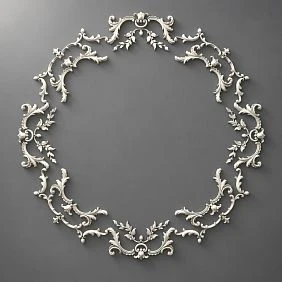
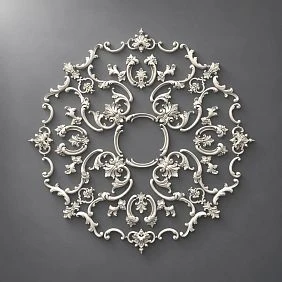
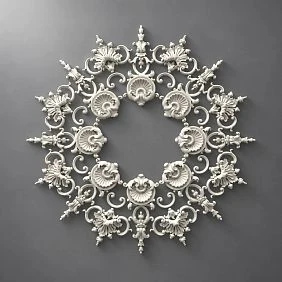
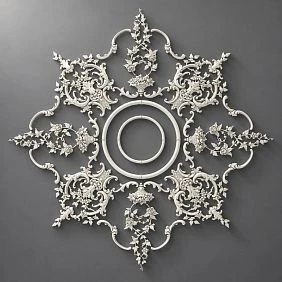
Why the circle is not just a shape, but an architectural classic
The circle as an element of ceiling decor has existed as long as architecture itself. This is no coincidence — the circle has a unique property: it concentrates the gaze at a single point without creating directionality. It does not "pull" to one side, does not create a vector, does not impose geometric tension. It simply gathers the space — quietly, confidently, organically.
That is why round polyurethane ceiling rosette has become a universal decorative tool that is equally appropriate in a classic living room and in a modern apartment with a neoclassical accent. It does not argue with the shape of the chandelier, does not compete with the geometry of the room, does not require special conditions — it simply works.
But this does not mean that choosing a round rosette is simple. The correct diameter, precise relief, understanding of the fixture's style and the room's proportions — all of this determines the difference between a "merely decorated" ceiling and a ceiling that is part of the architecture.




Round rosette: what makes it universal
They say a round rosette fits everywhere. This is true — but with a clarification: it fits everywhere if chosen correctly. Its universality lies not in the fact that any model will suit any interior, but in the fact that the circular form is inherently free of geometric constraints.
A square rosette requires a rectilinear context — straight moldings, strict furniture lines, a certain architectural language. An oval rosette requires a longitudinal axis — an elongated room, table, light group. A round rosette requires nothing specific — it responds to any interior because it creates no geometric conflict with anything.
A round rosette works well:
-
with a classic crystal chandelier — softly framing its base;
-
with a modern pendant light — neutrally fixes the attachment point;
-
with a chandelier — creates an even decorative ring around the light fixture's canopy;
-
with a minimalist lampshade — does not compete with the shape, but complements it;
-
with a large decorative chandelier — works as a second decorative "tier" above it.
It is this plasticity that makes the round ceiling medallion for a chandelier the most sought-after option in the category of ceiling medallions.
Our factory also produces:
When to choose a round ceiling medallion
There are situations where the round shape is not just an acceptable option, but the best one.
The light fixture is located strictly in the center of the room. Central placement of the chandelier is the most common scenario. It is in this case that the round medallion works with maximum efficiency: the symmetry of the room and the symmetry of the medallion coincide.
The interior is classic or neoclassical. For classic style, a round relief rosette is a historical norm. It was this shape that adorned the ceilings of mansions, estates, and city apartments for centuries.
You need to neatly design the chandelier attachment point. Attaching a chandelier to the ceiling is a technical node that, despite its utility, is visible. A round rosette neatly conceals it, turning a technical necessity into a decorative element.
A ceiling without complex geometry. On a flat white ceiling without moldings, frames, or complex relief, a round rosette is the only decorative element, and it handles this role flawlessly.
You want to add stucco without overloading the space. One round rosette is a minimal, delicate, self-sufficient decorative gesture. Not a system, not a set, not a ceiling program — just one precise detail.
You need a shape that definitely won't be wrong. If you are choosing ceiling stucco for the first time and are not confident in your spatial intuition, a round rosette is the option that cannot be 'placed incorrectly.'
Get Consultation
How to choose the diameter: the main parameter of a round rosette
Diameter is the key decision when choosing a round ceiling rosette. A rosette that is too small gets 'lost' under the chandelier and looks like a random detail. One that is too large presses down on the ceiling, creating disproportion.
Diameter and chandelier
The main guideline is the diameter of the lampshade or the overall size of the chandelier. The rosette should be slightly smaller than the light fixture or comparable to it — this creates the feeling that it 'holds' the chandelier, framing it.
-
Chandelier diameter 30–40 cm — rosette 250–320 mm;
-
Chandelier diameter 40–55 cm — rosette 300–400 mm;
-
Chandelier diameter 55–70 cm — rosette 380–460 mm;
-
Chandelier diameter 70–90 cm — rosette 450–550 mm;
-
Chandelier diameter over 90 cm — rosette 550–700 mm.
For small pendant lights with a diameter of 15–25 cm — rosette 200–280 mm. It should not be small: even above a compact pendant, a decorative "frame" with sufficient diameter is needed to be readable.
Room diameter and area
The second guideline is the room area. The rosette should be proportional to the room, even if the chandelier is small.
-
Room 10–14 m² — diameter 250–350 mm;
-
Room 15–20 m² — diameter 300–420 mm;
-
Room 20–28 m² — diameter 380–500 mm;
-
Room 28–40 m² — diameter 460–600 mm;
-
Room over 40 m² — diameter from 600 mm.
Ceiling diameter and height
Ceiling height affects the visual perception of size: with a low ceiling, a large rosette feels even larger. Therefore, with a ceiling of 2.5–2.6 m, it is better to choose a modest diameter — up to 350–380 mm. With a ceiling of 2.9–3.0 m — up to 450–500 mm. With a ceiling above 3.0 m, the diameter can be from 500 mm and above.
| Situation | Recommended diameter |
|---|---|
| Small bedroom, ceiling 2.6 m | 220–300 mm |
| Children's room | 200–260 mm |
| Study, ceiling 2.8 m | 280–360 mm |
| Living room 20–25 m², ceiling 2.8 m | 380–470 mm |
| Living room 30+ m², ceiling 3.0 m | 500–620 mm |
| Hall with high ceiling | 450–600 mm |
| Dining room with a medium chandelier | 350–450 mm |
Smooth or textured: how to choose the character of a ceiling rosette
This is not just an aesthetic choice — it is a choice of the decorative 'role' that the rosette will play on the ceiling.
Smooth round ceiling rosette
A smooth rosette is a form without ornament: a clear circular ring with a profiled rim, but without stucco pattern. It looks modern, delicate, and neutral. Such a polyurethane rosette is well suited for:
-
modern classic;
-
neoclassicism with laconic decor;
-
interiors where the light fixture itself is decoratively active;
-
bedrooms and studies where an accent is needed without excessive detail;
-
minimalist and contemporary style lighting fixtures.
A smooth form is a quiet statement. It is present on the ceiling but does not shout about itself. This type of rosette is appropriate where the interior is built on restraint.
Socket with moderate relief
One or two relief bands — concentric rings with a geometric or ornamental pattern. Meander, ionics, laurel wreath, ribbed band — this is the level of decorativeness that gives the rosette character without overloading the ceiling.
Works well in:
-
neoclassical interior;
-
living rooms with moderate decor;
-
dining rooms;
-
bedrooms with classical details.
Relief rosette with rich ornamentation
A rosette with acanthus leaves, laurel wreaths, stucco floral bands, and multi-tiered relief. It is an active decorative element — it takes on a significant share of the ceiling's "statement."
Suitable for:
-
classic interiors with rich decor;
-
living rooms with a crystal chandelier;
-
halls with high ceilings;
-
formal spaces.
An important principle: the more decoratively active the chandelier, the calmer the rosette can be. And vice versa: if the light fixture is minimalist, the rosette can take on more decorative responsibility.
Which ornament style to choose
The relief of a round rosette speaks of the era and style. It is not just a "pattern on the ceiling" — it is an architectural language that must harmonize with other interior details.
Acanthus ornament
Acanthus leaves are a classic motif of ancient architecture, passed through the Renaissance and Classicism into modern stucco. Lush, lively, organic. For classic and neoclassical interiors.
Laurel wreath
A continuous laurel garland around the rosette ring — a restrained, elegant, historically accurate ornament. Works well in modern classic and neoclassical styles.
Meander
Geometric ornament with an endless ribbon structure. Strict, architectural, versatile. Pairs well with the rectangular geometry of moldings and frames.
Ionic and pearl band
Delicate geometric ornaments characteristic of classical architectural orders. Used as intermediate bands between relief zones.
Floral medallion
In the center of the rosette — a floral rosette, around it — a smooth or relief ring. This is the traditional structure of a ceiling rosette in its classic form. Versatile for most classical interiors.
Geometric modern ornament
A strict geometric band without ornamental 'biology' — only lines, profiles, flutes. For modern neoclassicism and strict interiors with an architectural character.
Round ceiling rosette for various chandelier types: detailed analysis
Crystal chandelier
A crystal chandelier is a powerful decorative object in itself. It sparkles, it has many details, it attracts all attention. The rosette for a crystal chandelier should be in dialogue with it, not compete.
A good solution: a round rosette of medium diameter with a moderate acanthus band. There is relief, but it does not steal attention. Color — white to match the ceiling, or with delicate gilding of the bands in coordination with the chandelier's hardware.
Modern pendant chandelier
A laconic metal pendant, cylindrical lampshade, minimalist 'molecular' construction — these are fixtures without historical references. Suitable for:
-
a smooth round rosette with a profiled rim;
-
or a rosette with one delicate geometric band.
A rich classical ornament here would create a stylistic conflict.
Classic arm chandelier
A chandelier with multiple arms and tulip-shaped shades is a traditional and common form. It is classic enough to accommodate a relief rosette and versatile enough to work with both moderate and rich ornamentation.
For an arm chandelier, a rosette with one or two relief bands, with a diameter comparable to the diameter of the circle formed by the arms.
Art Deco chandelier
Geometric shapes, metal details, frosted glass. For such a chandelier, a round rosette with a geometric band. Meander, concentric fluting, strict profile — this is the language spoken by Art Deco.
LED ceiling light (shade)
A flat LED shade flush to the ceiling is an increasingly common scenario. Here, the rosette acts as a decorative ring around the shade. It is important that the diameter of the rosette is larger than the diameter of the shade — otherwise, the shade will visually 'eat' the rosette.
How to combine a round rosette with ceiling moldings
A round rosette works well both on its own and as part of a ceiling system. But if you add Moldings made of polyurethane — the result reaches the level of an architectural interior.
Round rosette in the center of a molding frame
A rectangular or square frame made of moldings — with a round rosette in its center. This is a classic technique that creates a "picture" on the ceiling: the frame sets the field, the rosette sets its center. The proportional ratio is important: the rosette occupies no more than 60% of the frame width in diameter.
Multiple circles: a system of rosettes
In formal rooms or rooms with several lighting zones, multiple round rosettes are sometimes installed. The system works under two conditions: all rosettes are of the same type and diameter, and are arranged symmetrically across the ceiling.
Round rosette and perimeter cornice
A cornice around the perimeter of the room — and a round rosette in the center of the ceiling. This is the simplest but very effective ceiling system. Ceiling molding in the form of a cornice frames the entire ceiling plane, the rosette fixes its center. Two details — and the ceiling acquires architectural completeness.
Corner elements and decorative overlays
If the molding frame is supplemented with corner decorative inlays, the system gains even greater expressiveness. The corners of the frame — rosettes or ornamental details — and the round central rosette create a full-fledged ceiling ensemble.
Round rosette for different rooms: how to choose exactly
Living Room
The living room is the main space of the apartment, where the ceiling decor is best visible and most closely perceived. For the living room, choose a round rosette of medium or large diameter (380–550 mm), with moderate or rich relief — depending on the interior style.
If molding frames are planned in the living room, the diameter of the rosette is coordinated with the size of the frame. If not, the rosette is chosen independently as the only ceiling decorative element.
Bedroom
The bedroom is a space of silence and tranquility. Ceiling decor here should not create excessive visual "activity." For the bedroom, a round rosette of small or medium diameter (220–350 mm), smooth or with delicate relief. White, matching the ceiling, not contrasting.
An important nuance: dimmed lighting with a dimmer is often used in the bedroom. The rosette looks especially soft in such lighting — and that is why smoothness of relief is important for the bedroom: sharp profiles create excessive shadows in oblique light.
Children's room
For a children's room, a small round rosette without complex ornamentation. White, smooth or with one delicate band. Size — proportionate to the room and the light fixture, not monumental.
Hall
The hall is the first space a guest sees. Ceiling decor here should make an impression at first glance. For the hall, a round rosette of larger diameter (420–600 mm) with expressive relief. If the ceiling is high — 3.0 m or higher — the relief can be rich.
Office
For a study, a strict, restrained rosette. Diameter medium — 280–360 mm. Relief — moderate, geometric, without organic ornaments. Color — white, matching the ceiling.
Entryway
In the hallway, a round rosette of small diameter (200–280 mm) under a ceiling lamp or spot light creates a neat decorative accent in a transit space. It is not the main decor — but it is noticed and works.
What to check before purchase
Let's list everything important to clarify before clicking "Buy."
Diameter. Have you already decided on the diameter based on the chandelier and room? Write it down and look for exactly that.
Relief height. Low relief (up to 15 mm) — for low ceilings and delicate interiors. Medium (15–30 mm) — for most applications. High (more than 30 mm) — for high ceilings and rich decor.
Shape of the central part. The hole for the wire — its size and shape. Make sure the chandelier wire will pass through the central hole of the rosette.
Weight. A standard polyurethane rosette with a diameter of 400 mm weighs 350–600 g. Mounting with glue at this weight is reliable and sufficient.
Painting capability. Polyurethane accepts any water-based and acrylic paint — this is a standard capability. Make sure the surface has no factory coating that could interfere with adhesion.
Type of glue. Specialized glue for polyurethane moldings ensures reliable adhesion. Do not use universal glues without compatibility testing.
Ceiling compatibility. Installation on plasterboard, concrete, plastered, and wooden ceilings is done the same way — with glue and acrylic sealant around the perimeter. Make sure the surface is dry and free of grease stains.
Packaging. The polyurethane product must be securely packaged — without deformation of the relief during transportation.
Installing a round rosette: step by step
Installation is the final but critically important stage. An incorrectly installed rosette nullifies the correct choice. The full professional algorithm is described in the guide installing polyurethane molding. Here is the essence.
Step one: marking the center
Find the center of the ceiling by the attachment point of the chandelier hook or cable. For a round rosette, this is the only axis — and it must align with the center of the rosette to within 2–3 mm.
Step two: fitting
Hold the rosette against the ceiling — check that the mounting cable or hook comes out through the center hole. If the hook protrudes significantly, mark the exit point on the rosette.
Step three: applying adhesive
Apply glue evenly over the entire back surface of the rosette — a uniform layer. Pay special attention to the perimeter. For rosettes with a diameter over 400 mm, add extra glue dots in the center.
Step four: installation
Press the rosette against the ceiling and hold for 3–5 minutes. For large items, it is convenient to use a telescopic support stand.
Step five: sealant
Apply acrylic sealant in an even strip around the outer perimeter of the rosette. Use a spatula or gloved finger — one smooth circular motion. The result is an invisible seam between the rosette and the ceiling.
Step six: painting
After the glue and sealant have dried (12–24 hours), apply primer and paint. White to match the ceiling, or with a color accent on the relief bands.
Painting a round rosette: three techniques
Solid white. The rosette is painted the same color as the ceiling. It blends in and is perceived as part of the ceiling plane. The relief is read through light and shadow, not color contrast. This is the most common and foolproof solution.
Contrast color. The rosette is painted a different color from the ceiling — lighter or darker. This creates an independent decorative accent. Rare, bold, requiring a confident architectural concept.
Gold or bronze on relief elements. Ornamental bands or relief details are highlighted with gold or bronze paint on a white background. This technique adds "luxury" without loud accents. Works well in classical and neoclassical interiors.
What to buy together with a round ceiling rosette
The rosette is the central element. But a complete result requires the right surroundings.
Minimum installation kit
-
Adhesive for polyurethane stucco — specialized, with high adhesion to ceiling surfaces.
-
Acrylic sealant — for sealing the circular perimeter joint.
-
Primer — for preparing the surface for painting.
-
Paint — acrylic or water-based in the color of the ceiling.
Extended kit for ceiling system
-
Moldings. Moldings made of polyurethane for creating frame contours around the rosette.
-
Cornice. Perimeter cornice along all walls of the room — for architectural completeness of the entire ceiling. In the section Ceiling molding All necessary cornice profiles are available.
-
Corner decorative elements. Decorative stucco At the corners of molding frames — for system completeness.
-
Extra glue and sealant — a small reserve for corrections.
| Task | What to buy |
|---|---|
| Arrange a chandelier in the center of the ceiling | Round ceiling rosette of the required diameter |
| Add classic style to the interior | Embossed round rosette with acanthus band |
| Do not overload the bedroom | Smooth or low-relief rosette up to 320 mm in diameter |
| Design a large chandelier | Socket with a diameter from 450 mm |
| Create a ceiling system | Socket, moldings, cornice, corner covers |
| Buy without mistakes | Socket by diameter, relief, and ceiling height |
Polyurethane vs. gypsum: why choose polyurethane
The market for decorative stucco features products made from various materials — gypsum, expanded polystyrene, polyurethane. Why is polyurethane more often chosen for ceiling rosettes?
Precision of relief reproduction. Round profiles and ornamental elements made of polyurethane are distinguished by clarity — each acanthus leaf, each profile belt, each ring has precise outlines without blurred transitions.
Ease and reliability of installation. A polyurethane round socket with a diameter of 500 mm weighs 500–700 g. Installation with glue without dowels and anchors is reliable and sufficient. A gypsum product of the same size weighs 3–5 times more and requires additional fastening.
Moisture resistance. Unlike gypsum, polyurethane is not afraid of moisture. This is important for the kitchen, bathroom, hallway.
Does not crumble. Upon accidental impact, a corner or sharp element made of plaster chips off. Polyurethane is elastic — it deforms without breaking.
Ease of painting. The smooth, non-porous surface accepts paint without priming in several coats. Buy a round ceiling rosette made of polyurethane means getting a product ready for installation and immediate painting.
Five interior scenarios: the round rosette in action
Scenario one: living room 24 m², ceiling 2.8 m, crystal chandelier with arms 65 cm in diameter.
Round rosette 480 mm in diameter, rich acanthus relief. White. Rectangular molding frame around, perimeter cornice. Result: a classic living room with a finished ceiling.
Scenario two: bedroom 16 m², ceiling 2.7 m, minimalist fabric lampshade.
Round rosette 300 mm in diameter, smooth with one profiled rim. White. Without additional moldings. Result: a delicate, almost invisible ceiling accent — just the right amount of decor.
Scenario three: hall 3 × 4 m, ceiling 3.0 m, large pendant light.
Round rosette with a diameter of 520 mm, moderate relief with a laurel band. White with gold highlighting of the band. Result: a formal ceiling accent in the first space.
Scenario four: office 14 m², ceiling 2.8 m, small recessed light fixture.
Round rosette with a diameter of 280 mm, geometric meander band. White. Without moldings. Result: a strict and precise decorative accent above the workspace.
Scenario five: children's room 12 m², ceiling 2.6 m, ceiling LED light fixture.
Round rosette with a diameter of 240 mm, smooth with a minimal profile. White. Result: a clean, neat ceiling without excessive details.
Common mistakes when choosing a round rosette
Mistake one: choosing the diameter "by eye" without measurements. A centimeter error in diameter on the drawing is 30–50 mm in reality. Measure, record, verify.
Mistake two: choosing a large relief rosette for a low ceiling. On a 2.5 m ceiling, a monumental rosette with high relief "brings" the ceiling closer to the person. Choose low relief and a moderate diameter.
Mistake three: choosing a rosette that is too small for a large chandelier. The rosette gets "lost" behind the light fixture and ceases to function as a decorative element. The diameter of the rosette should be comparable to the chandelier.
Mistake four: ignoring stylistic consistency. A relief classic rosette with crystal and curls above a minimalist LED shade is a style conflict. Choose a relief in harmony with the style of the light fixture.
Mistake five: mounting without primer. Without primer, the paint lays unevenly and there may be gaps. Always prime before painting.
Frequently asked questions
What is the difference between a round polyurethane rosette and a plaster one?
Polyurethane is lighter, not afraid of moisture, does not crumble upon impact, and is easier to install. Plaster is heavier and requires additional fastening. Visually, with the same relief, there is no difference.
How to choose the diameter of a round rosette for a chandelier?
The diameter of the rosette should be comparable to the diameter of the chandelier's lampshade or slightly smaller. Additionally, consider the room area and ceiling height.
Can a round rosette be mounted on a stretch ceiling?
Yes, provided the stretch fabric is installed tightly and evenly. The glue is applied to the fabric — make sure it is ready for adhesive mounting.
Smooth or relief rosette — which to choose for a modern interior?
For a modern interior, a smooth rosette with a profile rim or one delicate geometric band is often chosen. A rich classical ornament may create a stylistic conflict with modern furniture and lighting fixtures.
Do I need to prime a polyurethane rosette before painting?
Yes. Primer ensures even paint application. Use acrylic primer — it is compatible with polyurethane.
How long does a polyurethane rosette last on glue?
With proper installation — for the entire lifespan of the interior. Polyurethane products on glue hold securely if the surface was prepared: degreased, free of dust and loose areas.
What to buy together with a round rosette?
Glue for polyurethane moldings, acrylic sealant, primer and paint. Optionally — Moldings made of polyurethane for frame contours and cornices from the section Ceiling molding. The full range is in the catalog polyurethane products.
About the company STAVROS
STAVROS is a professional supplier of decorative polyurethane products for residential and commercial interiors. The company's catalog includes round, oval and square ceiling rosettes of various diameters, reliefs and styles, Moldings and cornices for creating ceiling frame systems, Decorative overlays and corner elements, Ceiling molding all types and full range polyurethane products for complete interior design. All STAVROS products are manufactured with high precision, resistant to moisture and mechanical stress, ready for installation and painting. Contact us to confirm shipping to your destination.