Article Contents:
- Characteristics of L-002 that need to be transferred to the project
- Why expensive thread sometimes looks weaker than a simple baluster
- Acanthus leaves: a motif that needs air
- Vertical flutes and architectural rhythm
- Frontal and side readability
- The first mandatory test: two L-002 side by side
- How to determine the conditional front side
- Same direction on a straight flight
- Opposite march: repetition or mirroring
- Landing as a separate design node
- Why the step cannot be assigned just for aesthetics
- How to check the step on a full-scale mockup
- Connection of L-002 and post L-069
- Handrail and top line of the railing
- Light as part of the baluster pattern
- Side natural light
- Frontal light and loss of depth
- Shadows between balusters
- Beech for enamel project
- Oak for transparent or semi-transparent finish
- Beech and oak in row L-002
- Light and dark enamel
- Patina and accentuation of recesses
- Oak tinting and unified finishing cycle
- "Standard" and "Prestige" for complex carving
- Why trial finishing is needed specifically on a carved sample
- Acceptance of batch before finishing
- Distribution map along the march
- Why quantity cannot be counted only by width L-002
- What to buy and coordinate together with L-002
- How not to confuse L-002 with the general category of carved balusters
- Practical scenario: light staircase in the hall
- Practical scenario: oak staircase with transparent finish
- Practical scenario: staircase against the wall with decorative frames
- Practical scenario: two flights visible simultaneously
- Practical scenario: staircase in a narrow corridor
- Practical scenario: staircase as the main object of the living room
- Unity of staircase and furniture without literal repetition
- Mistakes that make L-002 lose expressiveness
- Evaluating the model only by one large photo
- Assigning distance just for the sake of the drawing
- Rotating products randomly
- Not looking along the flight of stairs
- Mixing 'Standard' and 'Prestige'
- Not coordinating the handrail
- Not designing the landing separately
- Painting the entire row without a test pair
- Not considering the background behind the railing
- Considering an expensive model automatically more suitable
- What is the size of the L-002 baluster?
- What materials is L-002 made from?
- What is depicted in the carving?
- Why does one L-002 look expressive, while a row can become dark?
- Can a universal spacing between balusters be specified?
- Do all balusters need to be turned the same way?
- How to check the direction before installation?
- Which post is L-002 recommended with?
- Why is there no link to the L-069 card in the article?
- What is better for enamel — beech or oak?
- When to choose oak?
- What does "Standard" sanding mean?
- How is "Prestige" different?
- Can "Standard" and "Prestige" be mixed in one row?
- Which light best reveals the thread?
- Will dark enamel work?
- Is patina needed?
- How to accept an oak batch?
- How to accept a beech batch for enamel?
- Should spare balusters be ordered?
- Can L-002 be used not on a staircase?
- How to tell that L-002 does not fit the interior?
- How to match L-002 with a handrail?
- What to do if the landing breaks the rhythm?
- Can I choose the direction during installation?
- What should I specify in the order?
- Where can I see other baluster models?
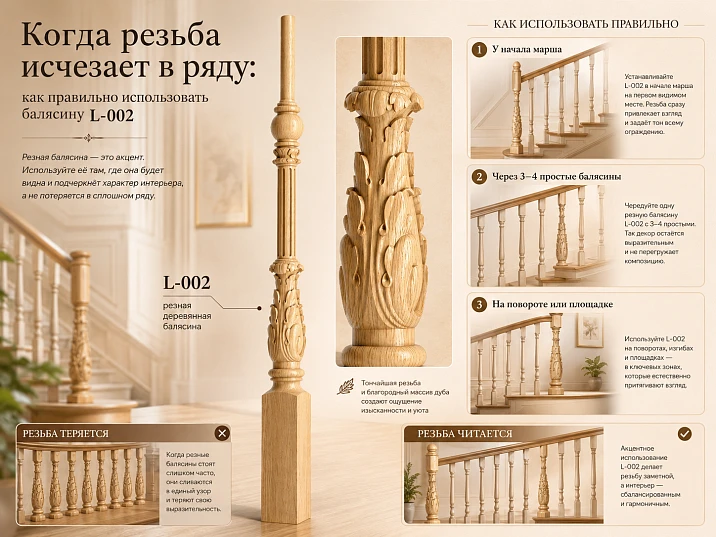
A carved baluster can look expressive in the product card and almost completely lose its character after installation. The reason is not always related to the quality of the product. Much more often, the pattern is "dampened" by the project itself: elements are placed too densely, turned with different sides, overlapped by a heavy handrail, painted in a too dark uniform tone, or connected to a post that lives in a different style. As a result, acanthus leaves and vertical flutes turn into an illegible strip, even though each detail individually remains beautiful.
Baluster L-002 requires a different approach. It needs to be chosen not only as a separate carved product, but also as a repeatable module of the stair railing. One module sets the shape, two show the interaction of neighboring motifs, and a full row forms the rhythm of the entire staircase. Therefore, before ordering, it is important to check not only the material and level of sanding, but also the direction of the carving, the side of the main view, the expected lighting, the character of the handrail, the shape of the posts, and how the ornament will behave on a straight flight and a turning landing.
The center of the article is carved baluster L-002 measuring 1000 × 70 × 25 mm. It is made of beech or oak, available with "Standard" and "Prestige" sanding, and its pattern is based on acanthus leaves and vertical flutes. The manufacturer recommends pairing this model with post L-069. The buyer's task is not just to purchase an eye-catching piece, but to assemble it into a coherent run where the carving remains legible from actual viewing angles.
Below is a breakdown of the path from a single sample to a full staircase composition: how to evaluate L-002 individually and in pairs, how to align the direction of the pattern, why the spacing cannot be set based only on a photo, how to check lighting and finish, how beech and oak differ in such a project, what to consider when choosing "Standard" and "Prestige," and what data to provide to the architect, staircase craftsman, or STAVROS manager.
Characteristics of L-002 that need to be transferred to the project
| Parameter | Confirmed value | Project value |
|---|---|---|
| Article number | L-002 | Specified in the order, specification, and batch marking |
| Type | Wooden carved baluster | Assessed as a repeatable relief module, not just as a single piece |
| Size | 1000 × 70 × 25 mm | Checked against the staircase structure, handrail, steps, and mounting method |
| Material | Beech or oak | Selected together with the future finish, column, and handrail |
| Sanding | "Standard" or "Prestige" | For a long row, uniform processing quality is desirable |
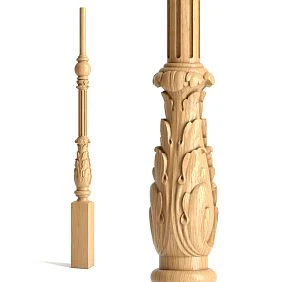
| Ornament | Acanthus leaves and vertical flutes | Readability depends on spacing, direction, light, and color |
| Recommended combination | Column L-069 | The scale of the acanthus, wood species, and finish need to be coordinated |
| Product card | Buy carved baluster L-002 | Before ordering, verify the current parameters of the selected configuration |
Size 1000 × 70 × 25 mm is a product characteristic, not a ready-made installation scheme. The actual railing height, trimming, seating, and handrail position are determined by the project. Similarly, the 70 mm width does not provide a universal distance between adjacent elements. It only shows how noticeable the wooden module will be in repetition.
The 25 mm thickness is important for a side view. When looking along the flight, the viewer sees not a frontal photograph, but an alternation of narrow planes, carvings, and shadows. Therefore, the model should be examined from the front, side, and at an angle before approving the entire staircase.




Why expensive carving sometimes looks weaker than a simple baluster
A simple turned baluster is read through its overall silhouette, while the expressiveness of L-002 is largely created by the internal relief. When shadows disappear or neighboring motifs visually overlap, the acanthus and flutes lose depth.
In a long flight, the gaze stops distinguishing each item separately and perceives the railing as a ribbon. If this ribbon lacks pauses, clear direction, and sufficient light contrast, the complex carving merges into a dark lattice.
You need to check not a single product photo, but at least a couple of samples and a general fragment of the row. Such a test shows whether the pattern is preserved from a normal distance, not just upon close inspection.
Our factory also produces:
Acanthus leaves: a motif that needs air
Acanthus leaves form expansions, curves, and recesses. In a single baluster, they are easy to trace from top to bottom, but in a row, neighboring expansions begin to interact and may merge.
The "air" between elements cannot be assigned only aesthetically: the distance is related to safety and construction. But within an acceptable design scheme, you can compare several options and see when the acanthus begins to read more clearly.
It is useful to place two items side by side, take photos from a real viewpoint, and compare shadows. The decision is then passed to a staircase specialist who checks it against the project.
Get Consultation
Vertical flutes and architectural rhythm
Flutes elongate the baluster and connect the plant-like plasticity with the stricter architecture of the staircase. They support the line of the posts and form a repeating vertical rhythm.
With side lighting, flutes create alternating light and dark stripes. With overly frontal lighting, the recesses almost disappear, and the central part of the row becomes flat.
During fitting, you need to check whether the flutes are visible from the lower landing, from the upper floor, and while moving along the flight. If they only appear under a special lamp, the everyday result may be weaker.
Frontal and side readability
| Viewing point | What reads better | Risk | What to Check |
|---|---|---|---|
| Frontally from the hall | Acanthus pattern and symmetry | Merging of motifs | Pauses between leaves and the scale of the handrail |
| Along the bottom of the flight | Vertical rhythm and lateral depth | Different turns | Same direction of all elements |
| From the upper landing | Transition from row to post | Ornament breaks at the turn | Logic of the last baluster and post |
| In motion | Alternation of light and shadow | Visual noise | How the drawing changes when passing by |
| From the adjacent room | Thickness and silhouette | Frontal carving almost disappears | Is the overall silhouette sufficient |
A staircase is rarely perceived strictly from the front. In the hall, a person sees it diagonally, on the flight — from the side, from the landing — along the row. The same ornament looks different in these angles.
The frontal view shows acanthus and symmetry, the side view shows thickness, silhouette, and direction. A rotation error is especially noticeable when looking along the flight, when one detail breaks the sequence of lines.
Therefore, before ordering, the main viewpoint is determined, but not limited to it. The model is photographed from at least three positions so that the artistic solution does not work only in one frame.
The first mandatory test: two L-002 side by side
One baluster shows the quality of carving, but says almost nothing about the behavior of the row. Two allow you to see the interaction of acanthus motifs, flutes, and shadows. This is a minimal mockup that helps move from an abstract impression to a design solution.
The samples are temporarily placed vertically, first identically, then one is deliberately turned. The comparison helps to understand how sensitive the model is to direction and where the conditional front side is. After that, you can check several distances acceptable within the preliminary fitting, without turning them into an installation standard.
The test is carried out in daylight and evening light, next to a sample of the handrail or post. This way the buyer sees a small section of the future staircase, not an isolated detail. It is useful to step back a few meters: up close, individual leaves are distinguishable, and from a distance, the overall rhythm becomes clear.
How to determine the conditional front side
Even with a near-symmetrical contour, the depth of the relief and the wood grain create an orientation that is better perceived from the main side. It must be chosen before installation. Otherwise, some products may end up turned differently, and the row will look irregular.
All balusters in the batch are laid out on a protected surface in one direction, comparing the top, bottom, leaves, and flutes. Then the viewing arrow is fixed for each flight. If the staircase is visible from two rooms, the decision is checked from both sides and the priority is determined in advance.
The marking is made removable and placed in a hidden area. This is especially important when finishing and installation are done by different contractors: after painting, the craftsman should not have to guess the original intent. It is useful to include a photo of the correct orientation in the installation map.
Same direction on a straight flight
On a straight section, balusters are usually oriented consistently. Then the acanthus forms a sequential ribbon, and the vertical flutes support a calm repetition. The row is perceived as assembled and professionally designed.
A randomly turned piece is often noticeable from afar, even if the difference seems small up close. The error disrupts the rhythm and creates a feeling of sloppy assembly. Such a flaw is especially visible in side light, when shadows go in the other direction.
Before fixing, the entire row is temporarily laid out or set up. The overall pattern, transition to posts, and behavior of the ornament along the inclined line of the flight are checked. If installation is done in stages, the direction is controlled after each small group, not just at the end.
Opposite flight: repetition or mirror symmetry
In a two-flight staircase, it is necessary to decide whether the orientation is repeated or the second row mirrors the first. The choice depends on whether both sections are visible simultaneously and what role the landing plays.
If the staircase is perceived as a symmetrical composition from the hall, mirror symmetry can emphasize the architecture. If the flights open sequentially and are not visible in one frame, the same direction sometimes looks calmer. The decision should support the layout, not follow a formal rule.
Both options are better shown in a visualization or a simple collage. You can photograph one pair of L-002, mirror the image, and overlay it on the staircase diagram. This technique does not replace a working project but quickly reveals poor orientation.
Landing as a separate design node
On the landing, the direction of movement, distances, and the role of the post change. Mechanically continuing the step of a straight flight can create an overly dense section or an accidental void. The ornament will look as if it was cut off, even though individual details are installed correctly.
The post can become a strong pause between two rows, but only if its scale and carving are coordinated with L-002. Otherwise, the transition looks like a collision of different decorative systems. Not only the post model matters, but also its position relative to the first and last baluster.
The landing is considered separately: first the technical scheme, then the artistic check. On the plan, the side of the main view, the direction of both rows, and the position of the post are marked. After that, it is checked whether an empty corner or an excessively dense group arises.
Why the step cannot be assigned only by beauty
The distance is related to safety, standards, step geometry, mounting method, and railing height. Artistic readability is an important but not the only parameter. Therefore, the article does not provide a universal number in millimeters.
The same value does not account for a specific flight, the presence of children, a landing, or the railing structure. A formula that looks good on one staircase may be unacceptable on another. Any attempt to "spread" the row solely for the sake of acanthus must undergo technical verification.
First, the specialist determines the permissible layout, then the designer checks the rhythm of L-002 within these constraints. If the pattern blends together, the model, lighting, finish, or layout is revised, not safety ignored. This order preserves both expressiveness and project responsibility.
How to check the spacing on a full-scale mock-up
Before installation, a non-load-bearing fragment of two or three balusters and a conditional handrail can be assembled. It is not for strength testing but for evaluating the pattern. The mock-up can be simple, but the dimensions and relative positions must match the layout under consideration.
The fragment is placed in the actual area or in a room with similar lighting. It is viewed from a distance, photographed, and several acceptable options are compared. It is useful to check the mock-up next to a wall fragment, a step, and a sample of the future color.
The result is passed to the staircase specialist. This order allows combining a technically correct railing with an expressive ornament. The mock-up itself does not grant permission for installation, but it helps avoid discovering an artistic error too late.
The combination of L-002 and post L-069
The L-002 card recommends post L-069 as a stylistically compatible element. This hint is important because the post defines the beginning, end, or turn of the row. It is larger than a baluster and should anchor the composition, not overwhelm it.
The scale of the acanthus, relief density, post width, and transition to the repeating balusters are compared. If the post is too heavy, L-002 becomes a background. If too light, the start of the railing seems unconvincing. A good combination supports the overall motif while maintaining hierarchy.
The material and finish are agreed upon in advance. An oak column with a transparent tint and beech balusters under dense enamel can be a deliberate decision, but should not happen by accident. The provided scheme does not contain a confirmed full URL for L-069, so the address is not invented; the current card should be clarified with STAVROS.
Handrail and top line of the railing
The handrail forms a strong diagonal line and unifies the row. A profile that is too massive visually presses down on the upper part of L-002, while one that is overly light does not tie together the rich carving. Therefore, the handrail cannot be chosen at the very end as a neutral addition.
The profile is shown next to the baluster and column. It is important whether it overlaps the upper fragment of the pattern, whether it matches the scale of the wooden parts, and whether it supports the overall character of the staircase. In a light interior, massiveness can be enhanced by color, while in a dark one, it can blend with the row.
The seating and fastening are determined by a specialist. The artistic check answers a different question: does the handrail help read the row as a whole. If the top line is too active, the acanthus leaves below lose their role.
Light as part of the baluster pattern
The relief exists thanks to light and shadow. In overcast, uniform lighting, protrusions and recesses become closer in tone. With side light, flutes and edges of acanthus leaves become more noticeable. Therefore, the lighting scenario needs to be checked before choosing the final color, not after installing the entire staircase.
| Type of lighting | How L-002 is perceived | What to Check |
|---|---|---|
| Natural side light from a window | Well reveals the relief and alternation of flutes | Doesn't the opposite side become too dark |
| Frontal even light | Softens shadows and makes the pattern calmer | Don't small recesses disappear |
| Light from above | Emphasizes upper edges and may darken lower ones | How does the acanthus look at eye level |
| Lighting along the wall | Creates long repeating shadows | Doesn't an overly active pattern arise? |
| Spotlights | Highlight individual sections of the row | Are there any sharp spots or gaps? |
| Weak evening lighting | Unites the row into a silhouette | Is the dignity of the overall outline preserved? |
A practical test is simple: a sample or finished specimen is placed in the intended area and observed in the morning, afternoon, and evening. A catalog photo cannot convey the light direction of a specific house. Even identical finishes in two halls look different if the windows are on different sides.
Side natural light
Light from the window, coming across the row, well reveals flutes and leaf edges. It creates soft shadows, thanks to which the relief is visible from a distance. For L-002, this is one of the most indicative scenarios, since vertical recesses begin to work as an architectural rhythm.
At the same time, the opposite side may become too dark, especially with rich tinting. If the staircase is visible from both sides, you need to ensure that one facade does not win at the expense of the other completely failing. Sometimes reflected light from a light-colored wall helps.
The final color is chosen after such a test. If the sample looks too contrasty in daylight, you can reconsider the tone, the degree of gloss, or the placement of the lights.
Frontal light and loss of depth
When light comes almost along the viewing axis, shadows hide behind protrusions. The surface looks smoother than it is, and complex carving becomes calmer. Flutes may almost disappear, and leaves are read only through their outline.
This may be acceptable if the interior requires a restrained row, but it is bad if L-002 is purchased specifically for the plasticity of the acanthus. The buyer must understand in advance that a product shot with expressive side light and real frontal light will give different results.
Sometimes it is enough to change the position of an existing light fixture, use light from a neighboring window, or choose a lighter tone. The solution is tested on a sample, not based on abstract recommendations.
Shadows between balusters
Each baluster casts a shadow on adjacent surfaces. In a long row, a second rhythm appears that overlays the wooden ornament. With a successful scheme, it enhances depth; with an unsuccessful one, it creates visual noise.
Active wallpaper, frequent molding frames, or a contrasting wall can increase fragmentation. A neutral background more often helps the carving read. This does not mean that there must be an empty white wall behind the staircase, but decorative layers need to be coordinated.
The mockup takes into account not only the wood, but also the wall, steps, risers, and the space behind the railing. Sometimes the problem that is being solved by changing the spacing is actually related to the background or the direction of light.
Beech for a project under enamel
Beech is reasonably considered when an even color, light enamel, or a calm background for carving is needed. A dense coating shifts attention from the natural texture to the form. Acanthus and fluting are read through light, shadow, and geometry.
However, paint does not hide poor preparation of complex recesses. After applying the coating, nap and processing marks may become more noticeable. The more complex the relief, the more important it is to agree in advance on the condition in which the product arrives at the painting workshop.
Beech balusters, posts, and handrail should preferably be coordinated as a single system. If parts arrive with different preparation, the finish may reveal differences. A large run is better ordered at the same time and in one configuration.
Oak for transparent or semi-transparent finish
Oak is chosen when it is important to preserve the natural grain and tie the staircase to oak flooring, doors, furniture, or handrail. The texture adds a second ornament over the acanthus and makes each baluster slightly individual.
This advantage requires control. With overly contrasting tinting, annual rings may compete with the carving. Therefore, a color sample is made on the same species and with comparable preparation, not on a random smooth sample.
For transparent finish, natural differences are especially noticeable. They are not a defect in themselves, but the run should look coordinated. When ordering, it is useful to state that all products are installed side by side in one staircase and to discuss batch selection.
Beech and oak in run L-002
| Criterion | Beech | Oak |
|---|---|---|
| Main Scenario | Enamel, even color, light classic staircase | Tinting, transparent coating, preserving texture |
| How the carving is read | Through the light and shadow of the coating | Through the relief and natural wood grain |
| Main risk | Dark dense enamel can make the row flat | Active texture can argue with acanthus |
| Connection with the column | Coordinate preparation for painting | Coordinate the shade and transparent finish |
| Acceptance | Check recesses and surface for enamel | Check natural differences and distribution along the flight |
| Product card | Select configuration L-002 | |
No single wood species is universally best. If the project requires an opaque light enamel, the natural texture of oak may not be the main advantage. If the interior is built around visible wood, the oak version gains additional meaning. The decision is made together with the finish and adjacent details.
Light and dark enamel
Light enamel usually preserves the distinction between illuminated edges and soft shadows. The row is perceived as lighter and reads from a greater distance. It is especially useful where there is little natural side light, but plasticity is still desired.
Dark enamel creates a graphic silhouette, but without side light it can merge recesses into a single band. It requires more careful inspection. On a single sample, the dark color looks striking, but on a full flight it becomes significantly denser.
The degree of gloss also affects the result. Strong highlights can hide the form, while a fully matte surface may absorb light. The sample is reviewed in the actual room and on at least two adjacent elements.
Patina and accentuation of recesses
A light patina can emphasize leaves and flutes, but the effect is repeated many times on each baluster. What looks delicate on a single sample can turn into a variegated ribbon in a long row.
Therefore, at least a couple of finished elements are tested, placed with the intended direction. They are viewed from a distance and while moving. If the patina begins to dominate, its intensity is reduced.
The patina should support the staircase architecture, not become a separate pattern over the acanthus. Column L-069 and the handrail are also checked in the same finishing system.
Oak tinting and a unified finishing cycle
The shade depends on the wood, preparation, composition, and light. The color on screen cannot replace a real sample. First, a test stain is made, applied to the steps, handrail, column, and floor, then the system is approved for the entire batch.
It is advisable to tint the main set and the reserve provided by the project simultaneously. Touching up part of it after a long time may result in a noticeable difference, even if a composition with the same name is used.
Before tinting, the batch should be distributed across the flights. This helps place natural wood variations deliberately, rather than discovering a sharp contrast after installation.
"Standard" and "Prestige" for complex carving
Card L-002 offers two levels of sanding. "Standard" is associated with machine processing, while "Prestige" involves more detailed manual preparation. For a simple geometric part, the difference may be perceived as moderate, but in acanthus leaves and flutes, the condition of the recesses matters more.
The choice depends on the future coating and project requirements. If the surface will be additionally prepared by a professional painting workshop, the scope of its work must be agreed upon in advance. If higher readiness of the complex relief is required, "Prestige" is considered. It cannot be stated that one option automatically suits everyone.
The main rule is a uniform level of processing for the entire railing, columns, and visible elements, if they are to be perceived as a set. Mixing categories in one staircase may become apparent after painting, when light reflects differently on some parts.
Why trial finishing is needed specifically on a carved sample
A smooth board shows the color, but does not show the behavior of the coating in flutes and around leaves. In recesses, more material may accumulate, and on sharp edges the layer looks thinner. Therefore, the final test coat should be done on a fragment with comparable relief or on one L-002.
It is even better to prepare a pair, because repetition enhances the effect. If the color is too dark, it will be noticeable immediately. If the patina creates mottling, two pieces will show the problem better than one.
The test pair is labeled and kept as a reference. The finished batch is accepted against it after finishing. This reduces the risk of disputes between the designer, the painting workshop, and the client.
Acceptance of the batch before finishing
First, the article number, quantity, material, and sanding level are checked. Then the products are laid out by flights, without damaging the protection and relief. Dimensions, overall pattern, and absence of obvious transport damage are checked.
For oak, natural variations are assessed; for beech under enamel, the surface and recesses are assessed. Comments are recorded before painting work begins. After the coating is applied, it is more difficult to determine the origin of a defect.
Balusters require careful storage conditions. They must not be piled in bulk on a damp or dirty base. The relief is protected from impacts, and acclimatization and storage conditions are agreed with the supplier and the finisher.
Distribution map by flight
Each baluster can be assigned a number, indicating the flight and position. This helps return it to its place after finishing. The map is especially useful in a complex staircase with two flights, a landing, and several viewing points.
For oak, the map allows for a smooth distribution of the wood grain, avoiding accidental contrast in the center of the main view. For enamel, numbering helps maintain direction and avoid mixing up sections of different lengths.
The document is handed to the installer along with photos of the trial row. If some products are stored separately, the number and section of the staircase are duplicated on the packaging.
Why the quantity cannot be calculated only by the width L-002
The quantity depends on the length of flights, landings, posts, construction, and safe step. The 70 mm width is not a formula. It is involved in the layout but does not replace the railing calculation.
An accurate order is formed based on the staircase project. If the scheme is not ready yet, the buyer first needs a specialist's calculation. After that, the artistic readability is checked, and if necessary, the model or finish is adjusted without violating technical requirements.
For a general selection, you can read the material about how to choose the type of wooden balusters for a staircase. The current article answers a narrower question: how to preserve the acanthus pattern specifically L-002 in an already calculated safe row.
What to buy and agree on together with L-002
| Element | Why it's needed | What to Check | Route |
|---|---|---|---|
| L-002 | Main repeating module | Quantity, beech or oak, "Standard" or "Prestige" | Buy carved baluster L-002 |
| Baluster category | Comparison with calmer models | Is complex carving needed for all sections | view all wooden balusters for stairs |
| Column L-069 | Recommended stylistic pairing | Scale of acanthus, material, and finish | Current URL is confirmed with STAVROS |
| Handrail | Forms the top line | Profile, fit, and scale | Selected according to the project |
| Paint sample | Color and light check | The actual breed and level of training | Prepared before finishing the batch |
| Lighting scenario | Reveals the relief | Side, top, and evening lighting | Coordinates in the interior |
A set for an expressive row is broader than a set of identical balusters. Even high-quality products will not come together into a unified look without coordinated posts, handrail, finishing, and lighting. A commercially correct order should include not only the article number and quantity, but also data about the entire staircase.
How not to confuse L-002 with the general category of carved balusters
L-002 is distinguished by a specific combination of acanthus leaves, vertical flutes, and a flat carved form. A general request for "carved balusters" includes many models with different pattern density, width, and styling. Therefore, advice for one model cannot be automatically applied to another.
When comparing, they look not only at price and height. The width of the ornament, side silhouette, direction, compatible posts, and row behavior are important. If the interior requires a calmer railing, another model may be more appropriate.
To view the assortment, you can view all wooden balusters for stairskeeping L-002 as a separate candidate with an expressive acanthus.
Practical scenario: light staircase in the hall
In a spacious hall, L-002 can become the main repeating decor. Light enamel supports airiness, and side daylight from the window reveals the flutes. Column L-069 sets the start of the row and scales the acanthus.
Before ordering, they check whether the carving competes with door trims, moldings, and floor patterns. If the hall is already rich in decor, the finish is made calmer. If the walls are neutral, the acanthus can sound more active.
For such a project, a trial pair in a real space is especially useful. It shows whether the light enamel is sufficient for the evening scenario and whether the row becomes too contrasting during the day.
Practical scenario: oak staircase with clear finish
Here, not only the shape matters but also the texture. Oak L-002 is paired with the handrail, steps, and posts. The stain sample is checked in daylight and evening light.
Too dark a tint can hide the flutes, while too contrasting a tint can overload the row. The batch is distributed before finishing so that natural wood differences look intentional.
Spare items, if provided by the project, are included in the overall tinting cycle. This helps avoid a late piece that noticeably differs from the main row.
Practical scenario: staircase against a wall with decorative frames
If there are molding frames or panels behind the railing, the vertical rhythm of the balusters interacts with the geometry of the wall. It is necessary to check whether the flutes coincide with the frequent grid of moldings and whether visual moiré occurs.
Sometimes a calmer wall color or reduced contrast of the finish helps. In another case, the frames can be positioned so that they create a large background rather than fragmenting each baluster.
The decision is made based on visualization and a sample, not on individual catalogs. The staircase and the wall should be considered as one view.
Practical scenario: two flights visible simultaneously
The main question is mirror symmetry. The mockup or visualization should show how the acanthus is oriented on the left and right flights. The post on the landing becomes the center of the composition. If both rows are randomly oriented independently, the overall appearance loses symmetry.
It is useful to choose one point from which the staircase is fully visible and create a diagram specifically for it. Then the decision is checked from the lower and upper landings. Sometimes a beautiful frontal view creates an awkward side pattern, so a compromise is required.
The L-002 pair on each flight provides more information than a computer model without real relief. Light and shadows on wooden samples help to finally confirm the direction.
Practical scenario: staircase in a narrow corridor
In a narrow space, the viewer is close to the railing and more often sees it diagonally. Complex carving is perceived more actively than in a large hall. Dark finish and a dense background can make the row visually heavy.
Here, side readability, a light handrail, and a calm wall are especially important. Light should not blind but softly reveal depth. If the acanthus still seems overly saturated, it is reasonable to compare L-002 with a simpler model from the category.
The purchase decision is made after trying it on in full scale. A catalog close-up does not show how close a person will pass by the carving every day.
Practical scenario: the staircase as the main object of the living room
If the flight is open to the living room, the railing becomes part of the permanent interior. It is seen not only in motion, but also while sitting on the sofa, at the table, or from the adjacent area. In this case, L-002 works as a long decorative panel.
It is necessary to check the connection with furniture, curtains, wall panels, and lighting fixtures. Acanthus can be supported by soft plant lines, but literally repeating the pattern on all items overloads the space.
It is better to unify the interior through the wood species, color, and character of the finish. On this topic, it is useful to look at, how to coordinate turned elements throughout the entire interior.
Unity of the staircase and furniture without literal repetition
A carved staircase does not have to exist separately from furniture. Turned and carved elements can be coordinated by wood species, shade, fluting, and character of the finish. At the same time, there is no need to transfer the acanthus L-002 to every leg, facade, and door panel.
A more subtle way is to repeat the vertical rhythm, material, or depth of tinting. An oak staircase can be supported by oak furniture legs without identical carving. Light enamel on balusters can echo furniture facades.
This way, the staircase remains the artistic center, and the furniture supports it. The buyer gets a cohesive interior without the feeling that one ornament is mechanically multiplied throughout the house.
Mistakes that cause L-002 to lose expressiveness
Evaluating the model based on only one large photo
The card shows the product, but not a long row. At least two balusters need to be seen side by side. Otherwise, it's impossible to understand how neighboring leaves and shadows will interact.
Setting the spacing only for the sake of the pattern
The step is determined by design and safety. The artistic check is performed within design constraints. You cannot improve the acanthus at the expense of violating railing requirements.
Rotating products randomly
Different directions disrupt the acanthus ribbon. The orientation is fixed before installation and duplicated in the placement map.
Not looking along the flight of stairs
From the side, the carving is perceived differently, and the error is directional
Mixing "Standard" and "Prestige"
Differences in treatment may appear after painting, especially in recesses. A large row should look uniform.
Do not coordinate the handrail
A too heavy top line visually overwhelms the acanthus. The handrail should be seen next to the baluster already at the selection stage.
Do not design the landing separately
The rhythm may break at a post or create a random empty section. The landing requires its own scheme.
Paint the entire row without a test pair
The effect of the coating is greatly amplified in repetition. Two finished balusters give a more honest representation than one smooth sample.
Do not consider the background behind the railing
An active wall, wallpaper, or a frequent frame grid can conflict with the carving. The background should be included in the visual check.
Assume that a more expensive model is automatically more suitable
The price and complexity of carving do not guarantee harmony. Sometimes a calm model better matches the scale of the room and the light.
Who L-002 suits
- a project with an expressive classical or Renaissance motif;
- a staircase visible from a spacious hall or living room;
- an interior where lighting and finishes are planned in advance;
- a client ready to consider the baluster as part of a series;
- in combination with a matched newel post, handrail, and wooden trim;
- a project for enamel, patina, or transparent finish after a test coat;
- a staircase where it is possible to make a trial pair and check the main angles;
- an interior where the acanthus does not compete with an excessive number of other patterns.
L-002 is especially convincing where the carving is visible not only up close but also from a distance. The space should allow the eye to gather the row into a single ribbon, and the lighting should reveal the relief.
When it is wiser to choose a calmer model
L-002 may be superfluous in an interior where walls, floor, doors, and furniture already have an active pattern. A simpler baluster can be more appropriate with poor lighting, minimalist architecture, or when it is impossible to coordinate the direction and finish of the entire row.
A calm model is also rational if the staircase is in a very narrow passage and the viewer almost always sees it from the side. In such a perspective, the complex frontal acanthus reveals itself less, and the overall silhouette becomes more important.
An honest choice does not have to end with purchasing the most complex model. You can view all wooden balusters for stairs also select a degree of decorativeness that matches the object.
What to convey to the staircase craftsman
| Data | What to specify |
|---|---|
| Article number | L-002 |
| Size | 1000 × 70 × 25 mm according to the product card |
| Material | Beech or oak |
| Sanding | "Standard" or "Prestige" |
| Finishing | Approved system of enamel, tinting, or transparent coating |
| Flights | Quantity, length, platforms, and main viewing points |
| Direction | Diagram for each section and marking of the front side |
| Posts | L-069 or another agreed option |
| Handrail | Profile, material, finish, and visual scale |
| Step | Determined by the project, safety, and staircase design |
| Light | Location of windows and light fixtures relative to the row |
| Layout | Photos of the trial pair and approved color sample |
| Distribution | Product numbers and positions on the flights |
| Reserve | Per the project and installer's decision |
Such a technical specification protects the artistic idea when transferred between the designer, manufacturer, finisher, and installer. Each participant sees not an abstract phrase "we need beautiful balusters," but a specific row with direction, material, light, and finish.
It is useful to attach a staircase plan, a photo of the hall, and the main dimensions to the document. If there is a visualization, the front side of L-002 and the position of L-069 are marked on it. This reduces the risk that the installer will choose the direction at their own discretion.
How to form an order specification
The specification begins with the exact quantity calculated from the staircase project. Then beech or oak, "Standard" or "Prestige," the future finish, and the distribution across flights are indicated. If a reserve is provided, it is included immediately.
The L-069 post, handrail, and other wooden elements are recorded as a separate line, even if they are ordered at different times. This helps control the wood species and preparation. For transparent finishes, it is especially important that materials are not chosen randomly.
In the note, it is worth writing that all L-002 are installed next to each other and should be perceived as a single artistic row. Such information is more useful than an order without context.
How to order L-002 on STAVROS
First, open the card and check the current options for material, sanding, and configuration. Then provide the quantity according to the staircase project, indicate that the products are installed next to each other in one row, and agree on beech or oak.
If the buyer is still choosing the type, it is useful to look at how to choose wooden balusters for a staircaseTo estimate the budget and assortment, you can review prices and assortment of STAVROS wooden balusters.
After selecting L-002, it is important to return to the narrow task: direction, light, L-069, handrail, single batch, and finish. The final step is Buy carved baluster L-002 not as a single sample, but as a calculated set for specific flights and landings.
What to check before confirming the order
- whether the article number L-002 matches in all lines of the specification;
- whether the quantity is calculated according to the project, not by approximate length;
- whether the wood species and sanding level are the same for the entire row;
- whether elements for both flights and the landing are included;
- whether the post L-069 or another selected post is specified;
- are the handrail and thread direction coordinated;
- is the paint sample ready for future finishing;
- is the main viewing side determined;
- is the distribution map after finishing prepared;
- does the installer understand that the pitch is set by the project and safety.
This check takes less time than fixing a finished row. It is especially important not to leave the decision about direction until installation: after trimming and finishing, rearrangement may be difficult.
FAQ about L-002 and readability of the carved row
What is the size of the L-002 baluster?
The card specifies the size 1000 × 70 × 25 mm. These values help select the model and prepare the project, but do not replace the calculation of mounting height, trimming, and seating under the handrail. The final geometry is determined by a specialist for the specific staircase.
What materials is L-002 made from?
Beech and oak are confirmed. Beech is often considered for enamel and even color, oak for tinting and preserving natural texture. The choice must be coordinated with the post, handrail, steps, and the future covering system.
What is depicted in the carving?
The ornament is built on acanthus leaves and vertical flutes. Acanthus creates plant-like plasticity, while flutes support the architectural vertical. It is their interaction that makes the model expressive but requires thoughtful light and direction.
Why does one L-002 look expressive, but a row can become dark?
In repetition, motifs and shadows accumulate. With dense visual mass, dark finish, weak side light, and an active background, the eye stops distinguishing individual leaves. Therefore, before ordering, at least two balusters are checked side by side.
Can a universal spacing between balusters be defined?
No. It depends on the structure, safety, fastening, flight geometry, and specific project requirements. Artistic readability is only assessed within the layout approved by a staircase specialist.
Do all balusters need to be turned the same way?
On one straight flight, a consistent row is usually needed. For the opposite flight and landing, orientation is determined by the overall composition. Sometimes a mirrored solution is justified, sometimes a uniform continuation.
How to check the direction before installation?
Products are laid out in one direction, a trial pair is placed, and photos are taken from key viewing points. The approved orientation is fixed on the diagram and duplicated with removable markings on each part.
Which post is L-002 recommended with?
The card specifies a combination with post L-069. However, the material, thread scale, finish, and post position on the site still need to be checked in the project. The recommendation helps start the selection but does not replace fitting.
Why is there no link to the L-069 card in the article?
The provided SEO scheme does not contain a confirmed full URL for this card. To avoid inventing an address and creating a broken link, the model is mentioned without a hyperlink. The current page should be clarified in the catalog or with a STAVROS manager.
What is better for enamel — beech or oak?
Beech is often a rational basis for even opaque painting, but the final choice depends on the technology and project requirements. If the entire staircase is oak, a single wood species may be more important than the general rule.
When to choose oak?
Oak is appropriate when you need to preserve the wood grain, use a transparent or semi-transparent coating, and tie the staircase to oak steps, handrails, posts, flooring, or furniture.
What does "Standard" sanding mean?
In the SEO scheme, it is described as machine sanding. The scope of subsequent preparation for enamel, tinting, or other coatings should be agreed with the finisher before ordering, especially in deep carved areas.
How is "Prestige" different?
"Prestige" implies more detailed manual processing. For complex acanthus relief, this can be important if the project has increased requirements for surface readiness. The current configuration should be checked in the product card.
Can "Standard" and "Prestige" be mixed in the same row?
Without a conscious reason, this is undesirable. After finishing, differences in preparation may show in light reflection and the condition of recesses. A large row is better formed within one processing category.
What kind of light best reveals the carving?
Soft side light is often useful, creating shadows in flutes and around leaves. But the specific scenario depends on the room. A sample is checked in the morning, afternoon, and evening, as well as under the main artificial lighting.
Will dark enamel be suitable?
It can be suitable for a graphic classic interior if the lighting preserves depth. Without side light, a dark row can turn into a solid stripe. Before finishing the entire batch, a test pair is mandatory.
Is patina needed?
This is a design decision, not a mandatory part of the model. Light patina can emphasize recesses, excessive patina can make a long row variegated. The effect should be evaluated on at least two adjacent balusters.
How to accept an oak batch?
They check the article number, quantity, dimensions, level of finishing, damage, and natural variations in texture. Then the products are sorted into batches before tinting so that the wood grain looks consistent.
How to accept a beech batch for enamel coating?
Special attention is paid to the surface, recesses, edges of leaves, and a uniform level of sanding. All remarks are recorded before coating application, since after painting it is harder to identify the source of the problem.
Do I need to order spare balusters?
The reserve is determined by the project, installation, and the possibility of later obtaining a fully matched product. There is no universal quantity. If a reserve is planned, it is better to order and finish it simultaneously with the main run.
Can L-002 be used not on a staircase?
Wooden balusters are also used in other interior tasks, but this article is dedicated to stair railings. For furniture, partitions, or decorative compositions, a separate check of size, fastening, and structural role is needed.
How to understand that L-002 does not suit the interior?
If the active acanthus clashes with other patterns, the lighting does not reveal the relief, the room is too narrow, or the architecture requires minimalism, it is wiser to look at calmer models in the baluster category.
How to match L-002 with a handrail?
The handrail is shown next to the sample. Its visual thickness, color, wood species, and whether it overlaps the top part of the design are checked. The technical fit is determined by a staircase specialist.
What to do if the landing breaks the rhythm?
The landing is designed separately. The position of L-069, the last baluster of the first flight and the first baluster of the second, is checked. Sometimes a post becomes a necessary pause, sometimes a different orientation of adjacent elements is required.
Can the direction be chosen during installation?
This is a risky approach. The installer may orient different sections differently, especially if the staircase is complex. The direction is better approved on a mockup, included in the diagram, and the products marked in advance.
What should be specified in the order?
Article L-002, quantity, beech or oak, "Standard" or "Prestige", future finish, post model, flight data, presence of a landing, and the main viewing side. The more complete the specification, the fewer random decisions.
Where can I see other baluster models?
For comparing turned, carved, round, and flat options, you can view all wooden balusters for stairs. This helps to understand whether the richness of L-002 is justified in your particular interior.
Conclusion
L-002 is bought for acanthus leaves, flutes, and classical plasticity. But the quality of a single carving is only half the result. The other half is created by the project: a safe step, uniform orientation, a proper transition to the L-069 post, a suitable handrail, side lighting, and a finish that does not hide the depth.
The correct sequence looks like this: examine one baluster from all sides, place two side by side, determine the main viewing point, check both flights and the landing, agree on a safe design, choose beech or oak, approve "Standard" or "Prestige", make a color sample, and order the entire row with one specification.
STAVROS offers a card for a specific L-002, a category of wooden balusters, and materials by general choice. This allows moving from an idea to an informed purchase: not just choosing an expensive carved piece, but assembling a stair ornamental band in which each acanthus motif remains distinguishable and supports the interior architecture.
Final visual check before installation
After finishing, but before final installation, it is useful to repeat a short control assembly. Two or three L-002 are placed side by side in the same direction, a fragment of the handrail or its color sample is added, and they are checked under the room's main lighting. This stage shows whether enamel, tinting, or patina has changed the perception of the acanthus compared to the untreated sample.
Special attention is paid to the flutes. If they have become too dark and merged, the problem is easier to discuss before installing the entire row. Also check the uniformity of gloss, the condition of recesses, leaf edges, and transitions between painted surfaces. For oak, assess whether the combination of adjacent textures creates a sharp random contrast.
The control pair is photographed from the same angle that was approved before finishing. Comparing "before" and "after" helps separate natural change from error. If the result is accepted, the photos become the standard for installation and subsequent acceptance.
How to accept the finished row after installation
Acceptance begins not with a close inspection of each detail, but from the main viewing points. First, look at the stairs from the hall, then from below along the flight, from the landing, and from the adjacent room. Check that a single direction is maintained, that there is no accidentally rotated baluster, and that the transition to L-069 is consistent.
After the overall assessment, move closer. Inspect the joints, coating, and condition of the carving. Artistic and technical acceptance are different tasks: safety, fastening, and compliance with the stair project must be confirmed by a responsible specialist, while visual inspection evaluates the pattern, color, and sequence of the row.
If a single baluster appears darker, first check the lighting and the wood texture. Not every difference indicates a defect. However, a sharp turn, a different processing category, or a clearly different finish should be compared against the specification and the reference pair.
Selection route L-002 without random decisions
- Open the L-002 card and verify the size, material, and sanding options.
- Obtain the technical diagram of the stair railing and the quantity calculation.
- Identify the main viewing points and the direction of each flight.
- Place at least two balusters side by side or create a full-size mockup.
- Check the combination with L-069 and the selected handrail.
- Compare beech and oak in the context of the future finish.
- Apply a stain test on the carved sample and check in daylight and evening light.
- Compile a unified specification, including processing and project reserve.
- Distribute and mark the products before finishing and installation.
- Accept the trial pair, then the entire finished row.
This route helps avoid substituting the project with an emotional purchase. The beauty of L-002 is preserved when each next step confirms the previous one: the product card provides texture, the project provides a safe scheme, the mockup provides readability, the color sample provides color, and the specification ensures batch uniformity.
Commercial outcome: buying a baluster or designing a row
The buyer formally orders individual wooden products, but in fact acquires a repeatable architectural motif. Therefore, the question "how much does one baluster cost" is important but insufficient. You need to understand how many elements will be included in the safe scheme, which wood species suits the finish, what level of sanding is needed, and how the row will connect with the posts and handrail.
If these decisions have already been made, the product card becomes the point for configuring a specific setup. If not, it is more useful to first gather the initial data and conduct mockup modeling. This approach reduces the risk of overpaying for complex carving that will no longer be readable after installation.
A conscious order of L-002 is a transition from a single beautiful detail to a complete staircase. That is why before purchasing, it is worth opening again the product card of the carved baluster L-002, verify the parameters, and pass the ready specification to the manager.
Why the same L-002 cannot be evaluated outside the context of the room
The scale of the room changes the perception of the carving no less than the finish. In a large hall, the viewer sees the row from a distance, so the overall silhouette, pauses, and transition to the columns are important. In a narrow corridor, a person is close by, noticing the depth of the flutes and the natural variations of the wood. The same color in these conditions can look either light or excessively dense.
The ceiling height also affects perception. In a tall space, rich carving gains an architectural scale, but in a small room it may begin to dominate. Therefore, the sample should be applied not only to the step but also to photos of walls, doors, furniture, and lighting fixtures. This helps to understand whether L-002 is the center of the composition or competes with existing decor.
The final choice should match the specific interior. If the mockup shows that the acanthus is too active, it does not mean the product is bad. It simply requires a different space, light, or a calmer environment. Such an honest conclusion is better than trying to resolve incompatibility with random dark staining or excessive reduction of visual pauses.