Article Contents:
- Carved wooden frame RM-046: what the dimensions 1518 × 780 × 44 mm confirm
- Painting stretcher 38 mm: what to measure besides thickness
- C=44 mm and a 38 mm stretcher: why the 6 mm difference proves nothing yet
- What drawing of RM-046 does a framer need before buying the frame
- How to compare the stretcher with the RM-046 drawing before physical fitting
- Image size and stretcher size are not the same thing
- The stretcher protrudes beyond the back plane of the frame: is this acceptable
- Beech or oak for RM-046: the finish is chosen after checking the painting
- How much does RM-046 cost and why the fit must be checked before payment
- RM-046 does not fit a 38-mm stretcher bar: what to do instead of altering an expensive frame
- Which mistakes are especially costly when buying RM-046
- What to write to the STAVROS manager before ordering RM-046 for a painting
- When not to buy RM-046 yet
- FAQ: RM-046 and a painting on a 38-mm stretcher bar
- What does C=44 mm mean for RM-046?
- Is C equal to the rabbet depth?
- Will a 38-mm thick stretcher bar fit into RM-046?
- Why cannot 6 mm be considered as a margin?
- What dimensions should I take from the painting before ordering?
- Why measure the diagonals?
- What is the internal size of RM-046?
- What is a mounting rabbet?
- Can a painting protrude beyond the back plane of the frame?
- Is RM-046 suitable for paintings at all?
- Is the painting's mounting hardware included in the price of RM-046?
- What to choose — beech or oak?
- What does 'under enamel' mean?
- How much does RM-046 cost?
- What to do if RM-046 does not fit?
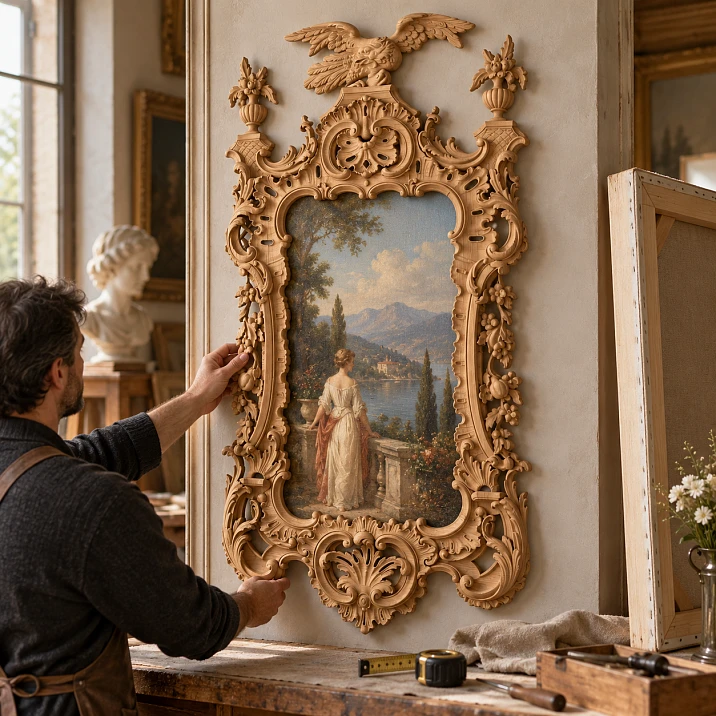
The painting is already stretched on a stretcher frame 38 mm thick. The RM-046 card specifies a size of 1518 × 780 × 44 mm, and the first arithmetic comparison looks promising: 44 − 38 = 6 mm. But these six millimeters do not yet exist as a confirmed mounting allowance. The parameter C=44 mm in the product line is not called the useful depth of the mounting rabbet, so it cannot be directly compared with the thickness of the stretcher frame.
Purchasing an expensive ready-made frame requires a different approach. First, measure the painting itself: the outer width and height of the stretcher frame, maximum thickness, both diagonals, and all protrusions on the back. Then, using the current RM-046 drawing, confirm the internal mounting contour, the width and depth of the rabbet, the method of fixation, and the position of the stretcher frame relative to the back plane of the frame. Only after this can you answer whether a specific painting fits.
RM-046 is indeed intended not only for mirrors: the manufacturer indicates the possibility of using the frame for paintings as well. But this confirms the purpose of the product in general, not compatibility with any canvas on a stretcher frame.
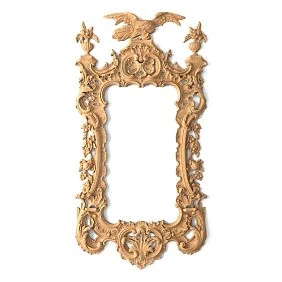
Carved wooden frame RM-046: what the dimensions 1518 × 780 × 44 mm confirm
The RM-046 card records one dimension line A × B × C = 1518 × 780 × 44 mm. Beech and oak are available, with sanding levels "Standard" and "Prestige". The average production time for custom orders is stated as 5–10 days. For the selected option, the card may also display the glue joint quality "Under enamel".
| Parameter | Confirmed for RM-046 |
|---|---|
| Article number | RM-046 |
| Size A × B × C | 1518 × 780 × 44 mm |
| Material | Beech / Oak |
| Sanding | "Standard" / "Prestige" |
| Application | mirrors and paintings |
| Beech, "Standard" | 132 000 ₽ |
| Beech, "Prestige" | 169 410 ₽ |
| Oak, "Standard" | 170 800 ₽ |
| Oak, "Prestige" | 208 220 ₽ |
Price as of the check date — September 7, 2026. Before placing an actual order, it should be re-verified in the product card.
The main mistake begins when the three catalog letters are automatically renamed into terms understandable to the buyer. A and B cannot be considered the internal dimensions for the painting without a drawing, and C cannot be declared as the rebate depth. A finished frame has several different geometries: the outer decorative dimension, the visible opening, the rear mounting zone, the profile body, and the overall projection. Which specific value C represents must be confirmed by the manufacturer's drawing.
Therefore buy carved wooden frame RM-046 reasonable after checking the mounting assembly, not just after comparing two numbers 38 and 44.




Painting stretcher frame 38 mm: what to measure besides thickness
Thickness of 38 mm is only one parameter of the finished painting. For compatibility with the frame, the framer or manufacturer needs the actual dimensions of the stretcher, not the size of the painted scene on the front side.
Measure the outer width and outer height of the wooden stretcher at several points. An old or large stretcher may have slight deformation; if you measure only one side, this will not be apparent. Then measure both diagonals from corner to corner. Their difference shows how much the actual shape deviates from a perfect rectangle, but a universal allowable limit without a frame project does not need to be assigned.
Thickness is also not measured in just one place. The maximum protruding dimension is taken as the baseline value for checking, because locally the wood, folded canvas, staple, or wedge may exceed the stated 38 mm.
Separately inspect the back side. Note the following:
- metal staples and places where they protrude;
- wooden wedges in the corners;
- hangers, hinges, wire, or other elements, if they are already installed;
- irregularities in canvas tension along the side edges;
- damage or deformation of corners.
It is better to photograph all protrusions next to a ruler. This allows not to argue about the wording "approximately 38 mm", but to compare the real object with the RM-046 cross-section.
Our factory also produces:
C=44 mm and stretcher 38 mm: why the 6 mm difference proves nothing yet
The arithmetic is correct:
44 − 38 = 6 mm.
Only the next step is erroneous: calling 6 mm free clearance. To do this, one would first have to prove that C=44 mm is precisely the useful depth of the rabbet and that all this depth is available for the stretcher. The card does not provide such a statement.
It is useful to imagine a cross-section of the finished framing. At the front is the decorative profile of the frame. Behind it is the body of the wooden structure. On the inner rear side there may be a rebate, or rabbet, on which the inserted element rests. The stretcher must fit into this joint, after which it still needs to be secured. The thickness of the entire profile and the depth of the available rabbet are different values.
| What is being compared | What is known now | What is missing |
|---|---|---|
| Stretcher thickness | maximum 38 mm per original measurement | recheck protrusions |
| Frame parameter C | 44 мм | assign C per drawing |
| Rebate depth | Not confirmed | Obtain from DWG/drawing |
| Rebate width | Not confirmed | Obtain from drawing |
| Internal mounting size | Not confirmed | Match with picture width/height |
| Securing the artwork | Not confirmed | Agree on the method and completeness |
If the drawing shows a useful depth of less than 38 mm, RM-046 is not suitable for this component without a separate design solution. If the depth is greater than 38 mm, the width and height of the seat, the overlap of the front part, and the method of fixation still remain. That is, even a positive answer on depth does not complete the check.
Get Consultation
What RM-046 drawing does a framer need before purchasing the frame
Before payment, not just a general view of the frame is needed, but a cross-section and dimensions of the rear seating part. In the request to the manager or manufacturer, one should directly list what data is required for an existing artwork.
First, the inner seating contour. It must be matched with the outer width and height of the stretcher. Second, the depth of the rabbet. It is this, not the overall size C, that needs to be compared with the actual thickness of the artwork. Third, the width of the rabbet, because it determines the support shelf and affects the overlap of the image edge.
It is also necessary to understand the shape of the rear part of the frame: whether there are protrusions, ledges, decorative elements, or other areas that limit space. Separately, ask how the manufacturer intends to secure the artwork in RM-046 and whether the corresponding element is included in the delivery of the specific version.
A working table before ordering might look like this:
| Parameter | Artwork | RM-046 | Status |
|---|---|---|---|
| Outer width of stretcher | ___ mm | mounting size ___ mm | Check |
| outer height of the stretcher frame | ___ mm | mounting size ___ mm | Check |
| maximum thickness | 38 мм | rebate depth ___ mm | do not confuse with C=44 |
| Diagonal 1 | ___ mm | Seating contour | Check |
| Diagonal 2 | ___ mm | Seating contour | Check |
| maximum rear protrusion | ___ mm | allowable zone ___ mm | Check |
| Fixation method | existing / remove | according to scheme RM-046 | Approve |
Before filling out this table, the buyer knows the external product dimensions, but does not yet know the mounting compatibility.
If the RM-046 fit is not confirmed, but the ready-made carved frame format is needed, you can first buy picture frames and select models based on the verified internal assembly.
How to match a stretcher with drawing RM-046 before physical fitting
When the manufacturer sends the current drawing, don't limit yourself to reading the numbers in the table. Convert them into two clear diagrams: a rear view and a cross-section. The rear view should show the inner seating contour of the frame. The cross-section should show the depth and width of the rabbet, the rear plane of the frame, and the intended position of the stretcher.
Then, overlay the actual rectangle of the painting onto this diagram. Use the outer dimensions of the stretcher, not the image size. If the stretcher is old and the diagonals differ, it's useful to mark not the ideal rectangle "per spec," but the real geometry of the four corners.
The check is carried out in two planes. From the rear view, you need to ensure that the entire external geometry of the stretcher fits within the mounting contour, taking into account the actual corners. From the cross-section, ensure that the maximum thickness and rear protrusions do not conflict with the rabbet depth, fasteners, and future hanging hardware.
A convenient working technique is to print the mounting part at 1:1 scale or make a rigid template based on confirmed dimensions. Such a template does not replace the RM-046 itself, but allows you to detect obvious discrepancies before payment and delivery. For an expensive painting, it is better to have the final decision confirmed by a framer or craftsman who will assemble the framing.
If physical fitting is possible, it should be done before final irreversible operations. Check the fit at all four corners, the position of the front overlap, the rear protrusion, and the possibility of standard fixation. A fitting cannot be considered successful if the painting only goes in with force, misalignment, or a promise to "slightly trim it later."
It is this check that turns the question "Is 38 mm less than 44 mm?" into a proper technical decision: the stretcher is either compatible with the confirmed RM-046 seating or it is not.
Image size and stretcher size are not the same thing
A painting has several boundaries, and when ordering a frame, they must not be mixed. The visible pictorial field is what the viewer should see. The canvas continues onto the side edges of the stretcher and is secured at the back. The wooden stretcher itself has external width and height. The frame, in turn, partially overlaps the edge of the work with its inner profile.
If near the edge there is an author's signature, date, a fragment of the composition, or a deliberately left margin, the amount of overlap becomes artistically significant. You cannot simply ensure that the wooden rectangle physically fits into the rabbet; you also need to make sure that the finished frame will not cover an important part of the work.
Therefore, when requesting a drawing, not only "internal dimensions" are needed. It is useful to obtain or determine the sight opening—the part of the painting that will remain visible after installation. A universal overlap value for RM-046 cannot be assigned without a drawing.
The general algorithm for selecting a profile and size can be additionally cross-checked in the material how to choose a wooden frame based on the size of the painting and stretcher, but for RM-046 the specific cross-section remains decisive.
The stretcher protrudes beyond the rear plane of the frame: is this acceptable
The protrusion of the stretcher to the rear by itself does not give an unambiguous answer of "yes" or "no." In different framing systems, the insert may be fully inside the rabbet, partially extend beyond the rear plane, or be secured by separate elements. For an expensive finished RM-046, this issue cannot be resolved by analogy with another frame.
If the stretcher protrudes, at least three things need to be checked. First, whether a reliable support on the rabbet and correct fixation remain. Second, whether the protrusion interferes with the hanging system and the frame's fit against the wall. Third, whether installing it requires modifying the back of the finished carved frame without the manufacturer's approval.
The buyer should not plan in advance to "slightly remove wood from the back" or reduce the stretcher. Such intervention changes the construction and may damage the expensive item or the painting. If the standard fit is not suitable, another framing method is considered first.
Beech or oak for RM-046: finish is chosen after checking the artwork
Material and sanding quality only matter after answering the question of fit. Otherwise, it's easy to waste time choosing an oak shade or preparing beech for enamel, only to find out that the finished stretcher frame doesn't install in RM-046 at all.
The product card has four main price options:
| Execution | Price at the time of check |
|---|---|
| Beech, "Standard" | 132 000 ₽ |
| Beech, "Prestige" | 169 410 ₽ |
| Oak, "Standard" | 170 800 ₽ |
| Oak, "Prestige" | 208 220 ₽ |
"Standard" and "Prestige" refer to surface finish quality. The "For enamel" designation refers to blank preparation and does not mean the frame is already painted white or another chosen color. Before ordering the finish, check the section choose sanding quality and wood preparation.
For the artwork, the frame color is checked next to the piece itself. Light enamel, dark tinting, natural oak, and complex decorative coatings change the perception of the painting differently. The sample should be evaluated not only near furniture and walls, but also next to the canvas under the lighting where it will hang.
How much does RM-046 cost and why the fit must be checked before payment
RM-046 is an expensive ready-made carved frame, so a compatibility error is especially frustrating. The difference between the minimum and maximum configurations in the current table is:
208 220 − 132 000 = 76 220 ₽.
But even 132,000 ₽ is the price of the frame, not a guarantee of a finished installed framing for the artwork. The full budget may separately include final finishing, adaptation or securing of the painting, hanging hardware, packaging, delivery, and installation.
This leads to the correct sequence. First, geometry is confirmed, then material and preparation, after which a final quote is requested. The reverse sequence—paying for a beautiful expensive frame first and then looking for a way to "force" an existing stretcher frame into it—creates unnecessary risk.
Before issuing an invoice, it is useful to check the payment and delivery terms for the wooden frame and separately clarify what exactly is included in the specific delivery.
RM-046 does not fit a 38-mm stretcher: what to do instead of reworking an expensive frame
The compatibility check may result in rejecting RM-046, and this is a normal commercial outcome.
If the inner seating contour, rebate depth, and fixing method are suitable, you can proceed with the selected RM-046 version. If not, you should not automatically modify the finished carved frame on site. It is more reasonable to return to a solution built around the actual picture.
One such path is a wooden molding. The linear profile allows assembling a frame to the specific external dimensions of the stretcher and the required seating depth. This is a different product scenario: the profile is selected based on the actual work, after which the framer calculates the frame structure.
In such a case, a transition is useful Buy wooden picture frame molding for paintingsIt does not mean that any baguette automatically fits 38 mm: the selected profile also has its rabbet checked. The advantage of this path is that the framing is designed around the existing artwork, rather than the artwork being adjusted to fit a pre-selected ready-made frame.
If you want to keep the format of the finished carved frame, you can first buy picture frame from the corresponding category and compare only those models for which the mounting dimensions are confirmed for a specific stretcher.
Which mistakes are especially costly when buying RM-046
The first mistake is recording C=44 mm as "rebate 44 mm". The reason is clear: there is a 38 mm stretcher nearby, and the arithmetic creates a feeling of a ready answer. The consequence is an order based on incomparable dimensions. Prevention is to request the purpose of C and the actual rebate depth from the drawing.
The second mistake is measuring only the thickness of the painting. Even perfect depth will not help if the external width or height of the stretcher is larger than the seating contour. Therefore, all dimensions and diagonals are needed.
The third mistake is using the size of the painted field instead of the size of the wooden stretcher. The canvas may be folded over the sides, and the frame rests on completely different geometry. For seating, the physical object is measured from the back.
The fourth mistake is not accounting for wedges and staples. A local protrusion can make the actual maximum thickness exceed 38 mm. The most protruding area must be checked.
The fifth mistake is choosing material and expensive finishing before geometric verification. It does not make the product more compatible. First seating, then aesthetics.
The sixth mistake is assuming in advance that the painting protruding backward is acceptable. This depends on the back cut, fixation, and hanging. Without this data, the answer is unknown.
The seventh mistake is planning self-modification of RM-046. For a finished complex carved frame, such an operation must be coordinated with the manufacturer, otherwise the risk of damage is disproportionate to the attempt to save time on selection.
What to write to the STAVROS manager before ordering RM-046 for a painting
A good request allows the manager to understand the task without a long correspondence. It is useful to separate product data and painting data.
RM-046 / 1518 × 780 × 44 mm / selected material / selected sanding.
There is a finished painting on a stretcher with an external size of ___ × ___ mm, the maximum measured thickness is 38 mm. Diagonals are ___ and ___ mm. On the back side there are/are no protruding staples, wedges, and hanging hardware.
We ask to confirm according to the current drawing the internal seating contour, the depth and width of the rabbet, the possibility of installing this stretcher, the permissible position relative to the rear plane of the frame, the method of fixation, and the completeness of RM-046 when used for a painting.
Photos of the front side, the entire back side, four corners in close-up, and problematic protrusions next to a ruler are added to the request. Such a set does not replace a physical fitting but makes the technical question specific.
After confirming the dimensions, the material, "Standard" or "Prestige", the required preparation for finishing, the delivery address, and the agreed pickup option are added to the same request.
When not to buy RM-046 yet
The purchase should be postponed if C=44 mm is already recorded in the project as the rabbet depth, but the drawing does not confirm this. The same applies to a situation where only the thickness of 38 mm is known, and the external dimensions of the stretcher and diagonals have not been measured.
RM-046 should not be ordered until the light opening and the overlap of the painting edge are clear. A physically compatible frame may turn out to be artistically unacceptable if it covers a signature or an important part of the composition.
A separate stop signal is a noticeable skew of the old stretcher. In this case, you first need to understand the actual geometry of the painting and decide whether its installation is acceptable without adjustment.
Purchasing is also premature when the fixation is not agreed upon or you plan to mill/trim the expensive ready-made RM-046 "on site" yourself. If the standard fit is not confirmed, it is safer to choose a different frame.
FAQ: RM-046 and a painting on a 38 mm stretcher
What does C=44 mm mean for RM-046?
This is the catalog parameter C in the line A × B × C = 1518 × 780 × 44 mm. Without a drawing, you cannot independently declare it as the depth of the seating rabbet.
Is C equal to the rebate depth?
This does not follow from the product card. To answer, an up-to-date cross-section of RM-046 with dimension assignments for the seating part is required.
Will a 38 mm thick stretcher fit into RM-046?
Based on one dimension of C=44 mm, it is impossible to answer. It is necessary to confirm the depth of the rebate, internal width and height, rear protrusions, and the method of fixation.
Why can't 6 mm be considered as a margin?
Because the calculation 44 − 38 compares a frame parameter of unknown purpose with the thickness of the stretcher. The margin will only appear if 44 mm actually turns out to be the useful seating depth, which has not yet been confirmed.
What dimensions should be taken from the painting before ordering?
The external width and height of the stretcher, maximum thickness, both diagonals, and maximum rear protrusions. Additionally, the position of a signature or important image near the edge is recorded.
Why measure the diagonals?
They help detect warping of the stretcher. For an old painting, identical nominal width and height at the edges do not yet guarantee a perfect rectangle.
What is the internal size of RM-046?
It is not confirmed in the provided data. It needs to be obtained from the current drawing and compared with the actual external size of the stretcher.
What is a seating rabbet?
This is the rear inner quarter/rebate of the frame, in the area where the insert element is placed and supported. For RM-046, the specific width and depth of the rebate must be confirmed against the drawing, not transferred from general examples.
Can the painting protrude beyond the rear plane of the frame?
Sometimes such a scheme is structurally possible, but for RM-046 it cannot be considered acceptable without confirmation of the rear assembly, fixation, and suspension.
Is RM-046 suitable for paintings at all?
Yes, the manufacturer allows the use of RM-046 for paintings and mirrors. This confirms the model's purpose, but does not guarantee compatibility with a specific 38-mm stretcher frame.
Is the painting mounting hardware included in the price of RM-046?
In the source data, the composition of such hardware is not confirmed. The completeness and method of fixation need to be requested separately for using the frame with a painting.
What to choose — beech or oak?
After checking the fit, the material is chosen based on the artistic task, interior, and finish. Beech is convenient for opaque finishing schemes, oak is often chosen for its pronounced wood texture, but the specific finish is still agreed upon separately.
What does 'for enamel' mean?
This is a characteristic of the preparation/quality of the blank for an opaque coating, not a ready white paint finish.
How much does RM-046 cost?
As of the check on September 7, 2026: from 132,000 ₽ for beech "Standard" to 208,220 ₽ for oak "Prestige". The current price should be verified before payment.
What to do if RM-046 is not suitable?
Don't force an expensive ready-made frame blindly. You can choose another ready-made model with confirmed fit, or switch to a wooden molding and design a frame for the actual painting.