Article Contents:
- KZ-007 for a wholesale order: which parameters must be fixed before calculating the batch
- What needs to be determined before the commercial inquiry
- The cornice is removed as a whole
- The cornice is divided into several removable sections
- The cornice remains on individual carcasses
- One-piece removable section
- Several removable sections
- Why the position of the butt joint must be planned in advance
- Case dimensions and decorative part dimensions are different schedules
- Furniture dimensions
- Ready-made decorative parts
- Before ordering, check access to the fasteners after the wardrobe is installed
- What is approved at the joint
- What to check after reassembly
- Disassembly must be checked with the same packaging that will go into delivery
- The result of the trial assembly must be an approved set
- Actual cutting map
- Dense cutting must be confirmed by production
- Why identical parts are not always interchangeable between cabinets
- When it is better to design interchangeable sets
- How to count twenty sets if parts are individually fitted
- To supplier KZ-007
- Furniture manufacturing
- Why this separation protects against incorrect expectations
- Control sample
- Production reserve
- Repair reserve
- Why a whole spare strip is more useful than random short offcuts
- The reserve for a dismountable series is best determined after reassembly
- How to label parts after cutting
- Marking must not remain on a visible surface
- Packaging of commercial blanks and packaging of finished furniture parts are different tasks
- Reassembly must follow the same documents as the actual installation
- What counts as a successful reassembly
- Why a joint above a carcass connection can be convenient, but is not mandatory
- How to work with side end pieces
- Why side end pieces are especially convenient for using up leftovers
- How to keep track of a part's identity after finishing
- Why two suppliers cannot be compared by the total sum "per cornice"
- You cannot give a profile supplier a furniture task in the form of "make twenty sets"
- How to submit a request to a supplier
- Why material KZ-007 cannot be changed after calculation without a new check
- How to separate a reference sample, production reserve, and repair stock
- Control sample
- Production reserve
- Repair reserve
- When a whole strip is more useful than a ready-made spare part
- How to store the repair reserve after furniture handover
- What to check when accepting a consignment
- What to check after cutting
- Why packaging markings matter more than the label on the part itself
- How many sets can be shipped in one transport unit
- What happens if parts from two wardrobes are mixed up
- How to prove interchangeability in practice
- Why serial furniture benefits from standard part codes
- What to do if the wardrobe design changes after the first batch
- Why you can't just install
- How to account for grain direction on solid wood
- Why MDF under enamel is easier for interchangeability
- How to label a revision of a set
- What to do with leftovers from the old revision
- How to estimate the real savings from serial production
- When a cutting map becomes part of a commercial proposal
- How to calculate the cost of one set
- How not to count the repair reserve twice
- How to work with staged delivery
- Stage 1
- Stage 2
- Why the first batch should not be too small
- When KZ-007 should not be chosen at all for modular furniture
- How to check the scale of KZ-007 on a cabinet facade
- Why you cannot replace KZ-007 with another cornice based only on a similar photo
- Why the passport must store the revision
- How to check the transport length before approving a solid section
- Why you cannot automatically split by the maximum vehicle length
- How to check that the finished joint is reproducible after three assemblies
- What to do if reassembly requires "hand tightening"
- How to evaluate the joint after reassembly
- Geometric
- Visual
- Operational
- How to work with different finishes within one cabinet series
- How to account for a height change from 100 to 95 mm on furniture
- What comes from the supplier
- What leaves the furniture workshop
- How to work with leftovers after cutting
- When the remainder cannot be considered a reserve
- How to hand over a kit to the site without dependence on a specific assembler
- When the modular curtain rod system is truly ready for scaling
- Why the final reorder must restore not only the profile but also the cabinet version
- Why serial production should be evaluated after delivery, not only in the workshop
- How to tell that a batch is ready for payment
- 1. Ordering only the total linear meters
- 2. Treating KZ-007 as a ready-made removable system
- 3. Not checking reassembly
- 4. Dividing the curtain rod strictly by cabinet units without design verification
- 5. Leaving joints "on site"
- 6. Treating body dimensions as decorative part dimensions
- 7. Not specifying the measurement point of a cut part
- 8. Confusing supplier's kit and workshop cutting
- 9. Considering 72 m a sufficient order without a map
- 10. Do not label finished parts
- 11. Not checking interchangeability
- 12. Make one shared reserve
- 13. Changing material without a new revision
- 14. Not checking packaging of finished parts
- 15. Placing a reorder only as "KZ-007, 5 pieces"

When a decorative cornice is installed on a single built-in wardrobe, many things can be resolved during assembly: trim a section, choose the joint point, change the installation sequence. In a series of 20, 40, or 100 identical wardrobes, such freedom quickly turns into a problem. If the furniture is assembled in the workshop, then disassembled for transport and reassembled at the customer's site, the decorative cornice must go through the same cycle without new fitting at each location.
That is why buying KZ-007 cornice wholesale for serial knock-down furniture should not be based on the formula "wardrobe width × number of sets." First, the designer determines how the cornice is connected to the carcasses, whether it is removed entirely or in several sections, where the joints run, which parts must be interchangeable between wardrobes, and how the set survives a test disassembly and reassembly.
Only after that is the batch of commercial strips calculated.
Main principle:
approved wardrobe design → KZ-007 removable section scheme → test disassembly → finished parts map → cutting → number of standard strips → reserve → order.
It is important to immediately separate two concepts.
KZ-007 — a ready-made profile.
A removable furniture cornice is a design assembly that a furniture manufacturer creates based on the selected profile.
The fact that KZ-007 is used on a wardrobe does not mean that the manufacturer sells it as a ready-made quick-release system with universal mounting. The fastening method, the possibility of dismantling, access to connections, and reinstallation must be verified by the designer of the specific furniture.
KZ-007 for wholesale order: which parameters must be fixed before calculating the batch
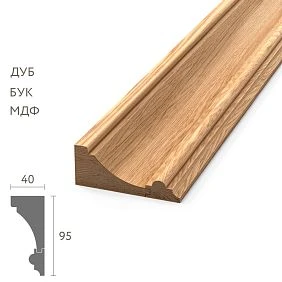
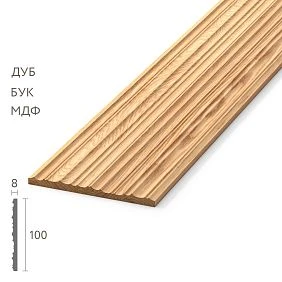
According to the current STAVROS KZ-007 product page, it comes in different versions depending on the material:
| Material | Section | Product length |
|---|---|---|
| MDF | 100×40 mm | 2600 мм |
| Beech | 95×40 mm | 2400 мм |
| Oak | 95×40 mm | 2400 мм |
Product card: buy cornice KZ-007.
This SKU has an important feature: MDF and solid wood differ not only in length, but also in profile height.
This means that the line:
KZ-007 — 50 pcs.
insufficient.
The minimum working entry should show:
-
material;
-
cross-section;
-
product length;
-
quantity;
-
finishing;
-
purpose.
For example:
KZ-007 / oak / 95×40×2400 / T-01 / cabinet SH-01 / 48 pcs.
Or:
KZ-007 / MDF / 100×40×2600 / E-01 / cabinet SH-02 / 36 pcs.
For the topic of this article, it is especially important not to automatically transfer the MDF 2600 mm map to oak or beech 2400 mm. But the central task here is different: even a selected and correctly calculated strip must become part of a repeatable removable furniture assembly.




What needs to be determined before the commercial request
Before sending the request to the supplier, the furniture production must understand:
-
which material is selected;
-
which profile height is included in the design;
-
how the wardrobe is divided into transport cabinets;
-
whether the cornice remains on the cabinets;
-
whether the cornice is removed entirely;
-
whether it is divided into several sections;
-
where the straight joints are located;
-
where the corner joints are located;
-
how the sections are labeled;
-
which details must be identical between the cabinets.
If this data is missing, the number of linear meters does not yet turn into a correct wholesale order.
Our factory also produces:



Why the cornice must be coordinated together with the collapsible cabinet structure
Let's imagine a furniture production facility that makes 20 identical bookcases.
In the workshop, the cabinet is assembled completely:
-
the carcasses are joined;
-
the fronts are adjusted;
-
the top line is aligned;
-
KZ-007 is installed;
-
the finished product looks like a single unit.
For delivery, the library is disassembled into three cabinets.
A key question arises:
what happens to the cornice?
Various design schemes are possible.
Get Consultation
The cornice is removed entirely
The advantage is fewer direct joints on the furniture facade.
But you need to check:
-
whether the long part can be safely removed;
-
whether it fits into the transport packaging;
-
how the corners are protected;
-
whether it can be reinstalled without new trimming;
-
is the fastening accessible after installing the cabinets against the wall?
The cornice is divided into several removable sections
Easier to transport.
But more joints appear.
It is necessary to determine in advance:
-
exactly where they are located;
-
how they align after reassembly;
-
whether the joints remain the same on all 20 cabinets;
-
whether parts from different cabinets can be mixed up.
The cornice remains on individual carcasses
Sometimes this can be structurally convenient.
But it is necessary to check the transportation of each cabinet together with the protruding decorative profile.
None of the three schemes is universally correct.
The correct one becomes the one that has passed a control cycle on a specific wardrobe.
A one-piece removable section or several parts: which is more important for the series
A wholesale batch must serve the serial process, not simply provide the required linear meters.
One-piece removable section
Advantages:
-
fewer visible straight joints;
-
it is easier to maintain a single pattern of the top line;
-
fewer parts in the set.
Limitations:
-
transport length;
-
packaging;
-
risk of damage to a long part;
-
access to the mounting;
-
difficulty of reinstallation.
Several removable sections
Advantages:
-
easier to transport;
-
easier to assemble by carcasses;
-
a separate section can be replaced.
Limitations:
-
more joints;
-
higher repeatability requirements;
-
parts must be marked;
-
moving a section to another cabinet by mistake can change the joint alignment.
Main conclusion:
the joint does not have to align with every cabinet carcass connection.
If three cabinets are joined into one wardrobe, the decorative cornice may have two, three, or another number of sections — if this is confirmed by the design.
A joint cannot be placed automatically:
above each inter-cabinet connection.
This is only one of the possible options.
Why the position of a straight joint must be planned in advance
Let's imagine the top line of a wardrobe is 2700 mm.
The commercial length of oak KZ-007 is 2400 mm.
A single 2700 mm piece cannot be made from a standard plank.
At least one straight joint is needed.
Question:
where will it be?
You can create:
2400 + 300.
But a short 300 mm filler may look accidental.
Allowed:
1350 + 1350.
Joint in the center.
The joint can be tied to the cabinet edge.
Which option is better is decided by the project.
What matters for the series is something else:
all identical cabinets Sh-01 must receive one approved scheme.
If one cabinet is assembled as 2400+300, the second as 1800+900, and the third as 1350+1350, the production process is no longer repeatable.
Cabinet dimensions and decorative part dimensions are different specifications
It is a mistake to assume:
cabinet 900 mm → cornice also 900 mm.
A finished decorative section can:
-
extend beyond the cabinet;
-
cover the joint;
-
end at the side panel;
-
have a corner cut;
-
continue over two cabinets.
Therefore, the designer needs two groups of dimensions.
Furniture dimensions
-
width of each cabinet;
-
total width;
-
depth;
-
side protrusions;
-
position of the end panels.
Finished decorative parts
-
front sections;
-
side endings;
-
corner elements;
-
lengths between cuts;
-
measurement point;
-
part code.
If the part has 45° cuts, the line:
900 мм
may be ambiguous.
The diagram must show between which points the length was measured.
Before ordering, it is necessary to check access to the fasteners after installing the cabinet
The control assembly should answer not only the question:
can the cornice be removed in the workshop?
It is necessary to check the actual sequence at the customer's site.
After installing the cabinets, restrictions may appear:
-
the wall is too close;
-
the ceiling prevents lifting the part;
-
the adjacent cabinet blocks the fastener;
-
the facade blocks access;
-
the cornice cannot be moved to the side.
If dismantling is only possible for a freestanding cabinet in the workshop, this does not yet confirm the maintainability of the finished product.
Therefore, it is useful to have the following in the working drawing:
the sequence for removing KZ-007 after furniture installation.
The article does not specify a particular fastening method. This is the furniture designer's task.
The connections must be agreed upon before launching the entire furniture series
A facade scheme is created for Ш-01.
It marks:
-
cabinet joints;
-
straight cornice joints;
-
corner terminations;
-
removable sections;
-
installation direction.
Separate units are created for those joints that differ.
For example:
С-01 — straight joint of the front sections.
С-02 — transition of the front part into the side.
С-03 — termination at the wall.
Such a structure is much stronger than the phrase:
join carefully on site.
What is coordinated at the joint
-
appearance;
-
place;
-
access to the mounting;
-
removal sequence;
-
re-installation;
-
possibility of replacing one part;
-
finishing of the ends.
No need to promise:
the detachable joint will be absolutely invisible.
A more realistic goal:
the joint must be pre-agreed, repeatable, and not require new fitting after transportation.
The control cabinet must be assembled, disassembled, and reassembled
This is the central check of the entire article.
A beautiful first assembly is not enough.
The correct test:
-
assemble the cabinet in the workshop;
-
install KZ-007;
-
check visible joints;
-
fully remove decorative sections in the prescribed sequence;
-
mark;
-
pack as it would be for actual transport;
-
unpack;
-
reassemble;
-
install the same parts without new trimming.
Only after this can the design be considered production-ready.
What to check after reassembly
-
do the joints match;
-
whether the length has been preserved;
-
whether the ends are damaged;
-
whether the finish is undamaged;
-
the parts do not require re-trimming;
-
no gaps have appeared due to mixed-up sections;
-
access to the fasteners is realistic;
-
the marking is clear to the assembler.
If during the second assembly you have to:
sand down slightly,
the serial process is not yet closed.
Disassembly must be checked with the same packaging that will go into delivery
Sometimes inspection is done too leniently:
-
removed the cornice;
-
placed it nearby;
-
put it back after ten minutes.
This does not simulate transportation.
At least the principle needs to be checked:
-
how the profile is protected;
-
where the long sections are placed;
-
how the ends are protected;
-
whether other parts press on them;
-
how the set does not get mixed up with the neighboring cabinet.
The article does not define a universal packaging solution. It depends on the material, finish, and logistics.
But a control re-assembly without checking the packaging logic is incomplete.
The result of the control assembly should be an approved set
After a successful test, the following appears:
Ш-01 / cornice set / revision 1.
It contains:
-
list of parts;
-
sizes;
-
type of connections;
-
removal sequence;
-
marking;
-
packaging scheme;
-
material;
-
finishing.
Now you can count not just one beautiful sample, but 20 identical sets.
How to convert twenty furniture sets into the number of product strips
After the control assembly, real finished parts appear.
Suppose one cabinet SH-01 requires:
| Detail | Quantity | Length of one part |
|---|---|---|
| Front section | 3 | 900 мм |
| Side end | 2 | 450 мм |
For 20 sets:
60 parts of 900 mm;
40 parts of 450 mm.
Net total length:
60×900 + 40×450 = 54,000 + 18,000 = 72,000 mm = 72 m.
If solid wood KZ-007 with a length of 2400 mm is selected, simple division:
72,000 / 2400 = 30 strips.
But this is only the mathematical minimum based on net linear meters.
It does not take into account how the parts are actually placed on the original bar.
Actual cutting map
One possible combination:
900 + 900 + 450 = 2250 mm.
Up to 2400 remains:
150 mm to account for the actual cut and trimming.
If this is done 30 times, we get:
-
60 parts of 900;
-
30 parts of 450.
There still remains:
10 pieces of 450 mm each.
From one 2400 mm strip, theoretically:
450×5 = 2250 mm.
This means two more strips yield:
10 side pieces.
Total:
32 strips of 2400 mm with no separate reserve.
This is why wholesale purchasing should not stop at the figure:
72 meters are needed.
The buyer needs 32 commercial blanks according to the accepted cutting map, not the mathematical 30.
The dense cutting layout must be confirmed in production.
In combination:
900 + 900 + 450 = 2250 mm
150 mm remains.
This looks comfortable.
But the article should not automatically treat the entire remainder as a technological allowance.
Need to consider:
-
kerf width;
-
end trimming;
-
possible edge defect;
-
accuracy of the finished length;
-
cuts;
-
finishing of the ends.
A furniture production technologist confirms that the actual 900 and 450 mm are obtained from the selected workpiece without risk.
If not, the map is adjusted.
Why identical parts are not always interchangeable between cabinets
On paper, the front section P-01 with a length of 900 mm is the same for all 20 cabinets.
But after a test assembly, it may turn out that each set is individually fitted.
For example:
-
the carcasses have slight actual differences;
-
the joint is tied to a specific left/right part;
-
the finish is matched by batches;
-
the joint is fitted within a specific pair.
In this case, the marking must link the parts to a specific cabinet.
For example:
C-01 / set 07 / P-1.
If the control batch has proven full interchangeability, warehousing and production can be simplified.
The main rule:
interchangeability must be verified, not assumed.
When it is better to design interchangeable sets
For serial production, this is a strong advantage.
If all front sections are truly identical and reproducible, you can:
-
make spare parts;
-
repair faster;
-
label more easily;
-
reduce the risk of a kit assembler's error.
But this can only be achieved through stable furniture geometry and an approved assembly.
If "universality" means having to adjust on site every time, the system stops being a serial product.
How do you count twenty sets if the parts are individually fitted?
Then the specification remains serial at the level of product strips, but the kit assembly is individual.
For example:
-
cabinet 01 — set K-01;
-
cabinet 02 — K-02;
-
cabinet 03 — K-03.
All use KZ-007 of the same version.
But the finished parts are not mixed.
This is especially important after finishing: visually identical parts are easy to confuse.
Two lists are required: for the supplier and for the furniture workshop
The profile supplier and the furniture workshop solve different tasks.
To supplier KZ-007
Transferred:
-
article number;
-
material;
-
standard cross-section;
-
product length;
-
number of whole slats;
-
finish or condition for finishing;
-
delivery requirements.
For example:
KZ-007 / oak / 95×40×2400 / T-01 / 32 pcs. + reserve.
For furniture manufacturing
Transferred:
-
cabinet code;
-
finished part;
-
length;
-
end type;
-
corner cut;
-
kit;
-
processing procedure;
-
marking.
STAVROS does not perform custom cutting or trimming of profiles to size, so we cannot promise that the customer receives a finished furniture kit at the same time as purchasing standard slats.
A product order and furniture cutting are different stages.
Why this separation protects against incorrect expectations
If the client says:
I need 20 KZ-007 kits for wardrobes,
this is not yet a product specification.
The supplier can sell standard slats.
But someone must:
-
make cutting;
-
make the cuts;
-
prepare the joints;
-
mark;
-
pack;
-
check reassembly.
These operations belong to furniture manufacturing or another contractor, not automatically to profile sales.
What reserve is needed for repeatable furniture sets
Formula:
plus 10%
too coarse.
For a dismountable series, you need to understand exactly what may need to be replaced.
There are three types of reserve.
Control sample
One set or part of a set that is stored as a reference.
Production reserve
Material for:
-
defects;
-
damage during cutting;
-
rework of the first series;
-
labeling error.
Repair reserve
For future replacement after handover.
These three tasks do not have to share the same percentage.
Why a whole spare plank is more useful than random short offcuts
If a 450 mm side section is damaged, a short leftover piece can help.
If a 900 mm front section is damaged, a longer piece is needed.
If a solid 2300 mm section is damaged, short leftovers are useless.
Therefore, it is better to store the reserve according to length capabilities.
For example:
-
2 whole strips 2400;
-
several useful short offcuts;
-
one ready-made front part.
This way the reserve truly matches the risks.
The reserve for a dismountable series is better determined after reassembly
A control cycle may reveal an unexpected weak point.
For example:
-
the ends of the side parts are often damaged during removal;
-
long front sections are stable;
-
one type of joint requires more careful packaging.
Then the reserve is adjusted.
There is no need to insure all parts equally before testing.
How to mark parts after cutting
The markings must survive:
-
workshop;
-
finishing;
-
packaging;
-
transportation;
-
reassembly.
For example:
C-01 / set 07 / P-1.
Ш-01 / set 07 / Б-Л.
Ш-01 / set 07 / Б-П.
Where:
-
П — front section;
-
Б-Л — left side;
-
Б-П — right side.
If the left and right sections are completely identical and interchangeable, the code does not need to be complicated.
But this must be established by the design.
Marking must not remain on a visible surface
The method is selected taking the finish into account.
Suitable options:
-
tags;
-
labels on the packaging;
-
marking on the invisible side;
-
packing list;
-
QR code.
The main point:
after delivery, the assembler clearly understands which part goes where.
Packaging of pre-production blanks and packaging of finished furniture parts are different tasks
Before cutting, the supplier packages standard strips for safe transportation.
After processing, the furniture workshop packages the finished parts.
At the second stage, it is important to:
-
not mix up the sets;
-
protect the cuts;
-
protect the finish;
-
not press on the protruding profile;
-
preserve the labeling.
The article does not specify a universal packaging material.
But it requires checking the packaging in a control cycle.
Reassembly must follow the same documents as the actual installation
Bad test:
the craftsman who made the cabinet remembers everything and reassembles it himself.
This tests the craftsman's memory, not the system.
Stronger:
-
the kit is labeled;
-
there is a diagram;
-
another assembler or the same assembler works from the document;
-
the parts are present after packaging;
-
new cutting is prohibited.
If the system works only because one person remembers every joint, it scales poorly.
What counts as a successful reassembly
Not only:
the cabinet went together.
Need to check:
-
all sections fell into place;
-
straight joints aligned;
-
the external pattern was preserved;
-
the ends are not damaged;
-
the finish is not chipped;
-
fasteners are accessible;
-
the cornice can be removed again if provided for;
-
there was no need to re-adjust the parts.
This is the criterion for readiness for series production.
Practical scenario: a wardrobe made of three cabinets
For example:
-
cabinet A — 900 mm;
-
cabinet B — 900 mm;
-
cabinet C — 900 mm.
Overall line:
2700 mm.
Option 1:
the cornice is divided by cabinets:
900 + 900 + 900.
Two straight joints.
Option 2:
1350 + 1350.
One central joint.
Option 3:
2400 + 300.
One joint, but a short filler.
Option 4:
another combination per the project.
You can't choose based on arithmetic alone.
It is necessary to assess:
-
appearance;
-
removability;
-
packaging;
-
repairs;
-
repeatability.
Why a joint above a cabinet connection can be convenient, but is not mandatory
If the cornice joint aligns with the boundary between cabinets, it is easier to assemble the sections.
Each cabinet gets its own cornice.
But there may be more straight connections.
If the cornice unites two cabinets with one long piece, the top line looks calmer.
But during disassembly, the common part must be removed separately.
Therefore, the location of the joint is a compromise between:
-
appearance;
-
logistics;
-
installation;
-
maintainability.
How to work with side ends
The side section can be:
-
a separate part;
-
part of the front corner element;
-
with the continuation of the common part.
This is determined by the design.
For the purchaser, it is important that the side ends exist separately in the bill of materials.
For example:
B-L 450 mm.
B-R 450 mm.
Then, when calculating the series, it is clear:
-
how many short parts;
-
how they are placed in the strips;
-
whether they can be obtained from the leftovers.
Why side ends are especially convenient for using leftovers
In our example, 450 mm is the short part.
After cutting the long front sections, there may be leftover pieces that fit the sides.
This helps with economy.
But you cannot assume in advance:
we will make all side panels from leftovers.
First, a real map is built.
If the leftovers are suitable in length and quality, they are used.
How not to lose the identity of a part after finishing
Before painting or tinting, you can have a code on the hidden side.
After finishing, it may disappear.
Therefore, the kit must be accompanied by:
-
a packing label;
-
a packing list;
-
a package code.
For example:
Sh-01 / kit 12 / 5 parts.
The assembler sees that all sections belong to one cabinet.
How to compare the cost of a wholesale order KZ-007
The price of a single strip by itself says almost nothing about the cost of a finished furniture series.
For twenty cabinets, you need to take into account:
-
the number of commercial blanks;
-
material;
-
finishing;
-
reserve;
-
packaging;
-
delivery;
-
cutting in the furniture workshop;
-
marking;
-
assembly and control re-assembly.
Therefore, it is more accurate to calculate:
total cost of preparing the batch ÷ number of finished cornice sets.
For example, if one option requires fewer strips but more manual fitting and rework, it may end up more expensive.
And conversely, a more structured kit assembly can reduce errors on site.
For requests such as building materials at wholesale prices the technical specification must be defined before comparing commercial proposals.
Why two suppliers cannot be compared by the total amount "per cornice"
Proposal A:
KZ-007, oak, 40 pcs.
Option B:
KZ-007, oak, 32 pcs.
At first glance, B is cheaper.
But you need to check:
-
whether the plank length is the same;
-
whether the material is the same;
-
whether the finish is the same;
-
whether the reserve is included;
-
whether packaging is calculated the same way;
-
whether delivery is included;
-
who performs the cutting.
If one quote already includes a reserve and another does not, comparing the total amount is misleading.
You cannot hand the furniture task to the profile supplier as "make twenty sets"
STAVROS sells standard products.
The furniture series appears already at the next stage.
Therefore, the purchase request must be specific:
KZ-007 / oak / 95×40×2400 / quantity 32 pcs. + reserve.
And within production:
Ш-01 / П-1 / 900 mm / 60 pcs.
Ш-01 / Б-Л / 450 mm / 20 pcs.
W-01 / B-P / 450 mm / 20 pcs.
This way, each participant receives exactly the information they can use.
How to submit a request to a supplier
A well-structured request might look like this:
We need a calculation for a batch of KZ-007 cornice for the production of twenty furniture sets. The material and finish are specified in the specification. The number of commercial blanks is calculated according to the approved cutting map; the reserve is allocated separately. Please confirm the available finish, batch cost, lead time, packaging, and delivery.
If the material has not yet been approved, the request can be split into two scenarios.
For example:
-
KZ-007 / MDF / 100×40×2600;
-
KZ-007 / oak / 95×40×2400.
But they should be compared taking into account the different geometry.
Why KZ-007 material cannot be changed after calculation without a new check
If the series is designed for MDF:
-
height 100 mm;
-
length 2600 mm.
Switching to oak or beech means:
-
height 95 mm;
-
length 2400 mm.
Consequently, the following changes:
-
external scale;
-
position of the lower cornice line;
-
cutting map;
-
potential number of joints.
Even if the topic of the article is dedicated to modular furniture, this geometric difference cannot be ignored.
A change of material requires a new revision of the set.
How to separate the reference sample, production reserve, and repair stock
These three groups are often mistakenly lumped together into a single “stock.”
Control sample
Needed to compare the first and subsequent batches.
may include:
-
one finished part;
-
one assembly;
-
one assembled section.
Production reserve
Used in the current production cycle.
Repair reserve
Retained after project handover.
This structure helps prevent the operational stock from being used up on current defects.
When a whole plank is more useful than a ready-made spare part
A whole plank is more versatile.
It can be used to make:
-
front section;
-
side section;
-
a new repair part.
But a ready-made part allows you to replace a damaged element faster.
Therefore, for a series, you can store:
-
1–2 whole planks;
-
several of the most critical ready-made elements.
The exact quantity is determined by the actual risk and the availability of reordering.
How to store the repair reserve after furniture delivery
Marking:
KZ-007 / oak / T-01 / project reserve.
If the set is custom:
SH-01 / set 07 / P-1 / reserve.
It is important to keep:
-
material;
-
finishing;
-
length;
-
part code.
Two years later, the note:
wooden cornice from the wardrobe
is almost useless.
What to check when accepting a consignment
Before cutting, the following are checked:
-
exact KZ-007;
-
material;
-
cross-section;
-
length;
-
quantity;
-
condition;
-
the ordered execution.
For example:
KZ-007 / oak / 95×40×2400.
If a different balance of materials arrived, the total footage does not save it.
What to check after cutting
At the production stage, the following are added:
-
cabinet code;
-
part code;
-
length;
-
cutting;
-
left/right attribution, if it exists;
-
kit;
-
finish;
-
marking.
This is already a different acceptance.
Why packaging marking is more important than the inscription on the part itself
The visible surface must not be damaged.
Therefore, it's better to:
-
a package;
-
tag;
-
label;
-
packing list.
One package:
Ш-01 / set 12.
Inside are all the finished sections.
This way the marking does not affect the finish.
How many sets can be shipped in one transport unit
There is no universal answer.
But the packaging logic must take into account:
-
length;
-
material;
-
finishing;
-
weight;
-
fragility of the corners;
-
possibility of mixing.
If one large box contains five cabinets, sub-kits must exist inside.
Otherwise, sorting begins on site.
What happens if the parts of two cabinets are mixed up
If the parts are fully interchangeable, this may not be a problem.
If they are individually fitted, the consequences are:
-
the joint does not align;
-
a gap appears;
-
the length requires trimming;
-
the finish differs;
-
packaging logic is lost.
Therefore, the control series must provide the answer:
individual or interchangeable?
How to prove interchangeability in practice
Not with words:
all cabinets are identical.
But with a test.
For example:
-
assemble two cabinets;
-
remove sections;
-
swap P-1;
-
reinstall;
-
Check the joints.
If everything matches, we can speak of high interchangeability.
If not, the set must remain individual.
Why serial furniture benefits from standard part codes
For example:
-
P-1 — front left;
-
P-2 — front center;
-
P-3 — front right;
-
Б-Л — left side;
-
Б-П — right side.
Then in all 20 cabinets the structure is the same.
In stock:
P-1 × 20.
Included:
Sh-01 No.07 / P-1.
This simplifies:
-
cutting;
-
control;
-
packaging;
-
reorder.
What to do if the wardrobe design changes after the first batch
Suppose, after the first five wardrobes:
-
the carcass became 20 mm wider;
-
the side panel changed;
-
the joint was moved.
You cannot continue using the old drawing for the next 15.
Need to create:
Sh-01 / revision 2.
It re-checks:
-
lengths;
-
joints;
-
cutting;
-
quantity;
-
packaging.
The old version remains in history.
Why you can't just remove
How to account for the grain direction on solid wood
If KZ-007 is made of oak or beech with visible wood, an additional layer appears in the knock-down series.
Two adjacent parts may differ in tone and pattern.
If appearance is critical, solid wood matching must be done before cutting, or at least before the final distribution of finished parts.
But the article should not promise an absolute match of the pattern.
Natural material is variable.
The goal is the visual consistency of a specific wardrobe.
Why MDF under enamel is easier for interchangeability
With opaque finishing:
-
wood grain is not a factor;
-
identical parts are easier to standardize;
-
a spare plank is easier to include in another set.
But the geometry still differs from solid wood:
100×40×2600 versus 95×40×2400.
That is, the visual interchangeability of the material does not cancel out the structural difference.
How to maintain a master specification for a series
Useful table:
| Set | Detail | Length | Qty per set | Material | Interchangeability |
|---|---|---|---|---|---|
| Ш-01 | P-1 | 900 | 1 | Oak | Yes/No |
| Ш-01 | P-2 | 900 | 1 | Oak | Yes/No |
| Ш-01 | P-3 | 900 | 1 | Oak | Yes/No |
| Ш-01 | Б-Л | 450 | 1 | Oak | Yes/No |
| Ш-01 | Б-П | 450 | 1 | Oak | Yes/No |
For 20 sets, the table scales.
This way, procurement, production, and logistics work with a single structure.
How to mark the set revision
For example:
Ш-01 / Р1.
After the change:
Ш-01 / Р2.
On the finished part label:
Sh-01 / R2 / P-1 / set of 12.
This protects against a situation where parts from the old revision remain in stock.
What to do with leftovers from the old revision
Do not write off automatically.
Check:
-
whether they are suitable for reserve R1;
-
whether they can be used in another model;
-
whether they can be shortened;
-
whether the finish matches;
-
whether they can be reassigned to R2.
But any reassignment is recorded.
Otherwise, the old element unexpectedly reappears in the new series.
How to evaluate the real savings from serial production
A series should reduce:
-
decision-making time;
-
number of adjustments;
-
amount of defects;
-
sorting time;
-
risk of re-trimming.
If twenty identical cabinets require twenty unique cornice solutions, then serial production has not been achieved.
Even ideal material consumption does not compensate for chaos.
When the cutting map becomes part of a commercial proposal
If a furniture manufacturer purchases material independently, the supplier only needs the number of whole strips.
But for the internal budget, the cutting map is needed earlier.
It shows:
-
32 strips;
-
reserve;
-
finishing;
-
packaging;
-
departure.
This way, the commercial department can calculate the cost of one cabinet.
How to calculate the cost of one set
Conditional formula:
(profile cost + finishing + cutting + packaging + production reserve) / number of sets.
If after the first batch part of the reserve is not used, it can be carried over to the second.
This makes the next series cheaper.
But the article does not fix specific prices: they change.
How not to count the repair reserve twice
The project may include:
-
2 additional panels for production;
-
2 for operation.
If the first batch did not use the production stock, it can be transferred to operational stock.
After that, there is no need to purchase 2 more without reason.
The reserve is a separate balance, not an automatic surcharge on every delivery.
How to work with delivery in stages
For example:
Stage 1
5 control cabinets.
Stage 2
15 more after confirming the reassembly.
This is stronger than purchasing the entire batch at once if the design is new.
The first batch checks:
-
actual consumption;
-
logistics;
-
joints;
-
packaging;
-
marking.
The next one already scales the confirmed system.
Why the first batch should not be too small
A single cabinet may turn out perfectly due to the attention of the best craftsmen.
Five already better demonstrate repeatability.
If the task is truly a series production, it is useful to check several sets, not just the exhibition sample.
The specific number is chosen by production.
The article does not insist on “exactly five.”
When KZ-007 should not be chosen at all for modular furniture
KZ-007 should not be used just because the profile looks good visually.
Another option should be considered if:
-
the profile is too bulky for the wardrobe;
-
the height of 95/100 mm conflicts with the fronts;
-
the removable assembly becomes too complex;
-
transporting long parts is inconvenient;
-
the chosen geometry creates disproportionate joints;
-
another SKU better matches the scale of the furniture.
Strong commercial material must be able to say:
in this design, KZ-007 is not optimal.
How to check the scale of KZ-007 on a cabinet facade
Before placing a wholesale order, a full-size fragment is useful.
You need to see:
-
profile 95 or 100 mm;
-
relation to cabinet height;
-
adjacency to pilasters;
-
top of facades;
-
distance to the ceiling.
This is especially important when switching from MDF to solid wood, because the height changes by 5 mm.
Why KZ-007 cannot be replaced with another cornice based only on a similar photo
Even a profile similar in style may have:
-
a different cross-section;
-
a different length;
-
a different protrusion;
-
a different pattern.
If the project is designed for KZ-007, replacing it with another SKU requires a new check.
You should not choose “what is in stock” as a direct replacement.
How to link a cornice to the passport of a specific furniture model
For serial production, it is useful to store not only the KZ-007 article number, but also the passport of the upper decorative unit of the cabinet.
For example:
SH-01 / cornice / revision 2.
In the passport:
-
KZ-007;
-
material;
-
product length;
-
finished parts;
-
joint points;
-
removal method;
-
packaging diagram;
-
marking;
-
interchangeability status.
Thus, after a few months, the product can be reproduced without reconstructing the logic from photographs and the craftsman's memory.
Why the passport must retain revisions
If the first version had:
P-1 = 900 mm,
and after testing it became:
P-1 = 920 mm,
old parts should no longer be considered current automatically.
The revision links the size to a specific project stage.
This is especially important if the first batch has already been shipped to the customer, while the second is still in production.
How to check the transport length before approving a single-piece section
Sometimes the designer aims to reduce the number of joints and designs a long removable part.
But real logistics may impose constraints:
-
body length;
-
elevator;
-
flight of stairs;
-
a doorway;
-
the ability to bring the part into the room;
-
packaging.
Therefore, a single-piece section must be checked not only against the length of the product strip.
You need to go through the entire route:
workshop → packaging → truck → unloading → elevator/stairs → room → installation.
If a part only fits in the workshop, the solution is not ready yet.
Why you can't automatically split by the machine's maximum length
For example, the machine allows long packaging.
But the site has a narrow elevator.
Or vice versa: the elevator is large, but a long section is difficult to package safely together with the cabinets.
Therefore, transport length is a chain of constraints, not a single number.
How to verify that a finished joint is reproducible after three assemblies
One reassembly is already useful.
For a new serial system, it is even more important to run several cycles:
-
assembly;
-
removal;
-
packaging;
-
reassembly;
-
removal again;
-
one more installation.
This is not a mandatory universal standard.
But if a joint raises doubts, several cycles help to understand:
-
whether the mounting point wears out;
-
whether chips appear;
-
whether positioning is maintained;
-
whether the craftsman needs new manual adjustment each time.
If the second and third cycles are already worse than the first, the design needs to be refined before mass ordering.
What to do if reassembly requires "hand-pressing"
Such a situation by itself does not yet mean failure.
You need to understand:
-
this is a normal part of the approved assembly;
-
or each assembler gets a different result.
A serial process must have a clear sequence.
If one craftsman knows where to press and at what angle to guide the part, while another cannot assemble without trimming, the documentation is insufficient.
Then the assembly must be described or changed.
How to evaluate the joint after reassembly
It is useful to distinguish three levels.
Geometric
The parts are in the correct position.
Visual
The joint matches the approved sample.
Operational
The part holds, is removed, and reinstalled in the prescribed order.
If only the first two are met, but the element cannot be removed without damage, the task of a dismountable wardrobe is not solved.
How to work with different finishes in one wardrobe series
For example:
-
some wardrobes are painted;
-
some are made of oak;
-
the KZ-007 profile is the same by name.
But the geometry is different:
-
MDF 100×40×2600;
-
oak 95×40×2400.
That is why even the same cabinet model gets different versions of the cornice.
For example:
Sh-01M — MDF.
Sh-01D — oak.
It is not possible to keep one common set of parts.
How to account for a height change from 100→95 mm on furniture
If the original furniture was drawn with KZ-007 in 100 mm MDF, switching to 95 mm solid wood can change:
-
top line;
-
distance to ceiling;
-
the relationship to the pilasters;
-
the proportion above the fronts;
-
neighboring decorative elements.
Therefore, the collapsible design and the material are consistent with each other.
You cannot first design a perfect removable system for 100 mm and then assume that 95 mm will substitute without consequences.
How to organize the supply of standard strips to a furniture workshop
for deliveries of finishing materials It is useful to separate:
What comes from the supplier
Standard strips KZ-007.
What leaves the furniture workshop
Finished labeled elements of specific cabinets.
Between them:
-
acceptance;
-
cutting;
-
finish;
-
finish;
-
control;
-
kitting.
This helps to accurately determine responsibility and not confuse a product defect with a production error of the workshop.
How to work with leftovers after cutting
The leftover must have at minimum:
-
KZ-007;
-
material;
-
finishing;
-
length.
If the series is individually fitted, additionally:
-
a set or the status "common pool".
For example:
KZ-007 / oak / T-01 / 620 mm / common pool.
There is no need to tie each short piece to one cabinet forever if the set is already closed and the leftover can be used further.
When a leftover cannot be considered a reserve
If the longest required repair part is 900 mm, a 620 mm piece is not a replacement for it.
Therefore, the total leftover:
8 м
does not indicate real repairability.
Stronger:
-
solid planks — 2;
-
segments 900+ — 3;
-
short ones — 12.
Thus, the additional order is accepted based on the actual length structure.
How to hand over a kit to the site without dependence on a specific assembler
A good kit should contain:
-
packing number;
-
list of parts;
-
installation diagram;
-
revision indication;
-
if necessary, removal procedure.
Then a new assembler can reproduce the result.
If, without the cabinet's author, no one understands where to place P-2, the system is too personalized.
Final control matrix for serial readiness
Before purchasing the main batch, a short table can be used:
| Check | Status |
|---|---|
| KZ-007 and material approved | Yes/No |
| Geometry 100×40 or 95×40 entered into the model | Yes/No |
| Removable section layout approved | Yes/No |
| Joint locations fixed | Yes/No |
| Control cabinet assembled | Yes/No |
| Control disassembly completed | Yes/No |
| Packaging logic verified | Yes/No |
| Reassembly without new trimming | Yes/No |
| Cutting plan approved | Yes/No |
| Number of full planks counted | Yes/No |
| Reserve determined | Yes/No |
| Marking is clear to the installer | Yes/No |
If the key lines remain "no", purchasing a large volume is premature.
When a modular curtain rod system is truly ready to scale
Not when a single display cabinet looks beautiful.
But when:
-
several sets are assembled identically;
-
parts are removed in the prescribed order;
-
the packaging does not damage the profile;
-
after delivery, everything goes back in place;
-
the installer does not make new cuts;
-
a reorder can be formulated by the part code;
-
a spare strip can be turned into the required element according to the documentation.
This is exactly what distinguishes a one-off carpentry fitting from a serial furniture system.
Why the final reorder should restore not only the profile, but also the wardrobe version
A year later, it may be necessary to replace one front section.
Bad request:
KZ-007 oak, 900 mm.
It does not answer the questions:
-
which version of the cabinet;
-
where the joint is located;
-
what finish;
-
is the part interchangeable;
-
whether the left or right section is needed.
Stronger:
SH-01 / R2 / P-1 / KZ-007 / oak / T-01 / 900 mm.
If the workshop cuts from a standard strip, it sees the exact target.
This is how a furniture passport becomes a real repair tool.
Why serial production should be assessed after delivery, not only in the workshop
Workshop assembly demonstrates technological precision.
The object adds:
-
the actual geometry of the room;
-
different lighting;
-
limited access;
-
the actual logistics.
Therefore, after the first few installations, it is useful to compare:
-
whether the joints matched the reference;
-
whether new trimming was needed;
-
whether the labeling is clear;
-
whether the parts get damaged during actual transportation.
If the system works well both in the workshop and on site, the remaining batch can be confidently scaled.
This is especially important for premium furniture: a beautiful control assembly does not yet prove that twenty sets will survive delivery equally well.
How to tell that the batch is ready for payment
Before paying for the main series, it is enough to check three levels of readiness.
The first is product-related: the correct KZ-007, material, cross-section, and length have been selected.
The second is design-related: removable sections, joints, access to fasteners, and the disassembly sequence have been approved.
The third is production-related: the control cabinet has already passed packaging and reassembly without new trimming, and the cutting map has given the exact number of whole strips.
If at least one level is not yet closed, the large order remains preliminary, even if the total linear meterage is already known.
Fifteen mistakes when wholesale purchasing KZ-007 for knockdown furniture
1. Ordering only the total linear meterage
Why it happens: it is easier to budget this way.
Consequence: unknown quantity of product strips and kits.
How to prevent: count finished parts and the cutting map.
2. Treat KZ-007 as a finished removable system
Why it happens: the cornice is planned for a dismountable wardrobe.
Consequence: the supplier is expected to provide a mounting structure.
How to prevent: separate the profile from the furniture assembly.
3. Not checking reassembly
Why it happens: the first assembly looks perfect.
Consequence: after transport, the joints require new trimming.
How to prevent: full cycle disassembly → packing → assembly.
4. Dividing the cornice strictly by cabinet bodies without design verification
Why it happens: it seems logical.
Consequence: extra visible joints appear.
How to prevent it: approve the position of each joint separately.
5. Leaving joints "on site"
Why it happens: the assembler is experienced.
Consequence: twenty identical cabinets get different layouts.
How to prevent it: a facade joint map.
6. Treating cabinet body dimensions as decorative part dimensions
Why it happens: the cabinet body is 900 mm.
Consequence: the actual part with a protrusion or cut does not match.
How to prevent: a separate list of finished parts.
7. Not specifying the measurement point of a cut part
Why it happens: the table lists only one length.
Consequence: different craftsmen measure along different edges.
How to prevent: a diagram with reference points.
8. Confusing supplier kit contents with workshop cutting
Why it happens: they expect a ready-made set along with the profile purchase.
Consequence: responsibility becomes blurred.
How to prevent: two separate lists.
9. Consider 72 m a sufficient order without a cutting plan
Why it happens: the total of net parts is known.
Consequence: 30 strips do not provide a real combination of parts.
How to prevent: count whole product blanks — in the example, 32 before reserve.
10. Do not label finished parts
Why it happens: the cabinets are identical.
Consequence: individually fitted sections get mixed up.
How to prevent: set and part code.
11. Not checking interchangeability
Why it happens: there is only one serial model.
Consequence: the spare part does not match the joint of another cabinet.
How to prevent: a real permutation test.
12. Make one shared backup
Why it happens: they add a percentage.
Consequence: many short pieces, but no long part of the required length.
How to prevent: reserve by function.
13. Change the material without a new revision
Why it happens: the SKU is the same.
Consequence: 100×40×2600 is replaced with 95×40×2400 without recalculation.
How to prevent: a new map and a new set.
14. Not checking the packaging of finished parts
Why it happens: the cornice came off neatly in the workshop.
Consequence: ends get damaged in transit.
How to prevent: packaging is part of the control cycle.
15. Place a reorder for only “KZ-007, 5 pcs”
Why it happens: the product is already familiar.
Consequence: material, length, finish, and purpose are lost.
How to prevent: full product configuration.
Checklist before ordering KZ-007
Before payment, the following must be determined:
-
SKU KZ-007;
-
material;
-
100×40×2600 or 95×40×2400;
-
finish;
-
cabinet model;
-
number of bodies;
-
the disassembly method;
-
cornice removal diagram;
-
number of removable sections;
-
position of joints;
-
side endings;
-
measurement points;
-
corner cuts;
-
access to the mounts;
-
control cabinet;
-
control disassembly;
-
packaging diagram;
-
reassembly;
-
no need for new trimming;
-
list of finished parts;
-
cutting map;
-
number of whole slats;
-
production reserve;
-
repair reserve;
-
marking;
-
interchangeability between cabinets;
-
delivery queue;
-
reorder format.
If only the total footage of KZ-007 is known, the serial task is not yet closed.
Final logic of the KZ-007 wholesale order
For a modular furniture series, the order should be as follows:
KZ-007
→ MATERIAL AND GEOMETRY
→ CABINET MODEL
→ TRANSPORT SPLIT DIAGRAM
→ SOLUTION: ONE-PIECE OR SECTIONAL CORNICE
→ JOINT MAP
→ ACCESS TO FASTENERS
→ FINISHED PARTS LIST
→ REFERENCE CABINET
→ DISASSEMBLY
→ PACKAGING
→ REASSEMBLY
→ CHECK THAT NO NEW TRIMMING IS NEEDED
→ CUTTING MAP
→ number of whole strips
→ RESERVE
→ KIT MARKING
→ PHASED DELIVERY
→ FIRST BATCH CONTROL
→ REORDER BY FULL SPECIFICATION
After that, you can order cornice KZ-007 as a standard item that is already built into a proven furniture system.
The main question in wholesale purchasing is not:
how many meters of KZ-007 are needed for twenty cabinets?
But:
which ready-made removable sections are needed for one cabinet, where their joints are located, whether they go through the cycle of disassembly and reassembly without new fitting, and how many standard strips are required after actual cutting?
If these questions are resolved before paying for a large batch, KZ-007 stops being just a decorative top strip and becomes a manageable part of a serial furniture set — without random joints, confusion during transport, and rework after delivery.