










































































Article Contents:
- What a person is actually looking for when they want to design a doorway without a door to the kitchen
- Open kitchen opening: what it is and why it cannot be left without a frame
- Main options for designing a doorway without a door to the kitchen
- Molding around the perimeter: a neat frame for a modern kitchen
- Wooden architrave: a clean edge instead of an unfinished slope
- Wooden portal: when a kitchen passage should look architectural
- Molding, architrave or portal: what to choose for the kitchen
- How to design an opening if there are tiles and wallpaper nearby
- Kitchen, hall, corridor: different scenarios for one opening
- How to design a doorway without a door from the kitchen to the living room
- How to design a doorway without a door in a Khrushchev-era apartment
- How to design a wide doorway without a door
- Material and finishing: why wood works well in a kitchen opening
- What to buy together for designing a kitchen opening
- Table: what to buy together for designing an opening without a door
- How not to confuse kitchen opening design with an arch, curtains, and random decor
- Practical selection for specific situations
- The door was removed, but traces of the frame remain
- The opening between the kitchen and living room is too empty
- The kitchen has tiles, and the living room has wallpaper
- Need to design a small opening in a Khrushchev-era building
- Need to make a modern passage without unnecessary carving
- Need to design a passage in a private house
- Installing too massive a portal in a small kitchen
- Using curtains as the main solution
- Not accounting for the transition between tiles and wallpaper
- Not protecting the external corner
- Not connecting the opening with the baseboard
- Choosing a profile only by photo
- Mixing plastic and wood without logic
- Copying a common portal without a kitchen scenario
- Forgetting about washable finishes
- Not making symmetry on a wide opening
- How to design a door opening without a door to the kitchen beautifully and practically?
- Can you design a door opening to the kitchen without a door using moldings?
- What is better for the kitchen: molding or architrave?
- When is a wooden portal needed?
- How to design a doorway without a door into the living room?
- How to design a doorway without a door in a Khrushchev-era apartment?
- What to do if there are tiles and wallpaper next to each other?
- Can curtains be used instead of framing the opening?
- Which profile to choose for a modern interior?
- What to buy for designing a doorway without a door?
- Is it necessary to frame the opening on both sides?
- What to check before ordering from STAVROS?
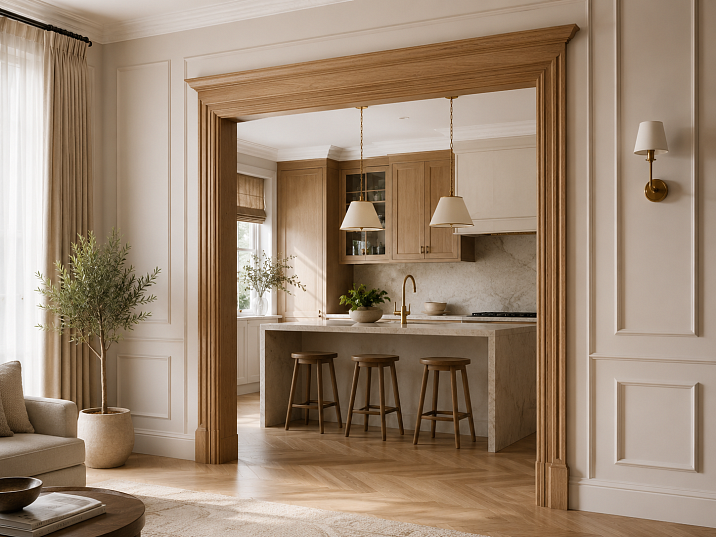
How to design a doorway without a door into the kitchen is not just a question of beauty. The door is removed to make the passage freer, connect the kitchen with the living room, add air to a small apartment, and make movement between rooms more convenient. But after dismantling or abandoning the door, another task almost always appears: how to cover the edges of the opening, how to hide the transition between tiles and wallpaper, how to protect the corners from impacts, and how to make the passage look not like a repair hole in the wall, but a finished part of the interior.
A kitchen opening is more complex than a regular interior one. Nearby, there may be tiles, paint, wallpaper, wall panels, a kitchen set, baseboards, hallway finishes, and flooring from two zones. People often walk through this passage with dishes, bags, chairs, and small household items. The edges get dirty faster, the corners receive more touches, and the finish must withstand cleaning. Therefore, it is better to immediately think of designing a doorway without a door into the kitchen as an architectural frame: molding, casing, wooden trim, portal, pilasters, capitals, or a more restrained combination of profiles.
On STAVROS you can select wooden moldings, cornices, baseboards, and architraves not as random decor, but as elements for neat framing of an opening. For one interior, a thin molding frame is enough. For another, a clean edge from an architrave is needed. For a wide passage between the kitchen and living room, a wooden portal with expressive verticals is appropriate. It is important not to copy the first photo you like, but to understand what task your specific opening requires: cover a joint, finish a slope, connect the kitchen and hall, protect a corner, add a classic accent, or create a modern straight line for painting.


What a person is actually looking for when they want to design a doorway without a door to the kitchen
The query 'how to design a doorway without a door' often sounds simple, but it hides several different situations. Someone has already removed the door, but the frame remains. Someone in a new building immediately made an open passage between the kitchen and hall. In a Khrushchev-era apartment, the door is often removed so the small kitchen doesn't feel cramped. In a modern apartment, a wide opening can be part of the kitchen-living room layout. In a private house, an open passage sometimes connects the kitchen, dining room, and hall.
In all these cases, a person is not looking for abstract decor, but a way to tidy up the opening. The wall should look finished. The edges should not crumble, get dirty, or catch on clothes. The joint of different materials should be covered. The passage should match the baseboard, doors, furniture, and finish of adjacent rooms.
The kitchen scenario adds its own requirements. If there is tile on one side of the opening and wallpaper on the other, the thickness difference needs to be neatly covered. If a kitchen unit is nearby, the profile should not interfere with opening the cabinet fronts. If the passage leads to the hall, the frame should look good from both sides. If the opening is wide, a simple thin strip may get lost, while a too massive portal may overload the space.
Therefore, the question 'how to beautifully design a doorway without a door' is better translated into a practical scheme: what kind of opening, what materials are around, what width, what style of kitchen and adjacent room, what role the decor should play. Then the choice between molding, architrave, and portal becomes clear.




Open kitchen opening: what it is and why it cannot be left without a frame
An open doorway is a passage without a door leaf and without a regular hinged door. It can be rectangular, wide, tall, narrow, with slopes, with remnants of a door frame, with smooth plaster, or with a difference in finishing materials. In the kitchen, such an opening often becomes a boundary between zones: kitchen and hall, kitchen and corridor, kitchen and living room, kitchen and dining room.
If you leave an opening without a frame, it rarely looks neat for long. Even a perfectly leveled slope gets marks from touches over time. External corners get dirty quickly. Wallpaper on the edge may peel off. Paint in high-traffic areas wears off. Tiles and wallpaper at the joint look random if there is no well-thought-out profile between them.
The frame solves several tasks at once. It covers the edge of the finish, protects the corner, sets a boundary between rooms, makes the passage visually cleaner, and helps connect the kitchen with the adjacent room. If the frame is chosen in style, the opening no longer looks like a place where a door was simply removed. It becomes part of the interior.
For a modern apartment, a smooth molding or a laconic trim is often chosen. For classic and neoclassical styles, a more expressive scheme is suitable: side verticals, a top element, pilasters, capitals, a cornice. For a small kitchen, it is better to be careful with the profile width. For a wide passage, you can enhance the architectural feel, otherwise the opening will look empty.
Our factory also produces:


Main options for designing a door opening without a door to the kitchen
| Design option | What it solves | When it fits | What to check before purchasing |
|---|---|---|---|
| Molding around the perimeter | Creates a decorative line, emphasizes the shape of the opening, covers small joints | Even rectangular passage, modern classic, neoclassical, kitchen-living room | Profile width, finish thickness, color for future painting, corner joints |
| Wooden architrave | Covers the edge of the opening, creates a clean frame, helps to design the slope | Opening after door removal, kitchen-corridor, kitchen-hall, small passage | Width of the trim, depth of the slope, transition to the baseboard, wall material |
| Wooden portal | Makes the passage architectural, emphasizes verticals, adds a stately accent | Wide opening, classic, neoclassical, private house, spacious kitchen-living room | Symmetry, height, scale, combination with furniture and doors |
| Pilasters and capitals | Create expressive side posts and portal completion | When a classic or formal effect is needed | Do not overload a small kitchen, check proportions and the top element |
| Wooden baguette or molding | Helps to design a joint, edge, decorative line, or additional section | Complex opening, transition between tiles and wallpaper, custom framing | Profile, thickness, mounting method, compatibility with finishing |
| Decorative elements | Add an accent and connect the portal with the interior | When a simple frame seems too empty | Do not mix different styles and do not overload the kitchen area |
This table shows the main thing: there is no single correct solution for all kitchens. Molding is good where a thin contour is needed. Casing is when you need to close the edge and neatly frame the opening. A portal is when the passage is wide and should look like an architectural part of the room. Pilasters and capitals enhance the classic style but require scale. Molding and baguette help where the opening is complex or there is a material joint.
Get Consultation
Molding around the perimeter: a neat frame for a modern kitchen
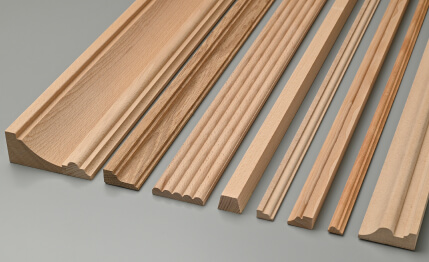
Molding is a good option when the opening is even and the interior does not require a massive portal. It creates a thin decorative line along the perimeter, emphasizes the geometry of the passage, and helps connect the kitchen with the adjacent room. Molding works especially well in modern interiors with classic elements: smooth walls, calm kitchen facades, neat baseboards, light paint, restrained decor.
If you need to frame an open kitchen opening with moldings, start by assessing the wall. Molding looks good on a flat surface. If the slopes are crooked, there is a rough transition between tiles and wallpaper, or the edge of the opening is damaged, first solve the technical part: leveling, corner protection, closing the joint. Only then choose the decorative profile.
For the buyer, molding is convenient because it does not take up much space. It does not visually narrow the passage, does not interfere with movement, and does not turn a small kitchen into a heavy classic zone. It can be used as a light frame, especially if there are already baseboards, cornices, or other linear elements nearby.
If you need a specific profile, you can look Wooden molding MLD-063 and assess whether its shape is suitable for a frame around the opening. Before ordering, it is important to check the dimensions, material, current finishing options, and how the profile will join at the corners. If the opening is wide, a single thin molding may not be enough: the frame can be reinforced with additional wooden elements or switched to a portal scheme.
Molding is especially useful if someone is looking for how to design a doorway without a door in a modern style. In photos, a clean line is often visible, but it is not always clear how the profile covers the actual joints. Therefore, when choosing, you need to look not only at the appearance but also at the practicality: what covers the edge, where the material boundary runs, and how the lower connection to the baseboard will look.
Wooden trim: a clean edge instead of an unfinished slope
Trim is usually associated with a door, but it is also useful for an opening without a door leaf. When the door is removed, the edge of the wall often looks unfinished. Traces of the frame, uneven edges, differences in finishes, and the joint between wallpaper and slope remain. Trim helps cover this area and turn the open passage into a neat frame.
For the kitchen, this is especially practical. In the passage, corners are often bumped by shoulders, bags, furniture, a child's chair, or household appliances. An open plastered corner quickly loses its appearance. Trim takes on part of the visual and practical load: it covers the edge, makes the line clear, and simplifies the perception of the transition between rooms.
If you need a clean edge of the opening, it is worth looking Wooden casings and choose a profile to match the width of the passage, the style of the kitchen and the adjacent room. For a small kitchen, it is better to choose a calm width and shape. For a more spacious passage, you can choose something more expressive, but it is important not to clash with the doors and baseboard.
The casing works well in conjunction with the baseboard. If the lower part of the opening is not coordinated with the baseboard, the frame looks random. Before ordering, think about how the vertical casing will meet the floor baseboard: whether the joint will be neat, whether the thickness matches, and whether an unnecessary protrusion appears.
When searching for "buy wooden door casing," a customer often looks for a part for a regular door, but in a kitchen opening without a door, the casing solves a similar task: it covers the edge, emphasizes the shape, and makes the transition neat. The only difference is that the frame is visible from both sides and must match two zones at once.
Wooden portal: when the kitchen passage should look architectural
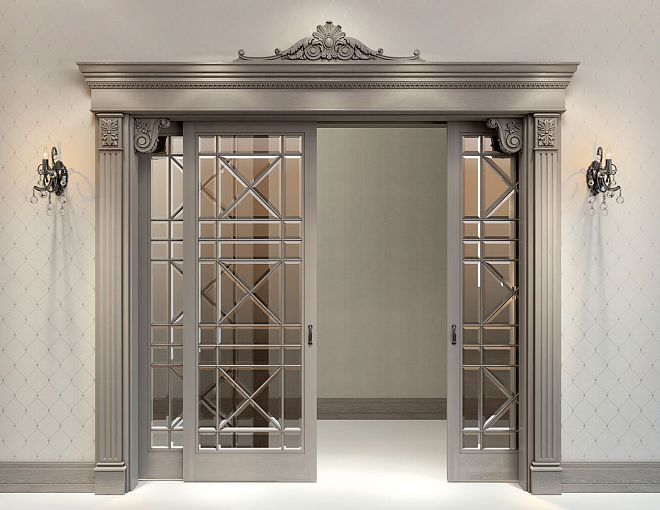
A portal is a solution for cases when the opening should become a noticeable part of the interior. This is not just a thin frame, but an architectural surround with pronounced side posts and a top finish. The portal is especially appropriate in a wide passage between the kitchen and hall, kitchen and living room, kitchen and dining room.
If a user is looking for how to design a wide doorway without a door, a thin molding may be too weak. A wide opening requires scale. Otherwise, the empty top lintel and large side planes look unfinished. The portal helps to assemble this area into a cohesive composition.
For a classic design, you can use pilasters and columns as a vertical base. They enhance the side parts of the passage and make the opening look like an architectural entrance, rather than an ordinary construction opening. The top can be supplemented with a cornice part, and the expressive finish can be supported through Capitals, if such a style suits the kitchen and the adjacent area.
A portal requires caution in small spaces. In a Khrushchev-era apartment or a narrow kitchen, a massive surround can look heavy. There, it is better to use a thin casing or molding. But in a spacious kitchen-living room, the portal helps to separate zones without a door: the passage remains open, but the boundary between the kitchen and hall becomes clear.
If you want to see a similar design scenario, you can study the material about doorway decor without a doorFor the kitchen, it's important to narrow down the task: consider the washable area, high traffic, tiles, wallpaper, kitchen furniture, and odors.
Molding, casing, or portal: what to choose for the kitchen
| Element | What it does | When it is better to choose | When it may not be suitable |
|---|---|---|---|
| Molding | Draws a thin decorative frame on the wall | Even opening, modern apartment, neoclassical, neat outline | If you need to cover a deep slope or a strong material transition |
| Casing | Covers the edge of the opening and makes the frame tighter | Opening after door removal, kitchen-corridor, kitchen-hall | If you need a prestigious wide portal |
| Wooden portal | Makes the passage architectural and expressive | Wide passage, kitchen-living room, classic, private house | If the kitchen is small and there is no room for visual scale |
| Pilaster | Enhances the side verticals | Classic and neoclassical interiors | If the interior is minimalist or the opening is too narrow |
| Capital | Completes the top of the pilaster and adds decorativeness | Portal, wide passage, ceremonial design | If you need the simplest modern contour |
| Bagette and trim | Help close joints and assemble a custom frame | Complex openings, tile and wallpaper transitions, non-standard finishes | If you want a ready-made solution without selecting profiles |
It's better to choose not by asking 'what's prettier', but by asking 'what needs to be covered'. If the opening is even and you only need to emphasize the contour, choose a molding. If you need to cover the edge of a wall, a casing is better. If the passage is wide and should become an architectural accent, a portal is needed. If there are tiles, wallpaper, and a thickness difference nearby, a combination may be needed: casing along the edge, molding as a decorative line, trim for additional sections.
How to design an opening if there are tiles and wallpaper nearby
The kitchen often differs from the adjacent room precisely in its finish. On the kitchen side, there may be tiles, porcelain stoneware, washable paint, or panels. On the living room side, there may be wallpaper, decorative plaster, or painted walls. These materials meet at the opening, and the joint rarely looks nice without a profile.
Tile is usually thicker than wallpaper. If you simply bring the materials to the corner, the edge looks rough. On the outer edge, tile can create a hard line, while nearby wallpaper will be vulnerable. In such a case, the design should not only decorate but also cover the difference.
Molding is suitable if the difference is small and the wall is fairly level. It creates a decorative border and makes the transition neater. A casing is better if you need to cover a wider area or design a slope. Wooden trim can help if you need a custom-width filler piece.
It's better to match the frame color with existing elements: baseboards, doors, kitchen fronts, countertops, wooden furniture, ceiling lines. If the opening is finished on its own, it looks random. If it repeats the color of the doors or baseboards, the interior feels more cohesive.
Pay special attention to the bottom points. There, the profile meets the baseboard, floor, and wall corner. These are the places that most often reveal a poor selection. If the trim is thicker than the baseboard or the joint is not thought out, even an expensive frame can look untidy.
Kitchen, living room, hallway: different scenarios for one opening
| Zone | How best to design | What to consider | Commercial route |
|---|---|---|---|
| Kitchen — living room | Molding around the perimeter or a portal | Style of two rooms, passage width, view from both sides | View moldings, trims, or portal elements |
| Kitchen — living room | Wide portal or expressive frame | Symmetry, scale, furniture group nearby | Select pilasters, capitals, baguette, moldings |
| Kitchen — corridor | Casing and connection with baseboard | High traffic, corner protection, dirt from entry area | Choose casings and materials for durable finishing |
| Kitchen in a Khrushchev-era building | Narrow molding or thin casing | Do not overload a small opening | View restrained profiles and simple lines |
| Modern apartment | Smooth frame for painting | Clean geometry, minimal carving, even corners | Select a molding or trim of the desired profile |
| Private house | Portal, pilasters, decorative elements | Overall style of the house, ceiling height, passage width | Assemble a set of wooden elements |
The same profile can look different in different conditions. In a narrow corridor, it appears larger. In a wide hall, it looks thinner. On a light wall, the relief is softer; on a contrasting one, it is more active. Therefore, before purchasing, it is useful to view the opening from two points: from the kitchen side and from the adjacent room side.
How to design a doorway without a door from the kitchen to the living room
The passage from the kitchen to the living room often becomes the main visible transition in an apartment. If the door is removed, the living room gets more light and air, and the kitchen feels less isolated. But along with this, the role of the opening increases: it constantly comes into view.
If the living room is decorated in a classic style and the kitchen is modern, the opening can become a connecting element. A restrained molding or trim can help combine different finishes. If both zones are neoclassical, a more expressive portal can be made. If the interior is minimalist, it is better not to overload the frame with carved decor.
The width of the passage is important. A narrow opening is better not to weigh down with large pilasters. A wide one, on the contrary, needs a more confident frame. Sometimes it is enough to add verticals and a top line so that the passage no longer looks empty.
If the living room already has a wooden baseboard, baguette, solid wood furniture, or decorative elements, it is better to tie the opening design to them. For such tasks, you can look at Wooden Picture Frame and other profiles that help assemble an interior frame without a random set of details.
How to design a doorway without a door in a Khrushchev-era apartment
In a Khrushchev-era apartment, the main danger is overloading the small space. The kitchen is usually compact, the passage is narrow, and the ceilings are low. A massive portal with large decorative elements can look heavy and make the room feel visually tighter.
Thin solutions work better: a neat trim, a narrow molding, a calm profile for painting, a clean frame without excessive carving. If you want to add decorativeness, it is better to do it through proportion and color, rather than through a large number of details.
For a Khrushchev-era apartment, it is important to think through the lower part of the opening. The baseboard, floor covering, and vertical frame should meet neatly. If this is not done, a small opening will look sloppy even with a good profile.
Another point is light. In small apartments, an open passage is often made for light and air. Therefore, the framing should not visually narrow the opening. The smaller the kitchen, the more carefully you need to choose the width of the profile.
How to design a wide doorway without a door
A wide opening requires a different logic. Here, a thin molding can sometimes get lost. A large empty lintel above the passage looks unfinished, and the sides may seem too plain. Therefore, a wide doorway without a door is often better designed as a portal or a reinforced frame.
The first step is symmetry. In a wide passage, any misalignments are more noticeable. The side elements must be identical in width and height, and the top part must be consistent with them. If pilasters are used, they should be perceived as architectural posts, not just decorative overlays.
The second step is scale. The wider the opening, the bolder the profile can be. But it's important not to conflict with the ceiling height. A low ceiling and an overly heavy top element create pressure. In a spacious room, the portal can be more expressive.
The third step is connection with furniture. If a wide kitchen-living room has a large dining table, an island, a sofa group, or a tall cabinet, the portal helps organize the space. It marks the transition but does not block the view or bring back the feeling of a door.
For such tasks, you can combine pilasters, capitals, baguettes, decorative elements, and moldings. The main thing is not to assemble a portal from random parts. All parts must match in style, scale, and future finish.
Material and finish: why wood works well in a kitchen opening
Wood in an opening provides what kitchen finishes often lack: warmth, texture, and the feel of a real architectural detail. Tile, paint, and smooth facades can look too flat. A wooden molding, casing, or portal adds relief and makes the transition between rooms more expressive.
At the same time, the kitchen area requires practicality. The surface must withstand cleaning, touching, and possible dirt. Before ordering, you need to check the current material and finish options in the product card or clarify with a STAVROS manager. You cannot choose a profile based only on a photo: it's important to understand how it will be painted, how it is protected, and how it will behave in a specific area.
If the profile is planned for painting, the color can be tied to doors, baseboards, kitchen facades, or the wall. A contrasting frame makes the opening more noticeable. A frame in the color of the wall looks calmer and more modern. A wood texture can support furniture, countertops, flooring, or other solid wood elements.
If there is tile nearby, the finishing must be especially neat. A rough joint between wood and tile is noticeable. It is better to plan in advance which profile covers the edge where the junction line runs, whether sealant will be used, and how to protect the contact area from dirt.
What to buy together for framing a kitchen opening
Framing an opening is rarely limited to a single detail. Even if a molding is chosen, additional profiles, linear elements, baguettes, decorative items, and materials for installation and finishing may be needed. If a portal is chosen, the set becomes broader: side elements, a top part, capitals, possibly a cornice, and additional components.
Before purchasing, it is better to make a simple list. What covers the edge of the opening? What decorates the wall plane? What protects the external corner? What connects the frame to the baseboard? What will be used for installation and final treatment? This approach helps avoid a situation where the main profile is bought, but important small items have to be sought later.
If a basic frame is needed, you can start with moldings and architraves. If a wide decorative passage is needed, add pilasters, columns, and capitals. If the opening is non-standard, look at linear elements and baguettes. If you want to enhance decorativeness, use wooden decorative elements, but only where they truly support the style, rather than overloading the kitchen.
Table: what to buy together for framing a doorless opening
| What to add to the purchase | Why it's needed | Which scenario it suits | Link |
|---|---|---|---|
| Moldings, cornices, baseboards, and architraves | For frames, joints, lines, and connection with other finishes | Modern kitchen, kitchen-living room, kitchen-hallway | wooden moldings, cornices, baseboards, and architraves |
| Door casings | To close the edge of the opening and finish the slope | After removing the door, a narrow passage, kitchen-corridor | Wooden casings |
| Molding MLD-063 | For a neat decorative line around the perimeter | Even opening, modern classic, light frame | Wooden molding MLD-063 |
| Molding | For an expressive frame, joints, and decorative detailing | Wide opening, kitchen-living room, custom framing | Wooden Picture Frame |
| Pilasters and columns | To assemble the architectural verticals of the portal | Classic, neoclassical, wide passage | pilasters and columns |
| Capitals | To complete the pilasters and a more expressive portal | Ceremonial passage, kitchen-living room, private house | Capitals |
| Decorative elements | For accents and connection with the overall interior | Classic portal, decorative kitchen, spacious hall | wooden decorative elements |
| Article on a similar scenario | To compare the general approach to portals | When you need a broader understanding of the open doorway topic | doorway decor without a door |
| Article about framing | To see the architectural approach to the arch and opening | When a more expressive scenario is needed | frame of a doorway without a door |
Such a table helps to assemble a purchase as a set, not in pieces. For a simple opening, a molding or casing is enough. For a wide passage, it's better to immediately think about a portal. For a complex junction of tiles and wallpaper, additional profiles may be needed. For classics — pilasters, capitals, and decorative elements.
How not to confuse a kitchen opening design with an arch, curtains, and random decor
When a person looks for how to design a doorway without a door to the kitchen, search results often show curtains, decorative stone, plastic panels, drywall arches, screens, drapes, and sliding partitions. These are not always bad solutions, but they obscure another scenario.
Curtains and drapes provide soft separation but do not frame the architectural edge. They can hide the opening but do not solve the problem of the tile and wallpaper joint, corner protection, neat slope, or connection with the baseboard. For a kitchen, textiles also require maintenance due to nearby odors, steam, and dirt.
Decorative stone creates an active texture but is not suitable for every interior. In a modern kitchen, it can look out of place, especially next to smooth facades and calm walls. Plastic panels can cover the edge but often fall short of wood in terms of quality feel and interior depth.
A drywall arch changes the shape of the opening. If the goal is to preserve a rectangular passage and frame it neatly, an arch is unnecessary. Moreover, in a small kitchen, an arched shape can sometimes look outdated and visually reduce the height.
Molding, casing, and a portal work differently. They do not mask the opening but frame it as part of the architecture. This is especially important for a kitchen, where the passage should be not only beautiful but also practical.
Practical selection for specific situations
The door was removed, but traces of the frame remain
In this case, casing or a denser frame is usually needed. Molding may not cover demolition marks if the damage is extensive. First, assess the edge of the opening, the depth of the slope, and the wall condition. Then choose a profile that will cover the problem area and match the baseboard.
The opening between the kitchen and the living room is too empty
If the passage is wide and the wall around it looks empty, consider a portal. Side elements will add verticality, the top part will complete the composition, and decorative details will help connect the passage with the living room interior. For classic style, look at pilasters and capitals. For restrained neoclassicism, choose calmer profiles.
The kitchen has tiles, and the living room has wallpaper
The main task is to cover the transition. You need to choose a profile that neatly overlaps the boundary of materials. Sometimes a casing helps, sometimes a molding, sometimes additional linear trim. Before ordering, you need to measure the thickness of the finish and understand where exactly the frame line will run.
Need to design a small opening in a Khrushchev-era apartment
Don't overload it. Choose a narrow molding or a neat casing. It's better to make a clean line than a complex portal. The color can be matched to the wall, doors, or baseboard. If you want contrast, use it carefully: a small opening quickly becomes visually heavy.
Need to make a modern passage without excessive carving
Choose smooth profiles, a laconic frame, calm geometry. The molding can be painted in the wall color or slightly highlighted. The casing should be even and not clash with furniture fronts. A portal is also possible, but without excessive decorativeness.
Need to design a passage in a private house
In a private house, the scale is usually larger. Here you can use a portal, pilasters, capitals, baguette, and wooden decorative elements. But even in a large house, it's important not to mix everything at once. If the kitchen facade is calm, the portal should support the interior, not steal all the attention.
Mounting logic: what to consider before purchasing
Even the most beautiful profile won't save an opening if the installation logic isn't thought out. Before ordering, you need to understand where the element is attached, how flat the wall is, what finish difference there is along the edges, how the profile will meet the baseboard, and what will happen at the corners.
The first point is measurement. Measure the height of the opening, width, depth of the slope, thickness of finishing materials, distance to kitchen furniture and nearest switches. If the profile is wide, it may hit a socket, the edge of a backsplash, or a furniture module. Such things are better seen before purchase.
The second point is joints. The molding will have corner connections. The trim will have junctions with the floor and the top part. The portal will have connections of verticals, the top element, possibly capitals and decorative details. Joints should not be random, but planned.
The third point is finishing. If elements are to be painted, you need to understand at which stage it is more convenient to do this: before installation, after installation, or a combination. If the profile comes into contact with tiles or a washable surface, the junction area should be neat and resistant to cleaning.
The fourth point is symmetry. For a wide opening, this is critical. The side elements must stand level, otherwise the portal will look crooked even with expensive details. Before installation, it is worth marking the axes and checking the visual perception from the kitchen and living room sides.
Mistakes when designing a door opening without a door to the kitchen
Installing a too massive portal in a small kitchen
In a small room, a large portal can eat up space. It will look not like an architectural accent, but like a heavy frame. For a Khrushchev-era apartment, narrow corridor, and small kitchen, it is better to choose a thin molding or a neat trim.
Using curtains as the main solution
Curtains can add softness, but they do not cover the edge of the opening and do not solve the problem of joints. For the kitchen, textiles quickly absorb odors and require maintenance. If a finished frame is needed, it is better to choose molding, trim, or a portal.
Not accounting for the difference in height between tiles and wallpaper
Tiles and wallpaper are rarely in the same plane. If the profile does not cover the difference, the joint will look rough. Before purchasing, you need to measure the thickness of the finish and choose an element that actually covers the problem area.
Do not protect the external corner
The passage area quickly receives impacts and touches. An unprotected open corner can get dirty and damaged. A trim, molding, or properly selected profile helps maintain a neat appearance.
Do not connect the opening with the baseboard
The baseboard and the opening frame meet at the bottom. If their thickness, color, and style are not coordinated, the bottom looks random. This is especially noticeable in the hallway and kitchen, where the eye often glides along the floor line.
Choose a profile only by photo
The photo shows the style, but does not show your wall thickness, tile offset, ceiling height, or passage width. Before ordering, you need to check the dimensions and actual conditions.
Mix plastic and wood without logic
A plastic corner next to a wooden trim or solid portal often looks out of place. If a wooden scenario is chosen, it is better to maintain it consistently.
Copy a common portal without a kitchen scenario
What looks beautiful in a spacious hall may not suit the kitchen. Here, cleaning, odors, tiles, backsplash, furniture, and frequent traffic are important. The design must take these conditions into account.
Forgetting about washable finishes
A kitchen opening gets dirty faster than a passage between a bedroom and a living room. If the frame is painted, the coating must be practical. If wood is used, the appropriate finish needs to be specified.
Don't create symmetry on a wide opening
A wide passage immediately reveals misalignments. If the side elements are uneven, the portal looks untidy. Symmetry must be planned at the measurement and marking stage.
Who would suit decorating an opening with moldings, architraves, and a portal
This solution suits those who want to keep an open passage but don't want to see an unfinished wall edge. Moldings, architraves, and wooden portals are especially appropriate in apartments where the kitchen is connected to a hall, living room, or corridor. They help divide zones without a door while maintaining a sense of a cohesive interior.
Molding suits those who like neat lines and don't want to weigh down the passage. Architrave suits those who need to cover the edge and get a clean frame. Portal suits those who want to make the passage a noticeable architectural part of the interior.
For a small kitchen, it's better to choose restrained solutions. For a spacious kitchen-living room, more expressive elements can be considered. For classic and neoclassical styles, pilasters, capitals, and baguettes work well. For a modern interior, smooth profiles and calm paint are suitable.
Such decoration may not be suitable if a temporary finish is needed for a short period or if the opening is planned to be redone soon. Also, a complex portal should not be chosen if the room is too small and the ceiling is low. In such cases, it's better to stick with a thin profile.
Where to buy elements for decorating the STAVROS opening
It's best to start a purchase by understanding the task. If you need a lightweight outline, open the section with moldings and architraves. If you need to cover an edge after removing a door, look at architraves. If you want to assemble an expressive portal for a wide passage, add pilasters, capitals, baguettes, and decorative elements.
Before ordering, check the width of the opening, height, depth of the slope, thickness of tiles and wallpaper, connection to the baseboard, and the style of adjacent rooms. For the kitchen area, think about the finish separately: the surface should be practical to clean and suitable for kitchen conditions.
On STAVROS, you can select elements step by step: first choose a frame, then add extension parts, then check decorative accents and installation materials. This approach is better than a random purchase because the opening is assembled as a unified system.
FAQ
How to design a door opening without a door into the kitchen beautifully and practically?
First, you need to understand what exactly is required: cover an edge, hide the transition between tiles and wallpaper, protect a corner, or create an architectural accent. For a lightweight frame, molding is suitable; for a clean edge, an architrave; for a wide passage, a wooden portal.
Can a door opening into the kitchen without a door be designed with moldings?
Yes, if the opening is even and there is no need to cover a deep slope. Molding emphasizes the shape of the passage well, creates a neat line, and is suitable for modern classic, neoclassical, and calm interiors.
What is better for the kitchen: molding or architrave?
Molding is better if a decorative line on the wall is needed. Architrave is better if you need to cover the edge of the opening, traces of door removal, or a slope. Sometimes they can be combined if the opening is complex.
When is a wooden portal needed?
A portal is needed if the opening is wide, noticeable, and should look architectural. It works well for a kitchen-living room, classic interior, private house, and spacious rooms.
How to design a doorway without a door into the living room?
For the passage between the kitchen and living room, it's important to consider the style of both rooms. If the interior is calm, molding or a casing will work. If the passage is wide and the living room is expressively decorated, you can assemble a portal.
How to design a doorway without a door in a Khrushchev-era apartment?
It's better to choose narrow molding or thin casing. A too massive portal can overload a small kitchen and visually narrow the passage.
What to do if there are tiles and wallpaper nearby?
You need to cover the thickness difference. For this, choose a profile, casing, molding, or wooden trim. Before ordering, it's important to measure the thickness of the materials and understand where the framing line will go.
Can curtains be used instead of framing the opening?
You can, but curtains don't cover the edge of the wall and don't solve the task of architectural framing. For a kitchen, they are also less practical due to odors and dirt. If you need a finished opening, it's better to use moldings, casings, or a portal.
Which profile to choose for a modern interior?
For a modern interior, it's better to choose smooth, restrained profiles without excessive carving. They can be painted to match the color of the wall, doors, baseboard, or kitchen fronts.
What to buy for framing a doorway without a door?
Usually, you need moldings or architraves, and for a wide passage, portal elements: pilasters, capitals, baguette, and decorative details. For complex joints, additional profiles and installation materials may be needed.
Do I need to frame the opening on both sides?
If the opening is visible from both the kitchen and the hall or corridor, it's better to consider both sides. One beautiful side and an unfinished second often look untidy.
What should I check before ordering from STAVROS?
Check the dimensions of the opening, the depth of the slope, the thickness of the finish, the style of the kitchen and adjacent room, the connection to the baseboard, the current profile parameters, material, and finish options in the product card.
Result: how to make a kitchen opening without a door complete
An open kitchen opening can make the apartment more convenient, brighter, and more spacious. But only under one condition: its edges must be thoughtfully finished. Without a frame, the passage quickly looks unfinished, especially if tiles, wallpaper, paint, baseboard, and kitchen furniture meet nearby.
Molding helps create a light decorative line. The architrave covers the edge and makes the slope neat. A wooden portal turns a wide passage into an architectural element. Pilasters, capitals, baguette, and decorative details can enhance a classic scenario but require the right scale.
Before purchasing at STAVROS, you should measure the opening, define the task, choose the frame type, check compatibility with the finish, and assemble a set without random parts. Then the passage between the kitchen and the hall, corridor, or living room will look not like a place where a door was forgotten, but like a well-thought-out part of the interior.