









































































Article Contents:
- What is a baguette for an icon and how is it different from a regular frame
- Baguette as a decorative frame
- Molding as a blank for an exact size
- When a ready-made kiot is needed, and when a wooden baguette is enough
- Need to design an icon in the home prayer corner
- Need to assemble an icon case
- Need to select a frame for the iconostasis
- Need to replace a regular frame with a carved wooden profile
- Need to make a gift
- Need to design a church element
- Buying a regular picture frame without church context
- Choosing only by photo
- Do not consider the icon size
- Confuse baguette and icon case
- Buy overlay instead of frame profile
- Do not count the footage
- Do not plan the finishing
- Mix different ornaments without a system
- Do not check the product card
- Where to buy baguette for an icon?
- Which baguette should I choose for an icon?
- How is a baguette different from a kiot?
- What should I buy together with a baguette for an icon?
- Can I use a regular wooden baguette for church decoration?
- How to choose a baguette according to the size of the icon?
- Is carved molding suitable for a home prayer corner?
- When is K-045 needed?
- When is it better to choose K-071?
- What is the carved overlay IKN-009 for?
- Do I need to buy molding with a reserve?
- What to clarify before ordering?
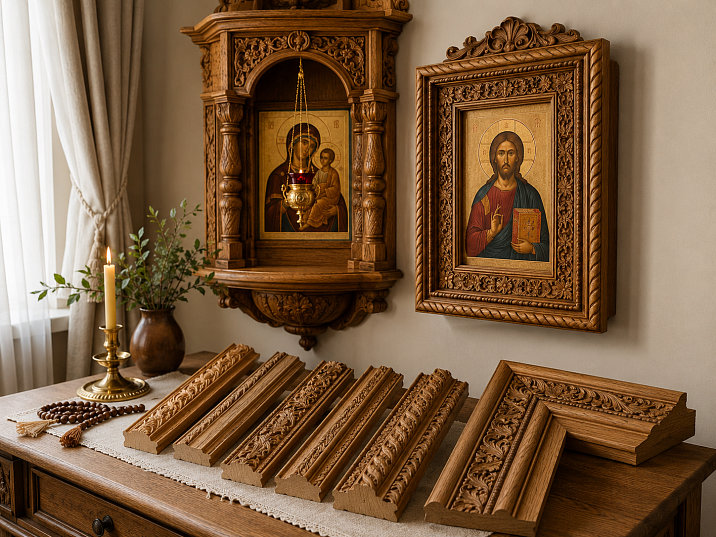
Buying a baguette for an icon should not be like a regular frame for a painting, but as a detail that must carefully support the holy image, preserve a respectful design character, and help assemble a complete wooden composition. An icon, a kiot, a home prayer corner, a small iconostasis, a church portal, or a temple element require a different approach than a decorative painting, mirror, or interior panel. Here, not only the size and profile matter, but also the ornament, scale of carving, material, depth of the future framing, finishing options, and compatibility with other elements of church decor.
A baguette for an icon can be calm and almost invisible if the task is to neatly frame a small image in a home prayer corner. It can be more expressive if you need to assemble a kiot, frame a central icon, emphasize a temple element, or create a decorative border around the image. The mistake begins where the buyer chooses a baguette only based on a beautiful fragment of carving. In the finished product, the profile works around the perimeter, repeats at the corners, interacts with the plane of the icon, the depth of the kiot, overlays, columns, pilasters, and other details.
For such a task, STAVROS has not just one random profile, but several directions: carved molding, wooden baguette, church decor, carved overlays, pilasters, and columns for more complex projects. If you need buy a baguette for an icon STAVROS, it is more convenient to start not with the general catalog, but with an understanding of the future product: whether it will be a simple frame, a deep kiot, a fragment of an iconostasis, a home prayer corner, or a decorative church element for finishing.
In this article, we will analyze how a baguette for an icon differs from a regular frame profile, when molding is needed, when it is better to think about a kiot, how to choose the ornament and scale, which STAVROS products to look at first, what to buy together, and how not to confuse a baguette, kiot, overlay, column, and a regular frame.




What is a baguette for an icon and how it differs from a regular frame
A baguette for an icon is a decorative profile that frames the image around the perimeter. It can be part of a simple frame, the outer contour of a kiot, an additional decorative border, or an element of a more complex church composition. Unlike a regular baguette for a painting, such a profile must correspond not only to the size of the image but also to the meaning of the framing. Random decorativeness, too domestic a pattern, or a profile that looks like a poster frame are inappropriate here.
An ordinary frame usually solves a simple task: to separate the image from the wall and make it visually complete. A baguette for an icon works deeper. It should not argue with the image, not draw attention away, not seem like a random piece of furniture. Good carved molding emphasizes the border, creates a noble outline, and helps incorporate the icon into a wooden icon case, iconostasis, or prayer corner.
There is another difference: a baguette for an icon is often not chosen alone. Along with it, overlays, additional profiles, elements of church decor, columns, pilasters, or a central symbolic accent may be needed. Therefore, the purchase should not follow the principle "I liked the profile — I take it," but rather the route: icon size → design format → depth → ornament → material → finish → accompanying elements.




Baguette as a decorative frame
In the simplest version, the baguette becomes a frame around the icon. It covers the edge, sets the boundary of the image, and makes the design cohesive. This approach is suitable for a home prayer corner, a small icon, gift packaging, a chamber icon case, or a single image on the wall.
The frame should not be rough. If the image is small, a too wide and active profile can visually overwhelm the icon. If the icon is large, a thin profile can get lost and fail to provide the necessary depth. Therefore, the scale of the baguette is always linked to the size of the image.
Our factory also produces:


Molding as a blank for an exact size
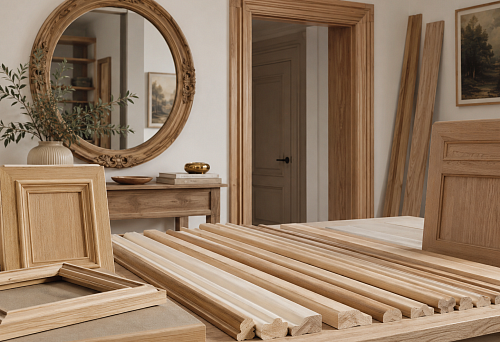
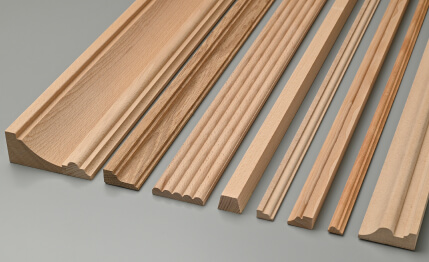
Carved molding is convenient because it can be used as a linear profile to assemble a frame of the desired size. This is important for workshops, restoration tasks, church projects, and private orders where a standard frame is not suitable. Molding provides freedom in length, helps choose the proportion, and assemble the framing for a specific image.
When choosing molding, you need to understand in advance how it will be cut, joined at the corners, painted, or tinted. The ornament should transition beautifully along the perimeter. A too large pattern on a small frame may break off awkwardly, while a too small one on a large icon case will get lost.
Get Consultation
When a ready-made icon case is needed, and when a wooden baguette is enough
A baguette frames the icon along the perimeter. An icon case is a deeper wooden housing for placing and protecting the image. If you just need to make a neat frame, carved molding or a baguette is sufficient. If depth, a protective housing, internal seating, a door, or complex architecture around the icon is required, then it is already about an icon case.
Sometimes the baguette becomes part of the icon case: it frames the outer contour, inner edge, decorative belt, or top part. Therefore, the question "baguette or icon case" does not always mean choosing one over the other. Often it is more correct to think this way: the icon case is the product, while the baguette and moldings are elements from which it can be assembled or decorated.
Which STAVROS elements are suitable for framing an icon
To frame an icon, you can use several groups of STAVROS products. The main scenario is carved moldings or baguette for the frame. The extended scenario includes church decor, overlays, pilasters, columns, and additional elements for the icon case, iconostasis, or church object.
| Element | Role in framing | When to look | URL |
|---|---|---|---|
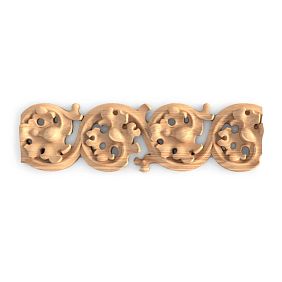
| Carved molding K-076 | Main contour or frame around the icon | When you need to choose a carved baguette for an icon or icon case | carved molding K-076 for icon case |
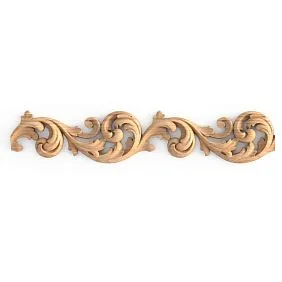
| Carved molding K-045 | More expressive wooden framing | When a wide decorative belt is needed | Wooden baguette K-045 for church decoration |
| Carved molding K-071 | Ornamental contour for neat finishing | When a thin carved profile of oak or beech is needed | Carved baguette K-071 from oak or beech |
| Church decor | Selection of details in a unified style | For a kiot, iconostasis, analogion, temple decoration | STAVROS wooden church decor |
| Carved overlay IKN-009 | Central symbolic accent | When you need to add a cross or an expressive overlay | carved overlay IKN-009 with cross |
| Pilasters and columns | Vertical architectural elements | For iconostasis, portal, large church decoration | wooden pilasters and columns for church portal |
| Wooden molding and trim | General group of profiles for frames and borders | When you need to compare shapes and select a profile | wooden baguette and molding STAVROS |
This table helps quickly divide tasks. If you need to frame an icon around the perimeter, it's logical to start with K-076, K-045, or K-071. If you need to create a more complex church composition, you should look at the church decor section, IKN overlays, pilasters, and columns. If the task is not yet defined, it's useful to open the general section of wooden baguettes and moldings and compare profiles by character.
Carved molding K-076: basic transition to purchasing a baguette for an icon
Carved molding K-076 can be considered as the main starting option when a buyer wants to purchase a baguette for an icon and assemble a neat wooden frame. Its purpose is to provide a decorative contour that can be used around the image, in a shrine, or in a more complex church product.
K-076 is especially convenient for those who do not want to take a regular smooth profile. The carved pattern immediately adds depth and a handcrafted character to the church design. Such molding does not look like a universal picture frame: it is closer to wooden decor that can support an icon, a prayer corner, or an element of an iconostasis.
Before ordering, you need to check the dimensions and current parameters in the product card. For a frame around an icon, not only the width of the profile is important, but also how it will look on the specific size of the image. A small icon requires a more careful scale. A large image allows for a more noticeable relief.
K-076 should be considered as the main transition in the commercial route of the article: the buyer came with the question "where to buy a baguette for an icon", receives an explanation of how to choose a profile, and moves on to the real STAVROS product.
Carved molding K-045: when a wider decorative contour is needed
K-045 is suitable for a scenario where a simple thin frame is not enough. If the icon is large, if you need to design a shrine with an expressive outer band, if the wooden frame should be more noticeable, you can look at K-045. This profile helps make the framing more rich and architectural.
A wide decorative contour is especially appropriate in temple projects, home iconostases, large prayer corners, and items where the baguette should not get lost. But width requires care. For a small icon, an overly active profile may feel heavier than the image itself. Therefore, K-045 is best chosen after measuring and understanding the overall composition.
If the frame is assembled from several profiles, K-045 can work as an outer belt, and a thinner profile as an inner contour. This approach helps create depth without accidental clutter. It is only important to check the joining, finish, and overall width of the finished product in advance.
Carved baguette K-071: a thin ornamental profile for neat framing
K-071 should be considered when a thinner ornamental contour is needed. This could be a frame for a small icon, an inner belt of a shrine, an additional line around the image, or a neat design for a home prayer corner.
In the SEO scheme, K-071 is designated as a carved baguette made of oak or beech. For the buyer, this is an important point: the type of wood affects the character of the item, the finish, and the visual perception. Oak is usually perceived as denser and more solid, beech as calmer and more pliable in finishing. Before ordering, you still need to check the current material options in the product card, because availability and parameters depend on the specific item.
K-071 is useful where carving is needed, but without excessive scale. It can support an icon delicately, without competing with the image. This profile is especially convenient for frames where precision, a clean contour, and a neat ornamental line are important.
Church decor and overlays IKN: when a frame is no longer enough
Sometimes the buyer needs not just a wooden baguette for an icon, but a complete church design. For example, you need to assemble a shrine with an upper accent, design a home iconostasis, add a symbolic overlay, create a fragment of temple furniture, or support the overall style of a lectern, portal, columns, and carved details.
In this case, you should look not only at the molding, but also at STAVROS wooden church decor. This section helps to select elements that are initially related to church themes and may better suit the shrine, iconostasis, or temple interior.
Special attention is deserved carved overlay IKN-009 with crossSuch a detail is needed not as a frame profile, but as a symbolic accent. It can be considered for the central part of the composition, the top finish, a decorative node, or additional decoration next to the baguette.
It is important not to mix roles. The baguette goes along the line. The overlay works as a separate accent. The pilaster or column creates a vertical line. The capital completes the architectural part. If all this is combined without a plan, it will look overloaded. If assembled according to the task, the elements help make the icon case or iconostasis expressive and cohesive.
How to choose a baguette for an icon by size
Size is the first selection parameter. The baguette should match the icon, not just be appealing on its own. A small image next to a wide carved profile can get lost. A large icon in a too-thin frame will look unfinished.
Start with the exact size of the icon. Then determine whether only a frame along the edge is needed or a deep icon case. For a simple frame, the profile width and the outer size of the finished product are important. For an icon case, depth, internal fit, and possible additional contours are added.
If the icon is intended for a home prayer corner, the placement location should be considered. On a small shelf or in a narrow corner, too wide a frame can be obstructive. On a wall with several icons, one profile should match the neighboring images. In an iconostasis, it is important that the baguette does not stand out from the overall architecture.
For a workshop or carpentry project, it is useful to make a diagram in advance: icon size, inner field width, baguette width, outer size, corner joint, space for overlays, case depth. Such preparation reduces the risk of error when purchasing molding.
How to choose a baguette by depth and icon case format
An icon case differs from a regular frame in depth. In it, the icon is not just framed along the edge, but placed inside the body. Therefore, the baguette can be used in different ways: as an outer decorative contour, as an inner frame around the image, as an additional belt, or as part of the facade design.
If a shallow icon case is needed, the profile should be proportionate. A too-massive baguette with a small depth can look like a heavy overlay. If the icon case is deep, a thin profile can get lost on the facade. Here it is important to look not only at the frontal view but also at the side perception.
For a home prayer corner, a more restrained solution is often sufficient. For a church icon case, iconostasis, or analogion, more richly decorated elements can be used. But even in a church project, you should not overload every level with carving. The image should remain the main focus.
If in doubt, it is better to consider a set: the main profile, inner contour, possible carved overlay, additional vertical elements. This makes it easier to understand where a baguette is needed and where a different type of decor is already required.
Ornament: how to choose a pattern that does not conflict with the image
The ornament in the baguette for an icon should be respectful and proportionate. A pattern that is too active can draw attention away. A profile that is too simple sometimes looks mundane and does not support the sacred nature of the item. The balance depends on the size of the icon, the placement location, and the overall style.
For a small icon, it is better to choose a calmer or thinner carved contour. For a large image, a more expressive molding can be used. For an iconostasis or a church element, the ornament can be richer, but it must be subordinate to the overall architecture.
The repeatability of the pattern is particularly important. The molding runs along the perimeter, so the carving will repeat. You need to imagine not a small fragment, but the entire frame. If the ornament looks good only on a short section, it may look different at the corners and on the long sides.
Another important point is the combination with overlays. If the baguette is already active, the overlay should complement it, not compete. If the baguette is calm, the central accent can be more expressive. For such tasks, it is useful to look at church decor not in isolation, but as a system.
Wood species: oak or beech and what that changes
Wood is important not only as a material but also as a visual foundation. Oak and beech are perceived differently in church decoration. Oak is more often associated with density, solidity, and pronounced natural texture. Beech can look softer and calmer, and is well suited for finishing, painting, and tinting.
If the buyer chooses Carved baguette K-071 from oak or beechIt is important to verify the actual material in the product card. You cannot choose only by the breed name: you need to consider the future finish, adjacent details, color, and scale of the product.
For a home prayer corner, the wood can remain warmer and more intimate. For a church space, a more solemn appearance is often needed. For a restoration task, it is more important to match the existing material and shade. For a workshop that makes custom icon cases, predictability of processing and compatibility of all parts are critical.
If different elements are used in one product — baguette, overlays, pilasters, columns, additional profiles — it is better to coordinate the material in advance. Even parts that are close in color may differ after finishing if selected randomly.
Finishing: enamel, tinting, varnish, and preparation for order
Baguette for an icon often requires final finishing. This can be clear varnish, tinting, enamel, or another option that matches the product. The exact finishing options should be checked in the product card or clarified with a STAVROS manager, because parameters may differ for different items.
Finishing affects the character. A transparent coating preserves the feel of the wood. Tinting helps bring the baguette closer to an existing icon case, furniture, iconostasis, or interior. Enamel may be appropriate if the product needs to fit into a specific color scheme. But the choice of finishing cannot be made separately from the ornament: deep carving and a smooth surface perceive color and light differently.
For church products, accuracy is important. The coating should not clog the carving, hide the pattern, or make the profile too rough. If the product is made to order, it is better to clarify in advance how the molding will be processed, where the joints will be, how the ends are closed, and how the final finish will behave at the corners.
If the baguette is purchased for a workshop, it is worth planning the technology right away: cutting, fitting, assembly, sanding, coating. If the buyer takes the profile for a home project, it is better not to start work without an accurate diagram and understanding of what materials will be needed along with the baguette.
Baguette, molding, icon case, overlay: how not to confuse similar products
| Product | What it is | When to buy | Common mistake |
|---|---|---|---|
| Bagette for an icon | Linear decorative profile for a frame | When you need to frame an icon around the perimeter | Buy as a regular frame without considering the ecclesiastical nature |
| Carved molding | Long-length blank for exact size | When the frame or icon case is assembled to custom dimensions | Do not calculate corners, length, and pattern repeat |
| Icon case | Deep wooden housing for an icon | When you need not just a frame, but a protective and decorative item | Thinking that one baguette will replace the entire corpus |
| Carved overlay | A separate decorative or symbolic element | When a central accent, cross, or ornamental detail is needed | Using an overlay instead of a frame profile |
| A church column or pilaster | A vertical architectural element | For an iconostasis, portal, or temple composition | Buying for a small frame where it is not needed |
| A regular baguette for a painting | A frame profile without a church context | For paintings, mirrors, decorative panels | Apply to the icon without checking the ornament and meaning |
The main difference is in the role. The baguette goes around the perimeter. The kiot creates a case. The overlay adds an accent. A column or pilaster builds architecture. If the buyer understands this difference, they assemble the correct set faster and do not buy unnecessary items.
Commercial choice: which STAVROS product to look at for your task
| Scenario | What to buy | Why it fits |
|---|---|---|
| Frame the icon in a wooden frame | carved molding K-076 for icon case | Suitable as a main profile for a decorative contour |
| Make a wider decorative belt | Wooden baguette K-045 for church decoration | Helps create an expressive framing |
| Choose a thin ornamental contour | Carved baguette K-071 from oak or beech | Good for a neat frame or inner belt |
| Design a shrine, iconostasis, or temple element | STAVROS wooden church decor | Allows you to select elements in church style |
| Add a symbolic central accent | carved overlay IKN-009 with cross | Suitable as a separate decorative detail |
| Assemble a portal or large vertical composition | wooden pilasters and columns for church portal | Needed for iconostasis, portal, temple decoration |
| Compare wider wooden profiles | wooden baguette and molding STAVROS | Helps choose a profile for a frame, shrine, or decor |
This block helps transition from the question "which baguette to choose for an icon" to a specific purchase. There's no need to immediately open dozens of sections. It's enough to define the scenario: frame, wide contour, thin profile, shrine, iconostasis, overlay, or architectural element.
What to buy together with baguette for an icon
A baguette rarely works alone. Even a simple frame requires calculation, trimming, joining, and finishing. A more complex icon case or iconostasis is almost always assembled from several groups of parts. Therefore, it is useful to prepare a set before ordering.
| What to buy together | Why this is needed | When it is especially useful |
|---|---|---|
| Carved molding K-076 | Main frame or contour around the icon | For basic design of the image |
| Carved molding K-045 | More expressive decorative belt | For large icons, icon cases, temple projects |
| Carved baguette K-071 | Thin ornamental contour | For inner frame, small image, calm design |
| Carved overlays IKN | Symbolic or central accent | For an icon case, prayer corner, church composition |
| Church decor STAVROS | Selection of elements in one style | For an iconostasis, lectern, temple decoration |
| Pilasters and columns | Architectural verticals | For a portal, large icon case, iconostasis |
| Wooden molding and trim | Comparison of profiles and selection of additional lines | When a set of several contours is needed |
If only one profile is being purchased, it is important not to forget about corners, trimming, and finishing. If a kiot is being assembled, you need to think not only about the front frame, but also about the depth, body, inner fit, possible overlays, and top finish. If an iconostasis is being designed, the individual baguette must conform to the overall architecture.
Practical selection for different tasks
Need to frame an icon in a home prayer corner
For a home prayer corner, it is better to choose a calm, proportionate profile. The icon should remain the main focal point. If the image is small, do not take a too wide baguette. A good starting point could be K-076 or K-071, if they are suitable in scale for the specific icon.
If there are several icons in the corner, it is important not to make each frame different in character. It is better to choose a similar logic: one material, similar finish, coordinated ornament. Then the prayer corner looks cohesive, rather than a set of random frames.
Need to assemble a kiot
For a kiot, one baguette may not be enough. You need to understand the depth of the body, inner size, outer contour, possible overlays, and top design. The baguette can go along the front part, while additional profiles can cover the inner frame or decorative band.
If the kiot should be expressive, you can combine carved moldings with church decor. If the task is intimate, it is better not to overload the product. The main thing is to calculate the structure in advance so that the profile is not too wide or thin.
Need to select a baguette for an iconostasis
An iconostasis requires architectural thinking. Here, the baguette is not a separate frame, but part of a common system. It must match the verticals, columns, pilasters, overlays, central elements, and overall scale. In this scenario, you should look not only at moldings, but also at church decor, pilasters, and columns.
Need to replace the regular frame with a carved wooden profile
If the icon is already framed in a simple frame, carved molding can make the image more expressive. But before replacing, you need to check the size, depth of fit, and external format. You cannot simply take a wide baguette if the placement space is designed for a thin frame.
Need to make a gift
For gift wrapping, neatness and versatility are important. It is better to choose a profile that looks noble but not too heavy. You need to know in advance where the icon will stand or hang: on a shelf, on a wall, in a prayer corner, in a shrine.
Need to design a church element
For a church project, not only beauty is important, but also coordination with existing decor. The molding must match in scale, ornament, material, and finish. It is especially useful here to look STAVROS wooden church decor and select elements not separately, but as a system.
Selection by material, scale, ornament, and installation location
The material affects the feel of the product. A wooden baguette looks warmer and more noble than a plastic or random frame. This is especially important for an icon because the framing should support the image, not look like a household replacement.
The scale determines how noticeable the profile is. A thin baguette gives a neat outline. A wide molding turns the frame into a decorative belt. Several profiles allow you to assemble a more complex composition, but require precise calculation.
The ornament should match the task. A home icon does not always require elaborate carving. For a kiot or iconostasis, the decorativeness can be higher. For a restoration task, it is important not to stand out, but to fit into the existing style.
The installation location also changes the choice. An icon on a wall in an apartment, a kiot in a private house, a lectern, a temple object, and a home iconostasis are different scenarios. The more complex the location, the more carefully you need to select not only the baguette but also the accompanying details.
Installation, trimming, and calculation: what to consider before ordering
Before purchasing, you need to measure the icon and determine the outer size of the future frame. If using molding, it is important to calculate the footage taking into account corners, trimming, and possible allowance. An error of a few centimeters can be critical, especially if the ornament needs to match nicely.
Corners require attention. The carved profile at the joint should look neat. If the pattern breaks off roughly, the frame loses quality. For a workshop, this is a technical task; for a private buyer, it is a reason to consult in advance and not start assembly without a plan.
Preparation for finishing is also important. Wood may require sanding, primer, tinting, varnish, or other coating. The exact materials and finishing options should be clarified for the specific product. You should not assemble the frame first and then think about how to treat hard-to-reach areas.
If the baguette is used in a kiot, the depth and internal fit must be considered. If it is used in an iconostasis, verticals, repeatability, and joining with other elements are important. If it is a home prayer corner, neatness and harmony with neighboring images are important.
Mistakes when buying a baguette for an icon
Buying a regular baguette for a painting without a church context
A regular frame profile can be beautiful, but it is not always suitable for an icon. The ornament, scale, and character must correspond to the holy image. It is better to immediately look at carved molding and church decor.
Choose only by photo
The fragment of carving in the photo does not show how the profile will look around the perimeter. You need to imagine the entire frame, corners, external size, and adjacent elements.
Do not consider the size of the icon
A too wide baguette can overwhelm a small image. A too thin one will get lost next to a large icon. The profile size should be linked to the size of the icon.
Confuse baguette and icon case
A baguette is a profile. An icon case is a housing. If protection, depth, and full placement of the image are needed, a single baguette is not enough.
Buy an overlay instead of a frame profile
A carved overlay can be a beautiful accent, but it does not replace the molding around the perimeter. Each element has its own role.
Do not calculate the footage
Molding is purchased taking into account the length of the sides, trimming, corners, and allowance. Buying 'approximately' often leads to a shortage of material.
Not planning the finish
Color and coating change the perception of the carving. If the finish is chosen randomly, the profile may look heavier, cheaper, or darker than expected.
Mixing different ornaments without a system
Bagette, overlays, columns, and pilasters should work together. If each element is chosen separately, the finished product may become overloaded.
Not checking the product card
Before ordering, you need to verify the current dimensions, material, availability, finish options, and features of the specific item. If there is not enough data, it is better to clarify it with a STAVROS manager.
Who is suitable for a baguette for an icon, and who should choose a different solution
| Suitable | May not be suitable |
|---|---|
| Workshops that produce icon cases | If a fully finished icon case without adjustment is needed |
| For temple projects and restoration tasks | If the buyer is looking for a plastic frame |
| For a home prayer corner | If a simple photo frame without church styling is needed |
| For designers working with church or classical interiors | If it is not possible to accurately calculate the size |
| For private customers who need natural wooden decor | If a minimal budget without solid wood is needed |
| For carpenters and carvers assembling a custom product | If you have no experience trimming and joining the profile |
Carved wooden baguette is suitable for those who want to frame an icon respectfully, neatly, and for a long time. It is especially useful when a standard frame does not fit in size, depth, or style. But if you need a ready-made closed case, you should consider the entire icon case. If the task is very simple and temporary, carved molding may be excessive.
How to buy a baguette for an icon on STAVROS
Start by defining the task. If you need a frame around the icon, look at K-076, K-045, and K-071. If you need an icon case or church composition, additionally open the church decor section. If a symbolic accent is required, pay attention to IKN-009. If the project is large and includes verticals, look at pilasters and columns.
Before ordering, check the icon size, future outer frame size, profile width, material, finish, joining method, and the need for a margin. If the product should match an existing icon case, iconostasis, or interior, it is better to check compatibility with a STAVROS manager in advance.
This approach helps avoid buying a random beautiful profile that later does not fit in scale. The buyer gets a clear route: choose a scenario, select molding, add necessary elements, check parameters, and proceed to order.
FAQ
Where to buy a baguette for an icon?
You can select a baguette for an icon on STAVROS among carved molding and wooden baguette. The main option to start is buy a baguette for an icon STAVROS through the carved molding card K-076.
Which baguette to choose for an icon?
For a calm design, a neat carved profile will work. For a more expressive contour, you can look at K-045. For a fine ornamental solution — K-071. The choice depends on the size of the icon, the depth of the design, and the installation location.
How is a baguette different from a kiot?
A baguette frames the icon along the perimeter. A kiot creates a deep wooden case in which the icon is placed and protected. A baguette can be part of a kiot, but does not replace the entire case.
What to buy together with a baguette for an icon?
Along with the baguette, additional profiles, carved overlays IKN, church decor elements, pilasters, columns, and finishing materials may be needed. The set depends on whether a simple frame, a kiot, or an iconostasis is being assembled.
Can a regular wooden baguette be used for church design?
Yes, if the ornament, scale, and material match the task. But for a kiot, iconostasis, or temple element, it is better to immediately look at carved moldings and church decor STAVROS.
How to choose a baguette based on the size of the icon?
The smaller the icon, the more carefully you need to choose the profile width. A large image allows for a more expressive framing. Before purchasing, you need to calculate the inner size, outer size of the frame, and allowance for trimming.
Is carved molding suitable for a home prayer corner?
Yes, if the profile is proportionate to the icon and does not overload the space. For a home corner, it is especially important that the frames of several icons match each other.
When is K-045 needed?
K-045 should be considered when a wider and more noticeable decorative framing is needed. It is suitable for a large icon, a shrine, a church element, or an expressive wooden belt.
When is it better to choose K-071?
K-071 is suitable for a thin ornamental outline, an inner frame, neat design of a small icon, or a quiet prayer corner. Before ordering, check the current material and parameters in the product card.
What is the carved overlay IKN-009 for?
IKN-009 is not a baguette, but a separate decorative overlay with a cross. It is used as a symbolic accent in a shrine, church composition, or prayer corner.
Is it necessary to buy molding with a reserve?
Yes, a reserve is often needed for trimming, joining corners, and possible adjustments. The exact reserve depends on the frame size, assembly method, and ornament.
What to clarify before ordering?
Need to clarify dimensions, material, current finishing options, compatibility with the task, availability, method of use in a frame or icon case, and the need for accompanying elements.
Result: how to choose a baguette for an icon without accidental purchase
A baguette for an icon is not just a beautiful frame. It is a wooden profile that should carefully frame the image, support the sacred character of the item, and precisely match in size, ornament, material, and future finishing. For a home prayer corner, a calm and proportionate outline is sufficient. For an icon case, a more thoughtful set is needed. For an iconostasis or a church project, the baguette becomes part of the overall architecture.
At STAVROS, you can start with carved molding K-076, compare it with K-045 and K-071, complement the composition with church decor, overlay IKN-009, pilasters, or columns. The main thing is not to choose a profile based only on a fragment of carving. First, determine the size of the icon, the format of framing, depth, installation location, and accompanying elements. After that, buying a baguette turns into a clear commercial route: select a profile, check the product card, assemble the set, and order STAVROS wooden parts for your task.