Article Contents:
- What is KPU-112 and why 75 mm needs to be seen on the actual trim
- KPU-112 molding does not replace the existing trim
- Trim width: first check before ordering
- Nominal trim width and usable surface are not the same thing
- A paper strip of 75 mm will give more information than a product photo
- Three main schemes: top, three sides, or a full decorative contour
- Only the top side
- Top and two vertical sides
- All four sides
- Closer to the window opening
- Centered
- Closer to the outer edge
- Counting the width of the entire casing instead of the working surface
- Buy by total perimeter
- Start cutting before deciding on corners
- Use every leftover just because it is longer than the required section
- Decorate all windows after a successful fitting on one
- Can KPU-112 be used only on one central window of the facade?
- Do I need to make the same decor on the first and second floors?
- Can I use the leftover KPU-112 on the door frame?
- What should I do if the top of the window is 2100 mm?
- Can I connect several short leftovers on one visible side?
- Do I need to buy a separate spare plank?
- Can I run KPU-112 inside an existing molding frame around the window?
- What should I do if the left and right sides of the trim differ in width?
- Can I use KPU-112 only on the verticals?
- Is there any point in installing KPU-112 on a very wide smooth trim of 200 mm?
- What is more important when buying — the total length or the number of individual pieces?
- If after cutting there are many short pieces left, does that mean the calculation was done incorrectly?
- Can I first order one KPU-112 as a trial?
- Where can I see other sizes and patterns of trim?
- Where can I order KPU-112?
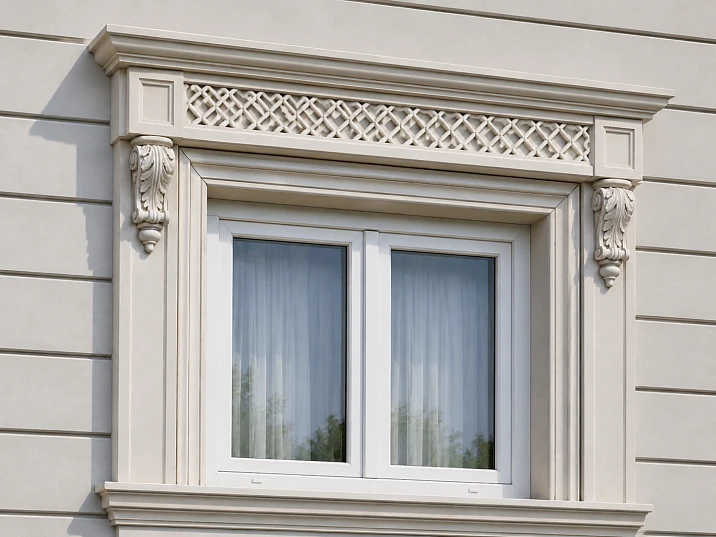
If the facade trim is already installed, fits well to the window opening, and you don't want to replace it just because of its too simple appearance, you can consider an additional decorative layer. One option is the decorative polyurethane trim KPU-112.
The current size of one KPU-112 strip is 75 × 5 × 2000 mm, and the price at the time of checking is 8,070 ₽ per piece. On the STAVROS card, the dimensions are described as A = 75 mm, C = 5 mm, L = 2000 mm, so for calculation you can indeed use 75 mm as the cross-sectional dimension of the decorative strip and 2000 mm as the length of one strip. The manufacturer also indicates the possibility of indoor and outdoor use, including on openings and walls.
The main task before ordering is not just to measure the window perimeter. First, you need to check whether the already installed trim has a suitable flat surface 75 mm wide, then choose a scheme — only the top, three sides, or another decorative contour — and only after that lay out each required segment across two-meter strips.
It is at the last stage that errors often occur. If 4.8 m of trim is required, arithmetically it seems sufficient to divide 4.8 by 2 and round up to three strips. In a specific case, three strips may indeed be sufficient, but such a coincidence cannot be applied to any window. Cutting depends on the length of each side separately. Sometimes the total footage fits into two strips, but the actual three segments will require three.
Therefore, the purchase scheme here is as follows:
check the trim → mark 75 mm → choose the position of the strip → measure each side to be decorated → create a map of segments → lay them out across strips 2000 mm long → only after that buy KPU-112.
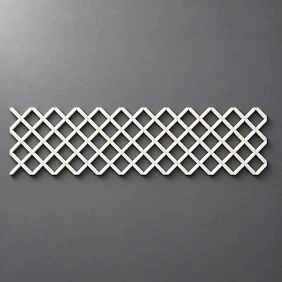
What is KPU-112 and why 75 mm should be seen on the actual trim
KPU-112 — decorative polyurethane molding. The current card shows dimensions of 75 × 5 × 2000 mm and a price of 8,070 ₽ per two-meter plank. The product is also available in the STAVROS polyurethane molding section at the same current price.
| Parameter | KPU-112 |
|---|---|
| Product type | decorative linear molding |
| Material | Polyurethane |
| Size | 75 × 5 × 2000 mm |
| Cross dimension A | 75 мм |
| Thickness C | 5 мм |
| Plank length L | 2000 мм |
| Price at time of check | 8 070 ₽ |
In the catalog, 75 mm seems like a small number. On the trim, it's 7.5 cm, which is a fairly wide decorative strip.
If the existing window frame has a total width of 100–110 mm, KPU-112 will occupy a significant portion of its front surface.
If the trim is wide — 150–180 mm, there is much more freedom to shift the molding toward the inner or outer edge.
Therefore, before ordering, it's more useful not to look at photos of KPU-112 on the screen, but to take painter's tape or a paper strip exactly 75 mm wide and apply it to your window frame.
This immediately reveals three things:
is there enough space;
does the decorative strip not become too large;
where exactly should it run relative to the edges of the trim.




KPU-112 molding does not replace the existing trim
In the scenario under consideration, the trim already performs its main compositional function: it forms the framing of the window opening.
KPU-112 is added on top of the existing scheme as a separate decorative strip.
This fundamentally distinguishes the task from a complete replacement of the window framing.
When dismantling the existing trim, one has to re-solve the width of the new framing, junctions, corners, and the outer contour of the opening.
When adding KPU-112, the original geometry already exists. The buyer needs to solve a narrower task:
whether the ornamental strip fits on the finished base and whether it improves the appearance.
Therefore, you shouldn't change all the decoration at once if the existing framing is technically acceptable and the problem is only a lack of decorativeness.
On the other hand, KPU-112 should not become a way to mask a poorly installed platband. If the existing piece is skewed, damaged, or has problematic joints, additional ornamentation may only draw more attention to the defect.
First, assess the condition of the base. Then—the decor.
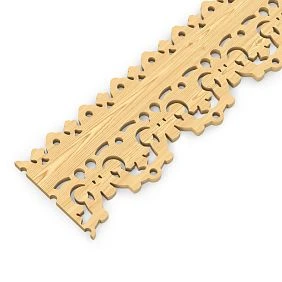
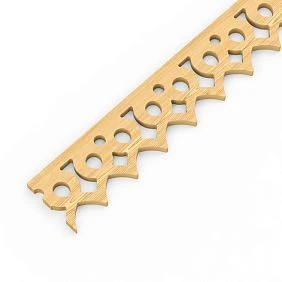
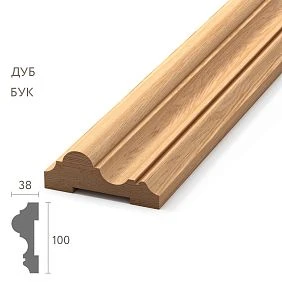
Our factory also produces:
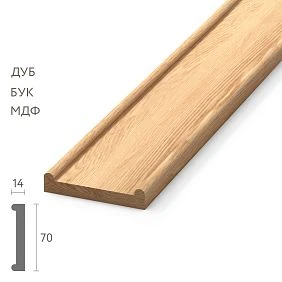
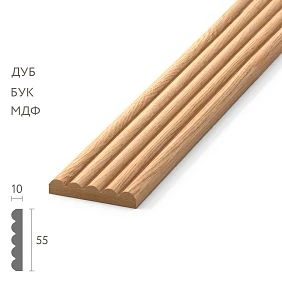
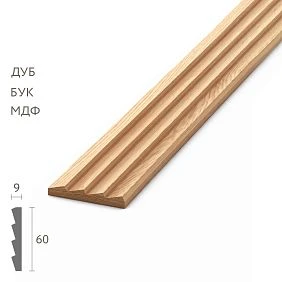
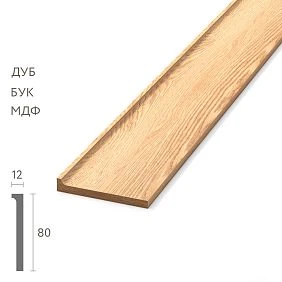
Platband width: first check before ordering
The most straightforward calculation is to compare the actual width of the front part of the platband with the 75 mm of KPU-112.
Suppose a smooth platband has a width of 110 mm.
After placing the 75 mm strip, the remainder is:
110 − 75 = 35 mm.
If we conditionally place the decorative molding exactly in the center:
35 / 2 = 17.5 mm.
That is, on both sides there will be only 17.5 mm of smooth surface left.
On a 160 mm wide platband, the situation is different:
160 − 75 = 85 mm.
When centering:
85 / 2 = 42.5 mm.
The same KPU-112 looks different on these two trims.
The narrow remainder makes the ornament almost completely determine the appearance of the platband.
The wide remainder allows leaving a calm smooth frame around it.
For a preliminary assessment, it is convenient to use a table.
| Width of the front part of the platband | After the 75 mm strip, what remains is | With conditional centering on each side |
|---|---|---|
| 90 мм | 15 мм | 7.5 mm |
| 100 мм | 25 мм | 12.5 mm |
| 110 мм | 35 мм | 17.5 mm |
| 120 мм | 45 мм | 22.5 mm |
| 140 мм | 65 мм | 32.5 mm |
| 160 мм | 85 мм | 42.5 mm |
| 180 мм | 105 мм | 52.5 mm |
| 200 мм | 125 мм | 62.5 mm |
This table does not introduce a rule that 120 mm is "allowed" and 110 mm is "not allowed". It shows the real scale.
The final decision is made according to the template.
Get Consultation
The nominal width of the trim and the useful surface are not the same thing
This is one of the most important practical points.
The trim may have a total width of 140 mm, but this does not mean that there is a flat strip 140 mm wide on it.
On the front part there may be:
bevels;
steps;
chamfers;
grooves;
its own small relief.
For additional decorative molding, the part of the surface where KPU-112 is actually intended to be placed is important.
For example:
total width of the trim is 140 mm;
25 mm on each side are occupied by profiled edges;
central smooth part:
140 − 25 − 25 = 90 mm.
With a KPU-112 width of 75 mm, there remains:
90 − 75 = 15 mm,
that is, when centered within the smooth area — only 7.5 mm on each side.
At a total size of 140 mm, the solution seemed very loose.
At an actual mounting surface of 90 mm, it becomes tight.
Therefore, measure the area where the decorative trim will actually run, not the maximum outer dimension of the existing casing.
A paper strip of 75 mm will give more information than a product photo.
For the first fitting, you don't need to buy a two-meter-long strip.
Take paper or cardboard and make a strip 75 mm wide.
If you need to check not only the width but also the overall scale, you can prepare a longer mock-up.
Secure it with painter's tape on the casing.
Look at the window from three distances:
up close;
from the usual approach point to the house;
from afar, where the entire facade is readable.
This third view is especially important for exterior decoration.
A detail that seems large right at the window can be perceived much more calmly from a distance.
Conversely, an active repetition of the ornament on three sides of several windows at once can become a very noticeable element of the entire facade.
If the paper strip already occupies almost the entire front plane of the trim, this is a reason to check a calmer scheme — for example, use KPU-112 only on top.
Three main schemes: top, three sides, or a full decorative contour
After checking the width, a second question arises — how many sides of the window to decorate at all.
Only the top side
This is minimal intervention.
KPU-112 becomes a decorative accent above the window, while the vertical trims remain in their original form.
This option is especially interesting if:
the framing is already wide enough;
you need to slightly strengthen the top of the window;
vertical repetition of the ornament seems excessive;
the side trims are partially overlapped by other facade elements.
The amount of material in this scheme is minimal.
The top and two vertical sides
This is the most obvious outline for a window if the bottom side does not require the same treatment.
A continuous U-shaped decorative scheme appears.
But it is here that cutting is especially important: two long verticals often almost completely occupy separate two-meter planks.
All four sides
This option makes sense only if the actual window architecture and existing framing imply a closed decorative band.
The lower part of the facade window may have its own sill element or another architectural detail, so adding KPU-112 on the fourth side automatically is not advisable.
First, you need to determine the actual construction of the specific framing.
Only the top of the window: the simplest calculation, but not always the simplest design
Suppose the upper section has a length of 1400 mm.
KPU-112 is supplied as a 2000 mm strip.
For one continuous top segment of 1400 mm, one strip is sufficient.
After cutting, theoretically remains:
2000 − 1400 = 600 mm.
But the 600 mm remainder should not be automatically considered suitable for any next section.
If the second window also requires a top of 1400 mm, it cannot be obtained from the 600 mm.
However, if the project includes a short decorative section up to 600 mm and the pattern of the molding allows using this remainder without an unfortunate break in the ornament, it could potentially be useful.
That is why, with multiple windows, it is useful to compile a list of all parts rather than calculating each opening in isolation.
Why "total length / 2 meters" sometimes is wrong
Consider a window that requires three separate parts:
top — 1400 mm;
left vertical — 1300 mm;
right vertical — 1300 mm.
Total length:
1400 + 1300 + 1300 = 4000 mm, or exactly 4 m.
If we count only the total length:
4 / 2 = 2 planks.
But two KPU-112 planks of 2000 mm each do not allow obtaining three whole segments of 1400, 1300, and 1300 mm.
Let's check the combinations:
1400 + 1300 = 2700 mm — does not fit into one two-meter plank;
1300 + 1300 = 2600 mm — also does not fit.
Therefore, each of the three large segments requires its own two-meter blank.
Actual order:
3 KPU-112 planks, not 2.
This is the reason why trim cannot be purchased only by total footage.
Cutting is needed.
Your example: window 1400 × 1700 mm on three sides
Suppose the decorative line repeats:
top — 1400 mm;
left side — 1700 mm;
right side — 1700 mm.
Total length:
1400 + 1700 + 1700 = 4800 mm.
By length:
4800 / 2000 = 2,4;
after rounding, you get 3 planks.
Checking the cutting.
First plank:
1700 mm + remainder 300 mm.
Second:
1700 mm + remainder 300 mm.
Third:
1400 mm + remainder 600 mm.
In this case, the result of simple division coincided with the actual cutting:
you need at least three two-meter planks if each side must be made from a single piece and other installation features do not require additional material.
Cost of three planks at the current price:
3 × 8 070 = 24 210 ₽.
But the coincidence of the result does not make the method total length / 2 m sufficient for the next window. As the example of 1400 + 1300 + 1300 mm showed, with the same 4 linear meters, three planks may be needed instead of the arithmetic two.
Cutting should start with the longest pieces
The practical algorithm for calculating an order is simple.
Make a list of required pieces.
For example:
1700;
1700;
1400;
600;
550;
400 mm.
First, distribute the longest ones.
Bar 1:
1700 + possible remainder 300.
Bar 2:
1700 + remainder 300.
Bar 3:
1400 + can check if another 600 fits.
1400 + 600 = 2000 mm.
In an ideal arithmetic model, these two segments fully use one bar.
Remaining:
550;
They are together:
950 mm.
That is, theoretically, they fit into another strip.
This approach is much more accurate than simply summing all the centimeters.
When placing a real order, it is also necessary to take into account the actual cut, the nature of the joints, and the acceptability of using specific offcuts from the standpoint of the molding pattern.
The ornament can make a mathematically suitable offcut inconvenient.
Decorative molding differs from a completely smooth batten.
It has a specific pattern on it.
Therefore, the situation:
“600 mm left, but a 550 mm piece is needed”
does not yet guarantee that this particular remainder will be the best solution.
Before using short remainders, it is worth checking:
how the pattern ends on the cut fragment;
whether the ornament can be joined;
whether the cut falls into a visually unfavorable part of the pattern.
We will not invent an exact repeat step for KPU-112 without confirmed data. It is better to include a check of the actual pattern before final optimization of cutting.
That is, the calculation has two levels:
geometric — whether the length is sufficient;
visual — whether the specific remainder is suitable for the required place.
How to calculate KPU-112 for multiple windows at once
With several identical windows, it becomes possible to use leftovers more efficiently.
Suppose each window only needs a top piece 1400 mm long.
For one window:
1 plank 2000 mm → cut piece 1400 mm + leftover 600 mm.
For four windows, a simple calculation gives four planks and four leftovers of 600 mm each.
Total in leftovers:
600 × 4 = 2400 mm.
But from this, you cannot make another top piece 1400 mm long without a joint, because the leftovers are in four separate pieces.
This example shows why even a large total leftover does not mean real savings.
For long visible sides of a window, it is especially valuable to preserve a whole continuous piece, if the project and installation technology allow it.
When the joint on the long side becomes a separate design solution
If the area being finished exceeds 2000 mm, one KPU-112 strip is physically insufficient.
For example, a horizontal line 2400 mm long.
A connection of at least two segments will be required.
Then the task is no longer only quantitative.
You need to decide:
where the joint will be located;
how it will fit into the pattern;
how noticeable it will become after finishing;
whether it would be better to change the decorative scheme.
For a window less than two meters wide, there is usually no such problem on the upper section.
It appears for a large opening, stained glass, or a combined window group.
That is why the plank length of 2000 mm is not just a product characteristic, but a real limitation when designing a continuous strip.
Where to place KPU-112 on a wide casing
If the casing is noticeably wider than 75 mm, the trim does not necessarily have to be positioned exactly in the center.
There are three fundamental positions.
Closer to the window opening
The ornamental strip is more strongly connected to the window itself.
The outer smooth part of the casing remains wider.
In the center
This results in the most formally symmetrical layout.
It is convenient if the existing casing itself has a calm rectangular shape.
Closer to the outer edge
The ornament works more strongly as a border of the entire framing and visually enlarges its outer contour.
Which option is better is determined not by a universal formula, but by the existing architecture of the facade.
A 75 mm strip of paper allows you to compare three positions before purchasing.
Do not strive to leave equal margins on both sides at any cost
On a perfectly flat trim, centering looks natural.
But if the inner edge already has a step or a pronounced transition to the window opening, geometrically equal offsets may be perceived as visually unequal.
In such a case, it is more useful to take into account the actual profile lines.
For example, on a trim 160 mm wide, the mathematical center leaves 42.5 mm on each side.
But if 25 mm of the inner part visually belongs to another step, the central position relative to the entire width may look shifted.
Therefore, a paper template is needed not only for the answer "fits / does not fit," but also for finding the correct axis.
Thickness 5 mm: the additional layer will be noticeable from the side
The KPU-112 card specifies size C = 5 mm.
This is a relatively small offset from the base plane, but it exists.
If decorative trim is installed on an already finished casing, an additional relief layer appears.
It needs to be assessed:
near the slope;
near the top junction;
in the corners;
when looking at the window from the side.
A five-millimeter layer can look very neat on a wide flat frame and completely different on a narrow multi-step detail.
For this, it is useful to make not only a paper strip 75 mm wide, but also a simple three-dimensional imitation of the thickness, if the borders of the platband are located very close.
Why KPU-112 should not be called a molding just for the sake of text variety
KPU-112 in the considered product scenario is a decorative polyurethane trim.
It is supplied as a linear strip 2000 mm long and is used as a repeating decorative band.
This is convenient precisely for finishing an existing platband.
A local overlay would provide a separate ornamental accent.
The trim allows you to run the pattern along the entire selected side.
A molding can form an independent border or frame.
In a specific project, different products can be combined, but replacing the correct type of product with words like "overlay", "baguette", or "molding" just for stylistic variety is not necessary.
The buyer must understand that we are talking specifically about the two-meter decorative trim KPU-112.
Only the top decorative accent: when it is better than full framing
Not every smooth window needs to be surrounded by ornament on three or four sides.
Sometimes the facade only lacks a pronounced top line.
This is especially likely when the vertical casings are already noticeable enough due to their length.
The top of the window, on the contrary, seems too simple.
Then one horizontal strip of KPU-112 allows you to change the accent without greatly increasing the amount of decor.
There is also a commercial advantage.
For a top section up to 2000 mm long, one two-meter strip is usually sufficient.
For example, a top of 1500 mm:
1 KPU-112 is purchased;
cost at the time of check — 8,070 ₽.
This is significantly less than framing the entire U-shaped contour with three planks.
Therefore, before ordering, it is useful to first try only the top and see if the problem is solved.
Three sides: when the ornament should become part of the entire casing
If the top strip looks random on its own, and the existing side casings are very smooth, it is more logical to check the U-shaped contour.
In this option, the molding turns from a separate accent into a permanent part of the framing.
For the 1400 × 1700 mm window considered above, the minimum parts list is:
1400 mm;
1700 mm;
1700 mm.
It requires three KPU-112 strips when using whole segments on each side.
Cost:
24,210 ₽ at the current price of three strips.
That's already a noticeable amount.
That's why, before placing the order, you need to stick 75 mm paper strips on the facade along all three sides.
One strip on top may seem restrained.
Three strips create a much more active ornamental contour.
Full perimeter: first check whether the bottom side is needed
For a facade window, the bottom zone is often arranged differently than the top and side parts.
There may be a separate sill element, drip edge, or another architectural boundary.
Therefore, you shouldn't automatically add a fourth strip just for the sake of a closed rectangle.
If the bottom frame structurally and compositionally matches the other sides, the option can be checked.
But then the quantity calculation is again done based on the list of individual parts.
For example:
top — 1400;
bottom — 1400;
left side — 1700;
right — 1700.
Total length:
6200 mm.
Arithmetic says:
6200 / 2000 = 3.1 → at least four strips.
The cutting check confirms: each large piece in this set practically requires a separate strip, because 1400 + 1400 and 1700 + any of these elements do not fit into 2000 mm.
That makes 4 slats.
Cost:
4 × 8 070 = 32 280 ₽.
For such an order, the decorative necessity of the bottom side should be quite obvious.
How to design corners and why this needs to be decided before cutting
The linear footage along the top and vertical sides meets at the two upper corners.
A simple length calculation says nothing about how this joint will actually look.
Before cutting, you need to choose the principle for designing the corner.
The specific technique depends on the product's pattern, the actual profile, and the installation solution.
Therefore, the article should not promise that any KPU-112 corner is assembled in one universal way.
Practically before serial installation, it is useful to take two short test fragments or make a mock-up and check:
how the pattern aligns;
doesn't it create a visually heavy spot;
how is the 5 mm thickness perceived in the joint.
It is especially important to do this before the final cutting of all two-meter strips. Otherwise, you can get many correctly length-cut parts that are inconvenient to join with the chosen method.
The top part is longer than two meters: you need to calculate already with the joint
Let's take a wide window or a window group with a top line of 2600 mm.
One KPU-112 has a length of 2000 mm.
So, at least the following will be required:
2000 + 600 mm.
But buying "1.3 strips" is impossible.
Two strips are required.
After cutting a 600 mm piece from the second plank, a large 1400 mm fragment remains, which can potentially be used on the other side or on a second window.
This is where a common cutting map for multiple openings starts to yield real savings.
If a 1350 mm piece is needed in another section, the 1400 mm remainder may fit in length.
If 1700 mm is required — no.
Therefore, long openings are better calculated together rather than one by one.
How to create a cutting map without special software
For a private house, a regular spreadsheet is sufficient.
For example:
| Detail | Required length | From which strip |
|---|---|---|
| Window 1, left side | 1700 мм | №1 |
| Window 1, right side | 1700 мм | №2 |
| Window 1, top | 1400 мм | №3 |
| Window 2, top | 1400 мм | №4 |
| Short section | 550 мм | check remainder No. 3 or No. 4 |
After that, the remainders are recorded separately.
Strip No. 1: 300 mm.
No. 2: 300 mm.
No. 3: 600 mm.
No. 4: 600 mm.
Now it is clear which remainder is theoretically suitable for the 550-millimeter section.
Such a simple list prevents two opposite errors:
purchasing extra slats;
an attempt to build a layout from remnants that are actually too short.
The project price depends on the number of slats, not just on linear meters.
At the current price of 8,070 ₽ per two-meter KPU-112, the cost can only be estimated after cutting.
| Number of planks | Total nominal length | Cost |
|---|---|---|
| 1 | 2 м | 8 070 ₽ |
| 2 | 4 м | 16 140 ₽ |
| 3 | 6 м | 24 210 ₽ |
| 4 | 8 м | 32 280 ₽ |
| 5 | 10 м | 40 350 ₽ |
| 6 | 12 м | 48 420 ₽ |
But the line "6 m" does not mean that any composition of 5.8 or 6 m in length is guaranteed from three slats.
The purchased unit is a two-meter slat.
That is why the budget is directly linked to the map of individual segments.
When a full replacement of trims is still more reasonable
The scenario of adding KPU-112 is good if the existing framing already suits you in terms of geometry, width, and condition.
But sometimes trying to preserve it creates too many compromises.
A full replacement should at least be considered if:
the useful plane of the trim is clearly already 75 mm;
the molding has to be placed over a complex relief;
the existing framing has damage;
the added strip makes the structure visually overly layered;
the new architectural idea requires a different width of the entire trim.
In such cases, KPU-112 should not be used at any cost just to avoid dismantling.
Sometimes it is simpler to design a new framing entirely.
When nothing needs to be added at all
There is also a fourth option — leave the facade as is.
A smooth casing may look too plain up close, but on the facade it works correctly.
Especially if nearby there are already:
rusticated corners;
cornices;
columns;
decorative pediment;
pronounced base trim.
Additional ornament around each window increases the decorative density of the entire building.
Therefore, the paper mock-up should be evaluated not only on one window in close-up.
Take a photo of the entire facade.
The added strip should improve the architectural rhythm of the building, not just make a single casing "richer."
One window may look good, but ten may already be overloaded.
This is especially important for a repeating facade.
Let's imagine a house with eight identical windows.
On one window, the U-shaped KPU-112 looks expressive.
After repeating it across eight openings, the result is:
8 upper ornamental strips;
16 vertical ones.
A total of 24 long decorative lines.
The visual effect is completely different.
Therefore, with a large number of windows, the following order is useful:
make one mockup;
photograph it;
mentally or in a graphic sketch, repeat the scheme along the facade;
only then calculate the total order.
Large-scale purchase is especially sensitive to error.
If one window requires three strips, eight windows will require up to 24 strips without considering the possibility of optimization between different openings.
At the current price, this is already:
24 × 8 070 = 193 680 ₽.
Such a scheme must not be chosen without a large-scale check.
Several windows need to be calculated as a common cut, not by multiplying the first order
Suppose the first window required three strips.
The simplest calculation for six windows:
3 × 6 = 18 slats.
This is a safe upper-level estimate for identical cutting, but it may not account for useful remnants.
If one window leaves a 600 mm fragment, and another facade element needs short sections of 550 mm, part of the material can be redistributed.
Therefore, for a large project, it is better to compile a single list of parts from all windows and only then lay them out on 2000 mm slats.
At the same time, savings should not be built solely on the theoretical sum of remnants: the decorative pattern and the position of joints may limit the use of some pieces.
Symmetrical windows should preferably be calculated as one system
If two windows are located next to each other on the same facade, KPU-112 on them will be visually compared.
Even small differences become noticeable:
on one window the strip is shifted closer to the opening;
on the other — closer to the outer edge;
The upper ornament starts from a different part of the pattern;
The joints are located in different places.
Therefore, after choosing a scheme, it is useful to note:
The distance of KPU-112 from the edge of the existing trim;
The method of finishing the upper corners;
The position of the decorative pattern;
The height of the start of the vertical segments.
For a single window, a slight difference may be unnoticeable.
In a row of identical openings, it becomes a disruption of rhythm.
Windows of different sizes should not automatically receive the same scheme
The facade may have:
narrow stairwell windows;
wide living room windows;
small bathroom windows;
door openings.
KPU-112 with a width of 75 mm will have a different relative scale on each of them.
On a wide casing of a large window, the ornament may look calm.
On a small opening, the same strip will become dominant.
Therefore, the rule "one facade — one decorative contour on all windows" does not always lead to the best result.
Sometimes a unified style is maintained by the color and material of the casings, and KPU-112 is used only on the main openings.
The main window of the facade can be highlighted separately
If the central axis of the house has a larger window, a balcony block, or another significant opening, decorative trim does not necessarily need to be repeated on all the others.
One of the options:
regular windows retain smooth casings;
the main window receives KPU-112.
Then the trim works not as mass edging, but as a means of architectural hierarchy.
Commercially, this also changes the order.
Instead of dozens of strips, material is needed only for one accent opening.
This option is worth checking before deciding to "decorate every window" without fail.
The actual condition of the facade surface cannot be ignored.
The KPU-112 card allows external application of the product.
But this does not mean that any existing surface can be used as a ready-made base without inspection.
On a real object, the following must be considered:
the material of the trim;
its coating;
flatness;
the presence of dirt and damage;
the conditions of the specific adhesive and finishing system.
We will not invent a universal technology for all facade bases.
It is more correct to match the requirements of the materials used with the specific surface before installation.
In the article about purchasing, this is important because a successful size of 75 mm does not automatically mean the base is ready for installation.
Why exterior finishing requires looking at the detail from a distance
People often view interior decor from one to two meters away.
The facade — from a much greater distance.
This changes the perception of scale.
A fine pattern may read not as a separate ornament, but as a relief strip.
Therefore, the choice of KPU-112 for the facade trim should be evaluated on two levels:
locally — whether the molding sits beautifully on the trim itself;
architecturally — what it does to the facade as a whole.
If the local detailing is pleasing, but from afar the window becomes too heavy, the decorative task is not solved.
How color changes the visual width of KPU-112
The 75 mm strip remains physically the same, but color affects its visual weight.
If KPU-112 is painted in the color of the existing trim, the ornament is read primarily through the relief.
This is the calmest option.
If the trim noticeably contrasts with the casing, its width visually becomes much more prominent.
On a 110 mm casing, a contrasting 75 mm strip effectively becomes the main color element.
Therefore, border-width trims are especially useful to try on while considering the future finishing.
White paper on a dark casing can already roughly show how strong the contrast will become.
Inner and outer decorative strips produce different effects
On the wide KPU-112 casing, it can be placed closer to the window or farther from it.
If the strip runs along the inner zone, it visually emphasizes the opening itself.
If along the outer one, it expands the decorative contour of the casing.
This is especially noticeable on small windows.
The inner strip can visually reduce the calm field around the glass.
The outer one can more strongly separate the window unit from the plane of the facade.
Before installation, it is useful to take two photos with the paper template in both positions.
Thus, the decision is made not by an abstract rule, but by a specific facade.
KPU-112 and the existing stucco molding around the window
Sometimes the casing is already supplemented with an upper pediment, a lower sill element, or other decorative details.
In such a situation, a continuous KPU-112 on three sides may be excessive.
For example, a pronounced upper element already creates an accent above the window.
Then it is more reasonable to check the additional strip only on the verticals.
In another project, it is the opposite: the side casings have their own relief, while the top remains smooth.
Then KPU-112 is only needed there.
The main advantage of the additional trim is that you don't have to redo the entire frame. You can use it locally where the decorative layer is truly missing.
How to compare the cost of adding KPU-112 versus a full redo
You should compare not the price of one strip with the price of one new casing, but two complete schemes.
For KPU-112, consider:
the number of two-meter strips;
cutting;
finishing and installation materials;
the work of adding the decorative layer.
For a full redo:
dismantling the existing frame;
new set of parts;
preparation;
new installation;
finishing touches.
Without a specific estimate, it cannot be claimed that KPU-112 is always cheaper.
But if the existing trims are in good condition and the issue is purely decorative, an additional strip allows at least not replacing the entire set automatically.
This is the logic of the solution in question.
How to determine that 75 mm is too much
There are several clear signs.
After installing the paper template, almost no visible surface of the original trim remains.
The ornament begins to be perceived not as d
An example where two meters of total stock do not save from an additional plank
Suppose four segments are needed:
1250;
1250;
1250;
1250 mm.
Total length:
5 m.
By total:
5 / 2 = 2.5 → arithmetically at least 3 planks.
But on one plank 2000 mm long, two segments of 1250 mm do not fit:
1250 + 1250 = 2500 mm.
Therefore, each piece requires a separate plank.
4 planks are needed, although the total footage is only 5 m with a total purchased length of 8 m.
This example is useful for multiple windows or identical short sides: the length of each individual part can affect the order more than the total meters.
An example where the remainder really helps
Another set:
1400;
600;
1350;
650 mm.
The first two-meter plank:
1400 + 600 = 2000 mm.
Second:
1350 + 650 = 2000 mm.
The total length of the parts is 4 m.
Exactly 2 planks are needed.
Here the cutting perfectly matches the total length.
The difference between this and the previous example shows why it is important for the buyer to know the set of sizes, not just the number of meters.
How to calculate an order for two different windows
Window A:
top 1400;
two verticals of 1700.
Window B:
only top 1200.
For window A, three strips are initially required.
From the top piece of window A, 600 mm remains.
From the verticals — 300 mm each.
A 1200 mm piece for window B cannot be obtained from these leftovers.
Therefore, one more strip is required.
Total order:
4 KPU-112.
After cutting window B from a two-meter plank, 800 mm remains, which can already be useful for another short section.
Thus, several windows gradually form a common cutting map.
What to check before final installation
When the quantity is calculated and the material is selected, it is useful to check the entire contour again without rushing before fixing.
Mark the position of the strip on all sides.
Compare the left and right verticals.
Check the top corners.
Look at the window from a distance.
If the facade has several identical openings, compare the markings between them.
After this, you can proceed to installation using materials and technology suitable for polyurethane, the existing surface, and outdoor conditions.
Specific requirements for adhesive and surface preparation should be taken from the instructions of the installation system used, not replaced with universal advice from an article.
Main mistakes when buying KPU-112 for ready-made platbands
Counting the width of the entire platband instead of the working surface
Why it happens: the maximum external dimension is measured with a tape measure.
Consequence: KPU-112 seems to fit according to the numbers, but actually lands on slopes or steps.
How to avoid: measure exactly the usable face strip.
Buying by total perimeter
Why it happens: 6 meters are perceived as three planks of two meters each.
Consequence: individual long pieces cannot be laid out across these three blanks.
How to avoid: first write down the length of each side.
Start cutting before deciding on corners
Why it happens: the side dimensions are already known and it seems like you can cut right away.
Consequence: the chosen connection scheme requires different end preparation.
How to avoid: first do a test corner.
Using every leftover just because it is longer than the required section
Why it happens: an attempt to minimize waste as much as possible.
Consequence: the pattern or joint location looks worse than on a solid piece.
How to avoid: check not only the length of the leftover, but also its appearance.
Decorating all windows after a successful fitting on one
Why it happens: a single opening looks good.
Consequence: repeated repetition makes the facade overly saturated.
How to avoid: assess the scale of the entire building before serial purchasing.
When purchasing KPU-112 is justified
Decorative trim is especially logical when existing facade casings:
are already installed;
are in good condition;
have a sufficiently wide and suitable surface for the chosen scheme;
seem too smooth;
do not require a full architectural rework.
Additionally, the size of KPU-112 itself should look convincing after trying a 75 mm strip.
And the cutting of two-meter planks should be calculated based on the actual sides of the window.
If all these conditions are met, an additional decorative strip allows changing the appearance of the framing without automatically replacing the entire casing.
When it's better not to buy KPU-112
You should refuse the purchase or at least compare another option if:
the useful area of the casing is too narrow;
the molding almost completely covers the existing framing;
there is already a lot of ornament on the facade;
a large number of inconvenient joints is required;
the existing casings need repair or replacement regardless of the decor;
a full-size template makes a small window visually heavy.
This is not a drawback of KPU-112.
A simple decorative molding 75 mm wide is not suitable for every already installed frame.
Where to buy KPU-112 and see alternatives
If after trying on the 75 mm strip fits, buy decorative molding KPU-112 can be in a separate product card. Current size — 75 × 5 × 2000 mm, price at the time of checking — 8,070 RUB.
Other options are collected in the section buy decorative polyurethane molding. In the current catalog, KPU-112 is presented among other models of polyurethane molding.
For a wider selection, you can go to the section You can buy ready-made stucco matching the Baroque style. Calculate the quantity: linear meters of cornices and moldings, number of rosettes, pilasters, consoles, corner elements. Add a ten to fifteen percent allowance for trimming..
If the task after trying on turned out to be broader than the additional strip on the trim, you can separately look at Polyurethane wall decor, without mixing it with the calculation of KPU-112.
What to put in the cart: a short reminder
For the top side up to 2000 mm, if one continuous segment is needed:
usually, 1 KPU-112 plank is initially considered.
For a window of 1400 × 1700 mm on three sides:
segments 1400 + 1700 + 1700 mm;
3 planks;
cost — 24,210 ₽ at the time of check.
For four sides of the same conditional contour:
1400 + 1400 + 1700 + 1700 mm;
4 planks with the specified cutting;
cost — 32,280 ₽.
But these figures cannot be transferred to another window based on perimeter alone.
First, write down the actual segments.
KPU-112 calculation algorithm before ordering
1. Check the existing trim.
If it itself requires replacement, additional linear footage does not solve the main problem.
2. Measure the useful face surface.
Not the overall dimension, but the place where the strip will actually run.
3. Set aside 75 mm.
Use paper or painter's tape.
4. Choose a decorative pattern.
Only the top, three sides, or another meaningful option.
5. Measure each side separately.
6. Write down all segments from long to short.
7. Distribute them across 2000 mm planks.
8. Record the leftovers separately.
9. Check whether the leftovers can be used without an awkward joint or pattern disruption.
10. Decide the corner construction before final cutting.
11. Multiply the actual number of planks by the current price.
12. If there are multiple windows, recalculate them as one combined layout.
Only after this does it become clear how many KPU-112 actually need to be ordered.
FAQ
Can KPU-112 be used only on one central window of the facade?
Yes. It is not necessary to repeat the decorative molding on every opening. One main window can be highlighted separately if it fits the facade composition.
Is it necessary to make the same decor on the first and second floors?
Not necessarily. Windows may differ in size and role. A 75 mm wide strip, which works well on a large first floor, may be too active on smaller upper windows.
Can the remaining KPU-112 be used on a door opening?
In terms of length — if the remainder matches the required segment. But first, you need to separately check the width, ornament orientation, and the door opening composition itself. The manufacturer specifies the use of KPU-112 for finishing openings as well.
What to do if the top of the window is 2100 mm?
One 2000 mm long strip no longer covers such an area entirely. An additional fragment and a pre-planned joint location will be required, or a different design scheme.
Can several short remnants be joined on one visible side?
Geometrically, this is possible depending on the lengths, but a large number of joints on a visible ornamental strip may degrade the result. For the main side, it is better to first compare the option with a solid segment.
Do I need to buy a separate spare strip?
There is no automatic rule. The decision depends on the layout, the number of windows, the presence of complex connections, and whether usable pieces remain after the main panel. First, create a complete layout, then decide on the reserve.
Can KPU-112 be installed inside an existing molding frame around a window?
If there is indeed an additional frame on the facade, that is a separate placement zone. You need to measure its usable surface and check the 75-millimeter dimension there, rather than transferring the calculation from the trim.
What to do if the left and right sides of the trim differ in width?
Do not use one central marking automatically. Each side needs to be measured separately and checked whether it is possible to maintain a visually identical position of the molding.
Can KPU-112 be used only on verticals?
Such a composition can be considered if the top of the window already has an independent decorative element. The molding does not have to run along all sides just for continuity.
Does it make sense to install KPU-112 on a very wide smooth trim of 200 mm?
The 75 mm size leaves a lot of free field. But the correct position needs to be chosen with a template: in the center, closer to the opening, or to the outer edge. A wide trim gives more options, but does not automatically determine one correct one.
What matters more when purchasing — the total length or the number of individual pieces?
For two-meter lengths, both indicators matter, but the final number of strips determines the cutting of individual pieces. The same total length may require a different number of strips.
If many short pieces remain after cutting, does that mean the calculation was done incorrectly?
Not necessarily. The reason could be the length of the sides themselves. If each required element is longer than half of a two-meter strip, two such segments cannot physically be obtained from one blank, so large leftovers are inevitable.
Can I first order one KPU-112 as a trial?
For a complex or repeated facade project, a trial full-size assessment may be more useful than a bulk purchase. Before buying even one strip, the 75 mm scale can be pre-checked with a paper template.
Where can I see other sizes and patterns of the trim?
Other models are presented in the section decorative polyurethane molding.
Where can I order KPU-112?
After checking the width of the trim and the cutting, you can order KPU-112 75 × 5 × 2000 mmPrice at the time of check — 8,070 ₽ per plank.