Article Contents:
- What exactly is the NPU-191
- Why the smooth door doesn't necessarily need to be continued with slats
- First, separate the decorative door from the electrical panel itself
- What door dimensions need to be taken before purchasing the NPU-191
- Full-size template 210 × 197 × 12 mm: check before ordering
- Center the NPU-191 or shift it due to the handle
- Check the opening: 12 mm is a small thickness, but it changes the geometry
- The 12 mm relief and surrounding slats: what will be visible from the side
- How much free space to leave around NPU-191
- Why one NPU-191 is enough — and when it is too small
- Overlay or molding frame: different ways to make the door intentional
- Color of NPU-191: matching the door, slats, or contrasting
- Light in the hallway: why NPU-191 may appear more noticeable than it seems on the card
- Connection of NPU-191 with the vertical rhythm of slats
- Installation of NPU-191 on a decorative door
- What to buy together with NPU-191
- Material of the decorative door: why the same NPU-191 is installed differently
- Operation: access to the panel, cleaning, and maintenance
- Door panel scale: when NPU-191 is too large or too small
- When NPU-191 is justified, and when it's better to leave the door panel without decor
- The gap around the perimeter of the door panel cannot be masked with an overlay
- How hinge placement affects the composition
- Decorative accent and recognizability of the technical zone
- Three style scenarios for the same NPU-191
- How to check visual scale from a distance
- Commercial calculation: how much this exact solution costs
- Mistakes that make a decorative door panel less convenient
- Practical algorithm before purchasing
- Decision matrix: whether NPU-191 is suitable for your door panel
- Result: NPU-191 should decorate the door, not complicate the electrical panel
- FAQ
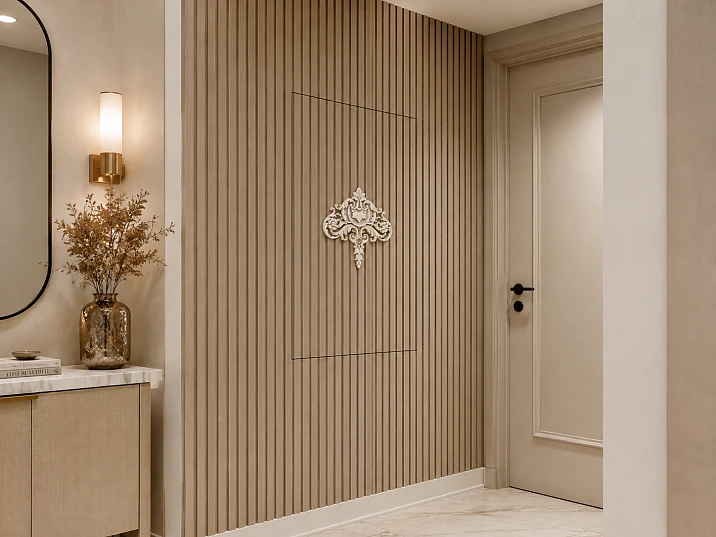
A slat wall in the hallway works well as long as the vertical rhythm remains continuous. But the electrical panel requires separate access, so a smooth opening door appears in the finish. Against the background of the slats, it often looks like a technical rectangular patch: the plane is different, the chiaroscuro disappears, and the vertical rhythm suddenly breaks off.
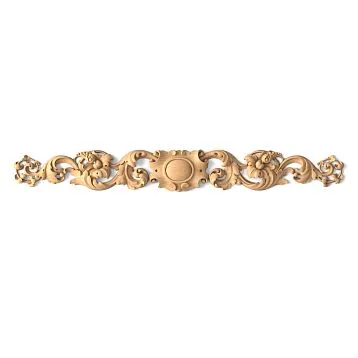
The most obvious solution is to try to continue the slats on the door and make it almost invisible. But this approach is not suitable for every hatch: it adds thickness and mass, and raises questions about hinges, handles, gaps, and opening. Another path is not to disguise the door as a slat wall, but to deliberately make it a separate decorative element. For this, you can use one carved decorative overlay NPU-191 made of polyurethane.
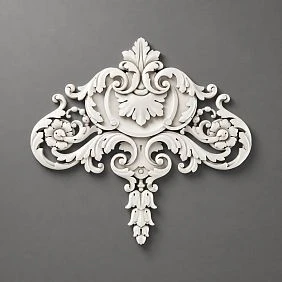
The current STAVROS card shows the size of NPU-191 as 210 × 197 × 12 mm, the material is polyurethane, and the current price is 2,220 RUB per piece. The STAVROS catalog also explains the dimensions: A = width, B = height, C = thickness, so for this model you can correctly count 210 mm in width, 197 mm in height, and 12 mm in projection. The card allows the overlay to be used on door panels, furniture facades, and wall panels, as well as adhesive mounting and painting.
For the original task, this means the following: one NPU-191 can be considered as a central decorative accent on a separate smooth door in front of the panel, if the door itself is large enough, the overlay does not cover the handle or push mechanism, does not interfere with opening, and does not turn the decorative panel into an obstacle for servicing the electrical panel.
The key limitation of the article: it is specifically about an external decorative door or false panel that already covers the technical panel and opens independently. The overlay should not be glued to the factory cover of the electrical equipment, nor should it cover markings, locks, ventilation openings, controls, or access to devices. If there is doubt about where the decorative part ends and the standard electrical equipment begins, it is better to first consult with an electrician.
After this article, the buyer should be able to do five things: measure the door, check the fit of NPU-191 at 1:1 scale, evaluate the free margins and opening mechanism, choose a color, and only then decide whether to buy one NPU-191 for 2,220 RUB or leave the door smooth.
What exactly is NPU-191
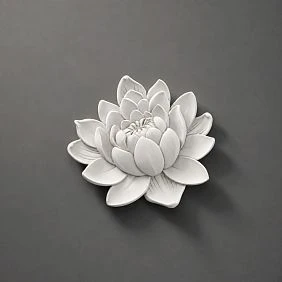
NPU-191 is not a "decor for an electrical panel" as a separate technical class of product. It is a carved decorative overlay made of polyurethane, which in this project is proposed to be used on an external decorative door.
| Parameter | NPU-191 |
|---|---|
| Type | Carved decorative overlay |
| Material | Polyurethane |
| Width A | 210 мм |
| Height B | 197 мм |
| Thickness C | 12 мм |
| Current price | 2,220 RUB/piece |
| Main article scenario | one overlay on a smooth door panel |
After checking the actual fit, you can buy the molded decor NPU-191 made of polyurethane.
The NPU-191 card is useful for two more reasons.
First, the manufacturer directly classifies the overlay as decor for door panels and furniture facades. This means the very idea of using the product on a flat, opening decorative door does not contradict the stated areas of application.
Second, the card confirms the possibility of adhesive mounting and painting. This allows designing NPU-191 as a lightweight applied relief, rather than as a separate frame structure.
But the card does not know the dimensions of a specific electrical panel door, does not know the location of the handle, hinges, or push latch, and does not confirm compatibility with any door covering. Therefore, the final decision is always made by the mockup and dry fitting.




Why a smooth door does not necessarily need to be continued with slats
The desire to hide a technical hatch is understandable: if the entire wall is slatted, you want to preserve the verticals. But an "invisible door" and a "beautiful door" are two different design strategies.
Continuing the slats on the opening panel creates the illusion of a continuous wall, but requires precise matching of the pitch, thickness, and position of the lamellas. On a small door, it is easy to get a shifted rhythm, trimmed slats at the edges, or a complex gap around the panel.
A smooth door, on the contrary, honestly shows that there is a functional element in the wall. If you decorate it with a single NPU-191, it stops looking like a forgotten technical spot and turns into a small decorative panel within the slatted surface.
This approach is especially appropriate when:
-
the slatted wall itself is already quite active;
-
the door is small and gluing several slats onto it is inconvenient;
-
there is a desire to keep the low weight of the opening panel;
-
quick and clear access around the panel is needed;
-
the interior allows for a classic or ornamental detail;
-
a molding frame around the hatch would look too heavy.
There is another plus: the smooth surface creates a visual pause between the verticals. If a relief NPU-191 appears in the center of this pause, the contrast of "slats — smooth zone — ornament" becomes deliberate.
A wider selection of slatted solutions for the entry area is covered in the STAVROS article about slatted panels and stucco decor in the hallwayThe new article addresses a narrower issue — a specific door in front of the electrical panel and one NPU-191.
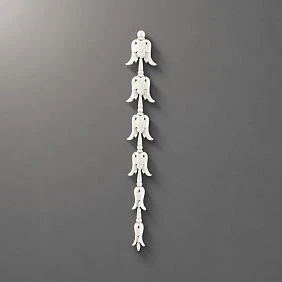
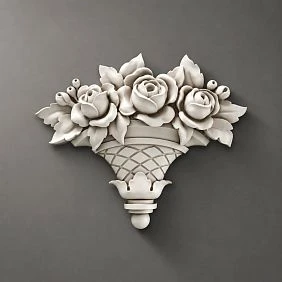
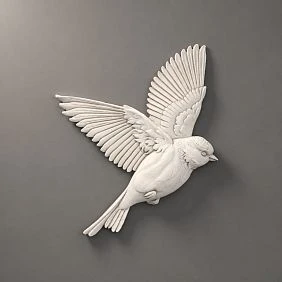
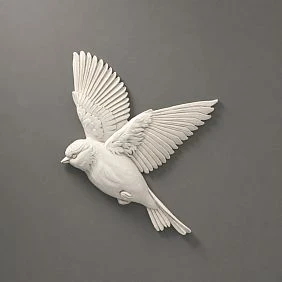
Our factory also produces:
First, we separate the decorative door from the electrical panel itself.
This is the most important technical point of the entire topic.
The external smooth door may be part of furniture or wall finishing: an opening panel, a hidden hatch, a small hinged facade door, a removable or swing false panel. Behind it is the electrical panel itself with its own factory cover, circuit breakers, markings, and internal components.
NPU-191 is installed only on the external decorative panel, if such a panel is indeed separate.
Do not:
-
gluing the overlay directly onto the factory cover of the panel;
-
covering the lock of the standard enclosure with the overlay;
-
blocking ventilation openings;
-
making the decor part of the access mechanism to the circuit breakers;
-
connecting the decorative door and surrounding strips with the overlay;
-
mask so thoroughly that a person does not understand where the access to the shield is.
The decorative door should continue to open normally after installing the NPU-191. If the door opens by pressing, the pressing area must be preserved. If there is a handle, leave free access to it. If the panel is removable, the overlay must not interfere with gripping and removing it.
The principle is simple: the decor changes the appearance of the door, but does not change its technical function.
Get Consultation
What door dimensions need to be taken before purchasing the NPU-191
For this article, the orientation of the NPU-191 dimensions is confirmed: 210 mm — width, 197 mm — height, 12 mm — thickness.
This means that for initial fitting, at least five door parameters are needed.
-
W — the net width of the front part of the door.
-
H — the net height.
-
R — the area of the handle, push mechanism, or recess.
-
P — the margins needed near hinges or the edge of the panel.
-
D — distance to the surrounding rack surface and possible depth difference.
If the NPU-191 is installed strictly in the center, the mathematical fields are calculated as follows:
side field = (W − 210) / 2;
top and bottom field = (H − 197) / 2.
These formulas only answer the geometric question. They do not indicate whether the field is visually sufficient or whether a handle falls into it.
For example, for a conditional door 350 × 450 mm:
(350 − 210) / 2 = 70 mm on the sides;
(450 − 197) / 2 = 126.5 mm at the top and bottom.
On such a surface, the NPU-191 physically fits with noticeable fields.
For a conditional door 300 × 350 mm:
(300 − 210) / 2 = 45 mm on the sides;
(350 − 197) / 2 = 76.5 mm on top and bottom.
Physically, the overlay also fits, but the side margins are already noticeably narrower. If a handle is located nearby, the central placement may be uncomfortable.
And for a door 240 × 260 mm:
(240 − 210) / 2 = 15 mm on the sides;
(260 − 197) / 2 = 31.5 mm on top and bottom.
Here, the NPU-191 almost fills the entire front part. This option cannot be automatically considered successful: the ornament may look cramped, and the technological margins for the handle and door edge practically disappear.
| Example door | Side margins at center | Top/bottom | What to check |
| 240 × 260 mm | 15 мм | 31.5 mm | most likely too tight |
| 300 × 350 mm | 45 мм | 76.5 mm | handle and visual air |
| 350 × 450 mm | 70 мм | 126.5 mm | calm fit is possible |
| 450 × 600 mm | 120 мм | 201.5 mm | doesn't the NPU seem too small |
The last example shows the opposite problem. On a large door, the NPU-191 physically fits without issue, but it can get lost as too small a central sign.
Therefore, geometry checks capacity, and a full-size mockup checks scale.
Full-size template 210 × 197 × 12 mm: check before ordering
A paper rectangle 210 × 197 mm is only the first layer of checking. It shows how much space the NPU-191 takes up on the front plane of the door.
But the real overlay has relief and a thickness of 12 mm. Therefore, it's better to do the check in two stages.
Stage 1 — flat template. Cut out a rectangle 210 × 197 mm from paper or cardboard. If you have a photo or drawing of the product, transfer an approximate outline of the ornament onto it. Attach it to the door with painter's tape.
Check:
-
whether the template overlaps the handle;
-
whether it ends up too close to the edges;
-
whether there is enough clean space;
-
does the center of the door look meaningful;
-
does the pattern not conflict with the vertical slats around it.
Stage 2 — volumetric mockup. Add a spacer of about 12 mm to the template or attach a real NPU-191 without glue.
Now you need to look from the side.
Check:
-
does the decor not protrude beyond the plane of the slats more than expected;
-
does it not catch on the adjacent panel when opening;
-
does it not interfere with fingers gripping the handle;
-
does it not fall into the door's trajectory;
-
does it not turn a small panel into an overly massive object.
It is especially useful to take a short video of the door opening and closing with the mockup. A static photo does not show the kinematics.
After such a check, you can order NPU-191 210 × 197 × 12 mm already as a concrete solution, not as a product photography experiment.
Center NPU-191 or offset it due to the handle
Central placement looks obvious only on a door without hardware.
If there is a handle, push-to-open button, finger groove, or hidden magnetic mechanism, the composition changes.
Handle on the side
If the handle is at the right edge, the mathematical center may leave too little distance between the ornament and the hand.
In this case, NPU-191 can be slightly shifted to the left if visual balance is maintained after the shift.
The offset should be calculated not from the geometric center of the entire door, but from the free decorative field.
For example:
-
door width — 350 mm;
-
on the right, 50 mm is occupied by the handle and the grip working area;
-
300 mm of clean surface remains.
Then it is more logical to center the decorative composition within these 300 mm, rather than in the full size of 350 mm.
This is not a universal formula for all handles. The point of the method is different: first subtract the functional area, then build the decor.
Push-to-open
If the door opens by pushing, you need to determine the actual point where the user usually presses.
The NPU-191 should not force pressing on relief leaves or thin sections of the ornament every time.
Allowed:
-
leave the pressing area free;
-
shift the overlay;
-
change the height;
-
abandon the NPU if the entire door is too small.
Recess or hidden grip
If fingers go behind the edge of the door, the NPU can remain centered. But you need to check whether the 12-millimeter protrusion interferes with the natural movement of the hand.
Opening check: 12 mm is a small thickness, but it changes the geometry.
A smooth door has its own trajectory.
If it opens outward, the edge of the panel and everything attached to it moves along an arc.
NPU-191 protrudes by 12 mm. This does not mean it will necessarily interfere with something. But the additional overhang must be taken into account, especially if nearby:
-
a protruding edge rail;
-
the casing;
-
a side wall of the cabinet;
-
mirror;
-
hooks;
-
entrance door;
-
another technical hatch.
The most reliable test is to open the door to the full working angle with a full-scale mock-up.
You need to check not only the moment of full opening. Contact can occur in the middle of the trajectory.
The door opens towards the slatted wall
If the hinges are located near the slats, the decorative relief may run close to the outermost lamella.
With the door closed, the gap looks sufficient, but when it swings, the trajectory changes.
The door opens to the free side
Here the risk is lower, but you need to check whether the NPU falls into the walkway zone. The hallway is cramped: a person may brush the protruding decor with a bag or clothing.
Removable panel
If access is achieved by removing the entire door, the NPU must not cover the grip points.
You need to determine in advance where the fingers hold the panel and where it is placed during maintenance.
12 mm relief and surrounding slats: what will be visible from the side
In the frontal photo, NPU-191 looks almost like a flat ornament. In a real hallway, it is often viewed at an angle.
The slat wall already has its own depth. The door can be:
-
flush with the base;
-
slightly deeper than the front surface of the slats;
-
approximately in the same plane as the slats;
-
slightly protruding.
Add to this 12 mm of NPU-191.
This results in different scenarios.
The door is deeper than the slats. The overlay can partially compensate for the recess and bring the decorative center closer to the front plane of the slat wall.
The door is flush with the slats. The NPU will become the most protruding element in the center.
The door already protrudes. An additional 12 mm may make it too bulky.
Therefore, before purchasing, it is useful to measure not only the width and height, but also the plane difference.
Let us denote:
-
Tdoor— how much the front plane of the door protrudes or is recessed relative to the base wall; -
Trail— the protrusion of the front part of the slats; -
NPU = 12 mm.
You need to compare the final surfaces, not a single number.
If the door is recessed by 8 mm relative to the face of the slats, and the NPU protrudes from it by 12 mm, the top of the relief will be approximately 4 mm ahead of the front plane of the slats. This is a completely different visual result than on a flat sketch.
Such calculations are made only on the actual object: the thickness of a specific slat system may be different.
How much free space to leave around the NPU-191
There is no universal requirement of "minimum 50 mm."
The free space should be chosen based on four factors:
-
door size;
-
NPU-191 ornament shape;
-
handle position;
-
activity of surrounding battens.
Main principle: the edges of the overlay should not look randomly pressed against the door boundary.
If there is 15 mm left to one edge and 80 mm to the opposite without reason, the composition looks erroneous.
But asymmetry is acceptable when there is a functional reason — for example, a handle.
Field and door edge
The smaller the distance to the edge, the stronger the NPU is perceived as part of the door itself, rather than as a separate central panel.
Field and battens
If the door is narrow, the ornament may visually almost touch the vertical slats. Then the smooth pause disappears and the two textures begin to argue.
Field and handle
Functional clearance matters more than decorative symmetry.
If the hand regularly touches the relief, the composition needs to be changed.
Why one NPU-191 is enough — and when it is too small
The original theme is built on a single overlay.
This is logical: the electrical panel door is a small local object, not a large decorative wall.
One NPU-191 works well if:
-
the door is approximately medium-sized;
-
the ornament is clearly readable;
-
a clean field remains around;
-
there is no second large decorative element nearby;
-
the slat wall itself creates a framing effect.
But on a large decorative panel, one NPU-191 may get lost.
For example, a conventional door 600 × 800 mm with central placement leaves:
(600 − 210) / 2 = 195 mm on the sides;
(800 − 197) / 2 = 301.5 mm at the top and bottom.
Physically, everything is convenient, but visually 210 × 197 mm may look like a small sign in the center of a large surface.
This is not a reason to automatically add a second overlay. It is better to consider:
-
a larger separate decorative element;
-
a molding frame;
-
door coloring;
-
continuation of the slat pattern part;
-
leave the door smooth.
The article deliberately does not suggest "buy two NPU-191", because the original task is to test one central element.
Overlay or molding frame: different ways to make the door intentional
A molding frame around the door can look impressive, but changes the character of the technical unit.
One NPU-191
Advantages:
-
one part;
-
minimum mounting joints;
-
no need to go around the handle with long profiles;
-
less visual geometry near the rails;
-
decor price — 2,220 ₽.
Disadvantages:
-
may get lost on a large door;
-
ornamental style does not suit all interiors;
-
the central accent does not mask the rectangle of the door itself.
Molding frame
Advantages:
-
emphasizes the borders;
-
can make the hatch look like a paneled door;
-
suitable for a more classic wall.
Disadvantages:
-
more cuts and joints appear;
-
hinges and edge must be precisely accounted for;
-
The frame further emphasizes the rectangle;
-
Next to the slat rhythm, there may be too many lines.
Smooth door without decor
This is not an "unfinished" option.
If the slats are expressive enough, a calm smooth rectangle can be the best pause.
In that case, there is no need to spend money on NPU-191.
If you want to compare other options, you can Buy decorative polyurethane overlays after mocking up several models.
Color of NPU-191: matching the door, slats, or as a contrast
The color determines whether the overlay will be an architectural relief or an independent decoration.
In the color of the door
The calmest option.
If the door and NPU-191 are painted the same color, the technical rectangle turns into a small monochrome panel.
The relief is read through the shadow.
This works especially well next to natural wooden slats: the smooth painted insert remains independent but gains decorative depth.
In the color of the slats
This way, you can visually connect the door to the surrounding wall.
But if the slats have a natural wood texture, simple brown paint on polyurethane will not replicate the wood grain.
It is better to perceive this as a color echo rather than an imitation of the material.
Contrast
For example, black NPU on a light door.
This option makes the overlay the first noticeable object.
For a technical door, this is not always beneficial: instead of masking, a person notices the panel even faster.
Contrast should only be used if the door is deliberately turned into a decorative focal point of the hallway.
In the color of other moldings
If the hallway already has a polyurethane cornice, baseboard, overlays, or decorative elements, NPU-191 can be integrated into the overall system.
Then it looks not like a random shape on the hatch, but like part of the interior.
To expand such a system, you can You can buy ready-made stucco matching the Baroque style. Calculate the quantity: linear meters of cornices and moldings, number of rosettes, pilasters, consoles, corner elements. Add a ten to fifteen percent allowance for trimming. from the general catalog.
Lighting in the hallway: why NPU-191 may be more noticeable than it seems on the card
The hallway is rarely lit as evenly as the living room. Often there are ceiling spotlights, sconces by the mirror, cabinet lighting, or light from the adjacent room.
The 12 mm thick relief of NPU-191 reacts to such light.
Frontal diffused light. The overlay looks calmer, especially if painted in the door color.
Side light. The ornament becomes significantly more plastic, the edges cast a pronounced shadow.
Light from above. The lower part of the relief gets a darker shadow, and the NPU may visually appear larger.
Backlighting of the slat wall. The most complex scenario. The slats create a series of vertical shadows, and the smooth door provides a pause. The NPU-191 in the center of this pause can work well as a separate relief, but only if light does not hit it with an accidental bright spot.
Therefore, the mockup should be checked twice:
-
during the day;
-
in the evening under the main hallway light.
If the overlay only looks good under a bright work light, that is not enough.
Connection of NPU-191 with the vertical rhythm of the slats
NPU-191 has a central plant pattern. The slat wall has a vertical linear rhythm.
To prevent the two systems from conflicting, it is useful to choose one of three logics.
Door as a pause
The rails reach the edges of the door, but a smooth surface remains inside.
NPU-191 is installed in the center.
This is the clearest option: the rails form the outer background, the door is a calm window, and the overlay is the central ornament.
Door in the color of the rail wall
If the panels are painted, you can paint the smooth door in the same shade and leave NPU-191 monochrome.
Then the door stands out less in color but still differs in texture.
Contrasting door
For example, wood around and a light painted panel in the center.
In this case, NPU-191 should support this contrasting insert rather than try to hide it.
If the slat finish is not yet complete, you can buy wall slat panels and pre-define a clear boundary around the technical door.
Should one or two slats be continued onto the door along with NPU-191
The mixed option seems like a compromise: keep the door mostly smooth, but add a couple of short verticals and NPU-191.
This technique is only possible after a mockup, because there is a risk of making the composition too fragmented.
The door already has:
-
a rectangular outline;
-
one NPU-191;
-
a handle or opening mechanism;
-
gaps around the perimeter.
If you add two more slats, the small surface immediately gets several different languages.
This option makes sense when one or two slats continue a very important common axis of the wall.
You shouldn't do this just "to make the door look like the panels."
For the original theme, a cleaner logic is a smooth door plus one NPU-191.
Mounting NPU-191 on a decorative door
The product card allows adhesive mounting. In related products for NPU-191, STAVROS shows KUDO HIGH TACK mounting adhesive.
But the choice of adhesive depends not only on the polyurethane, but also on the door surface.
The door can be:
-
painted MDF;
-
plywood;
-
furniture board;
-
painted metal;
-
plastic;
-
with other sheet material.
A universal instruction "apply any glue" would be incorrect here.
Before installation, you need to check the compatibility of the composition with two materials simultaneously:
-
polyurethane NPU-191;
-
door covering.
STAVROS highlights a separate section materials for installation and finishing, where mounting adhesive systems are presented.
Dry fitting before glue
First, the overlay is applied without glue.
Check:
-
the center;
-
height;
-
handle;
-
opening;
-
shadow;
-
door edge.
Only after this is the marking transferred to the surface.
Do not use the NPU as a handle
The carved overlay remains a decorative element.
Even if the relief is convenient to grip with fingers, you should not open the door by the ornament.
If there is no standard handle and the door is not push-to-open, first decide on a normal way to open it.
Account for additional mass
The card does not provide confirmed weight for the NPU-191 in the available information, so the load on the hinges cannot be calculated numerically.
But the logic itself remains: any overlay part adds mass.
If the door is very light, on magnets, thin hidden hinges, or removable fasteners, after a dry fit you need to check that the mechanism is rated for the final construction.
What to buy together with the NPU-191
For the simplest project, the cart can consist of a single item — NPU-191.
But the actual installation will require several more materials.
| What may be needed | Why |
| NPU-191 | Decorative relief |
| Compatible mounting adhesive | fixation to the door surface |
| Painter's tape | temporary fixation and marking |
| Primer | preparation of NPU before painting, if required by the finishing system |
| Paint | attachment to the door or interior |
| Material for local finishing | neat joint around the perimeter, if needed |
Not every item must be purchased at STAVROS, and not every one is needed for a specific project.
But if you need a compatible product from the manufacturer's catalog, the NPU-191 card directly shows KUDO HIGH TACK adhesive among related items.
Before application, you still need to check the glue instructions and the material of the door itself.
Decorative door material: why the same NPU-191 is mounted differently
The word "smooth door" describes the appearance, but not the base. This is not enough for installation.
The same NPU-191 can be found on painted MDF, metal, plywood, laminated board, or plastic. The polyurethane itself remains the same, but surface preparation and glue selection change.
| Door base | What to check before installation | Main risk |
| Painted MDF | strength of the paint coating | the glue holds onto the paint, and the paint peels off from the MDF |
| Plywood / wood board | Finish coating and flatness | Absorbent or unstable substrate |
| Painted metal | Adhesion to a specific enamel | The compound holds polyurethane but adheres poorly to the coating |
| Laminated board | Smoothness and adhesive compatibility | Weak adhesion to the decorative layer |
| Plastic / composite | exact material type | mounting compound incompatibility |
Painted MDF. This is a convenient base if the door is made like a furniture facade. But not only the adhesive needs to be checked. If the enamel adheres poorly to the substrate, the overlay may come off together with the paint layer. On the test area, it is important to ensure that the coating is durable and fully dried.
Painted metal. Here, you cannot assume that "mounting adhesive sticks to everything." Adhesion depends on the type of coating. Powder coating, smooth enamel, and factory coating provide different surfaces. Before permanent fixation, a small test in a non-visible area is useful.
Laminated surface. The smoother it is, the more critical the adhesive instructions become. You should not mechanically scratch the front part of the door just to increase adhesion without a recommendation from the mounting system: you can ruin the finish and still not achieve a reliable bond.
Plastic and composite. Here, it is especially important to know the material precisely. Some adhesive compounds are compatible with one plastic and undesirable for another. If the material is unknown, first find out from the door manufacturer.
From this follows a useful purchasing order: first determine the material of the decorative door, then choose NPU-191, then select the mounting compound for the specific pair of materials. Not the other way around.
In the STAVROS catalog there is Mounting and finishing materials, and the NPU-191 card shows KUDO HIGH TACK among related items. But even a related product does not eliminate the need to check the instructions specifically for your surface.
Operation: access to the panel, cleaning, and maintenance
Access to the panel after decorating: what to check by hand
A beautiful mockup is not enough.
After temporarily fixing NPU-191, you need to open the door several times as it would happen in real life.
Check:
-
the door opens without additional effort;
-
the handle is accessible;
-
the finger does not get caught on the ornament;
-
the panel opens to a sufficient angle;
-
the NPU does not touch the edge of the slats;
-
after opening, there is normal access to the inner cover of the shield;
-
the outer door does not close by itself during maintenance;
-
if it is removable, it can be removed and put back without touching the decor.
If at least one point fails, the decorative scheme is changed.
There is no need to trim the factory electrical panel or its cover for the NPU-191.
Cleaning and use in the hallway
The hallway is not a sterile zone. There is dust, outerwear, bags, shoes, and moisture from the street.
The embossed NPU-191 collects dust more than a smooth door.
Especially if the pattern is light and illuminated from the side.
Therefore, when placing it, it is worth assessing:
-
whether the overlay can be easily wiped;
-
whether the door is behind a rack with wet clothes;
-
whether bags hit it;
-
is there a shoe bench nearby where a person regularly leans against the wall;
-
does the entrance door hit it.
If the panel is located in a very active area, a smooth door without relief may be more practical.
Door scale: when NPU-191 is too large or too small
If the door is small
The main danger of a small door is the attempt to use NPU-191 at all costs.
The width of 210 mm and height of 197 mm already set a noticeable minimum dimension.
If the door has a width of 230–250 mm, the free field on the sides will be small.
If the handle is also there, the composition becomes even tighter.
In this case, there are four solutions:
-
leave the door smooth;
-
take a smaller decorative overlay;
-
move the decor to a smooth field nearby;
-
design the entire area with color without relief.
To select a smaller product, you can look at decorative polyurethane overlays.
If the door is large
A large door creates the opposite problem: NPU-191 may get lost.
If you place it strictly in the center of a large surface, a lot of empty space will remain around it.
But this is not necessarily bad.
In a minimalist hallway, a small central sign can work as a deliberate detail.
If you want more architecturality, it is better to compare:
-
one NPU-191;
-
larger central overlay;
-
molding frame;
-
combination of color and NPU;
-
smooth door.
Don't buy several identical NPU-191s just because one seems small. Repeating the same central ornament on a technical door may look accidental.
When NPU-191 is justified, and when it's better to leave the door without decoration
When an overlay is better than fully masking the electrical panel
There are cases when trying to make the panel 'invisible' creates more problems than it solves.
For example:
-
the slatted pattern is difficult to align precisely;
-
the door is often opened;
-
the hinges are not designed for additional panels;
-
need simple access;
-
the door itself is already neatly made;
-
the hallway is small and additional relief of the slats on the hatch is not needed.
Then it is better to recognize the functional element as part of the interior.
NPU-191 does this softly: it does not hide the rectangle, but explains it as a decorative insert.
When NPU-191 does not need to be purchased
This is a mandatory commercial conclusion.
The door is smaller than the required field
If the overlay almost touches the edges, the ornament will be squeezed.
The handle falls into the pattern
Function is more important than symmetry.
Decor interferes with the push mechanism
If you have to press on the relief every time, the design is bad.
12 mm of protrusion hinders opening
Even a beautiful fit does not justify contact with adjacent slats.
The door is already decorative
If it has routing, a mirror, a brass handle, or other relief, NPU-191 may become redundant.
The slat wall is very active
Complex wood texture, lighting, mirror, and hooks already provide enough information.
The interior is fundamentally minimalist
The plant ornament may not stylistically fit.
The decor complicates maintenance.
If after installation access to the panel becomes less clear or convenient, it is better to refuse the NPU.
In these cases, not buying the NPU-191 is the right decision, not a loss of decorative capability.
The gap around the perimeter of the door cannot be masked with an overlay.
The opening panel has a mounting seam around the perimeter. It is needed for the movement of the panel.
One of the common design mistakes is trying to make the NPU-191 so large or offset that the ornament "covers" the noticeable gap.
There is no need to do this.
The overlay must be entirely within the front plane of the door and not connect it to the fixed wall.
If the leaf or edge of the ornament visually extends onto the slatted panel, it may look impressive in the closed position, but when opening, the two parts of the structure
How the placement of hinges affects the composition
The hinges are almost invisible when the door is closed, but they greatly affect where the overlay can be placed.
If the hinges are on the right, the right part of the panel rotates around its axis when opening, while the left part describes a large arc.
The NPU-191 itself is usually located closer to the center, but its edge still moves.
For evaluation, a simple test is sufficient:
-
attach a volumetric mock-up;
-
open the door at 30°;
-
at 60°;
-
at the full working angle.
This is better than calculating complex geometry without precise data about the hinges.
It is also necessary to check whether the 12-millimeter relief creates a lever for accidental impact: if the open door is across a narrow passage, a person may catch the overlay with clothing.
In such a layout, it is sometimes wiser to move the NPU closer to the hinge side, but only if it does not disrupt the composition or interfere with the mechanism.
Decorative accent and recognizability of the technical zone
A fully hidden panel may look impressive in photos, but in a real apartment, access should remain clear to residents and a specialist.
This does not mean that the door needs to say "electrical panel."
It is enough that:
-
the handle or opening mechanism does not disappear;
-
the door is not permanently disguised;
-
it can be opened without a tool, if the design provides for it;
-
there is no decor nearby that a person is afraid to damage when accessing;
-
the owner understands that there is a panel behind the cover.
NPU-191 can even help: a small decorative panel becomes a visual landmark on a slat wall.
For the family, this is also convenient after renovation: no need to remember which of the identical slat inserts opens. For an invited electrician, the owner can immediately point to the specific decorative door without dismantling panels or explaining the hidden system using project photos.
The main thing is not to use the overlay as a way to hide the very fact of access from everyone except the designer. Decorative integration should make the technical area neat, not mysterious.
Three style scenarios for the same NPU-191
NPU-191 has a pronounced floral ornament. On a slat wall, it can work differently.
Calm neoclassicism. The slats and the door are painted in one light color. NPU-191 is also monochrome. The relief is read only by shadow.
Here the overlay looks like a small paneled accent without a frame.
Wood + light insert. The slats are natural, the door is painted in the wall color, the NPU is light.
The technical area turns into a separate decorative panel, and the wood remains an external frame.
Dark modern hallway. The slats are graphite or black, the door is the same color, the NPU is also dark.
The ornament becomes almost hidden and appears under side light. This is a way to use the classic form without a strong stylistic contrast.
The riskiest option is a bright gold NPU on a small white door among wooden slats, if gold is not repeated anywhere else. Then the technical hatch becomes the main decorative object of the hallway.
How to check the visual scale from a distance
The electrical panel is often at eye level or slightly higher, but a person sees it not only while standing in front of the door.
There are three real viewing points in the hallway:
-
from the front door;
-
from the hallway;
-
from the mirror or the wardrobe.
The paper template needs to be viewed from each one.
At close range, the quality of the fields and the handle are assessed.
At medium range, whether the ornament is readable.
At far range, whether the NPU-191 turns into a small spot and whether the door as a whole stands out too much.
If the overlay is barely visible from the main entry point, that's not necessarily bad. Perhaps its role is to be noticed only when approaching.
If the task was specifically to "remove the technical blemish," and the NPU doesn't change anything at normal distance, the purchase may not deliver the expected effect.
It's useful to compare two identical frames — one with an empty door and one with the NPU-191 mockup — without digital zoom. If the eye catches the technical rectangle in the first frame, but perceives it as a small panel in the second, the decor solves the problem. If both options look the same, it's better not to complicate the node.
Commercial calculation: how much this particular solution costs
In this topic, the arithmetic is simple.
1 NPU-191 = 2 220 ₽.
No pair, set, or multiple identical elements are required.
That's why before purchasing, you need to decide not "how many," but whether one overlay is needed at all.
Let's compare three logics.
| Solution | NPU-191 | Cost of NPU | What the buyer gets |
| Smooth door | 0 | 0 ₽ | minimalist pause |
| One central NPU-191 | 1 | 2 220 ₽ | Decorative panel |
| Another decor scheme | Depends on the project | another | frame or different scale |
If there are two identical technical hatches in an apartment and you want to repeat the motif, then two NPU-191 units will be needed:
2 × 2 220 = 4 440 ₽.
But repeating the overlay on the second hatch is only worth it if both elements are visible in one composition and truly need to be identical.
For one electrical panel, buying a second NPU "for symmetry" is not required.
Mistakes that make the decorative door less convenient
Mistake 1. Gluing NPU-191 directly onto the standard electrical panel cover
Why it occurs: there is a desire to minimize the number of doors.
Consequence: the decor interferes with the standard body and may cover access elements.
Check: determine whether the surface is indeed a separate decorative door.
How to avoid: decorate only the external false panel.
Error 2. Center on the door without considering the handle
Why it occurs: the mathematical center looks the most neat.
Consequence: the hand constantly touches the relief.
Check: open the door ten times with the template.
How to avoid: center on the free decorative field.
Error 3. Check only width and height
Why it occurs: 210 × 197 mm physically fit.
Consequence: 12 mm overhang starts to catch when opening.
Check: a three-dimensional mockup.
How to avoid: always check the third axis.
Error 4. Bring the ornament close to the edge
Why it occurs: the door is small.
Consequence: the NPU looks cramped and the risk of damage increases.
Check: photo of the entire wall, not a close-up.
How to avoid: smaller overlay or no decor.
Error 5. Making the NPU a handle
Why it occurs: the relief is convenient to grip.
Consequence: the decorative part receives a constant mechanical load.
Check: determine a separate standard method of opening.
How to avoid: do not pull the door by the trim.
Mistake 6. Choosing adhesive only based on polyurethane
Why it occurs: the card indicates adhesive mounting.
Consequence: the compound may work poorly with the door covering.
Check: compatibility with both substrates.
How to avoid: choose adhesive for the specific pair of materials.
Mistake 7. Masking poor NPU hatch geometry
Why it occurs: the decor should "distract attention".
Consequence: curved gaps do not disappear, but become more noticeable next to a symmetrical ornament.
Check: first look at the empty finished door.
How to avoid: bring the technical part up to the decor.
Practical algorithm before purchasing
-
Make sure there is a separate decorative opening door in front of the panel, not just the standard equipment cover.
-
Measure the width W and height H of its front part.
-
Mark the handle, push-to-open, recess, or another opening area.
-
Mark the hinge side.
-
Measure the depth difference relative to the rails.
-
Cut out a template 210 × 197 mm.
-
Place it mathematically centered.
-
If the handle interferes, center it on the free field.
-
Add a thickness of about 12 mm and check the volume.
-
Open the door to the full working angle.
-
Check access to the electrical panel itself.
-
Look at the composition from the entrance door.
-
Compare monochrome and contrasting color.
-
Check the actual material of the door surface.
-
Choose a compatible mounting compound.
-
Only after all checks buy NPU-191 made of polyurethane or abandon it if the smooth door works better.
Decision matrix: is the NPU-191 suitable for your door
| Condition | Solution |
| The door is noticeably larger than 210 × 197 mm, the handle is free | NPU-191 is worth trying |
| Side margins after centering are very small | look for a smaller overlay |
| The handle falls into the ornament | shift the NPU or abandon it |
| The push zone falls on the relief | change the composition |
| 12 mm interferes with the opening trajectory | NPU-191 do not use |
| The door is large and NPU gets lost | check a larger decor |
| Slats are active, but the smooth door looks technical | monochrome NPU may help |
| The smooth door already looks neat | additional decor is not necessary |
| Decor has to be glued onto the standard shield cover | do not use such a scenario |
| Normal access to the panel is maintained | proceed to the installation test |
Result: NPU-191 should decorate the door, not complicate the electrical panel
For this task, one specific product is needed — the carved decorative overlay NPU-191 made of polyurethane.
Its confirmed dimensions are:
210 mm in width × 197 mm in height × 12 mm in thickness.
Current price:
2,220 ₽ per piece.
The best scenario is a separate smooth decorative door that already provides normal access to the panel. NPU-191 is placed on its front as a central or slightly offset relief accent.
First, check:
door size → free margins → handle → hinges → 12 mm thickness → opening trajectory → access → color → base → glue.
Only then is the product glued on.
If the overlay interferes with the handle, comes too close to the edge, catches the slats, or makes access less convenient, you don't need to buy NPU-191.
If the door is large enough, the relief doesn't interfere with function, and one overlay turns a technical surface into a small decorative panel, 2,220 ₽ gives a clear result without a molding frame and without trying to weigh down the hatch with slatted panels.
After checking, you can order stucco decor NPU-191.
If this size or pattern doesn't fit, it's better Choose decorative polyurethane overlays according to the actual size of the free field.
For the wall itself, available slatted panels for interior finishing of the hallway, and to expand the entire decorative system — Polyurethane moldings.
FAQ
Can NPU-191 be glued onto a metal decorative door?
The possibility depends on the metal coating and the chosen adhesive. The fact that NPU-191 allows adhesive mounting doesn't mean compatibility with any painted metal surface. You need to check the mounting compound's instructions and do an adhesion test on an inconspicuous area.
What to do if the door opens upward instead of sideways?
The check changes: you need to ensure that the additional relief and mass do not interfere with the holding mechanism, and that in the open position the NPU does not hit the wall or ceiling area. The central layout with a side door cannot be transferred automatically.
Can the NPU-191 be left unpainted?
Technically, the final decorative finish is chosen according to the card and manufacturer's recommendations. In the interior, the decision depends on how the factory surface of the product combines with the door. For a finished project, a real color sample is usually made first.
If the electrical panel is large, can two NPU-191s be installed?
A separate composition can be designed, but that is a different intent. Two identical central overlays may look like a random repetition. For a large door, it is better to first compare one larger overlay and a frame layout.
Is the NPU-191 suitable for a door with a mirror?
If the mirror occupies the front part, adhesive mounting of polyurethane decor on it requires a separate check of the composition and design. In addition, the ornament on the mirror becomes significantly more noticeable. This scenario needs to be mocked up separately.
Can the NPU-191 cover a magnetic lock?
No, if it interferes with the normal operation of the mechanism or access to it. The decor is placed around functional areas, not over them.
What to do if the edge of the door is located directly between two slats?
First, check how the panel opens and whether it touches the outer slats. The NPU position is calculated only after the technical gap itself is made correctly.
Is an additional molding needed around the NPU-191?
Not necessarily. The point of the original scheme is precisely that one central overlay turns a smooth door into a decorative panel without a second rectangular frame. Molding makes sense only if one NPU is not enough for the chosen style.
How to preserve the position of the overlay after repairing the door?
Before dismantling, take a photo of the panel and record the distances from the edges of the door to the extreme points of the NPU. After repainting, this will allow you to restore the composition without fitting from scratch.
Where to look for other overlays if 210 × 197 mm does not fit?
In the section polyurethane decorative overlays. It is better to compare models using full-size templates specifically on your door.