


























Article Contents:
- What are ecopolymer, phytopolymer and duropolymer
- Ecopolymer: the product name does not yet reveal its base
- Phytopolymer: the prefix does not guarantee a plant-based composition
- Duropolymer: a well-known product system has a specific composition
- Polyurethane: a family name, not a single hardness
- One line or several simple rectangles
- Frames where the profile should be visible from a distance
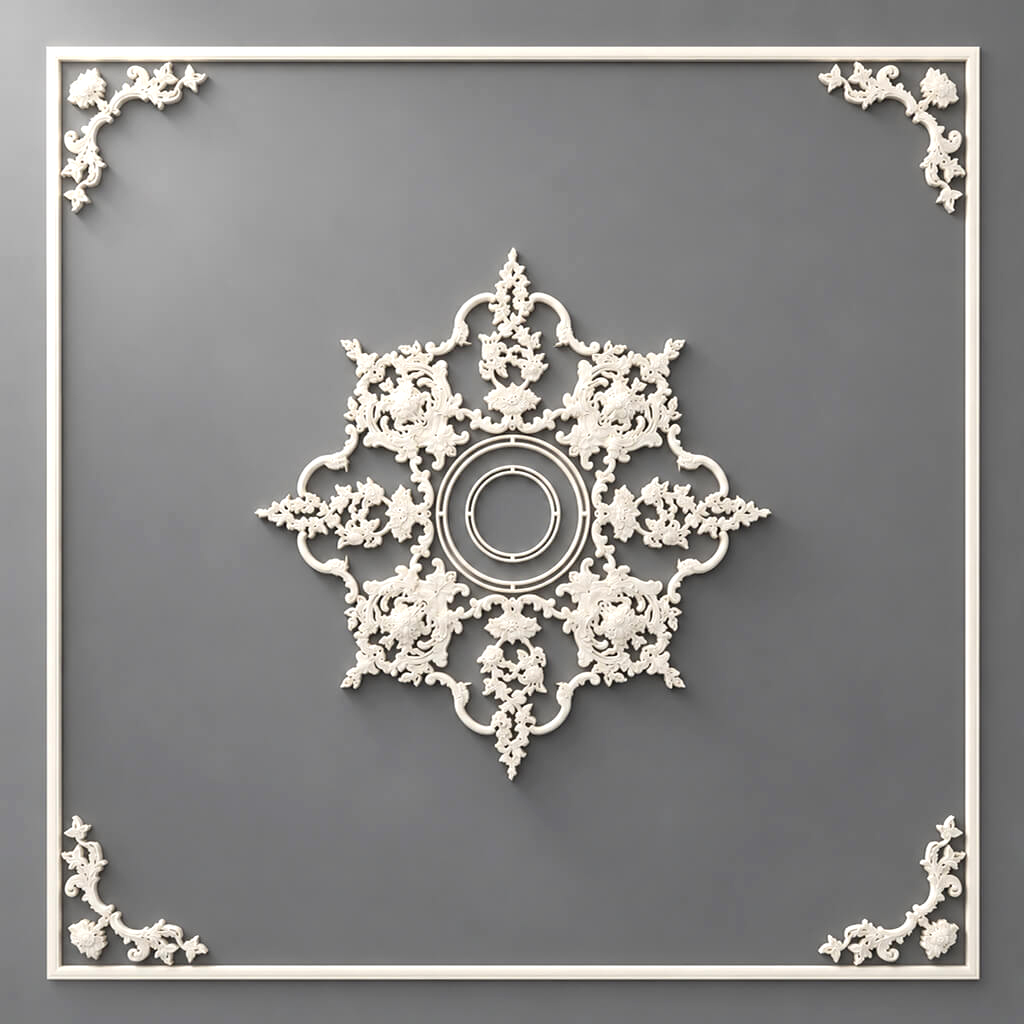
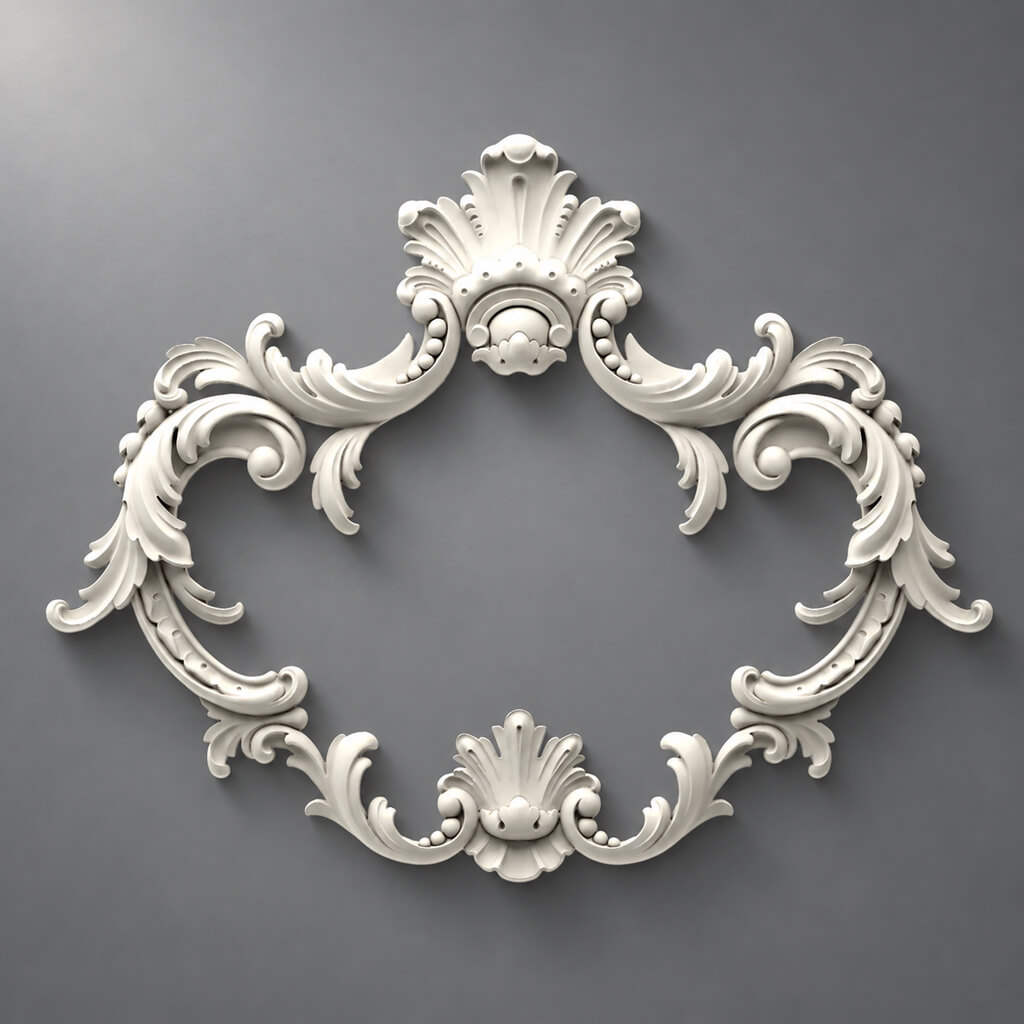
- Complex decorative panel
- STAVROS MLDPU-027 moulding: two sections of one shape
- MLDPU-027U-2: ready-made corners for the 14 × 9 mm profile
- MLDPU-027U-1: a variant for a different section
- A ready-made radius corner is not a flexible moulding
- Project one: strict rectangular frames
- Project two: smooth contours without ornament
- Project three: classic frames with relief
- What to write in the order
- First — composition, purpose and documents
- Then — dimensions and cross-section shape
- Finally — surface and future finish
- Step one: calculate a regular frame as a reference
- Step two: determine the junction points from the drawing
- Step three: create a cutting map
- Why such calculations should not be replaced with a 10 percent margin
- Marking is more important than installation speed
- Adhesive is selected for both the profile and the substrate at the same time
- The entire composition should be painted, taking into account the different geometry
- Ecopolymer and duropolymer — what is the difference?
- How does FitoPolymer differ from DuroPolymer?
- Is duropolymer polystyrene or polyurethane?
- Ecopolymer or polyurethane — which is better for wall moldings?
- Can ecopolymer and polyurethane moldings be painted?
- Which moldings are suitable for standard decorative frames?
- How do you finish a frame with rounded corners?
- What is MLDPU-027?
- What is the difference between MLDPU-027U-1 and MLDPU-027U-2?
- Where to buy STAVROS polyurethane stucco?
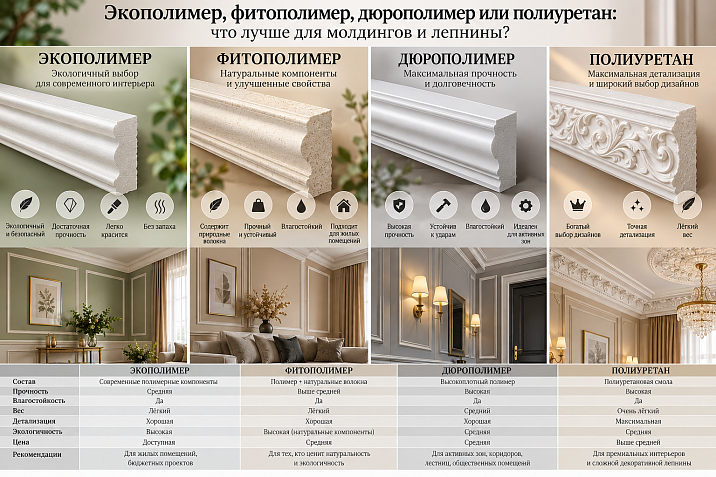
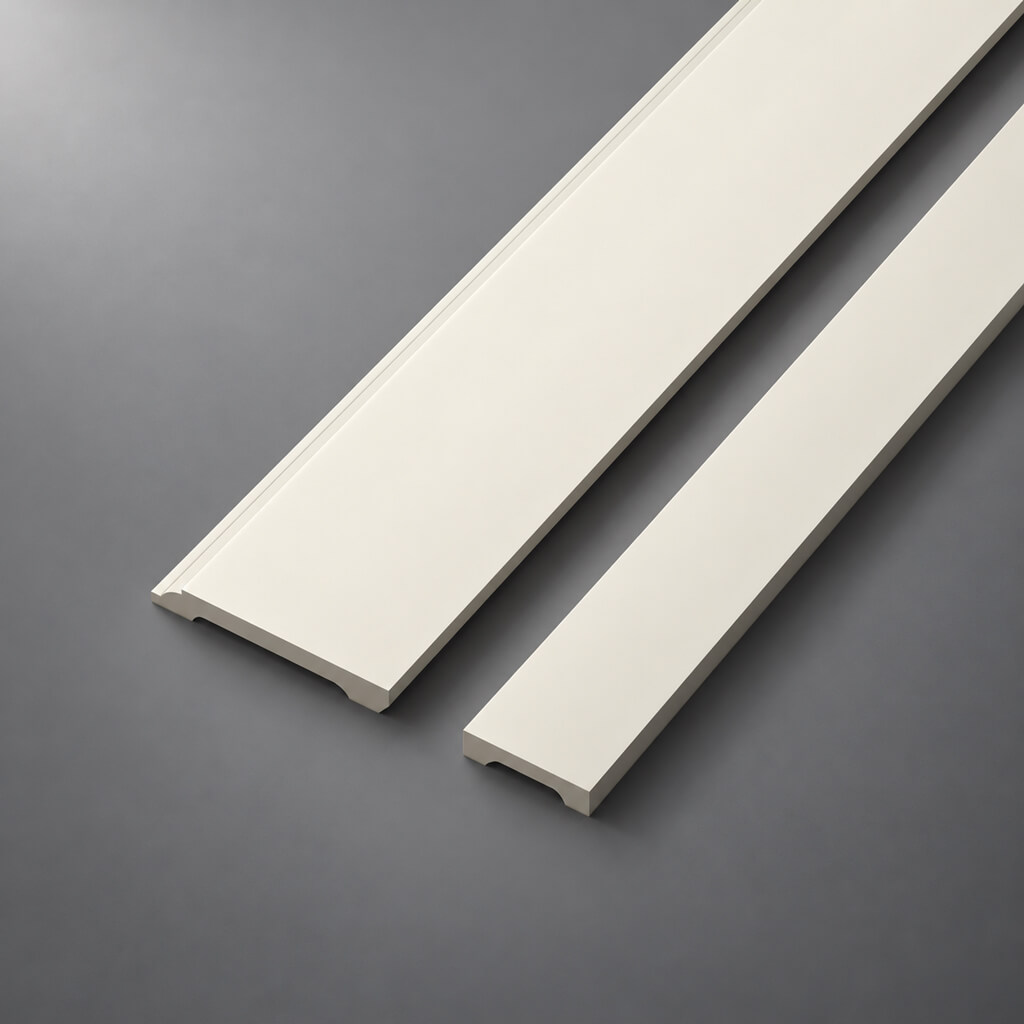
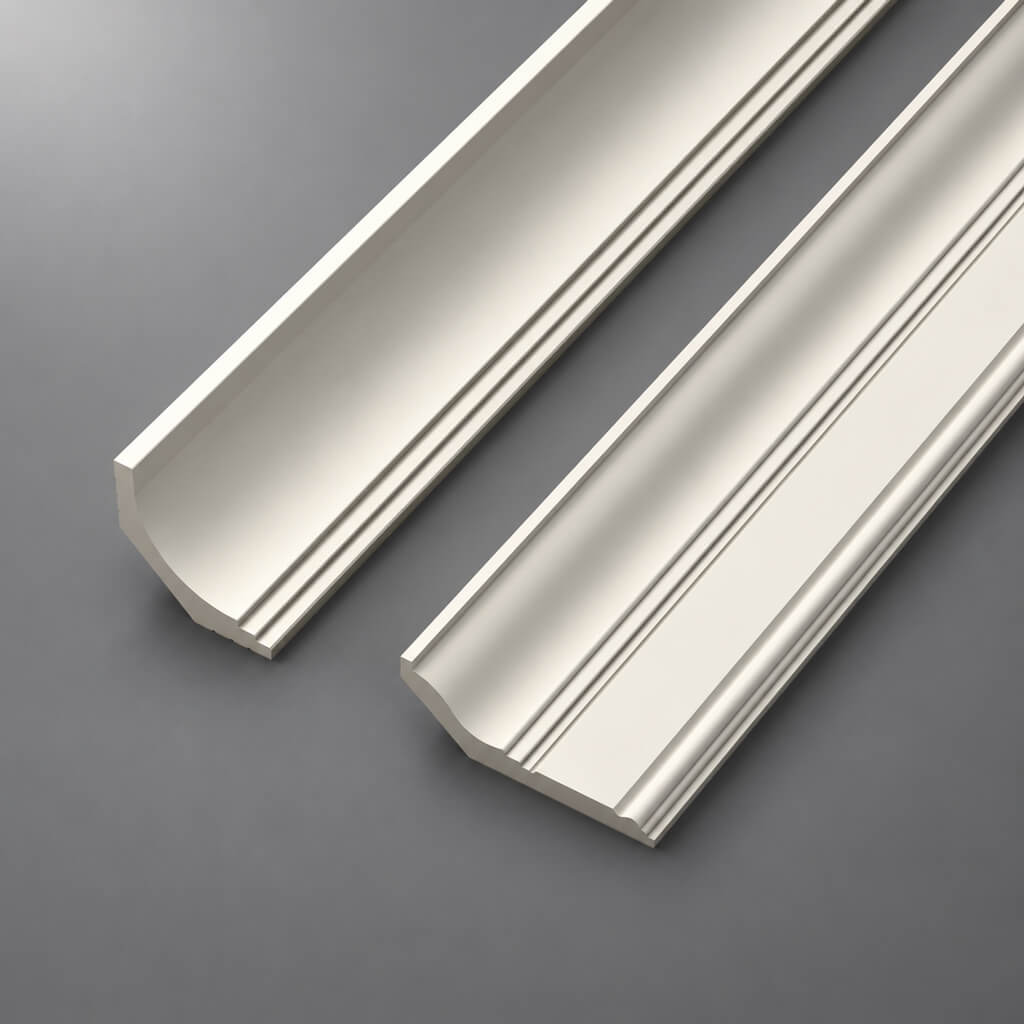
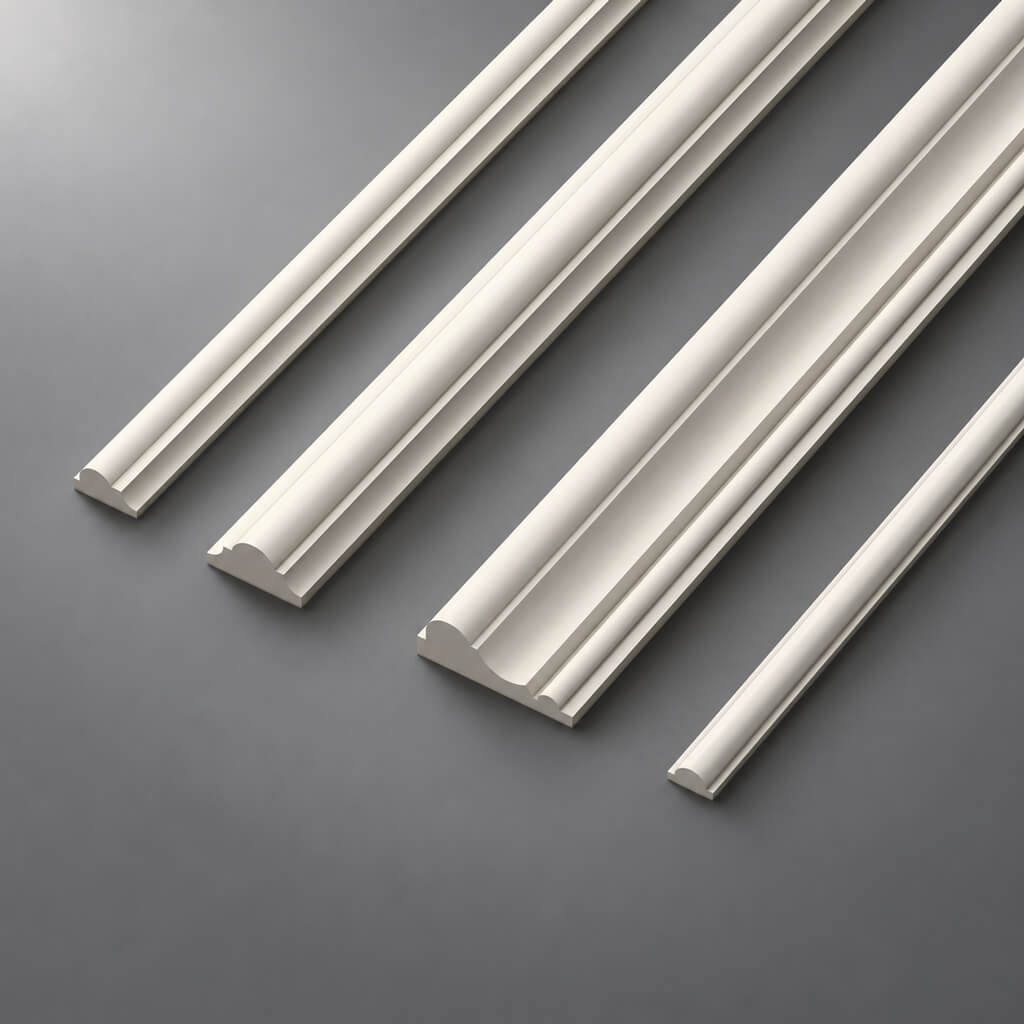
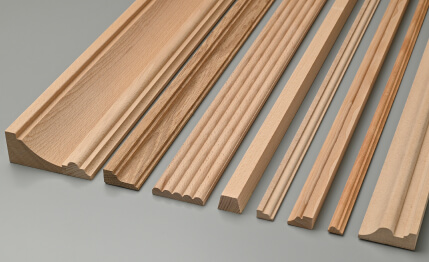
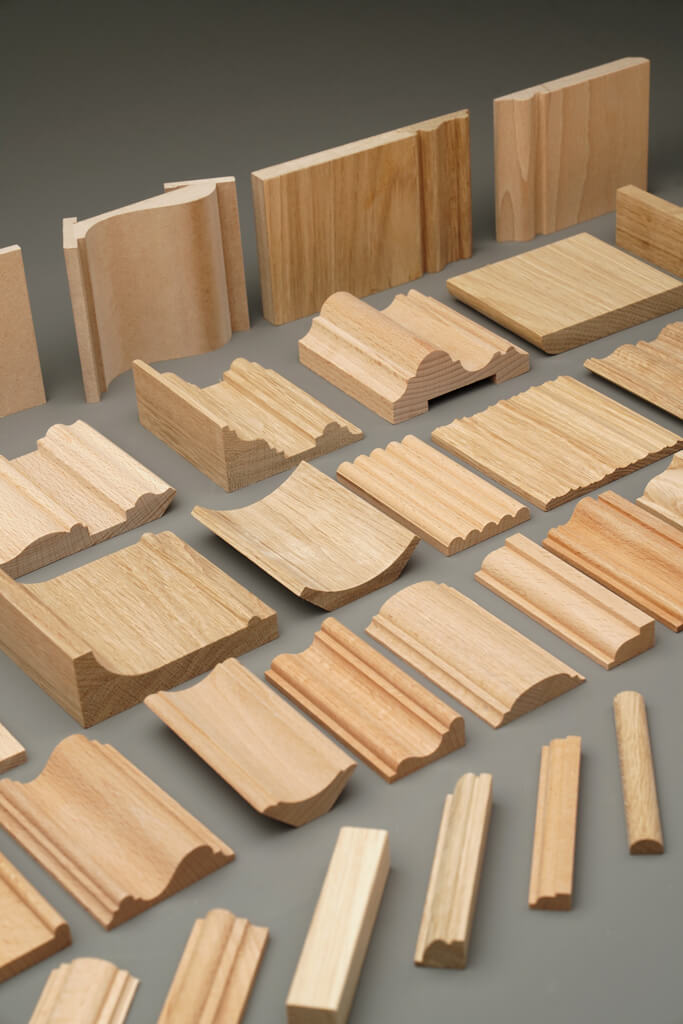
Four white moldings lie side by side on the counter. All are intended for painting, all promise a neat wall contour. The price tags read "ecopolymer," "phytopolymer," "duropolymer," and "polyurethane." From the photo, it is hard to tell how one strip differs from another. But once you plan not just a single straight line but several frames with smooth corners or relief inserts, the difference becomes far more significant.
For simple straight moldings, you can choose a suitable product from any of the listed options, provided that its composition, characteristics, and installation rules are known. For a complex wall composition, what matters more is not the attractive name of the polymer but the availability of compatible profiles, corners, and decorative overlays. It is precisely in this scenario that you should consider polyurethane molding STAVROS.
The difficulty begins with terminology. Polyurethane is the name of a family of polymers. The other three words in commerce may denote specific product lines or formulations, but on their own they do not always reveal the chemical composition. The buyer has to compare not four strictly defined substances but four ways of describing a finishing material. Let us figure out how to translate these names into clear purchasing criteria, from the cross-section of a straight molding to the precise calculation of a frame with ready-made rounded corners.


What ecopolymer, phytopolymer, and duropolymer are
Ecopolymer: the product name does not yet reveal its base
The word "ecopolymer" appears in catalogs of interior moldings, cornices, and skirting boards. In particular, Cosca sells decorative products under this name. However, the word itself is not a universal chemical formula. To find out what a specific molding is made of, you need to open its technical data sheet: it may specify a polystyrene base, the composition of the mixture, or another specific material designation.
The prefix "eco" does not equal confirmation of natural origin, the absence of any emissions, or suitability for any room. Such claims must be backed by documents and test conditions. If a seller promises a "fully eco-friendly material," ask them to specify which document confirms this particular property and which product code the document applies to.
In practice, this means a simple thing: an eco-polymer profile should be chosen based on the drawing, purpose, resistance to impacts, surface quality, and mounting method. A rectangular frame on a dry painted wall does not require any mysterious advantage from the material that cannot be verified.
Our factory also produces:



Phytopolymer: the prefix does not guarantee a plant-based composition
A similar situation applies to the term "phytopolymer." It is used for interior skirting boards, moldings, and other profile products. For example, product descriptions under this name sometimes mention a polystyrene base. At the same time, other explanations of the composition also appear in market advertising materials. They cannot be turned into a single rule.
"Phyto" does not automatically mean that every component is derived from plants. Moreover, the name does not prove safety in contact with heat or suitability for a children's room without reviewing the relevant documentation. What remains decisive is the manufacturer's information about the specific product, its scope of application, and its characteristics.
For a buyer of a phytopolymer molding, there are three useful questions: which polymer base does the manufacturer specify, is factory priming provided, and which adhesives are approved for installation? The answers matter more than the similarity of the name to another material.
Get Consultation
Duropolymer: a well-known product system has a specific composition
The name Duropolymer® is known from Orac products. In the manufacturer's technical description, it is an extruded impact-resistant material based on high-density polystyrene. This means that, with respect to this product system, it is correct to speak of a dense polystyrene material, not a type of polyurethane.
Dense Duropolymer molding cannot be evaluated by the properties of loose foam plastic. These are products with a different purpose, a different production technology, and different mechanical behavior. Impact-resistant profiles are suitable for straight decorative lines and a number of areas where accidental contact is possible. But the word "impact-resistant" does not replace the results of comparable tests of two specific models.
The expression "Duropolymer molding" should be matched with a product code and manufacturer. If another supplier uses a similar name, one should not automatically transfer all the properties of Duropolymer® to their product.
Polyurethane: the name of a family, not a single rigidity
Polyurethane is a separate family of polymers. Its representatives can differ in density, elasticity, internal structure and manufacturing technology. Therefore, the phrase "polyurethane stucco" does not mean that all products made from this material are equally strong, equally flexible, or suitable for the same conditions.
Interior decor uses molded polyurethane moldings and relief details. Their value lies not only in the properties of the strip itself, but also in the ability to obtain a repeatable ornament, a corner element of a given shape, and a central overlay coordinated with a specific profile.
This is exactly how a number of STAVROS systems are built. The stucco in the catalog includes straight profiles and standalone decorative details. At the same time, for each item code, size, material, purpose and compatibility must be clarified separately.
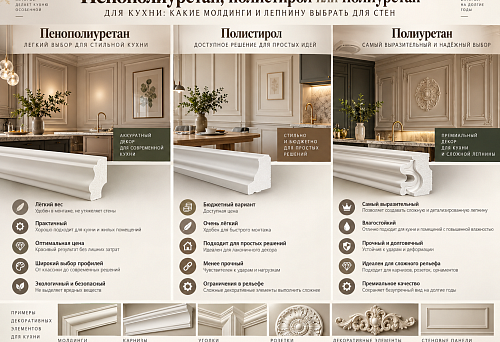
Material comparison: what is known in advance and what needs to be checked
| Criterion | Ecopolymer | Phytopolymer | Duropolymer | Polyurethane |
|---|---|---|---|---|
| What the name means | Trade designation of products | The name of the product group used in the market | In particular, the branded Duropolymer® | Polymer family |
| Chemical base | According to the datasheet of the specific model | According to the datasheet of the specific model | Duropolymer® by Orac is high-density polystyrene | Polyurethane |
| Straight moldings | Available for purchase | Available for purchase | Available for purchase | Available for purchase |
| Impact resistance | depends on the product | depends on the product | Can be high | Depends on the formulation and cross-section |
| Complex corner pieces | View the manufacturer's range | View the manufacturer's range | View the manufacturer's range | In particular, available from STAVROS |
| Factory corners | Must be checked | Must be checked | Must be checked | There are systems with compatible elements |
| Painting | With a suitable finish | With a suitable finish | With a suitable finish | With a suitable finish |
| Installation method | Per instructions | Per instructions | Per instructions | Per instructions |
The table gives no grounds to declare one material the best on all counts. It shows which information can be established from the name and which has to be verified against the product. For example, a claimed "increased strength" does not answer the question of whether a thin moulding protrusion will withstand a blow from the leg of a moving chair. Such a conclusion requires comparing construction and test results, not advertising.
A wall has another requirement — decorative. A smooth straight line and a frame with shaped corners create a different visual effect. If the finish is limited to the first option, you can avoid paying for an ornamental system. If the second is needed, the range of ready-made parts is often decisive.
What is best for wall mouldings: choosing by task
A single line or several simple rectangles
For a horizontal divider on the wall, a frame around a painted panel, or a clean border without additional elements, a quality profile of any of the types under consideration may be suitable. There is one condition: the product must be intended for the corresponding finish, and its mounting system must be compatible with the substrate.
In that case, compare not only the price of a single strip, but also the price per linear meter, the length of the factory product, the cross-section shape, and the cutting costs. If one model is 2000 mm long and another is 2600 mm, the same price "per piece" says nothing about the overall cost of the finish.
Make sure the profile is suitable for painting if a uniform color with the wall is planned. If the surface has already been primed by the manufacturer, check whether an additional layer is needed before the chosen paint. A smooth product photo does not replace inspecting its actual surface.
Frames where the profile should be visible from a distance
For a small wall section, a line about 10–15 mm wide is sometimes enough. On a tall empty wall, such a line may almost disappear from a distance, especially under diffused lighting. A wider molding creates a noticeable shadow and is perceived as an independent architectural contour.
You cannot mechanically choose the largest profile. If a narrow strip of wall remains between the frame and the door casing, protruding stucco may look cramped. First draw the frame to scale and check the width of the free margins; only then choose the cross-section.
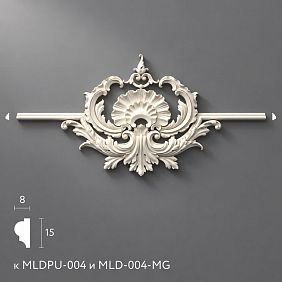
If a simple relief contour is needed, you can consider polyurethane molding MLDPU-004 STAVROS measuring 15 × 8 × 2600 mm. It does not require ornamental overlays and is suitable for an independent geometric pattern.
Complex decorative panel
Here the list of requirements changes. The straight profile must be aligned with the corner pieces, and the central overlay must not randomly cover the molding pattern. The paint must look the same on different elements. The dimensions of the relief should be correlated with the overall dimensions of the panel itself.
If planning molded decoration made of polyurethane, it is important to check factory pairs: the very fact that two parts are made of polyurethane does not yet mean they are geometrically compatible. A 14 mm wide profile and a corner piece designed for a different cross-section may not match in the line of convexity and the height of the protrusion.
Why ready-made rounded corners are sometimes more important than the name of the material
A regular rectangular frame consists of four straight segments with joints at the corners. Most often they are mitered, fitted, glued, and then the seams are finished. Many decorative materials can handle rectilinear geometry — provided the right tools and careful work.
A smoothly rounded corner produces a completely different result. It is no longer two segments meeting at a right angle, but a small arc-shaped section that changes the character of the entire contour. In a rectangular frame, attention often lingers on the vertices. In a rounded one, the line moves continuously, and the transition looks softer.
Trying to bend ordinary rigid molding for such a frame is a mistaken solution. Even if the strip bends slightly in your hands, this does not yet confirm an acceptable bending radius or that the geometry will be preserved after installation. It is far more predictable to choose pre-made arc-shaped corner elements.
STAVROS MLDPU-027 molding: two cross-sections of the same shape
Polyurethane molding MLDPU-027 has a smooth convex shape and is available in two sizes — 14 × 9 × 2600 mm and 20 × 12 × 2600 mm. In the first case, the line is thinner and protrudes less from the wall; in the second, the sculpting of the profile itself is more noticeable. These are not two different patterns, but different scales of a similar shape.
On a wall 3.2 m wide divided into three small frames, even a difference of a few millimeters is noticeable because the profile is repeated along the entire perimeter. On a single short strip it seems insignificant, but on several closed contours it begins to affect the density of the decor.
MLDPU-027U-2: ready-made corners for 14 × 9 mm profile
Corner element MLDPU-027U-2 STAVROS is explicitly stated as intended for MLDPU-027 measuring 14 × 9 mm. The product card lists four versions with dimensions across the two main overall sizes: 84 × 84, 124 × 124, 164 × 164 and 204 × 204 mm. These are not interchangeable parts: the scale of the arc and the share of the corner in the overall frame pattern change.
The smallest corner may be appropriate in a compact composition. A larger radius will take up a greater part of the contour line. Therefore, the size should be chosen together with the width and height of the future frame, not after all the straight mouldings have already been cut.
MLDPU-027U-1: version for a different section
Corner moulding MLDPU-027U-1 also forms a smooth turn and is offered in four versions: 84 × 84, 124 × 124, 164 × 164 and 204 × 204 mm by main overall dimensions. In STAVROS materials, it is matched with the larger MLDPU-027 version measuring 20 × 12 mm.
Do not select U-1 and U-2 based only on matching numbers such as 124 × 124: their other section parameters differ. One line may end up higher than the adjacent one, even when the outer boundaries of the two corners appear similar at first glance. Before ordering, open the drawings in both product cards and check not only the width but also the junction geometry.
A ready-made radius corner is not a flexible moulding
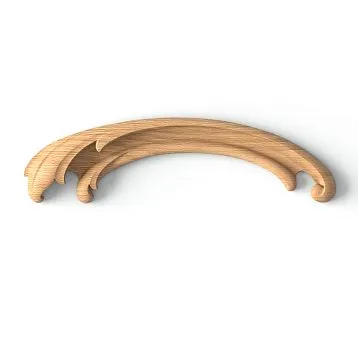
The corner piece performs only a specific turn. Straight sections of a suitable profile are usually installed between such corners. It cannot be claimed that the entire MLDPU-027 series can bend along an arbitrary curve: that would require separate technical information on flexibility and minimum radius.
That is why rounded frames are planned from the corners toward the straight segments, and not the other way around. First, the arc model and its junction point are chosen, then the remaining straight lines are measured.
Three projects for one wall: what the choice of decorative system changes
Let's take a conventional wall 3600 mm wide and 2700 mm high. It is intended to accommodate three elongated vertical frames. In each variant, the wall color, the distance between the frames, and the overall symmetry remain the same; only the way the outlines are finished changes.
Project one: strict rectangular frames
Three rectangles made of smooth straight moulding give a clear geometric rhythm. Such decor is appropriate in a passage hallway, a small living room, or an office, where expressiveness should be built on proportions rather than ornament. With suitable characteristics, you can use a polystyrene profile, a product called "ecopolymer", or polyurethane moulding.
For the STAVROS variant, MLDPU-004 is suitable. The main task before purchasing is to choose the width of the frames and make sure that the outer margins of the wall remain proportionate to the gaps between them. Six identical verticals in the finished composition will be more noticeable than the cross-section pattern when examining a single strip on a table.
Project two: smooth contours without ornament
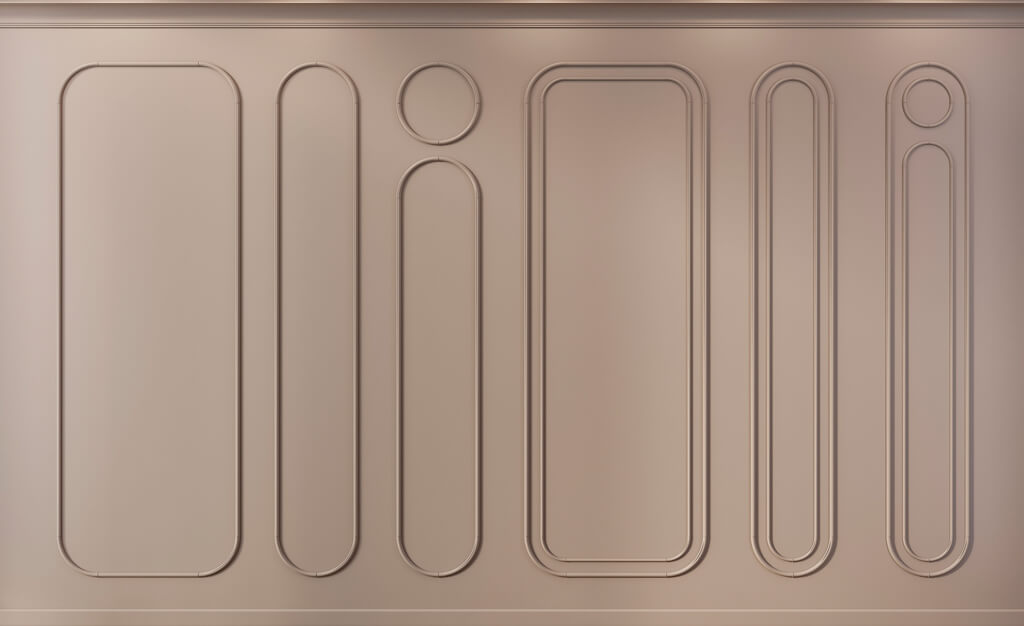
Let's keep the three frames but replace the right angles with ready-made arched elements from the MLDPU-027 series. Now the decorative line does not break off with a miter cut at each vertex. The contour becomes softer, although it has no leaves, scrolls, or central accents.
For a more delicate composition, a 14 × 9 mm cross-section is used with the corresponding MLDPU-027U-2 elements. If you choose a different cross-section, you should select the corner version intended for it. Not all combination options can be considered confirmed merely on the basis of the common series name — finally check the product cards and drawings of the selected versions.
The advantage of the second project lies not in the abstract "special strength of polyurethane", but in the availability of ready-made geometry that is difficult to reproduce with high quality by simply cutting straight profiles.
Third project: classic frames with relief
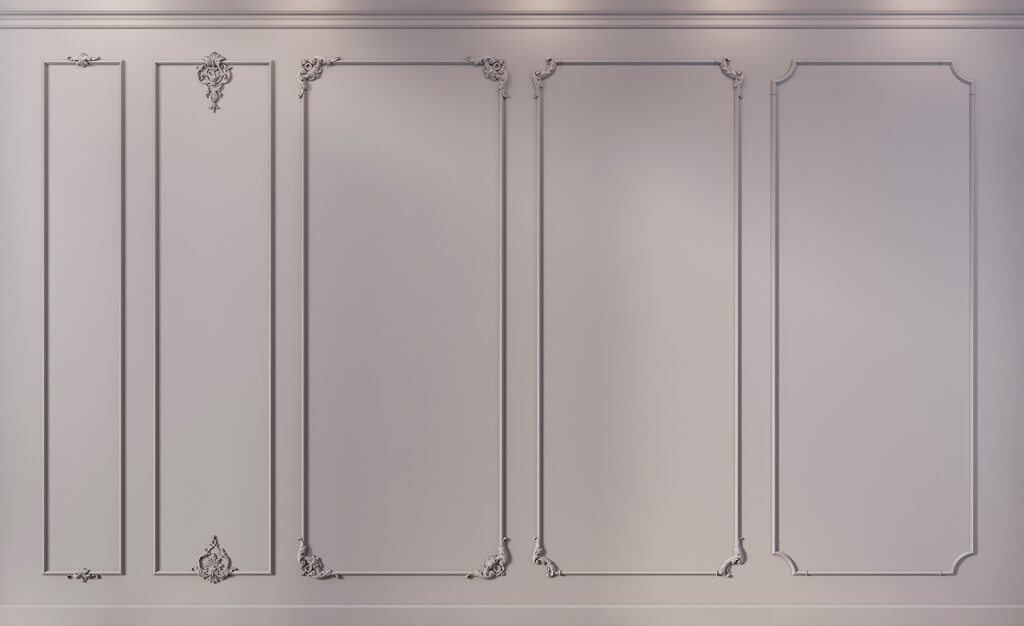
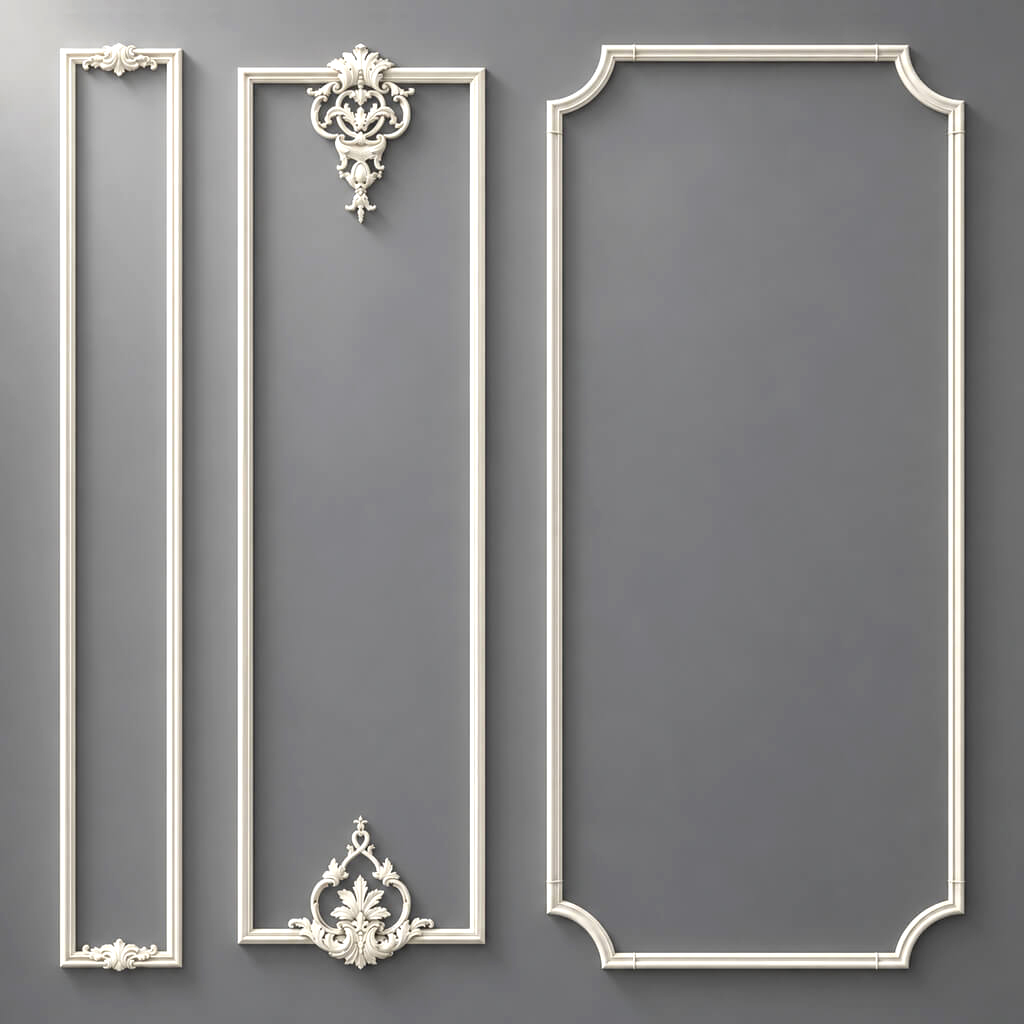
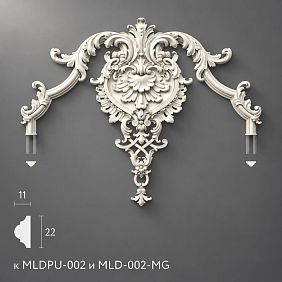
If the interior requires a richer architectural pattern, you can move on to the MLDPU-002 system. polyurethane molding MLDPU-002 measuring 22 × 11 × 2600 mm forms a noticeable stepped contour. It is complemented by corner and central decorative elements specially provided for this series.
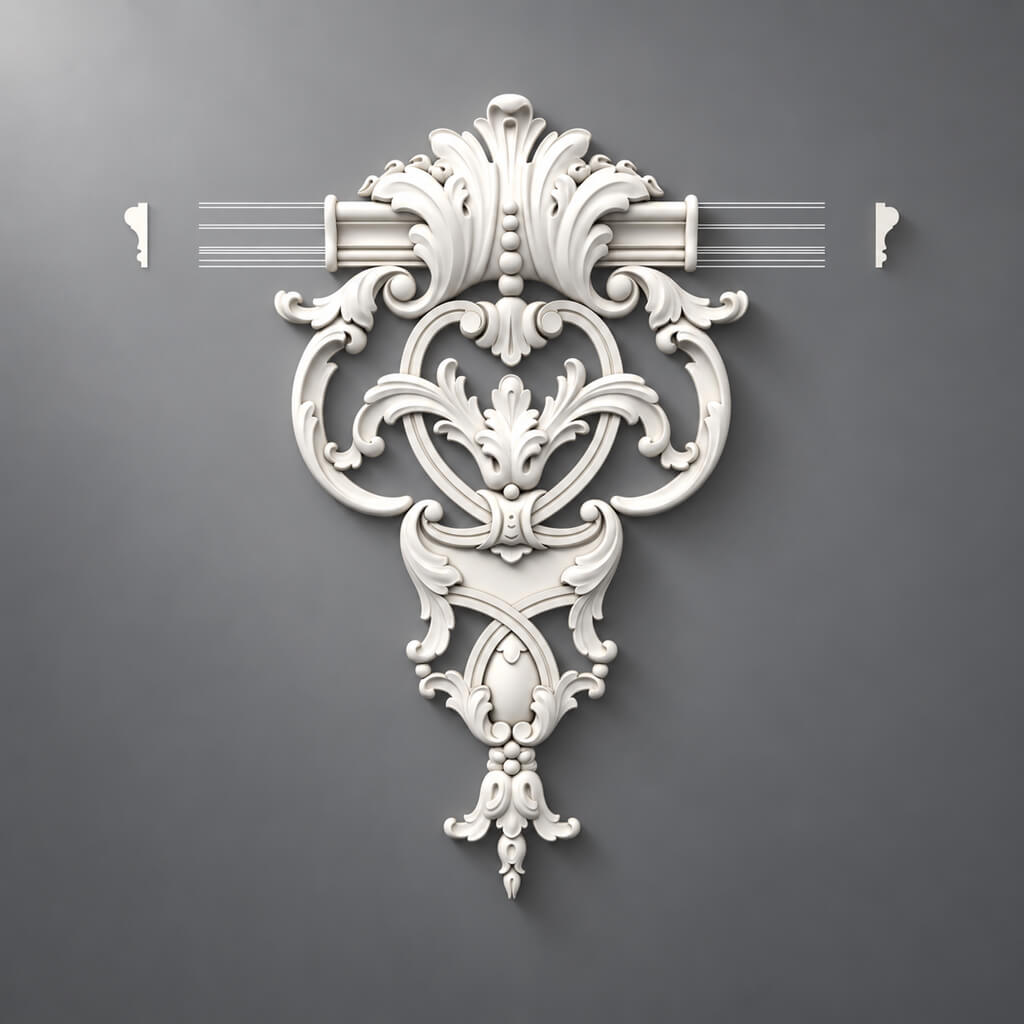
For example, MLDPU-2-2.1 decorative overlay measuring 235 × 237 × 21 mm is designed for creating a composition with the profile of the 002 series. It becomes an independent accent that cannot be achieved by simply increasing the width of a straight molding.
If a large door casing is installed next to the frame, the overlay will have to be matched to its relief. Too dense an arrangement of three-dimensional details can spoil the composition, even if each of them is individually made carefully.
The choice between these three solutions does not come down to an argument about “which polymer is better.” The first option solves the task of geometry. The second — geometry with radiused turns. The third — architectural ornament. In each case, elements that differ in meaning are ordered.
Which STAVROS polyurethane products to use
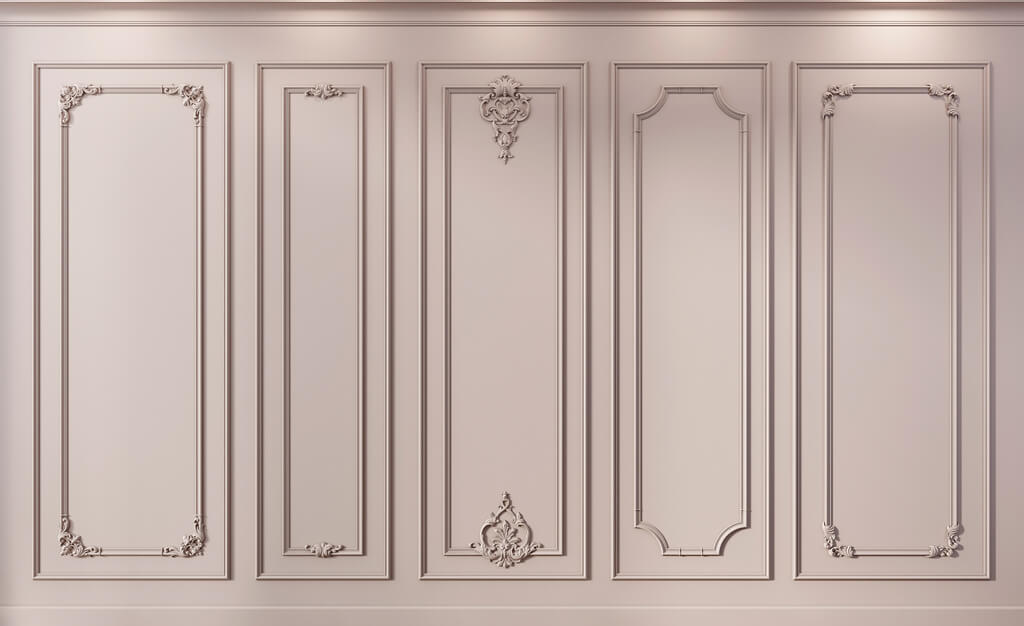
| Product | Size, mm | Role in composition |
|---|---|---|
| MLDPU-004 | 15 × 8 × 2600 | Simple straight contour |
| MLDPU-027 | 14 × 9 × 2600 | Thin convex line |
| MLDPU-027 | 20 × 12 × 2600 | A larger convex line |
| MLDPU-027U-2 | From 84 × 84 to 204 × 204 across two main dimensions | Ready-made arched corners for a 14 × 9 mm profile |
| MLDPU-027U-1 | From 84 × 84 to 204 × 204 across two main dimensions | Ready-made arched corners; profile compatibility is verified against the drawing |
| MLDPU-002 | 22 × 11 × 2600 | Classic frame system |
| MLDPU-2-2.1 | 235 × 237 × 21 | Central decorative element of the 002 series |
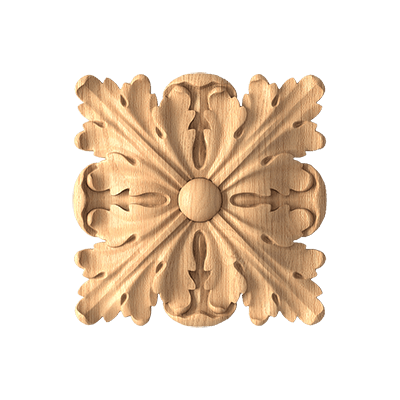
| NPU-500 | 208 × 208 × 18 | Large relief applique for independently checking combinations |
The table shows the variants listed in the catalogue. It does not mean that all the listed parts can be joined together in a single frame. For example, NPU-500 can be assessed as a separate relief accent, but its factory geometric compatibility with an arbitrary moulding cannot be assumed without a drawing.
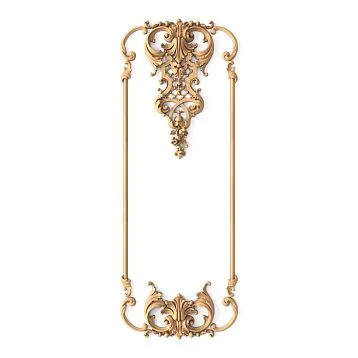
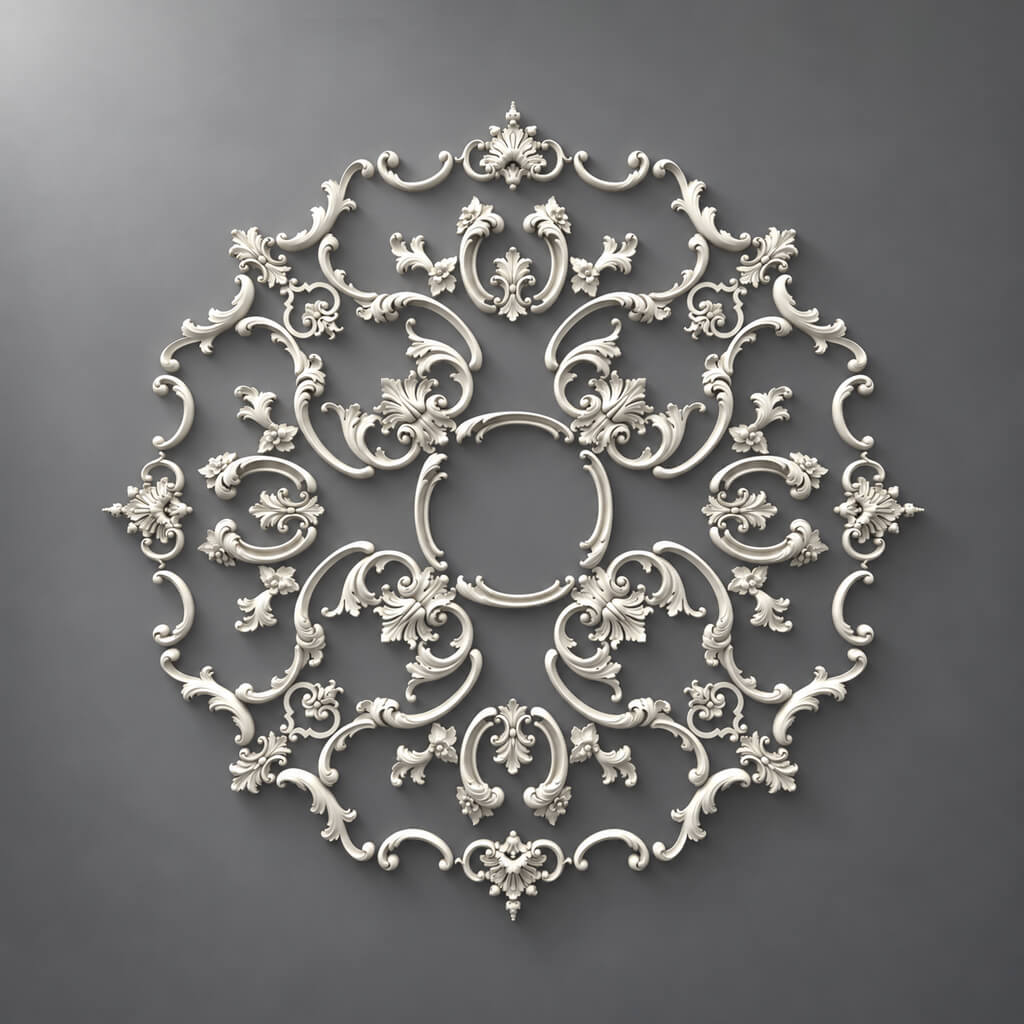
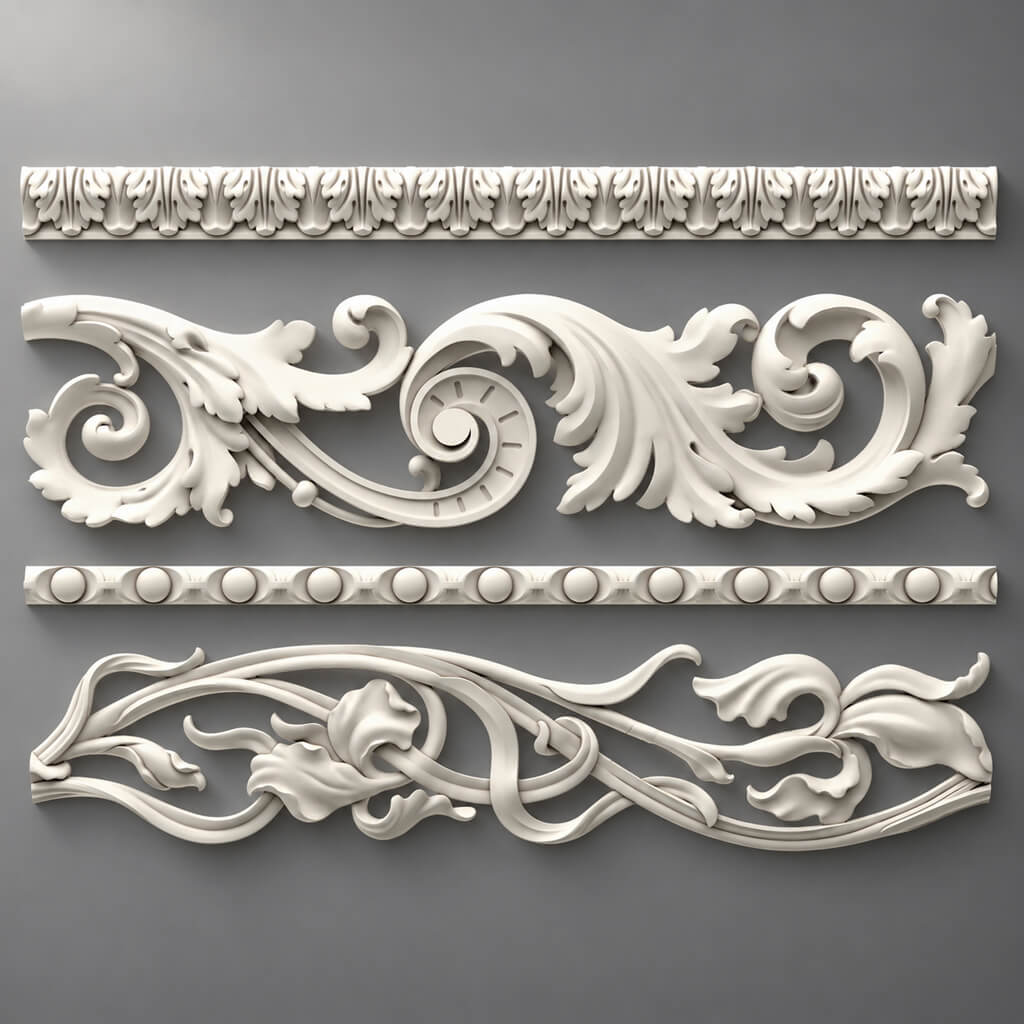
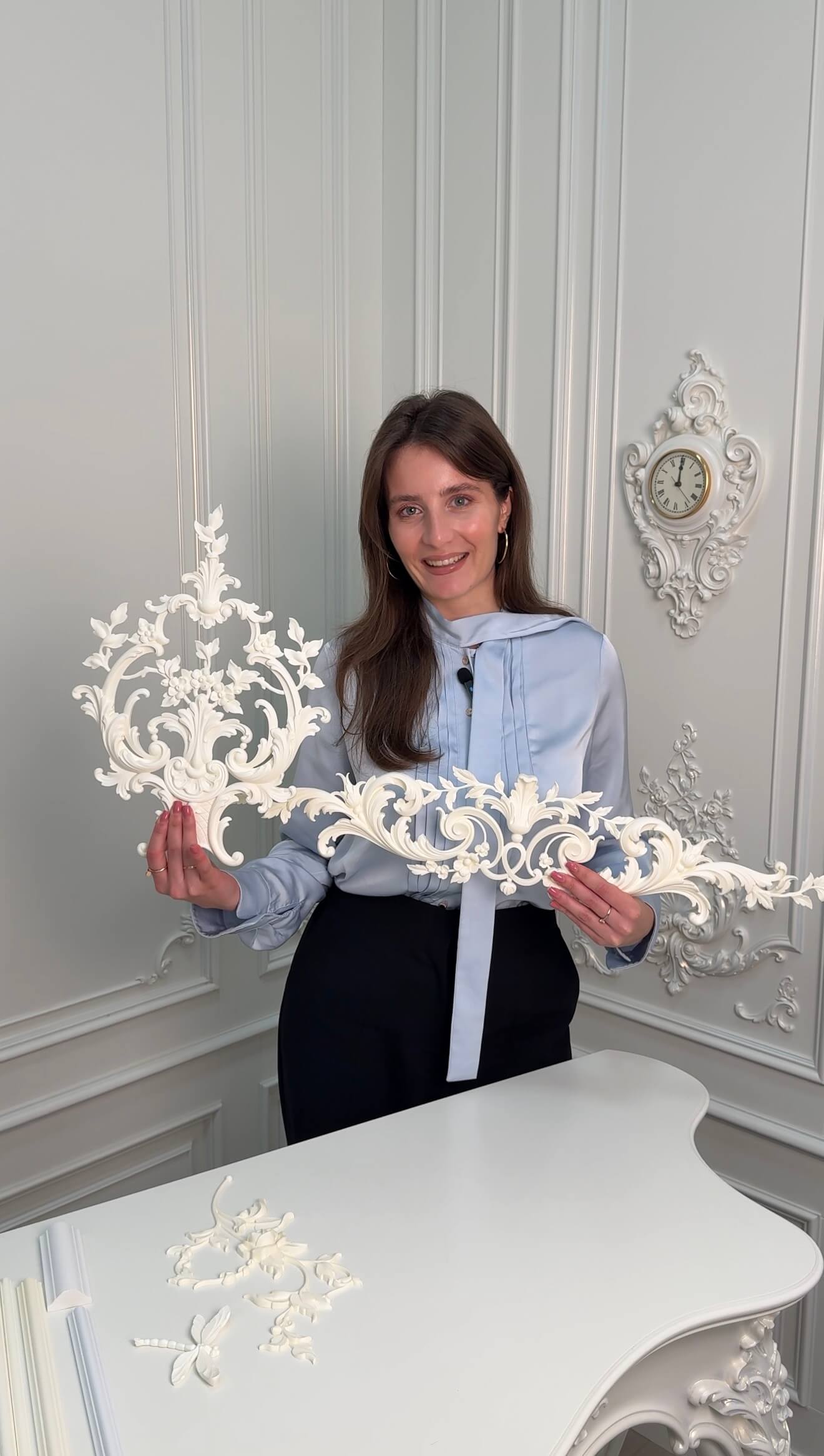
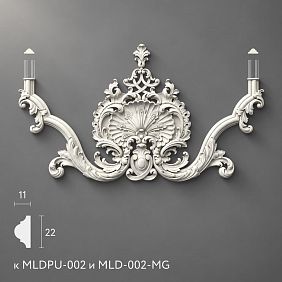
В catalog of polyurethane decorative overlays various shapes for wall decor are presented. They are selected not by the overall colour palette of the photographs, but by actual dimensions, projection thickness and placement in the composition.
What to write in the order
For a single frame system, it is not enough to specify “four corners and a moulding”. The order must include the full article number, size variant, quantity, selected bar length and purpose of the elements. If a corner is produced in four sizes, the U-2 index alone is not sufficient.
Additionally, it is worth saving the drawings of the products you used for marking. They will help coordinate installation with the contractor and verify the delivery before work begins. This is especially relevant for frames in which each straight piece is pre-calculated for a specific corner insert.
How to check molding quality before purchase
First — composition, purpose, and documents
Ask for technical information for the exact item code, not an advertising description of the entire collection. Compare the stated use, requirements for painting and adhesive. If emissions, fire reaction, or mechanical resistance indicators matter for the project, you need the relevant documentation, not an inference from the “eco” prefix.
Materials from different manufacturers cannot be declared equal just because both are intended for painting. One profile is designed for a standard dry wall, while another may have separate restrictions on humidity or installation conditions.
Next — dimensions and cross-section shape
The nominal width of the molding and the height of its projection determine different things. The width is responsible for the strip occupied on the wall, while the projection is responsible for the depth of the shadow and the likelihood of hitting the profile during use. Two moldings 20 mm wide can look completely different due to differing height and relief shape.
For ready-made corners, check the position of the connecting ends. Even matching external dimensions of the arc do not guarantee that its cross-section will match the cross-section of the selected straight strip. It is better to compare elements against factory drawings, and for a large order volume, purchase samples for a trial assembly.
Finally — the surface and future finish
Inspect the product under side lighting. If damage, unevenness, or poor-quality finishing is visible, a solid matte paint will not always hide them. Contrast lighting, on the contrary, can make a defect more noticeable.
Do not expect a thick layer of paint to level out the joint on its own. It can blur fine texture, and a crack in a moving joint may still appear after painting. It is more reliable to ensure a tight fit, choose a suitable material for the seams, and do a test paint on a separate area.
How to calculate a frame with ready-made rounded corners
This is the area where simply adding up the perimeters often leads to an incorrect order. If the corners are purchased as separate ready-made parts, part of the overall outline is already occupied by them. Straight profiles are needed only between the junction points.
Step one: calculate a regular frame as a reference
Suppose the project specifies an outer frame outline 1200 mm wide and 900 mm high. The perimeter of the corresponding rectangle is:
P = 2 × (1200 + 900) = 4200 mm.
This is a convenient starting value, but for a frame with ready-made radius corners it cannot automatically be taken as the length of the straight moldings to purchase. Part of the outline will be formed by the corner elements themselves, and the actual lengths of the straight sections depend on their junction points with the arcs.
Step two: determine the junction points from the drawing
Let t denote the distance from the conventional vertex of the rectangle to the point where the straight profile joins the ready-made corner element along each side. For a symmetrical geometry with the same offset t on both sides, we get:
- length of one horizontal straight part: 1200 − 2t;
- length of one vertical straight piece: 900 − 2t;
- number of straight pieces: two horizontal and two vertical;
- number of separate ready-made corners: four.
The value of t must be measured on the actual drawing of the selected corner. It cannot be equated to the number 84, 124, 164 or 204 mm from the card without understanding what exactly the dimension line on the drawing indicates.
For an illustrative calculation, let us assume that in a conventional system the junction point is 120 mm from each vertex. This is a teaching value, not the stated installation dimension of MLDPU-027U.
Then the horizontal pieces will each be 960 mm long, and the vertical ones 660 mm each. Total length of the straight sections:
2 × 960 + 2 × 660 = 3240 mm.
The difference from the perimeter of the rectangle does not disappear: part of the frame is created by four separately purchased corner pieces. And the length of the arc itself must be taken into account in the geometry of the finished contour, not added to the order of straight moulding.
Step three: draw up a cutting plan
If the factory strip is 2600 mm long, for one conventional frame the segments can be distributed across two strips: obtaining 960 and 660 mm on each. In total, 1620 mm of usable length is placed on a strip; there remains room for the kerf width and possible adjustment. Two strips are required here not because 3240 divided by 2600 rounds up, but because the chosen cutting scheme actually accommodates all four whole segments.
If there are three such frames, six pieces of 960 mm and six pieces of 660 mm will be required — a total of 9720 mm of straight profile. By linear meterage, the lower bound is four strips of 2600 mm. It is achievable with the following distribution:
| Plank | Segments, mm | Total length of segments, mm |
|---|---|---|
| 1 | 960 + 960 + 660 | 2580 |
| 2 | 960 + 960 + 660 | 2580 |
| 3 | 960 + 660 + 660 | 2280 |
| 4 | 960 + 660 + 660 | 2280 |
This scheme has a limitation: the first two strips have only 20 mm left for cuts and all tolerances. If the actual segments require cuts with additional allowance, the saw cannot be set to the required accuracy, or the dimensions are specified along a different section line, four strips may no longer ensure correct cutting. In that case, the map is recalculated or an additional strip is provided.
Overlays and corner elements are counted separately: three frames with four identical ready-made corners require 12 corners, not "12 meters of molding". In addition, it is clarified in advance whether the selected corners can be used in all four orientations, whether there is a left and right version, and whether the upper and lower parts of the project differ.
Why such calculations should not be replaced with a 10 percent reserve
For long moldings, the cutting task is not equal to adding up lengths. For example, if six pieces of 1500 mm are required, the total meterage is 9000 mm. Four strips of 2600 mm give 10400 mm, but each yields only one solid piece of 1500 mm. To install all six segments without intermediate joints, six strips are needed.
Therefore, a list of segments is first compiled and distributed across factory lengths. Only after that are the reserve for defects, a trial cut, and complex sections discussed. A percentage reserve is useful, but it does not replace checking the placement of parts on a specific strip.
How much straight moldings and the system with corners cost
The price of one strip does not reflect the entire order amount. The difference is especially noticeable when ready-made corners and decorative elements are added to the profile. As a reference, let us take the published STAVROS prices for the selected product options. They may change; before payment, the cart and configuration must be rechecked.
| Position | Price per piece at the time of check | What's included in the calculation |
|---|---|---|
| MLDPU-004, 15 × 8 × 2600 mm | 3190 ₽ | Straight strip only |
| MLDPU-027, 14 × 9 × 2600 mm | 3990 ₽ | Straight strip only |
| MLDPU-027, 20 × 12 × 2600 mm | 7190 ₽ | Straight strip only |
| MLDPU-027U-2, 124 × 124 mm | 690 ₽ | One ready-made corner |
| MLDPU-027U-1, 124 × 124 mm | 1050 ₽ | One ready-made corner |
| MLDPU-002, 22 × 11 × 2600 mm | 5460 ₽ | Straight strip only |
| MLDPU-2-2.1, 235 × 237 × 21 mm | 5350 ₽ | One decorative overlay |
For example, a kit for a project conventionally consists of two MLDPU-027 strips 14 × 9 mm and four MLDPU-027U-2 corners measuring 124 × 124 mm. The cost of the parts themselves will be:
2 × 3990 + 4 × 690 = 10 740 ₽.
This is an example of a set price, not a statement that any rectangle of the given dimensions can be assembled from it without changes. For a specific wall, the dimensions of the arc, the junction points, the actual cutting plan and the number of strips are confirmed first. Delivery, possible packaging costs, adhesive, wall preparation, painting and installation are not included in the stated amount.
Another project may turn out to be cheaper if it can be done with ordinary straight profiles. In particular, four MLDPU-004 strips cost 12,760 ₽ at the quoted price, without the other work. But such a comparison is valid only as a comparison of two sets of products, not as proof that one chemical material is more economical than another.
If only a dividing line is required and there is no need to create radiused corners, buying a corner system for aesthetic reasons is optional. If, however, the project fundamentally requires identical smooth turns on several frames, the additional costs become payment for a specific ready-made shape.
Installation and painting: differences that are forgotten when buying
Regardless of what the packaging says, the moulding must be fixed to a solid base. If it is glued to poorly adhering paint, peeling wallpaper or dusty plaster, reliability will be limited by the weakest intermediate layer. Even a quality material will not correct this defect.
Marking is more important than installation speed
For a framed composition, determine the horizontal and vertical axes, the height of the elements, and the distances from doorways and the skirting board. With rounded corners, mark out in advance not only the outer contour but also the places where the straight sections begin. If marking is done according to the overall dimensions of the rectangle and the corners are placed "by eye", identical frames may end up with different radiused turns.
Before applying adhesive, do a dry fit of the entire composition. Check not only one side but the full closed contour. At this stage it is especially easy to see a mistake in choosing the cross-section: a straight strip and a corner element either form a continuous line or noticeably diverge in relief.
Adhesive is selected for both the profile and the base
There is no universal composition that can be recommended without testing for any ecopolymer, phytopolymer, duropolymer and polyurethane. Compatibility is determined by the manufacturer of the adhesive and of the product. The wall finish, room conditions, size of the part and requirements for fixation until curing are taken into account.
Materials recommended by the relevant installation system are used to join the profiles. If the manufacturer provides a separate compound for the joints, it should not be replaced with whatever sealant happens to be at hand. Excessive compression of the joint and painting too early can also impair the appearance of the connection.
The entire composition should be painted, taking into account the differing geometry
When a wall features straight mouldings, smooth arched corners and relief overlays, the same colour does not yet guarantee the same result. On a convex element the light falls differently, and the recesses of the ornament may remain darker. A preliminary test coat on small samples is therefore useful.
Thin coats of finish usually preserve the pattern of fine decorative details better than an attempt to hide all imperfections with a thick layer of paint. Surface preparation, priming and drying intervals must comply with the instructions for the selected products and finish. If a matte wall with gloss mouldings is planned, it is worth checking in advance whether the outlines will begin to visually fragment the room.
Nine mistakes that lead to unnecessary costs
Mistake 1. Equating a marketing name with the chemical composition. An exact formulation cannot be automatically derived from the word “ecopolymer”. The consequence is that the buyer compares the wrong characteristics. Solution: check the base of the specific model in the documentation.
Mistake 2. Expecting any product with the prefix “phyto” to be plant-based. The name may be part of the product positioning. Before purchase, request the actual description of the raw materials and documents confirming the properties that matter for the project.
Mistake 3. Assuming a duropolymer is soft foam plastic. Impact-resistant profiles on a high-density polystyrene base cannot be judged by a sample of lightweight packaging material. Products of similar purpose should be compared once finished.
Mistake 4. Declaring polyurethane to always be more durable. The formulation, cross-section and construction significantly affect resistance to damage. The practical approach is to compare confirmed tests and real operating conditions.
Mistake 5. Assuming that a rigid polyurethane strip can be bent freely. A frame with smooth corners does not prove that a straight moulding is flexible. For a repeatable curved turn, a purpose-made corner piece should be selected.
Mistake 6. Choosing a corner by a similar pattern. The corners of two models may match in outer dimensions but differ in cross-section. Before ordering, verify the purpose, drawings, and exact codes, for example U-1 and U-2.
Mistake 7. Calculating only the perimeter. Ready-made corner elements take up part of the outline, and the selected straight sections must fit within the length of the factory strips. You need a cutting plan and a piece-by-piece count of corners.
Mistake 8. Installing on a weak surface. The profile may come off together with the paint or the top layer of plaster. The base must be checked and reinforced before gluing the decorative elements.
Mistake 9. Choosing a large ornament without checking the scale of the wall. On a narrow wall section, an expressive applique may leave too little free space. Prepare a full-scale layout for at least one fragment and assess the composition from a normal viewing distance.
Frequently asked questions
Ecopolymer and Duropolymer — what is the difference?
Ecopolymer is a designation used by sellers of decorative products; the term itself does not reveal a universal composition. Duropolymer® by Orac is a specific proprietary system described as an extruded impact-resistant material based on high-density polystyrene. When comparing two profiles, check the manufacturer, the actual polymer base, and the cross-section dimensions. If an ecopolymer product also has a polystyrene base, that does not automatically make it equal in properties to a specific Duropolymer profile.
How does phytopolymer differ from Duropolymer?
The word “phytopolymer” appears in commercial descriptions of moldings and skirting boards, but by itself it does not guarantee a specific chemical formulation. Duropolymer® has a more defined proprietary technical description — a high-density polystyrene base. The differences between two purchased products must be determined from the data sheet, drawing, surface, and purpose. Products cannot be considered identical or different merely because different names are printed on the packaging.
Is duropolymer polystyrene or polyurethane?
In the case of proprietary Duropolymer® by Orac, this refers to a material based on high-density polystyrene manufactured by extrusion. It is not another name for polyurethane. But when buying a specific molding, you should still verify the manufacturer and specifications: one word in a product listing does not replace a technical description. It is especially incorrect to transfer the properties of soft expanded polystyrene to impact-resistant dense profiles.
Ecopolymer or polyurethane — which is better for wall moldings?
For a simple straight line, a suitable eco-polymer profile may be sufficient if its purpose, surface quality and compatibility with the installation system are confirmed. When creating complex frames, it is necessary to check the availability of matching additional parts. STAVROS, for example, has polyurethane mouldings MLDPU-027 and ready-made arched elements. That is why one compares not only the material itself, but also the decorative result that can be achieved without custom-making each corner.
Can eco-polymer and polyurethane mouldings be painted?
Yes, products of both types intended for painting exist. However, the question is not limited to the word "can": you need to know whether a primer is required, which composition the manufacturer recommends, whether surface preparation is needed and how the treated joints are painted. On complex reliefs, it is advisable to carry out a test paint application. Aggressive solvents or arbitrary compositions should not be used without checking their compatibility with the specific decorative material.
Which mouldings are suitable for ordinary decorative frames?
For rectangular frames, high-quality straight profiles of various materials can be used. They are selected by cross-section, length, permitted installation method and the overall interior scheme. From the STAVROS polyurethane range, for a restrained contour you can consider MLDPU-004 measuring 15 × 8 × 2600 mm. For a more pronounced classic framing — MLDPU-002 measuring 22 × 11 × 2600 mm. The number of strips is determined by the cutting map.
How to create a frame with rounded corners?
First, a straight profile and ready-made corner pieces specially designed for it are selected. Then, according to the drawing, the points where each corner ends and the straight section begins are marked. The resulting segments are measured, a cutting map is drawn up and a dry fitting is performed. This procedure is especially useful for the MLDPU-027 series: it eliminates attempts to bend an ordinary rigid strip and helps achieve identical turns on several frames.
What is MLDPU-027?
This is a STAVROS polyurethane decorative moulding with a smooth convex profile. It is available in two cross-sections — 14 × 9 and 20 × 12 mm; the strip length in both cases is 2600 mm. The product is used for straight lines and frames, including with separately available corner pieces. When purchasing, you must choose a specific cross-section, since the parameters and price of the two variants differ.
What is the difference between MLDPU-027U-1 and MLDPU-027U-2?
Both items are ready-made polyurethane arched corners, available in four overall size options. MLDPU-027U-2 in the catalog is intended directly for the straight profile MLDPU-027 14 × 9 mm; the larger 20 × 12 mm version is matched with MLDPU-027U-1 in STAVROS materials. The products have different cross-section dimensions, even if the main corner dimensions are the same. Compatibility must be checked against the specific variants and drawings.
Where to buy STAVROS polyurethane stucco molding?
You can start your selection with the general catalog of polyurethane products and the specific product cards for moldings. For those searching for “buy stucco molding”, it is more convenient to immediately determine whether only a straight profile is needed or a system with additional corners and overlays. For the latter case, the assortment is useful Decorative polyurethane moldings. Before payment, you should verify the dimensions, product compatibility, and actual consumption for the project.
Which material to choose in the end
Ecopolymer, phytopolymer, duropolymer, and polyurethane cannot be compared as if each name necessarily represents a separate composition with unchanging properties. In one case it is a trade designation, in another it is a proprietary formulation with a specific polymer base, and in a third it is the name of an entire family of materials.
For a simple wall line, it is enough to choose a suitable profile with clear characteristics and a reasonable price. There is no reason to reject high-quality, dense polystyrene products in advance here. But if you need a frame with identical rounded corners or a classic composition with relief overlays, compatible parts and well-thought-out geometry are especially important.
At STAVROS, this option is provided by the polyurethane systems MLDPU-027 with ready-made corner elements and MLDPU-002 with ornamental overlays. Before purchasing moldings for walls determine the type of composition, check the cross-section of each element, and draw up a cutting map. This will allow you to choose the finish based on the actual task, not on one attractive word on the packaging.