

























Article Contents:
- Duropolymer — what kind of material is it and what is it made of
- Is duropolymer polystyrene or polyurethane?
- Why duropolymer should not be equated with lightweight expanded polystyrene
- Where duropolymer moldings are used
- One line dividing the wall
- Classic frame on a painted wall
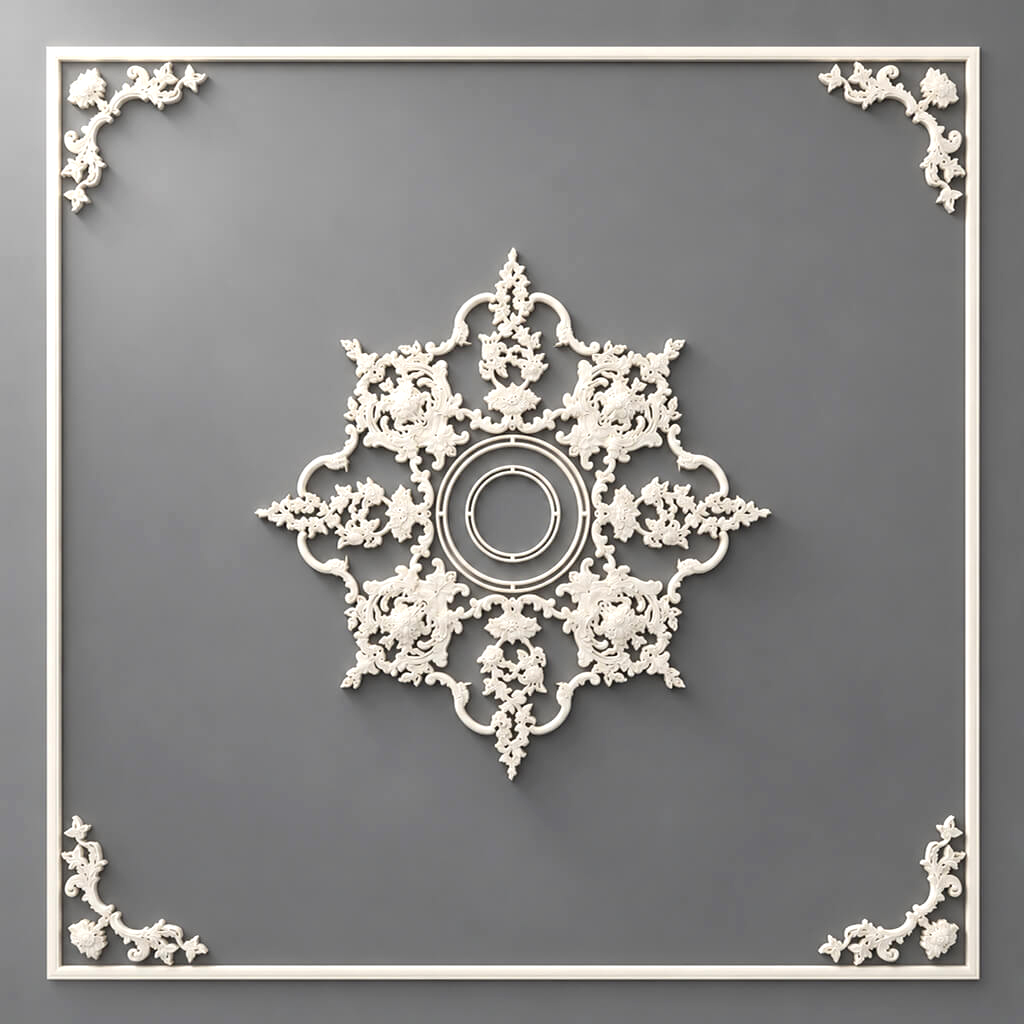
- Frame with three-dimensional corners and a central ornament
- MLDPU-001 — when a thin line is needed
- MLDPU-002 — the base of an expressive frame
- MLDPU-003 — a wider architectural border
- Corner element MLDPU-2U-1.1
- Central overlay MLDPU-2-2.1
- Standalone floral overlays
- First option: straight lines only
- Second option: frames with a deeper profile
- Third option: polyurethane composition with ornament
- The sum of perimeters is only the first step
- Sometimes changing dimensions saves more than a percentage of the reserve
- In a high-traffic room, protruding areas matter more
- Walls and decorative products must be compatible with the coating
- Reliability of fastening is not the same as the strength of the polymer
- Duropolymer — what kind of material is it?
- Is duropolymer polystyrene or polyurethane?
- How does duropolymer differ from polyurethane for moldings?
- Which is better for straight wall frames?
- Which is stronger: duropolymer or polyurethane?
- Which stucco to choose for a classic wall panel?
- Can duropolymer and polyurethane stucco be painted?
- How do I choose a corner overlay for MLDPU-002?
- Why can a ready-made polyurethane composition cost more than a single duropolymer frame?
- Where can I buy polyurethane stucco molding for walls?
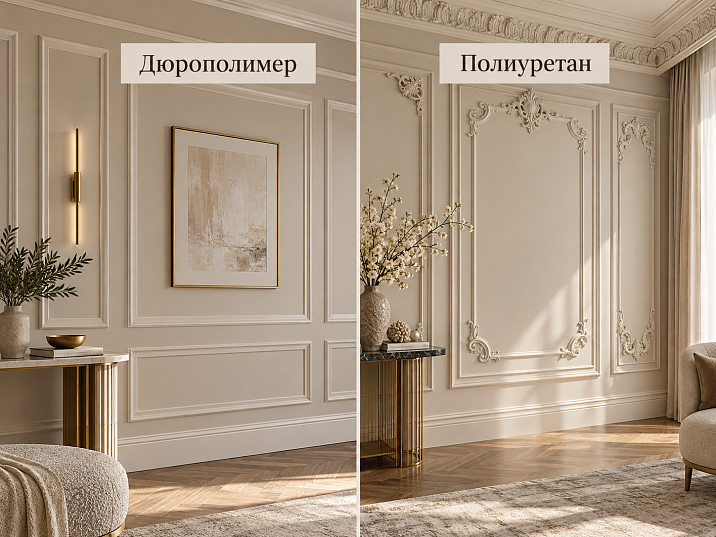
In a store, two white moldings can look almost identical. One is made of duropolymer, the other of polyurethane, and both are intended for painting. The difference becomes noticeable not so much when looking at a straight strip as when trying to assemble a finished wall composition from it: matching corners with ornament, inserting a central relief element, and maintaining the proportions of several frames.
For a simple line or strict geometric frames, dense duropolymer may well turn out to be a good choice. It is not equivalent to loose foam plastic, and in a version designed to withstand impacts it deserves serious consideration. For an elaborate stucco composition, it is worth evaluating molded polyurethane — above all, the range of compatible profiles and decorative parts. But the word “polyurethane” itself does not yet guarantee either greater strength or better installation.
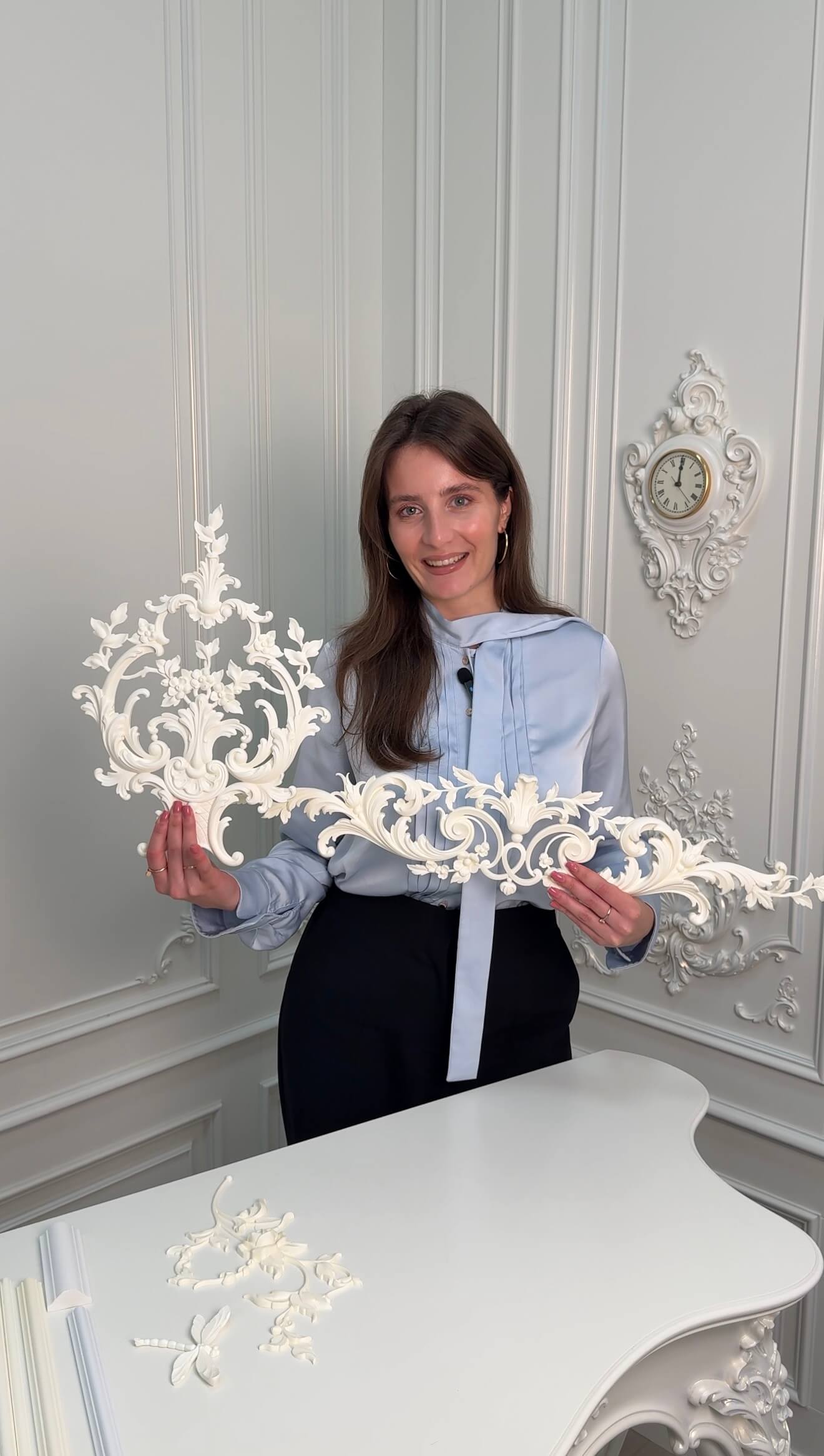
STAVROS has polyurethane moldings of various cross-sections and overlays intended for them. Such Moldings is interesting where an ordinary frame must turn into an architectural element of the wall. First, however, one should sort out the name of the material: the confusion around duropolymer often gets in the way of making a meaningful choice.


Duropolymer — what kind of material is it and what is it made from?
Is duropolymer polystyrene or polyurethane?
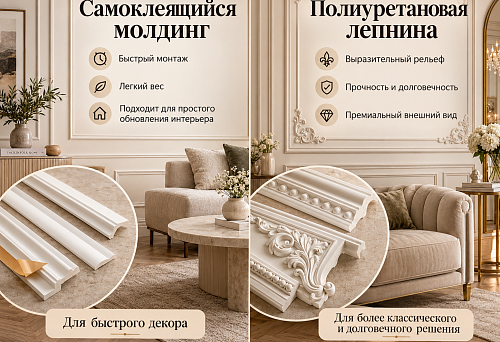
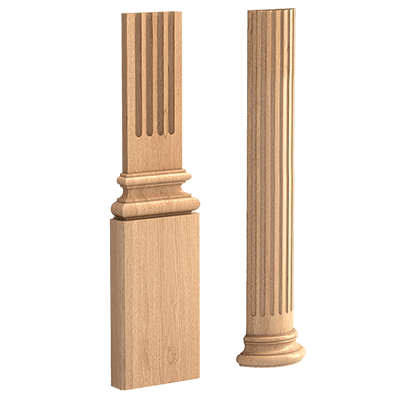
Duropolymer is not a type of polyurethane. The name Duropolymer® is used by the interior decor manufacturer Orac for an extruded impact-resistant polymer material based on high-density polystyrene. In its own material descriptions, Orac distinguishes Duropolymer® from Purotouch®: the latter is a polyurethane used, among other things, for products with fine detailing. The lighter polystyrene group Durofoam® is mentioned separately.
These are fundamentally different materials, although all of them may be sold as white profiles for painting. At the same time, the word "duropolymer" on the Russian market is sometimes used more broadly than the brand name. If the product is not an Orac item, you cannot rely on the catalogue label alone: ask for the product data sheet, composition information and the manufacturer's designation.
The phrase "duropolymer or polystyrene" is also not quite accurate. In the brand system, Duropolymer® is a material based on polystyrene, not a separate chemical alternative to it. It is more correct to compare a duropolymer profile with other types of polystyrene products: lightweight foamed, dense extruded and impact-resistant modifications.
Our factory also produces:



Why duropolymer cannot be equated with lightweight expanded polystyrene
A lightweight foamed profile and a dense extruded product can differ significantly in rigidity, resistance to indentation and surface character. A low-density expanded polystyrene element is easier to damage with a fingernail or the edge of a hard object. A dense impact-resistant polystyrene moulding may behave completely differently under comparable impact.
You cannot transfer the impression of a cheap foam ceiling skirting to all polystyrene mouldings. And conversely: the word "high-density" does not mean that a particular thin edge will never chip. What matters is the profile, the thickness of the protruding parts, the impact load and the operating conditions.
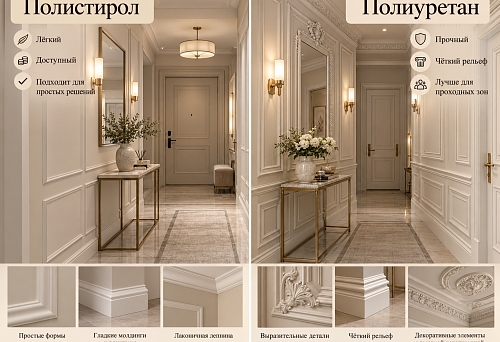
In a hallway along the wall, decor is more often hit by bags and furniture. On a high wall in a bedroom there is almost no such contact. The same material in these two places solves different tasks. That is precisely why the product data sheet is more useful than a general argument about which polymer is stronger.
Get Consultation
Where duropolymer mouldings are used
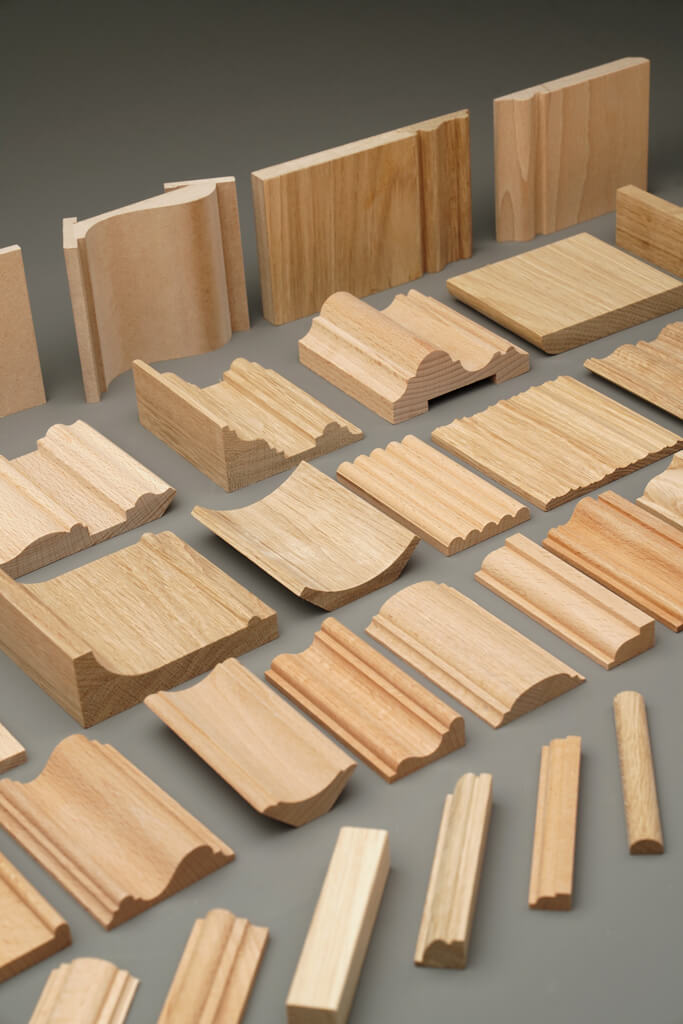
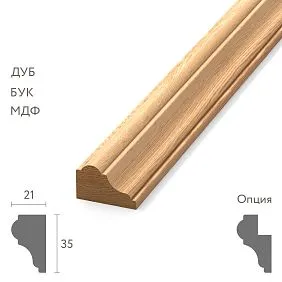
The main clear area of application is straight wall and floor decor: skirting boards, frame profiles, divider strips, simple architectural lines. When choosing a specific product, you need to check whether it is intended specifically for walls, floors or another area.
One should not conclude that it is impossible to make a detailed product from duropolymer. Technology and the capabilities of each manufacturer differ. However, for an ordinary linear profile, its practical value is more often associated with a straight shape, geometry, installation and resistance to everyday contact rather than with having a large set of three-dimensional ornaments.
Duropolymer or polyurethane: what's the difference
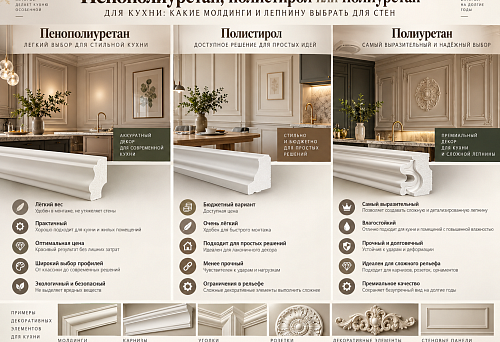
These materials have different chemical bases and typical methods of producing decorative items. Duropolymer in the Orac sense is an extruded high-density polystyrene material. Polyurethane interior decor can be manufactured by moulding: the compound takes on the shape of the mould, including intricate patterns of leaves, scrolls and multi-layered reliefs.
This explains why, when comparing two catalogues, a buyer often discovers a different specialisation. In one it is easier to select dozens of strict straight profiles, in the other — to complement moulding with three-dimensional corners, swags and centre appliqués. But the possibilities depend on the specific product line, not just on the name of the material.
| What we compare | Duropolymer based on dense polystyrene | Moulded polyurethane |
|---|---|---|
| Straight wall profile | Suitable for the relevant purpose | Suitable for the relevant purpose |
| Resistance to accidental impacts | At Orac the material is specifically positioned as impact-resistant | Depends on the specific formulation, cross-section and product |
| Very fine relief | Rated by the selected profile and assortment | Molding enables the production of complex ornamental details |
| Corners and center inserts | Availability and compatibility must be confirmed with the manufacturer | The STAVROS assortment includes parts for specific molding systems |
| Painting | Coatings approved by the manufacturer | Compatible coatings and preparation according to the product card or instructions |
| Adhesive mounting | The adhesive is selected to suit the product and substrate | The same requirements for base compatibility and strength |
| Care and local repair | Depend on the finish, damage, and construction | Depend on the finish, damage, and construction |
| Price of the finished finish | Depends on the profile, length, and installation | Depends on the profile and the number of additional parts |
Which is stronger — Duropolymer or polyurethane? There is no universal answer. The manufacturer Orac itself highlights the impact resistance of its Duropolymer range, and high detail as an advantage of its Purotouch® polyurethane range. Comparing a product designed for impact contact with a thin carved overlay and declaring one material the unconditional winner would be incorrect.
Behavior during processing also differs. A rigid straight strip and a relief overlay are cut and installed using different technological techniques. One cannot automatically assume that any polyurethane molding can be bent to a radius: flexibility must be specified in the documentation for the specific version. The same applies to Duropolymer profiles.
Which material to choose for wall moldings
One line dividing the wall
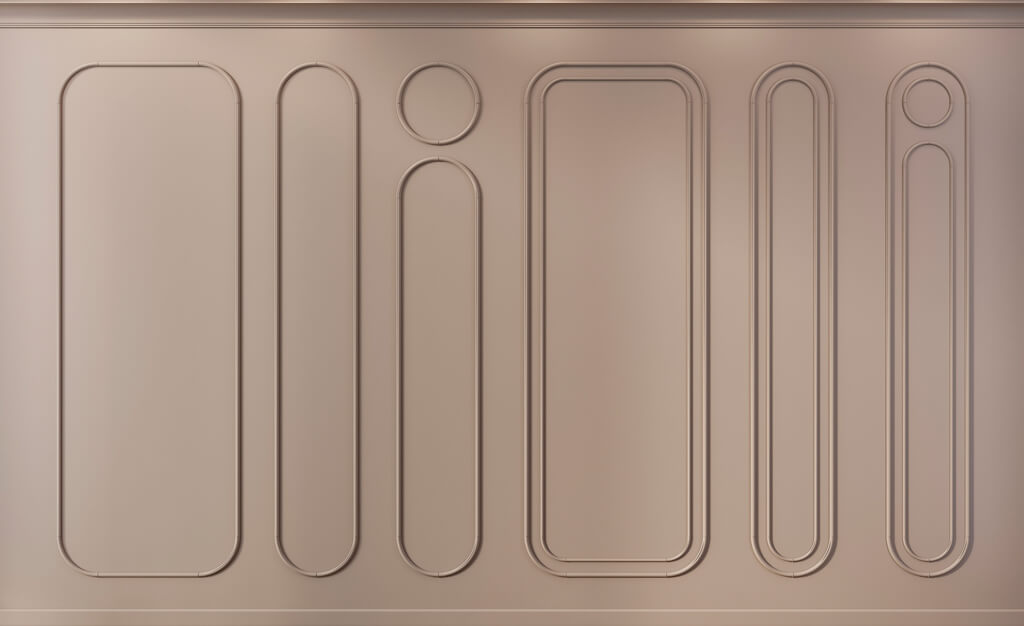
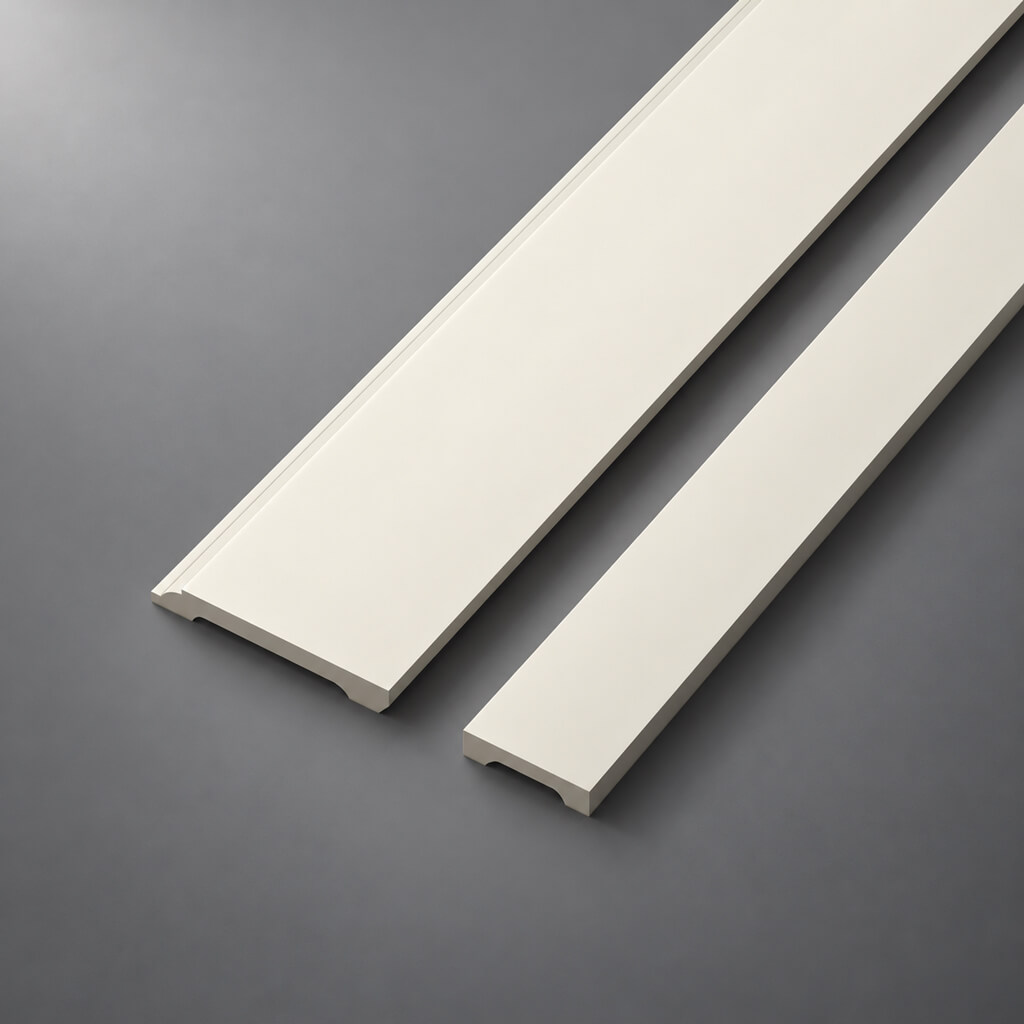
For a horizontal divider between two colors, a calm frame above the headboard, or a thin border around painted areas, an elaborate ornament is not necessary. A straight profile of the required cross-section and neat joints are enough. Here, duropolymer and polyurethane should be compared practically: sample to sample, the price of one installed meter to the price of the other, identical purpose to identical purpose.
If a suitable dense duropolymer molding is cheaper, has a clean surface, and meets the requirements for mechanical contact, there is no reason to pay extra just for the name of another material. For STAVROS customers, polyurethane moldings serve as an alternative: they should be evaluated by the shape of the cross-section and the possibility of further developing the composition.
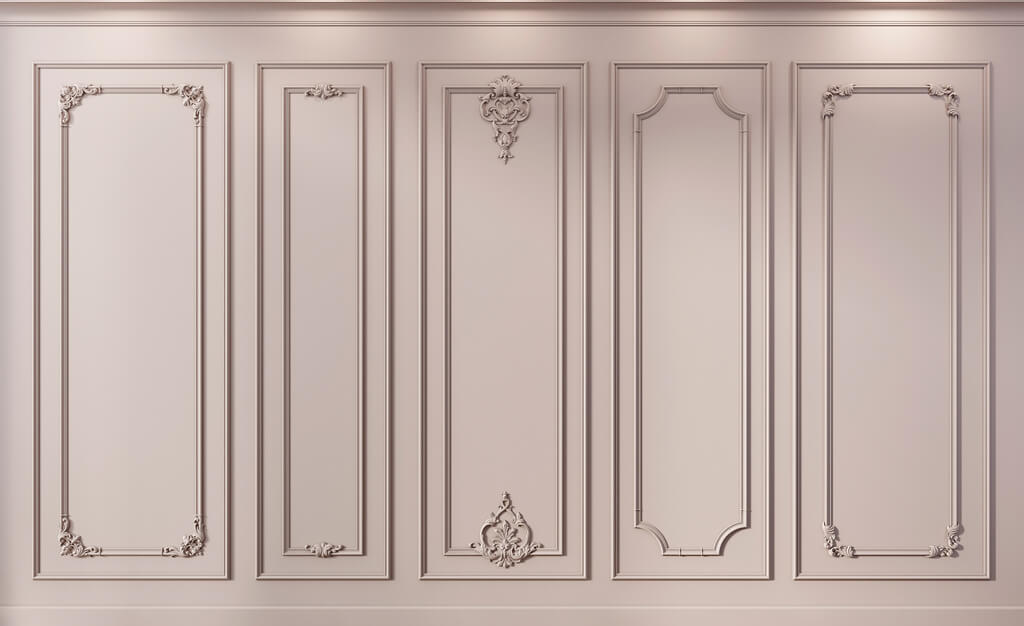
Classic frame on a painted wall
Here, not only the material but also the profile matters. A narrow molding draws a neat line along the wall. A profile with several steps creates a more complex shadow. In side lighting, such relief is more noticeable than under even frontal lighting; in a narrow passage, on the other hand, protruding decor ends up closer to a person and is more often subjected to contact.
Before buying, place the sample against the wall at the intended height. Step back to the usual viewing distance, look from the side, check its proximity to the baseboard, casing, and outlets. Two profiles that seem equally appropriate on a table may be perceived quite differently on a three-meter wall.
Frame with three-dimensional corners and a central ornament
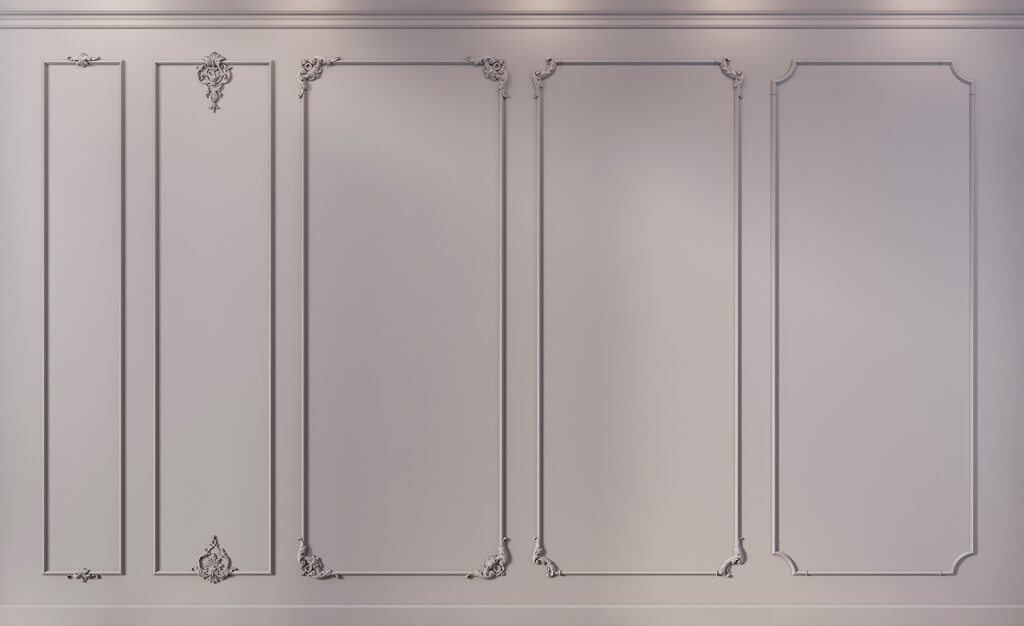
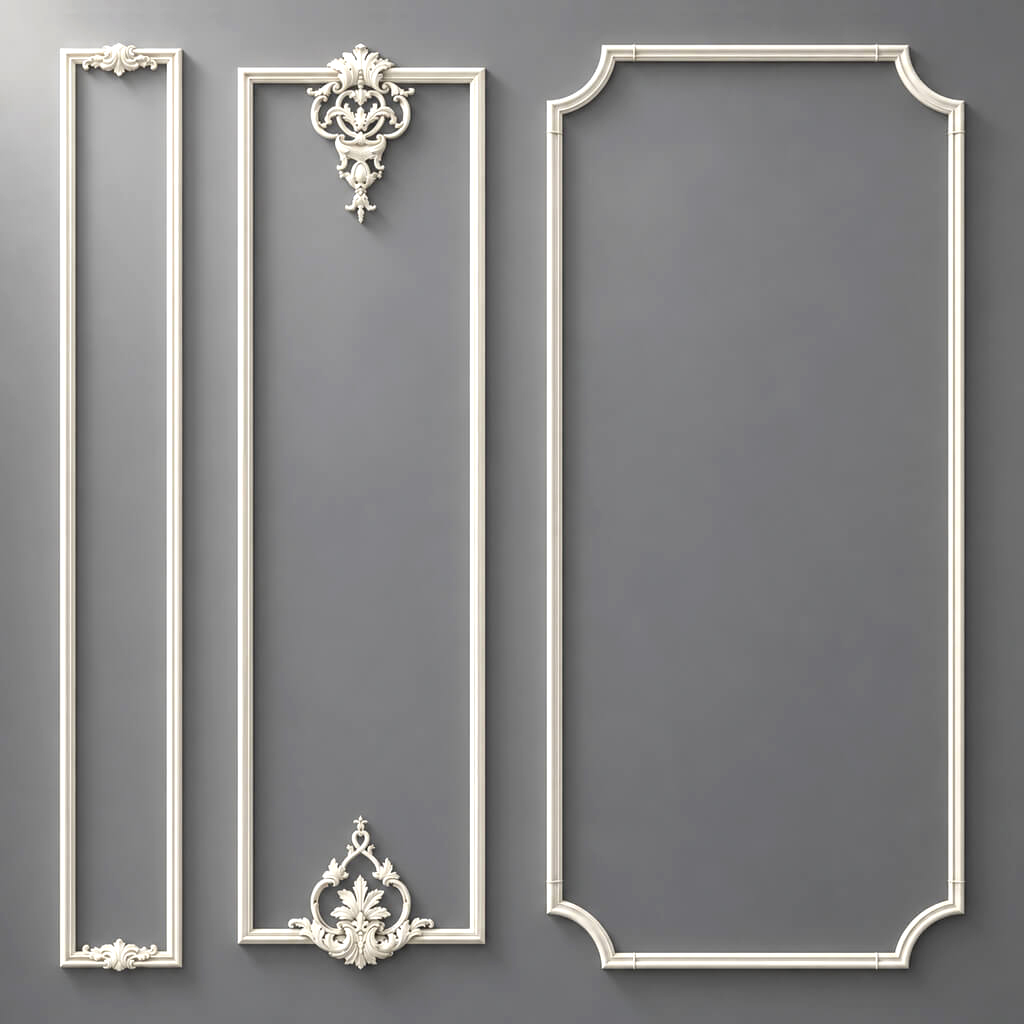
It is precisely in this scenario that the choice becomes more specific. For a beautiful frame, it is not enough to buy four straight strips and any decorative overlay. You need to check whether the cross-section lines will align at the joint, whether there is enough space for the central element, and how the joints will be positioned.
STAVROS has a whole group of products designed for this task: Polyurethane moldings includes both profiles and relief details. The advantage here lies not in the unproven superiority of polyurethane under any load, but in the ability to select elements with a confirmed shared purpose.
What STAVROS polyurethane moldings offer
The STAVROS catalog presents three representative cross-sections. All dimensions given below refer to specific products, not to the entire polyurethane range.
| Product | Size, mm | What it changes in the design |
|---|---|---|
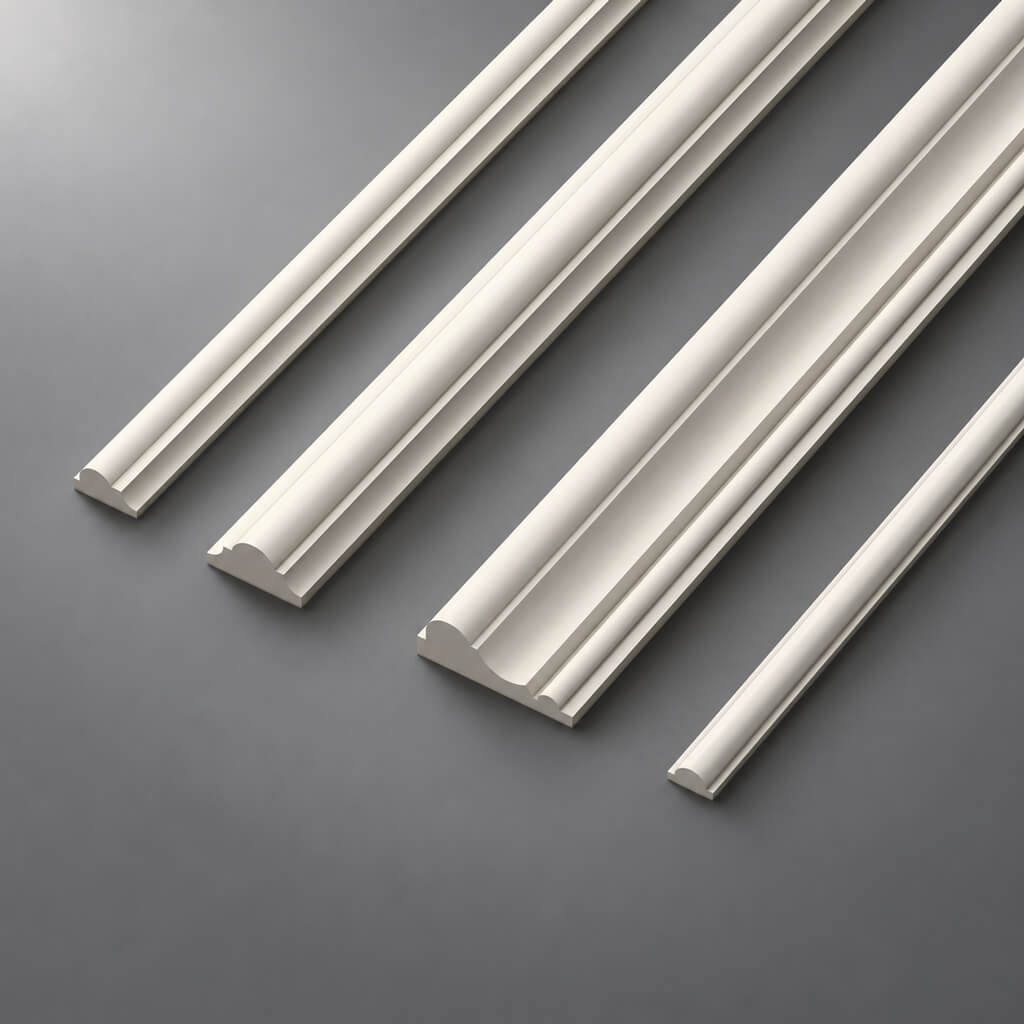
| MLDPU-001 | 10 × 6 × 2600 | A fine semicircular decorative line |
| MLDPU-002 | 22 × 11 × 2600 | A more pronounced multi-stepped frame profile |
| MLDPU-003 | 35 × 12 × 2600 | A wide architectural border |
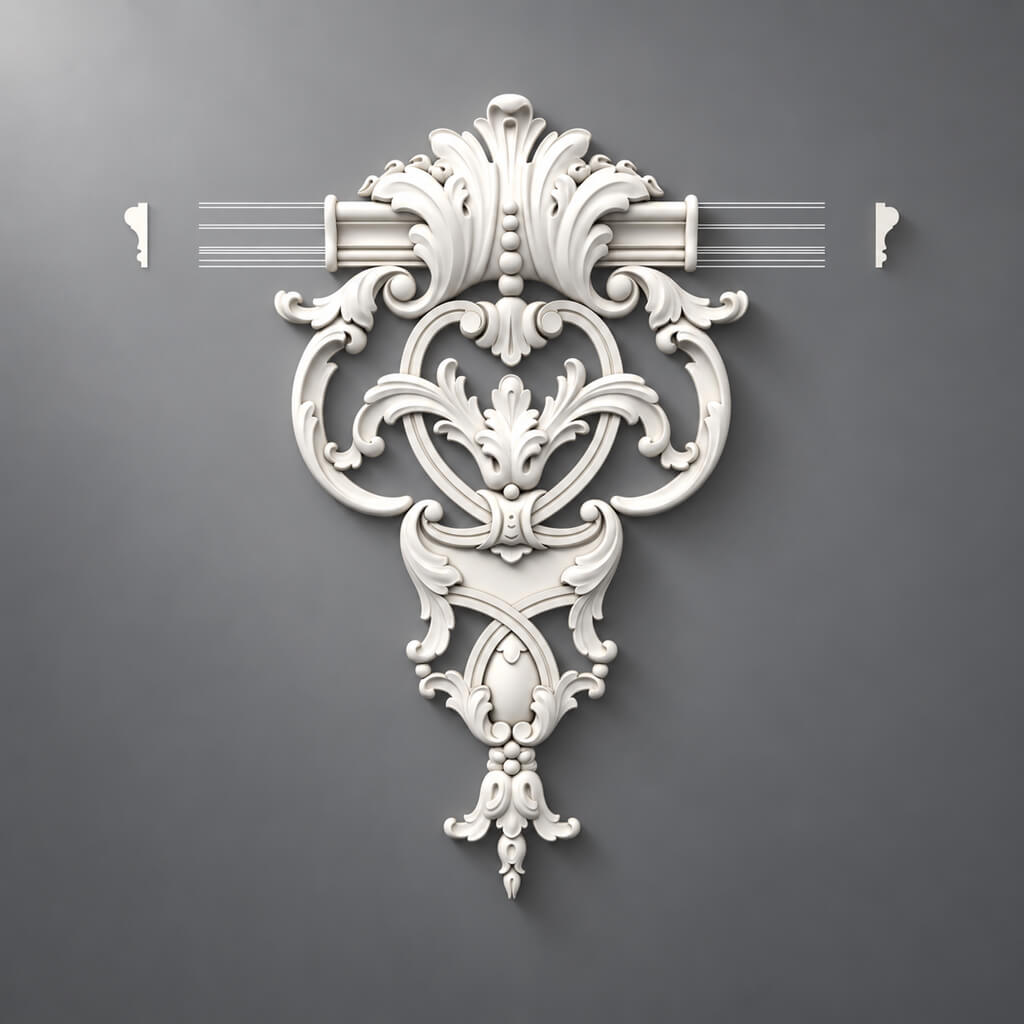
| MLDPU-2U-1.1 | 210 × 210 × 18 | Corner ornament for the 002 system |
| MLDPU-2-2.1 | 235 × 237 × 21 | Central decorative element of the 002 system |
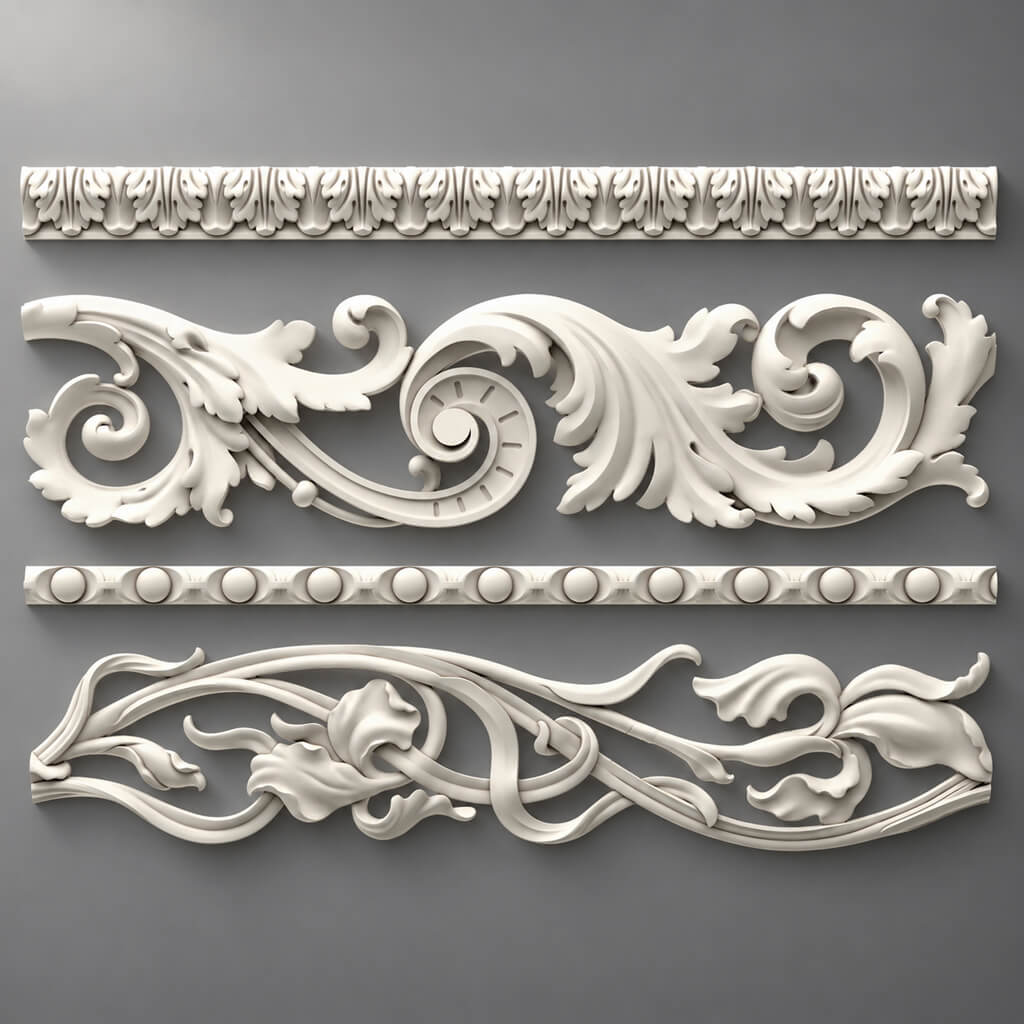
| NPU-316 | 28 × 200 × 6 | A standalone narrow floral applique |
MLDPU-001 — when a fine line is needed
The 10 × 6 mm cross-section practically does not compete with other wall elements. polyurethane molding MLDPU-001 it can be considered for clean-lined rectangles, the inner contour of a decorative panel, or a fine line on a furniture front. The length of one strip is 2600 mm.
For a wall with patterned wallpaper, such a small profile often looks calmer than a massive relief. But if the goal is to accentuate a wall more than three meters high from a distance of several meters, a thin line may not be noticeable enough. It is better to check this with a sample rather than from the product card photo.
MLDPU-002 — the basis of an expressive frame
Polyurethane molding MLDPU-002 has a cross-section of 22 × 11 mm and a length of 2600 mm. It already expresses architectural stepping: the line is not limited to a single rounded bead. It is specifically for the 002 series that the manufacturer offers special corner and center ornaments.
This is a suitable example of the transition from ordinary trim to a system: the dimensions of the overlays and their purpose are tied to a specific profile. However, "compatible" does not mean "can be installed on any frame without a drawing." The height and width of the finished field, the position of the center overlay, and the joining of the straight sections remain project tasks.
MLDPU-003 — a wider architectural border
У of the MLDPU-003 decorative molding cross-section 35 × 12 mm. It is 13 mm wider than MLDPU-002 but protrudes from the wall only 1 mm more. Therefore, the visual difference is determined not so much by the additional depth as by the width and shape of the profile.
It makes sense to compare such molding with the baseboard and door casings in the room: a frame that is too narrow around a wide door may get lost, while one that is too wide next to a thin baseboard may be perceived as a foreign element. There is no universal size for all rooms.
How to combine molding, corner and center stucco
Corner element MLDPU-2U-1.1
A rectangular frame made of four mouldings usually requires mitred corners and precise pattern matching. An alternative for the 002 series is Corner molding MLDPU-2U-1.1 measuring 210 × 210 × 18 mm. The manufacturer specifies its use with MLDPU-002 and MLD-002-MG.
The element sits in the corner of the frame and connects two straight directions with an ornamental pattern. A closed rectangular composition with four identically finished corners will require four pieces. But these 210 mm are the overall size of the overlay, not a universal value that can be subtracted from the length of each moulding without verification. The junction points are determined from the drawing and a trial layout.
Central overlay MLDPU-2-2.1
Stucco decor MLDPU-2-2.1 measures 235 × 237 × 21 mm. STAVROS explicitly states its compatibility with the MLDPU-002 moulding. The overlay can mark the centre of the top side of a wall frame or another straight section of the composition.
A projection of 21 mm means that this piece stands out from the wall more noticeably than the MLDPU-002 profile with a height of 11 mm. The difference is 10 mm. In a passage area, this must be taken into account not only for the sake of the pattern: a three-dimensional part is easier to catch on, and in a narrow corridor it may appear excessively large.
There is also a geometric limitation. If the frame is 500 mm wide, a central element with an overall width of 235 mm occupies almost half of that dimension even before corner accents are taken into account. In a wide panel of 1200–1500 mm, the same overlay reads differently. Therefore, the pattern is selected after the dimensions of the decorative field have been determined.
Standalone floral overlays
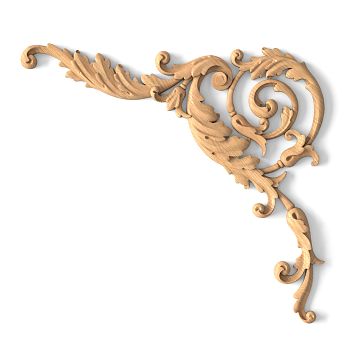
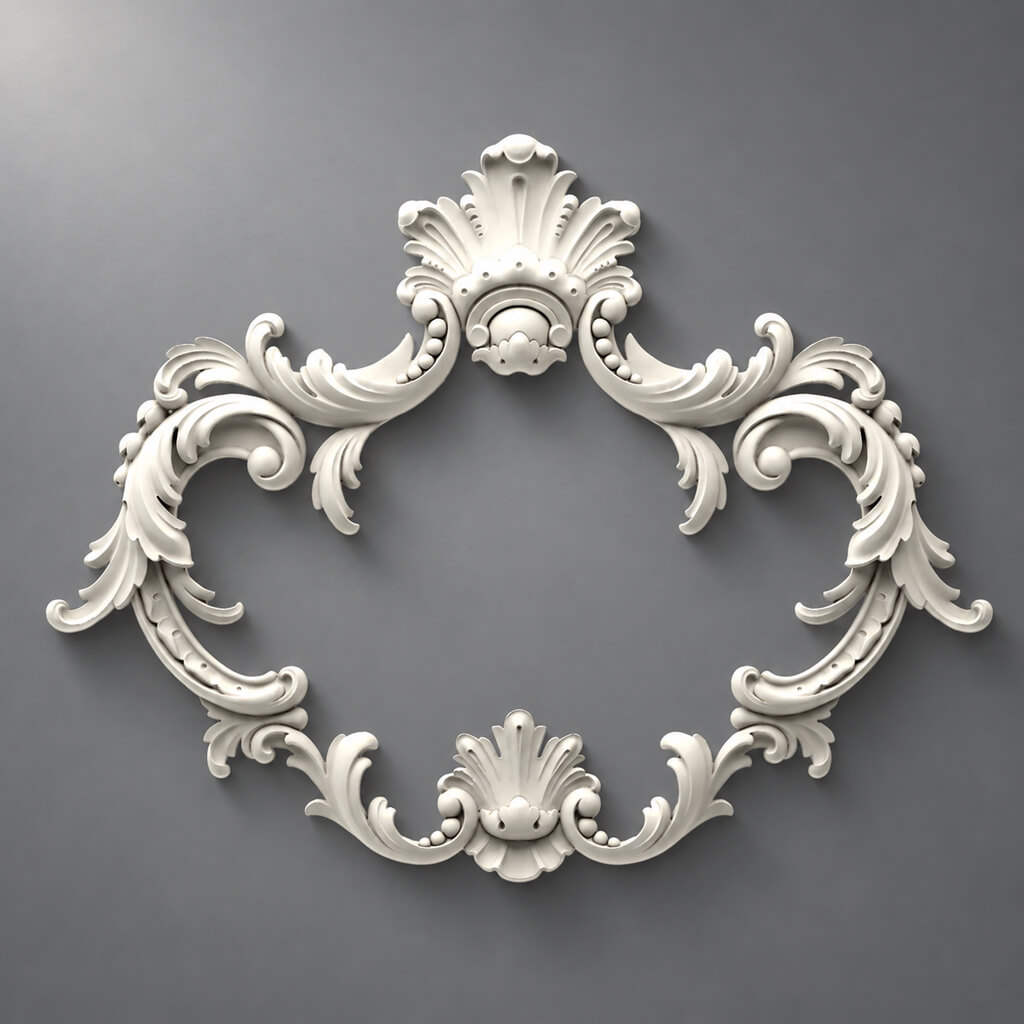
If the frame should not have four heavy ornamental corners, a single relief accent on the flat part of the wall is enough. For example, polyurethane overlay NPU-316 measures 28 × 200 × 6 mm and is made in the form of an elongated decorative plant element.
This is a standalone overlay, not a confirmed factory connector for MLDPU-001, MLDPU-002 or MLDPU-003. It can be considered an independent wall accent, but geometric matching with an arbitrary molding cross-section cannot be promised. This is precisely where the difference between "matches in style" and "compatible as a system part" affects the result.
Three design options for a single wall
Suppose there is a painted wall 3600 mm long with one central decorative zone. The specific fields, clearances from furniture and doors still need to be marked out. Before buying, it is worth comparing three solutions at the same scale.
First option: straight lines only
Thin frames made of MLDPU-001 or a suitable duropolymer profile are suitable when the wall already has a noticeable wallpaper pattern, large paintings or expressive furniture. The molding only organizes the plane. The corner is formed by miter-cutting straight segments; additional overlays are not needed.
In this case, the main criterion is not artistic relief but even geometry, the quality of the joints, ease of painting and price. Duropolymer can handle this task without a noticeable limitation of functionality. It is not worth buying an expensive stucco system if the intended interior does not involve ornament at all.
Second option: frames with a deeper profile
If the wall looks too flat, the expressiveness of the line is increased: instead of a thin rounded molding, a profile with more developed steps is chosen, for example MLDPU-002. The frame still consists of straight segments, but creates a more noticeable shadow. Particular attention is paid to the angled joints and a uniform paint finish.
You don't necessarily need to place three identical rectangles on one wall. Sometimes it's better to leave a large central field and two narrower ones at the edges. Dimensions are calculated from the actually visible sections between the casing, the corner of the room, and furniture, not from the geometric center of the entire wall.
Third option: a polyurethane composition with an ornament
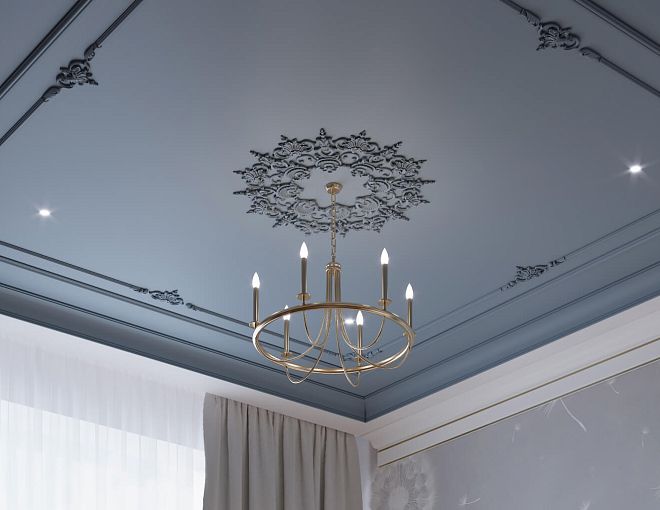
In a classic room, compatible corner elements and one or more central accents are added to the straight sides of MLDPU-002. The contour turns into a sequence of relief nodes and the lines connecting them. Here it already makes sense to choose molded decoration made of polyurethane in addition to the profiles.
It's important not to confuse the decorative goal with fill density. Four large corners and a central overlay may prove excessive for a small frame. In that case, it's better to enlarge the field itself, drop some of the accents, or go back to the second option. A good system gives you the ability to choose rather than obliging you to use all its elements at once.
How to calculate the number of moldings without unnecessary purchases
The sum of perimeters is only the first step
Let's consider another, larger project: four rectangular frames measuring 1100 × 1700 mm are planned on several walls along conventional cutting lines. This is a training example without overlays, with simple joints. The perimeter of one frame is 2 × (1100 + 1700) = 5600 mm. Four require 22,400 mm of profile.
If the strip length is 2600 mm, simple division gives 22,400 / 2600 ≈ 8.62, that is, nine strips by linear meterage. But nine strips cannot yield all the continuous elements of this scheme.
You need eight pieces of 1700 mm and eight of 1100 mm. After cutting a 1700 mm piece, only 900 mm remains from the strip, not counting the saw kerf: a continuous 1100 mm piece cannot be obtained from it. Therefore, the eight long parts take up eight separate strips, while the eight short 1100 mm pieces can be cut in pairs from four more. That makes twelve strips in total if all sides must be without intermediate joints.
| Parts | Quantity | Cutout | Need strips of 2600 mm |
|---|---|---|---|
| Verticals of 1700 mm each | 8 | One per strip | 8 |
| Horizontals of 1100 mm each | 8 | Two per strip | 4 |
| TOTAL | 16 | No intermediate joints | 12 |
Two joined short offcuts would theoretically save material, but additional seams will appear on a painted wall. Their quality depends on the joining technique, movement of the substrate, and the neatness of the finish. That is why a cutting plan is drawn up before ordering.
Sometimes changing dimensions saves more than a percentage of reserve
Let's imagine the composition can be slightly reduced: instead of 1100 × 1700 mm, adopt frames of 990 × 1550 mm along the cutting lines. Then one 2600 mm strip fits one 1550 mm segment and one 990 mm segment: 2540 mm together, leaving 60 mm for allowances accounted for separately, and for saw cuts.
Four frames require eight verticals and eight horizontals. Each of the eight strips yields one piece of each type — eight strips in total instead of twelve. This is not universal advice to reduce frames: a project may have fixed proportions. But the example shows why, before buying, you should check two or three acceptable sizes rather than mechanically adding ten percent to the total perimeter.
If corner and center overlays are used, this calculation is revised entirely. The straight sections will depend on the actual points of junction with the parts, so it is not possible to subtract only the outer dimension of the overlay from the perimeter without a drawing.
How much finishing costs: a simple profile versus a system with overlays
When comparing costs, you cannot place the price of a single duropolymer strip next to the price of a finished polyurethane composition. The latter includes additional products and more complex work. For a correct calculation, linear footage, ornamental details, adhesive, surface preparation, and painting are calculated separately.
According to STAVROS product cards as of October 22, 2026, the price of MLDPU-001 is 1740 ₽ per 2600 mm strip, MLDPU-002 is 5460 ₽, and MLDPU-003 is 7580 ₽. These are not universal market material costs but values for the named products at the time of checking; they must be confirmed before purchase.
For the example with four frames made of MLDPU-002 measuring 1100 × 1700 mm, the cost of just twelve strips will be 65,520 ₽ (12 × 5460). The 990 × 1550 mm option with eight strips is 43,680 ₽ (8 × 5460). The difference is 21,840 ₽, excluding adhesive, delivery, installation work, and finishing. Changing the dimensions is permissible only when it does not worsen the proportions of the wall.
There is another example: a single decorative frame. If, according to its working drawing, two MLDPU-002 strips, four corner elements MLDPU-2U-1.1, and one center overlay MLDPU-2-2.1 are sufficient, the set of parts at the stated prices is:
| Detail | Quantity | Price per unit on the date of checking | Total |
|---|---|---|---|
| MLDPU-002, 2600 mm | 2 | 5460 ₽ | 10 920 ₽ |
| MLDPU-2U-1.1 | 4 | 4490 ₽ | 17 960 ₽ |
| MLDPU-2-2.1 | 1 | 5350 ₽ | 5350 ₽ |
| Total for products | 34 230 ₽ |
This is an illustration of the composition of a purchase, not a factory kit and not a ready-made estimate for an arbitrary wall size. After checking the drawing, the number of straight profiles may change; in addition, suitable installation materials, finishing, and labor will be required separately. A comparable price for a duropolymer solution cannot be stated without a specific item code and a verified product card.
Durability, painting and service life: what to check before ordering
In a walk-through room, protruding areas matter more
Impacts rarely hit the perfectly flat middle of a wall. More often, the outer edges, the lower part of the molding near furniture and the protruding parts of the ornament suffer. Therefore, when comparing duropolymer and polyurethane, check not only the name of the material but also the shape of the product: the thinner and more strongly a separate part protrudes, the more carefully you need to choose the installation location.
For a narrow corridor with a clear passage, it is worth considering a simple impact-resistant profile. For a living room with wide walls and fewer accidental contacts, a complex polyurethane overlay may be quite appropriate. At the same time, decorative moldings should not be used as protective handrails, bumpers or load-bearing elements.
Walls and decorative products must be compatible with the coating
Both materials can be painted if the manufacturer permits the chosen composition and preparation method. It should not be assumed that any paint is equally suitable for any profile. Some solvents can damage polystyrene; polyurethane products may also have their own limitations regarding primers and coatings.
A delicate ornament loses out when it is covered several times with thick, uneven layers. The recesses stop being legible, the joints become noticeable, and it begins to feel like a solid plastic mass. It is better to do a small test paint on a sample and determine in advance the sequence of painting the wall, profiles and overlays.
Reliability of fastening is not the same as the strength of the polymer
Even a high-quality molding will come off together with weak paint, fragile plaster or the paper layer of wallpaper. Preparation must take into account the actual surface: cleaning, removal of peeling areas, drying, and selection of an installation compound for the two specific materials.
If the profile is glued directly onto fragile wallpaper, the strength of the bond is limited by the adhesion of the wallpaper to the wall. If the decorative composition is being installed for years, it is often more sensible to provide a strong prepared base under the adhesive line. At the same time, standalone overlays require checking the contact area and temporary fixation according to the manufacturer's instructions.
Installation of duropolymer and polyurethane moldings: the real differences
For straight molding, the working sequence is broadly similar: check the substrate, mark out the lines, dry-fit the elements, cut to size, choose a compatible adhesive, join and paint the parts. The differences lie in the tools, the method of finishing the joints and the additional elements.
With a dense polystyrene profile, you cannot use solvent-based compounds that are aggressive to polystyrene without testing them first. A polyurethane product also requires an adhesive system approved by the manufacturer. You cannot recommend a single universal adhesive on the principle of "suitable for all polymers" without taking into account the wall primer, temperature and the geometry of the part.
The corner overlays of system 002 change the assembly sequence. Instead of four straight profiles all mitred at 45°, the project provides for four separate ornamental corner blocks, with straight sections between them. This creates a different cutting plan. The central piece can additionally divide a single line into two separate segments.
Before installation, you need to do a dry fit: place the moldings and overlays on the marked surface without adhesive, check the pattern, orientation, ends and actual distances. With complex relief, this preparation helps avoid the situation where almost the entire composition is installed but the last element cannot be correctly joined.
Do not assume a polyurethane profile is flexible just because the word "elastic" appears in the description. Arches and curved walls require specially approved flexible or ready-made radius products. You should not heat standard profiles with a heat gun to force a bend without the manufacturer's instructions.
When it is better not to buy complex polyurethane stucco
Installing decorative overlays does not always improve an interior. If the wall is narrow, a full-height wardrobe stands nearby, and only 500–600 mm remains on the free section, a three-dimensional ornamental composition may prove disproportionate. A polyurethane system is especially advantageous where there is sufficient flat surface for it and its relationship with doors, furniture, skirting boards and lighting has been thought through.
Skip unnecessary relief if the task comes down to a single neat dividing line. Do not buy profiles before fixing unstable plaster or the cause of recurring cracks. Do not add standalone overlays at random if you have no idea how their pattern will combine with the molding.
And conversely: when a project calls for large classical panels, repeated ornament and coordinated corner pieces, a plain straight strip may not be enough. Then the advantages of the STAVROS system become concrete: the buyer is choosing not an abstract "more expensive plastic" but the geometry of a specific composition.
Mistakes that lead to unnecessary expenses
- Treating duropolymer as polyurethane. Because the profiles look similar, the materials get confused, and then adhesives and processing methods are selected using the wrong instructions. Check the composition and designation with the manufacturer.
- Comparing duropolymer with soft foam. This distorts the perception of impact resistance. Compare products of comparable purpose, density and geometry.
- Claiming that any polyurethane is stronger. Thin protruding ornament and a dense straight profile experience different loads. Study the properties of specific models and the installation conditions.
- Choosing only by the width in the photo. Two moldings of similar width may differ in projection, step shape and shadow character. Compare the cross-section drawing and samples under real lighting.
- Buying an overlay without checking the system. The corner element MLDPU-2U-1.1 is designed for the 002 series profile; compatibility with any other molding is not guaranteed.
- Ordering a profile by total linear meters. The length of straight sections may not allow them to be obtained without joints from the mathematically minimum number of planks. First make a cutting plan.
- Not taking into account the dimensions of the ornamental blocks. A central overlay about 235 mm wide on a narrow frame takes up a significant part of the composition. Build it to scale before ordering.
- Using random glue or thick layers of paint. The former can damage the material or produce a weak bond, while the latter hide fine relief. Check compatibility and do a test painting.
Where to choose and buy STAVROS polyurethane stucco
For a simple frame, first determine the width and shape of the profile. For an ornamental one, additionally select compatible corner and center pieces. Therefore, when searching for the query “Buy moldings” it makes sense to start by understanding the composition of the future design: whether you need a standalone sculpted accent, a frame with ready-made corners, or only straight lines.
For a visitor who is searching for “polyurethane moldings buy”, it is more useful to first choose a moulding system and use its drawings to determine the number of overlays than to try to buy the pieces separately. The STAVROS catalog presents molding decorative elements and compatible profiles. Clarify the dimensions, availability, price, and required installation materials for your project.
Frequently asked questions
Duropolymer — what kind of material is it?
As a brand name, Orac Duropolymer® is an extruded impact-resistant material based on high-density polystyrene. It is used in ready-made decorative profiles. It is not the same as lightweight foam skirting. However, on the market the name may be used without indicating the original manufacturer, so for a specific purchase check the composition, data sheet, and purpose of the product rather than relying only on the term.
Is duropolymer polystyrene or polyurethane?
In the Orac materials system, duropolymer is related to polystyrene. Polyurethane is a different polymer group used for its own types of decorative products, including complex molded overlays. The statement “duropolymer is polyurethane” is incorrect with respect to the branded Duropolymer®. When choosing a product from another manufacturer, the composition should be checked separately.
How does duropolymer differ from polyurethane for mouldings?
The chemical base and typical manufacturing technology differ, but for the buyer the properties of the specific profiles are decisive. Orac duropolymer is positioned as an impact-resistant material for linear decor. The STAVROS polyurethane range includes molded ornamental elements that can be matched to certain mouldings. Both groups can be used under paint if the manufacturer's instructions are followed.
Which is better for straight wall frames?
For simple frames without relief inserts, both materials are suitable, provided the selected products are intended for walls and meet your requirements for cross-section, price and installation conditions. Compare samples under identical lighting, check the dimensions and whether you can obtain continuous straight lengths. Polyurethane does not become mandatory simply because the profile is planned to be painted.
Which is stronger: duropolymer or polyurethane?
Test results and the construction of specific products are needed. A dense duropolymer profile may withstand accidental impacts well, whereas a complex molded applique has vulnerable thin protrusions. In another situation, a polyurethane profile with a suitable cross-section may prove quite practical. It is not possible to correctly compare materials based on a single marketing adjective.
Which moulding should I choose for a classic wall panel?
If you need a frame with pronounced corner ornaments, at STAVROS you can consider moulding MLDPU-002, the compatible corner element MLDPU-2U-1.1 and the central applique MLDPU-2-2.1. Take into account not only the system name, but also the dimensions of the parts, the lengths of straight sections and the overall size of the decorative field. For small frames, the whole set may be excessive.
Can duropolymer and polyurethane mouldings be painted?
Yes, products suitable for painting exist in both groups. However, the permitted composition, the need for priming and the preparation method are determined by the manufacturer. First check the compatibility of the paint with the specific profile and its factory surface. Then make a small test paint application: if the coating is too thick, small ornament details lose their definition.
How do I select a corner applique for MLDPU-002?
For this STAVROS series, MLDPU-2U-1.1 measuring 210 × 210 × 18 mm is provided. With a standard frame with four such corners, the number of elements is four. However, the dimensions of the applique do not replace a working drawing of the joint. Before cutting the profile, you must clarify the abutment points, the orientation of the pattern and the position of adjacent parts.
Why can a ready-made polyurethane composition cost more than a single Duropolymer frame?
The buyer pays not only for the length of the straight profile, but also for separate corner and center overlays, as well as for more complex assembly and finishing. Comparisons should be made for identical decorative tasks. If four straight lines are needed, additional ornaments do not provide a mandatory practical advantage. If a complex classical pattern is specified, the cost of the composite system reflects a different configuration.
Where to buy polyurethane stucco for walls?
You can find suitable products in the STAVROS catalog. Before ordering, determine the frame dimensions, choose a profile, create a cutting map, and calculate corner and center overlays separately. If factory compatibility is important, focus on specific series, for example MLDPU-002 with the corresponding decorative elements. Installation compounds and paint should also be selected according to the materials and the substrate.
Which material to choose in the end
For straight decorative lines and minimalist frames, dense polystyrene-based Duropolymer may be a suitable solution, especially when the profile is subject to everyday contact and a complex relief is not required. Compare specific products — their cross-sections, purpose, surface, cost, and installation instructions.
When the task goes beyond a standard contour and the wall needs ornamental corners, center accents, and a coordinated classical pattern, it is worth considering STAVROS polyurethane moldings and overlays. Here you can choose complete combinations of parts instead of trying to fit a randomly purchased ornament to an arbitrary strip.
The best result begins with a scaled sketch, verification of element compatibility, and a cutting map. Material matters, but it is the combination of geometry, product purpose, and careful installation that determines how convincing the finished stucco composition will look.