Article Contents:
- One extra plank is not extra: it changes the order structure
- K-075 in numbers: four cross-sections, one length, and different standards
- Material and quality cannot be left "by default"
- Length 2000 mm does not mean selling by meters
- Preliminary packaging cost
- Why the cart and the total may differ
- When the twenty-first plank is justified
- When the quantity can be reduced
- How to compare two scenarios
- Parts list
- Utilization factor formula
- Why a universal waste percentage cannot be promised
- 14 × 8 mm — thin line
- 18 × 10 mm — moderate profile
- 22 × 13 mm — pronounced relief
- 30 × 17 mm — large decorative strip
- Cabinet: repeatability matters more than random savings
- Door: two-meter length may be less than panel height
- Dresser and nightstand: short parts yield useful leftovers
- Wall panel and boiserie: quantity grows faster than the number of frames
- Range logic, not a single point
- Example of a combined order
- Beech and oak in one package
- Standard and Prestige in one request
- What to check before painting
- Why the braid requires careful application
- Wood differences are not a printing defect
- Stock for oak has additional value
- Preparation "for tinting"
- Connected baseboard
- Drawing before ordering a batch
- What to request before payment
- Why two frames are not always twice as expensive to deliver
- Why one frame does not always mean one delivery line
- What to check after opening
- Quantity check
- What is purchased
- How much is purchased
- What it is made of
- In what quality
- How it is packaged
- Private wardrobe in the bedroom
- Series of dressers
- Decorating a door and a wardrobe with one profile
- Restaurant with repeating panels
- Restoration stock
- Mistake 1. Multiplying only the price of the bar
- Mistake 2. Not noticing the word "up to"
- Error 3. Declaring two frames as guaranteed
- Error 4. Removing the reserve for one frame
- Error 5. Counting linear meters instead of pieces
- Error 6. Mixing sections in one line
- Error 7. Not specifying the wood species
- Error 8. Not specifying the sanding quality
- Error 9. Taking 'under enamel' as finished painting
- Error 10. Not checking transport units
- Error 11. Starting cutting before acceptance
- Error 12. Ordering the second batch later without a sample
- Error 13. Using the packing frame as a mounting frame
- Error 14. Not updating the count after changing the quantity
- Error 15. Not saving the reserve as full-size
- Why the boundary is more important than the average quantity
- A boundary order cannot be approved verbally
- Strategy 1. Exactly 20 pcs without a separate reserve
- Strategy 2. 21 pcs with a full reserve
- Strategy 3. Reassemble the project and order more deliberately
- Why you can't distribute packaging across the price of each plank and forget about it
- Unit packaging cost as an analytical metric
- Quantity increased from 20 to 21
- Quantity decreased from 21 to 20
- Cross-section changed
- Material changed
- How many K-075 30 × 17 mm fit according to the published standard?
- Does the 21st plank definitely require two frames?
- Why is the frame priced separately?
- What is the published price of the frame?
- Can I decline the frame?
- Can the 21 planks be packed more tightly into one frame?
- Can I add several thin planks to the 18 large ones?
- How many frames are preliminarily needed for 36 planks of 22 × 13 mm?
- How many frames are needed for 61 planks of 18 × 10 mm?
- And for 101 slats 14 × 8 mm?
- Is delivery included in the price of the packaging frame?
- Can K-075 be ordered by the meter?
- How to calculate the quantity for frames?
- Is a spare slat needed?
- What is more profitable: 20 or 21 pcs?
- Can I order 40 pcs in two frames?
- If I need 41 items, how many frames should I count?
- Is beech or oak better for K-075?
- What to choose: 'Standard' or 'Prestige'?
- Will K-075 arrive already painted?
- Can I paint after installation?
- What to do if one slat is damaged during delivery?
- Can I order one more plank later?
- Where can I check the price and availability?
- How to order K-075 with delivery?
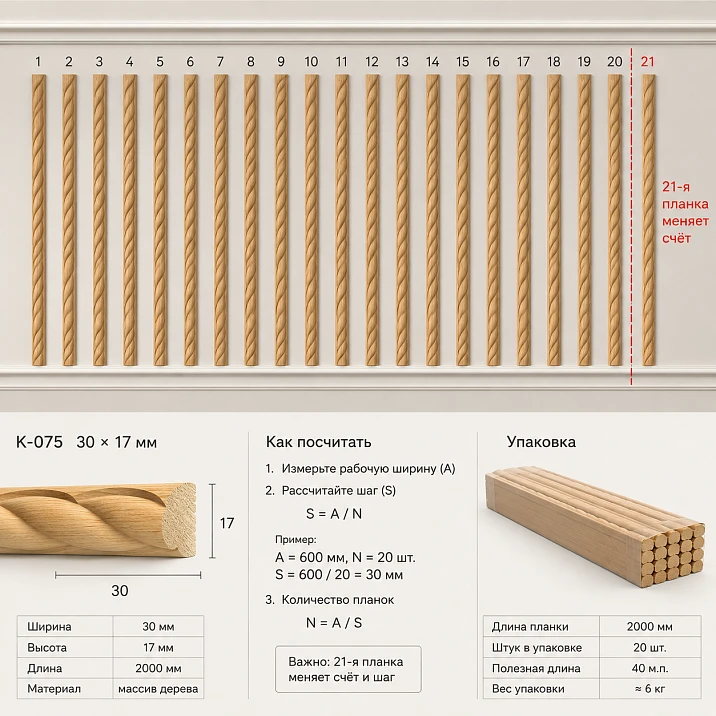
The buyer needs twenty-one two-meter K-075 slats with a cross-section of 30 × 17 mm. The price of the product is clear, the quantity is calculated, and the material is chosen. It seems all that remains is to multiply the cost of one slat by twenty-one and proceed to payment. But the product card specifies the packaging standard: for this cross-section — up to 20 pcs. One additional item can change not only the product part of the order, but also the preliminary number of rigid packaging frames.
This is where a question arises that cannot be solved with a single formula "price × quantity". When purchasing wooden baguette K-075 you need to simultaneously check the cross-section, length of 2000 mm, wood species, sanding quality, preparation for coating, number of slats, allowance for cutting, published packaging standard, and delivery conditions. The twenty-first slat may require a second frame, but the final configuration is confirmed only in the STAVROS invoice.
The short answer is: according to the published standard for K-075 30 × 17 mm, twenty slats are preliminarily placed in one frame, while twenty-one may require two. The calculation is rounded up, but it remains preliminary. The material, quality, mixed order composition, current shipping rules, and warehouse decisions may affect the number of packages.
One extra slat is not extra: it changes the order structure
The difference between twenty and twenty-one K-075 is just one piece. But in logistics, the boundary is not drawn by the percentage increase, but by the capacity of the packaging unit. If for the 30 × 17 mm profile it is published as "up to 20 pcs.", the twentieth bar is at the upper limit of one standard, and the twenty-first goes beyond it.
The buyer sees a 5% increase in quantity:
21 ÷ 20 = 1,05.
The packaging part may grow differently:
-
20 bars — preliminarily 1 frame;
-
21 bars — preliminarily 2 frames.
With the published frame cost of 390 rubles, the preliminary calculation looks like this:
20 pcs.: 1 × 390 = 390 rubles;
21 pcs.: 2 × 390 = 780 rubles.
These figures cannot be presented as the final bill. The card reports the frame cost and packaging standards, but the actual shipment may take into account the composition of the entire order. Therefore, the correct wording is not "the twenty-first bar always doubles the packaging," but "according to the published standard, it may move the order to a second frame."




K-075 in numbers: four cross-sections, one length, and different standards
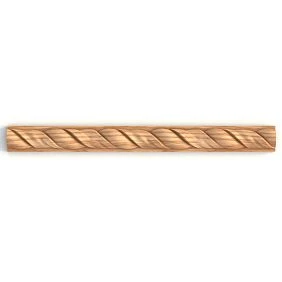
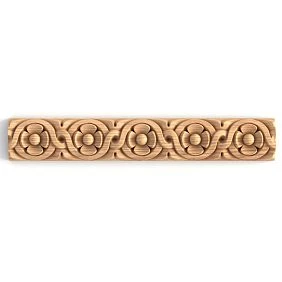
K-075 — carved wooden molding with braid ornament. The strips are 2000 mm long and are offered in four cross-sections. As the profile increases, the number of products that can be packed in one rigid frame according to the published standard decreases.
| Cross-section K-075 | Length | Published packing standard | Boundary pair of quantities | Preliminary logic |
|---|---|---|---|---|
| 14 × 8 mm | 2000 мм | up to 100 pcs. | 100 and 101 pcs. | 100 — one frame; 101 may require a second |
| 18 × 10 mm | 2000 мм | up to 60 pcs. | 60 and 61 pcs. | 60 — one frame; 61 may require a second |
| 22 × 13 mm | 2000 мм | Up to 35 pcs. | 35 and 36 pcs. | 35 — one frame; 36 may require a second |
| 30 × 17 mm | 2000 мм | up to 20 pcs. | 20 and 21 pcs. | 20 — one frame; 21 may require a second |
The table does not indicate that the smaller profile is cheaper to ship in any quantity, and the larger one is always more expensive. It only shows the published configuration limit. The result depends on the number of slats, the number of frames, the route, the transport company, and other items in the request.
Our factory also produces:
Material and quality cannot be left "by default"
K-075 is available in beech and oak. For ordering, you also choose the sanding quality "Standard" or "Prestige". Surface preparation and the quality of re-gluing must match the future finish: opaque enamel or a transparent system where the wood texture is visible.
If the invoice only states "K-075, 21 pcs.", the specification is incomplete. Two products with the same article number but from different wood species or with different preparation cannot be considered one agreed batch for a visible frame.
Get Consultation
A length of 2000 mm does not mean selling by the meter
Molding looks like linear material, but K-075 is ordered as fixed-length slats. The buyer first calculates the total length of the decor, then converts it to a whole number of two-meter products and adds a justified allowance.
Quantity formula:
Q = rounding up (Ltotal ÷ 2000) + R,
where Q is the number of slats, Ltotal is the total length of all segments in millimeters, R is the allowance in whole slats or the result of a cutting plan.
The allowance cannot be assigned only as a percentage. Five percent of twenty slats gives one slat, but five percent of three gives 0.15 slats, which cannot be purchased as a separate product unit. For long-length decor, it is more accurate to create a cutting plan.
Preliminary formula for the number of packaging frames
When the number of planks and the standard for the selected cross-section are known, the packaging can be estimated:
K = rounding up (Q ÷ N),
where K is the preliminary number of frames, Q is the quantity of K-075, N is the published standard for one frame.
For twenty-one planks of 30 × 17 mm:
K = rounding up (21 ÷ 20) = 2.
For forty planks of the same cross-section:
K = rounding up (40 ÷ 20) = 2.
For forty-one:
K = rounding up (41 ÷ 20) = 3.
The formula is useful for budgeting, but it does not replace confirmation of the configuration. It does not know whether different cross-sections, wood species, and finishes can be combined in one frame; it does not account for protective pads, other long-length products, and internal warehouse rules.
Preliminary packaging cost
If the price of one frame in the current card is P, then:
Cpack = K × P.
At P = 390 rubles:
| Quantity K-075 30 × 17 mm | Preliminary frames | Preliminary packaging cost |
| 1–20 pcs. | 1 | 390 rub. |
| 21–40 pcs. | 2 | 780 RUB |
| 41–60 pcs. | 3 | 1170 RUB |
| 61–80 pcs. | 4 | 1560 RUB |
This table is used for planning only. Before payment, check the current cost of the frame, the number of transport spaces, and the possibility of joint configuration in the issued invoice.
Why four sections have different norms
Profile 14 × 8 mm takes up less space than 30 × 17 mm. Therefore, more thin strips fit within one published norm. The explanation should stop here: without manufacturer data, one cannot describe the internal layout, number of rows, thickness of spacers, or frame construction.
The difference in norms helps the buyer see the connection between cross-section and logistics:
-
compact profile 14 × 8 mm — up to 100 pcs.;
-
18 × 10 mm — up to 60 pcs.;
-
22 × 13 mm — up to 35 pcs.;
-
the largest in the line 30 × 17 mm — up to 20 pcs.
The cross-section is chosen not for a convenient packaging boundary, but according to the scale of the decor. You cannot replace 30 × 17 mm with 22 × 13 mm just to fit thirty-five items into one standard. A different profile will change the width, relief, shadow, and proportions of the frame.
The total cost of the order is broader than the price of one strip
The price of the product remains important, but it only answers one question. For the budget of batch K-075, an extended formula is useful:
Ctotal = Cgoods + Cpack + Cfin + Cinstall + Cdelivery,
Where:
-
Cgoods — cost of strips of the selected cross-section, material, and quality;
-
Cpack — packaging frames;
-
Cfin — primer, enamel, oil, varnish, or another confirmed system;
-
Assembly — adhesive, fasteners, consumables, and labor;
-
Delivery — transportation to the site.
If finishing and assembly are done by the buyer themselves, these costs still exist, although they are not in the product line K-075. If the linear molding is ordered for furniture production, cutting, test cuts, marking of sets, and control of serial facades are added to the budget.
Why the cart and the invoice may differ
The cart shows the selected items. The invoice must confirm the actual configuration: quantity, material, quality, packaging, and delivery. That is why before payment it is important to compare not only the total amount, but also the structure of the lines.
Check:
-
whether the cross-section has changed;
-
whether the length of 2000 mm is specified;
-
does the quantity match;
-
whether beech or oak is selected;
-
whether "Standard" or "Prestige" is specified;
-
whether the batch preparation matches;
-
how many frames are included;
-
what is the price of each frame;
-
how many shipping units are declared;
-
is there delivery and additional services.
One extra line in the packaging may be justified by the norm. But the absence of the expected second frame should also be clarified: perhaps the warehouse offered a different combined configuration, or perhaps the packaging has not yet been accounted for.
Twenty or twenty-one: the cutting map makes the decision
The most dangerous advice is to automatically refuse the twenty-first strip to save one frame. If the spare part is needed for the project, saving on packaging can lead to a reorder, new delivery, and a difference in the wood batch.
When the twenty-first strip is justified
It is needed when the cutting map shows that twenty strips cover only the finished size without reserve. An additional item may be required for:
-
a test cut of the corner;
-
checking the pattern joint;
-
replacing a part with a cutting defect;
-
selecting a section by texture;
-
repairing damage during installation;
-
serial furniture with repeating frames;
-
preserving the batch reference;
-
future local replacement.
In such cases, the question is not phrased as "how to remove one plank," but "how much does the risk of being left without a suitable reserve cost."
When the quantity can be reduced
Reduction is justified if the updated cutting map shows sufficient remnants. For example, several short bridges can be obtained from ends that were not previously allocated. The decision is confirmed by a dimension sheet, not by the desire to go under the packaging limit.
How to compare two scenarios
| Scenario | Plus | Risk |
| Order 20 pcs. | Preliminarily one frame | No separate reserve; reorder may be more expensive |
| Order 21 pcs. | There is a spare plank from the same batch | A second frame may be required |
| Reassemble the cutting map and leave 20 pcs. | One frame is preserved without material loss | A confirmed scheme of all details is required |
| Order 21 pcs together with another zone of the object | The stock is used in the project, not just sitting idle | Need to agree on the overall configuration and wood species |
The right decision depends on the cost of a mistake. For one small frame, a reorder may be acceptable. For a hotel, restaurant, or a series of cabinets, production downtime and batch differences cost more than extra packaging.
Calculation of slats starts not with the total length, but with the list of parts
Total footage is convenient for a preliminary estimate, but it hides the length of each segment. Two schemes with the same 38 linear meters may require different quantities of two-meter slats due to leftovers.
Parts list
For each frame, record:
-
product number;
-
installation location;
-
length of the top part;
-
length of the bottom part;
-
lengths of the verticals;
-
method of joining corners;
-
allowance for trimming;
-
ornament direction;
-
usable remainder.
After that, the parts are distributed across planks of 2000 mm length. One remainder can carry over to the next frame if the length, direction, and quality of the section are suitable.
Formula for utilization coefficient
To control cutting, you can calculate:
U = Lparts ÷ (Q × 2000) × 100%,
where U is material utilization, Lparts is the sum of finished parts, Q is the number of planks.
A high percentage is not always good. If it reaches almost 100%, the production has no margin for trimming and error. A too low percentage signals that the cutting map needs revision or the remainders should be directed to other nodes.
Why you can't promise a universal margin percentage
The K-075 ornament, corner joints, and facade lengths create specific waste. For identical doors, the margin can be small; for a set of different frames, it's higher. The percentage doesn't see that a 300 mm leftover is useless for a 420 mm part, even though the total material seems sufficient.
Four K-075 profiles solve different tasks
Choose wooden molding by the meter means comparing not only ornaments but also the profile scale. In K-075, the braid pattern remains common, but the width and depth change the visual weight.
14 × 8 mm — thin line
The compact profile suits small facades, narrow panels, inner frames, and delicate accents. It takes up less free space and works more calmly next to handles. On a large cabinet, such a line can get lost, especially after painting in the background color.
18 × 10 mm — moderate profile
This version is more noticeable but doesn't turn the frame into a heavy border. It's used on medium-sized furniture doors, door panels, and small wall compositions. The published norm is up to 60 pieces per frame.
22 × 13 mm — pronounced relief
The profile creates a deeper shadow and requires more free space. It's chosen for large facades, doors, frames, and panels where a narrow braid would look weak. The borderline packaging pair is 35 and 36 pieces.
30 × 17 mm — large decorative strip
This exact option is the focus of the article. It is noticeable on long surfaces and suits large furniture, doors, and architectural frames. At a length of 2000 mm, a single plank is already a significant part of the order, and the published limit is restricted to twenty pieces.
Comparison of profiles before purchase
| Cross-section | Visual character | Typical task | What to check | Packaging limit |
| 14 × 8 mm | Thin, subtle | Small facades, inner frame | Will it be lost after painting | 100/101 pcs. |
| 18 × 10 mm | Moderate | Medium-sized doors | Is there enough space near the handle | 60/61 pcs. |
| 22 × 13 mm | Pronounced | Large facade, door | Does it overload the corners | 35/36 pcs. |
| 30 × 17 mm | Large, embossed | Cabinet, panel, large frame | Thickness, joint, gaps, and packaging | 20/21 pcs. |
The table helps narrow down the choice but does not replace a full-size fitting. Draw the profile on the facade or attach a sample: on screen, 30 mm looks different than on a real door.
Size cannot be changed after packaging approval
Sometimes a customer first selects 21 slats of 30 × 17 mm, sees a possible second frame, and tries to replace the cross-section with 22 × 13 mm. Such an adjustment changes not only the packaging standard. It needs to be recalculated:
-
the width of the decorative field;
-
depth of the relief;
-
the position of the handles;
-
indents from the edge;
-
the length of each segment;
-
corner joints;
-
the overall scale of the facade;
-
number of slats;
-
the finish and the sample.
Packaging follows the product choice, not the other way around. First, the profile and cutting layout are approved, then logistics are calculated.
Where K-075 works convincingly and how it affects the quantity
The carved profile is purchased not for storage in a frame, but for a specific composition. To correctly order 20 or 21 slats, you need to know where exactly each two-meter element is used. The same K-075 can frame a furniture panel, run along a door, form a wall frame, or connect several facades. But the cutting map for these tasks will be different.
Wardrobe: repeatability matters more than random savings
On a large wardrobe, there are usually several identical doors. Even a small difference in frame width or wood grain pattern repeats many times and becomes noticeable. Before you look at wardrobe decor ideas with wooden baguette, it is useful to make a table for each door.
Suppose the wardrobe has six doors, and each requires four pieces. If the verticals are long, one plank may yield only one such segment and a short remainder. Simply dividing the total length by 2000 mm will give too optimistic a result. Here, the twenty-first plank often becomes not 'extra' but a technological reserve for the entire series.
For the wardrobe, check:
-
whether all doors have the same dimensions;
-
whether the ornament direction matches;
-
whether leftovers can be used for horizontals;
-
where hinges and handles are located;
-
is fitting of frames on site needed;
-
will all strips be painted at the same time;
-
is there a reserve for one full leaf or only for one part.
If the reserve covers only one short segment, it will not save in case of damage to a long vertical. Therefore, the reserve is assessed by the critical part, not by the sum of millimeters.
Door: two-meter length may be less than the height of the panel
When designing door K-075, it should be compared with the actual height of the decorative frame. If the vertical is longer than 2000 mm, it cannot be obtained from one strip without a joint. Either change the contour, or design a connection, or choose another solution. Ideas for door decor with carved molding help to see the overall composition, but specific dimensions are still taken from the panel.
The door list takes into account:
-
four sides of the frame;
-
corner trimming;
-
pattern symmetry;
-
lock and handle;
-
the hinge side;
-
gaps to the edge;
-
opening direction;
-
possibility of painting before hanging.
If there are several identical doors on the site, ordering in one batch reduces the risk of differences in material and preparation. In this case, refusing the twenty-first plank for the sake of packaging can destroy the reserve for several panels at once.
Dresser and nightstand: short parts give useful leftovers
Small facades allow more efficient use of the two-meter length. From one plank, you can sometimes get several horizontals or verticals if their lengths and the direction of the ornament match. Before ordering, it is worth looking at decor ideas for dressers and nightstands and then building your own cutting map based on the actual facades.
Short parts have another problem: a large number of corners. Each cut requires precision, and an error in one joint can render two segments unusable at once. Therefore, a high material utilization rate does not always mean a sufficient margin.
Wall panel and boiserie: the quantity grows faster than the number of frames
On wall K-075, dozens of rectangular fields can be formed. Here, not only the total number of slats matters, but also the repeatability of sizes. If the frames are identical, cutting can be optimized in series. If widths vary from wall to wall, remnants are distributed more complexly.
For boiserie, each plane is recorded separately:
-
wall width;
-
position of doors and sockets;
-
the height of the baseboard;
-
top line of the composition;
-
width of each field;
-
lengths of all verticals;
-
corner transitions;
-
places where the profile is interrupted.
In a large project, one spare plank may be too small a reserve. Then the packaging boundary is considered together with the entire batch: it may be more rational to order not 21, but 22–24 items, if this covers the actual repair need and still fits within the preliminary two frames.
After moving to the second frame, the reserve can be recalculated anew
When the twenty-first plank already takes the order beyond the norm of one frame, it is useful to look at the range of 21–40 pcs. Preliminarily, it belongs to two frames. This does not mean that you should mindlessly add another nineteen items, but it opens up the possibility of building a justified reserve or combining several project zones.
The logic of a range, not a single point
If the project needs 21 items, the packaging part is preliminarily the same as for 22, 25, or 40 planks of the same cross-section — two frames. The product cost, weight, and delivery increase accordingly, so additional planks are not free. But it is at this stage that you can check:
-
whether a neighboring door has been forgotten;
-
whether a profile for a second cabinet is needed;
-
whether a repair reserve is required;
-
whether it is possible to finish the plinth and baguette with the same wood species;
-
whether it is advantageous to complete the entire batch with one finish;
-
Will there be a repeat order in a month?
The right goal is not to "fill the frame to the limit," but to avoid expensive repeat logistics when there is an obvious future need.
Example of a combined order
The main cabinet requires 21 slats of 30 × 17 mm. In the adjacent office, a frame of four segments with a total length of 5.8 m is planned. The cutting map shows 3 more slats. The total batch is 24 pieces. Preliminarily, this is still two frames.
Such an order may be more rational than the "21 now + 3 later" scheme, because the material and preparation are aligned in one batch. But the decision needs to be confirmed in terms of timing, budget, storage, and actual configuration.
Why you cannot automatically mix cross-sections in one frame
The buyer may have 18 slats of 30 × 17 mm and 5 slats of 22 × 13 mm. Arithmetically, it seems that the free space in the norm allows combining everything into one package. However, the published norms apply to each cross-section separately and do not describe mixed stacking.
Different profiles differ in:
-
width;
-
depth;
-
contact area;
-
resistance to lateral load;
-
requirements for gaskets;
-
marking;
-
place in the order.
Therefore, mixed configuration is coordinated with the warehouse. The article should not promise that the free "two positions" from the norm of 20 can be filled with any other molding.
Beech and oak in one package
Wood species can be found in one project, but mixing them in the frame also requires confirmation. For production, something else is more important: each visible composition must have an agreed material. If the facade is finished with oak under a transparent tint, a random beech insert will differ in texture even with a similar color.
"Standard" and "Prestige" in one request
Two qualities of sanding cannot be recorded in one line. They differ in the degree of surface preparation. If part of K-075 is ordered in "Standard" and part in "Prestige", the painter and installer must understand why the batches are different and where each is used.
For a single frame, it is better to choose one quality. Mixing can manifest after painting: areas with different roughness reflect light differently and require a different amount of preparation.
Beech under enamel: when texture should not control composition
Beech is convenient for covering finishes when a uniform color of furniture, door, or wall is required. But the phrase "under enamel" does not mean a ready-painted plank. It is a characteristic of wood preparation and re-gluing that needs to be agreed upon in the order.
What to check before painting
-
whether all 21 items are prepared equally;
-
whether there is a mix of batches "under enamel" and "under tinting";
-
whether the quality "Standard" or "Prestige" is selected;
-
whether a test painting will be performed;
-
how the ends will be treated after cutting;
-
who is responsible for priming;
-
when parts are marked according to frames;
-
How the relief is protected during drying and transportation.
Unpainted K-075 gives the freedom to match the project's color. At the same time, the buyer gets the responsibility to assemble a complete paint system. One enamel code does not describe the primer, gloss level, or application method.
Why the braid pattern requires careful application
The relief creates recesses and protrusions. A too-thick layer can soften the pattern, while insufficient application will leave unpainted areas in the grooves. A test piece shows how many layers preserve the expressiveness of the ornament.
For a large batch, it is reasonable order samples of wooden decor to check the color, gloss, and relief before finishing all twenty-one slats. The sample does not replace the specific K-075 if it is not in the set, but it helps compare the wood species and finishing system.
Oak for tinting: the batch matters more than an individual slat
Oak is chosen when the natural texture needs to be preserved. In a transparent finish, each lamella remains visible. Therefore, ordering in one batch is especially important: a slat added later may differ in pattern and base tone.
Wood differences are not a printing defect
Natural oak does not repeat a single pattern. The task of the project is to distribute the differences meaningfully. Before cutting, the slats are laid out, numbered, and assigned to specific facades. Calmer areas can be directed to small frames, expressive ones to central zones.
The reserve for oak has additional value
The twenty-first plank may be needed not only due to a cutting error. It allows selection by texture and preserves material from the same batch for repairs. In a transparent system, reordering after a year is harder to coordinate visually than an additional element kept with the object.
Preparation "for tinting"
For an open texture, corresponding re-gluing and surface quality must be confirmed. You cannot order a version for enamel and then expect a calm pattern under transparent oil. to choose beech for enamel or oak for tinting understanding the differences in material and sanding levels helps, but the final record must appear in the invoice.
"Standard" or "Prestige": the difference is not visible in the line name
"Standard" includes machine preparation and allows a larger volume of subsequent finishing. "Prestige" is supplemented with detailed manual sanding of hard-to-reach areas. For a carved braid, this is significant: grooves and transitions are harder to process after cutting and assembly.
| Criterion | "Standard" | «Prestige» |
| Preparation | Machine sanding | Machine and detailed manual sanding |
| Painter's work | More finishing may be required | Less preparatory treatment before coating |
| Serial batch | Suitable with well-established in-house preparation | Convenient when uniformity of complex relief is important |
| Transparent finish | Requires careful surface control | Helps better reveal the relief, but does not eliminate checking |
| Impact on packaging | The rate is taken by cross-section, and mixing of qualities is coordinated | The same rule |
Quality selection cannot be made solely by price. For a workshop with a professional sanding line, "Standard" may be a working option. For a finished interior project where manual finishing on site is undesirable, "Prestige" reduces the risk of uneven surface.
What to order together with K-075
A baguette profile without a mounting and finishing system remains a semi-finished product. The buyer needs to determine in advance what to cut with, how to assemble corners, what to fix with, what coating to apply, and how to close the junctions.
| What to add | Why | For which scenario | What to check |
| Materials for installation and finishing | Glue, brushes, oil, and other consumables | Furniture, doors, panels | Compatibility with the base and the chosen finish |
| PLT-001-075 | Connect the baguette and the baseboard with a common classic line | Walls, boiserie, study | The species, size, availability, and separate packaging |
| Samples | Check the beech, oak, and finish | Transparent tinting or a complex color | Correspondence to the actual product |
| Drawings and catalogs | Clarify the cross-section and prepare the project | Serial furniture and doors | Relevance of documentation |
| Design project | Lay out frames and joints | Complex wall or many facades | Final dimensions and number of fields |
| Delivery | Confirm transport locations | Any remote order | Frames, route, acceptance |
В in the section of materials for installing wooden baguette Adhesives and finishing materials are presented. The specific composition is assigned after checking the substrate, coating, and installation conditions. The presence of the product near K-075 does not prove universal compatibility.
Related baseboard
When K-075 is used on wall frames, it can be paired with wooden baseboard PLT-001-075. The accompanying product is chosen not only by pattern: height, thickness, wood species, finish, corner joints, and specific packaging conditions are compared.
Drawing before ordering a batch
For a production project, it is useful to download current catalogs and drawings. The specification must rely on the confirmed cross-section, not on a photo of the product at screen scale.
Installation materials cannot be considered part of the frame
The packaging frame protects long products during transportation. It is not a mounting frame and is not part of the interior structure. After acceptance, its function ends, and the installation of K-075 is performed using a separate technology.
This distinction needs to be stated because the word "frame" is used in two senses:
-
a rigid packaging frame for transportation;
-
a decorative or furniture frame assembled from moldings.
In the invoice, they should not be mixed. One relates to logistics, the other to the final product.
How to choose glue without random advice
Glue is selected according to the chain "plank — finish — base — operating conditions". For K-075, different bases are possible: solid wood, MDF, plywood, painted surface, plaster. A single adhesive name cannot be recommended for all.
Before purchasing, clarify:
-
what surface is on the back side of K-075;
-
whether the plank will be painted before installation;
-
whether the base absorbs the compound;
-
Is instant fixation required?
-
Can micro-pins or other mechanical retention be used?
-
Will the seam be visible?
-
Is dismantling possible?
-
What temperature and humidity are expected.
Recommendations for installing carved moldings Useful as a general basis, but the working technology is approved for a specific object.
Packaging and delivery are two different calculations
The cost of the frame is not equal to the cost of transportation. The frame forms a protected space, and the transport company calculates delivery according to its own parameters: dimensions, weight, direction, and tariff.
What to request before payment
-
number of frames;
-
external dimensions of each item;
-
total weight, if available in the documents;
-
city of departure;
-
method of handover to the carrier;
-
terminal or address delivery;
-
insurance;
-
inspection requirements upon receipt;
-
shipping deadlines;
-
separate delivery cost.
On the page payment and delivery you can check the current pickup options. The final rate is better requested for a specific invoice, because 21 slats and 2 frames are no longer an abstract parcel.
Why two frames are not always twice as expensive to deliver
Transport tariffs may depend on volume, weight, and minimum cost per item. Therefore, doubling the number of frames does not guarantee an exact doubling of shipping costs. Calculations should be based on the carrier's commercial offer or the seller's estimate.
Why one frame does not always mean one delivery line
The order may contain other long-length items, separate boxes with hardware, and materials that cannot be packed together. The number of product items, frames, and shipping units are different indicators.
Acceptance of K-075 begins before opening the frame
When the cargo arrives, first inspect the packaging. Signs of impact, moisture, deformation, or tampering are recorded before disassembling the frame. Then, the number of units is checked against the documents.
What to check after opening
-
SKU K-075;
-
cross-section of each group;
-
length 2000 mm;
-
quantity;
-
material;
-
sanding quality;
-
preparation for coating;
-
relief integrity;
-
end condition;
-
absence of fractures and deep dents;
-
marking of different positions.
For 21 planks, it is convenient to lay out products by numbers. If one part is set aside as a reserve, it should not be immediately cut into small fragments: it retains value as a full-size replacement.
Quantity check
Count the products themselves, not the visible layers in the frame. In mixed deliveries, groups are checked separately. If some planks are covered by spacers, unpacking is done carefully without damaging the ornament.
Storage before cutting
Two-meter molding cannot be leaned against a wall in a damp room and forgotten until installation. Wood is stored in stable conditions, protected from water, heating devices, direct sunlight, and construction dust.
The batch must remain marked. If beech and oak, "Standard" and "Prestige," or different cross-sections arrive simultaneously, they are physically separated. A mixed-up plank is discovered too late—after painting or installation.
Before work, the material is adapted to room conditions according to an agreed technology. One universal conditioning period cannot be promised without data on packaging, temperature, and humidity.
An experienced frame is cheaper than reworking twenty-one planks
Before launching the entire batch, it is useful to assemble one test frame. It shows what is not visible in the table:
Change control: who has the right to add the twenty-first plank
The quantity often changes in correspondence. The designer added a frame, the furniture maker increased the allowance, the purchaser saw the packaging boundary and removed the margin. Without a change log, the final invoice no longer matches the project.
For each adjustment, record:
-
previous quantity;
-
new quantity;
-
reason;
-
who approved;
-
how the cutting map changed;
-
how the packaging changed;
-
whether delivery needs to be updated;
-
which version of the invoice is valid.
The phrase "remove one to make twenty" is especially dangerous. If it was said by a person who has not seen the cutting map, the decision cannot be made automatically.
Mixed order: K-075, plinth, and installation materials
Comprehensive finishing may include K-075, PLT-001-075, glue, oil, and brushes. It is convenient for the buyer to receive everything in one shipment, but the packaging requirements for the items differ.
Two-meter linear products are protected by a rigid frame. The plinth may have its own packaging standard. Cans and tubes must be transported so as not to damage the wood or leak onto the surface.
Before combining, clarify:
-
how many frames;
-
how many boxes;
-
whether related materials can be placed inside the long-length package;
-
whether the risk of damage will increase;
-
how are positions marked;
-
how is mixed cargo accepted.
You cannot independently deduct the space for a skirting board from the K-075 standard. The published “up to 20 pcs.” refers to a specific profile, not to any set of long-length products.
What to check in the product card immediately before payment
The article helps to understand the logic, but commercial data changes. Before confirming the order, open the card and re-check:
-
available cross-sections;
-
length;
-
selected material;
-
sanding quality;
-
preparation for coating;
-
the current price of the strip;
-
availability;
-
the published cost of the frame;
-
the standard for your cross-section;
-
related products;
-
quick order conditions;
-
delivery information.
If the card and a previously saved calculation differ, the current invoice takes priority. A screenshot of the old page does not replace the seller's confirmation.
How to read the invoice for 21 K-075
The invoice must allow answering five questions without guessing.
What is being purchased
The line should make it clear that it refers to K-075, not a neighboring article. The cross-section and length must match the project.
How much is being purchased
Quantity is 21 pcs, if the cutting map has not changed. Check the unit of measurement: pieces, not linear meters.
What it is made of
Beech or oak. For a mixed order, each wood type is listed as a separate line.
In what quality
"Standard" or "Prestige", as well as agreed preparation. The wording must be unambiguous for production.
How it is packaged
Number of rigid frames, cost of each, and total amount. If the second frame is not specified, ask a question before payment. If more than two are specified, ask to explain the configuration.
Example of a complete request to the manager
Carved molding K-075 is required.
Cross-section: 30 × 17 mm.
Length of one strip: 2000 mm.
Quantity: 21 pcs.
Material: beech.
Sanding quality: "Prestige".
Preparation: under enamel.
Purpose: frames on cabinet facades.
Batch: all items of one agreed configuration.
Please confirm:
-
current price of one strip;
-
availability of the entire batch;
-
production time for the missing quantity;
-
number of rigid packaging frames;
-
cost of each frame;
-
total packaging cost;
-
number of transport seats;
-
ability to add installation materials;
-
cost and delivery time;
-
procedure for inspecting cargo upon receipt.
This request is better than the phrase "send 21 braids." It captures all parameters affecting production and the invoice.
How not to confuse K-075 with similar products
K-075 is a decorative carved molding. It does not replace a structural batten, door frame, baseboard, or finished frame.
| Similar name | What is the difference | Why confusion is dangerous |
| Wooden picture frame molding | A broad category with many profiles | You can order a different pattern or cross-section |
| Molding | May have a different profile and purpose | The relief and joint will change |
| Baseboard | Covers the junction of wall and floor/ceiling | Different geometry and installation |
| Rail | Can be smooth and structural | No K-075 pattern |
| Ready-made frame | Assembled product | K-075 is supplied in planks for cutting |
| Packaging frame | Transport protection | Does not remain part of the decor |
В in the catalog of carved wooden baguettes compare the article number, profile, and size, not just the word "baguette."
Who is K-075 30 × 17 mm suitable for
The large cross-section is suitable for a buyer who:
-
decorates large facades or doors;
-
wants a noticeable braid relief;
-
has enough free space;
-
is ready to build a cutting map;
-
takes into account the 17 mm thickness near the hardware;
-
plans for beech or oak finishing;
-
accepts the need for a packaging frame;
-
orders a batch, not random pieces.
When it's better to choose a different cross-section
30 × 17 mm may not be suitable if:
-
facade too narrow;
-
the handle is close to the frame;
-
a barely visible line is required;
-
the thickness interferes with opening the adjacent door;
-
the profile overlaps the panel;
-
The proportions of the room require thinner decor;
-
The cutting layout produces unjustifiably large waste.
Then they compare 22 × 13, 18 × 10, or 14 × 8 mm. The decision is made based on the mockup, and the packaging is recalculated for the chosen option.
When K-075 is not needed at all
Sometimes the task is formulated incorrectly. If a deformation gap at the floor needs to be covered, a baseboard is required. If the body needs reinforcement, a structural part is used. If the client wants a ready-made frame without cutting, a assembled product or design service should be considered.
K-075 is chosen for its carved linear ornament. It decorates the surface but should not bear any load for which it is not intended.
Five purchase scenarios and different answers to the question about the 21st plank
Private wardrobe in the bedroom
The calculation yielded 20.3 planks. Rounding up already leads to 21. Here, the twenty-first is not a reserve but a necessary part of the finishing volume. It cannot be reduced to twenty without changing the frames.
Series of dressers
The final cut fits into 19 slats, with two more set aside as reserve. It can be checked whether one spare slat is enough. If so, 20 pieces may be more rational. The decision is confirmed by the production map.
Door and cabinet decor with a single profile
The cabinet requires 18 slats, the door 3. A total order of 21 pieces may require two frames, but separate orders would create two deliveries and a risk of batch differences. A single purchase seems more reasonable.
Restaurant with repeating panels
The project needs 39 slats and one spare. 40 pieces preliminarily fit into two frames. Forgoing the reserve does not change the packaging, so saving one slat for logistics is pointless.
Restoration reserve
The site requires exactly 20 pieces, but the client wants one full-size part for the future. A second frame may seem expensive. They compare the cost of storage and re-delivery with the risk that a future batch will differ.
Mistakes that make the bill unexpected
Mistake 1. Multiplying only the price of the slat
The packaging frame and delivery remain outside the calculation. The budget turns out to be incomplete.
Error 2. Not noticing the word "up to"
"Up to 20 pcs." is the upper published norm, not a promise that any quantity will be packed the same way.
Error 3. Declaring two frames as guaranteed
The formula provides a preliminary estimate. The final result is confirmed by counting.
Error 4. Removing margin for the sake of one frame
Without a cutting map, this solution increases the risk of reordering.
Error 5. Counting linear meters instead of pieces
K-075 has a fixed length of 2000 mm. Orders are placed in whole slats.
Error 6. Mixing cross-sections in one line
14 × 8 and 30 × 17 mm are different items with different norms.
Error 7. Not specifying the breed
Beech and oak cannot be selected after receiving the batch.
Error 8. Not specifying the sanding quality
"Standard" and "Prestige" require different amounts of preparation.
Error 9. Mistaking "under enamel" for finished paint
The plank requires a finish coat if it is not ordered separately.
Error 10. Not checking transport units
Frames, boxes, and cans may travel separately.
Error 11. Starting cutting before acceptance
After cutting, it is harder to prove transport damage or misgrading.
Error 12. Ordering a second batch later without a sample
Natural wood may vary in tone and grain.
Error 13. Using the packaging frame as a mounting frame
This is transport protection, not part of furniture or a wall.
Error 14. Not updating the invoice after changing the quantity
Switching from 20 to 21 pcs should trigger a re-check of packaging and delivery.
Error 15. Not keeping the spare full-length
A spare plank, immediately cut into random pieces, loses its value for repairing a long part.
Purchasing route without returning to forgotten lines
-
Determine the application location of K-075.
-
Select the cross-section based on a full-size fitting.
-
Compile a list of all parts.
-
Create a cutting map from 2000 mm strips.
-
Determine a justified reserve.
-
Obtain the final quantity.
-
Compare it with the norm of the selected cross-section.
-
Preliminarily calculate the frames with rounding up.
-
choose beech or oak
-
Choose "Standard" or "Prestige".
-
Record the preparation for coating.
-
Add installation and finishing materials.
-
Request an invoice with a separate line for packaging.
-
Check the delivery and the number of seats.
-
Pay only after all parameters are agreed upon.
-
Accept the cargo before cutting.
-
Assemble the sample frame.
-
Start serial production.
If the composition is complex, you can order a design project for the layout of the wooden baguette. The designer is given the dimensions of the facades, the selected profile, restrictions on handles, and the overall finish.
Boundary quantities for all profiles: where the preliminary calculation changes
The topic of the twentieth and twenty-first slats relates to the 30 × 17 mm profile, but the same principle applies to other versions. It is useful to see all the boundaries in advance, especially if several K-075 profiles are used in the project.
| Cross-section | One frame pre-assembled | First transition | Two frames pre-assembled | Second transition |
| 14 × 8 mm | 1–100 pcs. | 101 pcs. | 101–200 pcs. | 201 pcs. |
| 18 × 10 mm | 1–60 pcs. | 61 pcs. | 61–120 pcs. | 121 pcs. |
| 22 × 13 mm | 1–35 pcs. | 36 pcs. | 36–70 pcs. | 71 pcs. |
| 30 × 17 mm | 1–20 pcs. | 21 pcs. | 21–40 pcs. | 41 pcs. |
The table is constructed mathematically based on published standards. It is intended for a preliminary estimate, not for independently assigning warehouse packaging. The invoice may show a different configuration if the order is mixed or additional product protection requirements apply.
Why the boundary matters more than the average quantity
For a buyer who needs 17 strips, the packaging standard has almost no effect on the choice of stock: up to twenty, there are three positions left. But when the need is exactly 20 pcs., any project adjustment moves the order across the boundary. Therefore, boundary quantities require re-verification before payment.
If the designer adds another frame, the purchaser must not simply change the number from 20 to 21. It is necessary to re-check:
-
cutting map;
-
product cost;
-
packaging frames;
-
delivery;
-
production timelines;
-
storage location;
-
acceptance of two transport units.
A borderline order cannot be approved verbally.
The quantity at the edge of the norm is recorded in writing. The phrase "we'll take twenty, and then we'll see" is not suitable for production: after cutting, it quickly becomes clear that the missing long element cannot be assembled from short remnants.
Three purchasing strategies for a project with 20–21 slats
There is no single answer for all buyers. It is useful to compare three models and choose the one that matches the risk of the object.
Strategy 1. Exactly 20 pieces without a separate reserve
It is suitable when the cutting map is verified, the parts are short, the remnants are usable, and a repeat order does not cause critical downtime. The advantage is one frame in advance. The disadvantage is the lack of a full-size spare plank.
Before approval, you need to answer the question: what is the longest part and is there a remnant capable of replacing it? If not, the reserve is effectively absent.
Strategy 2. 21 pieces with a full reserve
The buyer keeps one two-meter plank from the same batch. It is suitable for replacing a long vertical, re-cutting, and future repairs. The cost of the strategy is the product value of the additional K-075 and a possible second frame.
This approach is especially convincing for oak under a transparent finish, serial facades, a remote site, and a tight installation schedule.
Strategy 3. Reassemble the project and order more deliberately
If a second frame is already needed in advance, you can combine decor from several rooms or order a real repair kit. This is not about filling the package with unnecessary items, but about synchronizing future work.
For example, instead of 21 planks for a cabinet, 26 are ordered: five are allocated to a door that will be made in a month anyway. Both areas get the same wood species, the same quality, and a common finishing system.
| Strategy | Quantity | Pre-packaging | Who it suits |
| Without reserve | 20 pcs. | 1 frame | Simple cutting map, available reorder |
| One full reserve | 21 pcs. | 2 frames | Facade series, oak, remote object |
| Combined project | 22–40 pcs. | 2 frames | Multiple zones with one K-075 |
How to account for packaging in the estimate so it doesn't look like a random surcharge
In a construction or furniture estimate, it is better to list packaging as a separate line item. Then the client sees that the 390 rubles relate not to additional processing of the plank, but to rigid transport protection.
Example structure:
-
K-075 30 × 17 × 2000 mm — 21 pcs.;
-
material — beech;
-
quality — "Prestige";
-
preparation — for enamel;
-
packaging frame — quantity per confirmed invoice;
-
delivery — separate calculation;
-
installation materials — separate items;
-
finishing — according to the selected system.
Why you cannot distribute packaging across the price of each plank and forget about it
For internal calculation, the frame cost can be divided by the number of items. But in a commercial invoice, it is better to keep a separate line: when moving from 20 to 21 slats, the unit share of packaging changes abruptly. A separate line makes the calculation transparent.
Unit packaging cost as an analytical indicator
With one frame for 390 rubles and twenty slats:
390 ÷ 20 = 19.5 rubles per slat.
With two frames and twenty-one slats:
780 ÷ 21 ≈ 37.14 rubles per slat.
This is not a new product price, but a way to see the impact of a boundary quantity. With forty slats in two frames, the unit indicator is again equal to 19.5 rubles. Therefore, the packaging load is maximum immediately after crossing the boundary and gradually decreases within the next range.
The indicator cannot be used as a basis for buying unnecessary items. It serves to compare scenarios and explain to the customer why the total increased disproportionately to one slat.
What to do if the quantity changes again after payment
The project may change after the invoice has been issued: a facade was added, a door was removed, frame sizes were adjusted. In this case, the old packaging calculation is no longer reliable.
The quantity increased from 20 to 21
You need to request a new invoice and confirm:
-
presence of an additional bar;
-
belonging to the same batch;
-
second frame;
-
change in delivery;
-
new shipping date.
You cannot simply pay the difference for one K-075 without updating logistics.
The quantity decreased from 21 to 20
Check whether the second frame has been removed from the invoice and whether the transport units have changed. Then make sure the cutting map has actually been recalculated, not just formally reduced.
The cross-section has changed
When switching, for example, from 30 × 17 to 22 × 13 mm, everything is recalculated: quantity, packaging standard, offsets, cutting, finishing, and appearance. This is a new order variant, not a cosmetic edit of a line.
The material has changed
Replacing beech with oak affects the product cost, visual result, and finishing. The number of frames may remain the same, but the invoice and production order are still updated.
Check before final clicking "pay"
Perform a final check based on the principle of four matches.
The project matches the specification. All frames and lengths are accounted for.
The specification matches the cart. The article, cross-section, material, and quantity are the same.
The cart matches the invoice. There is no accidental substitution of quality or wood species.
The invoice matches the logistics. Frames, transport units, and delivery are specified.
If at least one match is missing, it is better to postpone payment until the document is corrected. Such a pause is cheaper than receiving twenty-one strips of the correct article number, but with the wrong cross-section or without accounting for packaging.
FAQ: questions about K-075, the twentieth and twenty-first strips
How many K-075 30 × 17 mm fit according to the published standard?
The card indicates up to 20 pcs. in one rigid packaging frame. The final configuration is confirmed in the invoice.
Do exactly two frames are needed for 21 strips?
According to the preliminary formula, two. But this cannot be unconditionally promised: the warehouse must confirm the number of packages and the possibility of joint configuration.
Why is the frame priced separately?
It is used for safe transportation of two-meter carved molding and is added to the product part of the order.
What is the published cost of the frame?
In the current card at the time of preparing the material, it is 390 rubles. Before payment, check the current value in the invoice.
Can I refuse the frame?
Packaging conditions are determined by the seller, taking into account safe shipping. The possibility of changes must be agreed upon before payment.
Can 21 slats be packed more tightly into one frame?
The article cannot promise a deviation from the published standard. This issue is decided by the STAVROS warehouse.
Can several thin slats be added to 18 large slats?
Mixed packaging of different cross-sections is not separately described. It must be confirmed in a specific invoice.
How many frames are preliminarily needed for 36 slats of 22 × 13 mm?
The standard is up to 35 pcs., so the preliminary calculation gives two frames.
How many frames are needed for 61 slats of 18 × 10 mm?
With a standard of up to 60 pcs., two frames will be preliminarily required.
And for 101 slats 14 × 8 mm?
For quantities up to 100 pieces, the preliminary estimate is also equal to two frames.
Is delivery included in the price of the packaging frame?
There is no reason to consider it included. Packaging and transportation are checked as separate line items.
Can K-075 be ordered by the meter?
The card offers slats 2000 mm long. The quantity is calculated in whole items.
How to calculate the quantity for frames?
Make a list of all segments, distribute them across two-meter slats, and add a reserve confirmed by the cutting map.
Is a spare slat needed?
It depends on the complexity of the cuts, the number of identical facades, the material, and the cost of reordering. There is no universal percentage.
Which is more profitable: 20 or 21 pcs.?
Profitability is determined not only by packaging. Compare the need for reserve, the risk of re-delivery, and the cost of downtime.
Can I order 40 pcs. in two frames?
According to the standard of 20 pcs., the preliminary calculation gives two frames. The final configuration will be confirmed by the invoice.
If 41 items are needed, how many frames should be counted?
Preliminarily three: rounding up from 41 ÷ 20.
Is beech or oak better for K-075?
Beech is convenient for covering enamel, oak — for projects with an open texture. The choice depends on the finish and adjacent parts.
What to choose: "Standard" or "Prestige"?
"Standard" is suitable when the workshop is ready to perform additional finishing. "Prestige" includes detailed manual sanding of complex relief.
Will K-075 arrive already painted?
The finish should not be considered included without a separate line. Preparation for enamel or tinting is not equal to a finished coating.
Can I paint after installation?
Only according to an agreed technology. The relief, corners, and adjacent surfaces complicate application, so a test sample is often made first.
What to do if one plank is damaged during delivery?
Secure the packaging and defect before cutting, keep the documents, and contact the seller according to the current acceptance procedure.
Can I order one more plank later?
Technically, the order depends on current availability and conditions. For beech and especially oak, batch differences are possible, so it is better to plan a reserve in advance.
Where can I check the price and availability?
Open the product card and check the price of K-075 immediately before issuing the invoice.
How to order K-075 with delivery?
Provide the full specification, confirm the packaging units, and then place the order wooden baguette with delivery in a suitable manner.
The twenty-first K-075 should appear in the invoice deliberately — STAVROS's decision starts with a full specification
For K-075 30 × 17 mm, the standard is up to 20 slats in one rigid packaging frame. Therefore, the transition from twenty to twenty-one pieces can indeed change the packaging part of the order: preliminarily, instead of one frame, you get two, and the calculation at the stated cost of 390 rubles changes from 390 to 780 rubles. But this is not the final amount and not an unconditional promise of two units — the actual configuration is confirmed by the invoice.
The main decision is made earlier. First, choose the cross-section, compile a parts list, lay out the segments across slats 2000 mm long, and determine whether the twenty-first K-075 is needed as finishing material or reserve. Then fix either beech or oak, "Standard" or "Prestige", preparation for coating, installation materials, and delivery. Only after that compare the cost of one and two frames.
At STAVROS, you can order K-075, choose another wooden baguette, add PLT-001-075, materials for installation and finishing, samples, and delivery. A complete order should contain not just one line "21 slats", but a clear specification: article number, cross-section 30 × 17 mm, length 2000 mm, quantity, wood species, quality, preparation, number of frames and transport units. Then the twenty-first slat will not be an unexpected surcharge — it will be a deliberate part of the project and budget.