Article Contents:
- Wooden crucifix IKN-023: what is confirmed by the product card
- What one product item means
- Why "made to order" does not mean arbitrary custom design
- How to determine the central position
- How much free space to leave
- One center instead of a gallery
- When a smooth insert is better than solid slats
- Oak
- Oak
- The material of the panels does not determine the material of the crucifix
- When to choose "Standard"
- When to choose "Prestige"
- For enamel
- For tinting
- Three schemes for combining with panels
- On a solid field
- On a smooth insert
- Next to slatted panels
- Why you cannot attach only to the slats
- Can you use only glue
- What to do if the panels are already installed
- Commercial request to the manager
- Project timeline
- How to preserve hierarchy
- IKN-023 on a central smooth insert
- IKN-023 on a solid slat wall
- IKN-023 on a smooth wall next to panels
- Base
- Electrical
- Shelf or lower furniture
- What to include in the specification
- Finishing to match the wall tone
- Tinting near wooden slats
- Considering the crucifix as a regular wall plate
- Fixing the position without a template
- Ignoring the 45 mm thickness
- Choosing the wood species based on the panel name
- Taking 'under enamel' as a finished coating
- Considering 'Prestige' as a finished finish
- Buy fasteners in advance
- Hang the product only on decorative rails
- Make too active lighting
- Surround the crucifix with random decor
- Allocate only 5–10 days in the schedule
- Do not verify the commercial proposal
- 1. What is the size of IKN‑023?
- 2. What material is the crucifix made of?
- 3. What to choose for enamel — beech or oak?
- 4. What is better for tinting?
- 5. What does "under enamel" mean?
- 6. What does "under tinting" mean?
- 7. How does "Standard" differ from "Prestige"?
- 8. Is the suspension included in the set?
- 9. How much does IKN-023 weigh?
- 10. Can a crucifix be glued to the wall?
- 11. Can IKN-023 be mounted directly to wooden slats?
- 12. What to do if the panels are already installed?
- 13. Is a smooth insert needed behind the crucifix?
- 14. At what height should the IKN-023 be placed?
- 15. What gap should be left around the crucifix?
- 16. Can backlighting be installed?
- 17. Can candles be used near a wooden crucifix?
- 18. How long does manufacturing take?
- 19. Why is there no fixed price in the article?
- 20. What should be specified in the calculation request?
- 21. Can a product of a different size be ordered?
- 22. Is the IKN-023 suitable only for home interiors?
- 23. Do I need to select additional carved elements?
- 24. How do I know if the size fits?
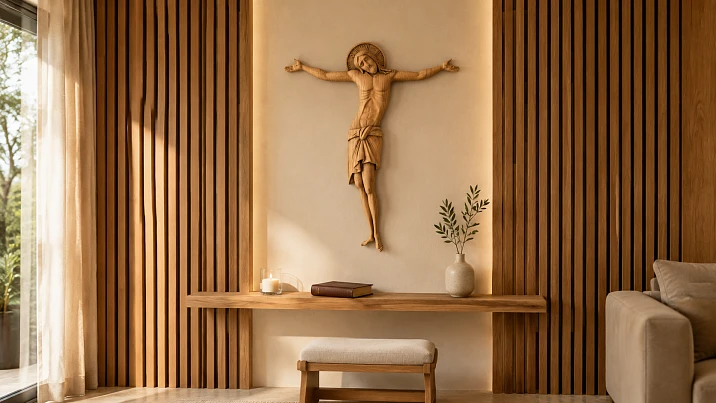
A home prayer area cannot be designed on the principle of an ordinary decorative wall. The crucifix in it is not a random interior accessory or a way to fill an empty space between slats. It is the semantic center around which a calm, respectful, and convenient part of the room for prayer is organized. Slat panels can form a background, separate the area from the rest of the space, and emphasize the vertical direction, but they should not compete with the image or turn it into one of many elements of the composition.
The specific model IKN-023 allows a transition from general considerations to purchase. The manufacturer specifies dimensions of 420 × 500 × 45 mm, two materials — beech and oak, two levels of sanding, and preparation options for enamel or tinting. These characteristics alone are enough to check the wall scale, choose the finishing principle, and prepare a reliable base before placing an order. However, the card does not state the weight, the type of standard mounting, or the calculated load on the fastener. Therefore, it is impossible to pre-assign dowels, hooks, glue, or recommend hanging the product directly on decorative slats.
The correct sequence is simple: determine the central place for the crucifix, check the size in full scale, choose the wood and future finish, coordinate the lighting, find out the actual mounting method, and only then fix the configuration in the order. This approach protects both the product and the wall, and most importantly, preserves the dignity of the prayer area.
Wooden crucifix IKN-023: what is confirmed by the product card
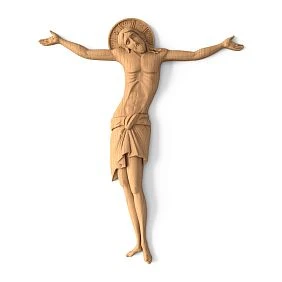
IKN-023 is presented in the catalog as a wooden crucifix with an iconographic relief of the Crucifixion of Christ. The size is indicated by three values: 420 × 500 × 45 mm. Beech and oak are offered for manufacturing. The buyer can choose between the sanding quality "Standard" and "Prestige", as well as between a blank for enamel and for tinting. The product is made to order; the card indicates an average time of 5–10 days.
| Parameter | Confirmed data | What to do before payment |
|---|---|---|
| Model | Crucifix IKN-023 | Specify the article number along with the product name |
| Image | Iconographic relief of the Crucifixion of Christ | Examine photographs and the drawing, without replacing the assessment of the physical sample |
| Size | 420 × 500 × 45 mm | Check the markings A, B, and C according to the drawing and make a full-size template |
| Material | Beech or oak | Choose the wood species considering the future finish |
| Sanding | "Standard" or "Prestige" | Clarify the differences in preparation and the scope of work before the final coating |
| Workpiece | For enamel or tinting | Do not confuse the prepared blank with a fully finished product |
| Availability | Custom Order | Get current confirmation for the selected configuration |
| Production | On average 5–10 days | Agree on the actual timeframe and add time for finishing and delivery |
| Installation | Weight and standard suspension are not specified in the card | Request this data before preparing the base and fasteners |
Prices for different versions change, so in a long-lived article it is safer not to fix a specific amount. Commercial calculation should relate to the selected combination: wood species, grinding quality, preparation type, quantity, and city of receipt. A saved figure from an old card does not guarantee the current price.
After checking the size and version, you can buy the wooden crucifix IKN‑023 directly in the model card. An exact link is especially important in a category where different crosses, crucifixes, icons, and carved elements are presented: the article number excludes substitution with a similar product.




What one product item means
The buyer orders a specific carved product IKN‑023, not a ready-made prayer area or a set with wall panels, lighting, shelf, and mounting. The completeness must be confirmed separately. It is not allowed to assume from a photo that the price includes suspension, anchors, decorative frame, finishing, or installation.
Such clarification is not a formality. If the wall is already sheathed with slats, the mounting method affects the possibility of safe installation. If the blank is purchased for tinting, color approval, test painting, coating application, and drying appear in the schedule. If the product is sent to another city, packaging, transportation, and acceptance are added.
Our factory also produces:
Why "to order" does not mean arbitrary individual design
IKN-023 is a catalog model. Production to order means manufacturing the selected version, not an automatic ability to change the iconography, proportions, size, or relief in a single piece. Any deviation from the card requires separate approval. If the manager has not confirmed the change in writing, standard parameters are assumed.
Get Consultation
Wall crucifix 420 × 500 × 45 mm in a prayer area with slatted panels
Size cannot be assessed by numbers alone. On a narrow wall section, 420 × 500 mm may be perceived as large, while on a tall slatted field, it may seem restrained. The relationship of the item to the visible width of the panels, room height, distance to the person, and the number of neighboring objects is important.
The first step is to make a paper or cardboard template according to the confirmed dimensions. It is placed on the wall without damaging the finish and viewed from several points: from the entrance, from the prayer spot, from another part of the room, and under evening lighting. The template does not show the carving but effectively reveals the scale, height, and free margins.
The 45 mm thickness is also important. This is a relief volume, not a flat image. Side light will create shadows, the item will be noticeable in profile, and the protrusion of the slatted panels will affect the abutment. If the cross is placed on a smooth insert within the slatted field, it is necessary to compare the depth of the insert with the depth of the surrounding relief. The item should not visually "sink" between the slats or accidentally touch their protruding edges.
How to determine the central position
The center of the prayer area does not always coincide with the geometric center of the entire wall. On one side, there may be a door, window, switch, or furniture. Therefore, first determine the actual compositional area, then center the crucifix within it. If the area is bounded by slats, a smooth insert, or a low shelf, these boundaries should be obvious.
The height is chosen not by a universal number from the floor. Consider the person's position during prayer, viewing distance, the presence of a lectern, shelf, or cabinet, the height of neighboring icons, and the overall geometry of the room. If the family has an established religious tradition for placing images, it takes priority over an abstract design rule. When in doubt, it is appropriate to seek advice from the clergy of one's denomination or parish.
How much free space to leave
IKN-023 must be read as a whole. If slats, a shelf, a sconce, or other images come almost flush, the contour of the crucifix loses clarity. Free space acts as a pause: it separates the main image from the architectural background and helps focus attention.
There is no single indentation. It is determined by a full-scale mockup. An active, contrasting slat wall will require more visual breathing room than a calm, monochromatic surface. If the panels have a large pitch and deep shadows, the border around the piece can be formed with a smooth plane. If the slats are painted in a soft, close tone, the crucifix can be placed directly against their background—but only on a prepared base and with technically approved installation.
Why the crucifix should be the main element, not part of a decorative set
Slat panels themselves create a strong rhythm. Adding several carved overlays, an ornamental baguette, an active cornice, and multiple backlights can turn a prayer area into a showcase of finishing techniques. For a prayer space, such competition is especially undesirable.
The prominence of IKN-023 is not necessarily achieved by large size. It is created through hierarchy: the crucifix occupies a clear central position, a calm background is maintained around it, light highlights the image without theatricality, and additional items remain subordinate. A shelf, lectern, or small cabinet can be functional but should not draw attention with intricate carving or contrasting color.
It is important to use the word "decor" correctly. IKN-023 is in the catalog of church carved decor, but in a home prayer area, the crucifix has religious significance. Considering it only as a wall decoration would be wrong. The interior part of the article addresses scale, material, background, and installation, but does not replace the spiritual meaning of the piece.
One center instead of a gallery
If the task is formulated as "one crucifix—the main wall element," you should not automatically surround it with a random collection of images after purchase. Additional icons or religious items are placed thoughtfully, with respect for family tradition. Their number and relative position are not determined by furniture symmetry.
From an interior perspective, one center simplifies working with slat panels. The verticals of the wall form a background, and the transverse structure of the crucifix creates a clear contrast. Several equally large items would destroy this clarity and require a different composition.
When a smooth insert is better than continuous slats
A smooth insert within a slat field is useful in three cases. First, it provides a visual pause around a complex relief. Second, it allows for a level and durable base to be prepared in advance. Third, it simplifies final finishing and possible wall maintenance.
But the insert should not look like a random rectangle barely exceeding the product's dimensions. Its proportions are checked against the wall layout. The edge of the insert is aligned with the slat spacing, baseboard, ceiling, and furniture. If the area is already finished without the insert, panels cannot be cut or the base changed without assessing the entire mounting system.
Carved crucifix in beech or oak: what options are available for ordering
Beech and oak are not just two price options. They reveal carving differently and respond to the finishing concept in different ways. With opaque enamel, the natural grain is hardly the main factor, but the evenness of preparation and readability of the relief matter. With tinting, the wood texture becomes part of the image, and the difference between species is more noticeable.
Beech
Beech has a relatively calm, uniform structure. It is logical to consider it for an enamel option, when the color should tie the crucifix to a light wall, painted panels, or other wooden details. An opaque coating shifts the focus to the iconographic relief, light, and shadow.
This does not mean that beech is automatically supplied painted. The phrase "under enamel" describes the preparation of the blank for future opaque finishing. Who performs the finish, what materials are used, and whether painting is included in a specific order must be clarified before payment.
Beech can also be considered for agreed tinting, if the available configuration is confirmed by the product card or manager. However, the result is evaluated on a sample. The tone on screen does not show how the coating will reveal the structure of the specific wood or how it will look in deep areas of the carving.
Oak
Oak is chosen when expressive texture and a more noticeable presence of natural wood matter. Under tinting, the relief gains additional depth: protrusions and recesses perceive light differently, and the natural grain adds complexity to the surface.
Next to oak slat panels, full matching should not be promised. Even the same species can differ in cut, grade, batch, and finish. If the goal is a unified wood field, real samples are needed. If the goal is to highlight the crucifix, the tone is deliberately made lighter or darker than the background.
Oak under enamel is also possible only in a confirmed configuration, but with opaque finishing, its pronounced texture ceases to be the main argument. The choice of species may then depend on the technical specification, availability, and agreed cost, rather than a photo of oak grain.
The panel material does not determine the crucifix material
An oak slat wall does not obligate ordering IKN-023 in oak. Painted panels do not force choosing beech. Materials are linked by composition but retain different functions. Sometimes a beech crucifix under calm enamel reads better against a wooden background. Sometimes oak under tinting creates a cohesive natural ensemble. Both solutions require sample verification.
If the wall finish is still being chosen, a suitable system can be viewed in the section buy slat panels for walls for interior finishing. First, determine the wall's structure and color, then match them with IKN-023; panels should not be selected solely by the wood species name in the crucifix card.
"Standard" or "Prestige": how sanding quality affects the order
The card offers two sanding qualities. They cannot be reduced to a "cheaper or more expensive" formula. Sanding is related to how detailed the carved surface is prepared and how much subsequent work will be required before coating. On an iconographic relief, recesses, transitions, and small areas are especially important, where rough self-refinement could alter the shape.
Before choosing, request an official description of the options and clarify who will perform the finish. If the crucifix is handed to a professional finishing workshop, it must assess the blank's condition and coating technology. If the buyer plans to work independently, experience should be honestly evaluated: complex relief requires care, and sanding or material application errors are difficult to correct.
When to choose "Standard"
This option may be suitable if subsequent professional preparation is already included in a separate technological process. For example, the item arrives at a workshop where specialists perform inspection, priming, interlayer treatment, and finishing according to an approved system. Then the initial quality is considered together with the entire finishing estimate.
It cannot be automatically claimed that "Standard" is ready for immediate enamel or tinting without additional assessment. The level name does not replace inspection. Before ordering, it is useful to obtain close-up surface photos and manufacturer recommendations.
When to choose "Prestige"
"Prestige" is considered when more detailed surface preparation is important and the risk of rough manual refinement of complex relief needs to be reduced. But even this option does not equal a ready finish coating. The blank is still checked, dusted, and finished using appropriate technology.
This choice is especially justified if a transparent or semi-transparent coating will leave the wood structure and surface quality visible. Under enamel, minor defects can also appear with side lighting, so saving on preparation without evaluating the result is unwise.
Wooden religious decor for enamel and tinting
The type of preparation is determined before ordering, not after delivery. The blank for enamel is designed for opaque coating, while the blank for tinting is for finishing where the natural structure remains significant. These options cannot be considered fully interchangeable.
Under Enamel
Enamel allows the crucifix to be connected to the room's architecture through color. A light option on dark panels creates a clear contrast. Dark, calm enamel on a light wall makes the silhouette cohesive. A coating in a close tone creates a monochrome where the relief is revealed through shadows.
For a sacred item, one should not choose a color just because it is fashionable in the current interior. It is better to assess the longevity of the solution, the respectfulness of the image, and compatibility with other religious items in the family. If traditional artistic finishing is required, it should be coordinated with a specialist who understands the material and the purpose of the item.
Enamel does not mean "necessarily white." But the possibility of a specific color, the painting service, and the price cannot be promised without confirmation. The card indicates the preparation of the blank, not any ready-made shade.
Under Tinting
Tinting preserves the presence of wood. On oak, it highlights the grain and creates a richer depth. On beech, the result will be calmer, but it also depends on the composition and technology. A test stain is mandatory if the crucifix must match panels, a shelf, or furniture.
The test is performed on a sample of the same wood species with comparable preparation. Applying the composition to a random board is insufficient: density, grain direction, and sanding change the result. The comparison is carried out in both daylight and evening lighting.
Three schemes for combining with panels
| Diagram | IKN‑023 | Slat wall | Effect |
| Contrasting | Lighter or darker than the background | Calm panels | The Crucifixion reads immediately as the center |
| Related | Close wood temperature | Panels with natural texture | Solid, restrained composition |
| Monochrome | Enamel in a close color | Painted slats | Relief and chiaroscuro play the main role |
The contrasting scheme is simpler in hierarchy but requires restraint in other details. The related one looks natural, yet is especially sensitive to mismatched samples. The monochrome can be very calm, but with flat frontal lighting, the relief will lose expressiveness.
How to position IKN-023 on a slat background
There are three main options: on a solid slat field, on a smooth insert within the panels, and on a smooth area next to the slat zone. Each is acceptable only if the supremacy of the crucifix is maintained and the base is safe.
On a solid field
The slats create a vertical structure behind the entire piece. This enhances height and can visually support the central axis. The risk is an overly active background, especially with contrasting slats and dark gaps. A paper template helps check whether the relief lines fragment the image.
The technical issue is resolved before panel installation: where the load-bearing anchor is located, how the load will be transferred, and whether access to the mounting is possible. Decorative slats do not become a reliable base simply because they are made of wood.
On a smooth insert
The insert separates the image from the rhythm and simplifies base preparation. It can be painted to match the panels or contrast with them. The insert size should provide a free field, and its borders should align with the overall modular logic of the wall.
A too-narrow insert looks like a technical patch. A too-wide one turns the slats into random side strips. The solution is checked on a scale layout and with a template in the room.
Next to slat panels
If IKN-023 is placed on a smooth wall next to vertical cladding, the panels can mark the boundary of the prayer area on the side. It is important that their edge does not cross the crucifix or divide the composition in half. It is usually calmer when the main element is entirely on one plane, and the slat zone serves as architectural accompaniment.
In this variant, the difference in finishes is especially noticeable. An oak crucifix on a smooth light wall can be supported by oak slats on the side. An enameled piece is tied to the wall, and panels add natural texture. Materials do not have to match literally.
Lighting the prayer area without a theatrical effect
Light should help see the relief and use the area, not turn the crucifix into a display object. A too narrow bright beam creates sharp shadows and can be distracting. Uniform frontal light, on the contrary, makes the carving look flat. Usually, a combination of soft general lighting and moderate side or top accent is useful.
Before installing the light fixture, check how shadows fall on the face and figure of the relief. The angle of light is evaluated on a physical sample or a quality mockup. At a depth of 45 mm, even a slight shift of the fixture changes perception.
If a wall sconce is planned, its mounting and wiring are coordinated with the base behind the panels. You cannot first close the wall and then look for a place for the cable near the main element. The light fixture should not cover the crucifix, create glare on the coating, or visually compete with it through a complex shape.
The use of candles and oil lamps involves open flame, heat, and soot. Distances and protection are determined by fire safety rules and the characteristics of specific items. Flame cannot be placed close to a wooden relief, finish coating, curtains, or panels. If safe placement is impossible, a different type of lighting is used.
Mounting a wooden crucifix next to decorative slats: what to clarify before payment
Card IKN‑023 does not specify the weight, standard suspension, or allowable load of the mounting. Therefore, the article cannot assign specific fasteners. The right solution starts with requesting data from the manufacturer and inspecting the wall by a specialist.
Before ordering, answers to the following questions are needed:
-
What is the actual weight of the selected version?
-
Are there standard points or suspension elements?
-
Is the suspension included in the kit?
-
What requirements apply to the base?
-
Does the manufacturer allow the chosen installation method?
-
Where do hidden utilities run behind the panels?
-
Is a mounting plate provided at the required point?
-
Can the product be serviced or removed without damaging the wall?
-
Who is responsible for installation and acceptance of the mounting?
Why you cannot attach only to the slats
Slat panels may be a decorative cladding installed with adhesive, a backing, or their own system. Their ability to support additional load should not be assumed. The mounting must transfer the weight to a base designed for that purpose.
Even if the lamella seems sturdy, its fixation, direction of force, and condition of the backing are unknown. "By-eye" installation creates a risk of the product falling and damaging the wall. A proper mounting plate is provided by the design, or a solution is developed after inspecting the finished structure.
Can I use only glue
Without manufacturer data and base calculation, such advice cannot be given. Adhesion depends on materials, contact area, wall covering, humidity, preparation, and load. In addition, a glued product is difficult to remove for maintenance or repair. A specific system is chosen by a qualified installer after receiving IKN-023 specifications.
What to do if panels are already installed
First, their construction is determined: base type, location of studs or embedded parts, layer thickness, and routing of utilities. If documentation is unavailable, the wall is inspected in a safe manner. Sometimes it is more rational to place the crucifix on an adjacent smooth section than to damage the finished finish or create an unreliable fastening.
Do not drill the wall until the final position is confirmed. An error is especially noticeable on a rhythmic slat surface: a shifted hole is difficult to hide, and reinstallation will disrupt symmetry.
Buying IKN-023 crucifix: what parameters to specify in the order
The order must be precise enough for the seller to confirm one specific configuration. Phrases like "medium-sized wooden crucifix" or "as in the photo" are insufficient.
| Order item | What to specify |
| Name and article number | Crucifix IKN-023 |
| Size | 420 × 500 × 45 mm |
| Quantity | Usually 1 piece for the described scenario |
| Material | Beech or oak |
| Sanding | "Standard" or "Prestige" |
| Preparation | For enamel or tinting |
| Finish | Who performs the final finishing and under what system |
| Receiving | City, delivery or pickup |
| Lead time | Current confirmation for the selected configuration |
| Installation data | Weight, hanging, base requirements and completeness |
First, the material and preparation are chosen, then the price is obtained. You cannot multiply the minimum cost of a category by the quantity and consider the estimate ready. Different sanding and wood options cost differently, and finishing and delivery may be calculated separately.
Commercial request to the manager
A useful wording looks like this: "Please calculate one crucifix IKN-023 measuring 420 × 500 × 45 mm, material — oak, sanding quality — "Prestige", preparation — for tinting, delivery to the specified city. Please confirm the current price, lead time, completeness, weight, availability of hanging and base requirements."
Such a request eliminates most discrepancies. If the material or preparation changes, the calculation is obtained anew. The lead time of one configuration cannot be automatically transferred to another.
Project schedule
The average production time is extended by the time for approval, payment, delivery, acceptance, and finishing, if it is done separately. Installation is scheduled only after the wall is ready and the coating is fully dry. If the prayer area must be completed by a certain date, a reserve is planned.
Preparation of the base, electrical work, and panels can be done in advance, but only after receiving installation data. Otherwise, the embedded part will end up in the wrong place or will not match the actual suspension system.
When the size 420 × 500 mm will be appropriate
IKN‑023 is suitable for a home area where a noticeable but not architecturally huge central element is required. It can work above a small shelf, on a smooth insert in a slatted field, or on a separate wall next to panels. Appropriateness is determined not by the room area itself, but by the size of the specific compositional area.
The model is worth considering if:
-
the pattern is clearly readable from the place of prayer;
-
there is enough free space around it;
-
the relief of the panels does not break up the iconographic image;
-
the base allows safe installation of the product;
-
beech or oak are compatible with the chosen finish;
-
one central element matches the family's intention.
A different size or model is better chosen if IKN‑023 gets lost on a very high wide wall, does not fit between furniture and ceiling, covers a switch, requires dangerous intervention into finished panels, or does not match the family's religious tradition. An inappropriate scale cannot be compensated with additional frames and decor: this will complicate the area but will not fix the original proportion.
Church utensils and carved decor: what to choose additionally
If besides the crucifix other religious items are needed, the section buy church utensils helps navigate to the category. The exact anchor here leads not to a random general catalog, but to a selection of church items and carved elements.
Additional items are chosen only after the center is approved. A shelf, icon case, icon, or architectural detail should not appear just because there is free space on the wall. Each item must have a clear function and a respectful position. Questions of religious appropriateness are best resolved according to family tradition and the advice of a spiritual mentor, not by interior fashion.
For carpentry and architectural details, the section is available Buy carved wood decor. It is used if the project truly requires coordinated wooden elements: for example, a calm profile, shelf, or another carved detail. The catalog should not be turned into a list of mandatory additions to IKN‑023.
How to maintain hierarchy
The additional item should be smaller in visual weight or located off the central axis. Contrast, lighting, and carving complexity also affect weight. A small bright gilded detail can compete with a large calm crucifix more strongly than a large plain shelf.
Before purchasing, it is useful to make a collage or a full-scale layout. First, only IKN‑023 is shown. Then necessary items are added one by one. As soon as the main image stops dominating, the composition is simplified.
Three practical schemes for a home prayer area
The size of IKN-023 remains unchanged, but the result depends on the architecture of the space. For the project, it is useful to consider not just one beautiful image, but several schemes and choose the one that addresses the real constraints of the room. None of them is a universal religious norm: these are options for organizing the wall, and questions of tradition are decided separately by the family.
IKN-023 on a central smooth insert
Slat panels are placed on the sides, while the center remains a flat surface with a prepared base. This scheme gives the crucifix the most calm background. The verticals support the central axis but do not run directly behind the iconographic relief. Lighting is easier to adjust because shadows from the slats do not mix with shadows from the carving.
The width of the insert is determined by a template. You cannot simply add the same small margin to 420 mm and consider the proportion found. On a narrow, tall wall, one frame of air is needed; on a wide one, another. The insert is evaluated together with the floor, ceiling, baseboard, and any lower shelf.
The technical advantage is that the mounting plate and wiring can be placed behind the flat surface. But this only works with early design. If the insert is a thin decorative panel without a solid base, it does not solve the load issue. The drawing must specify not only the visible material but also the structure behind it.
The finish of the insert can be close to the color of the slats or contrasting. A close tone preserves the integrity of the wall, and the crucifix stands out through material and relief. A contrasting insert forms a kind of architectural field but should not look like a random frame or household backing.
IKN-023 on a solid slat wall
This option ties the product more strongly to modern finishes. It is appropriate when the slat spacing is calm, the color is not too contrasting, and mounting is planned in advance behind the cladding. The template is applied specifically to the image of the slats with the actual spacing: conventional hatching in a sketch can hide a conflict between the lines and the figure of the relief.
Special attention is paid to the axis. If the center of the crucifix falls between the slats and the edges relate to the module asymmetrically, the eye may notice a slight shift. Sometimes the product has to be moved by part of the spacing so that the background looks balanced. This decision is checked on the layout, not corrected during drilling.
Solid cladding requires coordinated access to the base. The panel installer must know the exact location of IKN‑023 before starting work. He does not choose fasteners for a religious item arbitrarily, but can prepare the structure as per the assignment after receiving the weight and suspension scheme.
If the relief of the slats protrudes deeply, the side view needs to be checked. A crucifix with a thickness of 45 mm may be positioned in front of the plane of the lamellas, partially recessed between them, or resting on a spacer platform — any option requires a technical solution. The item must not be left in contact only with individual protruding edges.
IKN‑023 on a smooth wall next to panels
This scheme is convenient when the slat finishing is already completed and interfering with it is undesirable. The crucifix is placed on an adjacent sturdy section, and the slats mark the boundary of the zone. The main task is to avoid a visual gap. The distance from IKN‑023 to the edge of the panels should look deliberate and maintain a free field.
If the smooth section is narrow, not only the 420 mm dimension but also the side margins are checked. A crucifix that formally fits with a few centimeters on the edges may look cramped. In this case, it is better to change the wall composition or choose a different model than to try to hide the tightness with an additional frame.
The transition between the smooth and slatted surfaces can be supported with color. For example, a tinted oak crucifix connects with the wooden slats while remaining on the light wall. A version under enamel may match the smooth plane, and the relief will stand out through shadows. Samples will show which connection is more convincing.
What to coordinate before installing slat panels
The most expensive mistake occurs when the wall finishing is already completed and the crucifix data starts being collected after it. The designer knows only the size of the front part, but not the weight and suspension; the panel installer closes the base; the electrician runs the cable off-center; then the buyer is forced to choose between damaging the new wall and a compromise position for IKN‑023.
To avoid this, a separate prayer zone specification is created. It does not require complex documentation, but clear levels of responsibility must be present.
| Participant | What he should receive | What result is required |
| Customer | Card and confirmed configuration IKN‑023 | Approved material, sanding, and preparation |
| Designer | Drawing, template, finish samples | Position, free spaces, and lighting scheme |
| Panel installer | Installation point and base requirements | Embedded part or access to a solid wall without accidental support on slats |
| Electrician | Position of the crucifix and lights | Safe cable exits outside the mounting area |
| Finisher | Wood species, preparation option, test stain | Approved technology and color sample |
| Product installer | Weight, suspension, wall construction | Suitable mounting system and safe installation |
Substrate
The drawing shows the base wall material, leveling layers, frame or panel backing, location of the embedded part, and thickness of the decorative coating. The phrase "concrete wall" is insufficient if there are several layers of unknown thickness between the concrete and the cross. Fasteners are selected based on the entire system.
The embedded part cannot be specified only by the size 420 × 500 mm. Real suspension points are needed. If the manufacturer provides them after order placement, the finishing installation is planned to preserve the ability to adjust. If the wall is already being closed without this information, the project takes unjustified risk.
Electrical
Cables must not pass where the base will be drilled. The layout records routes, exits, and distribution points. If built-in lighting is used, access to the driver and maintenance must be provided. Equipment cannot be walled up without the possibility of replacement.
The switch is placed conveniently, but not within the visual field of the cross. Its position is checked not only on the plan, but also on the front elevation. A small technical element next to the central image can disrupt the composition more than it seems.
Shelf or lower furniture
If a shelf is planned under IKN-023, it must not accidentally open
Photos of hidden work with dimensions are useful after the wall is closed. They do not replace the project, but help the installer understand where the embedded part is and where the utilities run.
Technical specification for finishing IKN-023
The words "paint to match the wall" or "make like oak panels" are insufficient. Carved relief reacts to coating differently than a flat slat. Material accumulates in recesses, too thick a layer softens details, and uneven tinting enhances contrast where it was not intended.
The technical specification should describe the desired result, but not impose an unverified technology. The contractor selects a compatible material system and makes a sample.
What to include in the specification
-
exact article number and wood species;
-
sanding quality;
-
preparation for enamel or tinting;
-
color reference or approved sample;
-
desired degree of texture preservation;
-
preferred degree of gloss;
-
lighting conditions in the room;
-
need to treat visible side surfaces;
-
requirements for the back side in the hanging area;
-
packaging method after finishing;
-
time for complete drying before transportation and installation.
It is wiser to do a test on a separate sample of similar wood. Experimenting directly on the front part of the crucifix is risky. A small swatch on a flat board shows the color, but does not fully show the behavior of the composition in the carving; therefore, the craftsman must take into account the geometry of the relief.
Finishing to match the wall
If IKN‑023 is stained close to the slat panels, the match is evaluated under the same light. Different materials and primers can give a different surface even with the same color code. The goal should not always be a laboratory match: a slight difference in lightness sometimes helps the relief to read.
Monochrome requires particularly precise lighting. Too uniform light will dissolve the form, too side-on will give heavy shadows. Before final installation, the position of the luminaire is checked on the finished coating.
Tinting next to wooden slats
They compare not the names of shades, but samples. "Walnut," "oak," "honey," or "wenge" from different manufacturers denote different colors. On IKN-023, the tone may appear darker in recesses than on a flat panel. If the difference is part of the design intent, it is approved deliberately.
There is no need to apply many decorative effects just to emphasize the carving. Patina, gilding, or contrasting detailing belong to a separate artistic decision and require professional approval, especially considering the religious purpose of the product.
Acceptance of the product after manufacturing and delivery
Upon receiving IKN-023, they check not only the absence of damage but also compliance with the ordered configuration. The procedure depends on the contract and carrier rules, so acceptance conditions are read in advance. Do not postpone inspection until the packaging is discarded and the product is handed over to the finisher.
First, photograph the outer packaging from all sides. Traces of impact, compression, or wetting are recorded before opening. Then carefully open the cargo in good lighting, without touching the front relief with a sharp tool.
Check:
-
Does the article number IKN-023 match.
-
Do the declared dimensions and quantity correspond.
-
Is the selected wood species indicated in the documents.
-
Do the "Standard" or "Prestige" and the preparation type match?
-
Are there any cracks, chips, or damage to protruding parts?
-
Is the overall plane deformed?
-
What is the condition of the back side and the mounting area?
-
Are the agreed hangers or documents included, if they should be part of the set?
-
Is the packaging required for damage claims preserved?
Natural wood may vary in grain and shade. This is not a reason to ignore obvious defects, but it is also not a basis to expect identical texture in every lamella. Under a transparent finish, the character of a specific blank is assessed especially carefully before applying the coating.
If a problem is found, do not sand, glue, or touch up the product yourself before contacting the seller. First, take photos and follow the agreed procedure. Unauthorized modifications can hinder an objective assessment.
After acceptance, the crucifix is stored and handed over to the finisher in accordance with the manufacturer's recommendations. Do not leave the wooden blank near a strong heat source, in a damp area, or where it could be hit by construction tools. Specific storage conditions should be clarified with the seller, and installation is carried out after dusty and wet processes are completed.
Who is IKN‑023 suitable for, and who needs a different model
IKN-023 is suitable for a family that consciously chooses the crucifix as the main image of the home prayer area, has a wall section for the dimensions 420 × 500 × 45 mm, and is ready to decide on the finish and mounting in advance. The model is especially logical when one expressive wooden relief is needed without many competing details.
Another option should be considered if the wall section is too narrow, the relief is lost at a distance, installation is impossible without damaging the finished structure, or the family prefers a different iconography and tradition. You should not choose IKN-023 just because its color can be matched with the slats. Religious appropriateness and a conscious attitude matter more than interior coincidence.
If the doubt concerns only the scale, compare templates of several models on one photo of the wall or directly in the room. If the doubt concerns the spiritual side, the designer should not present an aesthetic opinion as a religious recommendation. Here, consultation with a person whom the family trusts in matters of faith is appropriate.
Mistakes when ordering and installing IKN-023
Treating the crucifix as an ordinary wall overlay
This loses the meaning of the prayer area. The interior should support the religious object, not use it as a trendy pattern against the slats.
Fixing the position without a template
The size 420 × 500 mm is perceived differently on different walls. A paper mock-up reveals the mistake before drilling and installation.
Ignoring the 45 mm thickness
The relief protrudes from the plane, creates shadows, and is visible from the side. The depth is compared with the slats, insert, and lighting.
Choosing a breed by panel name
Oak does not guarantee a match with oak, and beech is not the only option under enamel. Samples and confirmed configuration are needed.
Taking "under enamel" as a finished coating
This is workpiece preparation, not a promise of a fully painted product. The finish and contractor are agreed upon separately.
Considering "Prestige" as a ready finish
This refers to the quality of sanding. Coating, tinting, enamel, and protective layer are a separate stage.
Buying fasteners in advance
Weight and standard suspension are not specified. Without this data, the mounting system cannot be correctly selected.
Hanging the product only on decorative rails
Panels are not automatically a load-bearing base. The load must be transferred to a prepared structure.
Making too active highlighting
A sharp theatrical beam and deep shadows can distort perception of the relief. The light is tested on a mockup and kept restrained.
Surrounding the crucifix with random decor
Many frames, overlays, and shelves destroy the hierarchy. One main element requires visual breathing room.
Allocating only 5–10 days in the schedule
This is the average production time, not the full project cycle. Time is needed for approval, delivery, finishing, and installation.
Not cross-checking the commercial proposal
The article number, wood species, sanding, preparation, and quantity must match the selection. Any replacement changes the calculation.
How to make a decision before payment
The purchase of IKN‑023 is justified when meaning, scale, finishing, and installation are all confirmed simultaneously. The crucifix is indeed the main element of the prayer area, the template looks good on the wall, the material is chosen based on samples, and the base is prepared according to the actual product data.
The final check consists of ten steps:
-
Approve IKN-023 as the central religious image of the zone.
-
Check the size 420 × 500 × 45 mm against the drawing.
-
Make a template and choose the position.
-
Decide whether a solid slatted background or a smooth insert is needed.
-
Choose beech or oak.
-
Choose "Standard" or "Prestige".
-
Fix the preparation for enamel or tinting.
-
Obtain data on weight, suspension, and base.
-
Agree on the current price, deadline, and delivery.
-
Verify the final statement before payment.
If the buyer needs a broader overview of sizes and types of products, one can read once, how to choose a wall crucifix. But in the project under consideration, the solution is already narrowed down to IKN‑023: the task is not to classify the entire assortment, but to properly order a specific relief for a specific wall.
It is useful to also perform a reverse check: temporarily remove all panels, lighting, and furniture from the visualization. If IKN‑023 is still chosen because of its image, size, and significance to the family, the decision is based on what matters most. Then restore the background and ensure that the architectural elements aid focus rather than turning the crucifix into a component of a trendy composition. This test separates a conscious purchase from an attempt to fill a striking wall area.
The final statement is saved in a single document. Correspondence where different messages mention beech, oak, "Standard", "Prestige", enamel, and tinting can easily lead to errors. The final line must simultaneously include the article number IKN‑023, size 420 × 500 × 45 mm, wood species, sanding quality, preparation type, quantity, city, current cost, lead time, and installation data. If even one parameter changes, the offer is re-verified.
This procedure does not complicate the purchase but makes it predictable. The manufacturer understands the required finish, the finisher gets a suitable blank, the installer works with a known load and base, and the family gets a cohesive prayer area where the central image does not conflict with the slat wall and does not depend on random technical decisions.
FAQ about the wooden crucifix IKN‑023
1. What is the size of IKN‑023?
The card specifies the size 420 × 500 × 45 mm. Before ordering, it is necessary to open the drawing and check the designations A, B, and C, and on the wall — place a full-size template.
2. What material is the crucifix made from?
Beech and oak are available. The choice is related to the future finishing and desired texture. The material of the slat panels does not automatically determine the wood species of the crucifix.
3. What should be chosen for enamel — beech or oak?
Beech is often considered for opaque painting due to its calmer structure, but the final choice depends on the available configuration and finishing technology. Oak under enamel cannot be excluded or promised without confirmation from the product card and the manager.
4. What is better for tinting?
Oak gives a more pronounced wood grain pattern, beech is calmer. But the result is determined not only by the wood species, but also by preparation, composition, application technique, and lighting. A test sample is needed.
5. What does "under enamel" mean?
This is a preparation option for an opaque coating. It does not mean that the product is already painted or that enamel of any color is included in the price.
6. What does "for tinting" mean?
This is preparation intended for finishing that preserves the visibility of the wood structure. The specific shade, protective layer, and the person performing the work are agreed upon separately.
7. How does "Standard" differ from "Prestige"?
These are grinding quality options. Before choosing, it is necessary to study the official description and assess the scope of subsequent preparation. Neither option should automatically be considered a ready-made finish coating.
8. Is the suspension included in the set?
This is not confirmed in the available specifications. The completeness, presence of mounting points, and installation recommendations should be requested from the seller before preparing the wall.
9. How much does IKN‑023 weigh?
The weight is not specified in the product card. It must be clarified for the selected material and version, since this data is needed by the installer and affects the mounting.
10. Can the crucifix be glued to the wall?
Without the weight, manufacturer requirements, and assessment of the base, adhesive mounting cannot be recommended. The system is chosen by a specialist taking into account the wall, coating, and the possibility of safe removal of the product.
11. Can IKN‑023 be mounted directly to wooden slats?
Slats cannot be considered a load-bearing base without calculating their system. The mounting must transfer the load to a solid foundation or a pre-provided embedded element.
12. What to do if the panels are already installed?
It is necessary to determine the wall structure, the location of the base, and utilities. After inspection, a specialist will determine whether installation is possible at the chosen point. Sometimes it is safer to use an adjacent smooth section.
13. Is a smooth insert needed behind the crucifix?
Not always. It is useful if the rhythm of the slats interferes with reading the relief or if a prepared base is required. The decision is made after checking the template and the wall structure.
14. At what height should the IKN-023 be placed?
There is no universal mark. The position of the person during prayer, furniture, neighboring images, and family tradition are taken into account. In case of religious doubts, it is appropriate to consult the clergy of one's denomination.
15. What gap should be left around the crucifix?
The indentation is determined by the scale of the wall and the activity of the panels. The main criterion is that the IKN-023 is read as a whole and does not visually or physically collide with the slats, shelf, or lights.
16. Can lighting be installed?
Yes, if the electrical work, mounting, and lighting scenario are designed in advance. The light should softly reveal the relief, not blind, and not create excessively harsh shadows.
17. Can candles be used near a wooden crucifix?
Open flame requires compliance with fire safety rules. Flame, heat, and soot must not affect wood, coatings, panels, curtains, or other flammable materials.
18. How long does manufacturing take?
The card indicates an average time of 5–10 days for custom production. The exact readiness of the selected configuration needs to be confirmed, and finishing and delivery should be accounted for in the schedule.
19. Why is there no fixed price in the article?
The cost depends on the material and quality of sanding and may be updated. The buyer needs the current price of a specific configuration as of the order date, not an outdated figure.
20. What should be specified in a quote request?
You need to specify IKN‑023, size, quantity, beech or oak, "Standard" or "Prestige", preparation for enamel or tinting, and the city of delivery. Additionally, request the lead time, weight, hanging method, completeness, and base requirements.
21. Can a product of a different size be ordered?
The article covers the standard model 420 × 500 × 45 mm. The possibility of changing the size pertains to a custom order and requires separate confirmation; it cannot be assumed based on the fact of custom production.
22. Is IKN-023 only suitable for home interiors?
The card describes the product as a wooden iconographic relief. Its specific suitability for a home, chapel, or other space depends on the task, scale, and religious context. This article only covers the home prayer area.
23. Do I need to select additional carved elements?
No. A single IKN-023 can be a sufficient main element. Additional items are only purchased when their function is clear and the compositional and religious hierarchy is preserved.
24. How do I know if the size is suitable?
The template should be confidently readable from the place of prayer, there should be free space around it, and the installation should not conflict with slats, furniture, or lighting. If this is not achieved, consider a different position or model.