Article Contents:
- Modern furniture leg MN-232 160×73×92 mm: what exactly the apartment hotel buys
- Beech MN-232
- Oak MN-232
- Size 160×73×92 mm
- "Prestige"
- Why MN-232 suits hotel furniture
- All money works in furniture
- No need to organize storage
- The model is sold individually
- All 80 parts are used when launching the object
- Beech under enamel is easier to reproduce later
- Damage during installation
- Chip during transportation of the cabinet
- Impact from a cleaning cart
- Damage by a guest
- Repair after several years
- Change in assortment
- Why this is convenient for the management company
- Why this is convenient for the furniture maker
- Why this is convenient for oak
- 80 pieces
- 82 pieces
- 84 pieces
- 88 pieces
- Oak
- Oak
- One SKU
- Same geometry
- One level of preparation
- Uniform finish
- Easier to label
- What one batch does NOT guarantee
- What is especially important to preserve
- Why it's convenient to tint the reserve right away
- When you can store the reserve untinted
- What may differ
- Why one batch helps
- Why one batch still doesn't make oak identical
- How to use the reserve aesthetically
- Why the word "nominally" is mandatory
- What to ask the manager
- Why the entire batch is important for the series at once
- What this means
- What needs to be coordinated
- Why the 27 warehouse units cannot simply be taken separately
- Stage 1. Readiness of the cabinet bodies
- Stage 2. Delivery of legs to the furniture maker
- Stage 3. Finishing
- Stage 4. Assembly
- Stage 5. Acceptance
- Stage 6. On-site installation
- Stage 7. Transfer of reserve
- Reserve is finished together with the main batch
- Reserve is stored prepared but not painted
- Order 80 MN-232
- Order 84 MN-232
- Surcharge for four reserve thrust pads
- Full spare kit
- Why this calculation is more useful than the price of one leg
- Beech, 80 working
- Beech, 84 with reserve
- Oak, 80 working
- Oak, 84 with reserve
- Before the facility opens
- After opening
- Why this is important
- What to do
- When this is especially important
- Why the threshold of 4 is convenient
- Alternative threshold
- What the article number gives
- What the size gives
- What the finish code gives
- What the object gives
- Why you don't need to unpack the entire reserve
- Why you can't hide it too far away
- Ready painted 4 pcs.
- Unpainted 4 pcs.
- How to choose
- But the aging of the coating still differs
- How to reduce the difference
- For beech under enamel
- For oak
- Why quantity first
- Why marking before finishing is important
- Yes, allocate immediately
- No, first sort all 84
- For oak, the second approach is especially useful
- What does this give
- Reserve 4 MN-232
- Ready-made cabinet
- Why the article is not included in the calculation of the ready-made cabinet
- Option 1. First four legs for the prototype
- What is ordered next
- Why this is better than buying 84 before the first physical sample
- When a pilot is not needed
- Final furniture height
- Indentation from the front
- Position relative to the baseboard
- FUR-021
- Stability
- Mounting assembly
- What’s next
- What matters for oak
- Operational decision
- How to prevent
- Commercial property
- Twenty identical items
- The model is planned for years
- The oak remains visible
- Object deleted
- Repair should be fast
- Own furniture production nearby
- The object is small and not critical to downtime
- There's nowhere to store a reserve
- Ready to replace all four later
- MN-232 is not part of a strict standard
- Recipient address
- Ability to accept the entire quantity
- Who signs off on the acceptance
- What to do in case of discrepancy
- Check 100% by quantity and item number
- Size
- Surface
- Geometry
- Finish
- Conclusion
- Why this is important
- Why the old order 84 cannot be kept
- Therefore, the reserve is especially beneficial with a stable design standard
- Why we do not count downtime costs
- Why the fastener code is important
- Yes
- No
- What to choose
- The 20 cabinets are indeed identical
- Design is standardized
- Repair should be fast
- The facility is designed for a long term
- The oak remains visible
- Repeat logistics is inconvenient
- Nightstands are easily repaired in our own workshop
- Beech goes under standard enamel
- The object is planning a redesign
- Storage is expensive or inconvenient
- Future replacement of the entire set of four with another compatible model is acceptable
- Error 1: Order 80 and call it "with a reserve"
- Error 2: Order 84 and write "5% is standard for hotels"
- Mistake 3. Buy 82, but operations think there is a full set
- Mistake 4. Store reserve without FUR-021
- Mistake 5. Paint 80, but leave four reserve pieces without finish code
- Mistake 6. Consider "one batch" a guarantee of identical oak
- Mistake 7. Not separating installation reserve from operational reserve
- Mistake 8. Not replenishing reserve after first replacement
- Mistake 9. Buy 84 before pilot cabinet approval
- Mistake 10. Not confirming warehouse stock with manager
- Mistake 11. Building oak order only on current 27 pcs.
- Mistake 12. Not including 5–10 day lead time in overall schedule
- Error 13. Mixing two different finishing waves without a control sample
- Error 14. Storing reserve without labeling
- Error 15. Using reserve for systematic production defects
- Error 16. Buying 10% just because "it's safer"
- Error 17. Not recalculating reserve when the number of cabinets changes
- Error 18. Assuming the future price equals today's price
- Error 19. Not checking the top mounting
- Error 20. Storing painted reserve in conditions where the coating gets damaged
- If the reserve is already on site
- If there is no reserve
- Formula for internal calculation
- Option A. Take 82 and produce 2
- Option B. Immediately order 84 as a single agreed batch, waiting for the missing ones
- Option C. Temporarily reduce the reserve to 2
- Scenario 1. Save the oak and MN-232
- Scenario 2. Save the deadline
- Scenario 3. Split the project
- Why a separate act is needed
- When it is better to store on site
- Why this is important for accounting
- Correct Sequence
- What is the size of MN-232?
- Is MN-232 suitable for a bedside table?
- Can MN-232 be used in hotel furniture?
- How many legs are needed for 20 nightstands?
- Why 84 and not 85?
- What percentage of reserve do four spares provide?
- Does this mean hotels always need 5%?
- What will it be for 10 nightstands?
- What will it be for 40 toggles?
- How much do 80 beech MN-232 cost?
- How much do 84 beech ones cost?
- How much does a beech reserve of four cost?
- How much do 80 oak ones cost?
- How much do 84 oak ones cost?
- How much does an oak reserve cost?
- How many beech MN-232 are currently shown in stock?
- Is this enough for 84?
- How many oak ones are shown in stock?
- Is 80 enough?
- Is 84 enough?
- What is the stated production time?
- What heel plate does the MN-232 card recommend?
- What size is FUR-021?
- How many FUR-021 should I buy for 80 legs?
- And for 84?
- How much do 84 FUR-021 cost?
- How much does a full beech order of 84 + 84 FUR-021 cost?
- Oak?
- Do I need to stock up on top fasteners?
- Should you paint the reserve right away?
- Why is the reserve especially useful for oak?
- Does one batch guarantee the same oak?
- Do you need to buy 88 pieces?
- When is 80 enough?
- Where can I buy legs for the nightstand?
- Where can I buy MN-232?
- How to order 84 MN-232?
- How to check the current price?
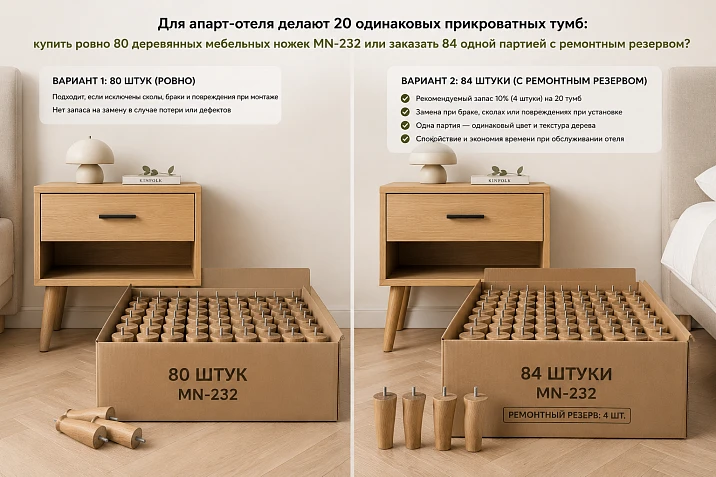
Four spare MN-232s are not "another 5% just in case." For an apartment hotel, this is one fully replaceable set of four supports for one bedside table, which costs 9,600 rubles in birch or 11,880 rubles in oak at the current price.
Working requirement:
20 nightstands × 4 legs = 80 MN-232.
If you order 80, each leg received immediately has its place. No reserve. If you order 84, four parts remain as a complete repair kit.
Mathematically, such a reserve equals:
4 / 80 × 100 = 5%.
But 5% here is not an industry standard for hotels. It is a consequence of the specific design: one nightstand uses four supports, and the customer decided to store one complete set for 20 identical items.
At the time of the check, MN-232 costs:
-
beech — 2,400 ₽;
-
oak — 2,970 ₽.
Therefore:
80 beech = 192,000 ₽;
84 beech = 201,600 ₽;
reserve surcharge — 9,600 ₽.
For oak:
80 × 2 970 = 237 600 ₽;
84 × 2 970 = 249 480 ₽;
surcharge — 11,880 ₽.
If the legs are equipped with the recommended FUR-021 and one floor protector is installed on each support, it is reasonable to calculate the reserve not only for wood. Four spare legs without four compatible floor protectors is an incomplete repair kit.
At the time of the check, the MN-232 card shows 137 beech and 27 oak legs in Saint Petersburg. Therefore, an order of 84 beech legs nominally fits within the displayed stock:
137 − 84 = 53 pcs.
For oak:
80 − 27 = 53 pcs. need to be additionally ordered;
84 − 27 = 57 pcs. need to be additionally ordered.
The card indicates an average production time of 5–10 working days for unavailable items. For a large oak batch, this is already a procurement that needs to be synchronized with the production of cabinets, finishing, and the installation schedule.
After confirming the quantity, material, and reserve, you can buy furniture legs MN-232 160×73×92 mm one specification — 80 working or 84 with a full repair kit.
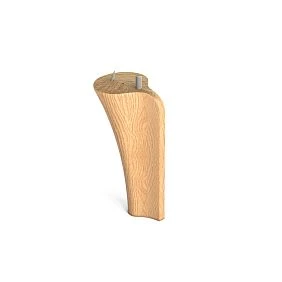
Modern furniture leg MN-232 160×73×92 mm: what exactly an apart-hotel buys
| Parameter | MN-232 |
|---|---|
| Size | 160×73×92 mm |
| Material | Beech / Oak |
| Sanding quality | «Prestige» |
| Beech | 2,400 ₽ at the time of check |
| Oak | 2,970 ₽ at the time of check |
| Displayed availability of beech | 137 pcs. |
| Displayed availability of oak | 27 pcs. |
| Recommended hardware | FUR-021 |
| Production of unavailable item | on average 5–10 working days |




Beech MN-232
Beech is rational for serial furniture under covering enamel. In a B2B project, the repeatable geometry, single article number, and the ability to run the entire batch through a unified preparation and painting system are especially valuable here.
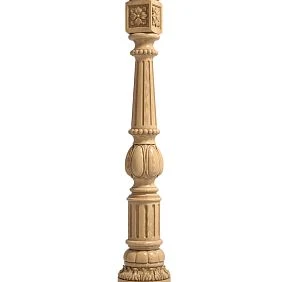
Our factory also produces:

Oak MN-232
Oak makes more sense if the wood texture remains visible. Then the repair reserve from the same purchase has additional aesthetic meaning: the spare part goes through the same design finish together with the main batch.
Even within a single delivery, the natural wood pattern is never absolutely identical. The reserve reduces the risk of noticeable discrepancy, but does not guarantee identity.
Get Consultation
Size 160×73×92 mm
For 20 identical nightstands, this size must be fixed in the design documentation. The specification must include exact A×B×C.
"Prestige"
The "Prestige" sanding quality sets a single declared level of surface preparation. During incoming inspection, the actual surface is still checked according to the scheme adopted at the production facility.
Why MN-232 suits hotel furniture
The manufacturer's card directly classifies the model as bedside tables, hotel furniture, and serial furniture projects.
Buying furniture legs for 20 cabinets: first, calculate the working requirement
If you need buy furniture legs for a series, the working quantity is calculated based on the design.
N = number of cabinets × number of supports per cabinet.
20 × 4 = 80 pcs.
This is only the working set without reserve.
Why buying exactly 80 MN-232 seems logical
The option without reserve has strong arguments.
All money works in the furniture
Every paid leg is installed in a cabinet.
No need to organize storage
Reserve wooden fittings require marking, protection, and accounting.
The model is sold individually
If necessary, replacements can be ordered separately, as long as the item remains available.
All 80 parts are used when the facility is launched
The management company does not keep expensive stock in the warehouse without an immediate function.
Beech under enamel is easier to reproduce later
If the color code, primer system, and enamel are recorded, future beech replacements are easier to match to the series than clear oak.
What is the risk of ordering exactly 80 legs
The reserve is needed not because MN-232 will necessarily break. Such a forecast would be unfounded.
It is about operational scenarios.
Damage during installation
The leg can be dropped, hit with a tool, or the finish can be ruined already at the assembly stage.
Chip during cabinet transportation
Finished furniture goes through packaging, loading, elevator, corridors, and the room.
Impact from a cleaning cart
The lower part of the furniture is in the zone of regular contact with cleaning equipment.
Damage by a guest
Commercial furniture is used more intensively than residential.
Repair after several years
Even one accidental mechanical injury raises the question: where to get the exact SKU of the same size and appearance?
Assortment change
Current availability is not a promise for years ahead.
Why one full set of four spare legs is more convenient than a random stock of 1-2 pieces
In B2B operations, the storage unit must be clear.
One spare MN-232 covers one single defect.
Two cover two single defects or half a set.
Four allow completely re-equipping one cabinet if it is easier to replace all four for aesthetic or technical reasons.
This does not mean that if one leg is damaged, four must be replaced. But having a full set provides that option.
Why this is convenient for the management company
In the warehouse, it is not a "remainder of 4 pieces," but:
a repair kit for one bedside table — MN-232, 4 pcs.
Why this is convenient for the furniture maker
If after a year the service team finds two damages on one cabinet at once, there's no need to decide whether the scattered stock is enough.
Why this is convenient for oak
If you need to replace the entire set of four, the difference between the new and old shade within one cabinet is less noticeable than one new leg next to three aged ones.
This is not a mandatory repair rule, but one of the practical scenarios.
84 MN-232 instead of 80: what is the real reserve percentage
Working quantity — 80.
Reserve — 4.
Formula:
4 / 80 × 100 = 5%.
It's important to formulate the result correctly.
You cannot write:
"For hotel furniture, a 5% reserve is needed."
Correctly:
In this project, one full four-legged repair kit equals 5% of the working requirement of 80 pcs.
Comparison of four reserve scenarios
| Order | Reserve | Share of 80 | What it covers |
|---|---|---|---|
| 80 | 0 | 0% | only the working assembly |
| 82 | 2 | 2,5% | two single replacements |
| 84 | 4 | 5% | One full set |
| 88 | 8 | 10% | two full kits |
80 pcs
Minimum investment.
Zero warehouse reserve.
82 pcs
Budget compromise.
But this is no longer a full set for one cabinet.
84 pieces
The most understandable operational unit.
88 pieces
Two full sets.
May be justified for a facility with heavy usage or remote logistics, but is not an automatic recommendation.
Price of four scenarios for beech
At a price of 2,400 ₽:
80 × 2 400 = 192 000 ₽.
82 × 2 400 = 196 800 ₽.
84 × 2 400 = 201 600 ₽.
88 × 2 400 = 211 200 ₽.
| Quantity | Cost |
|---|---|
| 80 | 192 000 ₽ |
| 82 | 196 800 ₽ |
| 84 | 201 600 ₽ |
| 88 | 211 200 ₽ |
Surcharge relative to 80:
-
82 → +4 800 ₽;
-
84 → +9 600 ₽;
-
88 → +19 200 ₽.
Price of four scenarios for oak
At a price of 2,970 ₽:
80 × 2 970 = 237 600 ₽.
82 × 2 970 = 243 540 ₽.
84 × 2 970 = 249 480 ₽.
88 × 2 970 = 261 360 ₽.
Surcharge relative to 80:
-
82 → +5 940 ₽;
-
84 → +11 880 ₽;
-
88 → +23 760 ₽.
Reserve price per one cabinet
Sometimes it's easier for a B2B customer to look not at 9,600 ₽, but at the cost of a distributed backup solution.
Beech
9,600 / 20 = 480 ₽ per one cabinet.
Oak
11,880 / 20 = 594 ₽ per one cabinet.
These amounts are not an additional detail of each cabinet. They show how much on average falls on one item if the cost of one full repair kit is distributed across the entire series.
Buying wooden furniture legs in one batch: what we actually gain
If a decision is made Buy wooden furniture legs in one series, the advantages cannot be overstated.
One SKU
The most important thing.
All working and spare parts — MN-232 160×73×92.
Same geometry
The repair part physically matches the frozen furniture project.
One level of preparation
The entire purchase is declared in "Prestige".
Unified finish
The reserve can be processed together with the main batch.
Easier to label
No need to distinguish the MN-232 reserve from dozens of similar legs in the warehouse after two years.
What one batch does NOT guarantee
-
absolute match of the oak grain pattern;
-
complete absence of natural differences;
-
identical aging with details that stood in the room for two years.
Beech MN-232 under opaque enamel: how important one batch is
For beech under enamel, the argument "one batch of wood" should be formulated carefully.
After opaque painting, the natural wood grain pattern barely participates in visual perception. Therefore, the stock from the original purchase is valuable primarily as:
-
the same article;
-
the same geometry;
-
the same surface preparation level;
-
the ability to pre-paint the reserve in the approved color;
-
finished part for quick replacement.
What is especially important to preserve
Not the phrase 'beech from one batch', but the finishing specification:
-
enamel code;
-
primer;
-
shine;
-
number of layers;
-
technological map;
-
control sample.
Why it is convenient to paint the reserve immediately
In a few years, the paint code may be known, but the old coating on the furniture will already slightly change the perception of color due to use, light, and cleaning.
A pre-painted reserve does not guarantee an absolute match with the old furniture, but it preserves the original standard of the object.
When the reserve can be stored unpainted
If the hotel has its own stable painting process and the repair is done professionally.
Then an unpainted leg remains more versatile for different rooms for longer, in case some furniture is later repainted.
Oak MN-232 for clear or tinted finishes: why the reserve of the initial purchase is more valuable
With oak, the wood grain remains part of the appearance.
What can differ
-
direction of fibers;
-
porosity;
-
saturation;
-
reaction to staining;
-
local contrast.
Why one batch helps
A furniture maker can pre-sort 84 legs and form twenty harmonious sets of four plus a reserve.
Why one batch still doesn't make oak identical
Natural wood is variable.
It is impossible to promise an identical pattern for four spare parts.
How to use the reserve aesthetically
There are two approaches.
Approach 1. The reserve is stored as four separate universal legs.
If one is damaged, it is replaced.
Approach 2. The reserve is stored as a set for one cabinet.
If the color of a new part differs too noticeably from the three old ones, the maintenance service may replace all four on one cabinet.
The second scenario is more expensive in terms of reserve consumption, but gives more control over the appearance.
Current availability of beech MN-232: can we cover 84 pieces now
The card shows 137 pcs in Saint Petersburg.
Nominal calculation:
137 − 84 = 53 pcs.
That is, the shown quantity is sufficient for both 80 workers and 4 reserve ones.
Why the word "nominally" is mandatory
The site card is not a reservation.
Until the manager confirms the available stock for a specific order, part of the quantity may:
-
be reserved;
-
be in another status;
-
change after someone else's purchase.
What to ask the manager for
Not just:
"Are there 84 pieces?"
But:
"Need 84 identical MN-232 160×73×92 mm in beech, "Prestige", for one serial project. Confirm available stock, possibility of shipment under one specification, and lead time for the entire batch."
Why the entire batch matters for a series
If the furniture maker receives 60 now and 24 in two weeks, finishing and assembly are split into two waves.
This may be fine if the project is planned that way.
But the decision must be deliberate.
Oak MN-232: why a serial order needs to be coordinated in advance
Current displayed stock is 27 pcs.
For 80 units:
80 − 27 = 53 pcs.
For 84:
84 − 27 = 57 pcs.
What does this mean
Even a basic order of 80 cannot be fulfilled from a single warehouse stock.
What needs to be agreed upon
-
how much is actually available now;
-
how much will be produced;
-
whether there will be a single readiness date;
-
whether the entire batch can be given to the furniture maker at once;
-
how to organize the finishing.
Why the 27 warehouse items cannot simply be taken separately
It's possible, but then the project is divided.
For oak, this is especially sensitive if you want to visually sort the entire series before tinting.
Production takes 5–10 working days: how to fit it into the hotel furnishing schedule
The card's timeframe is a guideline, not a promise of a specific completion date for the entire batch.
Stage 1. Readiness of the cabinet bodies
If the bodies will be ready in a month, there's no point in demanding urgent shipment of the legs to a warehouse without storage conditions.
Stage 2. Delivery of legs to the furniture maker
It's better to accept the batch before final assembly.
Stage 3. Finishing
Beech is painted, oak is tinted/lacquered according to the project.
Stage 4. Assembly
80 working legs go into 20 cabinets.
Stage 5. Acceptance
The appearance and stability of all products are checked.
Stage 6. On-site installation
Cabinets are distributed by numbers.
Stage 7. Transfer of reserve
Four spare legs must not get lost between the workshop and the maintenance service.
How to include reserve in the production schedule
There are two reasonable options.
Reserve is finished together with the main batch
Advantages:
-
ready for immediate replacement;
-
one finishing cycle;
-
one color code.
Disadvantages:
-
coating is also stored and ages;
-
the part becomes less versatile if the color standard changes later.
Reserve is stored prepared but not painted
Advantages:
-
color can be adjusted to the actual condition of the furniture later.
Disadvantages:
-
repair is not immediate;
-
a painting operation is needed.
For an apart-hotel with the requirement to quickly return the room to service, the first option is usually operationally simpler.
FUR-021 for MN-232: how many thrust pads are needed together with the batch
The MN-232 card recommends FUR-021.
The current FUR-021 card shows:
-
size 19×19×5 mm;
-
price 130 ₽;
-
fastening with a 3.5×20 mm self-tapping screw.
If the project uses one FUR-021 per leg:
Order 80 MN-232
Need 80 FUR-021.
Cost:
80 × 130 = 10 400 ₽.
Order 84 MN-232
Need 84 FUR-021.
Cost:
84 × 130 = 10 920 ₽.
Surcharge for four spare support pads
4 × 130 = 520 ₽.
You can Buy FUR-021 base plate together with the main batch, if this particular accessory is approved in the furniture project.
Why a spare MN-232 without FUR-021 is an incomplete repair reserve
Imagine the leg is damaged on Friday evening.
There is a perfectly painted MN-232 in stock.
But FUR-021 was removed from the old leg and it:
-
damaged;
-
lost;
-
worn;
-
dirty.
Repair stops due to a part costing 130 ₽.
This is bad B2B stock logic.
Full spare kit
For the scenario of 84 pcs:
-
4 MN-232;
-
4 FUR-021;
-
compatible top mounting hardware, if it is a replaceable part;
-
finish data;
-
object marking.
Cost of full beech reserve with FUR-021
Four MN-232:
4 × 2 400 = 9 600 ₽.
Four FUR-021:
4 × 130 = 520 ₽.
Full reserve:
10 120 ₽.
Distributed across 20 cabinets:
10,120 / 20 = 506 ₽ per cabinet.
Cost of full oak reserve with FUR-021
4 × 2 970 = 11 880 ₽.
-
520 ₽ FUR-021.
Total:
12 400 ₽.
Per cabinet:
12 400 / 20 = 620 ₽.
Why this calculation is more useful than the price of a single leg
The management company makes a decision based on the object, not on a single part.
506–620 ₽ per cabinet is the actual cost of creating one full spare set when distributed across the series.
Total batch cost with FUR-021
Beech, 80 working
192 000 + 10 400 = 202 400 ₽.
Beech, 84 with reserve
201 600 + 10 920 = 212 520 ₽.
The difference:
10 120 ₽.
Oak, 80 working
237 600 + 10 400 = 248 000 ₽.
Oak, 84 with reserve
249 480 + 10 920 = 260 400 ₽.
The difference:
12 400 ₽.
Why the reserve needs to be coordinated not only with the buyer, but also with the operations team
The buyer sees:
-
price;
-
quantity;
-
term.
The operations team sees:
-
where to store;
-
who is responsible;
-
how to find it in two years;
-
who replaces;
-
where the paint code is located.
If these two sides haven't agreed, four spare legs easily turn into an "unclear leftover in the warehouse."
Installation reserve and operational reserve are not the same thing
In the project, 84 pieces can easily be called "80 working + 4 spare" and consider the matter closed.
But the reserve has two periods of life.
Before the facility opens
The legs go through:
-
acceptance;
-
finishing;
-
assembly;
-
packaging;
-
transportation;
-
Installation.
If one part is damaged at this stage, the reserve is used even before occupancy.
After opening
Remaining spare parts are transferred to the operational stock.
Why this is important
Let's imagine:
-
ordered 84;
-
one leg was damaged during installation;
-
80 installed;
-
3 left in stock.
Formally, the facility opened with a reserve:
3 / 80 × 100 = 3,75%,
rather than the original 5%.
What to do
After final acceptance, recalculate the actual remaining stock.
If the facility's policy requires a full repair kit, the reserve must be restored to 4 units.
When this is especially important
If an oak element is damaged, but the entire batch has already been tinted.
You can order a new blank, but it will need to be separately adjusted to match the finish.
Rule for replenishing the reserve after commissioning the facility
The management company can establish a simple rule:
if the stock of MN-232 falls below four working parts, initiate replenishment to the full set.
This is not a construction standard.
This is an internal operational standard of a specific apartment hotel.
Why the threshold of 4 is convenient
It corresponds to one fully serviced bedside table.
Alternative threshold
Can be set:
-
minimum 2;
-
minimum 4;
-
minimum 8.
The choice depends on the logistics and policy of the facility.
What happens if the reserve is used and not replenished
First, there are 4 in stock.
After the first replacement — 3.
After the second — 2.
After a few years, the object unexpectedly returns to a near-zero stock scenario, even though it once "bought 5%."
Therefore, reserve is not a one-time purchase, but a managed balance.
How to label four reserve MN-232
The worst storage scheme:
"four wooden legs were lying somewhere in the warehouse."
Simple labeling is needed.
For example:
MN-232 / 160×73×92 / oak / Prestige / object APART-01 / cabinets BED-01 / finish OAK-03 / purchase 2026 / reserve 4 pcs.
What the article number provides
Eliminates confusion with similar supports.
What the size provides
Even if the article label is damaged, an additional check remains.
What the finish code provides
Operations understands which furniture the spare part belongs to.
What the object provides
If the warehouse serves several hotels, parts are not mixed.
Where to store the repair kit
Wooden parts should not be placed randomly near tools, heavy boxes, or wet cleaning chemicals.
Rational conditions:
-
dry warehouse space;
-
protection from mechanical impacts;
-
separate labeled packaging;
-
no direct contact with wet surfaces;
-
preservation of accompanying information.
Why you don't need to unpack the entire reserve
The fewer unnecessary manipulations, the lower the risk of accidental damage to the finished surface.
Why you shouldn't hide it too far away
The reserve only makes sense if the maintenance service can find it.
Finish the reserve immediately or store it as a blank: a solution for beech
Both strategies are possible for covering enamel.
Ready painted 4 pcs.
Advantage — repair speed.
A broken or damaged leg is replaced without a painting cycle.
Unpainted, 4 pcs.
Advantage — the ability to match the finish to actually aged furniture after a few years.
How to choose
If the item must be returned to service within hours or one day, a ready spare is more convenient.
If the facility has its own painting workshop and repair time is not critical, an unpainted spare is more flexible.
Oak: why a ready spare is often more convenient
When tinting oak, the recipe and the wood grain pattern matter more.
If four spare legs went through the same finishing along with the main batch, repair is simpler.
But coating aging still differs
Working legs:
-
receive light;
-
cleaning;
-
mechanical touches.
Reserve is stored in the warehouse.
After five years, their surfaces may not look exactly the same.
How to reduce the difference
Store the control sample and the finish formula.
Do not promise perfect invisibility of replacement.
Why one order batch and one batch of wood are not the same thing
The phrase "order 84 in one batch" in a commercial article should mean:
-
unified specification;
-
unified coordination;
-
unified project;
-
if possible, unified delivery/production cycle.
It should not promise that all 84 legs are cut from one board, one trunk, or absolutely identical solid wood.
For beech under enamel
This is almost irrelevant visually after opaque painting.
For oak
Natural variation persists even within a single production batch.
Incoming inspection 84 MN-232: why check a large order before finishing
The larger the series, the more expensive it is to discover a problem at the end.
Rational scheme:
-
verify the article number;
-
to check the quantity;
-
check the material;
-
check the size;
-
inspect the surface;
-
check the geometry on a sample or against an internal standard;
-
only then start the finishing.
Why quantity first
84 pieces after painting are harder to recount and distribute.
Why marking before finishing is important
The four spare ones can be set aside right away and not mixed with the 80 working ones.
Is it necessary to designate specific 4 legs as spare in advance
There are two approaches.
Yes, allocate immediately
Four pieces go through separate marking and are kept as a set.
Plus — clarity.
No, first sort all 84
The cabinetmaker can select the most harmonious sets of four for 20 cabinets, and keep the remaining four.
Plus — better visual control of the series.
For oak, the second approach is especially useful
You can first see the entire texture.
How to sort oak MN-232 into cabinets
Don't try to make all 84 identical.
The task is not to create a sharp random contrast within one cabinet if it matters to the design.
You can mark:
-
T01-A/B/C/D;
-
T02-A/B/C/D;
-
…
-
RES-1/2/3/4.
What this gives
When assembling, the legs of one cabinet are not mixed up.
How to mark beech legs for enamel
Complex sorting by texture is usually not needed.
It is enough:
-
batch numbers;
-
furniture code;
-
working/spare.
How much does a sorting error cost
If one cabinet receives three oak legs of a close tone and one sharply different, correction after installation requires:
-
searching for a replacement;
-
disassembly;
-
reinstallation.
Therefore, sorting before assembly is cheaper.
FUR-021: should the glides be marked together with the reserve
Yes, if they are part of the repair kit.
Box:
RES-MN232 — 4 legs + 4 FUR-021.
If the top fastener is also a consumable/replaceable part, its quantity is added to the kit.
Why you cannot automatically use the old FUR-021 when replacing a leg
It can be:
-
damaged;
-
worn;
-
lose the screw;
-
dirty.
The reserve should allow repair without donor parts from other furniture.
Finish reserve: whether to store paint together with legs
This depends on the coating system and the shelf life of the composition.
You cannot advise storing any paint for years without manufacturer data.
It is more correct to store:
-
code;
-
brand;
-
system;
-
recipe;
-
photo/sample.
If the material has a limited shelf life, it is purchased anew according to the specification.
What should be in the repair card of the cabinet
Minimum:
-
MN-232;
-
160×73×92;
-
beech/oak;
-
Prestige;
-
FUR-021;
-
finish code;
-
mounting scheme;
-
quantity 4;
-
reserve storage location.
Do you need to stock four legs or one ready-made cabinet
For a hotel, there is another approach — to store a whole spare cabinet.
Reserve 4 MN-232
Advantages:
-
cheaper;
-
more compact;
-
replaces only the damaged component.
Disadvantages:
-
on-site repair is needed.
Finished cabinet
Advantages:
-
the unit quickly gets a full replacement;
-
repair of damaged furniture can be done outside the room.
Disadvantages:
-
higher cost;
-
larger storage volume;
-
the body, front, and hardware age, not just the legs.
Why the article is not included in the finished cabinet calculation
The main intent is the quantity of MN-232.
But a B2B customer must understand that four spare legs are only one level of redundancy.
Pilot bedside table before ordering 84 MN-232: how to reduce the risk of a large purchase
Even if the product card confirms the use of MN-232 for bedside furniture, a large order is better tied to a physically approved sample.
Option 1. First, four legs for the prototype
The furniture maker assembles one bedside table.
Checks:
-
height;
-
visual proportion;
-
position of the leg relative to the facade;
-
stability;
-
mounting;
-
FUR-021;
-
finish.
After approval, these four legs do not become "extra." They are included in the working 80.
What is ordered next
If the prototype is approved:
-
another 76 workstations;
-
plus 4 spare ones.
Total for the second stage — 80 units.
The total purchase for the project remains:
4 + 80 = 84.
Why this is better than buying 84 before the first physical sample
The cost of a geometry error in one cabinet is significantly lower than reworking twenty.
When a pilot is not needed
If MN-232 has already been used in exactly the same cabinet and the project is repeated without changes.
What to check on the pilot bedside table
The final height of the furniture
160 mm is the height of the leg, not the entire bedside table.
Offset from the facade
MN-232 should look the same on all four corners.
Position relative to the baseboard
The bedside table may stand against a wall where the lower profile affects the rear clearance.
FUR-021
Contact with the actual floor covering of the room is checked.
Stability
The bedside table must not wobble after installing the four supports.
Mounting assembly
The fastening must be repeated serially without manual adjustment of each leg.
Why a serial project cannot be built on "fitting each one on site"
For a single custom cabinet, manual fitting is acceptable.
For twenty identical items, it turns into production instability.
A repeatable map is needed:
-
coordinates;
-
holes;
-
fasteners;
-
indents;
-
Hardware.
MN-232 must be part of the system, not a separate decorative detail.
What to check in the first five cabinets after launching the series
Even after the pilot, intermediate control is useful.
For example:
-
whether the legs are equally positioned;
-
whether there is a systematic offset;
-
whether the clearance is the same;
-
isn't the furniture wobbling;
-
does the finish match.
If the defect repeats already on the first five, the series is stopped until correction.
Why reserve should not mask production defects
Bad practice:
"Five legs are damaged during assembly, we'll take from reserve."
Reserve is intended for unforeseen single replacements, not for normalizing a systemic production error.
If damages repeat, the process needs to be fixed.
Scenario: one MN-232 damaged during installation
Order 84.
80 need to be installed.
One spare goes for replacement.
3 remain in stock.
What's next
If the object wants to maintain a full four-legged reserve, 1 new MN-232 is ordered after launch.
What's important for the oak
The new part will need to be refinished.
Therefore, it's better to detect installation damage before the entire finishing cycle is complete.
Scenario: two legs damaged on different cabinets
Out of 4, 2 remain.
The object still has two single replacements, but no longer a full set.
Operational decision
Whether to replenish immediately or wait for the next occurrence is determined by the internal standard.
Scenario: four legs of one cabinet are damaged
The reserve is used completely.
The cabinet can be refitted with one set of four.
After this, the warehouse balance is 0.
If the model is critical to the number standard, replenishment should be initiated immediately.
Scenario: after three years, one leg is replaced on an oak cabinet
If the new spare part visually differs from the three that have been in use:
-
one can accept a natural difference;
-
one can try to adjust the finish;
-
You can use the entire spare set of four on this cabinet.
The decision depends on the visual standard of the object.
Scenario: one leg is lost in the warehouse
This is not a technical defect of the product, but a defect in accounting.
How to prevent
The reserve is transferred via an act:
-
article number;
-
quantity;
-
storage location;
-
responsible person.
For a B2B project, this is not bureaucracy for the sake of bureaucracy. Otherwise, after a few years, the cost of the reserve has already been paid, but the parts are physically not there.
When a reserve of four MN-232 is especially justified
Commercial property
Downtime of a number has an operational cost, even if we do not assign it in rubles without object data.
Twenty identical items
One SKU repeats many times.
The model is planned for years
The longer the operating cycle, the more valuable predictable repair.
The oak remains visible
Spare from the original order is more aesthetically useful.
Object deleted
Re-delivery of one leg is inconvenient.
Repair should be fast
A ready finish kit reduces steps.
When it's enough to order only 80 MN-232
Own furniture production nearby
You can quickly manufacture or order a replacement.
The object is small and not critical to downtime
There's no point in freezing money in stock.
There's nowhere to store the reserve
Poor storage can damage the stock faster than furniture use.
Ready to replace all four later
If the model changes in a few years, the object allows replacing all legs on one cabinet with another compatible SKU.
MN-232 is not part of a strict standard
If the appearance of the part number does not depend on the exact model of the leg, future replacement is simpler.
When 82 pieces can be more reasonable than 84
If the customer wants only a spare in case of installation damage.
Two additional legs provide:
2 / 80 × 100 = 2,5%.
For beech, an extra charge:
2 × 2 400 = 4 800 ₽
Delivery conditions for a batch of furniture legs: what to check before payment
Before a large order, you need to open delivery conditions for a batch of furniture legs.
Not only the delivery price is checked.
Recipient address
Better to send where there will be incoming inspection and finishing.
Ability to accept the entire quantity
84 wooden parts require space for counting and temporary storage.
Who signs off on the acceptance
There must be a person responsible for:
-
quantity;
-
appearance;
-
packaging damage.
What to do in case of discrepancy
Record before starting finishing.
Why 84 pieces need to be counted before unpacking the production process
If the documents say 84, but physically there are 83, this must be detected immediately.
Not after:
-
60 are already painted;
-
20 are on pedestals;
-
boxes are thrown away.
How to organize incoming inspection without turning it into a laboratory
For a furniture project, a clear production procedure is sufficient.
Check 100% by quantity and item number
Because it is easy.
Size
Verify against the approved map and internal control scheme.
Surface
Visually inspect for damage.
Geometry
Check that the leg has no obvious defect that would hinder assembly.
Finish
If it arrives unpainted, finishing is controlled later.
Do we need to measure all 84 legs with a caliper?
The article does not establish such a procedure.
This depends on the quality system of furniture production.
The main thing is not to invent an excessive procedure where the manufacturer already provides an exact SKU and size.
Why pilot and serial acceptance solve different tasks
The pilot answers:
whether MN-232 fits our cabinet at all?
Incoming inspection of the batch answers:
whether what we have already approved has arrived?
Do not mix these stages.
What to do if the design of the cabinet changed after order 84
This is one of the main risks of early purchasing.
If the body:
-
became taller;
-
the lower assembly changed;
-
the supports shifted,
MN-232 may no longer fit.
Conclusion
First, the structure is frozen.
Then the serial order.
Why reserve should be included in furniture BOM
BOM — bill of materials.
For a cabinet project, you can write:
Working BOM of one cabinet:
-
MN-232 — 4;
-
FUR-021 — 4;
-
top fasteners — as per project.
Project reserve for the series:
-
MN-232 — 4;
-
FUR-021 — 4.
This way, the stock doesn't get lost in the purchase.
If a hotel orders 40 cabinets instead of 20
Working requirement:
40 × 4 = 160.
One full set of 4:
4 / 160 × 100 = 2,5%.
That is, the same physical stock ceases to be 5%.
Why this is important
The percentage depends on the scale of the series.
You cannot transfer “5%” from 20 cabinets to any object.
If there are only 10 cabinets
Working legs:
10 × 4 = 40.
Four reserve:
4 / 40 × 100 = 10%.
Again it is visible: one full set is a clear unit, but the percentage changes.
Scale table
| Cabinets | Working MN-232 | One reserve set | Share |
|---|---|---|---|
| 10 | 40 | 4 | 10% |
| 20 | 80 | 4 | 5% |
| 40 | 160 | 4 | 2,5% |
This is one of the most useful takeaways for a buyer.
Why a percentage standard without furniture construction is weak
If the cabinet uses 3 or 5 supports, the "full set" is already different.
For MN-232 in our article, the construction is fixed as 4 supports.
If one cabinet uses five supports
Then the reserve of 4 is no longer a full set.
The article no longer matches the original scenario.
What to do if the project decides to add a fifth central support
Recalculate everything.
20 × 5 = 100 workers.
One full reserve — 5.
5 / 100 = 5%.
Interesting, the percentage is again 5%, but for a different reason.
Why can't we keep the old order 84
It is physically insufficient.
Reserve and repair standardization of the number
If all bedside tables are the same, service is simpler.
But the MN-232 reserve only works if the following are preserved:
-
the same holes;
-
the same fasteners;
-
same finish;
-
Identical orientation.
If in two years some of the cabinets are modernized
For example, they change the housing but leave MN-232.
The reserve remains useful.
If the legs are also changed, the old stock loses some of its value.
Therefore, the reserve is especially beneficial with a stable design standard
The lower the probability of a redesign, the more sense it makes to store the exact SKU in advance.
How to assess the risk of a redesign
Not in percentages.
Ask questions:
-
is a reconstruction planned in 2–3 years;
-
long-term room standard;
-
modular or trendy furniture;
-
the property frequently updates the interior.
If the interior is updated every two years
Expensive repair stock for 10 years may be pointless.
If furniture is purchased for a long cycle
Reserve is more valuable.
Production time of 5–10 days and actual room downtime are not the same thing
Even if a new MN-232 can be manufactured in 5–10 working days, the repair chain is longer.
You need to:
-
detect a defect;
-
confirm the article number;
-
check availability;
-
place the order;
-
wait for the product;
-
finish;
-
deliver to the site;
-
replace.
Reserve reduces several steps.
Why we don't count downtime cost
Each apart-hotel:
-
its own occupancy;
-
rate;
-
opportunity to temporarily operate the room;
-
own service policy.
Without object data, one cannot invent a ruble cost for downtime.
How the object can calculate the reserve independently
Compare:
Creserve = 4 legs + 4 FUR + storage
с
Cfuture replacement = future price + delivery + finishing + labor + possible loss of room availability.
Even if the second amount cannot be known exactly today, the decision structure is clear.
Why a reserve can be beneficial even if never used
This is a common property of an emergency stock.
Its value lies in availability, not in mandatory consumption.
But if the facility's operational policy does not value such accessibility, it's better not to freeze the money.
Why a reserve may be disadvantageous even if one leg is ever damaged
If the entire furniture line changes anyway in three years, the spare part has been stored in vain.
Therefore, the decision depends on the interior's life cycle.
Furniture leg hardware: what else to include in the repair map
open Furniture leg hardware useful not for purchasing the entire catalog.
Only the components actually used need to be recorded.
For example:
-
FUR-021;
-
top plate;
-
stud;
-
self-tapping screw.
Why fastener code matters
In a few years, one MN-232 without proper mounting may sit uselessly in a warehouse.
Current FUR-021 card: don't forget that its availability also changes
The price of 130 ₽ and specifications are current as of the time of checking.
Separate availability of the batch of 84 pcs. must be confirmed before ordering, just like the legs.
Should spare FURs be installed on legs in advance
There are two options.
Yes
Ready repair part.
No
FUR is stored nearby in the packaging.
Plus — less risk of damaging it during storage.
What to choose
If service speed is critical — it can be prepared in advance.
If storage is long-term — separate packaging may be more convenient.
Four spare legs cannot be stored without assembly instructions.
In five years, the furniture will be maintained by another employee.
The part itself does not explain:
-
which fasteners;
-
what offset;
-
how to orient;
-
what tightening torque.
The article does not invent the tightening torque. It should be taken from the furniture technology of the project.
Photo of the reference assembly
One photo from below of the finished cabinet can be more valuable than a long text.
It shows:
-
orientation of MN-232;
-
FUR;
-
mounting;
-
indent.
It should be attached to the repair card.
When 84 MN-232 is a strong option specifically for this apartment hotel
A reserve of four is especially justified if several conditions coincide simultaneously.
20 toggles are indeed identical
One spare fits any item in the series.
The design is standardized
MN-232 is part of the visual standard of the number, not a random leg that can be easily replaced with another model.
Repair should be fast
The management company does not want to wait for a repeat purchase, finishing, and delivery.
The object is designed for a long term
The furniture is not planned to be completely replaced in a year or two.
The oak remains visible
A reserve from the original purchase is more aesthetically useful.
Repeat logistics is inconvenient
Especially if the object is far from production or the furniture maker.
When 80 pieces is a more rational order
Cabinets are easily repaired in our own workshop
No dependence on urgent external supply.
Beech goes under standard enamel
The finish is reproducible according to the saved map.
The object plans a redesign
In 2–3 years, the exact MN-232 may no longer be important.
Storage is expensive or inconvenient
Reserve warehouse is not free.
Future replacement of the entire set of four with another compatible model is acceptable
Then the exact SKU is not critical.
Decision matrix 80 vs 84
| Question | If "yes" — an argument for 84 | If "no" — an argument for 80 |
|---|---|---|
| Need a quick repair without ordering? | Strong | Weak |
| Is the cabinet design fixed for years? | Strong | Weak |
| Is the oak still visible? | Strong | Neutral |
| Is the object far from the supplier? | Strong | Weak |
| Is there storage space? | Strong | Weak |
| Is there an own workshop? | weaker | Strong |
| Is it acceptable to replace the entire leg model later? | weaker | Strong |
| Is the cost of 9,600–11,880 ₽ critical for the budget? | weaker | Strong |
This table is better than the universal phrase "take with a margin."
Errors in serial order MN-232
Error 1: Ordering 80 and calling it "with a margin"
80 is only the working requirement.
How to prevent: separately record the working quantity and the reserve.
Error 2: Ordering 84 and writing "5% is the standard for hotels"
In this project, 5% comes from four spare units for 80 working ones.
How to prevent: explain the origin of the percentage.
Error 3. Buy 82, but operations think there is a full set
Two legs are not four.
How to prevent: mark the meaning of the reserve.
Error 4. Store reserve without FUR-021
During repair, a cheap but necessary component is missing.
Error 5. Paint 80, but leave four spare ones without finish code
Years later, no one knows the recipe.
Error 6. Consider "one batch" a guarantee of identical oak
Natural wood is variable.
Error 7. Do not separate installation reserve from operational reserve
One part is consumed before opening, but the system thinks there are still four in stock.
Error 8. Not replenishing the reserve after the first replacement
Over a few years, the stock gradually drops to zero.
Error 9. Buying 84 before the pilot cabinet is approved
If a component is changed, the entire batch is redone.
Error 10. Not confirming the warehouse balance with the manager
The displayed 137 units are not a reservation.
Error 11. Building the oak order based only on the current 27 units.
For the series, the missing quantity still needs to be produced.
Error 12. Not including the 5–10 day lead time in the overall schedule
The cabinetmaker waits for the legs after the carcasses are ready.
Error 13. Mixing two different finishing batches without a control sample
Color and gloss may differ.
Error 14. Storing reserve without labeling
Years later, it cannot be confidently identified.
Error 15. Using reserve for systematic production defects
The stock masks a process problem.
Error 16. Buying 10% just because "it's safer"
Two full sets must have a real operational justification.
Error 17. Not recalculating the reserve when the number of cabinets changes
For 10 or 40 switches, the same set of 4 pieces gives a different percentage.
Error 18. Consider the future price equal to today's
Over the years, it may change.
Error 19. Not checking the top fastening
MN-232 fits the card, but the furniture unit must still be calculated.
Error 20. Storing painted reserve in conditions where the coating gets damaged
The reserve must remain functional.
How to place an order for 84 MN-232 for an apartment hotel
The specification must be readable by both the buyer and the furniture maker.
Product:
MN-232 / 160×73×92 mm / beech or oak / Prestige
Purpose:
20 bedside tables
Working quantity:
20 × 4 = 80 pcs.
Repair reserve:
4 pcs. = one complete set
Total:
84 pcs.
Hardware:
FUR-021 — 84 pcs., if one glider per leg is approved
Finishing:
code ___ / system ___ / reference sample ___
Object:
___
Delivery:
A single or coordinated phased batch
After approving such a line, you can order 84 legs MN-232 in one batch.
When the serial order for MN-232 can already be placed
-
The bedside table design has been approved.
-
The physical sample has passed inspection.
-
Four legs per table have been confirmed.
-
The size 160×73×92 mm has been recorded.
-
Beech or oak has been selected.
-
The finish has been approved.
-
The working requirement is calculated as 80.
-
Reserve selected: 0, 2, 4, or 8.
-
If a full set is selected, the total is 84.
-
FUR-021 is included in the specification.
-
Top mounting is approved.
-
Current availability confirmed by the manager.
-
For oak, production of the missing quantity has been agreed.
-
Finishing deadline added to the schedule.
-
Warehouse knows where to store the reserve.
-
Reserve is marked.
-
Responsible person assigned.
-
Restocking rule approved after use.
Control table before payment
| Parameter | Value |
|---|---|
| Cabinet | 20 |
| Legs for cabinet | 4 |
| Workers MN-232 | 80 |
| Reserve | 0 / 2 / 4 / 8 |
| Selected total | ___ |
| Material | Beech / Oak |
| Size | 160×73×92 |
| Quality | Prestige |
| FUR-021 workers | ___ |
| FUR-021 reserve | ___ |
| Finish | ___ |
| Color code | ___ |
| Availability confirmed | Yes/No |
| Production approved | Yes/No |
| Pilot cabinet approved | Yes/No |
| Reserve marked | Yes/No |
What actually happens during a breakdown: reserve and reorder are two different repair chains
To understand the value of four spare MN-232 units, it is useful to compare not the price of the leg, but the number of actions needed to restore the cabinet.
If the reserve is already on site
The sequence can be short:
-
record the defect;
-
determine whether the leg is actually damaged, not the fastener;
-
take the marked MN-232;
-
take a compatible FUR-021 and fasteners;
-
replace the part;
-
check stability;
-
write off the used reserve;
-
decide whether to replenish the stock.
If there is no reserve
External steps are added:
-
find the old specification;
-
check if MN-232 is still produced;
-
check the price;
-
check availability;
-
if not, agree on production;
-
place the purchase order;
-
wait for delivery;
-
reproduce the finish;
-
only after this, perform the repair.
The card's 5–10 business days period refers to the production of the missing item, not to the entire repair chain. Therefore, having a reserve saves not "5–10 days automatically," but eliminates several dependent steps.
Why downtime cost cannot be plugged into an article out of thin air
For one apart-hotel, the nightstand can be temporarily removed, and the room continues to operate.
For another, the room's configuration is part of the standard, and the furniture needs to be restored quickly.
Without data on rate, occupancy, SLA, and operating rules, one cannot honestly write:
"four spare legs will pay off after one day of downtime."
Such a calculation should be done by the facility itself.
Formula for internal calculation
You can compare:
Creserve
с
C reorder + C logistics + C finishing + C labor + C operational inconvenience/downtime.
If the second set of costs is potentially higher than 10,120 ₽ for a full beech set with FUR-021, the reserve becomes financially stronger.
If reordering is easy and the number doesn't lose revenue, 80 workers may be more profitable.
What to do if the current 137 beech units are sufficient, but the manager confirms only 82 available
This is a real procurement edge case.
The project needs 84, but the available warehouse is smaller.
There are three options.
Option A. Take 82 and produce 2
Suitable if deadlines allow.
Option B. Immediately order 84 as a single agreed batch, waiting for the missing ones
Simpler in terms of documentation and finishing.
Option C. Temporarily reduce the reserve to 2
Then the working 80 are closed, and the stock becomes 2.5%.
Such a decision can only be made consciously. You cannot continue writing "5% reserve" in the report if 82 were physically purchased.
What to do if there are 27 oak ones, and the project cannot wait the full term
Then the B2B customer needs to decide what is more important:
-
keep the oak;
-
keep the deadline;
-
keep the exact MN-232.
Scenario 1. Keep the oak and MN-232
Agree on the production of the missing 53 or 57 pieces.
Scenario 2. Save the deadline
Compare another support with sufficient availability.
Scenario 3. Split the project
Part of the cabinets is assembled later.
But for an apart-hotel, this can complicate installation and finishing.
The article should not automatically recommend "take beech instead of oak" because the material is part of the design.
Why it is useful to include a reserve in the project handover act
After the furniture work is completed, the contractor hands over not only 20 cabinets to the maintenance service.
If 84 are purchased, the following are also handed over:
-
4 MN-232;
-
4 FUR-021;
-
marking;
-
photo of the reference unit;
-
finish code;
-
mounting diagram.
Why a separate act
So that in a few years no one argues whether spare parts existed at all.
When the reserve should be stored with the furniture maker, not in the apart-hotel
If the contractor continues to service the facility under a service agreement.
Advantages:
-
professional storage;
-
the same craftsman performs repairs;
-
finishing area nearby.
Disadvantages:
-
the facility depends on the contractor;
-
when changing companies, the stock can be lost organizationally.
When it is better to store on site
If operation is independent and there is a dry storage room.
Reserve and warranty period
Having four spare MN-232 units does not replace the supplier's or furniture maker's warranty obligations.
If the defect is related to the quality of the product or assembly, the cause must first be determined.
Do not automatically write off the spare part to replace a component that the contractor should replace under their obligations.
Why this is important for accounting
Otherwise, the hotel pays for the repair from its own reserve, even though the case falls under warranty service.
When a spare leg should remain unused
If the problem is actually in:
-
to the mounting plate;
-
the base of the cabinet;
-
FUR-021;
-
misalignment of the housing.
First, diagnostics.
Then replacement of MN-232.
Why four spare parts do not cancel quality control of the main 80
Reserve is not compensation for poor acceptance.
If the main batch has a systematic defect, four spares will not solve the problem.
Correct sequence
incoming inspection → pilot → series → acceptance → reserve.
Purchaser's control financial sheet
| Scenario | Beech | Oak |
|---|---|---|
| 80 MN-232 | 192 000 ₽ | 237 600 ₽ |
| 84 MN-232 | 201 600 ₽ | 249 480 ₽ |
| Surcharge for 4 | 9 600 ₽ | 11 880 ₽ |
| 80 + FUR-021 | 202 400 ₽ | 248 000 ₽ |
| 84 + FUR-021 | 212 520 ₽ | 260 400 ₽ |
| Full reserve 4+4 FUR | 10 120 ₽ | 12 400 ₽ |
| Reserve price for 1 cabinet | 506 ₽ | 620 ₽ |
This table gives the buyer a complete answer without percentages and general reasoning.
Final check before payment
The order can be considered ready when the buyer answers four questions without explanation:
-
why there are exactly 80 working legs;
-
why the reserve is chosen as 0, 2, 4, or 8;
-
where the spare parts will be physically stored;
-
who is responsible for replenishing the reserve after use.
If the answer to the question "why four more" remains "just in case," the specification is not yet complete. For this series, a strong formulation is more specific: 84 = 80 working MN-232 + one fully serviceable four-legged repair kit for one cabinet.
FAQ
What is the size of MN-232?
160×73×92 mm.
Is MN-232 suitable for a bedside table?
Yes. The manufacturer's card directly indicates such use.
Can MN-232 be used in hotel furniture?
Yes. The description mentions hotel and serial furniture projects.
How many legs are needed for 20 nightstands?
With four supports for each:
20 × 4 = 80.
Why 84 and not 85?
Because 4 additional legs form one complete spare set for one nightstand.
What percentage of reserve do four spare ones give?
4 / 80 × 100 = 5%.
Does this mean hotels always need 5%?
No. This is only the result of a specific 20×4 project.
What will it be for 10 cabinets?
40 working legs. Four spare ones are already 10%.
What will it be for 40 cabinets?
160 working ones. Four spare ones are 2.5%.
How much do 80 beech MN-232 cost?
192,000 ₽ at the time of checking.
How much do 84 beech ones cost?
201 600 ₽.
How much does a beech reserve of four cost?
9 600 ₽.
How much do 80 oak ones cost?
237 600 ₽.
How much do 84 oak ones cost?
249 480 ₽.
How much does an oak reserve cost?
11 880 ₽.
How many beech MN-232 are currently shown in stock?
137 pcs. at the time of checking the card.
Is this enough for 84?
Nominally yes: 53 pcs. remain. But the free balance needs to be confirmed before payment.
How many oak ones are shown in stock?
27 pcs.
Is 80 enough?
No. Nominally, 53 are missing.
Is 84 enough?
No. 57 are missing.
What production time is indicated?
Average lead time is 5–10 business days.
Which support pad does card MN-232 recommend?
FUR-021.
What size is FUR-021?
19×19×5 mm.
How many FUR-021 should be bought for 80 legs?
If the project uses one per leg — 80.
And for 84?
84, so that the spare legs also have a set.
How much do 84 FUR-021 cost?
84 × 130 = 10,920 ₽ at the time of checking.
How much does a full beech order of 84 + 84 FUR-021 cost?
212 520 ₽.
Oak?
260 400 ₽.
Do I need to stock up on the top mounting hardware?
If it is a replaceable part of the selected assembly — yes, it should be included in the repair specification.
Should the spare be painted right away?
If quick repair is needed — yes. If the facility can paint later promptly and wants flexibility — it can be stored as a prepared blank.
Why is the spare especially useful for oak?
Because the natural texture and reaction to a transparent finish are variable.
Does one batch guarantee the same oak?
No.
Do you need to buy 88 pieces?
Only if two full spare sets are truly justified by usage.
When is 80 enough?
When repairs are easy to arrange later, storage is inconvenient, or the exact model is not critical for the room standard.
Where to buy legs for the cabinet?
In the category buy legs for a dresser, wardrobe, and nightstand.
Where to buy MN-232?
In the exact card for MN-232.
How to order 84 MN-232?
Send one specification to the supplier: 80 working + 4 repair, material, finish, hardware, and object.
How to check the current price?
Directly in the card before payment.
Final algorithm for solving 80 or 84
-
Confirm 20 identical cabinets.
-
Confirm four supports for each.
-
Receive 80 working MN-232.
-
Approve the pilot cabinet.
-
Choose birch or oak.
-
Decide how critical it is to preserve the exact SKU over the years.
-
Assess the service life of the interior standard.
-
Assess the availability of self-repair.
-
Assess reorder logistics.
-
Decide whether a full reserve set is needed.
-
If yes, add 4.
-
Get a total of 84.
-
Do not call these 5% an industry standard.
-
Include FUR-021.
-
Decide whether to store the reserve painted or unpainted.
-
Lock in the finish.
-
Confirm availability of beech/oak.
-
For oak, coordinate production of the missing quantity.
-
Perform incoming inspection.
-
Separate the reserve from the working parts.
-
Mark the reserve.
-
Hand it over to the maintenance service.
-
After installation, recalculate the remainder.
-
If the reserve falls below the internal minimum, replenish it.
-
Before each future replenishment, re-check the current card and deadlines.
Conclusion
For a series of 20 identical bedside tables, the working requirement MN-232 is unambiguous:
20 × 4 = 80 legs.
The question only begins after this figure.
An order of 84 pcs adds one full repair kit of four supports. That is why the reserve equals 5%: 4/80. This is not a hotel industry standard or a universal recommendation, but a convenient operational unit for a specific project.
At the current price, the beech reserve costs 9,600 ₽, the oak one — 11,880 ₽. If each spare leg is stored with the recommended FUR-021, the full repair kit costs 10,120 ₽ for beech and 12,400 ₽ for oak.
Distributed across 20 cabinets, this is 506 or 620 ₽ per item. This calculation format helps the management company understand the real cost of repair readiness.
For beech under an opaque enamel, the value of the reserve is primarily operational: exact article number, geometry, ready-made blank, and preserved finishing card. For oak, an aesthetic argument is added — natural wood is variable, and a reserve from the original purchase is more convenient than a future reorder, although no one guarantees an absolute match of the grain pattern.
Current availability amplifies the difference between the two scenarios. The card shows 137 beech MN-232 units, so 84 nominally fit into the remaining stock. Only 27 oak ones are shown: for 80, 53 are missing, for 84 — 57. Therefore, the oak project needs to be coordinated in advance as a combination of warehouse and production with a lead time of 5–10 working days for the missing item.
A reserve only makes sense with proper accounting. Four legs need to be marked, linked to FUR-021, the finish, the mounting scheme, and the specific cabinet series. After installation, the remaining stock is recalculated: if one spare is used before the opening, the actual reserve is no longer four.
If the facility has its own furniture production, easily accepts future replacements, or plans a quick redesign, it makes sense to buy exactly 80. If the room standard is designed for years, quick repair is important, reorder logistics are inconvenient, or oak is used under a visible finish, 84 MN-232 units look like a stronger B2B solution.
After approving the pilot cabinet, material, finish, and repair policy, you can order 84 legs MN-232 in one batch as 80 working + 4 reserve, rather than as unnamed "5% extra."