Article Contents:
- Why you shouldn't choose these handles by length alone
- Confirmed specifications of Palmer HL-054 and Tetras HL-033
- Palmer or Tetras: quick comparison by buyer's task
- When to buy Palmer HL-054
- For kitchen drawers
- For chests and cabinets
- For a medium-height cabinet
- When you need a handle about 1000 mm long
- For soft geometry and Japandi style
- When a deeper grip is needed
- For a tall hinged wardrobe
- For a kitchen tall cabinet
- For strict minimalism and loft style
- For a furniture system with eleven sizes
- When a handle almost the full height is needed
- For a less deep profile
- Measure the facade itself, not just the old handle
- Check the edge of the facade and the opening trajectory
- Make a full-size layout
- Maintain a single line within the furniture group
- Do not copy the proportion from someone else's furniture
- Example Palmer 1050 mm
- Example Tetras 1800 mm
- Same D, different appearance
- What to measure on old furniture
- Carefully remove the old hardware
- Measure the hole centers
- Match parameter D
- Check the facade thickness and screws
- Do not enlarge holes by eye
- When redrilling is unavoidable
- Beech for opaque enamel
- Oak for tinting
- How to match the handle with the facade
- What to choose for a wet kitchen
- When to choose HL-054 and HL-033 without coating
- When Palmer HL-054M is more convenient
- When Tetras HL-033M is more convenient
- Why you cannot mix finished and unpainted handle without a sample
- Kitchen set with drawers and tall cabinets
- Wardrobe with hinged doors in the bedroom
- Wardrobe in hallway
- Walk-in closet
- Commode
- Bedside table
- Kitchen island
- Wardrobe in a children's room
- Commercial interior
- Palmer in vertical position
- Palmer on a horizontal drawer
- Tetras vertically
- Tetras horizontal
- Make a list of fronts
- Paired handles on the cabinet
- Different sizes of the same series
- Do you need a spare copy
- Why you can't order "approximately"
- Mark one baseline
- Check the inner side
- Protect the face covering
- Do not overtighten the screws
- Check the orientation of Tetras faces
- Check Palmer for misalignment
- Test opening
- Select only by overall length
- Not checking the thickness of the facade
- Mix sizes without a system
- Order beech under clear varnish
- Completely paint over oak
- Install unpainted handle
- Do not account for overhang
- Drill using paper ruler without template
- Buy the entire set without a sample
- Refer to the old name Lagom
- Check the name and article number
- Check four sizes
- Inspect the wood
- Check the fasteners
- Group handles by furniture sets
- Do not touch the surface with dirty hands
- Do a test coat
- Finish the entire set with one system
- Protect threaded elements
- Allow the coating to dry completely
- Painted beech
- Tinted oak
- Areas of constant grip
- Fasteners
- One series — different sizes
- Single installation level
- How to combine Palmer and Tetras in one interior
- How to prepare for future replacement
- Check the grip in the actual position
- Assess the scale from a distance
- Check the color on the facade
- Check adjacent facades
- Record the result
- How is Palmer HL-054 different from Tetras HL-033?
- What sizes are available for Palmer?
- What sizes are available for Tetras?
- What to choose for a ceiling-height cabinet?
- What to choose for a kitchen drawer?
- What to choose for a chest of drawers?
- What does center-to-center distance mean?
- Why does Palmer 1050 mm have D only 320 mm?
- Can I replace a 320 mm handle with Palmer 1050 mm?
- Which Tetras has D 320 mm?
- How to measure an old handle?
- Can Palmer be installed vertically?
- Can Palmer be installed horizontally?
- Can Tetras be installed horizontally?
- Which handle protrudes less from the facade?
- What is more comfortable for a large palm?
- Which material should I choose for white enamel?
- Which material to choose for transparent tinting?
- Can the handle be left without coating?
- Is the mounting hardware included?
- What to choose for a narrow passage?
- What to choose for Japandi?
- What to choose for a loft?
- Can I use different lengths from the same series?
- Do I need to order all handles at once?
- What to choose: uncoated or series M?
- Can I paint oak with opaque enamel?
- Can I coat beech with clear varnish?
- How to avoid warping of Tetras 1800 mm?
- Where to buy Palmer HL-054?
- Where to buy Tetras HL-033?
- Where to see other wooden handles?
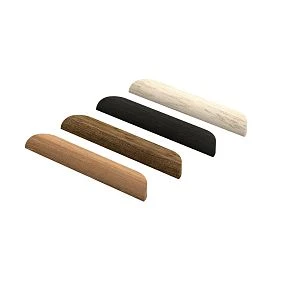
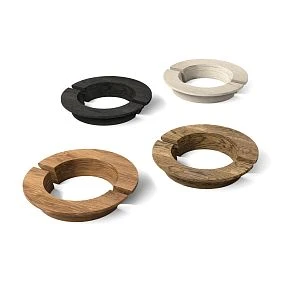
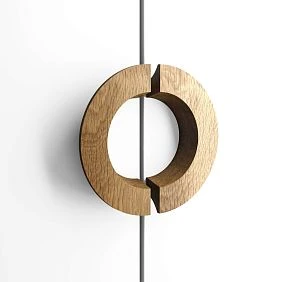
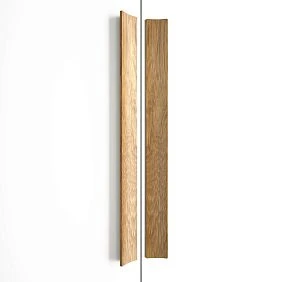
Why these handles cannot be chosen only by length
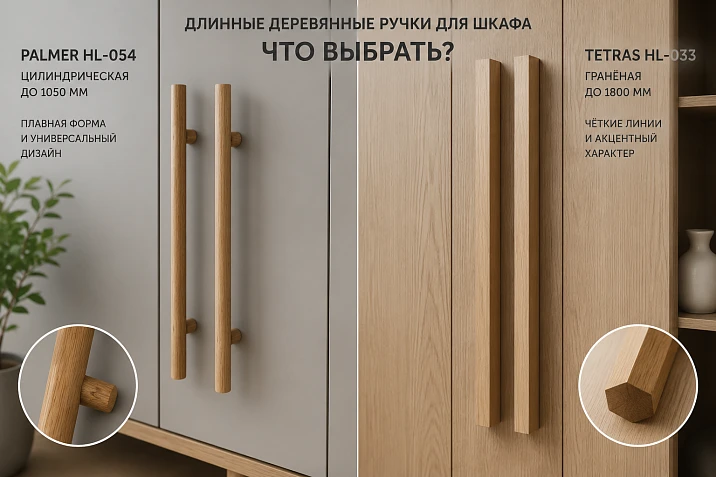
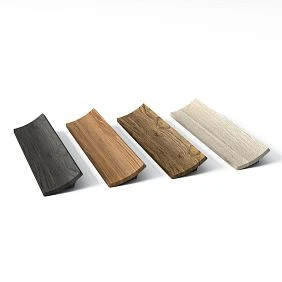
Palmer HL-054 and Tetras HL-033 both suit tall facades, but work differently. Palmer is a rounded handle bracket with a cylindrical cross-section of 16 mm and a projection of 37 mm. Tetras is a faceted profile handle measuring 25 × 19 mm. The first provides a soft grip and an external length of up to 1050 mm, the second forms a strict vertical and is produced in lengths up to 1800 mm.
Short answer: For kitchens, chests of drawers, and cabinets where a rounded handle up to 1050 mm long and a deeper grip are needed, choose Palmer HL-054. For a tall swing facade, a kitchen cabinet, or a floor-to-ceiling cabinet, Tetras HL-033 is better suited: the model is available in lengths up to 1800 mm and has a center-to-center distance of up to 1728 mm.
Buy long wooden handles for cabinets Choosing correctly means first determining not the color or even the overall length, but the facade's task. A tall cabinet door, a kitchen cabinet, a wide chest drawer, and a compact nightstand require different grips, different mounting centers, and different visual proportions. Palmer HL-054 and Tetras HL-033 allow you to assemble a unified furniture group, but their geometry, projection, and size ranges differ significantly.
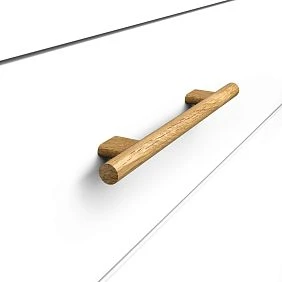
Palmer has a rounded cylindrical handle with glued legs. It protrudes more from the facade and gives fingers more space. Tetras is closer to a rectilinear profile: its edges form a strict line, and the smaller projection makes the handle visually more compact. Therefore, on the same door, Palmer looks softer and warmer, while Tetras looks stricter and more architectural.
It is especially important not to confuse the external length with the center-to-center distance. For Palmer, the longest version has an overall dimension of 1050 mm, but the mounting centers are spaced 320 mm apart. For Tetras, the 1800 mm version is mounted with centers 1728 mm apart. These are completely different scenarios for replacing an old handle. The first can cover a significant part of the facade with a relatively compact hole pattern, while the second requires drilling almost along its entire length.
Both models are supplied unfinished, made of beech or oak, with a "Prestige" sanding quality. Beech is prepared for enamel, oak for tinting. This format is convenient when handles need to be finished simultaneously with facades, panels, or other wooden fittings. If self-finishing is not part of the project, ready-made versions of Palmer HL-054M and Tetras HL-033M made of oak with a factory coating are available.
The new article does not replace the general material on how to choose the handle length for the facade. Here the task is: compare two specific models, understand the difference between a bracket and a profile, select the actual length, and check the mounting centers before purchase.




Confirmed specifications of Palmer HL-054 and Tetras HL-033
| Parameter | Palmer HL-054 | Tetras HL-033 |
|---|---|---|
| Type | Wooden bracket handle | Surface-mounted wooden profile handle |
| Shape | Cylindrical and rounded | Faceted and geometric |
| External lengths | 90, 250, 350, 670, and 1050 mm | 70, 180, 260, 400, 500, 600, 700, 900, 1200, 1500 and 1800 mm |
| Section and overhang | 16 mm; overhang 37 mm | 25 × 19 mm |
| Center distances | 16, 160, 256, 288 and 320 mm | 32, 128, 192, 320, 384, 512, 576, 768, 1120, 1440 and 1728 mm |
| Material | Beech or oak | Beech or oak |
| Preparation | Beech under enamel, oak under tinting | Beech under enamel, oak under tinting |
| Sanding | «Prestige» | «Prestige» |
| Fastening | Metal screws are included | Mounting kit included in the price |
| Main character | Soft minimalism, Japandi, modern classic | Strict geometry, minimalism, loft, modern classic |
Our factory also produces:
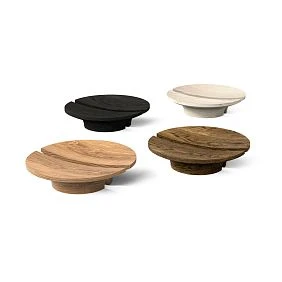
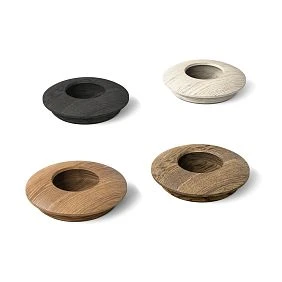
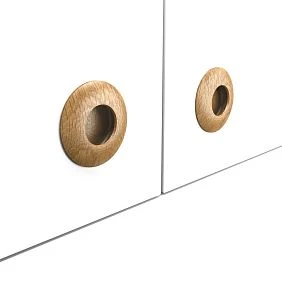
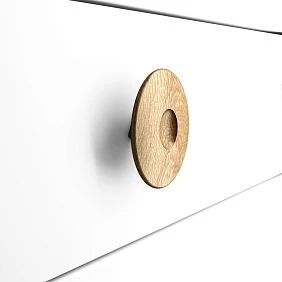
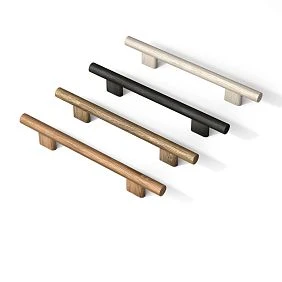
Palmer or Tetras: quick comparison based on purchase task
| Situation | Palmer HL-054 is better | Tetras HL-033 is better |
|---|---|---|
| Kitchen drawer | Rounded grip and horizontal dimensions 250–670 mm | Strict line 180–700 mm |
| Chest of drawers and cabinet | Tactile soft bracket and pronounced projection | Faceted accent on a minimalist facade |
| Medium height cabinet | 670 or 1050 mm | 700, 900 or 1200 mm |
| Floor-to-ceiling cabinet | Only if 1050 mm is sufficient per design | 1200, 1500 or 1800 mm almost full height |
| Replacing old handle without redrilling | If centers match 16–320 mm | If centers match 32–1728 mm |
| Grip depth | More finger space thanks to 37 mm offset | Flatter profile 19 mm |
Get Consultation
When to buy Palmer HL-054
For kitchen drawers
Palmer can be installed horizontally. Sizes 250 and 350 mm fit medium drawers, 670 mm fits a wide front or island. The rounded handle is convenient when opening the drawer with the whole palm, and the 37 mm projection leaves enough space between fingers and the front.
Before ordering, you cannot rely only on the drawer width. For the 350 mm version, the mounting centers are 256 mm, and for the 670 mm version — 288 mm. This design creates a long external silhouette with a more compact hole pattern. This is convenient for a new front, but requires precise checking when replacing an old handle.
If you need a uniform rounded design on different drawers, you can buy the long handle Palmer HL-054 in several sizes of the same series.
For a chest of drawers and a nightstand
On a chest of drawers, Palmer looks softer than a strict profile. The cylindrical shape does not conflict with rounded legs, front radii, and natural wood texture. Short versions 90 and 250 mm fit small drawers, 350 and 670 mm fit wide sections.
A 37 mm protrusion is useful on a facade with a frame, panel, or pronounced relief: fingers don't hit the surface. But this same protrusion must be considered near a passage, bed, or other furniture. The handle should not catch clothing or interfere with opening the adjacent door.
For a medium-height cabinet
Palmer 670 or 1050 mm creates a noticeable vertical line but doesn't aim to run almost the entire door. This suits cabinets where the handle should be large but leave calm margins at the top and bottom. The model works well in a bedroom, walk-in closet, hallway, and modern living room.
For a facade about two meters high, a 1050 mm handle takes up roughly half the height. This proportion looks balanced, especially if the lower point is in a comfortable grip zone. The exact offset is chosen based on user height, hinge placement, and the pattern of adjacent facades.
When a handle about 1000 mm long is needed
The query 'long furniture handle 1000 mm' can be fulfilled with Palmer 1050 mm, but the article should state the actual size. It's not exactly one meter. The total length of 1050 mm pairs with a center-to-center distance of 320 mm, so the handle can cover old holes on a compact grid and visually elongate the facade.
Suitable for this scenario wooden handle for cabinet 1050 mm, if the 320 mm centers match the project or the facade is being made from scratch.
For soft geometry and Japandi
The rounded shape pairs well with smooth facades, natural wood, matte enamel, and a calm palette. Palmer does not look decorative in the traditional sense but adds tactility to furniture. On a light facade, the oak version creates a warm line, while the painted beech can blend with the door or provide contrast.
When a deeper grip is needed
The 37 mm projection makes Palmer comfortable for large palms, frequent use, and facades where fingers need more space. In the kitchen, this is especially noticeable when opening a heavy drawer. However, convenience also depends on the edge shape, handle placement, and the force of the furniture hardware.
When to buy Tetras HL-033
For a tall swing door cabinet
Tetras is available in lengths of 1200, 1500, and 1800 mm. This allows the handle to run almost the entire height of the door. Such a vertical visually elongates the facade, makes the cabinet more architectural, and helps combine several tall sections into one system.
A long handle should not start too low or end at the ceiling without reason. The comfortable grip zone must remain accessible to all users, and the fasteners should not interfere with hinges, internal guides, or weakened areas of the facade.
For a facade almost the full height, you can buy a handle for a cabinet 1800 mm, if the center distance of 1728 mm matches the door design.
For a kitchen tall cabinet
A tall kitchen cabinet often has a front of 2100–2400 mm. Tetras 1200 or 1500 mm creates a noticeable vertical line but leaves calm fields. The 1800 mm version is closer to a handle almost the full height. The choice depends on the width of the cabinet, the position of adjacent handles, and where the user typically grabs the door.
The 25 × 19 mm profile protrudes less than Palmer. This makes the front visually more compact and reduces the risk of hitting the handle in a narrow passage. At the same time, the edges should remain comfortable for daily grip, so the installation height is checked on a mockup.
For strict minimalism and loft
Tetras has pronounced ribs and straight geometry. It works well on smooth fronts without frames, on tall cabinets, kitchen columns, and furniture with a vertical rhythm. In loft, the oak handle can be tinted deeper; in minimalism, paint the beech in the color of the front.
For a furniture system with eleven sizes
The main practical advantage of Tetras is the size range. Short options 70–260 mm are suitable for cabinets and small drawers, medium 400–900 mm for chests and wardrobes, long 1200–1800 mm for tall cabinets and high doors. You can keep one shape on all furniture, only changing the length.
For such a system, it is worth buying the wooden handle Tetras HL-033 in several sizes and preparing a list for each front in advance.
When a handle is needed almost the full height
Tetras is better than Palmer if the handle should visually match the height of the facade. The 1800 mm version has mounting centers of 1728 mm, so the design really works almost the entire length. It requires more holes along the vertical scale, precise marking, and a rigid facade.
For a less deep profile
The 19 mm projection brings Tetras closer to the surface. This is useful in a narrow wardrobe, a passage between a closet and a bed, or on a tall cabinet next to a wall. However, a smaller projection does not automatically mean convenience for everyone. You need to check if there is enough space for fingers and if the edge of the facade interferes.
Palmer HL-054 dimensions: what each option means
| External length | Center-to-center distance | Suitable scenario |
|---|---|---|
| 90 мм | 16 мм | Small drawer, cabinet, compact facade |
| 250 мм | 160 мм | Kitchen drawer, chest of drawers, small door |
| 350 мм | 256 мм | Wide drawer, medium facade, cabinet under sink |
| 670 мм | 288 мм | Tall door, wide drawer, kitchen island |
| 1050 мм | 320 мм | Cabinet, wardrobe, kitchen tall cabinet, medium and high height front |
With Palmer, the external size grows much faster than the distance between the mounts. This is its important design feature. The handle creates a long decorative line but does not require drilling the front almost along its entire length. For a new product, this is convenient: the furniture maker marks a compact grid of holes and gets a large visual element.
When replacing an old handle, this logic can be both an advantage and a limitation. If the front already has 320 mm holes, a 1050 mm Palmer can cover the previous area and significantly change the look of the furniture. If the old centers are 960 or 1280 mm, the long Palmer does not use them despite its external length. You will have to re-drill the front and decide how to cover the old holes.
Tetras HL-033 sizes: one profile for all furniture
| External length | Center-to-center distance | Suitable scenario |
|---|---|---|
| 70 мм | 32 мм | Small drawer, bedside table |
| 180 мм | 128 мм | Kitchen front, chest of drawers, cabinet |
| 260 мм | 192 мм | Medium drawer, cabinet door |
| 400 мм | 320 мм | Wide drawer or medium vertical front |
| 500 мм | 384 мм | Chest of drawers, wardrobe, kitchen island |
| 600 мм | 512 мм | Wide front, tall cabinet |
| 700 мм | 576 мм | Medium tall cabinet, wardrobe front |
| 900 мм | 768 мм | Tall cabinet door |
| 1200 мм | 1120 мм | Kitchen tall cabinet, high swing door cabinet |
| 1500 мм | 1440 мм | Floor-to-ceiling cabinet, walk-in closet |
| 1800 мм | 1728 мм | Handle almost the full height of a large front |
With Tetras, the external length and center-to-center distance are closer together. Therefore, the fastening truly runs along a significant part of the profile. This creates a strict long line and helps distribute force across the front, but requires precise geometry and coordination with the internal door structure.
If furniture is designed from scratch, it is convenient to choose Tetras simultaneously with the front cutting. If the handle replaces an old one, first measure the hole centers, then look for a match in the table. The 400 mm size of Tetras has a center-to-center distance of 320 mm — the same as the long Palmer 1050 mm. The appearance with the same grid will be radically different.
How to choose the handle length for the front
Measure the front itself, not just the old handle
For vertical installation, the height and width of the door are important. A handle that is too short gets lost on a tall front, one that is too long hits the frame, molding, or adjacent drawer. For horizontal installation, compare the length with the drawer width and leave equal margins on the edges.
A general guideline from an existing STAVROS article — a long vertical handle can occupy about one-third or two-thirds of the front height, and a horizontal one about half or two-thirds of the width. This is not a strict rule. Panel, veneer pattern, frame, and adjacent fronts can change the proportion.
Check the edge of the facade and the opening trajectory
The handle should not overlap the hinge, hit the countertop, wall, or adjacent door. For a double-door cabinet, two long handles are placed mirror-symmetrically and checked to ensure they do not collide when opening. On a drawer, the handle should not overlap the line of the adjacent facade.
Make a full-size layout
A cardboard strip 16 mm wide for Palmer or 25 mm for Tetras helps assess the length better than an on-screen image. The mockup is attached with masking tape and viewed from a distance, from the doorway, and from the side. Separately, check if the handle is comfortable to grip for people of different heights.
Maintain a single line within the furniture group
If different lengths are used in the kitchen, their centers or edges must follow a clear system. For example, vertical handles on tall cabinets start at the same height, while horizontal handles on drawers are centered. A random offset of a few centimeters is especially noticeable with long profiles.
Do not copy proportions from someone else's furniture
The same handle on a 450 mm and 600 mm wide facade looks different. A catalog photo shows specific furniture, lighting, and distance. In your own project, you need to check the actual dimensions.
More general principles are collected in the article about proportions of a long handle and cabinet door, but the final choice is still made based on the Palmer or Tetras drawing.
Handle length and center-to-center distance are not the same thing
External length A shows the overall size of the product. Center-to-center distance D is the distance between the centers of the mounting holes. It is D that determines whether a new handle can be installed without drilling new holes. The mistake occurs when a buyer only measures the edge of the old handle and looks for the same length.
Example Palmer 1050 mm
Overall size — 1050 mm, centers — 320 mm. The legs are located significantly closer to the middle, and the cylindrical handle continues beyond them. Such a handle may visually look like a meter-long one, but for installation it uses the standard 320 mm grid common for many facades.
Example Tetras 1800 mm
Overall size — 1800 mm, centers — 1728 mm. The mounts are located close to the edges of the profile. To replace an old handle, you will need almost the same center-to-center distance; otherwise, you will have to drill new holes.
Same D, different appearance
Palmer 1050 mm and Tetras 400 mm have D 320 mm. This is a clear example of why you cannot order by center-to-center distance without checking the overall length. One handle creates a long vertical accent, the other — a compact straight profile.
What to measure on old furniture
Remove the handle, mark the centers of the holes, and measure the distance between them in a straight line. Then measure the thickness of the facade, the diameter of the holes, the distance to the edge, and the free space on the front side. Only after that compare models.
How to replace an old handle without redrilling
Carefully remove the old hardware
The screws are unscrewed from the inside while holding the handle from the outside. If the fastening is stuck or the facade coating is fragile, do not pull the tool against the wood. First, loosen the connection and protect the surface.
Measure the hole centers
Place the ruler from the center of one hole to the center of another. Measuring from the edges gives an error. For long Tetras, it is especially important to control the vertical: the holes must be on the same axis.
Match parameter D
Matching the external length is not enough. If the D of the new handle equals the old one, redrilling is not required. If it differs, you need to decide whether the old holes can be covered by the handle itself, furniture repair, or new facade finishing.
Check the facade thickness and screws
The fasteners come in the kit, but the thickness of doors and drawers can vary. The screw should not be too short or protrude inward as a dangerous point. Before installation, test fit it without overtightening.
Do not enlarge holes by eye
Offset drilling causes the long handle to skew. For Tetras, the error is noticeable along the entire height. It is better to use a template, guide, and depth stop.
When redrilling is unavoidable
If the new model fundamentally changes the geometry — for example, a short bracket is replaced by a Tetras 1500 mm — the old centers rarely align. In that case, it is better to repair the facade professionally or replace it. Random plugs on the front side can ruin the result.
Beech or oak
Beech for opaque enamel
Beech Palmer and Tetras are prepared for opaque finishing. This is the choice for white, black, gray, colored handles, or an exact match with a painted facade. Opaque enamel hides natural differences in lamellas and provides a uniform color.
On Palmer, the color emphasizes the soft cylindrical silhouette. On Tetras, light and shadow read the facets, so even a handle in the color of the facade remains noticeable. A too-thick layer should not round the geometry of Tetras or fill the joints of Palmer legs.
Oak for tinting
Oak is chosen when visible wood texture is needed. On a long handle, the pattern becomes an important part of the facade. Tinting can match the countertop, baseboard, floor, or wooden panels, but an exact match from a photo cannot be expected.
For a set, it is better to order all handles simultaneously and finish them with one system. On long Tetras, the difference in shade between individual parts is more noticeable, so a sample is approved before applying the finish to the entire batch.
How to combine the handle with the facade
The handle can match the facade, be darker, lighter, or create contrast. Oak on a painted door creates a natural accent. Beech in enamel the color of the facade makes the geometry calmer. Dark Tetras enhances the vertical, light Palmer softens a large door.
What to choose for a wet kitchen
Not only the wood species matters, but also the protective system. An unfinished handle cannot be installed in an area of frequent contact with wet hands without a finish. Edges, ends, and areas around fasteners must be protected. The specific coating is chosen based on operating conditions.
Without coating or ready-made series M
When to choose HL-054 and HL-033 without coating
Unfinished models are suitable if the facades are still being made and the handles need to be finished in the same color or tone. This helps achieve a unified set and match the gloss. This option is also convenient for restoration, where a craftsman selects the shade manually.
When Palmer HL-054M is more convenient
If self-finishing is not needed, you can buy Palmer HL-054M with factory coating. The ready-made oak handle is suitable for cabinets, kitchens, chests of drawers, and nightstands. Before ordering, check the available sizes and colors in the current product card.
When Tetras HL-033M is more convenient
The finished version retains a strict faceted shape and a size range up to 1800 mm. For a cabinet or tall unit, you can buy Tetras HL-033M with coating, if the factory color matches the project and painting together with the facade is not required.
Why you cannot mix finished and unpainted handles without a sample
Even a similar color can differ in shade, depth, and gloss level. If some handles are factory-made and some are painted on site, they are compared side by side before installation. On one furniture wall, the discrepancy is especially noticeable.
How to choose a handle for specific furniture
Kitchen set with drawers and tall units
A kitchen rarely consists of identical facades. Below there are narrow and wide drawers, above there are hinged doors, and next to them a tall unit. Palmer allows using short sizes 90–350 mm on drawers and 670–1050 mm on tall doors. The series retains the same cylindrical character, while the length changes according to scale.
Tetras offers even more options. On small facades, you can use 70–260 mm, on wide drawers 400–700 mm, on a tall unit 900–1800 mm. This is convenient when a designer wants to run a single faceted line across the entire set.
You cannot simply choose the longest handle for a tall unit and install it on all doors. A profile that is too long on a narrow upper cabinet will look heavy, while a short handle on a tall unit will get lost. Sizes are distributed across groups of facades.
Swing wardrobe in the bedroom
For a calm interior, Palmer 670 or 1050 mm creates a soft vertical line. Two handles on a double-door wardrobe are placed symmetrically relative to the central gap. It is necessary to check that the handles do not collide and do not interfere with opening the adjacent section.
Tetras 1200–1800 mm suits a ceiling-height wardrobe and makes the facade more architectural. On a wide door, the handle can be closer to the edge; on a narrow one, it is placed in the center of the accessible area. Installation must account for hinges and facade rigidity.
More details about the differences between wardrobes can be read in the article about which wooden handle suits a tall facade.
Wardrobe in the hallway
In a narrow passage, the protrusion is important. Palmer protrudes by 37 mm, so it is necessary to check if it catches on clothes or interferes with the door. Tetras with a 19 mm profile is more compact, but the faceted shape may feel stricter. If the wardrobe is opposite the front door, the long vertical becomes a noticeable part of the entire hallway.
Wardrobe
In a dressing room, there are many identical tall facades. Tetras is convenient for repeating the rhythm of 1200, 1500, or 1800 mm. Palmer is suitable if the interior is softer and the handles should not go almost the full height. For open and closed sections, it is important to maintain a single installation line.
Chest of drawers
On a chest of drawers, handles are often placed horizontally. Palmer 250, 350, or 670 mm provides a rounded grip and pairs well with turned legs. Tetras 180–600 mm emphasizes the rectangularity of the drawers. On a wide chest of drawers, one long handle can replace two short ones, but the force and facade construction need to be checked.
Bedside table
For a small bedside table, Palmer 90 or 250 mm and Tetras 70 or 180 mm are suitable. A long handle should not extend beyond the facade boundaries or interfere with passage near the bed. In a pair of bedside tables, the handles should be oriented identically and installed at the same height.
Kitchen island
On the island, handles are visible from all sides. Palmer 350 or 670 mm looks softer and is convenient for frequent opening of wide drawers. Tetras 400–700 mm creates a strict horizontal line. The overhang is checked relative to the passage around the island.
Wardrobe in a children's room
The long handle should be accessible to the child but not have dangerous protrusions. The rounded Palmer is tactually softer. Tetras can be chosen in a short size and installed so that the edge does not fall at face level. The fastening must be reliable, and the coating suitable for frequent cleaning.
Commercial interior
In a store, hotel, salon, or showroom, handles work daily and simultaneously shape the furniture's image. For long facades, it is useful to order one sample, test the grip, and only then place the entire batch. The article number, size, wood species, coating formula, and fastener type are preserved.
Vertical or horizontal installation
Palmer in vertical position
Vertical installation is suitable for cabinets, tall units, and high doors. Due to the compact center distance, the long handle visually extends far beyond the legs. The top and bottom overhangs must be equally considered and not fall on the facade frame.
Palmer on a horizontal drawer
The handle is centered relative to the width of the facade. If the drawer is very wide and heavy, it is important to check whether it is convenient to open it with one hand in the middle and whether the furniture fittings can withstand the force. A long handle does not compensate for weak guides.
Tetras vertically
The profile creates a straight line. Even a few millimeters of markup error becomes noticeable over a length of 1500–1800 mm. Installation requires a template or precise guide. The top and bottom edges are checked against adjacent facades.
Tetras horizontally
Short and medium sizes are suitable for drawers and chests. The edges reflect light differently, so a row of handles must be installed with the same side facing. Before final tightening, check the orientation of each part.
How many handles to order
Compile a facade list
Record each door and drawer, their dimensions, handle orientation, and selected article number. For a kitchen, it is convenient to divide the list into upper cabinets, lower drawers, tall cabinets, and an island. For a wardrobe, into sections and double-door pairs.
Paired handles on a cabinet
On a double-door facade, two identical handles are usually needed. Their finish and oak pattern may naturally vary, so it is better to select a pair side by side. When installing vertically, the centers and height must match.
Different sizes of the same series
This is one of the strong scenarios for both models. Palmer allows linking cabinets, drawers, and wardrobes with five lengths. Tetras with eleven. In the list, it is important not to confuse the external length and D.
Is a spare copy needed
For home, a spare is usually not required. For a restaurant, hotel, or large series, one extra handle can speed up repairs. It is especially useful to keep a spare oak part from the same batch or a sufficient amount of paint.
Why you cannot order "approximately"
An error in one size disrupts the entire line. A handle of 900 mm instead of 1200 mm on one cabinet will be noticeable. Before payment, the list is checked against cards and drawings.
What to buy and prepare together with handles
Fasteners are included in the kit of both models, but the installation project includes more. You need a marking template, a drill, a depth stop, facade protection tools, and the selected finishing system. For replacing old handles, professional hole repair and local painting may be needed.
If the Palmer shape fits, but a different size or design is needed, you can choose a long handle-bracket for the cabinet. For strict profiles, it is useful to look at long profile handles for the cabinet.
| What to add to the project | Why | For which scenario | What to Check |
|---|---|---|---|
| Complete screws | Attach handle through the facade | Both models | Facade thickness and safe screw length |
| Drilling template | Keep the axis and same height | Extra long Tetras | Parameter D and edge offsets |
| Primer and enamel | Get covering color | Beech Palmer and Tetras | Compatibility and layer thickness |
| Tinting and protective finish | Preserve oak texture | Oak versions | Test swatch and color next to the facade |
| Repair of old holes | Hide the previous mounting grid | Replacement without D match | Material and facade coating |
| One test sample | Check grip, color, and scale | Large furniture series | Real facade and daily use |
How not to confuse a profile handle with the Gola system
Tetras is called a profile handle, but it is an overlay wooden part that is attached with screws through the facade. It is not a built-in aluminum Gola profile and does not create a completely handleless opening. The buyer must understand this difference in advance.
The overlay Tetras remains visible on the front side and participates in the design. The Gola system integrates into the body or facade and forms a niche for gripping. They cannot be compared only by the word "profile".
How not to confuse Palmer with a regular short bracket
Palmer has a series of lengths, including 670 and 1050 mm. At the same time, the mounting centers remain compact. A regular bracket 320 mm long with D 320 mm and Palmer 1050 mm with the same D look completely different. You need to read all four parameters A, B, C, and D.
Practical installation without unnecessary risks
Mark one baseline
For a series of facades, choose a single offset from the edge or a common center height. Measuring each facade again from different points is dangerous: an error will accumulate. Use a template or jig.
Check the inner side
Before drilling, make sure the hole does not hit a hinge, guide, shelf, or connector. On a tall Tetras front, the points are far apart, so check the entire route.
Protect the face covering
Painter's tape helps with marking, but its compatibility with enamel and veneer must be checked. The drill bit should be sharp, and the exit hole protected from chipping.
Do not overtighten the screws
Wood can deform, and the coating can crack. Tighten the handle evenly, checking the fit of the legs. If the front is warped, do not try to straighten it with the force of the fastener.
Check the orientation of the Tetras faces
Before final tightening, place all handles with the same side facing out. The light on the faces should be uniform. On a long vertical run, a wrong turn is noticeable.
Check the Palmer for skew
A cylindrical handle seems simple, but long versions also require precise vertical alignment. Measure the distance from both edges of the front and look at the handle from several meters away.
Test opening
After installation, open the facade several times from different parts of the handle. Check for movement, creaking, contact with the adjacent door or wall. Only then install the remaining products.
Mistakes when buying
Select only by total length
The customer sees 1050 mm and thinks the holes are located almost at the edges. With Palmer this is not the case: D is 320 mm. For Tetras 1800 mm D is 1728 mm. The error makes installation impossible.
Not checking the facade thickness
Fasteners are included, but facades can be thin or thick. The screw must securely enter the leg and not protrude inward.
Mixing sizes without a system
Different lengths of the same series are useful only with a clear logic. If identical doors have 900 and 1200 mm without reason, the furniture looks random.
Ordering beech under clear lacquer
Beech is prepared for enamel, so visible lamellas may differ. For transparent or semi-transparent finishes, choose oak.
Completely painting over oak
Opaque enamel hides the grain. If texture is not needed, beech is more rational.
Install unpainted handle
Without a protective finish, wood gets dirty faster from hands and moisture. This is especially critical in the kitchen and hallway.
Do not account for overhang
Palmer protrudes 37 mm. In a narrow passage or near a wall, this can be obstructive. Tetras is more compact but requires grip testing.
Drill using a paper ruler without a template
For a long Tetras, a small error turns into a noticeable tilt. It's better to use a rigid jig.
Buy the entire set without a sample
In a large kitchen or walk-in closet, one test sample helps check comfort, color, and proportion.
Rely on the old name Lagom
The designation Lagom HL-054 is preserved in the URL and some articles, but the current product card calls the model Palmer HL-054. When ordering, you should rely on the SKU HL-054 and the current product card.
Who is Palmer HL-054 for
Palmer is suitable for a buyer who needs a rounded handle with a comfortable deep grip and an external length of up to 1050 mm. The model is convenient for kitchen drawers, chests of drawers, bedside tables, cabinets, and tall cabinets. Five sizes allow maintaining one design on different facades without switching to another shape.
It is especially appropriate in minimalism, Japandi, modern classic, and interiors with soft radii. Beech under enamel helps connect the handle with a painted facade, oak under tinting — with a natural countertop, floor, or furniture.
When Palmer may not be suitable
The model is not suitable if you need a handle with a length of 1200–1800 mm, almost full matching of the door height, or a very small projection from the facade. It is also inconvenient for replacing an old long handle with a center distance significantly greater than 320 mm.
Who is Tetras HL-033 for
Tetras is designed for a buyer who needs a strict faceted line, a wide range of sizes, and the ability to design a tall facade almost full height. Eleven options allow using the series on bedside tables, drawers, chests of drawers, cabinets, and kitchen tall cabinets.
The model suits minimalism, loft, modern, and transitional interiors. The profile 25 × 19 mm feels assembled, and long sizes of 1200–1800 mm make the handle an architectural element.
When Tetras may not be suitable
The faceted shape may be too strict for an interior with soft lines. The 19 mm projection needs to be checked by people with large fingers. Very long versions require precise drilling and a rigid facade; for a simple replacement of an old bracket, they are only suitable if the centers match.
How to accept handles after delivery
Check the name and article number
For the first model, refer to Palmer HL-054, even if the old word lagom is in the URL. For the second, Tetras HL-033. The article number, size, material, and quantity must match on the box and in the order.
Check four sizes
Measure A, B, C, and D. For Palmer, it is especially important to ensure that the external dimension and centers are not confused. For long Tetras, check the total length and the distance between the extreme mounting points.
Inspect the wood
On beech, natural differences that will be covered by enamel are acceptable. On oak, the texture is evaluated and parts are distributed across the set. Cracks, chips, damaged edges, and deformed legs are fixed before finishing.
Check the fastening
Ensure the set matches the number of handles. Before drilling, test the screws against the facade thickness. If the length is not suitable, replacement is coordinated with the craftsman.
Assemble handles by furniture groups
Lay out the items by cabinets, drawers, and doors. Label the size and position. This prevents the error when a 700 mm handle is installed instead of 900 mm, and the difference is discovered after drilling.
How to prepare unpainted handles for finishing
Do not touch the surface with dirty hands
Wood quickly absorbs grease and dust. Store handles in clean packaging before priming and handle them with gloves. Contamination is especially noticeable on light oak tinting.
Make a test application
The sample shows the actual shade, gloss, and coating thickness. For Palmer, check if material accumulates near the legs. For Tetras, check if the enamel rounds off the edges.
Finish the entire set with one system
Different primers and varnishes produce different gloss levels even with the same color. It is better to coat all handles of a furniture wall simultaneously and dry them under identical conditions.
Protect threaded elements
Paint should not get into the mounting holes and interfere with the screws. Cover technical areas as recommended by the craftsman.
Allow the coating to dry completely
An under-dried handle easily gets fingerprints and sticks to the facade. Install only after the finish has fully cured.
Care for Palmer and Tetras
Stained beech
Wipe the surface with a soft cloth and a product compatible with the enamel. Abrasives alter the gloss, and aggressive solvents damage the color. In the kitchen, it is best to remove dirt immediately.
Tinted oak
Care depends on the protective finish. Oil, varnish, and other systems require different products. Water should not remain for long near the legs and around the fasteners.
Areas of constant grip
Over time, a more noticeable shine may appear in the middle of a long handle. Regular gentle cleaning reduces grease buildup. If the coating is damaged, local repair should be coordinated with a finisher.
Fastening
If the handle starts to move, check and tighten the screws without excessive force. Constant play destroys the facade holes. If loosening occurs again, find out the cause.
How to buy Palmer or Tetras at STAVROS
First, measure the facades and make a list. Then choose the shape: a rounded bracket or a faceted profile. After that, determine the external length and be sure to compare parameter D. Only then choose beech or oak, an unpainted or finished version with a coating.
For soft geometry and lengths up to 1050 mm, you can buy cylindrical furniture handle Palmer HL-054. For strict vertical and facade up to 1800 mm — buy long profile handle for cabinet Tetras HL-033.
If the dimensions do not match, open catalog of wooden handles for cabinet and choose another model. Current price, availability, material and delivery time are checked directly before placing the order.
Checklist before purchase
- exact name and article number of the model;
- total length A;
- width or cross-section B;
- C offset;
- center distance D;
- facade thickness;
- hinge and guide placement;
- vertical or horizontal installation;
- distance to door edge;
- opening trajectory;
- clearance in passage;
- number of identical facades;
- unified handle line;
- beech for enamel or oak for tinting;
- self or factory finishing;
- screw kit;
- one test sample for a large series;
- repair of old holes when replacing;
- current availability and lead time;
- spare sample for a commercial project.
How to create a unified handle system for the entire room
One series — different sizes
A large furniture group rarely consists of identical fronts. In a bedroom, a tall wardrobe, dresser, bedside tables, and vanity may stand side by side. In a kitchen — a tall cabinet, upper doors, deep drawers, and an island. Palmer and Tetras allow you to maintain a unified character without copying one length across all surfaces.
For Palmer, the logic might look like this: 90 or 250 mm on cabinets, 350 mm on medium drawers, 670 mm on wide fronts, and 1050 mm on the wardrobe. For Tetras, the range is even wider: 70–260 mm for small furniture, 400–900 mm for dressers and wardrobes, 1200–1800 mm for tall doors.
Single installation level
Even handles of different lengths must follow a common line. On vertical fronts, you can align the bottom edge, center, or comfortable grip zone. On horizontal drawers, handles are usually centered. The main thing is to choose one principle and apply it to the entire group.
If some handles are installed centered and others are offset without reason, long lines amplify the disorder. Before drilling, it is helpful to lay out the fronts on a drawing and mark each axis.
How to combine Palmer and Tetras in one interior
Mixing two series is possible, but only with a clear role. For example, use Palmer on a dresser and nightstands, and Tetras on a tall cabinet. They can be united by one wood species, the same shade, or a common enamel color. Without such a connecting principle, a rounded bracket and a faceted profile will look like randomly assembled hardware.
In most cases, it is safer to choose one series and vary the length. Mixing is justified when furniture groups differ in purpose or are located on different walls.
How to prepare for future replacement
After installation, save a table of dimensions, center distances, article numbers, and the coating formula. In a few years, this will help replace one damaged handle without repeated measurements. For custom tinting, it is useful to keep a small wood sample or a can of the finishing compound.
A photo of the front side is insufficient. The documentation must include parameter D and the screw length. These data determine compatibility.
How to approve a test handle before ordering a batch
Check the grip in the actual position
A handle that feels comfortable on a table may feel different on a vertical facade. Install one sample on a temporary mockup or the chosen door and use it for a few days. Check if it's convenient to open the facade with one hand, if your fingers don't press, and if clothes don't catch.
Evaluate the scale from a distance
Step back a few meters and look at the entire furniture wall. A Palmer 1050 mm may look calmer than expected due to compact mounting points. A Tetras 1800 mm, on the contrary, becomes a strong vertical. The scale should be evaluated not only next to the facade.
Check the color on the facade
The handle sample is applied to the finished surface under daylight and artificial light. Oak tinting may seem warmer in the evening, and enamel may change the degree of contrast. The decision is made only after comparison in the room.
Check adjacent facades
Open the door fully and make sure the handle does not touch the wall, another door, countertop, or appliances. For a double-door cabinet, check both handles simultaneously. For a drawer, check movement along the entire depth.
Record the result
After approval, record size A, parameter D, material, color, gloss level, and position on the facade. For a large batch, this becomes a working specification used by the cabinetmaker, finisher, and installer.
What to do if neither Palmer nor Tetras fit
There is no need to force a ready-made handle onto an unsuitable facade, shorten the profile, or move the legs without confirmed technology. If Palmer is too deep, Tetras is too strict, or the center distances do not match, it is better to open the catalog and choose a different model.
In this section, you can compare brackets, profiles, and other wooden handles without coating. This choice is safer than modifying a finished product, which can compromise strength, geometry, and appearance.
How to save the kit for future maintenance
After installation, photograph each furniture group, save the article numbers, dimensions A and D, material, color, gloss level, and screw length. For oak handles, it is useful to keep a tinting sample; for beech handles, keep the enamel code and primer name. This data will simplify replacing a single part, local coating repair, or reordering handles for a new cabinet section.
Do not rely solely on the model name in memory: Palmer's URL still has the old Lagom designation, and size ranges may be perceived inaccurately. The working specification should include the current name Palmer HL-054, article number, length, and center distance.
Frequently asked questions
How is Palmer HL-054 different from Tetras HL-033?
Palmer is a rounded handle bracket with a cylindrical cross-section of 16 mm and a projection of 37 mm. Tetras is a faceted handle profile 25 × 19 mm with lengths up to 1800 mm.
What sizes are available for Palmer?
External lengths: 90, 250, 350, 670, and 1050 mm. Center distances: 16, 160, 256, 288, and 320 mm respectively.
What sizes are available for Tetras?
70, 180, 260, 400, 500, 600, 700, 900, 1200, 1500, and 1800 mm. Center distances range from 32 to 1728 mm.
What to choose for a cabinet up to the ceiling?
Most often Tetras 1200–1800 mm, because it can run almost the entire height of the facade. Palmer is suitable if a length of 1050 mm is enough.
What to choose for a kitchen drawer?
Palmer provides a rounded grip and sizes 250–670 mm. Tetras is suitable if a strict line and size 180–700 mm are needed.
What to choose for a chest of drawers?
Both models are suitable. Palmer is softer and deeper in grip, Tetras is more graphic. The size is chosen based on the width of the drawer.
What does center distance mean?
This is the distance between the centers of the mounting holes. It is denoted by parameter D and determines compatibility with the old drilling pattern.
Why does the Palmer 1050 mm have a D of only 320 mm?
The legs are located closer to the middle, and the cylindrical handle continues beyond them. The external length is not equal to the mounting distance.
Can the 320 mm handle be replaced with a Palmer 1050 mm?
If the old handle has a center distance of 320 mm and the facade allows for a length of 1050 mm, this is possible after checking the drawing.
Which Tetras has a D of 320 mm?
The version is 400 mm long. Therefore, Palmer 1050 and Tetras 400 use the same grid, but look completely different.
How to measure the old handle?
Remove it and measure the distance from the center of one hole to the center of the other. Then measure the external length and the thickness of the facade.
Can the Palmer be installed vertically?
Yes. The card allows vertical use on swing facades and cabinet doors.
Can Palmer be installed horizontally?
Yes. It is suitable for drawers, chests of drawers, and wide kitchen fronts.
Can Tetras be installed horizontally?
Yes. Short and medium sizes are suitable for drawers and chests of drawers. The orientation of the edges must be kept the same.
Which handle protrudes less from the front?
Tetras has a profile of 19 mm. Palmer protrudes 37 mm and provides a deeper grip.
What is more comfortable for a large palm?
Usually Palmer due to its greater projection. But it's better to check comfort on a sample.
Which material should I choose for white enamel?
Beech. It is prepared for opaque coating.
Which material to choose for transparent tinting?
Oak. Its texture should remain visible.
Can the handle be left uncoated?
Not recommended for constant use. The wood will absorb dirt and moisture.
Does it include fasteners?
Yes. For Palmer, metal screws are included; for Tetras, the mounting kit is included in the price. The length needs to be checked against the facade.
What to choose for a narrow passage?
Tetras protrudes less. But you need to ensure the grip remains comfortable.
What to choose for Japandi?
Palmer often better supports soft rounded lines and natural wood.
What to choose for a loft?
Tetras with faceted geometry and dark oak tinting looks stricter and more architectural.
Can I use different lengths from the same series?
Yes. The main thing is to distribute them across groups of facades and maintain a single installation line.
Do I need to order all handles at the same time?
It's advisable for a set. This makes it easier to match the wood, shade, and a single batch of finish.
What to choose: without coating or the M series?
Unpainted versions are needed for finishing together with the facade. The HL-054M and HL-033M series are convenient if the factory color suits.
Can oak be painted with opaque enamel?
You can, but the natural texture will be hidden. For an opaque color, beech is more practical.
Can beech be coated with clear varnish?
Preparation for enamel allows noticeable differences in lamellas. If texture is important, choose oak.
How to avoid warping of Tetras 1800 mm?
Use a rigid template, one base axis, and check holes before drilling.
Where to buy Palmer HL-054?
In a separate STAVROS card under the current name Palmer, despite the old word lagom in the URL.
Where to buy Tetras HL-033?
In a separate profile handle card, where sizes from 70 to 1800 mm are available.
Where to see other wooden handles?
In the category of handles without coating, you can compare models by shape, length, and material.
Result: Palmer for a rounded grip, Tetras for a long strict vertical line
Palmer HL-054 and Tetras HL-033 fit the same type of furniture but create a different feel. Palmer is softer, deeper in grip, and limited to a length of 1050 mm. Tetras is stricter, closer to the facade, and available up to 1800 mm. Therefore, the decision cannot be reduced to which handle is longer.
For Palmer, it is critical to remember the compact mounting centers: the 1050 mm version has D 320 mm. For Tetras, the external length and center distance are closer: the 1800 mm version has D 1728 mm. It is the D parameter that determines replacement without redrilling.
Before ordering, measure the facade, old holes, door thickness, free passage, and hinge placement. Then choose beech under enamel or oak under tinting, unpainted or ready-made M series.
At STAVROS you can buy a long wooden pull handle Palmer for kitchen, dresser, and cabinet or buy a faceted wooden furniture handle Tetras for a tall cabinet and high hinged facade. If the dimensions do not match, open Buy wooden furniture handles and select the model based on the actual mounting grid.