Article Contents:
- Wooden post L-053 1200×100 mm: what the product card confirms
- Why the 1200×100 mm post cannot be considered "just a large baluster"
- The first baluster is already installed: what measurements to take before purchasing L-053
- 1. Finished railing height
- 2. Height of the first baluster
- 3. Position of the handrail axis
- 4. Handrail incline angle
- 5. First step landing
- 6. Distance to the edge of the step
- 7. Distance to the second baluster
- 8. Current end point of the handrail
- 9. Material of the existing staircase
- 10. Condition of the very first step
- Vertical position
- Horizontal position
- Angle
- Handrail Profile
- Remaining length
- The old handrail is too short
- The end is damaged during dismantling
- The profile is incompatible
- The angle changes
- The handrail itself already needs repair
- To the edge of the flight
- To the riser
- To the second baluster
- To the inner side
- Scenario A — replace only the first baluster
- Scenario B — rework the beginning of the railing
- Mistake 1. Comparing only the height
- Mistake 2. Not checking the 100×100 mm square
- Error 3. Ordering a post before inspecting the old mounting
- Error 4. Choosing oak only because the old staircase is "brown"
- Error 5. Not accounting for the first gap
- Error 6. Buying a new handrail in advance
- Error 7. Assuming the accompanying L-052 is guaranteed compatible
- Error 8. Painting L-053 without a test sample
- Error 9. Treating "Standard" and "Prestige" as only price tiers
- Error 10. Ignoring safety to preserve the old geometry
- What is the size of the L-053 post?
- What type of wood is L-053 made from?
- What sanding qualities can be chosen?
- Can the first baluster be replaced with an L-053?
- Will L-053 100×100 mm fit on the first step?
- Can the old handrail be kept?
- Does the second baluster need to be replaced?
- Do all the other balusters need to be replaced?
- What to choose — beech or oak?
- Why may the new oak post differ from the old oak?
- Can L-053 be painted to match the existing staircase?
- What to choose — "Standard" or "Prestige"?
- Can one post be ordered?
- Is a new finial required?
- Does the top support post need to be replaced?
- Which balusters can be viewed next to L-053?
- What to do if the old handrail is too short?
- Can the handrail simply be extended with a short insert?
- What to do if L-053 is too massive?
- Where to buy L-053?
- Where to see other wooden posts?
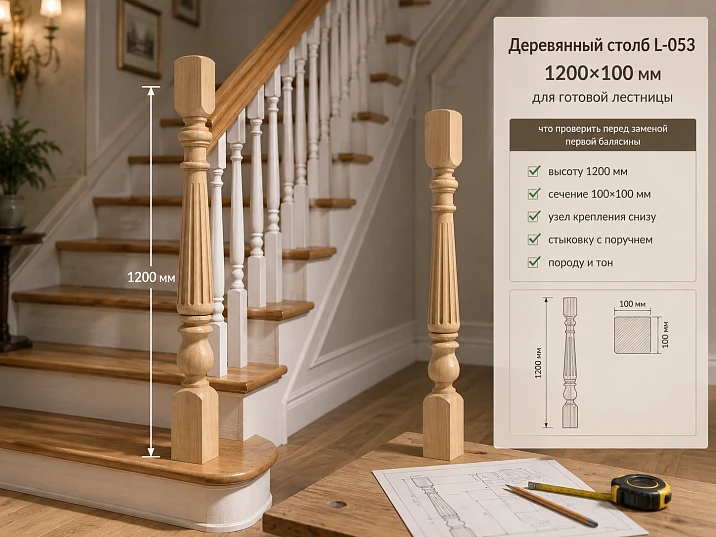
The staircase is already assembled and in use. They don't want to replace the entire row of identical balusters, and the handrail should preferably be preserved. The problem is at the start of the flight: the first vertical looks too light, and the owner wants a more pronounced entry accent. In the catalog, a wooden post L-053 measuring 1200×100 mm is found. At this stage, it's easy to make an overly simple conclusion: remove the first baluster, install the post in its place, and attach the old handrail to it.
For a finished staircase, such a scenario cannot be considered automatically compatible.
L-053 is not "the same baluster, just larger." The post belongs to the supporting elements of the railing and has a different cross-section, different height, and a different role at the start of the flight. Replacing one part affects at least four areas: the first step or landing, the lower attachment, the line of the existing handrail, and the distance to the second baluster.
Therefore, the main question before purchase is:
Does L-053 1200×100 mm fit into the existing geometry so that the craftsman can create a correct support assembly, maintain a safe structure, and join the old handrail without accidentally shifting its line?
If the answer is confirmed by the drawing and inspection of the staircase, it is possible buy an L-053 post as one specific modernization element. If, however, the handrail meets the decorative part of the post, the 100 mm cross-section does not fit on the first step, or the new post changes the first gap of the railing to an unacceptable size, purchasing a single SKU will not solve the problem.
The correct sequence for a finished staircase:
measuring the existing start of the flight → position of the handrail axis → 100×100 mm template on the step → checking the adjacent baluster → comparing the 1200 mm height with the handrail line → material and finish → design of the joint → only then ordering.
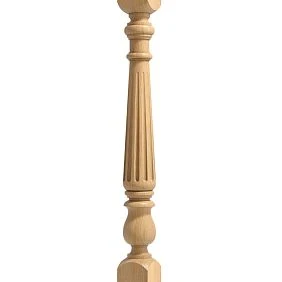
Wooden post L-053 1200×100 mm: what the card confirms
For L-053, the current specification table confirms one main size — 1200×100 mm. Beech and oak are available. For sanding quality, you can choose "Standard" or "Prestige."
The card also distinguishes surface preparation: for beech, the option under enamel is used; for oak, an execution under tinting is provided. All options are made-to-order items, with an average production time of 5–10 days.
As of the check on 31.08.2026, the prices in the card were:
| Execution L-053 | Price at the time of check |
|---|---|
| Beech, "Standard" | 15,610 RUB. |
| Beech, "Prestige" | 18,930 RUB |
| Oak, "Standard" | 28,560 RUB |
| Oak, "Prestige" | 31,420 RUB |
The price changes, so it needs to be re-checked before payment. For the restoration task, the difference between the four prices is less important than the compatibility of the post with the existing staircase.
Characteristics that need to be transferred to the working specification without rephrasing:
-
article L-053;
-
size 1200×100 mm;
-
beech or oak;
-
"Standard" or "Prestige";
-
preparation for the selected finish;
-
quantity — 1 pc., if only the first vertical is being changed;
-
compatibility with the existing assembly needs to be confirmed separately.
Already at this stage, it is clear why you cannot buy based only on a photo. Two numbers — 1200 and 100 mm — do not tell where the old handrail will end up and how much space will remain between the new post and the second baluster.




Why a 1200×100 mm post cannot be considered "just a large baluster"
A baluster and a post may be made of the same wood species and in the same style, but their role in the railing differs.
Intermediate balusters form a repeating row. A support or end post sets the beginning, end, or turn of the system and participates in the handrail support joint.
In a finished staircase, this difference is especially important.
If the first baluster was, conditionally, 50–60 mm wide, and L-053 is 100 mm, the new part takes up more horizontal space. It changes the first gap.
If the old baluster ended exactly under the handrail, a 1200 mm high post may rise above it. This is normal for a post as a compositional element, but the handrail attachment point needs to be found on the drawing, not "wherever is convenient."
If the previous baluster was fixed to the step using one principle, the new support joint may require a different structure. The article should not assign fasteners for the craftsman, because existing staircases differ in step material, stringer, carriage, and assembly method.
That is why the sequence "remove the baluster → insert the post → screw on the old handrail" is too primitive for a safe modernization.
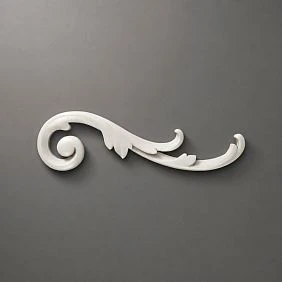
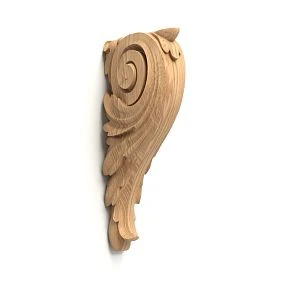
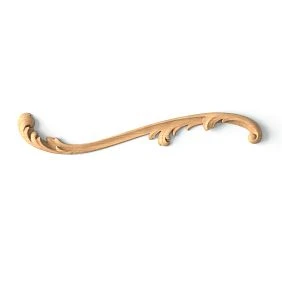
Our factory also produces:
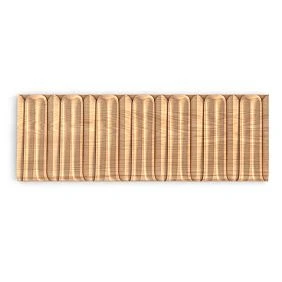
The first baluster is already in place: what dimensions to take before buying L-053
Before ordering, you need to take not one size, but a map of the beginning of the stairs.
Get Consultation
1. Finished height of the railing
Measure the existing handrail line at the point where the new post is planned.
2. Height of the first baluster
It shows how much the new 1200 mm part differs from the existing vertical.
3. Position of the handrail axis
Not only the top mark is needed, but also the actual line along which the handrail comes to the first vertical.
4. Angle of handrail rise
On a flight staircase, the handrail often comes to the post not horizontally.
5. Landing of the first step
You need to understand the actual free space for a 100 mm cross-section.
6. Distance to the edge of the step
You cannot assume that a 100×100 mm square can be placed at any point on the first tread.
7. Distance to the second baluster
After installing a wider post, the first gap will change.
8. Current endpoint of the handrail
If the old handrail is short and ends at the previous baluster, the new connection position may require additional length.
9. Material of the existing staircase
Oak, beech, other wood, or a painted structure affect the visual integration of the new element.
10. Condition of the very first step
The master must assess whether the necessary support node can be created in it without questionable rework.
These dimensions are better indicated on the front and side sketches.
L-053 with a height of 1200 mm: why the overall height does not yet indicate where the handrail will land
1200 mm is the overall height of the product. This is not the height of the handrail attachment point.
Let's imagine an existing railing where the handrail line runs at about 900–1000 mm relative to a specific step. From this, one cannot automatically conclude that L-053 is "too tall."
The entry post often deliberately extends above the handrail and receives its own decorative cap.
The key is where on its profile the zone is located to which the existing handrail can be project-wise connected.
If the connection falls on a calm geometric part of the post, the joint may be feasible. If the old handrail line is at a heavily profiled decorative section, the task becomes more complicated.
Therefore, one does not compare:
1200 mm against the height of the old baluster,
But:
Drawing L-053 against the actual railing line and the future connection point.
If the point does not match, purchasing one post may require replacing or reworking part of the railing.
Wooden starting post and existing railing: can the old line be preserved
Preserving the existing railing is the real goal, but it needs to be confirmed against five parameters.
Height position
The connection point must match the current railing line.
Horizontal position
The new post is wider than the first baluster. Its axis may end up at a different point.
Angle
The stair railing approaches the post at a specific angle. It cannot be assumed that the new connection will replicate the old one.
Handrail profile
Its shape affects the way it joins.
Residual length
After dismantling the old joint, the handrail must have sufficient length and a sound end face for the new connection.
If all five parameters match, retaining the old handrail becomes realistic.
If at least one does not match, you need to decide whether the existing part can be properly reworked or a new section is required.
Why the handrail end cannot simply be screwed to L-053 "wherever it works out"
The starting post is in the foreground. A connection error is more visible than on an intermediate baluster.
A random attachment point can:
-
land on the decorative part;
-
make the handrail visually too low;
-
disrupt the smooth line of the rise;
-
create a messy end;
-
shift the start of the railing;
-
force the loosening of an existing element.
Besides aesthetics, there is a structural side. The support post and handrail are part of the railing, so the connection method should be determined by a specialist based on the existing staircase.
The article can help check the geometry and formulate the right question for the craftsman, but should not replace their calculation of fasteners.
The first step and wooden post L-053: is there enough space for a 100 mm cross-section
Dimension B of L-053 is 100 mm. For a preliminary check, it is convenient to represent the base as a 100×100 mm square.
But even if the first step is wider than 100 mm, this does not mean that space is automatically available.
Need to consider:
-
edge of the tread;
-
step overhang;
-
location of the stringer or carriage;
-
existing second baluster;
-
handrail position;
-
passage nearby;
-
decorative edge;
-
possible mounting area from below.
If the post is placed too close to the edge, the craftsman may reject such a decision regardless of the fact that the square "fits by the ruler."
Therefore, the 100×100 mm template is only a geometric test.
How to make a 100×100 mm post template directly on the existing step
The simplest mock-up is made from thick cardboard.
Cut out a 100×100 mm square and place it on the first step in the proposed position L-053.
On the step, mark:
-
the edge of the template;
-
axis;
-
position of the adjacent baluster;
-
edge of the tread;
-
the handrail line in the plan.
Then look at the staircase from the front.
The template will quickly show:
-
how much more massive the beginning will become;
-
whether the first gap will decrease;
-
whether the post extends to the very edge;
-
whether the passage is preserved;
-
whether the axis conflicts with the handrail.
It does not show the thread, height, or mounting method. But it helps to rule out the option before ordering if 100 mm physically does not fit.
Do I need to move the second baluster after installing post L-053?
Not necessarily, but this issue needs to be checked.
Let's imagine that the old first baluster had a smaller width, and its axis was at the same point where the center of the new post is planned.
L-053 becomes wider on both sides. The first gap between it and the second baluster decreases.
There are two possible outcomes.
The first is that the new large post looks like an intentional accent, and the smaller first gap remains visually normal.
The second is that between the massive post and the second baluster, a too-narrow gap arises that looks accidental.
Then the following options are possible:
-
shifting L-053, if the step and handrail allow it;
-
rearrangement of the second baluster;
-
change of the row start;
-
selection of a different post;
-
refusal of local replacement.
It cannot be promised that "the second baluster will not need to be touched" until the front elevation sketch is built.
How to create a front elevation sketch of the stair start without a 3D model
A simple flat pattern is needed.
Draw:
-
the first step;
-
square L-053 with a width of 100 mm;
-
the second baluster;
-
the existing gap;
-
handrail line;
-
the upper part of the new post.
Then compare the two drawings:
before and after replacement.
Even a schematic drawing shows whether L-053 looks like a full starting post or an accidentally enlarged first vertical.
It is especially useful to photograph the existing staircase strictly from the front and overlay a conditional outline of the new post on the image.
Beech post L-053 for a painted staircase
Beech in the card is associated with preparation for enamel. It is a logical candidate for a staircase where existing balusters and handrail are already painted with an opaque coating.
In such a project, the following are important:
-
shade matching;
-
gloss level;
-
surface preparation;
-
condition of the old coating;
-
the ability to repaint only the new element or part of the system.
Even if the old balusters are also beech, the color of the old enamel may have changed.
Therefore, before ordering, it is useful to have the code of the existing paint or a physical color sample.
If the entire lower part of the staircase is to be repainted, the difference between fresh beech and old wood visually has less impact on the result.
Oak post L-053 for a staircase with visible texture
Oak makes sense if the existing staircase shows natural wood.
With a transparent or semi-transparent finish, the new post will be very noticeable: it is larger than the balusters and stands at the beginning of the flight.
Therefore, you need to check:
-
the wood species of the existing parts;
-
the direction and character of the grain;
-
shade of old oak;
-
type of tinting;
-
gloss level;
-
handrail color.
The card provides for an oak option with preparation for tinting, but this does not guarantee a match with the old staircase.
Why a new oak post may differ from an old oak staircase
Same wood species — not the same color.
Causes:
-
another batch of wood;
-
natural variability;
-
age of old parts;
-
light exposure;
-
old oil or varnish;
-
previous tinting;
-
repair coatings;
-
degree of sanding.
On a small baluster, the difference is sometimes lost. On L-053 1200×100 mm, it can be noticeable.
Therefore, a restoration project requires a test application.
It is better to compare the sample under the actual lighting of the staircase: daylight and evening.
"Standard" or "Prestige": what to choose for a single visible entry post
With a batch of twenty identical parts, the difference in preparation multiplies by the quantity. Here, there is only one item, but it is in the foreground.
If the craftsman will still fully prepare the surface for the restoration finish, "Standard" may be economically justified.
If you want to reduce manual work on complex areas and get a more prepared surface, "Prestige" is considered.
At the time of inspection, the price difference was:
beech: 18,930 − 15,610 = 3,320 RUB
oak: 31,420 − 28,560 = 2,860 RUB
But you shouldn't compare only these amounts. The estimate includes preparation, test painting, and the master's work.
Cost of one L-053: how to calculate the full restoration budget
The price of one post is only the first line.
The project may include:
-
dismantling of the first baluster;
-
preparation of the first step;
-
new support node;
-
refinement of the existing handrail;
-
new short section of handrail;
-
finish L-053;
-
local touch-up painting of the old staircase;
-
possible repositioning of the second baluster;
-
work with the upper or lower decorative element.
Therefore, the cheap option "we'll buy one post and that's it" may turn out to be an incorrect estimate.
Before paying for the goods, it is useful to get from the craftsman a list of all the work that is actually required.
Is it possible to replace only the first baluster without changing the others
Yes, such a scenario is possible if L-053 visually and geometrically works as a separate starting post.
He is not obliged to repeat the size of adjacent balusters. On the contrary, his task may be precisely to create a stronger beginning.
But you need to compare four elements:
-
L-053;
-
adjacent balusters;
-
the existing handrail;
-
the top or end post of the staircase.
If the new bottom becomes significantly heavier than the top finish, the composition may lose balance.
This does not mean you should automatically buy a second L-053 for the top. First, make a visual comparison.
Baluster L-052 next to L-053: a related product is a reference, not a guarantee
In the L-053 card, L-052 is shown among related products. This is a useful signal: the manufacturer considers these elements stylistically close in the catalog.
But the proximity of the cards does not confirm:
-
the same mounting height;
-
automatic step;
-
full compatibility of profiles;
-
ready-made connection with a specific handrail;
-
suitability for your old staircase.
Therefore, if the existing row of balusters visually does not match L-053 at all, you can look balusters for stairs to buy and evaluate closer options.
But the task of the article is not to push for replacing the entire row. First, the possibility of local modernization is checked.
Do you need to replace the last post if L-053 appears at the bottom?
Not necessarily.
The initial and final support elements do not have to be identical if the staircase architecture explains this.
But you need to look at the staircase as a whole.
If the top column:
-
much smaller;
-
of a different style;
-
of a different species;
-
painted differently;
-
has a completely different scale,
the new L-053 may look isolated.
In this case, three solutions are possible:
-
leave the top as part of the existing staircase history;
-
choose a more neutral starting column;
-
Modernize both support nodes.
The third option increases the scope of work and should not appear automatically.
Wooden handrail and new post: when it is better to keep the old handrail
The old handrail should be kept if it is in good condition and its geometry is compatible with the new node.
Check:
-
profile;
-
material;
-
angle;
-
length;
-
condition of the end face;
-
axis position;
-
possibility of neat joining.
Keeping the old handrail reduces the scope of restoration and helps maintain the familiar railing line.
But "keeping it at any cost" is also wrong. If connecting to L-053 requires weakening or ugly trimming of the existing part, it is better to consider another option.
When a new section of handrail will have to be purchased together with L-053
The reasons can be different.
The old handrail is too short
The new post axis is further than the old endpoint.
The end face was damaged during dismantling
After removing the old connection, no quality zone remains for the new joint.
The profile is incompatible
The shape of the handrail does not allow it to be neatly attached to the selected zone L-053.
The angle changes
After repositioning the first vertical, the handrail line requires a different start.
The handrail itself already needs repair
Then the post modernization becomes a reason to replace only the problematic section.
If the old handrail really cannot be preserved, it is possible Buy a wooden handrail for stairs after checking the profile and dimensions. But this purchase should be a consequence of incompatibility, not an automatic addition to L-053.
Is an under-rail plank needed after installing a new post
The answer depends on the existing railing system.
On an old staircase, the handrail may work together with an under-rail plank, groove, mounting insert, or another element. If the new support point on L-053 changes the position of the handrail, the associated parts also need to be checked.
You cannot take one common catalog assembly and transfer it to any finished staircase. In one system, the under-rail plank already exists and is preserved. In another, it does not. In a third, replacing the post forces only a short initial section to be redone.
Therefore, before ordering, the master is sent a photo of the handrail from below, the profile dimensions, and a photo of the connection with the first baluster.
If a new set of parts is needed, it makes sense to look at buy staircase components, but only after fixing the specific scheme.
Why safety is more important than the idea of "let's just replace one part"
Local modernization is attractive precisely because of the small amount of work. But the post belongs to the supporting part of the stair railing, so the structure cannot be subordinated to the desire to "not touch anything else."
If the craftsman says after inspection that for a correct assembly you need to:
-
reinforce the mounting plate;
-
rework the handrail connection;
-
modify the first step;
-
move the adjacent baluster;
-
replace a short section of the handrail,
this does not mean that L-053 is bad. It means that the old assembly does not allow a literal one-part replacement.
The opposite situation is also possible: the geometry matches, the first step allows installing a full post, the old handrail fits in height and profile, and the adjacent baluster stays in place. Then local modernization can indeed be compact.
The article should help distinguish these two scenarios in advance.
How to check the first step in four directions
A 100×100 mm template should be checked not just for "fits / doesn't fit," but in four directions.
To the edge of the flight
Is there sufficient distance from the future post to the outer edge of the tread.
To the riser
Does the base conflict with the geometry of the bottom step.
To the second baluster
How the first gap will change.
To the inner side
Does the new support zone intersect with the string, wall, decorative element, or other structural component?
Such a check does not replace the master's calculation, but it shows in advance where the main conflict will arise.
What to do if a 100×100 mm square physically fits but looks too heavy
Geometric compatibility does not guarantee stylistic compatibility.
On a light staircase with thin balusters, L-053 may be perceived as too massive, even if it technically fits.
To check, make a full-size vertical mock-up of at least a conditional width of 100 mm and height of 1200 mm. It is not necessary to reproduce all the carving—just the silhouette is enough.
Look at it:
-
from the lower landing;
-
from the stair side;
-
from the adjacent room;
-
from the top;
-
in daylight and evening lighting.
If the post visually "overpowers" the entire staircase, it is better to compare another model from the category buy staircase posts, rather than trying to justify L-053 just because it was already liked from the product card.
What to do if the existing first baluster is not aligned with the axis of the future post
This is a common situation.
The first baluster may have been installed closer to or farther from the edge. L-053 is wider, so the center of the new post will not necessarily coincide with the center of the old part.
There are several options:
-
keep the old axis — then the post expands symmetrically;
-
shift the post inward into the run;
-
shift it outward if the step allows;
-
change the position of the second baluster;
-
choose a different post.
Each shift changes the handrail line.
Therefore, the axis is one of the key dimensions in the working drawing.
Why an existing handrail can become too short due to just a few centimeters
On the finished staircase, it seems that the new support stands "approximately in the same place."
But if the axis of L-053 shifts by 30–50 mm, and the old handrail was precisely fitted to the end of the first baluster, its length may no longer be sufficient.
For a straight horizontal section, this is easy to notice with a tape measure. On an inclined flight, the horizontal change is related to the handrail angle, so the final length is determined by the actual geometry.
You cannot add a short insert to the handrail just because a few centimeters are missing, without assessing such a joint.
Sometimes it is neater to replace the initial section.
What to do if the handrail, on the contrary, becomes too long
The reverse scenario is also possible.
The new connection point of L-053 may be closer to the flight part than the old one. Then the old handrail needs to be shortened.
At first glance, this is simpler: the excess can be sawed off. But after cutting, a new end appears that must match the future joint and finish.
If the handrail is old, there may be a faded area nearby, previous holes, or traces of fasteners.
Therefore, shortening is also assessed before purchasing the post.
How to check the handrail angle relative to the decorative zone L-053
Take a side photo of the staircase and draw a line for the existing handrail.
On a separate image or drawing L-053, mark the height of 1200 mm and the intended connection point.
Then align the scales.
The goal is to see where the sloped line enters the post profile.
If it lands on a flat mounting section, the task looks promising.
If it lands on a narrow decorative transition or carved element, the drawing and technology need to be clarified.
You cannot choose the point based only on a nice picture.
Why the first step may require repair after removing the old baluster
The old element is already secured.
After its removal, the following may remain:
-
holes;
-
groove;
-
traces of adhesive;
-
coating chipping;
-
dent;
-
an area of a different color.
The new post is wider and may cover part of the traces, but this cannot be relied upon without inspection.
If the old hole extends beyond the future 100×100 mm outline, it will remain visible.
If the defect falls inside, the condition of the material still needs to be checked, because the new support node cannot be placed on a damaged area.
Why a 100 mm cross-section does not indicate the actual mounting base without a drawing
The card specifies size B = 100 mm, but this is the overall transverse dimension of the product.
For installation, the specific lower part of the post is important: its shape, geometry, and permissible connection area.
Therefore, the 100×100 mm template is needed for a general check of the location, but it does not replace the drawing of the lower node.
This is the same principle as with a handrail: the catalog figure sets the overall dimension, while the project uses specific zones of the product.
Can L-053 be installed on a landing rather than on the first step?
This option is only possible if the actual staircase and the railing project allow it.
Sometimes the starting post stands on the floor at the bottom step, sometimes on the first tread, and sometimes on the landing.
The article should not choose the position for the designer.
For the buyer, something else matters: before ordering, you need to know exactly where L-053 will be placed, because the following depend on that point:
-
the height of the handrail relative to the post;
-
the length of the old handrail;
-
angle;
-
position of the first baluster;
-
the available area.
How to compare L-053 with an existing top post in terms of scale
Measure the top post:
-
total height;
-
maximum width;
-
visible thickness;
-
height relative to the handrail.
Then compare with L-053 1200×100 mm.
It is not necessary to achieve a complete match. The beginning and end of the staircase may have different accents.
But if the top post, for example, looks visually twice as light, a new bottom element may disrupt the balance.
The best way is to look at two points of the staircase in one frontal photo or make a collage.
If there is no top post at all
Some staircases end at a wall or landing without a separate large post.
Then L-053 at the bottom does not have to have a "pair".
The main thing is that its appearance is logical relative to the architecture of the start of the march.
This is an example of a situation where an attempt to artificially symmetrize the staircase can lead to an unnecessary purchase.
If the existing balusters are painted, but the handrail is left wooden
Such a two-color option is common.
For example:
-
white balusters;
-
oak handrail;
-
oak steps.
In this case, material L-053 is chosen based on which element it should be perceived as.
If the post is painted white along with the balusters, beech under enamel may be more logical.
If it should continue the oak handrail and steps with a natural texture, oak is considered.
But mixing two finishes on one post without a clear project is not worth it.
Can oak L-053 be painted with enamel?
The technical choice of coating depends on preparation and finishing technology.
But commercially, one must ask: why buy more expensive oak if its texture is completely covered by an opaque finish.
Sometimes there is a reason: the entire staircase set is oak, the craftsman works with one wood species, or the customer deliberately chooses oak.
But if the task is only white enamel and there is no visible texture, beech often looks more rational.
This is not a universal economic recommendation, but a question of material matching the purpose.
Test painting: how not to ruin one expensive post
For restoring an old staircase, test painting is especially important.
It is better to agree on the color on a sample of the same wood species and preparation, rather than directly on the visible side of L-053.
Check:
-
shade;
-
transparency;
-
gloss level;
-
reaction of the breed;
-
combination with the old handrail;
-
combination with the step.
If a complex oak tone is needed, one sample under daylight is not enough. Look at it in the evening under the constant lighting of the staircase.
When "Prestige" is especially justified
For one entry post, higher preparation can be valuable if:
-
the finish is transparent;
-
the craftsman does not plan deep manual final sanding;
-
the staircase is in plain sight;
-
the carved profile will be illuminated from the side;
-
the project timeline does not allow for lengthy preparation of the product.
But the name of the quality does not cancel the acceptance.
Before finishing, the entire surface is checked.
When "Standard" may be more reasonable
If the restorer still has to:
-
locally adjust the surface;
-
do a test finish;
-
sand for a specific system;
-
adapt a new element to an old staircase,
part of the advantage of "Prestige" may be lost.
Then the price difference is compared with the cost of additional work.
How to accept L-053 before handing it over to the master
Upon receipt, you need to check:
-
article number;
-
size 1200×100 mm;
-
material;
-
selected quality;
-
compliance of preparation;
-
profile integrity;
-
absence of transport damage;
-
condition of the upper and lower zones;
-
absence of noticeable defects on the front part;
-
compliance of the shade with expectations before finishing, if this is important.
Do not start painting until the column is accepted in terms of geometry and quality.
What to do if, after receiving L-053, it turns out to be visually too large
Do not immediately try to "save the purchase" by redoing the entire staircase.
First, re-apply the column or mock-up in the actual position.
If the scale really doesn't work, it's better to stop before installation and discuss an alternative.
In the category buy wooden stair posts There are other models, and the problem can be solved with a calmer silhouette.
Is it possible to do a temporary fitting of a real post without mounting?
If the craftsman and site conditions allow safely placing the product in the design position without risk of falling or damage, a physical fitting gives a better visual result.
But you cannot leave a heavy element unfixed in a passage or on a step.
For a preliminary assessment, it's safer to use a lightweight mock-up.
How to check the passage near the starting post
L-053 is wider than the old baluster.
If the bottom step is located near a passage, the new post may visually or physically protrude more.
Check:
-
passage width;
-
the trajectory of entering the staircase;
-
position of the foot on the first step;
-
adjacent wall;
-
furniture nearby.
The post cannot be evaluated only from the railing side.
Should children and everyday use be taken into account
Any stair railing must remain safe in real-world use.
If the staircase is used by children, elderly people, or is in a heavily used home, it is especially important not to allow homemade fixing of the new post.
Questions of distances, strength, and applicable requirements should be resolved by a specialist for the specific staircase.
The article helps prepare initial data but does not replace the railing design.
Can the old hole of the first baluster be left under the base of L-053
Only after assessing the condition of the step.
If the old hole falls under the new post, it may be visually hidden. But structurally, it is important whether it weakens the future mounting area.
This is decided by the master after inspection.
One cannot assume that "not visible = does not exist."
If the old hole remains next to the new post
Then a separate surface restoration is needed.
Before installation, determine:
-
will the trace be visible;
-
can the coating be locally restored;
-
is it necessary to sand a large area;
-
how much the new coating will differ.
Sometimes widening the post base by a few millimeters is not worth disrupting the axis and railing just for the sake of it.
What to send to the STAVROS manager before ordering L-053
Instead of the message "need one post", it is useful to send:
-
article L-053;
-
photo of the beginning of the stairs;
-
photo from the side;
-
height of the existing railing;
-
size of the first step;
-
distance to the second baluster;
-
profile and dimensions of the handrail;
-
material of the old staircase;
-
desired finish;
-
photo of the top post;
-
drawing or dimensions of the existing joint.
The manager will be able to more accurately understand which product you are considering and what other data is needed.
How to fill out a specification
Example:
L-053 / 1200×100 mm / beech / "Prestige" / for enamel / 1 pc.
Or:
L-053 / 1200×100 mm / oak / "Standard" / for tinting / 1 pc.
As a separate line:
compatibility with the existing handrail, first step, and support assembly is confirmed before production and installation.
If a new handrail or another baluster is needed, they are listed as separate lines.
When it's better not to buy L-053
Refusing this specific post will be the right choice if:
-
the 100 mm cross-section does not fit on the first step;
-
the new post narrows the first opening too much;
-
The height and profile do not allow the handrail line to be saved correctly;
-
The old handrail cannot be properly joined;
-
The required offset violates the axis;
-
The first step is damaged and does not allow creating a correct support node;
-
Style L-053 conflicts with the rest of the row;
-
An exact restoration copy of the old part is needed;
-
New oak cannot be convincingly matched with the old finish;
-
The scope of necessary rework becomes larger than the client is ready to accept.
A good commercial article should help stop an incorrect purchase.
When L-053 fits particularly well
The model looks promising if:
-
the first step provides a free zone under 100 mm;
-
the existing handrail aligns with a suitable part of the post;
-
a height of 1200 mm creates a deliberate entry accent;
-
the adjacent row does not become too cramped;
-
the material and finish match the old staircase;
-
the craftsman confirms the structural joint;
-
no modification of the top post is required.
In such a situation, local modernization can indeed transform the beginning of the staircase without replacing the entire balustrade.
Decision tree before purchasing L-053
Before ordering, it is convenient to go through a short logical scheme.
Step 1. Does a 100×100 mm zone fit on the first step without questionable proximity to the edge?
If not — L-053 in this position is not suitable without design changes.
If yes — proceed further.
Step 2. Does the existing handrail line coincide with the permissible connection zone on L-053?
If not — assess the cost of reworking the handrail. If it is unacceptable, look for another post.
If yes — next step.
Step 3. Does the first gap become too narrow?
If it does — check shifting the post, moving the second baluster, or another model.
Step 4. Are the material and finish consistent with the old staircase?
If not, a test coat or another material is needed.
Step 5. Does the master confirm a safe support node?
If not, the purchase is stopped.
Only after five "yes" answers does an order for one L-053 really look like a controlled local modernization.
Local replacement or rework of the entire beginning of the staircase: how to compare two scenarios
The buyer often wants a minimal scope of work. This is reasonable, but you need to compare not just the price of one post.
Scenario A — replace only the first baluster
Advantages:
-
minimal intervention;
-
the row is preserved;
-
most of the finish is preserved;
-
less dismantling;
-
lower risk of damaging old elements.
Disadvantages:
-
the new post must fit exactly into the existing joint;
-
a stylistic imbalance may remain;
-
the old handrail limits freedom of positioning.
Scenario B — redo the beginning of the railing
For example, replace the first baluster, part of the handrail, and move the second baluster.
Advantages:
-
more freedom for proper rhythm;
-
easier to align the new post;
-
a cleaner joint can be made.
Disadvantages:
-
more work;
-
higher cost;
-
additional finishing will be required;
-
the risk of differences between new and old parts increases.
If scenario B yields a significantly better result with a moderate increase in the estimate, too strict a requirement of "we only replace one part" may be disadvantageous.
When replacing the first baluster does not solve the original problem at all
Sometimes the owner thinks the beginning of the staircase is "too weak," but the cause is not in the first vertical element.
The problem may be in:
-
a handrail that is too thin;
-
a large first gap;
-
the absence of a full lower post;
-
inconsistent top finish;
-
too light pattern of all balusters;
-
overall scale of the staircase relative to the room.
In this case, L-053 can add massiveness but not fully fix the composition.
Before ordering, it is useful to formulate what exactly should change after replacement.
Bad goal:
“I want it to look richer.”
Good:
“We need to create a pronounced entry accent without changing the existing row and handrail.”
Mistakes when buying L-053 for a finished staircase
Mistake 1. Compare only the height
The buyer sees 1200 mm and decides the post is suitable because it is higher than the railing.
Why it happens: height seems to be the main parameter.
Consequence: the handrail may end up in an unsuitable decorative part.
How to prevent: check the junction point against the drawing.
Mistake 2. Not checking the 100×100 mm square
Why it happens: it seems that the first step is "large."
Consequence: after delivery, it turns out that the base fits too close to the edge or the second baluster.
How to prevent: make a 100×100 mm template.
Mistake 3. Ordering a post before inspecting the old mounting
Why it happens: the buyer considers dismantling a simple operation.
Consequence: a damaged step or a complex hidden joint is detected.
How to prevent: first, an inspection by a specialist.
Mistake 4. Choosing oak only because the old staircase is "brown"
The brown color does not confirm the wood species.
Consequence: the new oak L-053 noticeably differs from beech or other wood under the tint.
How to prevent: determine the material of the old parts.
Mistake 5. Not taking into account the first gap
The new post is wider than the previous baluster.
Consequence: the row becomes visually cramped.
How to prevent: create a frontal layout.
Mistake 6. Buying a new handrail in advance
Why it happens: it seems that a large column necessarily requires a new handrail.
Consequence: an unnecessary purchase.
How to prevent: first check the possibility of keeping the old one.
Mistake 7. Assuming the accompanying L-052 is guaranteed compatible
The catalog shows product adjacency, not a ready-made project.
How to prevent: compare dimensions and drawings.
Mistake 8. Painting L-053 without a test sample
Especially risky for oak.
Consequence: the new column stands out more by color than by shape.
How to prevent: make a test paint sample.
Mistake 9. Considering "Standard" and "Prestige" only as price levels
The real difference should be evaluated together with the master's work.
Mistake 10. Ignoring safety to preserve the old geometry
If the master requires changing a node, you cannot force him to repeat the old position at any cost.
What photos to take before the consultation
Good photos reduce the number of guesses.
Need to measure:
-
the entire staircase from below;
-
the beginning of the flight from the front;
-
the first step from above;
-
the first baluster in close-up;
-
connection of the handrail with the first vertical;
-
handrail from the side;
-
top column;
-
material of the steps;
-
damage after the old baluster, if dismantling has already been done.
In one photo, it is useful to place a tape measure or ruler to make the scale clear.
But a photo does not replace actual dimensions.
How to check the future L-053 without dismantling the first baluster
If the old staircase is still assembled, it is not necessary to immediately disassemble it for fitting.
Allowed:
-
measure the axis of the first baluster;
-
place a 100×100 mm template on the step;
-
build a vertical mockup 100 mm wide;
-
draw a line of the existing handrail;
-
assess the first gap;
-
photograph the result.
This way you can understand whether it makes sense to order an exact drawing and invite a craftsman.
What to do if the first baluster has already been removed
Then the inspection should be carried out before cosmetic repair of the holes.
The craftsman sees the real old joint and can assess:
-
condition of the step;
-
hole locations;
-
possible zone for the new attachment;
-
the need to restore the wood.
If you putty everything at once "for beauty," part of the information about the old connection will be lost.
After fixing the dimensions, the surface can be prepared using restoration technology.
How to match a new post with the color of the steps and handrail if they are different
Sometimes the steps are dark, the handrail is medium in tone, and the balusters are white.
L-053 can continue one of these layers.
Option 1 — a white post together with the balusters.
Option 2 — an oak post together with the handrail and steps.
Option 3 — a combined solution, if it is provided by the designer.
It is not worth dividing one column into random colors on your own. A large vertical element should have a clear role.
Why one L-053 can visually change an entire staircase more than replacing several balusters
The column stands at the beginning of the movement and is perceived before the row.
Its size of 1200×100 mm makes it a strong accent.
Therefore, even one detail affects:
-
the scale of the beginning;
-
the rhythm of the balusters;
-
the perception of the handrail;
-
the balance with the upper landing;
-
the style of the room.
This is precisely why local replacement requires serious preliminary verification, despite the small quantity of goods.
Buy a stair post or choose a different model: when comparison is truly needed
If L-053 fits in terms of geometry and style, there is no point in endlessly searching for alternatives.
Comparison is needed when a specific conflict is identified:
-
100 mm is too wide;
-
1200 mm gives an awkward handrail point;
-
the ornament is too active;
-
the existing balusters are too simple;
-
the oak option does not pair well with the staircase.
Then the category buy staircase posts becomes not a common showcase, but a tool for solving a specific limitation.
Where to buy a wooden post L-053 and select other elements
If all checks are passed, a specific product is processed through the card wooden post L-053.
If you need to view alternative support elements, use the section buy staircase posts.
If after checking it turns out that the row needs to be changed, you can open the category balusters for stairs to buy.
If the old handrail is not preserved, consider separately Buy a wooden handrail for stairs.
For other nodes, a common section is used Buy staircase components.
Cross-linking here should follow real diagnostics, not force the buyer to change the entire fence.
Practical checklist before ordering one L-053
Before payment, check:
-
Size L-053 confirmed — 1200×100 mm.
-
Material selected — beech or oak.
-
Quality selected — "Standard" or "Prestige".
-
First step measured.
-
Template 100×100 mm made.
-
Distance to step edge checked.
-
Axis of first baluster measured.
-
Distance to second baluster measured.
-
New first gap constructed.
-
Height of existing handrail recorded.
-
The handrail angle was measured.
-
Its profile was checked.
-
The remaining length of the handrail was checked.
-
The old mounting location was inspected.
-
The material of the old ladder was determined.
-
A test paint sample was made or the method for doing it was chosen.
-
The top post was compared.
-
The master confirmed the support node.
-
It was decided whether a new handrail section is needed.
-
Only after this was L-053 included in the order.
If items 4–18 are not closed, selecting a product does not yet mean readiness for installation.
FAQ
What is the size of post L-053?
The main confirmed size is 1200×100 mm.
What type of wood is L-053 made from?
Beech and oak are available.
What sanding qualities can be chosen?
"Standard" and "Prestige."
Can the first baluster be replaced on L-053?
Such a scenario can be considered, but only after checking the step, handrail line, first gap, and support node.
Will L-053 100×100 mm fit on the first step?
It is impossible to answer based on one step size. The actual free installation area and position relative to the edge need to be checked.
Can the old handrail be kept?
Yes, if its height, angle, profile, length, and condition allow a correct connection with L-053.
Do I need to replace the second baluster?
Not necessarily. But a new wider post may reduce the first gap, so a frontal check is needed.
Do I need to replace all the other balusters?
No. The goal of the scenario is to preserve the existing row if L-053 looks like a deliberate starting post.
What to choose — beech or oak?
Beech is logical for a painted system, oak if visible natural texture is needed. The final choice depends on the old staircase.
Why can a new oak post differ from the old oak?
Due to a different batch of wood, age of the old finish, light, and tinting.
Can L-053 be painted to match the existing staircase?
Yes, the finish can be selected, but for a restoration match, a test coat and agreed technology are needed.
What to choose — "Standard" or "Prestige"?
Depends on the required surface preparation and the amount of further manual work by the craftsman.
Can I order one baluster?
The card shows the item per piece, but the actual ordering conditions are best confirmed before payment.
Do I need to buy a new finial?
Not automatically. First, they check the top of L-053, overall height, style, and the existing handrail line.
Do I need to replace the top support post?
No, if the composition remains balanced. This is a design requirement, not a mandatory one.
Which balusters can I view alongside L-053?
The card shows L-052 among related items, but catalog proximity is not a guarantee of compatibility with a specific staircase.
What to do if the old handrail is too short?
Include in the project a new starting section or another method of correct joining, approved by the master.
Can we simply extend the handrail with a short insert?
Such a solution cannot be recommended automatically. The joint must be assessed by a specialist based on the existing staircase.
What to do if L-053 is too massive?
Compare another model of the post, rather than redoing the entire staircase for an already selected SKU.
Where to buy L-053?
In the product card buy an L-053 post.
Where to see other wooden posts?
In the category buy wooden stair posts.
Summary: L-053 is purchased after checking the joint, not instead of it.
The wooden post L-053, sized 1200×100 mm, can become a strong starting accent on an already finished staircase. But it cannot be considered as an enlarged copy of the first baluster.
Local replacement works only when four systems converge simultaneously:
first step → new post → existing handrail → adjacent row of balusters.
First, check the 100×100 mm square and the position of the axis. Then determine where the old handrail meets the height of the new post. After that, assess the first gap and the overall composition of the staircase.
If the old handrail can be preserved without questionable rework, the adjacent balusters stay in place, the step allows for a proper support joint, and the material and color are matched, you can order one L-053.
If 100 mm does not fit, the handrail point falls into an awkward part of the profile, the first gap becomes too narrow, or the craftsman does not confirm safe fastening, the correct outcome of the article is not a purchase but a search for another model or a change to the project.
The price at the time of checking depends on the material and quality: from 15,610 RUB for beech "Standard" to 31,420 RUB for oak "Prestige". But the cost of the post is only part of the modernization budget. Before paying, you need to understand whether handrail rework, first step repair, trial staining, and modification of the adjacent baluster will be required.
Correct sequence:
measurement → 100×100 template → axis → handrail line → first gap → step condition → material → trial finish → craftsman confirmation → specification → order.
This way, L-053 becomes a truly informed replacement of the first baluster, rather than a purchase of a beautiful part that, after delivery, forces you to redo the entire staircase.