
































Article Contents:
- When you need a solid wood ceiling plinth
- How wooden ceiling plinth differs from polyurethane and MDF
- Wood — natural solid wood
- Polyurethane — lightness and complex profile
- MDF — even geometry
- Where to use wooden ceiling plinth
- Living Room
- Office
- Bedroom
- Entryway and stair hall
- Country house
- Wooden fillet, ceiling plinth or cornice: what's the difference
- Wooden fillet
- Ceiling Skirting
- Wooden curtain rod
- How to choose the width and height of the profile
- Low profile (20–40 mm)
- Medium profile (50–80 mm)
- Wide profile (90–150 mm)
- Principle of proportion
- Which material to choose: oak, beech, ash or pine
- Oak
- Oak
- Ash
- Spruce
- Color and finish: how to choose the right shade
- In ceiling color
- Matching the wall color
- Matching door and trim color
- Under varnish or oil — natural texture
- Under stain
- Contrasting Accent
- How to combine ceiling molding with floor molding and trim
- The rule of vertical route
- The rule of proportionality
- Profile matching
- Role of the trim
- What else to pair with a wooden ceiling molding
- Wooden ceiling molding in different interior styles
- Classic
- Neoclassicism
- Country house
- Modern Interior
- Jatoba
- Mistakes when buying a wooden ceiling molding
- What to buy together with a wooden ceiling molding
- How to buy a wooden ceiling molding without mistakes: a step-by-step algorithm
- About the Company STAVROS
- FAQ: Answers to Popular Questions

The top line of the room — the junction of the wall and ceiling — is a place that everyone sees but rarely thinks about. A white ceiling, white walls, and nothing in between. Or, worse, a cheap polyurethane cove molding that will yellow and peel within a year. Yet this very joint can make a room feel complete, architecturally precise, and expensive — if you cover it with the right material.
A wooden ceiling molding is not just about 'covering the gap.' It is an architectural feature that completes the vertical space of the wall at the top, just as a floor molding completes it at the bottom. When both profiles are made of the same material, from the same series, in the same tone — the room ceases to be a collection of elements and becomes an interior.
If you are planning to buy a wooden ceiling molding — this article will give you everything you need for the right choice: profile, material, width, color, coordination with floor details, and a complete system of wooden millwork.



When you need a solid wood ceiling plinth
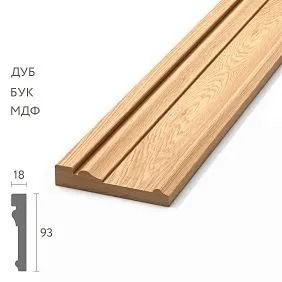
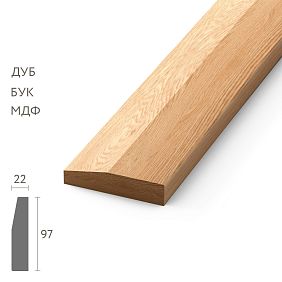
Ask yourself one question: is there anything wooden in this room — floor, doors, furniture, architraves, stairs? If yes — Wooden ceiling skirting board it logically completes the vertical «route» of wood in the interior: from the wooden floor through wooden floor baseboard и Wooden casings — to the ceiling profile at the top.
A solid wood ceiling plinth is chosen if:
-
the room has a wooden or parquet floor, which is supported by a wooden floor plinth;
-
the doors are wooden or have wooden architraves;
-
there is Wooden moldings or panels on the walls;
-
the interior is classic, neoclassical, or country style, where wood is the main finishing material;
-
you need to visually "close" the space — create a frame of wood around the perimeter of the room at the top and bottom;
-
the joint between the wall and ceiling is uneven and needs to be carefully hidden with a wooden profile;
-
the room is a study, living room, library, stair hall, where the status of the material matters.
Polyurethane and MDF work weaker in this context: they can visually imitate wood, but do not provide the organic feel of solid wood that "reads" next to real wood on the floor, in doors, and in furniture.

How a wooden ceiling plinth differs from polyurethane and MDF
Choosing the material is the first and fundamental decision. Let's consider all three options honestly.
Our factory also produces:


Wood — natural solid wood
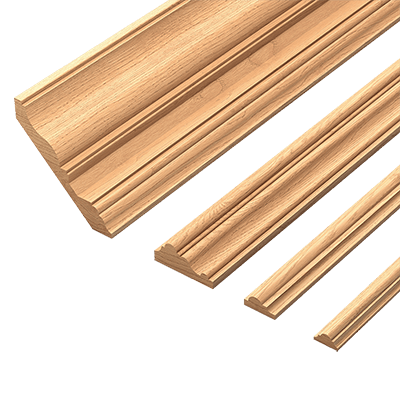
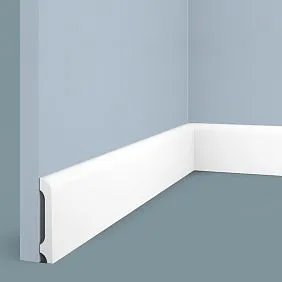
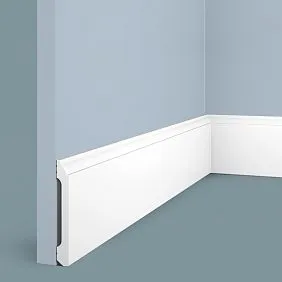
wooden ceiling molding made of solid wood — it is a living material with a unique fiber texture, strong cross-section, and that character that cannot be reproduced in synthetics. It accepts any coating: varnish, oil, stain, paint. It can be restored, repainted, sanded. A wooden profile next to a wooden floor, doors, and furniture creates a sense of a unified, well-thought-out space.
A wooden ceiling plinth is heavier than polyurethane — installation requires reliable fastening. But this is also a sign of quality: solid wood does not "play," does not deform with temperature changes, and does not crack.
Get Consultation
Polyurethane — lightness and complex profile
Polyurethane cornices and fillets are good where a complex stucco profile is needed, which would be too heavy and expensive in solid wood. Polyurethane is easy to paint, it is lightweight, and is glued with liquid nails. It is chosen for painted interiors when all decor is white and the natural texture of wood is not needed.
MDF — precise geometry
MDF profile is geometrically precise and stable. It is well suited for painting in the color of the walls or ceiling. But next to natural wood, MDF loses: the film coating "like wood" will never deceive the eye that has already seen real oak or ash on the floor.
The final selection principle: if the interior is wooden — use a solid wood ceiling skirting board. If the interior is painted, minimalist, white — use polyurethane or MDF for painting.
Where to use a wooden ceiling skirting board
Living Room
The living room is the main space of the house. Here Wooden ceiling skirting board it completes the top line of the walls and creates a horizontal frame around the perimeter of the ceiling. If the living room has Wooden moldings on the walls or wooden frames on paintings and mirrors — the ceiling profile made of the same wood closes the entire system. The gaze rises from the floor, glides along the walls and "catches" the wooden profile at the top — this is the feeling of completeness that distinguishes an expensive interior from a cheap one.
Office
The study is a space of concentration and status. The wooden ceiling profile here supports wall panels, dark doors, the library, and a massive desk. Wooden ceiling skirting in an office made of oak or walnut — this is not decor, it is part of the architecture of the work environment. Add Pogonazh iz massiva in a single series — and the office will look like a designed space, not a "haphazard" one.
Bedroom
In the bedroom, the ceiling molding should be calm. A wide dark profile in a small bedroom will create a feeling of pressure. Better — light wood, a smooth or softly shaped profile of medium width, matching the tone of wooden doors or wooden floor skirting board. A wooden ceiling molding in the bedroom should not "shout" — it should softly complete the space.
Entryway and stair hall
In the hallway, a wooden ceiling profile makes the entrance area cohesive and architecturally precise. This is especially important in a stair hall: a vertically elongated space with a wooden staircase, balusters, handrails, and wooden architraves requires horizontal finishing lines. wooden cornice along the perimeter of the hall — this is a horizontal point that "holds" the vertical of the staircase.
Country house
The best scenario for a wooden ceiling molding. In a country house, wood is everywhere: walls, ceilings, beams, stairs, furniture. Pogonazh iz massiva — moldings, architraves, cornices, profiles — work as a single natural system. A solid wood ceiling profile in a country house needs no justification — it is as organic here as a wooden beam or a wooden staircase.
Wooden cove molding, ceiling molding, or cornice: what's the difference
Three terms that are often confused — and that are indeed close in function but differ in form and scale.
Wooden fillet
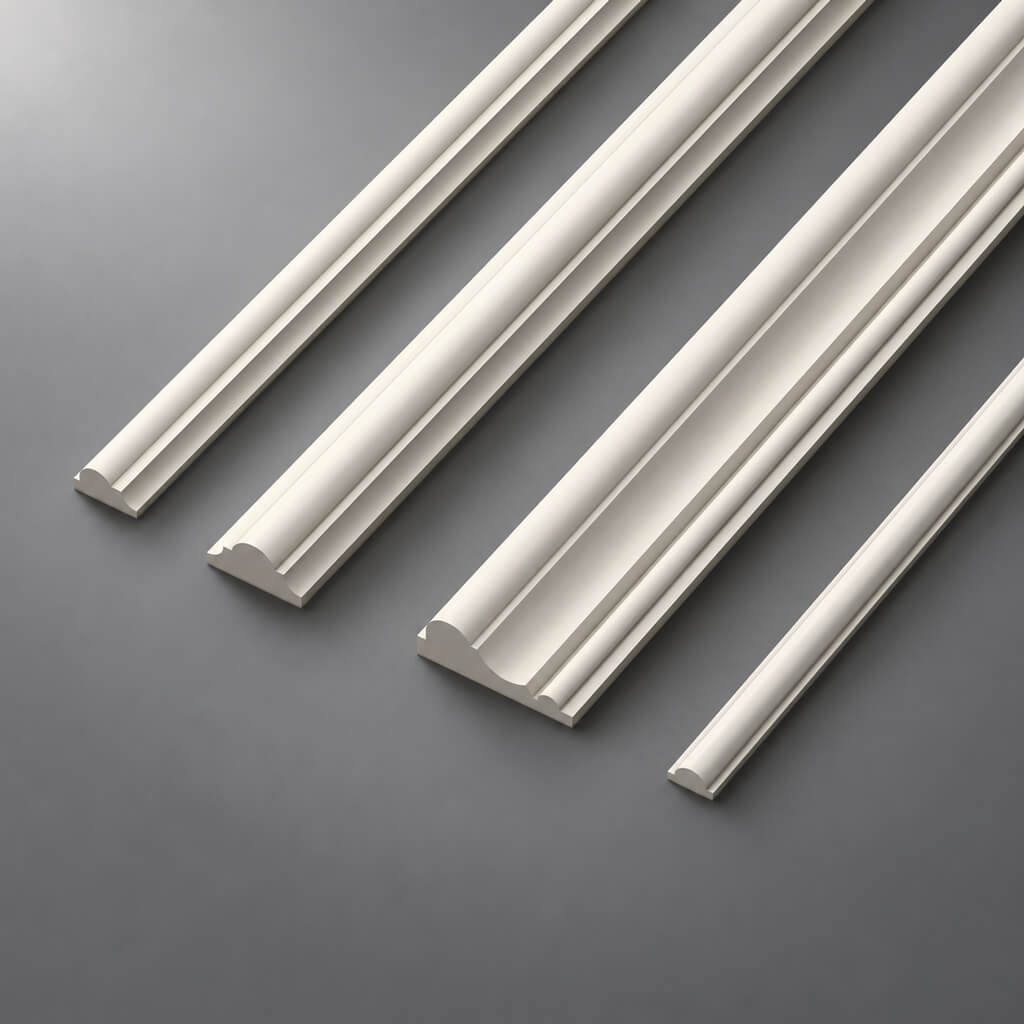
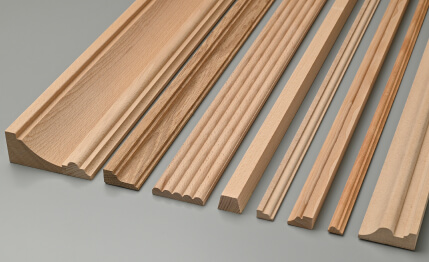
Wooden crown molding — is a lightweight, typically quarter-round or triangular profile for covering the right angle between the wall and ceiling. Minimal cross-section, minimal decorativeness. The task of the fillet is to neatly hide the joint without adding architectural weight. It is chosen for modern interiors, minimalism, Japandi, Scandinavian style.
Ceiling skirting board
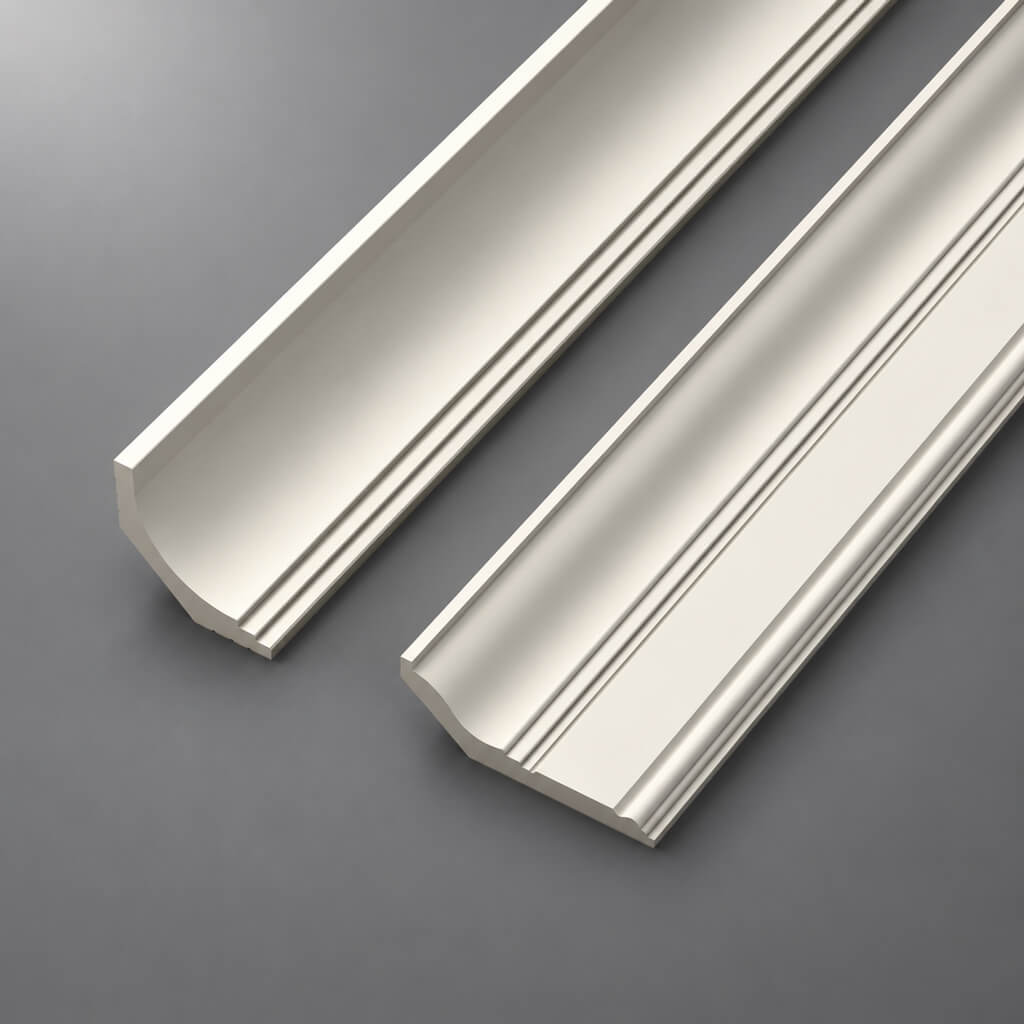
Ceiling plinth is a broader concept. It can be smooth or with a light profile, have a pronounced width, and create a noticeable horizontal line around the perimeter of the ceiling. Ceiling baseboard wooden — is both an architectural and decorative element. It is "read" in the room as a separate detail, not just a "closed joint".
Wooden cornice
wooden cornice — is the most expressive and "heavy" profile of the three. A classic cornice has a complex cross-section with several transitions, shelves, and fillets. This is an architectural element that carries a decorative load and sets the tone for the entire room. The cornice is chosen for classic, neoclassical styles, studies, and living rooms with high ceilings.
Briefly in a table:
| Type | Width | Decorative | Best context |
|---|---|---|---|
| Cove molding | narrow (20–40 mm) | Minimal | Minimalism, Japandi |
| Ceiling skirting board | medium (40–80 mm) | Moderate | apartment, country house |
| Cornice | wide (80–150 mm) | High | classic, study, mansion |
How to choose the width and height of the profile
This is a decision made considering three variables: ceiling height, room scale, and the presence of other wooden details.
Low profile (20–40 mm)
Lightweight Wooden crown molding for closing the joint without emphasis. Suitable for rooms with a ceiling of 2.5–2.7 m, where decorative expressiveness of the ceiling profile is not needed. Works well in modern interiors, Scandinavian style, children's room.
Medium profile (50–80 mm)
A universal solution for most apartments. Noticeable enough to read as an architectural detail, and restrained enough not to overload the space. wooden ceiling molding of this size aligns well with with wooden floor skirting height of 80–100 mm.
Wide profile (90–150 mm)
For classic, neoclassical, studies, and rooms with ceilings from 3 m. Wide wooden cornice creates an architectural horizontal line that visually "grounds" a high ceiling and makes the room cozier and more composed.
Principle of Proportion
A good guideline: the width of the ceiling profile is 1/25–1/30 of the wall height. For a 3 m wall, this is 100–120 mm for a cornice. For a 2.5 m wall, this is 83–100 mm for a ceiling plinth. For a 2.5 m wall in a modern interior, this is 30–50 mm for a cove molding.
And another rule that is most often broken: the ceiling and floor profiles should be proportionate. A heavy ceiling cornice with a thin floor plinth is an imbalance. The system works when the upper and lower horizontal lines "rhyme" in scale.
Which material to choose: oak, beech, ash, or pine
The wood species determines strength, texture, tone, and reaction to coating. Let's consider the main options used in solid wood trim.
Oak
Oak is the most chosen material for wooden ceiling profiles in premium interiors. Hardness, large expressive texture, warm brown tone — all this makes oak the leading material. An oak ceiling plinth with clear varnish or oil is a statement of quality.
Oak accepts stain and tinting well. It is used to make Wooden moldings, cornices, plinths, and Decorative Inserts in classic and study interiors.
Beech
Beech is denser and finer-grained than oak. The texture is calm, neutral, with a slight pinkish tint. Beech accepts any coating well and looks equally good under varnish and paint. For a light neoclassical interior or bedroom, it is one of the best options.
Ash
Ash is a species with a beautiful, large, and light pattern. A light whitish-cream tone makes ash an ideal choice for a natural Scandinavian or Japandi interior. A ceiling profile made of ash with a clear matte oil is a subtle, lively texture that doesn't need to be "enhanced" with stain.
Spruce
A soft and affordable species. For a country house in a rustic or Russian style, pine is an organic choice. Small knots and a lively texture are part of the material's character. For heavily used surfaces, pine requires a protective coating with a high degree of hardness.
Color and coating: how to choose the right shade
Choosing the color of a wooden ceiling profile is not an independent decision. It is an answer to the question: what exactly should it create unity with?
In ceiling color
A ceiling plinth painted to match the ceiling "disappears" into the interior — it covers the joint but does not accentuate it. This is an architecturally neutral solution for modern and minimalist interiors. At the same time, the wooden base holds paint more firmly than polyurethane.
Matching the wall color
If the walls are painted in a rich or warm tone, a wooden ceiling plinth in the same color creates the feeling that the ceiling is "sunk" into the color of the walls. A subtle designer technique that makes the room cozier.
Matching the color of doors and architraves
The most logical solution in a wooden interior. Wooden casings set a vertical wooden tone, wooden floor baseboard — a horizontal one from below, a ceiling plinth of the same tone — a horizontal one from above. The entire room is "inhabited" by wood around the perimeter — and this looks expensive and professional.
Under varnish or oil — natural texture
Clear varnish or natural oil preserves the color and texture of the wood. This is a choice for interiors where naturalness of the material is a value. A wooden ceiling plinth under clear oil next to wooden doors and parquet is one material language from floor to ceiling.
Under stain
Stain changes the tone of the wood without hiding the texture. With its help, light birch can be "aged" to look like dark walnut. For matching different wood species in one interior, it is an indispensable tool.
Contrast accent
A dark ceiling profile on light walls is a powerful design technique. It visually "lowers" the ceiling and adds coziness to the room. It only works if there is support: dark doors, dark furniture, dark wooden floor baseboard. Without this system, the contrast looks random.
How to combine ceiling plinth with floor plinth and architraves
This is the most important practical block. This is where a systemic decision is made that will determine whether the interior looks designed or "assembled."
The rule of the vertical route
Wood in the interior should "guide" the eye vertically: from the wooden floor through wooden floor baseboard by the wooden window casings to the ceiling profile. When all these details are made of the same material and the same tone, the route is read instantly.
The rule of proportionality
The ceiling profile and floor skirting should be proportionate. A thin 25 mm fillet at the top with a high 120 mm skirting at the bottom creates an imbalance. A rough rule: the ceiling profile should be 60–80% of the height of the floor skirting. With a 100 mm skirting, the ceiling profile should be 60–80 mm. With a 70 mm skirting, the ceiling profile should be 40–55 mm.
Profile coordination
The profile of the ceiling and floor skirting does not have to be identical, but should be in the same stylistic language. A shaped floor skirting requires a shaped or at least softly profiled ceiling skirting. A straight floor skirting requires a straight or filleted ceiling skirting.
The role of the casing
wooden casing — is a vertical connecting element between the floor and ceiling skirting. If the casings are shaped and classic, the ceiling profile can be more expressive. If the casings are smooth and modern, the ceiling skirting should be equally understated.
The best way to avoid inconsistency is to choose the entire Pogonazh iz massiva from the same series. The manufacturer has already coordinated the geometry and tone — all you have to do is select the desired items.
What else to pair with a wooden ceiling skirting
A wooden ceiling profile does not exist in a vacuum. Here are the details that create a unified system with it:
-
wooden floor baseboard — the horizontal lower frame of the room;
-
Wooden casings — the vertical wooden contour of doorways;
-
Wooden moldings and cornices — additional horizontal accents on the walls;
-
Pogonazh iz massiva — a complete system of wooden profiles in a single series;
-
wooden furniture handles — wooden accents on furniture in the same tone;
-
Decorative wooden inlays — for furniture, doors, walls;
-
wooden frames — mirrors, paintings, decor in a coordinated tone;
-
Solid Wood Items — complete catalog of wooden interior parts;
-
Carved Decor — if the interior requires a richer wooden ornament.
When all these details are made of the same material and the same tone, the room ceases to be a set of furniture and becomes architecture.
Wooden ceiling plinth in different interior styles
Classic
Wide wooden cornice with a shaped profile is a must-have element. Oak or walnut matching the doors and wooden floor skirting board. The ceiling profile in classic style creates a horizontal crown of the room — it is not modest, it declares style. Combined with wooden moldings on the walls and wooden casings — it is a complete architectural system.
Neoclassicism
A calmer profile, light tones, neat geometry. White or cream Wooden ceiling skirting for painting — for neoclassicism with white doors and light parquet. Or natural light ash — for neoclassicism with a warmer wooden character.
Country house
Natural wood, pronounced texture, medium or wide profile. Oak or pine depending on the character of the house. wooden cornice in a country house is often used together with slatted ceilings and wooden beams. This is not a "decor detail" — it is an organic part of the wooden space.
Modern interior
Lightweight Wooden crown molding with a clean cross-section. Ash or beech with clear oil. No ornament — only living texture in a minimalist context. A wooden ceiling profile in a modern interior is a "warm spot" of natural material surrounded by concrete, plaster, or painted walls.
Japandi
The principle of "less, but better": a narrow ash fillet, thin oil coating, zero ornament. The ceiling plinth in Japandi exists not to be noticed — it creates a calm, finished transition without disturbing the silence of the material.
Mistakes when buying a wooden ceiling plinth
Ten mistakes that occur regularly — and can be easily avoided by reading this section.
Buying a profile without considering ceiling height. A wide cornice of 130 mm on a 2.5 m ceiling will overload the room. Maintain the proportion.
Choosing color only from photos. The monitor lies. The shade of wood on screen and in person are different things. If possible, look at samples next to your floor, doors, or architraves.
Not considering the floor plinth. Disproportionate upper and lower profiles are one of the most noticeable mistakes in an interior. Look at them together.
Not coordinating with doors and architraves. The tone and profile of the ceiling plinth should rhyme with the tone and profile wooden architraves.
Choosing too massive a profile for a low room. This will visually 'press' the ceiling to the floor. In small rooms — only light and medium profiles.
Using too thin a fillet in a spacious room. A 20 mm fillet in a 40 m² living room will be unnoticeable and create a feeling of 'incompleteness' of the top line.
Not calculating the perimeter and reserve. Room perimeter + 10–12% for cutting, corners, and joints. Without reserve — improvisation on the spot, often costly.
Forgetting about external corners. In rooms with protruding columns, niches, or arches, there are external corners. They require cutting at 45° or special corner elements.
Mixing different wood shades without logic. Light ash on top, dark oak below, walnut on doors — if this is not a deliberate designer contrast with a system, it is chaos.
Buying ceiling profile separately from the rest of the molding. Pogonazh iz massiva — this is a system. Buying one element from it and taking the rest arbitrarily means giving up a coordinated result in advance.
What to buy together with a wooden ceiling plinth
Complete set of wooden molding for the interior:
-
Wooden ceiling skirting board — ceiling coves and profiles made of solid wood;
-
wooden cornice — for classic and study interiors with a more expressive profile;
-
wooden floor baseboard — the lower horizontal frame of the room;
-
Wooden casings — vertical wooden contour of doors;
-
Wooden moldings — additional horizontal profiles for walls and transitions;
-
Pogonazh iz massiva — a complete series of profiles, coordinated in geometry and tone;
-
wooden furniture handles — wooden accents on furniture in the same tone;
-
Decorative Inserts — for furniture, doors, and walls;
-
wooden frames — for mirrors, paintings and decorative objects;
-
Solid Wood Items — a full catalog of wooden interior details.
How to buy a wooden ceiling molding without mistakes: a step-by-step guide
-
Measure the room perimeter. The sum of all wall lengths is the base number of linear meters of profile.
-
Determine the ceiling height. This sets the allowable range for profile width.
-
Choose the profile type. Coved molding for a minimalist interior. Ceiling molding for apartments and country houses. Cornice for classic and office interiors.
-
Select the width. Based on the 1/25–1/30 proportion of wall height and considering the scale of the floor molding.
-
Choose the wood species and finish. Oak for status and durability, ash for a light natural tone, beech for neutral classic, pine for a country house.
-
Coordinate the color. With wooden casingswith doors, with wooden floor skirting and furniture.
-
Calculate the allowance. Perimeter + 10–12%.
-
Select all trim from one series. Ceiling plinth, floor plinth, architraves, moldings — from one catalog.
-
Go to catalog wooden moldings, cornices, and skirting boards and place the order.
About the company STAVROS
STAVROS is a Russian manufacturer of wooden trim and finishing products from solid wood. The company's catalog includes complete systems of wooden finishing: ceiling plinths, floor plinths, architraves, moldings, cornices, trim, decorative overlays, furniture handles, legs, and frames made of wood. STAVROS produces coordinated series — so that every element of a wooden interior works together, not separately. Full-cycle production, working with private clients, designers, and construction organizations throughout Russia.
FAQ: Answers to popular questions
Which wooden ceiling plinth is best to buy?
The choice depends on ceiling height, interior style, and the presence of other wooden details. For an apartment with a ceiling of 2.7–3 m — a medium profile of 50–80 mm. For classic style and an office — a wide cornice. For a modern interior — a light fillet of 25–40 mm.
How is a wooden ceiling plinth different from a cornice?
A ceiling plinth covers the joint between the wall and ceiling, has a moderate profile. A cornice is a more expressive architectural element with a more complex cross-section and greater width. Both solve a similar task but differ in decorative weight.
Can you paint a wooden ceiling skirting board?
Yes. A wooden profile made of solid wood is primed and painted in any desired color. Solid wood holds paint better than MDF and polyurethane and retains the painted surface longer without cracks.
What to pair a solid wood ceiling plinth with?
With a wooden floor plinth, architraves, moldings, cornices, doors, furniture with wooden handles and legs, frames, and other details from the same trim series.
How to calculate the amount of ceiling skirting board needed?
Room perimeter (sum of wall lengths) + 10–12% margin for trimming, corners, and joints. For rooms with niches, columns, and arches — up to 15%.
Are wooden fillet and ceiling molding the same thing?
Not exactly. A fillet is typically a narrow quarter-round profile used to cover a joint. Ceiling molding can be wider and have a more complex profile. In everyday practice, these terms are often used interchangeably, but technically they are different formats.