Article Contents:
- Why the price of a wooden baseboard cannot be estimated based on a single plank
- What makes up the price of a wooden baseboard
- Wood Species
- Height and thickness
- Profile shape
- Length of the strip
- Quality of sanding
- Preparation for enamel or tinting
- Oak: price for expressive texture and durable character
- Beech: calm texture and finishing flexibility
- How to compare oak and beech on one card
- 100 mm profile
- 120 mm profile
- 160 mm profile
- Curved or straight profile
- For enamel
- For tinting
- Is painting included in the price of the card
- Step 1. Determine the net perimeter
- Step 2. Choose a specific profile
- Step 3. Create a layout
- Step 4. Add a reserve
- Step 5. Multiply the number of planks by the current price
- Do not round each wall up to a whole plank
- Do not assemble a prominent wall from short fragments
- Do not buy the exact footage without a reserve
- Compare the full cycle of "Standard" and "Prestige"
- Do not automatically choose oak under enamel
- Finishing
- Installation materials
- Master's work
- Packaging and delivery
- Lifting and storage
- Repair reserve
- Need a baseboard for oak parquet
- Need an array for white enamel
- Need a wide baseboard for the living room
- Need a tall profile for the hall
- Need a rational profile for the entire apartment
- Need to reduce budget without switching to MDF
- Comparing starting prices of cards
- Not converting the price of a strip to linear meter
- Calculating only mathematical footage
- Confusing oak, beech, and combined construction
- Ignore the quality of sanding
- Considering 'under enamel' as finished painting
- Save on margin
- Not accounting for door trims
- Buying a high profile without checking the scale
- Not specifying delivery of a long-length product
- Living Room
- Bedroom
- Entry Hall
- Office
- Commercial interior
- How much does a wooden baseboard cost per meter?
- Why is the price listed per plank, not per meter?
- Which is more expensive — oak or beech?
- How to correctly compare the price of oak and beech?
- Does the height of the baseboard affect the price?
- What does the "Standard" quality mean?
- What does the "Prestige" quality mean?
- Does painting for enamel finish come included in the baseboard cost?
- How to calculate the cost for a room?
- What margin is needed?
- Why can't you just add ten percent?
- How does the length of the plank affect the cost?
- What is more cost-effective for white enamel — oak or beech?
- Can PLT-004 be compared to a solid oak baseboard?
- What additional expenses should be added?
- Can a wooden baseboard be restored?
- How to understand if buying solid wood is profitable?
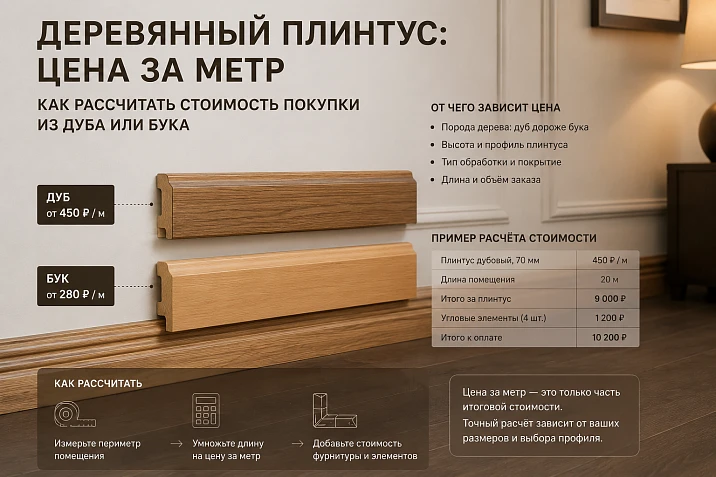
Wooden baseboard: price per meter — is one of the most practical questions before buying solid wood trim. It is not enough for the buyer to see the cost of one strip: they need to understand how many linear meters it covers, how much volume will be needed for a room or apartment, how much to add for cutting, and what the price will become after choosing oak, beech, a high profile, sanding quality, and preparation for finishing.
The comparison is complicated by the fact that wooden baseboards are sold not in abstract meters, but in ready-made planks of a certain length. For proven STAVROS models, solid oak and beech options often have a length of 2400 mm. If two planks cost differently, you cannot draw a conclusion based only on the price per piece: one model may be taller, thicker, more complex in relief, or more carefully prepared for final finishing. The true cost of the project becomes clear only after converting the price to a linear meter and laying it out along the walls.
Natural wood adds another level of choice. Oak and beech differ in grain, surface character, available finishing options, and the price of a specific execution. A baseboard for opaque enamel and a blank for tinting solve different tasks. The sanding quality 'Standard' and 'Prestige' also affects the budget: machine preparation is more cost-effective, while detailed hand sanding reduces the amount of subsequent refinement before finishing.
In the STAVROS catalog you can buy wooden baseboard for floor, sort products by price, compare height, thickness, length, and material, and then open PLT cards. Below we will break down the formula for the price per linear meter, the difference between oak and beech, the impact of a wide and high profile, calculating the number of strips, and additional costs that are often not included in the price of the product itself.
Why the price of a wooden baseboard cannot be evaluated based on just one plank
The price of one strip is convenient for the seller and clear when checking out, but it tells the buyer little without the length. A strip 2400 mm long covers 2.4 linear meters of a straight wall before accounting for trimming. To compare two models, the cost of each is divided by its length in meters. Only then can you see how much one linear meter of the selected profile costs.
However, even the price per meter is not the final budget. For a project, whole planks are purchased, not mathematically precise footage. If a room needs 17.2 meters of baseboard, seven planks of 2.4 meters each give 16.8 meters and will not cover the perimeter. An eighth plank will be needed, meaning the buyer pays for 19.2 meters of material. Some will remain as reserve or go to trimming.
The next factor is layout. Two rooms with the same perimeter may require a different number of planks. The first has four long walls that divide well into 2.4 meters. The second has many doors, niches, and short partitions. The total footage is the same, but in the second room more fragments remain that cannot be used without extra joints.
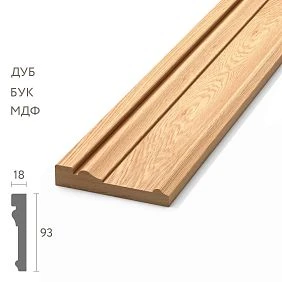
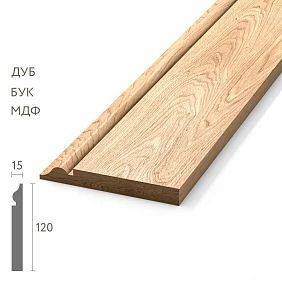
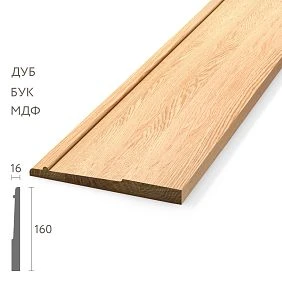
Finally, the price of a plank depends on the product itself. A profile 100 mm high and 15 mm thick cannot be directly compared to a baseboard 160 × 16 mm. A tall or shaped section has more material, more complex processing, and a larger finishing area. Therefore, a fair comparison always answers the question: how much does a meter of a specific profile cost in a specific material, and how many whole planks are needed for a specific room.




What determines the price of a wooden baseboard
Our factory also produces:
Wood species
Oak and beech are natural materials, but they offer different grain and commercial finishes. Oak is usually chosen for its expressive texture, noticeable fibers, and compatibility with oak parquet, doors, or furniture. Beech has a calmer and more uniform character, well suited for even staining and opaque enamel. The price depends not on an abstract wood rating, but on the specific product card, dimensions, quality of processing, and available batch.
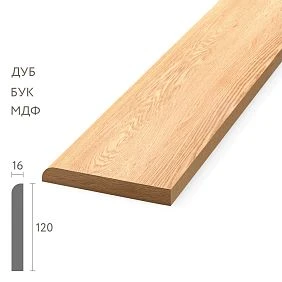
In one profile, oak and beech planks can have the same dimensions, making the comparison especially transparent. For example, PLT-005 in solid wood has dimensions of 120 × 16 × 2400 mm for both oak and beech. Here, the price difference can be attributed primarily to the wood species and chosen finish, rather than to length or height.
Get Consultation
Height and thickness
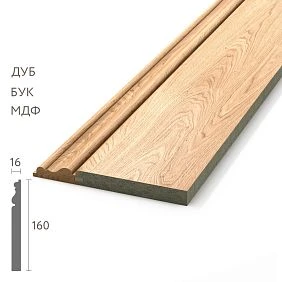
The higher and thicker the profile, the more wood is required per plank. Height also affects perception: a 100 mm baseboard creates a moderately noticeable line, 120 mm becomes a wide architectural belt, and 160 mm requires a spacious room and high doorways. The buyer pays not only for the volume of material but also for the scale of the finished element.
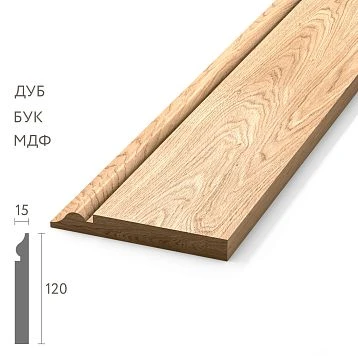
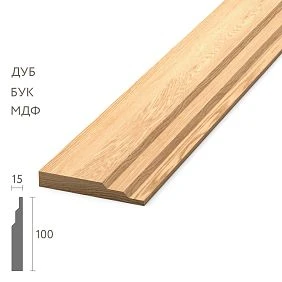
Thickness is important for door trims and furniture. PLT-006 in solid wood has dimensions of 100 × 15 × 2400 mm, PLT-005 — 120 × 16 × 2400 mm. The difference of one millimeter seems small, but the 120 × 16 profile contains more material and looks more massive. Comparing their price per meter without considering the cross-section is pointless.
Profile Shape
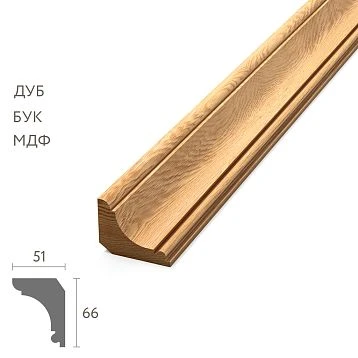
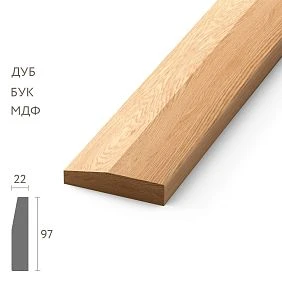
A straight plank and a complex classic relief require different processing. Grooves, steps, curves, and a shaped top increase milling time and sanding area. On a finished wall, such a baseboard creates a noticeable play of light and shadow, but before purchasing, you should check whether the interior needs this decorative effect.
A complex shape also affects installation. Corners require precise cutting, and joints require pattern matching. An error on a wide shaped profile can lead to the loss of a significant section, so the allowance sometimes has to be increased.
Plank length
Variants from the array in verified cards often use a length of 2400 mm. This affects the number of connections and how many whole products will fit into an order. The price per strip is converted to price per meter by dividing by 2.4. If another card specifies a different length, the formula changes.
You cannot compare a 2400 mm plank with a 2600 mm product only by the price per piece. A longer piece may be more expensive but have a lower cost per linear meter or allow covering a long wall with fewer joints.
Sanding quality
STAVROS uses the designations "Standard" and "Prestige". "Standard" means machine sanding and more affordable preparation. "Prestige" means detailed hand sanding, after which the product does not require additional surface finishing before subsequent stages of finishing. The choice affects not only the price of the plank but also the cost of the painter's or carpenter's labor.
A buyer who only compares product cards may see the higher price of "Prestige" and think they are overpaying for the name. In reality, part of the budget is transferred from subsequent preparation to the cost of the finished linear molding. For complex relief, hand sanding is especially valuable: finishing narrow grooves after installation is inconvenient.
Preparation for enamel or for tinting
These options are related to the future appearance of the product. For enamel, a workpiece is chosen that is planned to be covered with an opaque color. For tinting, when the visible wood texture needs to be preserved. For oak, the pattern usually becomes an important part of the interior; beech can be used for both tinting and enamel depending on the project.
The phrase "for enamel" does not necessarily mean that the baseboard is already painted. It is a characteristic of preparation or re-gluing, while the finish coating and its cost are checked separately. It is important for the buyer not to include imaginary finished painting in the calculation if the card does not confirm it.
Confirmed models for cost comparison
| Model | Confirmed execution | What affects the price | How to use in the calculation |
|---|---|---|---|
| PLT-001 | The current card table shows oak 120 × 15 × 2400 mm, "Prestige" quality, preparation options for enamel or tinting | Wood species, hand sanding, finishing option | Example of a classic oak profile 2.4 m long |
| PLT-005 | Oak or beech 120 × 16 × 2400 mm, "Prestige" quality; also the card includes MDF versions | Choosing oak or beech with the same cross-section and length | Convenient model for direct price comparison of wood species |
| PLT-004 | Height 160 × 16 mm; wood options are combined: MDF, veneer, and solid wood in the decorative part | Large height, complex construction, veneer and solid wood | Example of a high profile that cannot be considered fully solid |
| PLT-006 | Beech or oak 100 × 15 × 2400 mm; the profile is also available in MDF 100 × 16 × 2600 mm | Medium height, material, dual purpose baseboard/cornice | Example of a more compact wooden profile |
This table shows why you cannot build a rating based only on the price of the plank. PLT-006 has a height of 100 mm, PLT-005 — 120 mm, PLT-004 — 160 mm. PLT-004 in the wood version combines MDF, veneer, and solid wood, so it cannot be used as a pure example of the price of a solid oak or beech baseboard. PLT-001 and PLT-005 are closer to the task of comparing solid wood, but differ in thickness and available options.
If you need to see current values in one product group, it is more correct to look at prices for wooden baseboards in the category and open several cards. The price may change due to availability, material and finish, so the article explains the calculation method, not fixing numbers that will quickly become outdated.
How to correctly calculate the price per linear meter
The basic formula is simple:
Price per linear meter = price of one plank ÷ plank length in meters.
For a plank with a length of 2400 mm, the length in meters is 2.4. If the conditional price is 5000 rubles, the calculation looks like this: 5000 ÷ 2.4 = 2083.33 rubles per linear meter. This is an example, not the actual price of a specific product. The exact value is taken from the selected product card.
If a plank costs conditionally 6800 rubles and has the same length, the price per meter will be 2833.33 rubles. The difference between the two products is 750 rubles per linear meter. On a perimeter of 30 meters, the difference mathematically reaches 22,500 rubles, but the actual amount depends on the number of whole planks.
For a length of 2600 mm, the divisor will be 2.6. Therefore, you cannot transfer the calculation for solid wood to MDF or another format. Always convert millimeters to meters: 2400 mm = 2.4 m, 2600 mm = 2.6 m.
| Conditional price of a plank | Length | Calculation | Conditional price per meter |
|---|---|---|---|
| 3600 rub. | 2.4 m | 3600 ÷ 2,4 | 1500 RUB/m |
| 5000 RUB | 2.4 m | 5000 ÷ 2,4 | 2083.33 rub./m |
| 6800 rub. | 2.4 m | 6800 ÷ 2,4 | 2833.33 rub./m |
| 5200 RUB | 2.6 m | 5200 ÷ 2,6 | 2000 RUB/m |
Such a table is needed for comparison but does not replace order calculation. Whole planks will be added to the cart. If you need 25 meters of array with a length of 2.4 m, simple division gives 10.42. It is impossible to buy 10.42 planks, so the minimum will be 11 pieces, i.e., 26.4 meters before accounting for margin and layout.
Why the price per meter and the order price are different values
The price per linear meter answers the question of how expensive a specific product is when calculated for the same length. The order price answers a different question: how many whole slats will have to be paid for, taking into account walls, corners, and allowances. The difference between these values is especially noticeable in small rooms and complex layouts.
Let's imagine a room that needs 20.1 meters of baseboard. The plank length is 2.4 meters. Mathematically, 8.375 planks are required, meaning at least nine must be purchased. The total paid length will be 21.6 meters. If the price per meter is conditionally 2000 rubles, the mathematical cost of 20.1 meters is 40,200 rubles, but the actual cost of nine planks will correspond to 43,200 rubles. The difference is the cost of 1.5 meters of leftover.
The leftover is not necessarily a loss. It can be used to replace a damaged section, make a test paintout, or use a fragment on a short wall section. But at the time of purchase, it is still paid for. Therefore, next to the calculation of the price per meter, there should always be a column for 'number of slats'.
In a large apartment, the difference between the mathematical and actual footage may decrease because trimmings from one room transfer to another. If you count each room separately and round up, you will get an inflated order. It is more correct to first compile a general wall list, then distribute whole planks and leftovers across the entire object.
Which is more expensive: oak or beech baseboard
In most cards of the same profile, oak and beech can be compared without distortion if their height, thickness, length, and sanding quality match. Then the price difference is mainly related to the wood species and available finish. But the conclusion 'oak is always more expensive' should not be turned into a universal rule without checking the current table: the cost is influenced by availability, processing, promotion, and the specific model.
Oak: price for expressive texture and durable character
Oak skirting board is chosen when the wood grain should be visible. It pairs well with oak parquet, engineered wood flooring, doors, and furniture. Under tinting, the fibers remain part of the interior, so the buyer pays not only for the profile but also for the natural visual material.
For high-traffic areas, oak is often considered a conscious long-term choice. However, the wood species itself does not eliminate the need for protective coating and careful installation. The external corners of the baseboard remain vulnerable to impacts regardless of the price per meter.
Beech: calm texture and finishing flexibility
Beech has a more even and uniform grain. It suits interiors where natural wood should look calm, as well as projects under opaque enamel. With the same profile, a beech plank is often more budget-friendly, but the decision is made based on the current product card.
If the skirting board will be fully painted, the buyer should ask a practical question: is a pronounced oak texture needed if it will be covered by enamel? In such a situation, beech can provide the desired solid wood feel without paying for the visual advantage of oak, which will not remain visible.
How to compare oak and beech on one product card
PLT-005 is especially convenient for this calculation: oak and beech have the same size 120 × 16 × 2400 mm. Open the product card, select the same sanding quality, and compare the price of the planks. Then divide each price by 2.4. This gives a fair difference per linear meter.
For a specific project, you can choose the PLT-005 skirting board in oak or beech and immediately check how the wood species cost affects the entire perimeter. If the difference per meter is multiplied by 40–50 meters of the apartment, the total becomes noticeable. If the skirting board is needed only in one room, the decision may be determined by texture rather than savings.
| Criterion | Oak | Beech |
|---|---|---|
| Appearance | More pronounced fibers and natural grain | Calm, relatively uniform texture |
| Best scenario | Tinting, matching with oak flooring and furniture | Even toning or opaque enamel |
| How to compare price | Only with the same size, length and sanding quality | The same comparison conditions |
| Risk of overpaying | Buying an expressive species for full opaque painting | Expecting oak texture from a calmer material |
How profile height and shape affect cost
A wide wooden baseboard should be evaluated as an architectural element. It takes up more wall area, has a greater impact on doors, and requires more material for each plank. But the high price is justified only when the scale is needed for the interior. Purchasing a 160mm profile for a small room does not automatically make the trim more expressive — sometimes it simply overloads the wall.
Profile 100 mm
Height 100 mm suits many living spaces. It is more noticeable than a standard low baseboard but usually does not turn into a heavy belt. PLT-006 in solid wood has dimensions 100 × 15 × 2400 mm and can be used as a baseboard or cornice. This versatility is useful when creating repeating profiles, but before ordering you need to decide whether one relief is really needed at the floor and ceiling.
To evaluate this scale, you can select the wooden baseboard PLT-006 100 mm, convert the cost of an oak or beech strip into price per meter and compare with wider models. The difference will show how much the buyer pays for increased height and different geometry.
120 mm profile
The 120 mm height creates a wide bottom line. It suits spacious living rooms, hallways, studies, and rooms with large door casings. PLT-005 has a thickness of 16 mm and a classic profile. Compared to the 100 mm model, not only the material but also the visual role of the baseboard increases.
If the interior needs a wide baseboard, you can buy a wide baseboard 120 × 16 mm and compare the price of oak and beech on the same geometry. If the width is chosen only because it looks impressive in a photo, it's better to first mark 120 mm with painter's tape on the wall.
160 mm profile
Height 160 mm is intended for a large architectural scale. Such a baseboard noticeably affects the proportions of the wall, requires coordination with architraves, and is suitable for rooms with high ceilings. PLT-004 is an example of a high profile, but in wood versions it is a combined construction of MDF, veneer, and solid wood, not a completely solid plank.
Therefore buying a tall wooden baseboard 160 mm should be done after carefully reading the material in the product card. Its cost cannot be directly compared with solid oak or beech. The buyer compares different constructions, not just the height.
Shaped or straight profile
A curved baseboard may cost more due to processing and sanding. But its commercial value is only realized in a suitable interior. A straight profile is easier to paint and clean, while a classic one connects better with paneled doors, cornices, and wall panels.
When calculating, waste from corner cuts should be considered. The more complex the relief, the more important the precision of the joint. An extra plank in reserve may be wiser than trying to save to the last meter.
"Standard" or "Prestige": how sanding affects the overall budget
The quality of sanding is one of those parameters that buyers often overlook. It seems that two planks of the same size and material should cost the same. But "Standard" and "Prestige" mean different amounts of surface preparation.
"Standard" is machine sanding. It retains a more attractive price of the original product, but before demanding finishing, additional work by a craftsman may be needed. The amount of rework depends on the profile, future coating, and surface requirements.
"Prestige" is detailed hand sanding. The product does not require additional sanding before the next finishing stage. This is especially convenient for curved profiles, where manual processing after purchase takes a lot of time. The cost of the plank is higher, but part of the work is already done by the manufacturer.
| Option | What the buyer receives | When rational | What to include in the budget |
|---|---|---|---|
| Standard | Machine-sanded product | There is a craftsman who will prepare the surface; the project allows an additional stage | Possible manual finishing and time before painting |
| Prestige | Detailed manual sanding without the need for finishing | Complex relief, demanding tinting, tight deadlines | A higher price for the finished plank, but less preparation work |
To make the comparison fair, ask the finisher for the cost of the "Standard" preparation. If the difference between the options is less than the price of manual work on site, "Prestige" may be more advantageous. If the craftsman still performs the full cycle of preparation and painting, the basic option is sometimes more rational.
PLT-001 in the current table is presented as "Prestige". You can compare the price of PLT-001 baseboard made of beech and oak based on the available options on the card, but if one of the wood types is missing, its cost cannot be invented. The actual material selection is checked directly before ordering.
Baseboard for enamel or for tinting
Under Enamel
Opaque enamel covers the natural grain and provides a controlled color. The baseboard can be matched with walls, doors, architraves, or furniture. The price of the wooden blank is only the beginning of the budget: priming, painting, interlayer treatment, and the craftsman's work are accounted separately if these services are not included in the offer.
For enamel, beech often looks rational due to its calm structure. Oak can also be painted, but the buyer must understand that the expressive texture of the wood will be hidden. The decision is justified if the properties of the solid wood or a specific model are important, rather than the visible pattern.
Under Tinting
Tinting preserves the wood structure and requires more careful surface selection. On oak, the grain becomes part of the design; on beech, the color is usually distributed more calmly. Sanding errors and differences in absorption are more visible than under dense enamel, so preparation quality is especially important.
Samples should be included in the cost. A trial tinting on a scrap piece helps to see the shade next to the floor and door. Saving on a sample can lead to redoing the entire batch, which is much more expensive.
Is painting included in the card price
It cannot be assumed that the wording "for enamel" or "for tinting" means a finished topcoat. The card may describe the preparation of the blank. Before payment, clarify whether the product is supplied unpainted, what services are available, and what is included in the stated price.
How to choose material for parquet, boards, and doors
The price of a wooden skirting board only makes sense in the context of the interior. An oak floor does not require an oak skirting board of the same shade, but such a combination looks natural. You can choose a similar tint or make the skirting board darker to form a frame.
A beech profile is appropriate next to painted doors and calm furniture. Under enamel, it becomes a universal architectural element. If the doors and architraves are already ready, measure their thickness and compare with the skirting board: an expensive plank will not solve the problem of an unsightly protrusion near the doorway.
In an interior with several types of wood, it is better not to try to match everything at once. Determine the main material — floor, doors, or furniture — and tie the skirting board to it. Too many close but different shades make expensive solid wood look random.
How to calculate the cost of a wooden skirting board for a room
The calculation starts not with the price, but with a plan. Measure each wall along the installation line. Do not rely only on the project drawing: actual dimensions after plastering, finishing, and door installation may differ. Record lengths separately, not as a single sum. This way, you can see where a 2400 mm strip is used entirely and where a large fragment remains.
Step 1. Determine the net perimeter
Add up the lengths of the walls and subtract doorways where there will be no baseboard. Permanent built-in furniture can be excluded if it truly covers a section for the entire renovation period. It is better not to subtract a freestanding cabinet: when rearranged, an unfinished wall will be exposed.
Step 2. Choose a specific profile
Before calculating the quantity, you need to know the length of one strip. For solid wood PLT-005 and PLT-006, the format is confirmed as 2400 mm. Another model may have a different size. You cannot first divide the perimeter by 2.4 and then select a product with a different length.
Step 3. Create a layout
Start with the longest and most visible wall. Give it whole strips and the minimum number of joints. Then distribute the leftovers to short partitions. If you simply divide the total footage by the length and round up, you may get a theoretical minimum that does not work on real walls.
Step 4. Add spare
A reserve is needed for cutting corners, refreshing ends, possible errors, and future replacement. For a simple rectangular room, it is smaller; for a room with a bay window, niches, and many doors, it is larger. On a complex classic profile, the cost of error is higher because corner cutting requires precision.
Step 5. Multiply the number of planks by the current price
After the layout, the actual number of products becomes known. It is multiplied by the cost of the selected row in the card. Then finishing, installation materials, packaging, delivery, and labor are added separately if they are not included.
| Indicator | Conditional example | How to count |
|---|---|---|
| Net perimeter | 28.6 m | Sum of walls minus openings |
| Plank length | 2.4 m | Taken from the card of the selected option |
| Mathematical minimum | 11.92 planks | 28,6 ÷ 2,4 |
| Minimum whole planks | 12 pcs. | Round up |
| Work order | 13 pcs. | After layout and adding reserve |
| Product cost | 13 × current plank price | Uses the price of the selected material and quality |
The number 13 in the example is not a universal norm. In a simple room, twelve planks may be enough if the leftovers are distributed well. In a complex apartment, even thirteen may not be enough. The main purpose of the table is to show the difference between the mathematical minimum and the work order.
How to calculate the cost for the entire apartment
For an apartment, it is more profitable to create a general layout. A leftover piece 1100 mm long from the living room can cover a wall section in the hallway. If you calculate rooms separately, each will have a round-up, and the total order will be overestimated.
Create a list with columns: room, wall length, selected plank, leftover, where the leftover is transferred. First, distribute long whole pieces on open walls. Then use large fragments. Leave short inserts for niches and areas behind furniture, if this does not worsen installation.
If oak and beech are used in the apartment, calculations are done separately. The remainder of oak PLT-005 cannot be considered a replacement for a beech profile of the same size. The same applies to different sanding and preparation options: after tinting, the difference may become noticeable.
When ordering several models, PLT-006 100 mm, PLT-005 120 mm, and the high profile are calculated separately. They cannot be added into one total footage, even if all planks are 2400 mm long. Leftovers are not interchangeable by cross-section.
How not to overpay when calculating the quantity
Don't round each wall up to a whole plank
If you assign two planks to a 2.7-meter wall and forget about the 2.1-meter remainder, the estimate will quickly inflate. The remainder must get a specific place in another room or area.
Don't assemble a visible wall from short fragments
Saving material should not worsen the result. Three joints on an open wall are cheaper only on paper. In reality, the cost of work increases and the risk of shade differences rises. Whole planks are given to the most visible areas.
Do not buy exact footage without a reserve
Reordering a single plank may require separate delivery, and the shade of wood or tinting may differ slightly. A reasonable stock protects against greater overpayment later.
Compare the full cycle of 'Standard' and 'Prestige'
Cheaper machine sanding may require paid manual preparation. Request a finisher's estimate. Sometimes an expensive plank reduces the overall budget because it saves the craftsman's time.
Don't automatically choose oak for enamel
If the texture will be completely covered, compare beech. Oak is justified when its specific grain, properties, or particular finish is needed. Buying an expensive species without using its visual advantage may be unnecessary.
What additional costs to consider
The price of a wooden baseboard in the listing usually reflects the specific product and selected finish. The full renovation budget includes several additional items. Their composition depends on the project, so the article does not include unconfirmed rates.
Final finishing
An unpainted baseboard for enamel or tinting requires materials and labor. The budget may include samples, primer, stain, enamel, varnish, interlayer sanding, and drying. The specific technology depends on the material and desired result.
Installation materials
Glue, mechanical fasteners, compounds for joints and coating restoration are selected based on the base and profile. You cannot automatically use the same scheme for oak, beech, and combined PLT-004. If there are no confirmed product URLs, it is better to get recommendations from the installer and manager than to buy a random compound.
Master's work
The cost of installation depends on the number of corners, profile complexity, wall evenness, and finishing method. A straight long wall is cheaper to work on than a corridor with many doors. A tall relief baseboard requires more precise cutting and joint preparation.
Packaging and delivery
Planks 2400 mm long are considered long-length products. Safe transportation may require rigid packaging, and delivery conditions depend on the city, volume, and chosen transport scheme. These costs are clarified before payment, especially if the order consists of one or two planks: delivery can significantly change the price of a small order.
Lifting and storage
Check if the packaging fits through the elevator and stairs. Before installation, store the molding on a flat, supported surface in suitable conditions. Damage or deformation due to improper storage turns saved material into an additional purchase.
Reserve for repair
One spare plank is useful for future local replacement. Natural wood varies in pattern, and re-staining years later may not match perfectly. A reserve from the original batch reduces this risk.
What to buy together with the wooden baseboard
The "buy together" section should not turn into a random list of accessories. For a pricing project, elements that actually affect the final estimate are important: a spare of the same model, a finishing sample, an agreed profile at doors, and a suitable height option.
| What to add | Why | When it is especially important | What to Check |
|---|---|---|---|
| Spare plank of the same finish | Fixing a sawing error and future repair | Tinting, complex relief, large object | Wood species, size, sanding, and preparation |
| Sample for enamel or tinting | Checking the shade next to the floor and doors | Natural finish and complex colors | Same material and surface quality |
| 100 mm profile | Comparison of a more compact architectural line | Apartment with standard ceilings | Select wooden skirting board PLT-006 100 mm |
| Wide profile 120 mm | Creating an expressive lower belt | Living room, hall, study | Buy wide baseboard 120 × 16 mm |
| High profile 160 mm | Checking large classical scale | High ceilings and large openings | Buy high wooden baseboard 160 mm, considering combined construction |
| Classic oak profile PLT-001 | Comparison of hand sanding and preparation for finishing | Project with oak and noticeable texture | Buy wooden baseboard PLT-001 from oak or beech in a currently available version |
How not to confuse solid wood with MDF, veneer, and combined profile
The word "wooden" in the category name or description does not always mean that the entire plank is made of solid wood. One card may have options made of oak, beech, MDF, and moisture-resistant MDF. Another may have a combined construction with MDF, veneer, and a decorative part made of solid wood.
PLT-005 allows you to choose solid oak or beech, as well as MDF. To calculate the price of solid wood, you need to select exactly the "Oak" or "Beech" line. You cannot take the starting price of the card if it refers to the more affordable MDF.
PLT-004 in a wood finish is made of deep-milled MDF, veneered, with a decorative top part made of solid wood. This is a full-fledged interior profile, but its price is formed differently than that of a solid wood plank. In the article about oak and beech, it is used as an example of a high-end combined solution, not as a benchmark for solid wood pricing.
Before calculating, open the line of the selected material and write down the full name. If multiple materials are listed separated by a slash, the product is combined. This is not a drawback, but the comparison must be fair.
Practical choice for different situations
Need a baseboard for oak parquet
Compare the oak profile for tinting with a real floor sample. It is not necessary to achieve a perfect match; the same shade temperature and coating character are more important. Include trial tinting and sorting of planks by pattern in the budget.
Need solid wood for white enamel
Compare beech and oak with the same profile. If the texture is covered, beech may be more rational. Check that the card price refers to the blank, not the finished paint. Add the cost of final finishing.
Need a wide baseboard for the living room
PLT-005 120 × 16 mm allows comparing oak and beech on the same geometry. Mark the height on the wall, then calculate the price per meter for each wood type. Multiply the difference by the entire perimeter of the living room and decide if the oak pattern is justified.
Need a high profile for the hall
PLT-004 with a height of 160 mm creates a noticeable architectural line. But the wood options are combined. If you need solid wood specifically, look for a card with a direct indication of the material. If a high profile and natural veneer cladding are more important, compare the full construction.
A rational profile is needed for the entire apartment
PLT-006 with a height of 100 mm can provide more moderate material consumption and a calm scale. Calculate the price of oak and beech per meter, then make a general layout for the apartment. This approach is more useful than choosing the cheapest starting product in the category.
The budget needs to be reduced without switching to MDF
Compare beech, a lower profile height, and the "Standard" quality, if available in the selected card. But do not reduce the stock to zero and do not refuse trial finishing. Savings should reduce the cost of material, not increase the risk of rework.
How to create your own comparison table before ordering
When multiple suitable cards are open in a category, the numbers quickly get mixed up: one model has a more attractive slat price, another has a lower height, a third offers oak, and a fourth has more thorough sanding. A simple table helps compare not names, but the full commercial result. Create a separate row for each item and do not combine materials of the same article.
In the first column, enter the model and exact specification: for example, "PLT-005, beech, 120 × 16 × 2400 mm, Prestige, for enamel." In the second, the current plank price from the card. In the third, the price per linear meter. In the fourth, the number of whole planks according to the layout. In the fifth, the cost of the molding itself. In separate columns, indicate the expected costs for preparation, painting, installation, and delivery.
This form immediately reveals false savings. A model with the lowest unit price may require more slats or additional manual sanding. A more expensive "Prestige" sometimes turns out to be closer to the finished finish and reduces labor costs. The oak version can significantly increase the apartment budget but hardly change the cost of one small room. The decision becomes objective, not emotional.
It is useful to add a column "why I am choosing." For oak, it could be preserving expressive texture; for beech, a calm surface for enamel; for PLT-006, a moderate height of 100 mm; for PLT-005, a wide profile of 120 mm. If an expensive item has no clear advantage for the project, it is easier to exclude it without regret.
| What to record | Why | Which error is excluded |
|---|---|---|
| Full model execution | Separates oak, beech, MDF and combined options | Comparison of MDF starting price with solid wood |
| Price per linear meter | Brings different lengths to a common unit | Conclusion on the price of one plank |
| Number of whole planks | Shows the real basket after layout | Calculation based only on mathematical footage |
| Sanding and finishing | Accounts for preparation to finished surface | Choosing a cheap blank with expensive finishing |
| Logistics and reserve | Shows the total order budget | Unexpected expenses after paying for the goods |
After filling in the table, compare three final figures: the price per linear meter, the cost of the linear footage by the number of planks, and the total budget up to finished installation. The first is needed for reference, the second for the cart, the third for decision-making. It is the total budget that shows how profitable the selected oak or beech skirting board is.
Do not try to derive a single 'average price of a wooden skirting board.' The average value hides differences in species, sections, and quality. It is more useful to save the calculation for a specific model and update only the current price of the plank before placing the order. The formulas and layout will remain the same.
Errors that distort the price calculation
Comparing starting prices of product cards
A card may contain several materials. The starting price often refers to the most affordable option, not to oak or beech. To calculate the solid wood, you need to select a specific row of material, size, and sanding. Otherwise, the buyer compares an oak profile with MDF and gets an incorrect conclusion.
Do not convert the price of a plank to linear meter
Two planks may have different lengths. The price per piece does not show which one is more expensive for the same wall section. First divide the price by 2.4 or another actual length, then compare.
Counting only mathematical footage
A perimeter of 30 meters does not mean buying exactly 30 meters. Planks are sold as whole pieces, and the layout creates leftovers. The final cost is determined by the number of items, not by multiplying the perimeter by a conditional price per meter.
Confuse oak, beech, and combined construction
PLT-004 card contains MDF, veneer and solid wood in different parts of the profile. It cannot be placed in the same column as solid oak without explanation. The composition of the product is always fully checked.
Ignore sanding quality
"Standard" and "Prestige" have different levels of preparation. A cheap plank may require paid manual finishing. You need to compare the budget for the finished surface, not just the material cost.
Consider "under enamel" as finished paint
Preparation for enamel is not equal to the final color coating unless explicitly stated. Add finishing and labor to the budget. The same applies to tinting and varnish.
Saving on reserve
Buying without a reserve looks profitable until the first bad corner. Re-delivery of one plank and selection of a similar shade can cost more than a pre-planned stock.
Do not account for door trims
The thickness of the skirting board must match the architrave. If the profile protrudes, an additional solution will be required. The price of a beautiful plank does not include fixing an unprepared door unit.
Buying a tall profile without checking the scale
A 160 mm skirting board may look good in a catalog and turn out to be heavy in a room with a low ceiling. Before ordering, do a full-size layout. An inappropriate scale is the most expensive mistake because the material has already been purchased around the entire perimeter.
Not specifying delivery for a long-length product
A 2400 mm strip requires suitable packaging, transport, and entry route. For a small order, logistics can significantly increase the price per actually installed meter.
When a solid wood baseboard justifies its cost
Solid wood is suitable for a buyer who wants to preserve natural texture, match the baseboard with parquet, doors, or furniture, and get a product that allows subsequent surface renewal. An oak or beech profile can be re-stained or painted after preparation, if the construction and condition allow it.
The price is justified in an interior where the baseboard is truly visible. A wide plank of 100–120 mm runs along long walls, meets architraves, and becomes part of the architecture. In such a situation, natural material and quality of finish affect the overall impression.
Solid wood is reasonable for a country house, classic apartment, study, living room, restaurant, hotel, or salon where the finish is intended for long-term use. The buyer pays for the material, profile, and the ability to match the linear elements with other wooden components.
However, the high price does not exempt from proper room preparation. Uneven walls, unsuitable humidity, random fasteners, and poor finishing can ruin an expensive baseboard. The budget must include quality installation.
When it's better to choose another material
If the task comes down to a smooth opaque paint in the color of the wall, and natural texture is not needed, MDF may be more rational. It provides a stable surface for enamel and is often produced in longer lengths. A brief comparison with the price of MDF is useful, but it should not replace the topic of solid wood.
Another material should be considered in a project with a tight budget, large footage, and minimal requirements for natural texture. Also, solid wood may be excessive for temporary renovations or a room where the baseboard is almost completely covered by furniture.
A high combined profile is appropriate when a natural veneer finish and large geometry are needed, but a solid wood construction is not essential. PLT-004 demonstrates this scenario. It should be evaluated as a separate product type, not as a "cheap oak" or "expensive MDF."
Can a wooden baseboard be restored
One of the advantages of wood is the ability to refresh the surface. Minor scuffs, scratches, and color changes can sometimes be corrected with local preparation and refinishing. The scope of work depends on the depth of damage, the coating, and the profile shape.
Restoring a flat surface is easier than a relief with deep grooves. Tinted oak requires precise color matching, painted beech requires matching enamel and gloss. A spare plank from the original batch remains the most reliable solution for serious local repairs.
The possibility of restoration affects the long-term cost. More expensive solid wood can last through several cycles of renewal, while completely replacing a more affordable material can sometimes be more expensive in the long run. But you should not promise an unlimited service life: everything depends on conditions, installation, and care.
How to care for oak and beech baseboards
Care is determined by the finish coating. A surface painted with enamel is cleaned differently than one that is tinted and coated with a clear finish. The universal rule is to avoid excess water, abrasives, and strong mechanical impact. Specific products should be tested on an inconspicuous area.
Dust collects more often on the top horizontal edge and in the relief. A tall, shaped profile requires more regular cleaning. Timely care preserves the appearance and reduces the likelihood of costly restoration.
When wet cleaning the floor, water should not be left at the bottom end. Special attention should be paid to external corners and joints. Even oak needs a protective finish; natural durability does not replace proper coating.
How to choose a baseboard for different rooms
Living room
In the living room, a wide oak or beech profile can be justified if the walls are open and the baseboard is visible. A height of 120 mm pairs well with large doors and furniture. The price per meter is evaluated together with the visual role: expensive material here truly participates in the interior.
Bedroom
In the bedroom, a calm beech under enamel or soft tinting may be more rational than expressive oak. A 100 mm profile is often noticeable enough but does not overwhelm the room. If most of the perimeter is hidden by wardrobes, consider whether it is necessary to use an expensive model in all areas.
Hallway
The hallway requires durable finishing and well-thought-out external corners. Oak may be preferable based on usage, but the final decision depends on the coating. The cost includes end protection and quality installation.
Cabinet
Wooden baseboards pair well with libraries, panels, and solid wood furniture. Here, natural tinting can be preserved. If the interior is built around oak, the price of the species is justified by the connection of all elements.
Commercial interior
In a hotel, salon, or restaurant, large footage amplifies the price difference per linear meter. First, several options are calculated: beech, oak, 100 and 120 mm. Then, maintenance and the possibility of local repairs are considered. The lowest plank price does not always result in minimal costs over years of operation.
How to buy a wooden baseboard on the STAVROS website
Start with the category where you can select a solid wood floor baseboard. Sort products by price, but do not make a decision based on the first figure. Open the product card and choose the exact material. Note the height, thickness, length, sanding quality, and preparation for finishing.
For comparing species, the PLT-005 model is convenient. For a more compact profile, PLT-006. PLT-001 shows the oak version 120 × 15 × 2400 mm as "Prestige." PLT-004 is considered separately as a tall combined profile.
Convert the price of each selected plank into the cost per linear meter. Then create a layout and determine the number of whole pieces. After that, add finishing, installation, packaging, and delivery. This order protects against a situation where a cheap per-piece price turns into an expensive order due to inconvenient length or a large amount of waste.
Before payment, clarify current availability, material, and timelines. If the required species is not in the current table, the price of another option cannot be transferred. It is useful to provide the STAVROS manager with wall lengths, the selected profile, and the desired finish — this helps verify the quantity and configuration.
Frequently asked questions
How much does a wooden baseboard cost per meter?
You need to divide the actual price of the plank by its length in meters. For a 2400 mm product, the plank price is divided by 2.4. The resulting value is used for comparison, but the order is paid for by whole planks.
Why is the price per plank, not per meter?
Molding is produced as finished products of fixed length. The buyer receives a whole plank, so the cart counts pieces. The price per meter is a calculated indicator for comparison.
Which is more expensive — oak or beech?
Often the oak version costs more, but you need to check the same model with identical dimensions and quality. Availability and finish can change the difference.
How to correctly compare the price of oak and beech?
Select one article, the same length, height, thickness, and sanding. Divide the price of each plank by the length and multiply the difference by the required footage.
Does the height of the baseboard affect the price?
Yes. A tall profile requires more material and processing. But the price also depends on thickness, relief, wood species, and surface preparation.
What does the "Standard" quality mean?
This is machine sanding with a more affordable price. Before demanding finishing, additional manual preparation may be required.
What does the quality "Prestige" mean?
This is detailed hand polishing. The product does not require additional surface finishing before further treatment.
Is painting included in the cost of the baseboard for enamel?
Not necessarily. "Under enamel" may refer to the preparation of the workpiece. The presence of a finished coating and the cost of painting need to be clarified separately.
How to calculate the cost for a room?
Measure the walls, subtract openings, create a layout based on the length of the planks, and add a reserve. Multiply the number of whole planks by the current price of the selected finish.
What reserve is needed?
It depends on the number of corners, niches, and the complexity of the profile. The margin should cover trimming and possible errors. For complex layouts, it is larger than for rectangular rooms.
Why can't you just add ten percent?
The percentage does not account for layout. Sometimes one additional piece is enough, sometimes short walls require more. First distribute the strips, then determine the reserve.
How does the plank length affect the cost?
It determines the price per meter, the number of joints, and the quantity of whole items. A 2400 mm plank is converted to meters by dividing by 2.4.
What is more profitable under white enamel — oak or beech?
If the texture is completely covered, beech is often more rational. Oak is chosen when its properties, a specific model, or a partially visible pattern are important.
Can PLT-004 be compared to a solid oak baseboard?
Only with an explanation of the construction. The wood versions of PLT-004 combine MDF, veneer, and solid wood in the decorative part, so it is not a fully solid wood plank.
What additional costs should be added?
They include finishing, installation materials, labor, packaging, delivery, lifting, and a spare plank. The exact composition depends on the project.
Can a wooden baseboard be restored?
In many cases, the surface can be refreshed, but the method depends on the coating, depth of damage, and profile. A severely damaged section is easier to replace with a spare plank.
How to understand if it is profitable to buy solid wood?
Evaluate not only the initial price, but also the role of natural texture, the possibility of restoration, service life, and total lifecycle cost. If the wood is covered with enamel and barely visible, another material may be more rational.
What to save after placing an order
Save the card of the selected finish, quantity calculation, cutting layout, and finishing data. For future repairs, the exact model name, wood species, size, sanding quality, and used shade are useful. Such documentation helps avoid searching for a similar baseboard by photo and more accurately estimate the cost of local replacement in a few years.
Conclusion: the price per meter is needed for comparison, and the budget is for purchase
A wooden baseboard made of oak or beech cannot be chosen based on a single number in the catalog. The price of a plank is converted into the cost per linear meter, but the actual order is calculated in whole pieces. The final cost is influenced by the wood species, cross-section, length, sanding quality, preparation for enamel or tinting, layout, reserve, and additional work.
Oak justifies its cost when its expressive texture remains visible and is linked to the floor, doors, or furniture. Beech provides a calm pattern and often becomes a rational choice under enamel. "Standard" reduces the price of the initial plank, "Prestige" reduces the amount of manual preparation. Height of 100, 120, or 160 mm should match the room, not just the budget.
Before ordering, open the STAVROS product cards, select the exact finish, divide the price by the plank length, and create a layout along the walls. Then count whole pieces, add reserve, finishing, installation, and delivery. This calculation shows not an abstract price of a wooden baseboard, but the real cost of the finished lower line of the interior.