
















































































Article Contents:
- Wooden Window Casing: Why Wood Remains the Best Solution for Window Framing
- What is a Wooden Window Casing and Why is it Needed
- Types of Wooden Window Casings
- Smooth Wooden Casings
- Decorative Wooden Casings
- Carved Wooden Casings
- Casings for Painting and Tinting
- How to Choose a Wooden Window Casing
- By House Style
- By Shape and Profile
- By width
- By finish
- Wooden Window Casings for Exterior and Interior: What to Choose
- For facade
- For interior
- Wooden window casing for a house in Russian style with house carving
- How to choose wooden window casing according to window size
- Beautiful wooden window casings: which solutions look especially impressive
- For a wooden house
- For a country cottage
- For a dacha
- For classic facades
- For decorative window interior design
- What to combine wooden window casings with
- Casing + house carving
- Casing + carved overlays
- Door casing + cornice
- Casing + moldings
- Casing + millwork
- Casing + door trim in the same style
- How much does a wooden window casing cost?
- Buy wooden window casing: what to check before ordering
- Installation of wooden casings on windows
- STAVROS: wooden window casings with character
- Frequently Asked Questions
- Which wooden window casing is better to choose?
- Where to buy wooden window casings?
- Can wooden architraves be painted?
- Which casings are suitable for a wooden house?
- What to choose: smooth or carved casing?
- How to combine window trim with house carving?
- How to choose the width of wooden window trim?
- How long will wooden window trim last?

There comes a moment in every house's life when everything is done, yet the window still looks somehow unfinished to the world. The frame is in place, the glass is clean, the reveal is leveled. But something is missing. That something is called window trim. And if the house is wooden, suburban, alive — then wooden window trim becomes that final touch, after which the house truly begins to breathe.
Wood is not just a material. It's a living texture, a warm tone, a feeling of solidity. Wooden window trim makes a window noble. It turns a technical joint into a decorative detail, and the window itself — into an accent of the facade or interior.
Looking forwooden window trimthat will emphasize the style of the house and beautifully frame the window opening? Check out STAVROS solutions in the house carving section: decorative wooden elements, carved details, and expressive facade decor for windows.


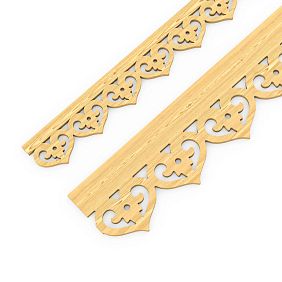
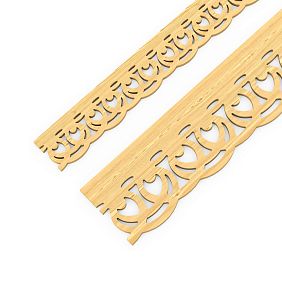


Wooden window trim: why wood remains the best solution for window framing
Plastic, MDF, polyurethane. All of these exist. All are cheaper. And yet — wooden window trim has remained the standard of window framing for centuries. Why?
Because wood is the only material that creates not just form, but atmosphere. When morning side lighting falls on a wooden profile with soft relief—you don't just see a plank. You see shadows that emphasize every transition. You see the texture of the grain. You feel that it's real.
What specifically does a wooden window casing provide:
-
Warmth. Wood is visually warmer than any synthetic material. It softens the facade, making it less industrial.
-
Nobility. Even a smooth wooden casing looks more expensive than wood imitation.
-
Versatility. Wooden casing suits both classic stone facades, log houses, and wooden homes.
-
System. Wooden casing easily integrates into a unified decorative system: with cornices, moldings, trim, and carved overlays.
-
Expressiveness. If decoration is needed—wooden casing is ideal as a base for house carving, overlay elements, and ornaments.
For wooden houses, country cottages, and all projects where working with wood is a fundamental choice, preciselyWooden window trimsare not an option, but the only correct solution.




What is a wooden window casing and why is it needed
Let's define the concept. A wooden window casing is a decorative profiled wooden strip that is installed around the perimeter of a window opening from the outside or inside. Its task is to cover the installation seam between the window frame (or the slope box) and the wall surface.
But to speak only of its technical function is to underestimate this element. A wooden window casing plays several roles at once:
Decorative function. Framing the window opening shapes the visual image of the window. Without a casing — it's just a wall with a hole. With a casing — it's an accent, a detail, an architectural element.
Visual completion. The casing gives the window a finished look. This works both on the facade and in the interior.
Architectural character. The shape of the profile, width, presence or absence of carving — all this speaks to the style. A wide, figured wooden casing on a classic house is a statement. A narrow, laconic one on a modern country house is a delicate accent.
Protection of the abutment zone. The casing physically covers the seam, preventing dust, moisture, and dirt from accumulating in the area where the frame meets the slope.
Basis for decoration. A wooden casing is an ideal base for appliedof carved elements, corner decorative details, and ornaments. It is on a wooden base that carved decor looks organic, not glued-on.
Our factory also produces:


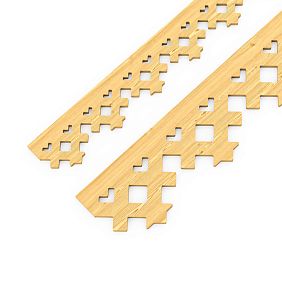


What types of wooden window casings are there
It's important not to get confused here. The assortment is vast — and that's good, because there is a solution for every house style and every request.
Get Consultation
Smooth wooden architraves
The simplest and most versatile option. A smooth profile without relief or with a minimal bevel. Accepts any finish well: white enamel, oak-toned stain, matte varnish.
Where it works best:
-
Modern country house with a laconic facade
-
Scandinavian interior
-
Minimalist room design
-
Situations requiring neat framing without emphasis
A smooth architrave is like a blank slate. It doesn't interfere, doesn't draw unnecessary attention, yet properly completes the window opening.
Decorative wooden architraves
A more expressive option: a shaped profile with multiple transitions, steps, and roundings. The relief is created in the profile's form itself—without additional overlays.
SuchDecorative wooden window casingSuitable for:
-
Classical and neoclassical facades
-
Country houses in the "traditional cottage" style
-
Interiors with wooden cornices, moldings, panels
A decorative profile is more interesting than a smooth one — it creates relief and shadows that change depending on the lighting angle. At the same time, it does not require additional overlay elements — the profile itself serves as decoration.
Continuing and finishing the article to the end:
shadows that change depending on the lighting angle. At the same time, it does not require additional overlay elements — the profile itself serves as decoration.
Good combination: decorative wooden casing +wooden corniceabove the window in the same profile +Wooden moldingson the wall. A system where each element supports the style.
Carved wooden window trims
This is the pinnacle of window design. The most expressive, decorative, and emotional option.
Carved wooden window trimIt carries ornamentation, patterns, and relief—deep, vibrant, unique. It's not just a window frame. It's a statement. It's the house's calling card.
Carved wooden window trims are especially relevant for:
-
Wooden houses and log cabins
-
Houses in Russian style
-
Country estates with historical or folk character
-
Dachas where warmth and individuality are valued
-
Any property where house carving is part of the architectural concept
Fundamental difference from decorative trim: here the ornament is an independent artistic element. Openwork, pierced, geometric, floral, solar — each type of carving carries its own visual meaning.
Wooden window trims in Russian stylewith traditional carving — the strongest decorative answer to the question 'how to make a wooden house expressive'.
Trims for painting and tinting
This is not a separate structural type, but a surface characteristic. A wooden trim without a finish coating — sanded, ready for painting. You choose yourself: white enamel, tinting, matte or glossy varnish, oil with wax.
Advantage: precise match to the desired shade. If the walls are painted in a specific RAL color — you paint the trims with the same paint. Complete match is guaranteed.
Wooden window trimfor painting — a universal basic choice for any project where the finish color is determined by interior or facade design.
How to choose a wooden window trim
This is the central practical question. We'll break it down by each parameter — in detail, without unnecessary words.
By house style
Wooden house. Only natural wood. Only carving that is organic to the wooden context. Openwork or three-dimensional carving with traditional motifs. Finish — natural varnish, oil, or white enamel. No MDF and no imitation: in a wooden house, any inauthenticity is immediately noticeable.
Classical facade. Brick, plaster, tall windows. Casing with a classic shaped profile, width from 80 mm. Possibly — with decorative corner overlays or a central medallion. White enamel or light tint.
Modern country house. Concise smooth or low-relief profile. Width 65–75 mm. Finish matching the facade or in a contrasting neutral color. No ornamental overload.
Interior window trim. Inside a room, casing functions differently than on a facade. It interacts with baseboards, moldings, cornices, furniture. Therefore, the profile style must coordinate with the entire interior system. Shaped profile in a classic interior, smooth — in a modern one.
By shape and profile
Profile shape is the visual character of the casing. Flat rectangle, beveled rectangle, wavy classic profile, multi-step architectural, carved ornamental. The richer the profile — the more it directs the viewer's attention.
Practical rule: the casing profile should be in harmony with other wooden elements of the room or facade. If the interior usesWooden moldingswith a classic profile — the casing should be in the same tradition.
By width
The width of a wooden casing is not an arbitrary choice. It must correspond to the scale of the window and the height of the room or facade.
| Width | Application |
|---|---|
| 40–55 mm | Small windows, bathrooms, pantries, minimalist interior |
| 60–75 mm | Standard interior openings, universal range |
| 80–95 mm | Large windows, classic interior, expressive facade |
| 100–130 mm | Formal rooms, high ceilings, monumental design |
For carved wooden trim: the richer the ornament, the wider the plank should be. Fine carving on a narrow plank gets lost. A wide surface gives the ornament space to "resonate".
By finish
Natural wood. Oil with wax or clear varnish. Maximum texture expressiveness. Best option for wooden houses and facades with natural materials.
White. White matte or glossy enamel. Universal option for classic, neoclassic, any facade with white windows. Whitewooden window trims— one of the most popular choices in private house construction.
For enamel. Painting in any RAL color. Allows for exact matching with interior or facade color scheme.
For varnish / tinting. Tinting to oak, wenge, walnut, beech, tobacco. Wood grain pattern is preserved with changed shade. For interiors with wooden floors, furniture, doors — a way to create a unified wooden environment.
Wooden window trims for exterior and interior: what to choose
The same trim does not perform equally well outside and inside. The tasks are different—and therefore, the choice is different.
For the facade
On the facade, the trim is immediately and fully visible. It contributes to forming the first impression of the house. Therefore, expressiveness is important here—not flashy, but noticeable.
For the facade, a wooden trim:
-
Must be made from properly dried wood (moisture content 8–12%)
-
Must have moisture-resistant coating on all surfaces, including the ends
-
Must harmoniously blend with the architecture of the house—in width, profile style, and character of the ornament
-
Can be enhancedhouse carving—with overlay elements, patterns, cornice details
An important principle for the facade: the trim is not on its own. It is part of the architectural language of the entire house. Trims, roof cornices, brackets, corner pilasters—all should speak the same language.
For interior
Indoor conditions are milder: no atmospheric exposure, no sharp temperature fluctuations. Therefore, the choice of material and finish is wider.
But interior casing is part of a more complex decorative system. It interacts with:
-
Baseboard (the lower boundary of the room)
-
with wooden cornices (the upper boundary)
-
moldingson walls
-
Door casings
If all these elements are coordinated in profile and finish — the room gains architectural integrity. This is what distinguishes a professionally designed interior from just a neat renovation.
Wooden window casing for a house in Russian style with house carving
This is a special conversation. One of the deepest and most important.
Russian house carving is not decoration. It is a language. Each element of the ornament had meaning: solar signs on spinning wheels and casings, plant scrolls as a symbol of vital force, birds as heralds of spring and good luck. A wooden house with house carving is a house with history, with character, with a stance.
Today, house carving is experiencing a genuine renaissance. Not as a museum exhibit, but as a living architectural element. New wooden houses, country estates, restored historical objects — all of this calls for carved decor.
Wooden window casing with house carving— is the central element of window decoration in this tradition. It includes:
Side posts with vertical ornamentation — symmetrical, with plant or geometric motifs.
The upper horizontal part ("towel") — the most decorative element of traditional casing. This is where the ornament is concentrated: openwork carving, symmetrical composition, central motif.
Corner elements — decorative accents at the junctions of vertical and horizontal parts.
How to avoid overloading the facade:
-
One type of ornament for all windows — not several different ones
-
Uniform finish (white enamel or natural varnish) — do not mix
-
Simple wall background — the casing should stand out against it, not get lost
-
Consistency with cornices and other wooden facade details
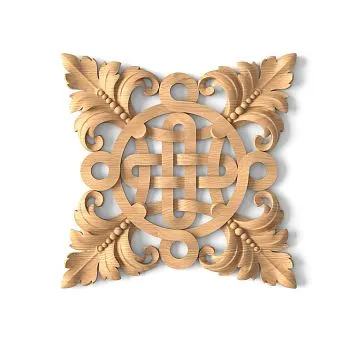
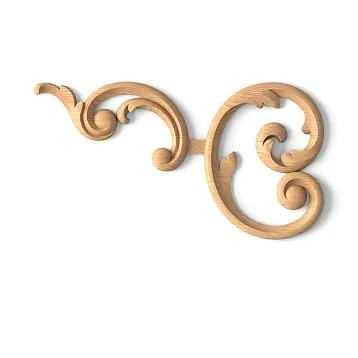
Additional carved decor —Wooden carved appliqués— can be used as additional accents on the casing. Corner rosettes, central medallions, decorative inserts along the length of the side strips — all this enhances the image without the need to make the entire casing solid carved.
How to choose a wooden window casing according to the window size
Proportionality is a principle that professional designers know as 'scale'. The detail must correspond to the whole. Casing to window, window to facade, facade to house.
Small windows (up to 800×800 mm). Narrow casing 40–55 mm, laconic profile. A wide casing on a small window creates a feeling of 'frame bigger than the picture'.
Standard windows (800×1200 — 1000×1500 mm). Casing 65–80 mm, standard profile. Carving — medium detail.
Large windows (1200×1800 mm and above). Casing from 85 mm. Rich decor, wide 'towel' at the top.wooden window trims— wide format for large windows is a monumental decor that works as an architectural accent of the entire facade.
Group of windows. If several windows are located nearby — the casings should be of the same width, the ornament — of the same type. The rhythm of repetition creates order. Disparity — chaos.
Proportions and relief. The depth of carving should correlate with the width of the strip. Small shallow relief on a wide strip — looks empty. Large high-relief ornament on a narrow strip — looks overloaded. Optimum: relief depth 8–15 mm with casing width 70–90 mm.
Symmetry. This is a mandatory requirement for any window trim. The side trims are of equal width. The top horizontal trim is symmetrical relative to the center. The offsets from the frame are the same on all sides.
Beautiful wooden window trims: which solutions look especially impressive
Theory is good. But concrete images and situations are much more useful. Here are the solutions that make the strongest impression.
For a wooden house
White openwork pine trim on a dark wood log wall—this contrast works flawlessly. The white pattern on a dark background reads as graphics. It is light, airy, and yet architecturally convincing.
Tinted lacquered trim with three-dimensional carving matching the color of the timber—a more monolithic option. The trim blends with the house, creating the impression that all the decor is from a single piece.
For a country cottage
Wide wooden trim 90–100 mm with a classic shaped profile for white enamel. Decorative corner rosettes. Simple, clean, aristocratic.
For a dacha
Wooden trims with simple openwork carving in a folk style. Bright coating—blue, green, burgundy. A dacha is a place where you can allow yourself color and individuality.
For a classic facade
Monumental oak trim 100 mm with a classic architectural profile. White matte enamel.wooden corniceabove the window in the same profile. A system that turns an ordinary window into an architectural detail.
For decorative interior window trim
In interiors, the combination works well: a wide oak casing for tinting +Wooden moldingson the wall + wooden slopes in the same tone. The entire window area becomes a decorative element of the room — not just a light opening, but an architectural frame.
What to combine wooden window casings with
A wooden casing is an element of a system. It is stronger when it's not alone. Let's examine key combinations.
Casing + house carving
House Carving— applied and cut-out decorative wooden elements for the facade. In a system with the casing, they create a complete window treatment: side casing posts + an upper "towel" with carving + corner overlays + additional carved details on the slope.
Casing + carved overlays
Wooden carved appliquésare mounted on the base profile of the casing, enhancing its decor. Corner rosettes, central medallions, vertical inserts — each of these elements can be added to an already installed smooth casing. This is a flexible system where you control the degree of decorativeness.
Casing + cornice
wooden corniceAbove the window is the upper horizontal element that 'covers' the casing. In classical architecture, this element is called a pediment. It completes the window frame from above, creating a sense of an overhanging superstructure. The combination of casing and pediment is one of the most expressive techniques in window decoration.
Casing + moldings
Wooden moldingsOn the walls, they create a horizontal rhythm for the interior. Window casings are vertical accents. Together, they form an architectural grid in which each zone is clearly defined. In a classical interior, such a system is mandatory.
Casing + millwork products
wooden carved trim— baseboards, cornices, friezes — complements the finishing system into a unified wooden environment. When the casing, baseboard, and cornice are made from the same wood species in the same style, the interior gains architectural integrity.
Casing + door trim in the same style
Windows and doors in the same room or on the same facade should speak the same language. The window casing and door casing should be from the same series, with the same finish, and a coordinated profile. This is a condition for architectural unity.
How much does a wooden window casing cost?
A direct question deserves a direct answer. But there is no direct answer here — because the price is determined by a set of specific parameters.
Wood species. Pine is the most budget-friendly option among conifers. Beech, birch — mid-price segment. Oak, ash, larch — above average price. Exotic species — maximum price segment. The choice of species affects both the price, durability, and visual character.
Width of the strip. Wider means more expensive. This is a direct correlation: more material, more work during milling.
Type of profile. Smooth is the base price. Shaped is more expensive. Carved is significantly more expensive.
Depth and complexity of carving. Surface relief 3–5 mm is a minimal surcharge. Volumetric carving 10–20 mm with ornament is a substantial surcharge. Openwork pierced carving is maximum labor intensity and cost.
Coating. Without coating (for painting) is the base price. Factory coating: tinting, varnish, enamel is more expensive.
Finished product or assembly system. Simple profile casing is the base price. Casing + corner overlays + central medallion + upper cornice-sandrik is a full decorative system, the price of which is summed from all elements.
Length. Standard strip length is 2100–2200 mm. Non-standard length is upon separate request.
General advice: do not perceive wooden casing as an item for saving. It is a visible, constantly perceived element. Bad casing — crooked, with uneven coating, with warped geometry — spoils the impression of the entire house. Good one, made from properly dried wood with precise processing, lasts 30–40 years and maintains its shape and appearance.
Buy wooden window casing: what to check before ordering
Practical checklist — for those who want to buy correctly the first time.
Quality of wood. Moisture should be within 8–12%. Kiln drying is a mandatory condition. Under-dried casing will warp after installation: the coating will crack, the shape will change, joints will separate.
Geometry. When receiving the order — check the straightness of the slats along their entire length. Lay them on a flat surface: the slat should not rest on both ends with a gap in the middle.
Surface treatment. The milled relief should be clear, without "crushed" edges and irregularities. Profile transitions — smooth. Surface — free of lint and coarse scratches.
Style compatibility. If you are buying a casing separately from other wooden elements — make sure the profile is stylistically compatible. Classic figured casing + minimalist baseboards = style conflict.
Dimensional accuracy. Measure all windows you plan to trim. Ensure the selected casing width covers the entire mounting seam with a 5–8 mm margin.
Decorative elements in the same style. If you plan tocarved appliqués, corner rosettes, or other decorative details — make sure they are available from the same series and match the finish.
Sufficient quantity. For one standard window, you need 2 side slats + 1 top horizontal one. Calculate the quantity with a 10–15% margin for trimming and possible defects during installation.
Buy wooden window casingandbuy wooden window casings with a full range of decorative elements — in the STAVROS catalog.
Installation of wooden window casings
Installation is not a topic for lengthy discussion. But several key points need to be known.
Surface preparation. The slopes and wall surface in the installation area must be dry, even, without peeling plaster. A damp base is a guarantee of problems with the wooden casing in a year.
Marking. Before installation, mark the position of the casing around the perimeter of the window. The offset from the frame should be the same on all sides — standard 5–10 mm. Check the horizontal and vertical alignment with a level.
Cutting corner joints. The side and top casings are joined at the corners at a 45° angle. This is done with a miter saw with precise angle setting. An error of 1° — and the joint is visible. Check the cuts before installation by dry-fitting the slats.
Fastening. Finish nails 40–50 mm every 400–500 mm + glue on the end abutting the frame. Nail heads are sunk with a nail set, filled with putty, sanded, and painted over.
Combination with decorative overlays. If plannedWooden carved appliqués on corner joints or in the center of the top horizontal part — they are installed after the main slats, with glue, and a finish nail for reliability.
Common mistakes:
-
Installation on a damp base
-
Asymmetric offset from the frame
-
Poor-quality cut — gap in corner joint
-
Buying warped material — everything will have to be redone
Why is it important to choose a quality profile from the very beginning? Because a warped casing cannot be corrected during installation. It can only be replaced. A geometrically precise plank made from properly dried wood is the only guarantee of a result that will please for years.
STAVROS: wooden window casings with character
When they say 'wooden home decor', there should be real production, real material, and real quality of processing behind it. Not declarations, but specific products with precise geometry and correct wood moisture content.
STAVROS is a manufacturer of solid wood products with a full production cycle. Drying wood to standard moisture content, milling on professional equipment, manual finishing of complex carved elements, surface finishing.
In the STAVROS catalog for window opening decoration:
-
wooden window trim— house carving, decorative facade elements, window carved decor
-
carved appliqués— for corner accents, central medallions, decorative inserts
-
Wooden moldings— for interior decoration system
-
wooden cornice— for roof and window decor
-
Carved Trim— baseboards, belts, friezes made of solid wood
Retail and wholesale work. Complete window trim set — in one place, in a unified style, from one material.
Frequently asked questions
Which wooden window casing is better to choose?
Depends on the task. For a wooden house in Russian style — carved casing with traditional ornament. For a classic facade — shaped wide profile for enamel. For a modern country house — smooth or minimalist profile matching the facade color. The main criterion is matching the architectural character of the house.
Where to buy wooden window casings?
In the STAVROS catalog — full range of wooden decor for window trim: from simple profiles to carved elements of house carving.Buy wooden window casing with delivery across Russia.
Can wooden architraves be painted?
Yes, this is one of the main advantages of wood. Wooden casing accepts any coating: white enamel, tinting, matte or glossy varnish, oil with wax. Repainting is possible multiple times — the surface is sanded and painted anew.
Which casings are suitable for a wooden house?
Only wooden ones — made from solid wood, in the same or similar material. Openwork carving, traditional patterns, natural or white finish. MDF and polyurethane imitations look inorganic in a wooden house.
What to choose: smooth or carved casing?
If the goal is neat framing without accents — smooth. If the goal is decorative finishing with character — carved. An intermediate option: smooth casing +carved appliquésat corner joints — a balance between simplicity and expressiveness.
How to combine casing with house carving?
Casing — the base. House carving — an ornamental accent on its surface or nearby. Principle: unified ornament style across the entire facade, unified finish, coordinated width of elements.Wooden window casing with house carving— the most expressive solution for a wooden house.
How to choose the width of wooden casing for a window?
Focus on the window size and room height. Standard — 65–80 mm. For large windows and high ceilings — from 85 mm. For small windows and narrow openings — 40–55 mm.
How long will wooden casing last?
With proper wood drying, quality coating, and timely finish renewal — 30–50 years. That's 3–4 times longer than MDF under similar conditions.