










































































Article Contents:
- RPU-070 does not just cover a repair trace — it changes the composition of the facade
- Carved decorative rosette RPU-070: parameters that determine the possibility of repair
- First, measure not the holes, but the entire damaged area
- What dimensions to take
- Grip zone
- Movement zone of the adjacent facade
- Drawer extension zone
- Mistake 1. Measuring only the center distance
- Mistake 2. Considering 50 × 50 mm as a solid patch
- Mistake 3. Forgetting about the 13 mm relief
- Mistake 4. Choosing the location only based on the hole
- Mistake 5. Not accounting for the new handle
- Mistake 6. Gluing onto a weak coating
- Mistake 7. Buying for the entire kitchen set at once without a trial fitting
- Can RPU-070 cover two holes from an old furniture handle?
- What is the size of RPU-070?
- What is RPU-070 made of?
- How much does RPU-070 cost?
- If the distance between holes is 50 mm, will RPU-070 definitely fit?
- Do I need to fill the holes before gluing the socket?
- Can RPU-070 be glued onto an already painted furniture front?
- What glue should I use for RPU-070?
- Can I install a new handle over RPU-070?
- Will 13 mm interfere with opening the door?
- How to check RPU-070 before purchasing?
- What to do if the old holes do not fit under RPU-070?
- Can RPU-070 be used on a dresser?
- Will RPU-070 fit a kitchen cabinet front?
- Will RPU-070 fit a sliding wardrobe?
- What is better: RPU-070 or a furniture plug?
- Can the socket be painted to match the cabinet front?
- Is it necessary to place RPU-070 exactly in the center of the door?
- Can multiple RPU-070 units be installed on one dresser?
- How is RPU-070 different from a regular overlay?
- Where can I buy RPU-070?
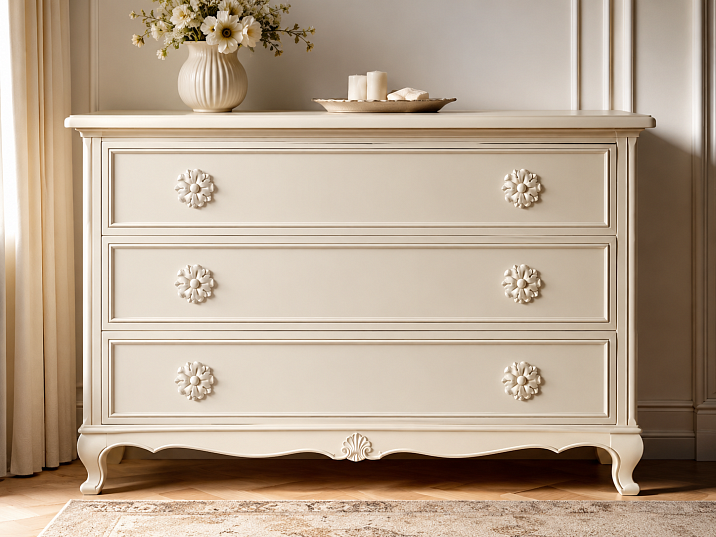
We changed the furniture handles, but two old holes, dark marks from fasteners, or chips around them remained on the facade. The new hardware is nice, the cabinet or dresser works fine, but your eye still returns to the traces of the old installation. You don't want to repaint the entire door. Replacing the facade because of a few holes — even less so. One decorative way to solve this problem is RPU-070, a carved decorative rosette made of polyurethane, measuring 50 × 50 × 13 mm.
But this solution has an important condition: the decorative rosette does not work as a universal patch. The 50 × 50 mm size does not mean that RPU-070 will automatically cover any two holes from an old handle. Before purchasing, you need to measure not only the holes themselves, but also the entire damaged area, the position of the new fasteners, the distance to the edge of the facade, and the free clearance in front of the adjacent door. The 13 mm relief is checked separately: the beautiful detail should not interfere with opening the furniture or get in the way of your fingers when using the new handle.
If, after measurements, it turns out that the old fastening does fall within the area covered by the decorative element, you can buy the carved rosette RPU-070 and turn the trace of repair into a meaningful part of the facade. This is a fundamentally different approach than simply filling holes with putty: the defect is not just hidden, a new relief accent appears in its place.
That is why you should choose RPU-070 not based on a photo or the phrase "five centimeters should be enough." First — a ruler. Then — a paper mock-up. And only then — the order.
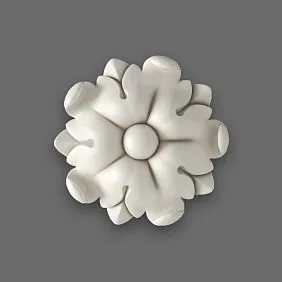
RPU-070 does not just cover the trace of repair — it changes the composition of the facade
An old hole from a furniture handle in itself represents a technical problem. It can be filled, the surface restored, or masked with a suitable plug. But a carved rosette works differently.
It does not try to become unnoticeable.
On the contrary, RPU-070 adds relief to the facade and turns the place of the former mounting into a decorative center or part of a new composition.
This is the essence of the solution. If your goal is to achieve a perfectly smooth modern door, without any ornament, a rosette may be unnecessary. If the furniture allows for a classic, neoclassical, eclectic, or simply more decorative character, the old hole can sometimes be not 'erased' but reimagined.
Instead of the question 'what to fill it with?' another arises:
can a decorative rosette be positioned so that it covers the traces of the old hardware and at the same time looks as if it was originally intended there?
For RPU-070, the answer depends on geometry.
Its confirmed size is 50 × 50 × 13 mm.
The first two values define the overall dimension across the facade. The third shows how far the relief protrudes forward from the surface.
All three numbers are important.
If you forget about the first two — the old holes may remain visible.
If you forget about the third — the new handle or the adjacent door may start catching on the decor.
Therefore, the RPU-070 should be viewed not as a picture from a catalog, but as a real three-dimensional part.




Carved decorative rosette RPU-070: parameters that determine the possibility of repair
Before any design considerations, it is useful to record the facts.
| Parameter | RPU-070 |
|---|---|
| Article number | RPU-070 |
| Correct name | Carved decorative rosette made of polyurethane |
| Size | 50 × 50 × 13 mm |
| Material | Polyurethane |
| Application type | Decorative finishing, including for furniture and doors |
| Scenario of this article | Masking traces of old furniture handle mounting |
| Price at the time of material preparation | 580 ₽ |
| Main check | Is the entire defect covered by the size and shape of the rosette |
| Additional check | Does the 13 mm relief interfere with the new handle and the movement of the facades |
| Product card | order decorative rosette RPU-070 |
The price may change, so before placing an order, it should be checked in the current product card.
What matters much more for repair is something else: 50 × 50 mm is the product's dimensions, not a promise to cover any defect up to 50 mm in size.
The carved decorative rosette has its own outline and relief. Therefore, you should look not only at the numbers, but also at the actual shape of the product. The old holes should be located where the rosette material will actually be after installation, not just inside an imaginary 50 × 50 mm square.
This is a subtle but critical difference.
Our factory also produces:




First, measure not the holes, but the entire damaged area
After removing the handle, rarely do two perfect small dots remain on the facade.
The real picture can be more complex.
The paint is pressed in around the hole.
There is a small chip.
Old hardware left a light or dark outline.
Under the handle base, the color is preserved differently than on the exposed surface.
A piece of the coating tore off during removal.
An imprint of the old support remains on the wooden or painted facade.
Therefore, measuring one hole diameter doesn't solve anything.
Let's imagine: the mounting hole has a small diameter, but the paint around it is chipped for several more millimeters. If the new socket covers the hole itself but leaves a semicircular chip nearby, the visual problem remains.
So, you need to measure the extreme points of the entire visible defect.
Get Consultation
What dimensions to take
To begin with, you will need seven values:
-
distance from the leftmost damage to the rightmost;
-
height of the damaged area;
-
distance between the old mounting holes, if there are two;
-
size of each hole including chips;
-
distance from the damage to the nearest edge of the facade;
-
position of the new handle relative to this area;
-
free space in front of the adjacent door or drawer.
Do not try to immediately compare these numbers with 50 mm.
First, transfer them onto paper.
Draw a rectangle or a defect diagram at full scale.
Next to it, make a 50 × 50 mm square, or even better, a mock-up of the actual RPU-070 contour based on the product image or drawing.
This immediately makes it clear what is being discussed.
Why the distance between holes is especially important
If the old handle was a button, usually one main mounting point remains after it. For decorative masking, this scenario is simpler: you need to check whether the hole and the surrounding defect fit under the RPU-070.
With a bracket, it is more complicated.
It has two mounting points.
There is a certain center distance between them — the distance from the center of one hole to the center of the other.
If these centers are already too far apart, one RPU-070 measuring 50 × 50 mm won't be able to cover both spots.
Even if the distance is theoretically less than 50 mm, that's not enough. The holes themselves have a diameter, and there may be coating damage around them.
Therefore, the real parameter to check is not the center distance itself, but the distance between the farthest outer points of the defect.
For example, two small holes may be located close together, but the paint around each may have chipped outward. The overall area will become noticeably wider than the center distance.
Conversely, an old handle might have left two clean, compact holes without chipping, making decorative masking much simpler.
Quick test: does the old mounting fit within 50 × 50 mm?
Take some painter's tape.
On the facade, mark a 50 × 50 mm square where the RPU-070 is intended.
No need to stick anything down permanently. For now, this is just a frame to check the scale.
Now look:
-
are both old holes inside;
-
is the entire chip around them hidden;
-
does the old paint stain not extend outward;
-
does the square remain at a sufficient distance from the door edge;
-
does it not intersect with the new handle;
-
is the normal symmetry of the facade preserved.
If the defect already extends beyond this area, RPU-070 as a standalone masking will most likely not fully solve the task.
But even if everything fits, the verification work is not yet finished.
The next question is shape.
The 50 × 50 mm dimension and the actual overlap are not the same thing
This is one of the key points of the entire article.
When the card specifies 50 × 50 mm, the buyer easily imagines a solid square plate. Place it over the defect—and everything disappears.
But we have a carved decorative rosette, not a construction patch.
A decorative item has a shape, edges, ornament, and relief.
Therefore, the old hole may be within the overall 50 × 50 mm footprint, but too close to the outer boundary of the decorative element.
That's why it's useful to carefully study the card, photos, and the available RPU-070 drawing before ordering.
The best position for the old hole is closer to the inner covered area of the decor, not right at its edge.
If doubt remains, don't try to resolve it with imagination. Print the image at 1:1 scale or make a paper template as accurate as possible.
Ten minutes of such preparation save a repeat order and redoing the facade.
A paper template of RPU-070 is more useful than ten photos of the interior
Photos are needed to choose a style.
A template is needed to understand if the product fits.
Take a sheet of thick paper or thin cardboard. Make a blank measuring 50 × 50 mm. If you can reproduce the outer contour of the socket from the card, even better.
Secure the mockup with masking tape in place of the old handle.
Now don't look at it up close.
Step back.
Close the door.
Open it.
Stand to the side.
Look from the passage side.
Try using the new handle.
If the facade is paired with an adjacent door, open both several times.
It is at this moment that problems become noticeable that cannot be seen in the catalog.
The socket is too close to the edge.
The handle looks pressed down.
The relief falls within the finger zone.
Two elements begin to compete.
On a small 50 mm drawer, they visually seem too large.
On a large door, on the contrary, they look like a neat accent.
After such a fitting, you can already consciously order decorative rosette RPU-070.
One old fastener: the most straightforward scenario for RPU-070
The handle-button was attached at a single point.
After removal, one hole remained.
The new handle is moved to another location, or the facade is switched to a different opening method.
This is one of the most convenient cases for a decorative rosette.
Why?
Because one defect is easier to place inside the decorative center.
There is no need to simultaneously subordinate two distant points to the rosette.
You can choose the position so that the old hole falls within the covered area, and the RPU-070 itself is aligned with the facade composition.
But even here there is an important caveat.
You should not glue the rosette crookedly just to cover the hole.
If the hole is noticeably off to the side of the geometric or compositional center, a choice arises:
-
slightly alter the composition;
-
additionally restore the hole and place the decor correctly;
-
choose a different shape or size of rosette;
-
abandon RPU-070 in favor of a more neutral repair method.
The decor should not reveal that it was installed solely for masking purposes.
A good result looks as if the socket has always been part of the furniture.
Two holes from the old pull handle: this requires a particularly precise measurement.
The pull leaves two points.
If the new handle has a different center distance, the old holes remain next to or between the new ones.
Sometimes RPU-070 can be placed so that both old points end up under a single element.
But this is not a universal scenario.
The main limiting factor is distance.
If the extreme points of the damaged area do not fit into the actual overlap of the RPU-070, it is impossible to make a fifteen-millimeter or twenty-millimeter margin appear.
Moving the socket won't help either if it ruins the composition.
In that case, it's better to look at other options polyurethane rosettes and choose a more suitable scale rather than buying the RPU-070 hoping "maybe it'll stretch."
The decorative element does not stretch.
The facade also should not adapt to a mistaken purchase.
If the old holes are far apart
This is typical for a long pull handle.
Here, RPU-070 may not be a solution for both openings at the same time at all.
There are several options.
The first is to locally restore the old holes without a socket.
The second is to use two independent decorative elements, if this matches the composition of the facade.
The third is to choose a larger polyurethane rosette from the catalog.
The fourth is to build a decorative frame with molding and include the repair area in a broader system.
That is why it is useful to open the section in advance where you can buy polyurethane rosettes, and compare several sizes.
RPU-070 is good not because it suits everyone.
It is good where its size truly matches the task.
The chip around the hole is sometimes more important than the hole itself
After removing the handle, you may discover an unpleasant surprise.
The hole itself is small.
But the metal base of the handle pressed on the coating for years.
A crack appeared along the edges.
A piece of enamel tore off when removing it.
A round or oval imprint remained.
Under the handle the color is almost new, around it the facade has changed slightly.
That's why the question "will the RPU-070 cover the hole?" is too narrow.
It's more correct to ask:
will it cover the entire visually damaged area?
If the hole is covered but a light outline of the old support remains nearby, the new decor does not solve the problem.
The same applies to the chip.
Sometimes it is better to carefully restore it before installing the socket, even if the spot will later be hidden. The base under the decorative element must remain solid and level.
A socket is a finishing decorative detail, not a way to ignore a damaged facade.
13 mm relief: why the third number cannot be considered secondary
The first two dimensions of RPU-070 answer the question "will it cover?"
The third answers the question "won't it get in the way?"
13 mm is already a noticeable volume on a furniture facade.
On a large cabinet door, such relief may seem natural.
On a narrow drawer next to the handle, it becomes significantly more important.
Check three zones.
Grip zone
Fingers pass between the handle and the front.
If protruding decor appears nearby, the hand may constantly brush against it.
The problem here is not just about comfort.
Constant contact accelerates wear of the finish and the decorative surface itself.
Movement zone of the adjacent front
On a hinged wardrobe, the adjacent door changes its position relative to the first one when opened.
In some designs, fronts pass close to each other.
The 13 mm protrusion needs to be checked in real movement.
Drawer extension zone
On a dresser, the decorative element must not catch on the adjacent front, decorative trim, or overhanging part of the body.
Therefore, a flat paper template gives only part of the answer.
To check the depth, you can temporarily attach a piece of material about 13 mm thick to it, simulating the future protrusion.
Then the result becomes much more realistic.
The new handle and RPU-070 should be designed as one composition
It is very easy to make the following mistake.
First, a new handle is chosen.
Holes are drilled.
They install it.
Then they notice the old holes and decide to cover them with RPU-070.
Each decision individually may be good.
Together — no.
The socket turns out to be too close to the handle.
The relief falls under the fingers.
The ornament hides behind the bracket.
The center of the socket and the axis of the handle accidentally do not align.
A strange narrow gap remains between the parts.
Therefore, if the replacement of the hardware is not yet complete, it is better to lay out the entire composition at once.
STAVROS has a separate article about how to combine furniture handles and decorative elements on the facade. Its logic is especially useful in this situation: the relief and the handle do not exist separately from each other.
RPU-070 is a non-load-bearing backing for a furniture handle
Here it is necessary to draw a strict line.
RPU-070 is considered a decorative socket.
There is no need to automatically turn it into a functional washer through which the fasteners of the new handle pass.
Such an idea seems tempting: the old hole is closed, the new handle is attached directly through the center of the decor, everything is unified.
But such a unit already requires a separate check.
It is necessary to understand:
-
whether the shape of the product allows drilling at the required point;
-
whether the relief will be damaged;
-
whether there is enough area for the base of the handle;
-
how the force will be distributed;
-
will the fastener crush the decorative part;
-
does the mounting system match the specific facade.
Without such data, it is better to separate the decorative and functional zones.
The handle is attached to the facade as a handle.
RPU-070 covers the old spot and works as decor.
This is clearer, more reliable, and easier to predict.
When a decorative plug is better than RPU-070
Not every old fastener needs to be turned into an ornate carving.
For example, after the handle, only one tiny clean hole remains on a modern white facade without any classical detailing.
What will RPU-070 provide?
Not just masking.
It will add a fairly noticeable relief of 50 × 50 × 13 mm.
If such decor is not supported by either the handle or the furniture style, the problem may become more noticeable rather than disappear.
In such a case, it is useful to look at the material about decorative caps for furniture handles.
The two methods have different purposes.
| Situation | RPU-070 | A small cap or local restoration |
|---|---|---|
| Need to add carved decor | Suitable | Does not solve the decorative task |
| Need the most discreet masking | Not always | More often logical |
| A noticeable area is damaged | Can hide and reinterpret an area | A small plug may not be enough |
| Furniture is classic or neoclassical | Good scenario | Possibly too technical result |
| Strictly minimalist furniture | May look alien | Usually calmer |
| Only a small hole needs to be closed. | Excessive decoration is possible. | A more direct solution. |
| There is a desire to change the entire character of the facade. | Useful. | Has almost no effect on the appearance. |
Do not try to make the RPU-070 solve a task for which it is stylistically unnecessary.
When, on the contrary, the rosette is more interesting than ordinary restoration.
There is furniture where, after changing the handles, you want not just to restore the old surface, but to make the facade more interesting.
For example, a chest of drawers with smooth drawers.
Cabinet with simple doors.
Sideboard being converted to a classic style.
Old nightstand after repainting.
Interior furniture door that already has a molding frame.
Here, holes become a reason for decorative remodeling.
RPU-070 simultaneously:
-
covers a defect of suitable size;
-
adds relief;
-
creates a new compositional center;
-
helps connect the facade with other molding;
-
can work in a single color scheme with furniture.
In this scenario, a decorative socket really does more work than a regular plug.
The center of the old handle does not always have to become the center of the new socket.
If the old mounting was exactly in the center of the facade, everything is simple.
RPU-070 can be tried on along the same axis.
But furniture handles are often positioned differently.
On a kitchen door — closer to the edge.
On a tall cabinet — in the comfortable grip zone.
On a drawer — centered horizontally, but not necessarily vertically.
If the old holes are in a functional rather than compositional point, directly placing a decorative socket over them can sometimes look strange.
You get a beautiful element in an ugly place.
What to do?
The first option is to abandon the socket and restore the hole.
The second is to include the RPU-070 in a broader composition where its offset becomes explainable.
The third is to use paired or repeating sockets on several facades so that the placement is perceived as a system.
The main thing is not to let the technical hole completely dictate the design.
Why paired placement sometimes saves the composition
Suppose on a double-door cabinet, the old handle was located at the inner edge of each door.
After replacement, holes remain.
One RPU-070 on each door can create a symmetrical pair.
As a result, the old functional spot turns into a repeating decorative motif.
But this technique only works with good geometry.
Sockets should:
-
be at the same height;
-
have a mirror-clear position;
-
not interfere with opening;
-
not conflict with new handles;
-
not look too large for the narrow part of the facade.
If one door differs in width, blind repetition already requires checking.
Symmetry is useful, but it does not cancel proportions.
Chest of drawers: RPU-070 can connect several drawers into one system
On the dresser, the situation is more interesting.
After replacing the handles, old holes may remain on each drawer.
If the sizes and placement repeat, several identical RPU-070 units can create a rhythm.
And that's when the repair stops looking like a repair.
Four identically placed decorative rosettes are perceived as deliberate design.
But here another risk appears — overload.
One RPU-070 measuring 50 × 50 mm seems compact.
Six such pieces on a small dresser already create a strong ornamental layer.
Therefore, make mockups for all facades at once, rather than trying one rosette on one drawer.
Only this way can you see the final saturation.
Kitchen facade: check not only the style, but also daily use
In the kitchen, the handle is used dozens of times a day.
That is why the relief next to it requires special attention.
If RPU-070 covers old holes but ends up right under your fingers every time you open the door, the decorative effect quickly stops pleasing.
For the kitchen, it is useful to run a simple test.
Attach a three-dimensional mock-up.
Open the cabinet ten times in a row.
Not deliberately carefully, but the way you use the furniture every day.
Do your fingers touch the decor?
Does the ring on your hand catch on the relief?
Do you have to change your natural grip?
Then the position is unfortunate.
A beautiful facade that is inconvenient to use is a bad facade.
Sliding wardrobe and adjacent doors: 13 mm can be critical
The sliding system has its own limitations.
One door passes relative to the other along the guides.
If you add a protruding element to the surface, you need to understand in advance whether it will fall into the trajectory of the adjacent facade or the structural parts of the wardrobe.
Do not automatically transfer experience from a regular hinged wardrobe to a sliding one.
For such furniture, the actual gap between the surfaces is critical.
If it is less than necessary for the free passage of the relief, RPU-070 cannot be installed in the chosen place, even if it perfectly covers the holes.
Here, functional compatibility matters more than decorative.
Cabinet door: small area makes 50 mm more noticeable
On a large wardrobe, a 50-millimeter socket is perceived as a local detail.
On a narrow cabinet, the same 50 mm can become the central decoration of the entire facade.
This is not bad.
The effect will just be stronger.
Before ordering, assess the ratio of the socket size to the width and height of the door.
If visually it takes up too large a share of the area, look at other options polyurethane rosettes or consider a less active way of masking.
Painting RPU-070 in the facade color: repair becomes almost architectural
There are two ways to show a decorative socket.
The first is to highlight it with color.
The second is to merge it with the facade.
For masking old holes, the second option is often especially interesting.
If the RPU-070 and the facade are painted in one color, the viewer notices primarily the relief, not the fact that a separate part is installed.
Light glides over the ornament.
Shadows appear.
The surface becomes more complex.
But there is no feeling that a contrasting patch was glued over the old hole.
This technique suits furniture that is being given a classic or neoclassical character.
At the same time, the preparation and painting technology must be selected taking into account the specific coating of the facade and the decorative element itself.
Do not automatically transfer the wall paint color to the furniture.
Contrast socket: when a defect turns into a deliberate accent
Sometimes you want the opposite.
Dark RPU-070 on a light facade.
Light on a deep dark color.
An accent decorative center that immediately catches the eye.
This is acceptable, but it sharply increases the requirements for positioning.
The contrast literally draws a frame of attention around the socket.
Any offset becomes more noticeable.
An inappropriate scale is too.
Therefore, if the RPU-070 is used primarily to hide old holes rather than as a pre-designed ornament, it is safer to first test the option in the color of the facade.
Contrast can be added later.
What to do with the old hole under the socket itself
A practical question arises: if the hole will be covered anyway, why repair it?
The answer depends on the condition of the facade.
If it is a clean small hole without damage to the surrounding surface, decorative masking can be part of the solution.
If the material around it is crumbling, there is a crack, coating delamination, or a weak area, simply covering everything from above is unwise.
The base must remain strong.
RPU-070 should not hold a crumbling facade.
Do not try to use decorative molding instead of constructive repair of the material.
First, restoration.
Then, decor.
Installation on an already painted facade requires an adhesion test.
Most such repairs occur not on a new blank, but on finished furniture.
The facade is painted.
Coated with varnish.
Laminated.
Has an unknown old coating.
Therefore, the attachment issue cannot be resolved with the phrase "we'll glue it with something."
The adhesive must work not only with polyurethane, but also with the specific facade surface.
If you want to understand the logic of choosing a composition, it is useful to read the material. molded decoration adhesive.
The main principle is simple: the strength of a decorative element cannot exceed the strength of the layer to which it is glued.
If old paint is peeling off the facade, the rosette will hold onto the paint, and the paint will hold poorly to the base.
Therefore, before installation, the surface is assessed, not just mechanically degreased out of habit.
Do not cover the damage until you have checked the flatness
After removing the handle, a dent sometimes remains around the old mounting.
The base of the handle was pressed against the facade for years.
The paint has formed a step.
There is an overflow of old material.
If you glue the RPU-070 onto an unevenness, it may sit at an angle.
On a small relief, the difference seems insignificant.
On a facade with a symmetrical pattern, a crooked position is noticeable.
Therefore, the surface under the socket must ensure a proper fit.
It is not necessary to bring the hidden area to museum-grade restoration, but protruding irregularities and unstable coating are better eliminated.
What to buy together with RPU-070
The set depends on the condition of the facade, not on the desire to fill the cart.
| Purchase | What it's for | When it is actually required |
|---|---|---|
| Buy socket RPU-070 50 × 50 mm | Cover a suitably sized defect and create a decorative accent | When measurements confirm compatibility |
| buy polyurethane rosettes | Compare RPU-070 with other sizes and shapes | If 50 × 50 mm is not enough or too much |
| Moldings for Furniture | Add other decorative elements to the overall system | For a comprehensive facade renovation |
| Buy polyurethane moldings for a furniture facade | Build a frame and connect the rosette to the door geometry | If a single RPU-070 looks random |
| decorative polyurethane elements | Complement the frame composition | For a more developed classic design |
| Mounting material | Secure the decorative element | Selected to match polyurethane and the specific facade coating |
This table does not mean that RPU-070 necessarily requires a molding.
On one facade, the rosette completes the composition on its own.
On another, it looks lonely without a frame.
This is verified with a mockup.
When the molding frame helps hide the history of renovation
Let's imagine a large smooth facade.
The old handle was not quite in the center.
You place the RPU-070 over the holes.
Technically, everything is covered.
But visually, the socket "hangs" in an empty plane.
Molding can fix exactly this problem.
It creates the internal geometry of the facade, and RPU-070 becomes an element within the field.
The result is no longer a "socket on an old hole," but a full-fledged decorative composition.
If this scenario is close, it makes sense Buy polyurethane moldings for a furniture facade only after the location of the handle, socket, and frame is marked on the actual facade.
First, marking.
Then, the order.
Not the other way around.
Not all decorative elements are suitable for repairing holes
The catalog has many beautiful overlays.
But a beautiful shape does not yet mean a suitable shape for masking.
For this task, the element must simultaneously:
-
cover the defect;
-
fit in the free space;
-
have a suitable relief;
-
match the style of the furniture;
-
not interfere with the handle;
-
not interfere with the adjacent facade;
-
look good specifically in the place of the old mounting.
Therefore, the query "decorative polyurethane elements" is useful for expanding the project, but it does not replace the precise check of RPU-070.
How RPU-070 differs from a random overlay of similar size
A buyer sometimes reasons like this:
"I need roughly a five-centimeter square. I'll take any ornament of that size."
For interior decor, this is too crude an approach.
RPU-070 belongs to rosettes.
In compositional logic, a rosette works as a local center.
An elongated overlay has a different role.
A corner element has a third one.
The decor for the molding is the fourth one.
Dimensions may match, but the purpose of the shape differs.
That is why, to cover the old central mounting of a furniture handle, a rosette often looks more natural than a random fragment of ornament.
It is perceived as a complete standalone part.
RPU-070 or a larger socket
The simplest reason to choose another option is that 50 mm is not enough.
There is no need to try to save on a few millimeters.
If the damaged area is wider, the appropriate size matters more than the article number that you liked first.
Open the section buy polyurethane rosettes and compare the options.
But a larger size creates new questions.
Does it fit on the facade?
Does it not become too heavy visually?
Doesn't it get too close to the handle?
Doesn't it overlap the molding?
Doesn't it extend beyond the edge of the panel?
Therefore, the task is not reduced to the rule "the bigger, the more reliably it will cover."
The size should be sufficient, but proportionate.
RPU-070 or two small decorative points
If the old bracket left two holes far apart, a single 50-millimeter rosette may not help.
Sometimes the idea arises to place a small decorative element on each point.
Compositionally, this is possible only in some cases.
If the holes are symmetrically placed, a pair can look intentional.
If the distance between them is random and the new handle is nearby, two ornaments are more likely to create visual noise.
Therefore, do not turn the technical number of holes into an automatic number of decor.
First, draw the entire facade.
When RPU-070 is appropriate on classic furniture
A classic facade often already has a system:
frame;
a panel;
handle;
symmetry;
central axis.
In such a structure, a carved decorative rosette easily gets a clear role.
If the old hole is in a suitable place, RPU-070 is not perceived as a foreign object.
She continues the language of furniture.
This looks especially convincing after painting in a common
Why the holes should first be assessed from inside the facade
From the front side, we see aesthetics.
From the inside, we see the construction.
If the old hole is significantly damaged, the edges are chipped, or the facade is cracked, an external rosette does not fix the problem.
Look at the back side.
Are there any cracks?
Is the material torn out?
Is the new hole too close to the old one?
Will the area between the two fasteners weaken?
This is especially important if a new handle is being installed nearby.
The decorative RPU-070 should not hide a structural problem that the owner forgets about right after the repair.
The old handle left not holes, but a large area
Sometimes the base of the handle was wide.
After removal, a rectangular or oval mark remains, noticeably larger than the mounting points.
This could be:
- color difference;
- dented coating;
- circle from the metal base;
- old varnish without fading;
- residue contamination;
- Mechanical damage.
If the area is larger than 50 × 50 mm, the RPU-070 itself will not completely cover it.
Then two paths are possible.
First, locally restore the surface, and cover the central part with the socket.
Or choose a larger decorative element.
There is no need to require a five-centimeter rosette to cover an eight-centimeter mark.
How to position the new handle relative to the decorative rosette
There is no universal distance because handles differ in shape, length, and grip depth.
But there is a practical criterion: the hand should be comfortable.
When trying it out, grip the handle the way you usually do.
Not with two neat fingers specifically for the test, but with a full working grip.
See where your knuckles and fingertips land.
If they touch the RPU-070, the distance is insufficient.
If the handle is long, check both ends.
If it's a button, check the space around it.
If the handle is located above the socket, check the hand movement from bottom to top.
If it's on the side, use a side grip.
A nice distance on the drawing means nothing if it's uncomfortable for a person to open the furniture.
The socket should not be covered by the handle itself.
Another compositional mistake.
RPU-070 is bought for the carved pattern.
Then it is placed on top of the old spot.
The new long staple goes right through the center.
Half of the ornament is hidden behind the metal.
The result is an expensive solution whose meaning is not visible.
If the handle covers a significant part of the rosette, ask yourself: why then do you need the decorative RPU-070 specifically?
Perhaps it is better to move it.
Or choose a different way of masking.
The decor should remain readable.
Why the new handle does not have to be in the place of the old one
Sometimes the best way to repair is to change the entire logic of the hardware.
For example, the old bracket was in the center of the drawer.
The new handle can be moved higher, lower, or replaced with a different type within the allowable design.
The freed central place gets RPU-070.
Thus, a technical necessity turns into a meaningful composition.
But any new drilling is done only after the final marking.
On an already decorated facade, fixing a mistake is much harder.
First, lay out the facade on paper
For a complex handle replacement, a regular sheet is more useful than a designer 3D project.
Draw the facade to scale.
Mark:
old holes;
damaged area;
new handle;
RPU-070;
door edges;
existing molding;
other elements.
Try a few options.
Sometimes the solution becomes obvious in five minutes.
Socket in the center.
Handle lower.
Or vice versa.
Socket between two points.
Or abandoning it.
Such planning is especially useful when updating several identical facades at once.
One facade first, the rest later
If you are repairing a kitchen set or a large wardrobe, do not rush to install RPU-070 on all doors at once.
Make one test facade.
Look at it:
in daylight;
in the evening;
with the handle;
in the open state;
next to neighboring doors;
from a distance of several meters.
And only when the result is truly convincing, repeat the system.
This is not a question of doubting the product.
This is normal work with specific furniture.
What to do if 50 mm is not enough
Do not enlarge the defect.
Do not shift the socket crookedly.
Do not leave half of the hole visible.
Do not try to cover the edge with a thick layer of paint.
Need to choose a different solution.
The first route is to compare polyurethane rosettes of a larger size.
The second is to locally restore the surface.
The third is to build a wider composition with a molding.
The fourth is to apply a decorative overlay of a different shape, if it is more logical given the geometry of the defect.
Catalog Furniture moldings useful precisely when the task no longer fits into the format of a single rosette.
What to do if 50 mm is too much
It can also be the other way around.
The hole is small.
The facade is narrow.
RPU-070 covers the defect with a huge margin.
Technically, everything works.
Compositionally — heavy.
There's no need to buy larger decor just because it reliably masks a small spot.
In this case, compare more compact options or return to neutral restoration.
A good size is not the maximum.
A good size is proportionate.
How not to confuse RPU-070 with the wooden R-070
STAVROS has different decor systems, and a similar article number can be confusing.
This article specifically refers to RPU-070 — a carved decorative rosette made of polyurethane, measuring 50 × 50 × 13 mm.
Not about the wooden rosette R-070.
The material matters not only for the name.
It affects the future finishing, installation, and overall character of the surface.
Before ordering, check the full article number — RPU-070.
One letter here changes the product group.
Don't call RPU-070 just a "patch over a hole"
This approach almost guarantees weak design.
RPU-070 has its own ornament.
It becomes a visible element of the facade.
If you perceive it only as a technical plug, it's easy to forget about style, axis, and scale.
It's better to think this way:
first, I decide whether a decorative rosette is appropriate on this facade; then I check whether it can simultaneously cover the old mounting.
Not the other way around.
Seven mistakes when buying RPU-070 for old holes
Mistake 1. Measuring only the center-to-center distance
The center-to-center distance shows the centers of the holes.
But chips and traces of the old handle lie beyond them.
Measure the entire defect.
Mistake 2. Considering 50 × 50 mm as a solid patch
This is the overall dimension of the decorative rosette.
The actual overlap depends on its shape.
Mistake 3. Forgetting about the 13 mm relief
The size on the facade fits, but when opening, the adjacent door hits the decor.
Such a product formally "fit," but functionally it didn't work.
Mistake 4. Choosing a location only by the hole
The socket covered the defect, but turned out to be offset relative to the facade.
It's better to partially restore the surface than to get an obviously crooked decor.
Mistake 5. Not accounting for the new handle
After installation, the two elements clash visually or physically.
Try them on simultaneously.
Mistake 6. Gluing onto a weak surface
Old paint is peeling, and along with it, after some time, the decor comes off.
The base needs to be checked before installation.
Error 7. Buying the entire set at once without a trial fitting
One socket in the photo and ten sockets on the facades are completely different levels of decorative saturation.
First, one test version.
Mistakes that appear after a successful purchase
Even a correctly chosen RPU-070 can be installed poorly.
Too much glue.
Uneven position.
Traces of compound at the edges.
Sloppy touch-up painting.
Different distances from the handle on identical facades.
Uneven orientation of sockets.
All these problems are not related to the quality of the model itself.
These are marking and installation errors.
They are especially noticeable on the series of doors.
If the decor repeats, use one template for all facades.
When RPU-070 is especially well suited
Let's summarize not the article's conclusion, but the practical boundary of application.
RPU-070 should be considered when several conditions are met simultaneously:
- the old hole or group of damages fits under the actual contour of the socket;
- the facade has enough free area;
- the decorative style of the furniture allows for carved relief;
- The new handle does not overlap the ornament;
- Fingers do not touch the decor;
- The 13-millimeter protrusion does not interfere with the movement of the facades;
- The surface allows for reliable attachment of the polyurethane element;
- The position of the old mounting does not force the socket to be installed obviously crooked.
With this set of conditions, RPU-070 solves two tasks at once.
Repair.
And decorative.
When it is better to refuse RPU-070
There is also a reverse list.
A socket is not the best choice if:
the defect is significantly wider than 50 mm;
the holes are too far apart;
the socket does not cover the damage with its actual shape;
the facade is very narrow;
the furniture is strictly minimalist;
the relief interferes with the grip;
the adjacent door passes closer than allowed;
the mounting point is in an obviously random spot on the facade;
The base is destroyed and requires structural repair;
The new handle completely covers the socket.
In these situations, it is better to choose a different element or another method of restoration.
An honest "doesn't fit" saves more money than trying to use a liked product at any cost.
Practical scenario #1: old knob in the center of the dresser
After the old knob handle, one hole remains in the center of the drawer.
The new hardware will be offset or replaced with another opening method.
The facade is smooth, but the furniture is styled in a neoclassical style.
Here, RPU-070 looks logical.
Checking for defects.
We make a template of 50 × 50 mm.
We check if it's too large for the box.
We simulate a 13 mm protrusion.
If everything passes — buy the carved rosette RPU-070 it can already be a deliberate decorative element, not just a masking tool.
Practical scenario #2: two close holes from a small staple
The old handle was compact.
After it, the two holes are close to each other.
There are no large chips around.
Theoretically, RPU-070 can cover the area.
But first, we measure the extreme points.
Then we check the actual outline of the socket.
If the holes turn out to be close to its outer edges, it's better not to risk it.
Even one visible millimeter of an old defect ruins the point of the entire purchase.
Practical scenario #3: long staple
The distance between the holes is large.
One RPU-070 does not cover both places.
Here the answer is simple: this model is not suitable for simultaneously masking two points.
Look at larger ones Polyurethane Rosettes or use another repair method.
Practical scenario #4: the hole is almost at the edge of the facade
RPU-070 covers it only if the socket is noticeably shifted toward the edge.
Technically possible.
Compositionally questionable.
Try them on.
If the decor looks random, do not use it just for masking.
Better to restore the surface.
Practical scenario #5: an old kitchen is completely repainted
A very good moment to work with stucco decor.
First, the holes are addressed.
Then, the new handle layout is determined.
Next, RPU-070 is tried on.
If the composition is liked, the decorative element is included in the overall finish.
you can additionally look at You can buy ready-made stucco matching the Baroque style. Calculate the quantity: linear meters of cornices and moldings, number of rosettes, pilasters, consoles, corner elements. Add a ten to fifteen percent allowance for trimming. and decide whether the facades need any additional relief.
Practical scenario #6: one door next to another passes very closely
Size 50 × 50 fits.
The opening is closed.
But the 13 mm protrusion does not fit into the structural gap.
So, RPU-070 is not suitable in this place.
No aesthetics are more important than the normal functioning of furniture.
Practical scenario #7: the opening is small, and the facade is modern
Technically, RPU-070 covers everything.
But after a trial fit, it becomes clear: a small carved rosette looks like a foreign decoration on a strict facade.
Remove the mockup.
Check out the material about decorative caps after replacing handles or consider local restoration.
Sometimes, abandoning decor is the right design.
How to order RPU-070 without mistakes
The purchase path should be shorter than the article itself.
Measure the dimensions of the defect.
Check the shape of the socket.
Make a 50 × 50 mm template.
Add a simulation of a 13 mm protrusion.
Try on the new handle.
Open and close the facade.
If everything matches, you can order decorative rosette RPU-070.
If the size doesn't match, don't order it "just in case."
Go straight to the category buy polyurethane rosettes and look for another dimension.
If the problem requires not just one socket, but a complete change of the facade, see molding for furniture and moldings.
Thus, each catalog page addresses its own level of the task.
FAQ: answers to popular questions about RPU-070 and holes from furniture handles
Can RPU-070 cover two holes from an old furniture handle?
Only if both holes, along with chips and other traces of the old mounting, completely fall within the actual covered area of the rosette. The overall size of RPU-070 is 50 × 50 mm, but the final decision is made after checking the shape of the product and actual measurements of the facade.
What is the size of RPU-070?
RPU-070 has a size of 50 × 50 × 13 mm. The first two values are needed to check the area on the facade, and 13 mm should be considered as a protruding relief.
What is RPU-070 made of?
It is a carved decorative rosette made of polyurethane. Before purchasing, do not confuse it with the wooden R-070.
How much does RPU-070 cost?
At the time of preparing the material, the price indicated in the product card is 580 ₽. The current cost should be checked directly before placing an order.
If the distance between the holes is 50 mm, will RPU-070 definitely fit?
No. If 50 mm is only the distance between the centers of the holes, the extreme points of damage will be even further apart. In addition, the actual shape of the decorative rosette must be taken into account. Therefore, a single center-to-center distance value is not enough.
Do I need to fill the holes before gluing the rosette?
If the holes are clean and the base is solid, the decision depends on the specific facade and installation technology. If there are cracks, chips, peeling, or material deterioration around, the surface must first be restored. A decorative rosette should not hide a weak base.
Can RPU-070 be glued onto an already painted furniture facade?
The possibility depends on the type and condition of the coating and the chosen mounting material. If the paint adheres poorly to the base, gluing on top will not fix the problem. First, the strength of the surface is checked.
Which adhesive should be used for RPU-070?
You need to choose a compound compatible with polyurethane and the material of the specific facade. The general logic of selection can be seen in the material molded decoration adhesive.
Can a new handle be installed on top of RPU-070?
You should not consider the decorative rosette as a standard load-bearing substrate for the handle without a separate structural check. It is safer to design the handle attachment directly to the facade and use RPU-070 as an independent decorative element.
Will 13 mm interfere with opening the door?
It may interfere if another facade, cabinet part, or grip area is nearby. Before ordering, you need to simulate the actual protrusion and open the furniture several times.
How to check RPU-070 before purchasing?
Make a paper template 50 × 50 mm, place it on the facade, mark the position of the old holes and the new handle. To check the depth, add a temporary mock-up about 13 mm thick.
What to do if the old holes do not fit under RPU-070?
Choose a larger model in the category polyurethane rosettes, restore the surface locally or build a wider decorative composition.
Can the RPU-070 be used on a dresser?
Yes, if the size, placement, and relief suit the specific facade. For a series of identical drawers, it is advisable to first make mock-ups for all facades to assess the overall decorative rhythm.
Will RPU-070 fit a kitchen cabinet front?
The model can be considered for a furniture facade provided it does not interfere with daily grip, opening of adjacent doors, and matches the finish. In the kitchen, ergonomics check is especially important.
Will RPU-070 suit a sliding wardrobe?
Only after checking the distance between sliding panels. The 13 mm relief must not fall into the path of the adjacent door.
What is better: RPU-070 or a furniture plug?
If you need to almost invisibly cover a small technical hole, a plug or local restoration may be more logical. If you need to simultaneously hide a defect and add a decorative relief, RPU-070 is more interesting.
Can the socket be painted to match the facade color?
A uniform color often helps visually tie the applied decor to the furniture. The specific preparation and painting technique should be chosen considering polyurethane and the existing facade coating.
Does RPU-070 need to be placed exactly in the center of the door?
Not necessarily, but the position should be compositionally justified. If the old hole forces the socket to be significantly shifted and the result looks random, it is better to choose another repair method.
Can I install several RPU-070 on one dresser?
Yes, if the identical elements form a clear rhythm on the facades. Before ordering several pieces, it's useful to make paper mockups on all drawers at once and assess the overall density.
How is RPU-070 different from a regular overlay?
This refers specifically to a carved decorative rosette, that is, an independent local ornamental element. Elongated, corner, and connecting overlays have a different compositional role.
Where to buy RPU-070?
The main card is in the STAVROS catalog: buy the carved rosette RPU-070. Before ordering, check the size 50 × 50 × 13 mm, the position of the holes, and the current price again.
Old holes can be turned into decor — but only after precise measurement
After replacing handles, you don't have to change the entire facade because of a few old mounting points. Sometimes the damage can be locally repaired. Sometimes a small plug is enough. And sometimes the place of the old hardware becomes a good spot for a new decorative accent.
RPU-070 is interesting precisely for the third scenario.
This is not invisible repair.
This is a carved decorative rosette made of polyurethane, measuring 50 × 50 × 13 mm, which can cover a suitable mark and simultaneously change the character of the furniture.
But you need to buy it with a ruler, not with hope.
Measure the extreme points of the old holes.
Add chips.
Check the mark from the handle base.
Match everything with the actual shape of the product.
See if there is room for the new handle.
Check the grip by hand.
Simulate the 13-millimeter relief.
Open the adjacent facades.
Only when all these checks are passed does the decorative idea become technically sound.
If 50 × 50 mm fits, you can order RPU-070 made of polyurethane and turn the former mounting spot into part of the new composition.
If the size is not enough, STAVROS allows you to go to the catalog and buy polyurethane rosettes of a different scale. If the update affects the entire facade, you can complement the solution with molding for furniture, moldings and other polyurethane elements.
The strength of such a repair is not that the defect was covered with something.
It lies elsewhere: after the work, a person sees not a trace of the old handle.
He sees a finished facade.
And this is exactly how you should approach choosing STAVROS decorative items — not as random patches, but as details that must simultaneously fit in size, function, and composition.