












































































Article Contents:
- NPU-227 is needed not to "hide a corner," but to complete the composition
- Characteristics of NPU-227 that need to be transferred to a real window
- Why it is not enough to know the width of the existing trim
- What measurements to take before purchasing
- A cardboard NPU-227 will show more than a product photo
- Do not try to make NPU-227 match the trim width millimeter by millimeter
- Four overlays on one window is not a mandatory rule
- Let's compare three options for refining a ready-made trim
- Can NPU-227 be glued over an already painted facade
- What to do if the trim and facade were painted several years ago
- The facade is not an interior: the mounting compound is selected separately
- NPU-227 should not hold the trim itself
- And what if the joint is even, but visually too simple?
- Do I need to cover the corner joint itself with NPU-227
- A 45-degree joint and a straight joint require different fitting
- What to do if the profiles have a pronounced relief
- Why the size C 11 mm cannot be ignored
- And what does the size L 123 mm mean
- Upper left and upper right corner: is mirroring needed
- The lower corners of the window are usually more complex than the upper ones
- The upper corners also cannot be designed in isolation from the cornice.
- One window can be made more decorative than the others.
- When four NPU-227s really work better than two.
- Why the same NPU-227 looks larger on a narrow window.
- A large panoramic window also requires checking.
- When it's worth looking at the category of corner trims rather than NPU-227 right away.
- When a corner trim is better than a new casing.
- When, on the contrary, it's better to redo the entire framing.
- Molding and NPU-227 perform different roles.
- Molding and corner trim: when the combination looks natural.
- Existing trim made of a different material
- A unified color scheme can visually blend the old and the new
- Fresh NPU-227 and an old facade of the same color can look different
- Contrasting NPU-227 is a bolder but more demanding option
- In sunlight, the relief of NPU-227 looks deeper than indoors
- Why exterior painting is not a cosmetic trifle
- Don't leave a gap around the overlay just because it's not visible from the ground
- A particular danger is gluing decor onto loose plaster
- What to buy together with NPU-227
- Can you order just one NPU-227 first
- How to calculate the quantity after a trial fitting
- Is a reserve needed
- Do not confuse NPU-227 with a regular straight decorative trim
- Do not confuse the trim with corner molding
- Do not confuse the decorative trim with a structural corner connector
- A finished insulated facade requires removing the existing wooden trim
- If the existing trim is wooden
- If the trim already has a corner pattern
- Facade decor should be readable from a distance
- Do not decorate one window in isolation from neighboring ones
- The first floor and the second floor may require different levels of saturation
- What to do if NPU-227 doesn't quite fit
- If NPU-227 seems too small
- Can I add more central decor above the window
- The decor around the window and the wall decor should support each other
- If the house is modern
- If the facade is classic
- A country house with simple windows: spot refinement is especially noticeable
- Restoration of an old facade
- A new facade that just seemed too calm after the work was completed
- Mistake: ordering four NPU-227s without measuring the bottom corners
- Mistake: choosing the size based only on a photo of the window
- Error: assuming that identical windows have identical angles
- Error: covering a diverging joint of the trim with an overlay
- Error: using interior mounting material outdoors
- Error: leaving old dust under the adhesive
- Error: not accounting for the relief of the existing profile
- Error: painting the overlay in advance and then discovering the need to refine the joint
- Error: making the decor contrasting before checking the composition
- Error: adding overlays to every window just for the sake of uniformity
- Error: mixing several unrelated ornaments
- When NPU-227 is truly suitable
- When it's better not to buy NPU-227
- Procedure before ordering — without unnecessary facade rework
- How to place an order if NPU-227 fits
- FAQ: questions about NPU-227 on an already finished window trim
- Can NPU-227 be installed if the trim is already mounted?
- What is the size of NPU-227?
- What material is NPU-227 made of?
- How much does NPU-227 cost now?
- Is NPU-227 exactly a corner cover?
- Can NPU-227 be used outside the house?
- Do I need to remove old paint from the trim?
- Can NPU-227 be glued directly onto a painted facade?
- Do I need to install four NPU-227 units on each window?
- Can NPU-227 be used only on the top?
- Will NPU-227 fit a narrow trim?
- What to do if the overlay is wider than the trim?
- Can NPU-227 be trimmed if it doesn't fit slightly?
- Do I need to cover the joint of the trims with NPU-227?
- Can NPU-227 reinforce a spreading joint?
- How to tell if NPU-227 is too large?
- Why should the 11 mm size be considered?
- What does 123 mm mean?
- Can NPU-227 be installed on a relief architrave?
- What adhesive should be used on the facade?
- Can interior adhesive be used?
- Is additional mechanical fastening of NPU-227 required?
- Can NPU-227 be painted to match the existing architrave color?
- Why may fresh paint differ from old paint?
- Can NPU-227 be made contrasting?
- What is better: NPU-227 or a new architrave?
- Where can I see other corner options?
- If the trim is too simple along the entire length, is NPU-227 sufficient?
- Can NPU-227 be combined with moldings?
- Do I need a reserve of overlays?
- How many NPU-227s are needed for ten windows?
- Can I order one NPU-227 first?
- Which corner should be checked first?
- Can NPU-227 be used on a wooden trim?
- Will NPU-227 be suitable for a facade with insulation?
- Do all windows in the house need to be styled the same way?
- Can NPU-227 be added several years after installing the window trims?
- What should you check right before ordering?

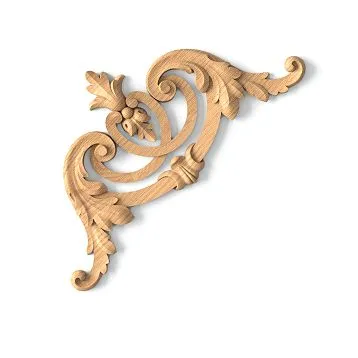
The window trims are already installed, the facade is painted, and the scaffolding has long been removed — and only now it has become noticeable that the framing lacks expressive corners. Removing the finished profile just for one decorative enhancement is not desirable. And in most cases, there is indeed no need for it. If the existing framing leaves enough free space, NPU-227 can be added to it — a decorative corner overlay made of polyurethane, measuring 90 × 89 × 11 × 123 mm, without disassembling the entire trim.
But buying four identical pieces just based on a photo of the facade is premature. First, you need to check the geometry of the already installed framing. The corner overlay must not just physically fit near the joint of two profiles. It needs a proper support area, a clear position relative to the vertical and horizontal trim, sufficient distance to the slope, drip edge, and neighboring architectural details. Additionally, the relief and the actual surface to which the decor will be glued must be taken into account.
The main idea here is simple: NPU-227 does not replace the trim and does not become its structural connector. It is added on top of the finished composition as a decorative corner element. If the existing framing is assembled reliably, is not damaged, and fits in proportions, there is no need to dismantle the entire window for such an enhancement.
Before ordering, it makes sense to do something that is often not done when choosing facade decor: take a tape measure and a piece of cardboard. Transfer the main dimensions of NPU-227 onto it, apply the mock-up to each corner of the window, and look at the framing not from arm's length, but from the point where the facade is actually perceived — from the path, yard, driveway, or the neighboring side of the property.
If the scale and fit match, you can buy the corner overlay NPU-227 separately and enhance the existing window without replacing the entire framing.

NPU-227 is not needed to "hide the corner," but to complete the composition
In a finished window casing, the corner often turns out to be the calmest spot.
The vertical plank rises upward.
The horizontal one runs above the window.
Two lines meet.
Technically, everything is neat.
But visually, nothing happens at this spot.
On a simple modern house, this may be exactly what is needed. On a facade with classical, estate, historical, or decorative architecture, such a joint can sometimes seem too dry. There is a profile, there is a frame around the window, but there is no architectural completion.
The corner NPU-227 allows you to intervene precisely at this point.
It does not require redesigning the entire window portal. There is no need to change the length of the casings, remove vertical elements, or rework the top plank. The decorative overlay adds relief where a geometric corner already exists.
But there is an important limitation: this technique only works when the very shape of the existing casing allows for additional ornament.
If the profile is very narrow and the NPU-227 significantly extends beyond its visual boundaries, the result will not be a completion, but a foreign part.
If the casing is wide and calm, the corner overlay can literally bring the entire frame together.
Hence the first question before ordering:
not "do I like the NPU-227?", but "is there a place on my finished casing where the NPU-227 will look like part of the original design?"




Characteristics of the NPU-227 that need to be transferred to a real window
The model card specifies four dimensional parameters: 90 × 89 × 11 × 123 mm. For the buyer, it is important not just to memorize the numbers, but to understand how to use them when fitting.
| Parameter | NPU-227 |
|---|---|
| Article number | NPU-227 |
| Product type | Corner decorative overlay |
| Material | Polyurethane |
| Size A | 90 мм |
| Size B | 89 мм |
| Size C | 11 мм |
| Size L | 123 мм |
| Full size per card | 90 × 89 × 11 × 123 mm |
| Price at the time of material preparation | 1 020 ₽ |
| Main article scenario | Addition to an already installed window casing |
| Possibility of facade application | Designed for decorative facade compositions |
| Main check before ordering | Free zone in the corner of an existing frame |
| Product card | order a decorative overlay NPU-227 made of polyurethane |
The price may change over time, so when placing an order, it needs to be checked again in the product card.
Dimensions, on the contrary, are needed already at the idea stage.
If there are many windows, do not start with the calculation "four corners × ten windows = forty parts." First, check one real window, preferably the most problematic one: with the smallest distance to the slope, drip edge, cornice, or adjacent decorative element.
If NPU-227 fits well there, checking the other windows is usually easier.
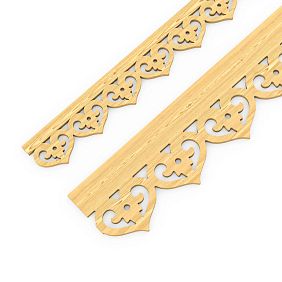
Our factory also produces:


Why it is not enough to know the width of the existing trim
Suppose the trim has sufficient width.
It seems the task is solved.
But the real corner consists not only of the profile width.
There is a joint of the vertical and horizontal parts.
There is the facade texture.
There is a seam around the trim.
There is a transition to the slope.
Sometimes the horizontal and vertical profiles are not perfectly in the same plane.
Sometimes one element protrudes slightly.
Sometimes the corner is cut at a 45-degree angle.
Sometimes a straight joint is used.
Sometimes there is already a small decorative lock on top.
Therefore, one number — "my casing is this many millimeters wide" — is not enough.
For NPU-227, you need to measure the free field around the intersection point of two lines.
Essentially, you are interested in the area where you can apply corner decor without conflicts with the existing architecture.
Get Consultation
What measurements to take before purchasing
Take a tape measure, a metal ruler, and a sheet of paper.
Measure:
-
the width of the vertical casing;
-
the width of the horizontal casing;
-
distance from the inner edge of the trim to the outer boundary of the free surface;
-
distance from the corner of the casing to the window slope;
-
distance from the upper corner to the nearest cornice, belt, or other decor;
-
actual protrusion of the casing relative to the wall;
-
presence of a difference in level at the joint of two profiles;
-
free space around the lower corners, if overlays are planned not only on top;
-
position of the drip cap;
-
distance to decorative seams, rustications, or other facade elements.
After this, the figures can already be compared with NPU-227.
But the comparison still should not be purely arithmetic. The corner overlay has an ornament and its own outer contour. It is not a rectangular plate of 90 × 89 mm.
Therefore, the next stage is a mockup.
A cardboard NPU-227 will show more than a product photo
For a preliminary fitting, it is not necessary to have the pad itself in hand.
Make a template.
On thick cardboard, mark the main dimensions 90 × 89 mm. Additionally, indicate the overall size L 123 mm as shown in the product drawing. If you can print the drawing at a 1:1 scale, even better.
Cut out the approximate outer contour.
Now go to the window.
Place the mockup in the upper left corner.
Then in the right one.
Check whether it extends too far beyond the edges of the trim.
Does it not cover part of the slope.
Does it not intrude into the adjacent architectural element.
Does it not look too large.
After this, step back five to ten meters.
On the facade, the scale is perceived completely differently.
A small detail that seems expressive in hand may practically disappear from the courtyard.
Conversely, an overlay that seems compact up close may visually expand on a small window frame and begin to dominate the trim itself.
Do not try to make NPU-227 match the width of the trim millimeter by millimeter.
The decorative overlay does not have to repeat the boundaries of the molding profile like a technical coupling.
Sometimes the ornament naturally extends beyond the conventional line of the trim.
The question is not about absolute matching.
The question is about proportion.
You need to see whether the NPU-227 is perceived as part of the corner composition or seems like an object randomly glued on top of two strips.
If the existing trim is thin and strict, a large carved accent can look alien.
If the profile is wider, has relief, or the facade overall supports classical detailing, the additional corner element reads much more organically.
So compare not only millimeters.
Compare visual weight.
Four overlays on one window are not a mandatory rule.
The phrase "corner overlay" easily leads to an automatic decision: since a window has four corners, four NPU-227s are needed.
Not always.
On facades, the upper part of the window often works more strongly.
The lower corners are already occupied by the window sill profile, drip cap, or horizontal molding.
Then two upper overlays can complete the composition without excessive richness.
On another facade, on the contrary, full decoration of all four corners looks more convincing.
In the third case, NPU-227 is not used on every window, but only on central or most significant openings.
Do not count the quantity before determining the scheme.
First, architecture.
Then arithmetic.
Let's compare three options for refining a finished casing.
| Option | What changes | When appropriate | Main risk |
|---|---|---|---|
| Two NPU-227 only on top. | The upper part of the window is reinforced. | The lower edge is already occupied by a drip cap or other decor. | The top may become too heavy |
| Four NPU-227s at the corners | A solid frame composition appears | The casing is quite wide, all corners are free | Overload of a small window |
| Leave the casing without overlays | Nothing changes | The architecture is strict, there is little space | The framing will remain visually simple |
There is also a fourth scenario — not adding NPU-227s, but rebuilding the framing with a new profile. But that is a different scope of work. The article is precisely about the situation when you want to avoid such a rework.
Can NPU-227 be glued over an already painted facade?
The very fact that the facade is painted does not mean it is too late to install the decorative overlay.
What matters much more is the condition of the surface.
The paint must adhere firmly.
There should be no loose layer underneath it.
There should be no peeling, blistering, chalk on the surface, or a deteriorated substrate.
Why is this crucial?
The adhesive bonds the overlay to the layer it is actually attached to.
If NPU-227 is held by the paint, and the paint itself barely holds to the plaster, the strength of the entire system is determined not by the polyurethane or the quality of the adhesive.
The weak link becomes the old coating.
Therefore, before installation, carry out a simple check: inspect the area, carefully tap or check suspicious spots, and make sure the coating is not peeling.
If the base is questionable, repair the base first.
What to do if the trim and facade were painted several years ago
The age of the paint itself is not a problem.
Sometimes several years of use even provide more useful information than fresh finishing.
If the facade has survived frosts, summer sun, and rain and still holds without peeling, you already see the real condition of the coating.
But contamination over this time is inevitable.
Dust.
Traces of precipitation.
Atmospheric deposits.
Possible efflorescence.
Therefore, the installation site cannot be considered ready just because it is visually clean.
Surface preparation must correspond to the specific coating and the chosen installation system.
This is especially important outside the house, where conditions are significantly harsher than interior ones.
A facade is not an interior: the mounting compound is selected separately.
A very common mistake is to use outside the same material that was previously used successfully to glue polyurethane decor in a room.
The facade has different conditions.
Rain.
Frost.
Solar heating.
Daily temperature fluctuations.
Wind.
Seasonal deformations.
Therefore, for the NPU-227 installed outdoors, a mounting compound designed specifically for exterior use and compatible with polyurethane and the existing substrate is required.
If in doubt, first study the material about molded decoration adhesive and only then select a specific system for your facade.
Do not buy adhesive based on the principle "it says universal on the package."
Outdoors, universality often ends with the first severe winter.
The NPU-227 should not hold the trim itself
This is a separate and very important boundary.
You already have window framing.
It should hold on its own.
Vertical and horizontal elements should not expect the new corner trim to additionally bind them and strengthen the joint.
NPU-227 is a decorative, not structural, part.
If the trim joint has come apart, the profile is pulling away from the wall, or one of the elements is loose, first repair the existing framing.
Do not cover a problematic joint with decor hoping it will no longer be visible.
The visibility of the problem will disappear.
The problem itself — no.
And what if the joint is even but visually too plain?
This is where NPU-227 is exactly in its role.
Two profiles are already connected.
The structure is stable.
The facade is ready.
Only additional ornament is needed.
The overlay fits in the corner and creates a more developed architectural finish.
It is this scenario that allows Buy NPU-227 for window framing without completely replacing the existing frame.
Do I need to cover the corner joint itself with NPU-227
Not necessarily.
This depends on the composition.
Sometimes the overlay is placed directly on top of the joint between the horizontal and vertical profiles.
Then it visually unites the two lines.
Sometimes the ornament only adjoins them and leaves part of the joint visible.
Both solutions are possible if they look cohesive.
You cannot only proceed from the principle that the overlay must necessarily hide something.
The decorative NPU-227 has a broader task.
It can frame a corner even when the joint is perfectly neat without it.
A 45-degree joint and a straight joint require different fitting.
If two trims are joined at a 45-degree miter, there is already a diagonal line in the corner.
NPU-227 can visually cover it and make the connection more decorative.
If the profile is assembled with a direct butt joint, the picture is different: one line butts into another.
A corner overlay can soften this geometry.
But with both options, you need to check how flat the surface remains.
If one profile is higher in relief than another, the back side of the overlay may not sit properly.
That is why without a physical fitting, you cannot give a universal "it will fit."
What to do if the profiles have pronounced relief
A flat smooth trim is the most understandable base for additional applied decor.
But many facade profiles themselves have steps, grooves, and protrusions.
Then NPU-227 will not touch a solid flat surface, but a relief.
Gaps are possible.
The overlay may wobble.
Part of the back side will be without support.
In this case, checking the width alone is not enough.
You need to assess the fit by depth.
If an existing trim is too complex in profile, it is sometimes better to abandon the overlay corner or choose a different decorative solution.
Why size C of 11 mm cannot be ignored
The buyer primarily sees 90 and 89 mm: these are clear dimensions for a corner.
But the product card also includes parameter C = 11 mm.
During fitting, it is important as an indicator of the product's volume.
Facade decor is perceived not only from the front.
On the side, the relief creates shadows.
Under sunlight, the protrusion becomes more noticeable.
Near the slope, additional volume can affect the perception of the window.
This is especially critical where the trim itself is very thin.
If the overlay is significantly more embossed than the surrounding profile, it will start to look like a separate object.
Sometimes that's exactly what's needed.
Sometimes no.
And what does size L 123 mm mean?
The NPU-227 card provides a full set of A × B × C × L = 90 × 89 × 11 × 123 mm.
You don't need to rename L to width, diagonal, or length of a specific ornament branch without checking against the drawing.
For the buyer, the correct practice is simple: before ordering, open the card, look at the NPU-227 drawing, and compare it with your layout.
Especially if free space is limited.
If you have a margin of tens of centimeters, an error in interpreting one parameter is less critical.
If the overlay must fit into a very tight corner, a drawing is mandatory.
Top left and top right corner: is mirroring needed
This is a question that often arises with corner ornaments.
NPU-227 needs to be considered in advance in terms of shape and orientation.
You should not automatically assume that any corner decorative piece can be rotated arbitrarily and get a mirrored pair without changing the pattern.
If the ornament is visually directional, orientation affects the composition.
Before ordering a batch for multiple windows, it is useful to:
-
look at photos and the drawing;
-
understand how the part looks when rotated;
-
make a paper mockup;
-
check the left and right corners separately.
If a specific drawing requires separate left and right models, this must be confirmed by the card. NPU-227 has no L or R designation in its name, so do not invent differing modifications on your own.
The lower corners of the window are usually more complex than the upper ones
At the top of the casing, there is often a relatively free area.
At the bottom, there is a drip cap.
Window sill belt.
Lower cornice.
Sometimes a decorative protrusion.
Water from the window should drain properly.
Therefore, the solution of "let's install four identical NPU-227s" is first checked from below.
The trim should not interfere with the operation of the drip edge.
It should not create an awkward intersection with the lower profile.
It should not block functional gaps.
If the lower part of the window is already architecturally saturated, two upper trims may be a more convincing solution than a full set of four.
The upper corners also cannot be designed in isolation from the cornice.
On a low facade, there may be little free space between the window and the interfloor or crowning cornice.
If the NPU-227 increases the visual weight of the upper corner, it can bring the window framing even closer to the cornice.
It will feel cramped.
This is especially noticeable on the second floor, where windows are located close to the roof overhang.
Therefore, when doing a paper mock-up, look not only at the window itself.
Include the wall area around it.
One window can be made more decorative than the others.
It is not necessary to buy the same number of NPU-227 for the entire house.
For example:
central window above the entrance;
staircase hall window;
large living room window;
main facade windows
can receive a richer framing.
The side and utility facades remain calmer.
This approach sometimes looks architecturally more convincing than mechanically repeating the same decorative richness on all openings.
NPU-227 allows for precisely local refinement because it does not require replacing the entire casing.
When four NPU-227 units really work better than two
A full frame is especially appropriate if the window has:
wide symmetrical framing;
sufficiently free lower corners;
a calm wall around it;
classical architecture;
absence of heavy additional decor above and below.
Then four identical corner accents tie the frame together.
The eye reads the window as a complete rectangular composition.
But before ordering a set, glue four paper mockups.
Step back.
Take a photo.
If it seems like there is too much ornament, remove the bottom two and compare.
Why does the same NPU-227 look larger on a narrow window
The absolute size of the detail does not change.
The context changes.
On a wide opening, the 90-millimeter corner accent turns out to be a small fragment of the overall frame.
On a narrow window, it occupies a noticeable part of the casing and has a stronger influence on its character.
That is why recommendations like "fits a standard window" are of little use.
The standardness of an opening says nothing about the width of a specific decor.
Measure your window.
A large panoramic window also requires checking.
One might think that on a large window, NPU-227 will definitely not be too large.
True — but it may turn out to be too small.
If the trim is massive and is perceived from twenty meters away, a small corner ornament can get lost.
Then it makes sense to open the section where you can buy polyurethane corner overlays, and compare NPU-227 with other options by scale.
Do not buy a specific item just because it was the first one you liked.
When it is worth looking at the category of corner trims instead of immediately NPU-227
There are several situations.
The free field is smaller.
The free field is larger.
The ornament of the existing casing does not match NPU-227.
A paired directional composition is needed.
The relief seems too active.
A different scale is needed.
Then the right route is not to abandon the idea itself, but to buy polyurethane corner overlays after comparing several models.
Categorical selection is especially useful when the trim already exists: the decor has to be adapted to the ready-made geometry, not the other way around.
When a corner overlay is better than a new trim
Let's compare the real costs of intervention without resorting to unconfirmed monetary calculations.
A new trim means:
dismantling;
risk of damage to the facade covering;
new marking;
trimming;
installation;
restoration of junctions;
repainting;
work around all four sides of the opening.
NPU-227 means local work in selected corners.
If the existing profile suits you in width, shape, and condition, changing it just for richer corners is indeed illogical.
A corner overlay in this case is not a compromise.
This is an independent way to make the finished framing more complex.
When, on the contrary, it is better to redo the framing entirely
There are situations where NPU-227 will not solve the problem.
The trim is too narrow.
The profile is installed unevenly.
The framing is damaged.
The angles diverge.
The window size is visually not supported by the existing frame.
The profile is too simple not only at the corners, but along the entire length.
The old trim is peeling off.
The architecture requires a different width of the trim.
Then the corner decor can only distract attention, but not fix the foundation.
Instead of a local overlay, it is more logical to consider Buy polyurethane trim or buy polyurethane moldings and rebuild the composition deliberately.
Molding and NPU-227 perform different roles
Molding creates a line.
The corner trim creates an accent.
If you imagine a window as a drawing, the casing is the pencil frame, and NPU-227 is the ornament at the point where the line turns.
Therefore, one does not replace the other.
You cannot take four corner trims and expect them to create a full framing where there is none.
Conversely, smooth trim does not necessarily provide the decorative richness that a corner element ensures.
In a finished window, these products can complement each other beautifully.
Molding and corner trim: when the combination looks natural
If the existing casing is assembled from polyurethane molding or a profile with a similar relief character, NPU-227 can be perceived as a logical continuation.
But 'polyurethane plus polyurethane' does not yet guarantee artistic harmony.
Look:
to the depth of the relief;
the nature of the ornament;
profile width;
lines that approach the corner;
the density of the pattern.
A very smooth modern molding and a rich floral corner overlay can conflict even with perfect technical installation.
Existing trim made of a different material
What if the window frame itself is not polyurethane?
Then the issue becomes more complicated.
It is possible to decoratively combine different materials, especially after a unified paint job.
But the mounting joint needs to be selected specifically for the two particular surfaces.
It is not possible to automatically transfer the polyurethane–polyurethane bonding scheme to polyurethane and an unknown substrate.
First, determine the material of the trim.
Then choose the mounting system.
If you are unsure, it is better to clarify compatibility before ordering installation materials.
A unified color scheme can visually combine the old and the new.
Perhaps this is the strongest technique for refining a finished facade.
The trim already exists.
NPU-227 is added later.
If they are left in different shades without an artistic reason, the new part may reveal its later origin.
If, after installation, the corner element and the trim receive a unified facade finish, the eye begins to perceive them as one system.
But there is a practical nuance.
The existing coating may have faded.
Even if the original color code is known, fresh paint sometimes looks visually different from old paint.
Therefore, local touch-up only with NPU-227 does not always give a perfect match.
Fresh NPU-227 and an old facade of the same color may look different.
This is especially noticeable on the sunny side.
The old coating has been exposed to ultraviolet light and precipitation for several years.
The new decorative element is painted with fresh paint.
The color is formally the same.
The difference is visible on the facade.
How to proceed depends on the state of the entire framing.
Sometimes it's enough to carefully match the shade.
Sometimes it's easier to repaint the entire casing along with the new overlay.
Sometimes the facade has been recently painted, and there's practically no problem.
Don't promise yourself a perfect match by paint number without a test swatch.
Contrasting NPU-227 is a bolder but more demanding option.
The corner overlay doesn't have to be painted to match the casing.
Contrast can highlight the ornament.
For example, a dark corner on a light frame or a light relief on a deep facade color.
But this technique sharply increases the visual significance of the detail.
Any error in position becomes more noticeable.
A slight height difference between the left and right corners is immediately readable.
An inappropriate scale too.
Therefore, to refine an already finished trim, it is safer to first consider a monochrome scheme.
Contrast is added only when it is truly supported by the house's architecture.
Under the sun, the relief of NPU-227 looks deeper than indoors.
This property of facade decor is often underestimated when choosing based on a catalog photo.
Direct sunlight creates deep shadows.
In the morning, one side of the ornament is darker.
In the evening, the other.
Under the overcast sky, the detail looks calmer again.
Therefore, the protruding relief on the facade is perceived much more actively than on the table in the showroom.
If you are torn between "expressive enough" and "too rich," make a mockup and look at the corner at different times of the day.
Why exterior painting is not a cosmetic trifle
On the facade, the finish performs not only a decorative function.
The finishing system must be designed for outdoor conditions.
You cannot simply take leftover interior paint, cover it with NPU-227, and consider the job done.
The choice of primer, paint, and sealing of joints depends on the specific facade system.
The article should not invent one universal brand or technology for all houses.
The right approach is to select materials for polyurethane, the existing coating, and outdoor use.
Do not leave a gap around the trim just because "it's not visible from the ground"
A small gap can indeed visually disappear at a distance.
But the facade works not only through the eyes.
Water gets into the joint.
Dirt accumulates.
When freezing, moisture can create additional stress on the connection.
Therefore, the neatness of joints is not only a matter of beauty.
If after a test fit it is clear that the NPU-227 cannot properly conform to a complex profile, the seating issue must be resolved before final installation.
A separate danger is gluing the decor onto loose plaster.
The corner trim is relatively compact, so it feels like the base hardly matters.
It does.
If the plaster under the paint is crumbling, the adhesive can hold NPU-227 perfectly together with a small fragment of the detached wall layer.
Visually, the connection will be "very strong."
Only it is no longer connected to the house.
Therefore, suspicious facade areas need to be brought into proper condition before decorating.
What to buy together with NPU-227
For a simple refinement, the list can be short. But it is useful to understand in advance where the overlay itself ends and the system begins.
| What you will need | Why | When needed |
|---|---|---|
| buy the corner overlay NPU-227 | Add a decorative corner to the finished trim | When the model matches in size and pattern |
| buy polyurethane corner overlays | Compare other sizes and shapes | If NPU-227 does not fit in scale |
| Buy decorative polyurethane overlays | Develop the facade composition with other elements | For more complex decoration |
| Buy polyurethane trim | Add to or replace the linear part of the framing | If the existing trim is insufficient |
| buy polyurethane moldings | Create a new frame line | When reworking a wider area |
| molded decoration adhesive | Select a mounting system | Mandatory for exterior installation |
| Exterior finishing system | Protect and unify the decor with the facade | Selected to match the existing facade |
Do not turn this table into a list of mandatory purchases.
If the existing trim is already good, you may only need NPU-227 and suitable installation and finishing materials.
Can you order just one NPU-227 first?
If there are many windows and doubts about the scale remain, this is a reasonable idea.
A paper template helps to understand the area.
A physical sample shows the relief, shadows, actual fit, and interaction with the profile.
On a large project, a trial fitting of one trim can prevent an error on dozens of corners.
This is especially useful when the existing trim has a complex relief or a non-standard width.
How to calculate the quantity after a trial fitting
Once the scheme is confirmed, the calculation becomes simple.
Two top window trims:
number of windows × 2.
Four corners:
number of windows × 4.
But don't rush to mechanically multiply all the windows in the house.
Divide them into groups.
Main facade.
Side.
Courtyard.
Large windows.
Small ones.
Windows near the cornice.
Windows above the plinth.
Possibly, different architectural roles will require different schemes.
Is a reserve needed
Automatically purchasing a large percentage of spare material is not required.
The quantity depends on the project, installation method, and working conditions.
If the site is remote, redelivery is inconvenient, or installation is done in large batches, a small reserve may be practical.
But inventing a specific percentage without information about the site is not advisable.
It is better to calculate the exact quantity according to the scheme, and then decide on the reserve separately.
Do not confuse NPU-227 with a regular straight decorative trim.
This is a fundamental point.
NPU-227 refers to corner decorative overlays.
Its shape is designed for composition in the area where two directions turn.
A straight overlay may have a similar floral or classic pattern, but work differently.
It extends along the line.
NPU-227 assembles the corner.
If the task is to emphasize the junction of horizontal and vertical trim, you should look specifically among corner models.
Do not confuse the overlay with corner molding.
Molding can frame an extended corner or create a continuous line.
NPU-227 is a local decorative element.
These are different products even when the word "corner" appears in both descriptions.
Before ordering, ask yourself:
Do you need to finish one point or an entire line?
If it's the intersection point of trims — consider NPU-227.
If a new linear part of the framing is required — look at linear profiles or moldings.
Do not confuse a decorative overlay with a structural corner connector.
In the furniture, joinery, and construction fields, the word "corner" often means a technical part.
NPU-227 does not tighten anything.
It does not replace fasteners.
It does not align the joint.
It does not hold the profile.
Her task is architectural drawing.
This must be understood before installation, so as not to assign functions to stucco decoration for which it is not intended.
A finished facade with insulation requires specialIf the existing trim is wooden
The same logic applies here.
NPU-227 can be painted in a common color and visually merge with the framing.
But attaching polyurethane to a painted wooden part requires a compatible mounting material and a stable base.
In addition, the movement of the wood must be taken into account.
If the wood has a pronounced texture, NPU-227 may fit differently than to a smooth polyurethane profile.
Physical fitting becomes mandatory.
If the casing already has a corner pattern
Not every casing that seems simple at first glance actually needs another detail.
Sometimes a beautiful transition is already formed on the profile.
Adding NPU-227 will simply cover it.
You'll get more ornament, but less clarity.
Attach the paper mockup with painter's tape.
Look at the 'before' and 'after' photo.
If the corner becomes heavier rather than better, keep the existing option.
Facade decor should be readable from a distance
In an interior, a person examines the molding from two meters away.
The facade is often viewed from twenty meters away.
Therefore, small plastic details and the large scale of the house interact differently.
NPU-227 should be evaluated from at least three distances:
close up — for the quality of the fit;
from five to ten meters — for the window;
from the main viewpoint — for the entire facade.
If an element looks good only up close but disappears in the overall architecture, it may be too small for this object.
Do not decorate one window in isolation from its neighbors
Imagine the main facade with three identical windows.
Four NPU-227s appeared on the middle one.
The sides remained simple.
This can be a beautiful hierarchy if the middle window is truly the main one.
But if such a concept is absent, the result will look unfinished.
Therefore, any local improvement is checked in a row.
Photograph the entire facade and apply the decor at least schematically to the photo.
The first floor and the second floor may require different saturation.
On the first floor, the window is closer to the viewer.
NPU-227 reads well.
On the second floor, the same product is perceived as smaller.
If you repeat an absolutely identical composition, the upper windows may look simpler.
This does not necessarily mean that a different size is required.
But the scale of the height is worth checking.
Sometimes uniformity is more important than differences.
Sometimes the architecture allows for reinforcement of the upper or central openings.
The decision is made based on the facade as a whole.
What to do if NPU-227 does not quite fit
Do not automatically trim the decorative element just to squeeze it into a tight corner.
Changing the shape may disrupt the pattern.
If the card and the construction do not allow for such modification, it is safer to choose a different model.
Category buy polyurethane corner overlays exists precisely for selection.
A few millimeters of incompatibility is a sufficient reason to compare alternatives.
If NPU-227 seems too small
The reverse problem.
The casing is wide.
The house is large.
The corner is empty.
NPU-227 physically fits, but looks lost.
Do not try to compensate for this with a contrasting color without checking.
Contrast will increase visibility, but will not necessarily fix the scale.
First, look at larger corner elements.
Only after that decide whether you really need a different model.
Can we add another central decor above the window?
Yes, but that is already a new level of composition.
Two corner NPU-227 plus a central top overlay create a more developed above-window design.
On a large classical facade, this may be appropriate.
On a small house, it is overloaded.
If the idea develops beyond four corners, it is useful to study the overall polyurethane facade molding and assemble the window as a single architectural system.
The decor around the window and the wall decor should support each other.
If the facade already has pilasters, belts, rustication, cornices, the corner overlay does not exist separately.
Its relief should match the overall saturation.
On a rich facade, the small NPU-227 can be a calm connecting element.
On an almost empty wall, it becomes the main decorative feature around the window.
Before ordering, also check the section Polyurethane wall decor, if further facade development is planned.
But do not add new elements just for the sake of quantity.
If the house is modern
Can NPU-227 be used?
Technically, the issue is resolved by size and installation.
Stylistically, not always.
On a facade with large smooth planes, hidden gutters, narrow metal reveals, and minimalist windows, carved corner decor can look out of place.
Even if it fits perfectly.
In such a case, a simple trim might indeed need to remain simple.
If the facade is classical
Here, the task is usually simpler.
The architecture already allows for divided window framing, corner accents, cornices, and additional relief.
NPU-227 can enhance an existing frame without needing to change the entire profile.
But the classical style does not justify overload.
Good classical design relies on proportion, not on the amount of ornament.
Country house with simple windows: point refinement is especially noticeable
On a house where the facade is already finished, but the windows look flat, replacing the entire trim is too big a step.
Four or two corner trims allow you to test a new level of decorativeness locally.
You can start with one central window.
Look at the result after painting.
If it really improves the architecture, repeat on the rest.
Such a sequential approach is much safer than buying a large batch without a real sample.
Restoration of an old facade
An old house has its own risk: the existing trim may be imperfect in geometry.
Small deviations that are almost unnoticeable on a straight casing become more obvious after symmetrical corners appear.
If the left trim is positioned higher than the right one, the eye immediately sees the difference.
Therefore, before installation, do not rely solely on the old edges.
Check the horizontal and vertical alignment.
Sometimes decorative finishing unexpectedly reveals old construction flaws.
A new facade that simply seemed too plain after the work was completed
A very common situation.
In the project, everything looked quite decorative.
After construction is completed, the house is perceived as simpler.
It is not necessary to start a major renovation.
NPU-227 is convenient specifically as a secondary layer.
The existing profile remains.
The color scheme remains.
Only the relief in the corners is added.
This allows for a dosed increase in decorativeness.
Error: order four NPU-227 without measuring the bottom corners
The top ones fit perfectly.
The batch has been purchased.
There is a drip edge on the bottom corner.
Two parts cannot be used.
That is why you need to measure all intended mounting points.
Not one "typical" place.
Error: choose the size only based on a photo of the window
The photograph distorts the scale.
A wide-angle lens does one thing.
A phone with zoom does another.
There is no ruler nearby.
The size of NPU-227 needs to be physically transferred to the facade.
Error: assuming that identical windows have identical angles
Construction is rarely that perfect.
On one window, the slope is wider.
On another, the downspout is closer.
The third one adjoins the rustication.
Before mass installation, check several edge cases.
Error: cover a diverging joint of the trim with an overlay.
After a few seasons, the problem will continue to develop under the decor.
NPU-227 does not repair the connection.
First, the structure.
Then, the decoration.
Error: use interior mounting material outdoors.
What held perfectly on the living room wall is not guaranteed to survive frost and rain.
For the facade, choose an exterior system.
Error: leave old dust under the adhesive.
A small detail creates a false impression that preparation is not needed.
Adhesion works with the surface that actually exists at the moment of installation.
If it is a layer of dust, the adhesive bonds with the dust.
Mistake: not accounting for the relief of the existing profile
Frontally, NPU-227 fits.
It does not sit properly on the back side.
A gap appears.
You need to check the volume, not just the contour.
Mistake: painting the overlay in advance, and then discovering the need to refine the joint
Sometimes it is wiser to first perform a trial fit and installation, then finally finish the junctions, and only after that assemble the final surface.
The specific sequence depends on the chosen system, but final finishing should not be planned in isolation from the actual fit.
Mistake: making the decor contrasting before checking the composition
Contrast increases the visual weight of NPU-227.
If the shape is already too large for the trim, color will only worsen the problem.
First, scale in a neutral layout.
Then, color.
Mistake: adding overlays to every window just for uniformity
Architectural hierarchy is sometimes more useful than complete uniformity.
Windows on the main facade can be richer.
Side ones — simpler.
It's important that this looks intentional.
Error: mixing several unrelated ornaments
Trim with a single pattern.
NPU-227 with another.
Window header lock with a third.
Cornice with a fourth.
As a result, all parts are beautiful individually, but the facade falls apart.
The new corner should support the existing system.
When NPU-227 really fits
A good scenario looks like this.
The trim is already securely installed.
Its shape and width suit you.
There is a free zone in the corners.
The size 90 × 89 mm visually fits.
The relief does not conflict with the existing profile.
The facade base is durable.
You can choose an external mounting and finishing system.
The ornament matches the architecture.
In such a situation, there is indeed no reason to change the entire casing.
You can order a decorative overlay NPU-227 made of polyurethane and perform local refinement.
When it is better not to buy NPU-227
The size doesn't fit.
Too small for a large casing.
Too busy for a modern facade.
The profile joint is damaged.
The base is loose.
The overlay interferes with the drip edge.
There's no proper flat surface for mounting.
The ornament conflicts with the existing molding.
A point detail isn't needed; a new frame is required.
In these cases, it's better to choose different decor or modify the window framing scheme itself.
Procedure before ordering — without unnecessary facade rework
If you reduce the entire article to a practical route, it looks like this.
Take a photo of the entire window.
Measure the vertical and horizontal trims.
Take measurements of the free field in each corner.
Check the bottom corners separately.
Compare the data with 90 × 89 × 11 × 123 mm.
Make a paper template.
Look at it up close and from a distance.
Decide whether you need two or four overlays.
Check the material and condition of the existing facade.
Select an external mounting system.
Resolve the issue with the overall painting.
After that, proceed to the order.
None of these items require removing the trim.
How to place an order if NPU-227 fits
Main card — buy the corner overlay NPU-227.
Before adding the required quantity to the cart, double-check:
article NPU-227;
material — polyurethane;
full size 90 × 89 × 11 × 123 mm;
current price;
required quantity;
ordering conditions in the card.
If after trying on the model doesn't fit, there's no need to change the entire project. Open the section where you can buy polyurethane corner overlays, and compare other options.
If it becomes clear that the problem is broader than one corner, proceed to buy facade decoration made of polyurethane and reconsider the window treatment as a system.
FAQ: questions about NPU-227 on an already finished window casing
Can NPU-227 be installed if the casing is already mounted?
Yes, if the existing frame is sturdy, there is enough space in the corner for the overlay, and the surface is suitable for surface mounting. Dismantling the casing for the NPU-227 itself is not required.
What is the size of NPU-227?
The current product card specifies 90 × 89 × 11 × 123 mm for parameters A × B × C × L.
What material is NPU-227 made of?
NPU-227 is made of polyurethane.
How much does NPU-227 cost now?
At the time of writing the article, the product card shows a price of 1,020 ₽ per piece. Before ordering, the price should be checked again, as it may change.
Is NPU-227 specifically a corner trim?
Yes. The model is in the category of polyurethane corner trims and is used as a local decorative element.
Can NPU-227 be used outdoors on a house?
The product card provides for the use of the item in facade decorative compositions. For outdoor installation, it is necessary to select facade mounting and finishing materials appropriate for the base.
Do I need to remove old paint from the trim?
Not always. The decision depends on the type and condition of the coating and the requirements of the chosen mounting compound. If the paint is peeling, installation over it is not allowed.
Can NPU-227 be glued directly onto a painted facade?
The possibility depends on the strength of the coating and the compatibility of the adhesive. A painted surface itself is not a prohibition, but a weak layer of paint cannot be a reliable base.
Do I need to install four NPU-227 units on each window?
No. Two top overlays, four corner pieces, or another quantity are possible depending on the window composition.
Can NPU-227 be used only on top?
Yes, if two top overlays create a complete composition and the bottom corners are occupied by a drip cap or other decor.
Will NPU-227 fit a narrow trim?
This is determined only by fitting. The size of the profile itself must be compared with the dimensions and actual contour of NPU-227.
What to do if the overlay is wider than the trim?
A small visually justified deviation beyond the profile is possible, but if NPU-227 looks disproportionate, it is better to choose a different corner model.
Can NPU-227 be trimmed if it does not fit slightly?
Do not rely on trimming without confirmation that it will not damage the shape and ornament. It is safer to select a suitable size from the corner trim category.
Does NPU-227 need to cover the joint of the trims itself?
There is no mandatory rule. The trim can visually unify the joint or be placed nearby — the decision depends on the pattern of the specific composition.
Can NPU-227 reinforce a diverging joint?
No. It is a decorative, not structural, element. A damaged trim should be repaired first.
How to tell if NPU-227 is too large?
Make a paper mock-up to scale and view it from the main vantage point of the facade. Evaluating only up close is often misleading.
Why is the 11 mm size important to consider?
It characterizes the volume of the product by parameter C. The relief affects the fit, shadows, and the ratio with the depth of the existing casing.
What does 123 mm mean?
In the card, this is parameter L. The exact position of this size should be checked on the product drawing, not renamed on your own.
Can NPU-227 be installed on a relief casing?
Only possible with a normal fit of the back side. A pronounced relief of the existing profile can create gaps, so a physical fitting is needed.
What glue should be used on the facade?
A composition for outdoor use is needed, compatible with polyurethane and your base. General selection principles are covered in the material molded decoration adhesive.
Can interior glue be used?
You should not choose an interior composition for the facade just because it is already available. Outdoor installation requires different weather resistance requirements.
Is additional mechanical fastening of NPU-227 required?
The method of attachment depends on the base, the facade system, and the chosen technology. It is incorrect to universally assign additional fasteners without this data.
Can NPU-227 be painted to match the color of the existing trim?
Yes, a uniform color helps visually unify the old framing and the new corner element. A specific priming and painting system is selected for exterior use.
Why can fresh paint differ from old paint?
The existing facade coating changes under the influence of sun and precipitation. Even an initially identical color may look different after several years.
Can NPU-227 be made contrasting?
Yes, if the architecture supports it. Contrast makes the overlay more noticeable and requires particularly precise positioning and scale.
What is better: NPU-227 or a new trim?
If the existing trim is in good condition and suits you in width and shape, NPU-227 allows you to locally complicate the corners without replacing it. If the profile itself is not suitable, it is better to reconsider the entire framing.
Where can I see other corner options?
In the category you can buy polyurethane corner overlays and compare NPU-227 with other part numbers.
If the trim is too simple along the entire length, is NPU-227 sufficient?
Not always. If the problem is not only in the corners, it makes sense to look at Buy polyurethane trim or moldings and rework the frame entirely.
Can NPU-227 be combined with moldings?
Yes, if the dimensions, relief, and style of the elements are coordinated. For a new frame composition, you can buy polyurethane moldings.
Is a reserve of overlays needed?
The amount of reserve depends on the scale of the object, installation conditions, and convenience of reordering. It is incorrect to state a universal percentage without data about the object.
How many NPU-227 are needed for ten windows?
With two top overlays — 20 pcs., with four corner overlays — 40 pcs. But before calculating the batch, you need to confirm that the scheme is indeed suitable for each type of window.
Can I first order one NPU-227?
Yes, such a check is especially reasonable with a large number of windows or complex existing trim. The actual part allows you to verify not only the size, but also the fit of the relief.
Which angle should be checked first?
The tightest or most complex one: near the drip edge, cornice, rustication, downspout, or adjacent decorative element. If NPU-227 fits there, the remaining points are usually easier to assess.
Can NPU-227 be used on a wooden trim?
Visually, such a combination is possible, but the installation must be selected for polyurethane and the specific wood coating. The technology for a plaster facade should not be applied automatically.
Will NPU-227 be suitable for a facade with insulation?
The possibility depends on the design of the specific facade system. Before installation, you need to understand what substrate is under the finish coating and which fastening method is acceptable for it.
Do all windows in the house need to be redesigned the same way?
No. Main windows can have more elaborate decor, while secondary ones can be simpler. The key is that the architectural hierarchy looks intentional.
Can NPU-227 be added several years after installing the trim?
Yes, if the existing framing and facade coating remain durable. Before installation, the old surface needs to be assessed and prepared for exterior mounting.
What should be checked right before ordering?
Full size 90 × 89 × 11 × 123 mm, free space in corners, shape of the existing profile, condition of the base, number of overlays, and current price.
A finished window does not need to be disassembled just for more expressive corners.
The most expensive path is not always the right one.
If the trim is already installed evenly, holds well, fits in width, and is generally satisfactory, removing it just because the corners lack relief is indeed unnecessary.
NPU-227 is interesting precisely for its possibility of local refinement.
It does not force you to replace all four sides of the window frame.
It does not require turning a small decorative issue into a repeated facade repair.
But this simplicity only works after a proper fitting.
Before purchasing, check four things.
First, the size. The full dimensions of the NPU-227 in the card are 90 × 89 × 11 × 123 mm.
Second, the flatness. The overlay should fit properly onto the existing profile or a prepared surface next to it.
Third, the proportion. Even a physically suitable ornament may be too large or too small for a specific window.
Fourth, the facade system. The adhesive, preparation, joints, and painting must be designed for outdoor conditions.
If all four checks are passed, you can buy the corner overlay NPU-227 in the required quantity and add it to the existing framing.
If the size does not match, there is no need to abandon the idea: compare other Polyurethane corner overlays.
If the fitting shows that the problem is not in the corners but in the scale of the window frame itself, then it is better to move from local decor to architectural decor made of polyurethaneor to the platbands or moldings and reassemble the entire composition.
In such a situation, STAVROS allows you to choose not an abstract "facade stucco molding," but a specific level of intervention: one corner piece, a set for a window, an alternative overlay, or a more developed framing system.
And this is perhaps the main advantage of NPU-227 for an already finished facade: it provides the opportunity to change the character of a window without destroying what has already been done well.