Article Contents:
- MLD-027 or MLD-038: quick selection
- How MLD-027 differs from MLD-038
- Semicircular profile MLD-027
- Symmetrical profile MLD-038
- Two sizes versus one
- Only MLD-027 has short planks made of solid wood
- For small furniture fronts
- For wardrobe doors and kitchen fronts
- For small wall frames
- For interiors with active decor
- For projects with ready-made corner pieces
- For a small order of beech or oak
- When MLD-027 might be too delicate
- Size 14 × 8 mm
- Size 20 × 11 mm
- How to check the size without ordering the entire length
- For a large wall frame
- For a door and a large furniture facade
- For strict geometry
- For a horizontal dividing line
- When MLD-038 will be too heavy
- Why equal dimensions are important
- Why this is not a block
- How to avoid an error in the order
- Soft shadow MLD-027
- Dense shadow MLD-038
- How color affects
- How to check light and shadow
- Dresser drawers
- Cabinet doors
- Wardrobe and dressing room
- Kitchen fronts
- Buffet and display case
- Furniture after restoration
- Small frame above the console
- Tall wall panel
- System of multiple frames
- Wall with active color
- Contrasting wooden profile
- Interior door
- Door portal
- Mirror
- Wall panel
- Partition and decorative structure
- Standard 45-degree miter cut
- Ready corner MLD-027U-2
- When a ready corner is truly useful
- Why MLD-027U-2 cannot be automatically installed with MLD-038
- How to calculate a frame with corner elements
- MDF under enamel
- Beech for enamel
- Oak for tinting
- Can MDF and solid wood be combined
- How to choose material for ready-made furniture
- Comparison of MLD-027 and MLD-038 in person
- Check next to the handle
- Material check
- Check under side lighting
- Start with finished dimensions
- Rectangular frame formula
- Several identical facades
- Count short MLD-027 strips separately
- Margin depends on geometry
- Keep a margin for repairs
- On the wall
- On the door leaf
- On furniture
- On oak for tinting
- How to prepare the joint
- The base must be strong
- Dry layout
- Adhesive Joining
- Additional fixation
- Installation before painting
- Installation after painting
- Material acclimatization
- MLD-038 and square block
- MLD-027 and round batten
- MLD-027 and floor skirting board
- Molding and casing
- Molding and furniture glazing bead
- MLD-027U-2 and regular corner cut
- MDF and solid wood
- Need to design a small cabinet door
- Need to make a frame on a tall wardrobe door
- Need to design a large wall
- Need to add molding to existing furniture
- Need to design furniture with active carving
- Need to assemble a strict modern panel
- Need to reduce the number of joints
- Need a frame without ordinary corners
- Need to design a commercial interior
- Living Room
- Bedroom
- Kitchen
- Entry Hall
- Office
- Children's room
- Walk-in closet
- Select only by the first digit of the size
- Calling MLD-038 a regular square bar
- Buying 14 × 8 mm for a too large wall
- Installing 16 × 16 mm on a small facade
- Not accounting for the length of the slats
- Mixing materials in one frame
- Ordering corners without checking the size
- Painting before a trial assembly
- Mounting on weak paint
- Not leaving a repair allowance
- Using MLD-027 as a standard floor skirting board
- How is MLD-027 different from MLD-038?
- Which profile creates a softer light-shadow transition?
- What does "square format molding" mean?
- Which size of MLD-027 should I choose?
- Which molding is suitable for a small door?
- Can MLD-027 be used on a wall?
- Is MLD-038 suitable for furniture?
- What angles are available for MLD-027?
- Can MLD-027 be used as a floor plinth?
- What to choose for enamel?
- How to preserve the oak texture?
- How much extra should I add?
- Can both profiles be combined in one interior?
- Which profile is better for a large wall?
- Why order samples?
- Where to buy MLD-027 and MLD-038?
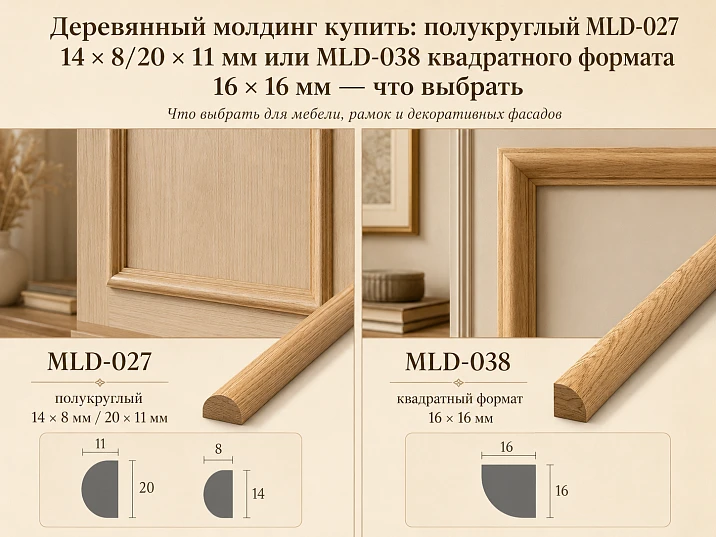
Comparison of two decorative profiles for furniture, walls, doors, mirrors, and panels
MLD-027 or MLD-038: quick selection
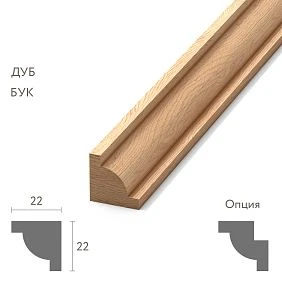
Short answer: For soft shading, small frames, and choosing between two cross-sections, the semicircular MLD-027 is better suited. The compact size 14 × 8 mm is convenient for drawers, cabinets, and thin edging, while 20 × 11 mm is for wardrobe doors, large facades, and wall frames. If a denser, symmetrical, and more noticeable line is needed, choose MLD-038 in size 16 × 16 mm. It is called a square-format molding due to equal dimensions, but it is a decoratively processed profile, not a regular square block.
Buy MLD-027 Buy MLD-038 Buy MLD-027U-2 Order samples
MLD-027 — semicircular roller. Provides smooth edging and soft side shadow, fits more easily into small furniture and calm wall frames.
MLD-038 — profile 16 × 16 mm. Equal dimensions make the line denser and more voluminous; it reads better on a door, large panel, and big wall.
MDF — length 2600 mm. Suitable for enamel and helps reduce the number of joints on a long line.
Beech and oak MLD-027 — 1000 or 2400 mm. Meter-long strips are convenient for small furniture projects and precise cutting.
Beech and oak MLD-038 — 2400 mm. One standard length simplifies a single calculation but does not provide a short meter option.
The material is chosen together with the finish. MDF and beech — for enamel, oak — for tinting while preserving texture.
Wooden molding is purchased not only by width and length. Two profiles with similar dimensions can work completely differently with light, furniture paneling, and wall framing. MLD-027 forms a soft semicircular bead, so the transition from plane to relief is smooth. MLD-038 protrudes 16 mm above the surface and has equal height, so the line looks denser, more architectural, and more noticeable from a distance.
The choice cannot be reduced to the rule "bigger means more expressive." On a small box or narrow door, a 16 × 16 mm profile can take up too much space. On a large wall, a thin MLD-027 14 × 8 mm may get lost and fail to create the desired frame. The right product is determined by the surface size, viewing distance, shape of adjacent parts, and future finish.
Comparison is especially important because both models are made from MDF, beech, and oak. The buyer can choose the same material but get a different result in terms of light and shadow. MDF and beech allow the profile to be painted with enamel, while oak retains the wood grain under tinting. After choosing the shape, you need to separately calculate the length of the strips, the placement of joints, and the allowance for corners.
For a soft decorative edging, you can buy the MLD-027 molding in sizes 14 × 8 or 20 × 11 mm. For a denser and more voluminous frame — buy the MLD-038 molding 16 × 16 mm. If no profile matches the scale of the project, it is better to open the catalog of wall moldings and compare other cross-sections.




How MLD-027 differs from MLD-038
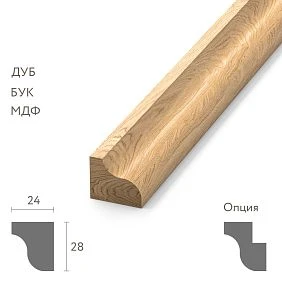
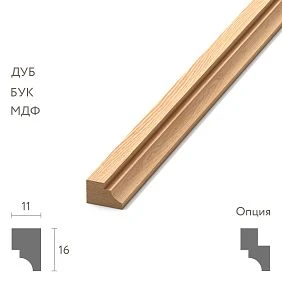
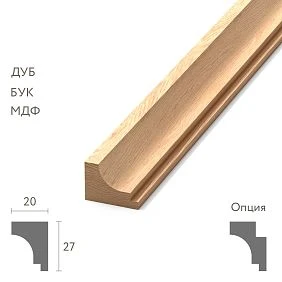
The main difference is the cross-sectional shape. MLD-027 is perceived as a semi-circular bead: the profile smoothly gains height, softly reflects light, and creates a rounded line. MLD-038 has symmetrical dimensions of 16 × 16 mm and a pronounced decorative quarter-round profile. It looks more structured and separates the frame from the background more strongly.
Our factory also produces:
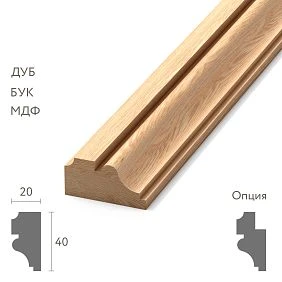
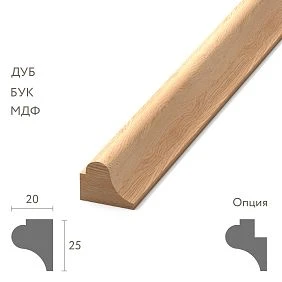
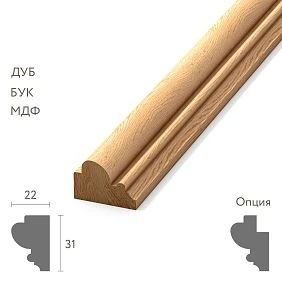
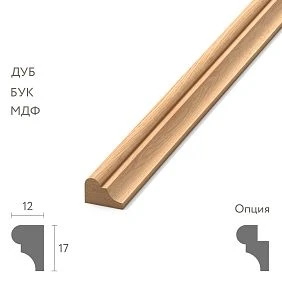
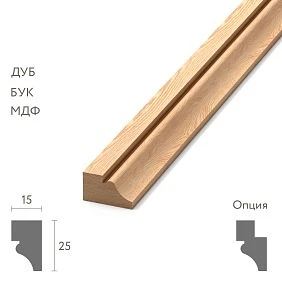
Semi-circular profile MLD-027
The semi-circular shape is suitable where the relief should soften rectangular geometry. On a facade, such molding creates a delicate edging and does not conflict with a handle, carved overlay, or panel. On a wall, it forms a thin frame that is perceived due to a soft shadow, not a large protrusion.
Get Consultation
Symmetrical profile MLD-038
The size 16 × 16 mm provides equal scale in height and projection. Such molding works well as an independent geometric line. It is suitable for a large frame, dividing belt, door, and furniture panel, where the profile should be noticeable not only up close but also from several meters away.
Two sizes versus one
For MLD-027, you can choose 14 × 8 or 20 × 11 mm. This allows you to maintain one shape in different scales: a small profile for drawers and cabinets, a medium one for wardrobe doors and walls. MLD-038 is produced in a single size of 16 × 16 mm. This uniform proportion is convenient if the same volumetric relief is needed throughout the entire room.
Short planks are only available for MLD-027 in solid wood
Beech and oak MLD-027 are available in lengths of 1000 and 2400 mm. The meter-long option helps avoid excess waste on a small facade or frame. For MLD-038, solid wood has a length of 2400 mm, and MDF has 2600 mm. For a small project, the waste will be larger, but the long plank is more convenient for an extended wall.
Confirmed characteristics of MLD-027 and MLD-038
| Parameter | MLD-027 | MLD-038 | What this means for the buyer |
|---|---|---|---|
| Shape | Semicircular roller | Symmetrical decorative profile of square format | MLD-027 is softer, MLD-038 is denser and more voluminous. |
| Cross-sections | 14 × 8 and 20 × 11 mm | 16 × 16 mm | MLD-027 has two scales, MLD-038 has one uniform proportion. |
| Materials | MDF, beech, oak | MDF, beech, oak | The shape can be compared in the same material. |
| MDF length | 2600 мм | 2600 мм | Suitable for long painted lines with fewer joints. |
| Length of beech and oak | 1000 or 2400 mm | 2400 мм | MLD-027 is more convenient for small projects, MLD-038 for a single long system. |
| MDF and beech | For enamel | For enamel | The profile can be combined with a wall or facade in an opaque color. |
| Oak | For tinting | For tinting | The natural wood texture is preserved. |
| Compatible angles | MLD-027U-2 | Selection separately per project | MLD-027 can be included in a ready-made decorative system. |
| Samples | OMLD-005 | OMLD-005 | Both profiles can be compared in person before calculating the footage. |
The size chart helps to see another important difference. MLD-027 20 × 11 mm is taller than MLD-038 in the first dimension, but protrudes less from the surface. Therefore, it may appear wider but softer. MLD-038 16 × 16 mm is more compact in height, but deeper, and this creates a stronger side shadow.
Quick comparison by task
| Task | What to choose | Why |
|---|---|---|
| Thin edging for a drawer or cabinet door | MLD-027 14 × 8 mm | A small semi-circular profile does not take up much space. |
| Frame on the cabinet door | MLD-027 20 × 11 or MLD-038 16 × 16 mm | The first is softer, the second is more voluminous; the choice depends on the light and shadow. |
| Large frame on the wall | MLD-038 16 × 16 mm | A deeper relief is better read from a distance. |
| Calm modern interior | MLD-027 | A smooth roller softens the geometry and does not create a heavy line. |
| Strict geometric composition | MLD-038 | A symmetrical section forms a dense architectural outline. |
| Small solid wood project | MLD-027 1000 mm long | You can reduce the leftover after cutting. |
| Frame with a ready-made decorative corner | MLD-027 + MLD-027U-2 | The system allows you to move away from a regular right angle. |
| Same proportion throughout the room | MLD-038 16 × 16 mm | One size is easier to repeat on doors, walls, and furniture. |
When to buy the semi-circular molding MLD-027
MLD-027 is chosen when the profile should add relief but not turn into a separate massive part. The semicircle accepts light gradually: one side is highlighted, the other goes into soft shadow. This effect is especially useful on small facades, where a deep protrusion would make the frame heavy.
For small furniture facades
The size 14 × 8 mm is suitable for cabinet doors, small drawers, narrow panels, and thin edging of a mirror insert. It leaves more free space between the frame and the edge of the facade. On furniture that already has carved overlays or expressive handles, this profile helps complete the contour without decorative competition.
For a compact project, you can buy molding 14 × 8 mm for furniture made of MDF, beech, or oak and immediately choose a length that will reduce the amount of unnecessary leftovers.
For wardrobe doors and kitchen facades
The section 20 × 11 mm is more noticeable but retains a rounded character. It is suitable for a large door, wide panel, sideboard, and kitchen facade, where the line should be readable from a normal distance. The 11 mm protrusion remains softer than the 16 mm of MLD-038, so the frame does not look excessively deep.
For small wall frames
MLD-027 creates calm geometry on a painted wall and pairs well with paintings, mirrors, and light decorative panels. The size 14 × 8 mm is suitable for a compact frame, 20 × 11 mm for a larger one. Before ordering, it is useful to make a paper template of the actual width and see if the line is lost at a distance.
For an interior with active decor
If there is a carved rosette, bracket, furniture overlay, or complex handle nearby, the semi-circular profile supports them more easily than MLD-038. It sets a boundary but does not become a second main accent. This is especially important on classic furniture, where too many relief elements quickly overload the facade.
For a project with ready-made corner pieces
MLD-027 can be combined with MLD-027U-2. This set allows you to assemble a decorative frame with a carved or shaped corner, without being limited to a standard 45-degree miter cut. The system is useful for doors, wall panels, and furniture where the corner should be part of the composition.
For a small order of beech or oak
Meter-long solid wood strips are convenient if several short pieces are needed. The buyer does not have to take only the 2400 mm length and leave a large remainder. But savings are only possible after precise layout: the four sides of the frame, corner cuts, and allowance must be calculated in advance.
When MLD-027 may be too delicate
On a high wall, wide door portal, or large panel, the 14 × 8 mm size may disappear. Even 20 × 11 mm sometimes provides insufficient depth if there is a tall baseboard and wide architraves nearby. In such a case, MLD-038 forms a more convincing contour.
MLD-027 14 × 8 or 20 × 11 mm
Two sizes are not just a choice of 'small or large.' They give a different ratio of height and projection. The 14 × 8 mm section works as a thin decorative edging. The 20 × 11 mm section creates a more noticeable bead and suits a larger-scale surface.
Size 14 × 8 mm
This option is chosen for dresser drawers, small doors, mirror inserts, thin frames, and furniture with other decorative details. On a facade 300–500 mm wide, it leaves enough air and does not bring the relief too close to the handle or edges.
Beech or oak 1000 mm long helps assemble compact projects. MDF 2600 mm long is convenient when several small frames are painted the same color and can be cut from a long strip.
Size 20 × 11 mm
Suitable for cabinet doors, kitchen fronts, large panels, and wall frames. The 20 mm height makes the contour more noticeable, but the 11 mm projection maintains a rounded, not massive, light-and-shadow effect. This is an intermediate option between the thin MLD-027 and the deeper MLD-038.
How to check the size without ordering the entire footage
Cut two cardboard profiles 14 and 20 mm wide, add conditional projections of 8 and 11 mm, and apply them to the facade. Look next to the handle, panel, and edge. For an accurate comparison of material and actual cross-section, it is better to order samples of wooden moldings.
When to choose MLD-038 size 16 × 16 mm
MLD-038 is needed where the line should be independent and clearly visible. Equal dimensions create a dense volume, and the quarter-round treatment prevents confusion with a regular unfinished batten. The profile is suitable for frames, dividing lines, and symmetrical design of large surfaces.
For a large wall frame
On a large wall, a 16mm protrusion creates a stable shadow. The frame is not lost in daylight and remains noticeable in the evening. This is useful in a living room, hall, study, or commercial space where the decor is viewed from several meters away.
For such a task, you can choose a compact wall molding and check whether its depth matches the baseboard, trim, and adjacent frames.
For doors and large furniture fronts
MLD-038 creates a voluminous frame on a tall cabinet, sideboard, door, or large panel. It is especially convincing when the surface is spacious enough and handles are located far from the contour. On a narrow door, the profile may interfere visually and physically, so a mockup is needed.
For strict geometry
One size 16 × 16 mm is convenient to repeat in different areas. For example, use it on a wall panel and support it with the same profile on furniture fronts. A uniform depth makes the system cohesive, especially in modern classics and interiors with clear rectangular frames.
For a horizontal dividing line
MLD-038 can be used as a noticeable belt on a wall or furniture if the project provides for such a function. A dense profile separates two painted areas better than a thin semicircle. At the same time, it remains a decorative element and does not replace a structural rail.
When MLD-038 will be too heavy
On a box, a small cabinet, a narrow mirror, or a facade with active carving, 16 × 16 mm can take up too much space. In this case, MLD-027 14 × 8 mm preserves the relief but does not overload the plane.
What does the query "square molding" mean?
MLD-038 is called square in format because its height and projection are equal — 16 × 16 mm. But this is not a square block with four straight edges. The profile is decoratively processed and has a quarter-round shape. This clarification is important so that the buyer does not expect a regular batten and does not use the product as a structural element.
Why equal dimensions are important
Symmetry of dimensions provides a balanced shadow and an equally confident line in both horizontal and vertical directions. The frame looks denser than MLD-027, even when its height is smaller than that of the 20 × 11 mm option.
Why this is not a block
A block is used as a blank, frame, or structural part. MLD-038 is intended for decorative framing. Its task is to form relief, light and shadow, and a finished border on the surface.
How to avoid an ordering mistake
In the specification, you need to write the full article MLD-038 and size 16 × 16 mm, not just "square batten." Then the craftsman, manager, and customer understand that we are talking about a specific decorative molding.
How the profile shape affects light and shadow
Chiaroscuro determines how noticeable the frame will be after painting or tinting. Even in a single color, the profile remains three-dimensional. The larger the protrusion and the sharper the surface change, the deeper the shadow. Therefore, MLD-027 and MLD-038 cannot be compared only by visible width.
Soft shadow MLD-027
The semicircle smoothly turns the surface toward the light. A soft highlight appears on one side, and gradual darkening on the other. Such a line does not cut the plane and suits calm facades and small frames well.
Dense shadow MLD-038
The 16 mm protrusion creates a more noticeable border on both sides of the profile. Even white enamel does not remove the volume. Under side lighting, the frame becomes expressive, so joints and geometry must be especially precise.
How color affects
Dark oak or contrasting enamel makes any profile visually stronger. MLD-038 in a dark finish requires a large surface. MLD-027 allows using contrast even on a smaller facade because its shadow is softer.
How to check chiaroscuro
Apply samples to the surface and look in the morning, evening, and under side artificial light. Frontal lighting smooths the relief, side lighting shows the real depth. Only after such a check should you calculate the total footage.
Which molding to choose for a furniture facade
A furniture facade is the most demanding surface for comparing MLD-027 and MLD-038. Here, not only the beauty of the profile matters, but also the distance to the handle, edge margins, opening trajectory, panel size, and the number of other overlays. An incorrectly chosen relief can make the door feel cramped or interfere with daily grip.
Dresser drawers
On a small drawer, MLD-027 14 × 8 mm usually looks more precise. It creates a neat border and leaves room for the handle. MLD-038 may suit a wide drawer but requires a larger margin. If the facade is already decorated with a carved overlay, a semicircular profile helps avoid overloading the surface.
Cabinet doors
For a compact cabinet, choose MLD-027 14 × 8 mm or a single simple contour without additional elements. On a two-door model, it is important that the frames of both doors match in height and offsets. Long panels are cut using one template to avoid different internal margins.
Wardrobe and dressing room
On a tall door, MLD-027 20 × 11 mm and MLD-038 16 × 16 mm work. The first creates a soft classic contour, the second a denser geometry. If the wardrobe is viewed from the other end of the room, MLD-038 reads more confidently. In a narrow dressing room, a semicircular profile may appear lighter.
Kitchen facades
For the kitchen, you need to check not only the scale but also the relief cleaning, coating durability, and position near the work area. MLD-027 has a softer shape without a deep side border. MLD-038 is more expressive but collects more shadow and requires careful finishing. The specific coating system must suit kitchen conditions.
Sideboard and display cabinet
On large classic furniture, MLD-038 can support a massive cornice and legs. If the sideboard already has carved overlays and complex handles, MLD-027 creates a calmer frame. The profile around a glass insert should not cover useful area or interfere with the glazing bead or glass fastening.
Furniture after restoration
New molding cannot be glued over weak varnish, peeling paint, or damaged veneered surface. First, the facade is restored, then markings are made. For old furniture, meter-long MLD-027 solid wood options are especially useful: they reduce leftovers when decorating several small parts.
The article reveals general selection principles wooden moldings for furniture and walls, and comparing MLD-027 and MLD-038 helps move from a general category to a specific profile.
Which profile is suitable for frames on the wall
On the wall, the size of the molding is evaluated from a distance. A profile that seems large in hand may become too thin on a wall four meters long. Additionally, light from a window or sconce changes the perception of depth. MLD-027 creates a delicate frame, MLD-038 creates a more architectural one.
Small frame above a console
MLD-027 14 × 8 mm is suitable for a compact panel, mirror, or painting. It does not compete with the object inside. If the frame remains empty and should itself form the decor, the size 20 × 11 mm or MLD-038 will be more noticeable.
Tall wall panel
A vertical frame from baseboard to cornice requires a line that will not get lost. MLD-038 16 × 16 mm reads well and creates a dense contour. MLD-027 20 × 11 mm is chosen if a softer shadow is needed and the interior should not look overly classical.
System of multiple frames
It is better to keep a single profile on one wall. MLD-038 simplifies the system with one size. MLD-027 allows two sections, but they must be mixed deliberately: for example, large outer frames 20 × 11 mm, small inner ones — 14 × 8 mm. Without hierarchy, the difference looks random.
Wall with an active color
If the molding is painted the color of the wall, volume remains the main expressive tool. MLD-038 creates a strong shadow even without contrast. MLD-027 provides calmer geometry and suits a rich shade where too deep a relief could overload the surface.
Contrasting wooden profile
Oak molding on a painted wall becomes an independent line. For a small room, MLD-027 is usually more suitable. MLD-038 in dark oak is better used on a spacious wall where its depth and texture have enough air.
To choose among other sections, you can select a decorative molding in the general category and compare how well MLD-027 or MLD-038 match the scale of the wall.
Molding for door, mirror, and interior panel
Interior door
On the door leaf, the molding must withstand movement and not interfere with the handle. MLD-027 20 × 11 mm creates a soft panel frame. MLD-038 is suitable for a large door and strict geometry. Before installation, the leaf is fully opened and checked to ensure the profile does not touch the wall, casing, or adjacent sash.
Door portal
On a fixed portal, the relief can be made larger than on the leaf. MLD-038 forms a noticeable frame around the opening, MLD-027 supports a calmer casing. The profile does not replace the casing itself and does not cover the installation joint without a well-thought-out assembly.
Mirror
MLD-027 14 × 8 mm is suitable for a thin edging of a small mirror. The 20 × 11 mm size is for a medium format. MLD-038 makes the framing deeper and can visually reduce the mirror field, so a sufficient base size is needed. The molding is not a finished frame: the method of attaching the mirror is calculated separately.
Wall panel
MLD-038 separates panels well from each other and creates a pronounced rhythm. MLD-027 softens straight lines and is suitable for a modern interior with delicate geometry. With multiple panels, joints and corners must align across the entire wall.
Partition and decorative structure
The molding can be used as an overlay line on a prepared surface, but not as a load-bearing batten. If the partition experiences load or movement, first design the frame, then add the decor. MLD-038 does not become a structural block just because of its 16 × 16 mm size.
Straight frame or composition with ready-made corner elements
A regular frame is assembled from straight sections with a miter cut at an angle. This is a universal method for MLD-027 and MLD-038. However, MLD-027 has an additional advantage — a compatible corner element MLD-027U-2, which allows for a more decorative transition.
Regular 45-degree miter cut
Fits a strict rectangular frame. Accuracy depends on the actual surface angle, tool, and end quality. On MLD-038, the depth difference is more noticeable due to the 16 mm protrusion. On the semicircular MLD-027, the gap is also visible, especially after dark tinting.
Ready-made corner MLD-027U-2
The corner element is designed for walls, doors, furniture, and partitions. It is made from beech and oak in four sizes: from a compact format of 84 × 84 mm to a large 204 × 204 mm. Dimensions and drawing must be checked against the specific frame, because the corner part has its own parameters and does not automatically replace a regular miter cut.
For a decorative system, you can buy the corner element MLD-027U-2 and separately calculate the straight sections MLD-027.
When a ready-made corner is truly useful
It helps make the frame more expressive, connect the molding with carved decor, and move away from dry rectangular geometry. On classic furniture, a door portal, or a wall panel, the corner becomes an independent element. On a small facade, a large size may be excessive.
Why MLD-027U-2 cannot be automatically installed with MLD-038
The shape and dimensions of the profile vary. The accompanying system is confirmed for MLD-027. If the designer wants to use a corner piece with a different molding, verification of drawings and physical fitting is required. Such compatibility is not guaranteed in the article.
How to calculate a frame with corner elements
First, select the size of the four corners. Then measure the distances between their attachment points, and only then calculate the straight moldings. You cannot take the external panel size and simply subtract an arbitrary corner width. The drawing shows the actual joining length.
MDF, beech, or oak
Both models are available in three materials. The shape can be chosen independently, but the material must match the future finish and other project details. If furniture, doors, and baseboards are already determined, it is better to select the molding to match them, not the other way around.
MDF under enamel
MDF MLD-027 and MLD-038 have a length of 2600 mm. This is convenient for long wall lines and reduces the number of joints. The smooth surface is suitable for opaque painting. The ends after cutting require proper insulation and preparation so that the enamel does not differ in absorption.
Beech for enamel
Beech is chosen when natural solid wood is needed, but the final surface will be opaque. For MLD-027, lengths of 1000 and 2400 mm are available; for MLD-038, 2400 mm. Beech is convenient to combine with wooden facades, doors, and other details that are also painted with enamel.
Oak for tinting
Oak retains a pronounced texture. On the semicircular MLD-027, the pattern runs along the smooth surface and creates a soft natural highlight. On MLD-038, the texture combines with deeper geometry, making the profile more noticeable. It is better to tint all strips in one batch after a test color sample.
Can MDF and solid wood be combined
Under opaque enamel, different bases can be visually unified, but the preparation technology will differ. Under a transparent coating, MDF does not replace oak. If different materials are used in one frame, the joint and finish stability must be calculated by the workshop.
How to choose material for ready-made furniture
For an oak facade under oil or tinting, choose an oak molding. For a painted facade, choose MDF or beech under enamel, based on the design and workshop requirements. It is important not only to match the color but also to replicate the gloss level and surface character.
Before purchasing compounds, you can view materials for painting MDF and other products for installation and finishing, without prescribing a single universal system without checking the substrate.
Why samples are more useful than choosing only from a photo
It is difficult to assess the cross-section of a molding on a screen. A photo shows the shape but does not convey the real shadow, depth, and relationship with the handle or facade. The OMLD-005 set contains 84 samples of moldings, cornices, and baseboards made of oak, beech, and MDF. Samples 100 mm long can be applied to the surface directly on site.
Comparing MLD-027 and MLD-038 in person
Place both profiles on the facade under the same lighting. First, look up close, then step back to a normal distance. MLD-027 may seem too thin in hand but harmonious on furniture. MLD-038, on the other hand, may look compact as a sample and too deep on a small door.
Checking next to the handle
The handle and molding are on the same working surface. The sample shows whether there is enough space for fingers, whether visual crowding occurs, and whether the frame comes too close to the hardware. This is especially important for MLD-038.
Material check
Oak, beech, and MDF look different even before finishing. The set helps to understand whether a natural pattern or a smooth base for enamel is needed. For the final color, a test coating on the actual material is still required.
Side light check
Place samples near a window or directional lamp. The MLD-027 semicircle will give a soft transition, MLD-038 a more noticeable shadow. This test often ultimately determines the choice.
For professional approval, you can purchase the OMLD-005 sample set, and after approving the shape and material, calculate the total footage.
How to calculate the amount of molding
The quantity is calculated not by surface area, but by the length of all lines. For a rectangular frame, add two heights and two widths. For multiple panels, each frame is calculated separately, then the footage is combined and distributed among planks of the selected length. After that, add a margin for corners, joints, trimming, and possible errors.
Start with finished dimensions
Measure not the wall or facade in general, but the exact contour of the future molding. On furniture, leave margins from the edge, handles, and panels. On the wall, consider the baseboard, sockets, switches, and adjacent frames. Changing the frame by a few centimeters can affect the cutting of planks.
Rectangular frame formula
For a frame with height H and width W, the base length is 2H + 2W. For example, an 800 × 500 mm frame requires 2600 mm of profile before allowance. For MLD-027 made of MDF, this is exactly one plank in total length, but corner cuts and cutting direction may require more. For a 2400 mm long solid wood plank, one plank is no longer enough.
Multiple identical facades
First calculate one reference frame, then multiply by the number of doors. But perform cutting according to the layout of all parts. The remainder from the long side of one door may fit the short side of another. This approach reduces waste, especially with lengths of 2400 or 2600 mm.
Count short MLD-027 planks separately
Meter-long options in beech and oak are convenient when most pieces are shorter than 500 mm. Two short sides can be obtained from one plank, but corner cuts reduce the usable length. You cannot count 1000 mm as two perfect 500 mm pieces without allowance.
Allowance depends on geometry
For a simple straight line, the allowance is less than for a frame with four corners. A system of multiple panels, an external corner, a complex door, and MLD-027U-2 require a separate layout. A universal percentage does not replace a cutting plan.
Keep allowance for repairs
After installation, it is useful to keep a suitable piece from the same batch. It will help restore a damaged area and check the finish color. This is especially important for oak: later purchase may differ in grain.
How to position joints
A long line may require joining two planks. The joint should not be left in a random center of the main wall or facade. Its position is chosen before cutting and is preferably moved to a less noticeable area where light does not run along the profile.
On the wall
The longitudinal joint is placed closer to the corner, behind furniture, or in an area not viewed frontally. However, a too short edge fragment may look unstable and be more difficult to install. The layout should be not only inconspicuous but also practical.
On the door leaf
It is advisable to assemble each side of the frame from a single piece. A longitudinal joint on a small door is too noticeable and experiences vibration. Lengths of 2400 and 2600 mm usually allow cutting sides without joining if the plan is made in advance.
On furniture
On a drawer or cabinet, it is better to avoid a joint. On a large built-in panel, it is possible but must match in height and shape. MLD-038 requires particularly precise alignment because the depth of 16 mm shows even a slight difference.
On oak for tinting
Not only the geometry but also the grain pattern is joined. Two planks are rotated so that the transition looks smoother. Opaque enamel hides the texture but does not hide unevenness.
How to prepare the connection
The ends must be clean and perpendicular. The sections are temporarily applied to the base, the straight line is checked, and only then they are fixed. The joint is filled with a material compatible with the future coating, without covering the decorative profile.
Installation: adhesive, fixation, and surface preparation
The installation method depends on the base and the length of the line. MDF facade, natural wood, painted wall, and plaster require different compounds. You cannot assign one adhesive based solely on the molding article. The condition of the coating, the weight of the assembled frame, door movement, and future finishing must be considered.
The base must be strong
The molding holds together with the layer to which it is glued. If the paint is peeling, weak putty is crumbling, or furniture lacquer has lost adhesion, the decor will come off along with the coating. Before marking, the surface is cleaned and, if necessary, restored.
Dry layout
All frame segments are assembled without adhesive. The corners, margins, handle position, and alignment of the inner opening are checked. On the wall, a temporary layout can be made with painter's tape and short templates.
Glue joint
The installation compound must be compatible with the molding material and the base. For interior furniture work, the master may use one system, for a painted wall — another. Excess adhesive should not come out onto the front part and interfere with priming.
Additional fixation
Long planks, moving doors, and uneven bases sometimes require micro-pins or other temporary fastening. The decision is made by the master. Visible holes must be prepared for the future finish and must not damage the thin MLD-027.
Installation before painting
Suitable for wall panels and furniture that will be fully painted after assembly. Joints and corners can be prepared as a single system. Care must be taken to ensure that the primer and enamel do not flood the semi-circular or quarter-circular profile.
Installation after painting
Convenient for contrasting oak molding or decor on a finished wall. But the ends and connection points must be finished in advance. Any adjustment after the finish may leave a light cut or damage.
Material acclimatization
Wooden slats are conditioned in the room before installation according to the workshop and manufacturer's recommendations. They are not installed immediately after cold delivery or in a damp area. MDF also requires dry storage and protection of the ends.
For the project, you can buy glue for wooden molding and finishing materials, but the specific composition is chosen after checking the base.
What to buy together with MLD-027 or MLD-038
The main profile rarely completes the project on its own. For a frame, corner elements, mounting materials, samples, and additional molding of the same material may be needed. It is better to buy the set after layout to avoid mixing lengths, wood species, and different finishing systems.
| What to add to the purchase | Why this is needed | For which scenario | What to Check |
|---|---|---|---|
| Semi-circular wooden molding | Forms a soft edging in two sizes | Furniture, small frame, door, mirror | 14 × 8 or 20 × 11 mm, length and material |
| Square format molding 16 × 16 mm | Creates a denser and more voluminous frame | Large wall, door, cabinet, dividing line | Sufficient margins and depth of 16 mm |
| Ready-made corner for semi-circular molding | Allows assembling a decorative frame with shaped corners | Wall, door, furniture, partition | Corner size, material, and junction drawing |
| Molding samples set OMLD-005 | Helps compare the profile and material on the object | Custom furniture, large wall, coordination with designer | Chiaroscuro, scale, combination with handle and decor |
| Materials for mounting MLD-027 | Provide fixation and preparation for finishing | Wall, facade, door, panel | Compatibility with base, wood or MDF |
| Moldings for furniture made of oak and beech | Allow choosing a different scale or profile | MLD-027 is too thin, MLD-038 is too deep | Cross-section, length, material and purpose |
How not to confuse these moldings with similar products
MLD-038 and square bar
Equal dimensions of 16 × 16 mm do not make MLD-038 an ordinary bar. It is a decorative quarter-round profile. A bar can be used in a frame, while a molding is used for framing and chiaroscuro. The article number must be specified in the order.
MLD-027 and round batten
A semi-circular molding has a flat mounting side and a convex front part. A round batten has a different cross-section and a different purpose. One product cannot be replaced by another just because of the rounded shape.
MLD-027 and floor skirting board
A molding can be used as a small decorative line near the junction if the assembly is designed in the project. But it is not a specialized standard floor skirting board and should not automatically replace it upon request for a "semi-circular skirting board".
Molding and a casing
A casing frames a door or window opening and usually has a greater width. MLD-027 and MLD-038 can complement a door, but they do not always cover the installation gap and do not replace a casing without calculation.
Molding and furniture glazing bead
The glazing bead can hold glass or a panel, while the decorative molding creates a frame. If the profile must perform a structural function, you need to check the furniture drawing. Do not place a load on a decorative part without confirmation.
MLD-027U-2 and a regular miter cut
MLD-027U-2 is a standalone shaped element, not a pre-cut straight strip. It changes the appearance of the frame and requires its own calculation. For simple geometry, straight moldings are sufficient; for a decorative system, corners are added.
MDF and solid wood
Externally, after enameling, they may look similar, but the lengths, end preparation, and base behavior differ. It is better to use one material in a single frame, unless the project specifies otherwise.
A broader overview is provided by the material Interior wooden molding, but to purchase a specific item, you need to refer back to the dimensions of MLD-027 and MLD-038.
Practical choice for specific situations
You need to design a small cabinet door
Start with MLD-027 14 × 8 mm. Its width and projection leave enough space for the handle and inner panel. Before ordering, check that the frame does not come too close to the edge and does not interfere with opening the adjacent door. For a small product made of beech or oak, it is convenient to calculate meter-long strips.
You need to make a frame on a tall wardrobe door
Compare MLD-027 20 × 11 mm and MLD-038 16 × 16 mm. The first creates a smooth contour, the second a deeper and stricter line. If the wardrobe is in a large room and viewed from a distance, MLD-038 usually reads more confidently. In a narrow dressing room, a semi-circular profile may look calmer.
Need to decorate a large wall
MLD-038 suits a large geometric frame due to its 16 mm depth. If the wall is already saturated with color, furniture, and carved decor, MLD-027 20 × 11 mm will maintain structure without heavy shadow. At the site, be sure to compare both samples under side lighting.
Need to add molding to existing furniture
First, check the material and condition of the facade. If the surface is painted, MDF or beech under enamel is easier to match with the existing color. If the furniture is oak and the texture is open, choose oak. The profile should support the scale of handles, legs, and cornice, not exist separately.
Need to decorate furniture with active carving
MLD-027 is usually safer. A soft border sets a boundary and leaves the carved overlays the main role. MLD-038 can compete with large ornament, especially under dark finish. If the frame should be noticeable, use one strong profile and reduce the number of other details.
Need to assemble a strict modern panel
MLD-038 16 × 16 mm suits repeating rectangular frames and horizontal lines. One size makes uniformity easier. For a softer modern interior with rounded furniture shapes, choose MLD-027.
Need to reduce the number of joints
MDF 2600 mm long is convenient for long lines of both models. But the material cannot be chosen only by length if the project requires natural oak. For solid wood, optimize cutting from 2400 mm planks, and for MLD-027 use meter-long options where they reduce waste.
Need a frame without ordinary corners
Choose MLD-027 and check MLD-027U-2. First determine the size of the corner element, then calculate the straight sections. Do not buy straight molding until the corners are approved: their geometry changes the useful length of the sides.
Need to design a commercial interior
In a hotel, restaurant, salon or showroom, repeatability, maintainability and spare parts are important. MLD-038 works well on large panels, MLD-027 on furniture and small frames. Save the cutting diagram, finish code and an extra piece for future repairs.
How profiles work in different rooms
Living room
MLD-038 suits a large wall composition behind a sofa, library or fireplace area. MLD-027 is good for small frames around pictures and mirrors. If the living room already has a wide baseboard and a noticeable ceiling cornice, the 16 × 16 mm profile more easily supports the overall scale.
Bedroom
Smooth MLD-027 helps create a calm panel behind the headboard and does not make the wall too heavy. In a large classic-style bedroom, MLD-038 can form a more architectural outline. The color is best tied to the headboard, doors or baseboard.
Kitchen
On facades, MLD-027 20 × 11 mm and MLD-038 are more often compared. The semicircle is visually simpler, the square format is more expressive. The coating must withstand kitchen conditions, and the relief must remain accessible for cleaning. The profile is not placed too close to the handle and working edge.
Hallway
In a narrow space, MLD-027 looks lighter. MLD-038 suits a spacious hall, large door or panel. Any protruding molding is placed so that it is not bumped by bags and outerwear.
Cabinet
Oak MLD-038 supports a large library and strict geometry. MLD-027 suits a small desk, cabinets and wall frames. If the furniture already has panels, the new profile should match them in scale.
Children's room
MLD-027 14 × 8 mm suits a light painted panel and small facades. Installation must be reliable, and edges carefully finished. The molding is not placed in a child's constant contact area or near moving parts of furniture without verification.
Wardrobe
For narrow facades, choose MLD-027; for wide built-in cabinets, choose MLD-038 or MLD-027 20 × 11 mm. The main criterion is the distance to the handle and the adjacent door. A full-size sample helps to see if the profile visually narrows the passage.
Mistakes when buying and installing
Choose only by the first digit of the size
MLD-027 20 × 11 mm is taller than MLD-038 but protrudes less. If you only look at the number 20, you might mistakenly consider it more massive. You need to compare both dimensions and the actual shape.
Calling MLD-038 an ordinary square bar
This is a decorative profile. Attempting to use it as a structural batten leads to incorrect load and purpose calculations. Specify the exact article number in the order.
Buying 14 × 8 mm for a wall that is too large
The thin line gets lost, and the frame looks weak. Before ordering, evaluate the profile from a distance and compare it with MLD-038 or other models in the category.
Installing 16 × 16 mm on a small facade
The profile takes up most of the door, approaches the handle, and leaves margins that are too narrow. For such a surface, MLD-027 14 × 8 mm is better.
Not considering the length of the planks
The buyer calculates the footage but does not distribute the segments into lengths of 1000, 2400, and 2600 mm. This results in extra joints or a large leftover. A cutting plan is needed.
Mixing materials in one frame
MDF, beech, and oak can accept finishes differently. Under a transparent finish, the difference is obvious. Even under enamel, it is better to assemble one frame from one material.
Ordering corners without checking the size
MLD-027U-2 has four options. An unsuitable corner changes the scale and does not match the straight sections. First, open the drawing, then calculate the set.
Painting before a trial assembly
After finishing, it turns out that the corners do not align or the profile interferes with the handle. Adjustment damages the enamel and tinting. First, a dry layout, then finishing.
Installation on weak paint
The adhesive holds onto the coating, which itself peels off the wall. The base needs to be reinforced. Otherwise, the molding will tear off along with the paint layer.
Do not leave a repair remainder
If damaged, you have to order a new strip, which may differ in oak shade. A small stock and a color sample make repairs easier.
Use MLD-027 as a standard floor skirting board
The semicircular shape can be used in individual decorative nodes, but the product remains a molding. For a standard floor joint, it is better to choose a profile designed as a skirting board.
Who is MLD-027 suitable for
- for small furniture fronts, drawers, and cabinet doors;
- for soft chiaroscuro and a smooth semicircular contour;
- for choosing between sections 14 × 8 and 20 × 11 mm;
- for a project where meter-long planks of beech or oak are convenient;
- for small wall frames and mirrors;
- for furniture with active handles or carved overlays;
- for a frame with corner elements MLD-027U-2;
- for MDF or beech under enamel;
- for oak with a calm tint;
- for interiors where the profile should not dominate.
Who is MLD-038 suitable for
- for a large wall frame and high panel;
- for a door, cabinet, or wide furniture facade;
- for dense chiaroscuro and pronounced relief;
- for a strict geometric composition;
- for repeating one proportion 16 × 16 mm in several zones;
- for a horizontal dividing line;
- for a spacious living room, study, hall, or commercial space;
- for MDF or beech under enamel;
- for oak with expressive tinting;
- for a project where the profile must be readable from a distance.
When it's better to choose a different profile
- MLD-027 is too thin, and MLD-038 is too deep for the surface;
- a wide flat strip without a rounded relief is needed;
- a real structural block is required;
- a specialized floor plinth is needed;
- the length of the planks or the location of the joints is not suitable;
- the facade is too narrow for the frame;
- the base does not allow for reliable installation;
- the project requires a different material or finished coating;
- the corner system MLD-027U-2 does not match the required geometry;
- the interior is already overloaded with relief decor.
In this case, it is more reasonable to look at all profile sizes and choose a model without compromising on scale.
What to Check Before Ordering
Before purchasing, record the model, cross-section, material, length, number of slats, and finishing method. For MLD-027, separately specify 14 × 8 or 20 × 11 mm. For MLD-038 — 16 × 16 mm. If the frame is assembled with MLD-027U-2, the specification must include the dimensions of the corners and the lengths of straight sections between them.
It is useful to attach a cutting diagram to the order. It shows each side of the frame, the location of joints, margins from the edge of the facade and handles. For a wall, add the dimensions of panels, baseboards, and adjacent frames. Such a diagram helps avoid buying extra footage and discovering after delivery that short pieces cannot be obtained from the selected length without an additional slat.
The material and finish are agreed upon before calculating the final cost. MDF and beech are chosen for enamel, oak for tinting. For multiple doors or panels, it is better to order the entire volume in one batch and keep one piece as a sample for repairs.
How to buy MLD-027 or MLD-038 at STAVROS
The customer journey starts with the form. For a soft edging and two size options, open the MLD-027 card. For a deeper line, choose MLD-038. Then select the material and length, calculate straight sections, and check the stock.
If the project is small, a semi-circular oak molding or beech 1000 mm long can reduce waste. For a long painted wall, MDF options 2600 mm are convenient. If a single volumetric profile is needed, the MLD-038 oak molding, beech, or MDF allows repeating the 16 × 16 mm section on multiple surfaces.
If in doubt, do not order the entire footage based only on a photo. First, you can compare MLD-027 and MLD-038 in person, check the light and shadow and scale. For a general understanding of minimalist profiles, the article is useful modern wooden moldings.
FAQ: questions about MLD-027 and MLD-038
How is MLD-027 different from MLD-038?
MLD-027 has a semi-circular profile of 14 × 8 or 20 × 11 mm and creates a soft shadow. MLD-038 comes in a size of 16 × 16 mm and forms a denser, voluminous contour.
Which profile creates a softer light-shadow?
MLD-027. The semi-circular surface smoothly receives light and does not produce a sharp shadow transition.
What does "square format molding" mean?
MLD-038 has equal height and projection — 16 × 16 mm. The profile is decoratively processed and is not a regular square bar.
Which size of MLD-027 should I choose?
14 × 8 mm is suitable for small facades and thin edging. 20 × 11 mm is more readable on cabinet doors, large facades, and wall frames.
Which molding is suitable for a small door?
More often MLD-027 14 × 8 mm. It leaves more free space and interferes less with the handle.
Can MLD-027 be used on a wall?
Yes. For a small frame, 14 × 8 mm is suitable; for a larger one, 20 × 11 mm.
Is MLD-038 suitable for furniture?
Yes, if the facade is large enough and the 16 mm depth does not interfere with opening and the handle.
What angles exist for MLD-027?
The series includes MLD-027U-2 in four sizes. The specific option is chosen based on the drawing and frame scale.
Can MLD-027 be used as a floor baseboard?
Only in a separately designed decorative unit. For standard floor abutment, it is better to choose a specialized baseboard.
What to choose for enamel?
MDF or beech. MDF is convenient with a length of 2600 mm, beech with natural solid wood and length options for MLD-027.
How to preserve the oak texture?
Select an oak profile for tinting and make a test paint on an actual piece.
How much extra should be added?
The extra depends on the number of corners, joints, and cuts. It's better to create a diagram for each plank rather than applying one percentage to all projects.
Can both profiles be combined in one interior?
Yes, if they have different hierarchy: for example, MLD-038 on large wall frames, MLD-027 on furniture. Random mixing on one surface may look inconsistent.
Which profile is better for a large wall?
Usually MLD-038 16 × 16 mm. It creates a deeper shadow and is better readable from a distance.
Why order samples?
To see the actual depth, material, and light-shadow effect next to the facade, handle, wall, or door before purchasing the full length.
Where to buy MLD-027 and MLD-038?
Both models are presented in separate STAVROS cards. Before payment, you need to check the cross-section, length, material, and quantity.
Result: MLD-027 for a soft line, MLD-038 for a denser frame
MLD-027 and MLD-038 solve one task — they create a decorative edging — but give different results. The semicircular MLD-027 in sizes 14 × 8 and 20 × 11 mm is suitable for small facades, calm wall frames, and projects where soft chiaroscuro is needed. Meter-long options in beech and oak are convenient for compact cutting, and MLD-027U-2 allows you to assemble a system with ready-made decorative corners.
MLD-038 in size 16 × 16 mm forms a deeper and more noticeable line. It is suitable for large doors, wall panels, cabinets, and strict geometry. Equal dimensions describe a square format, but the product itself remains a decorative profile, not a raw batten.
Before ordering, you need to check the profile in person, choose MDF or beech for enamel or oak for tinting, calculate lengths of 1000, 2400, or 2600 mm, and plan the joints in advance. On the STAVROS website, you can buy semicircular molding MLD-027 or buy wooden molding MLD-038, choosing a specific profile not by a random photo, but by the actual task, chiaroscuro, and surface scale.