



























Article Contents:
- Where wooden shelf brackets are used — real scenarios
- Open shelves in the kitchen
- Hallway: shelf by the mirror or above the console
- Study: bookshelves and shelves for decor
- Living room: accent wall with a shelf on decorative brackets
- Corner areas
- Shelf above the desk
- How a wooden bracket differs from a metal angle bracket — honest about the difference
- How to choose the size of a wooden bracket — the logic you need to know
- Shelf depth = bracket projection
- Height of the vertical part of the bracket
- Shelf thickness and mounting groove
- Distance between brackets
- Visual proportion: the bracket should not look "weak"
- Styles of wooden brackets: from smooth to carved
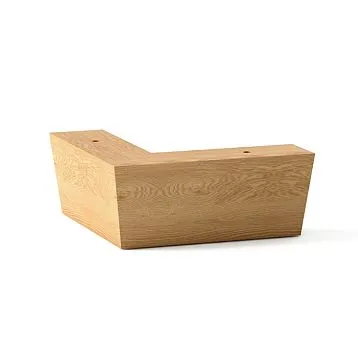
- Smooth wooden bracket
- Profiled bracket with relief
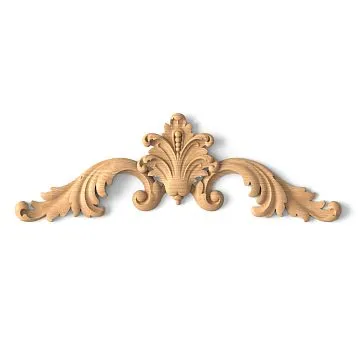
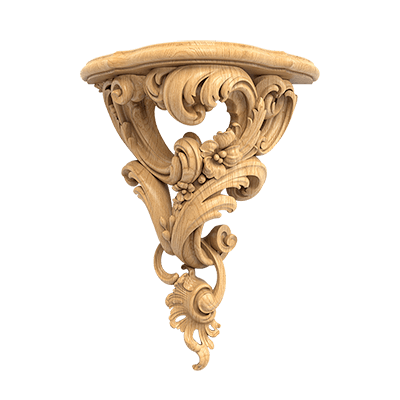
- Carved bracket — for classic and neoclassical styles
- Massive bracket for heavy shelves
- Compact bracket for hallway and corridor
- Wooden, metal or polyurethane — comparing honestly
- Ready-made selection scenarios — specific and to the point
- Scenario 1. Open shelves in a classic kitchen
- Scenario 2. Shelf in the hallway under the mirror
- Scenario 3. Bookshelves in the study
- Scenario 4. Accent wall in the living room
- Scenario 5. Corner shelf in a children's room or bathroom
- Wall material and fasteners — practice without theorizing
- Mistakes when choosing and installing shelf brackets
- How to order a wooden bracket: what to check before purchasing
- Wooden brackets in the interior decor system
- Wooden shelf bracket: the essentials in brief
- FAQ — answers to the most frequently asked questions
An open shelf on the wall is one of the most popular techniques in modern interiors. It is light, functional, and does not clutter the space. But needless to say, its beauty lies not only in the board hanging on the wall? It lies in what holds that board. bracket for shelf — this is not a technical detail to be hidden. It is a visible element that works for the overall look of the area: kitchen, hallway, study, living room.
That is why the question 'which bracket to choose' is not about load-bearing capacity. It is about style, proportion, scale, and material. A wooden decorative bracket made of solid oak or beech is completely different from a metal angle bracket from a hardware store. It holds the shelf and simultaneously becomes part of the interior.
This guide is about how to choose a wooden shelf bracket correctly: by size, style, load, and area of application.


Where wooden shelf brackets are used — real scenarios
Before moving on to the selection criteria, it's worth understanding: in which situations a wooden bracket is the best solution, rather than just one of the options.
Open shelves in the kitchen
The kitchen is the main area for using open shelves on brackets. Here they carry a practical load: spices, oils, vinegars, jars with grains, small dishes. But the kitchen is also a visible space: an area visible from the living room, from the hallway, which sets the tone for the entire interior.
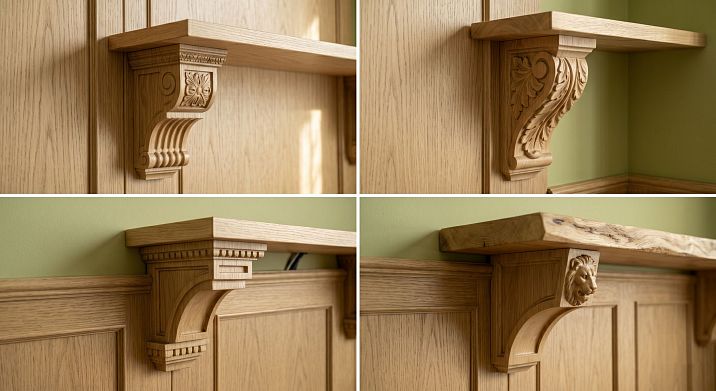
For a classic solid wood kitchen — a carved wooden bracket with a profiled relief. For a Provence or country style kitchen — a massive block bracket made of oak with rounded edges. For a modern kitchen with wood-look facades — a smooth bracket in the same tint as the kitchen set. Wooden brackets for shelves become part of the overall kitchen language — that's why a kitchen with them looks complete, rather than "with a shelf on a corner."
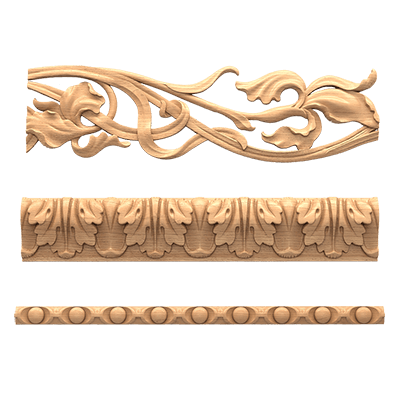
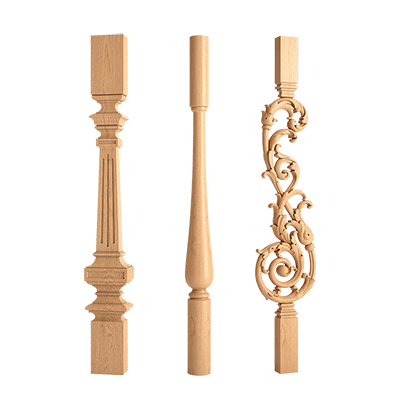
Our factory also produces:


Hallway: a shelf by the mirror or above the cabinet
In the hallway, an open shelf solves several tasks at once: keys, mail, candles, small decor. Often — a shelf under or next to the mirror. The bracket here is constantly visible, often from close range — accordingly, the detail matters. A small decorative bracket with a carved element or neat profile — and the hallway transforms from a "passage" into a space with character.
The depth of the shelf in the hallway is usually 15–25 cm. Wall bracket for a shelf in this scenario — compact, with a projection of 15–20 cm, with a mounting part height of 20–30 cm. Proportion: the bracket should be visible about 30–40% of the shelf depth — not completely hidden under the shelf (then it visually doesn't "work"), and not protruding too far forward.
Get Consultation
Study: bookshelves and decorative shelves
In a study, shelves bear maximum load — books are heavier than any kitchen decor. The average weight of books per linear meter of shelf: 20–35 kg. A wooden bracket made of solid oak, 25–30 cm deep and with a vertical part height of 35–40 cm, provides a safety margin that will withstand the book load when properly installed.
At the same time, a study is an area of special aesthetic requirements. A massive dark oak bracket for a bookshelf made of the same material creates a unity that makes a study a study, not just a room with a desk. furniture bracket here — not a detail, but a structural element.
Living room: accent wall with a shelf on decorative supports
An accent wall in the living room is a popular technique. Shelves on decorative brackets on such a wall are an organic part of this concept. Three shelves of different lengths, on carved brackets, with books and decor — this is both a functional area and an architectural composition.
In the living room, symmetry is important: if the brackets are carved, they must be identical on all shelves. If the shelves are of different lengths, the brackets should be proportionally different sizes. carved bracket for shelf in the living room — it is already an element of wooden interior decor, not just a support.
Corner zones
A corner shelf is often an underestimated solution for small spaces or for arranging "dead" corners. A corner shelf requires two or three brackets, one of which is placed in the very corner. Special corner brackets or standard brackets in pairs — both configurations work. The main thing is even load distribution.
Shelf above the desk
The work area is another common scenario. A shelf above the monitor or in the desk area: for books, stationery, small equipment. Depth — 20–25 cm, bracket height — sufficient for the overhang. Material: oak or beech in a tint matching the furniture. Brackets in this area are often visible — they are in the line of sight during work. Therefore, a neat profile, quality coating, and correct proportion are directly important.
How a wooden bracket differs from a metal angle bracket — honestly about the difference
The question sounds simple, but the answer is important. Because many people buy a metal angle bracket where a wooden bracket is needed — and then see that the shelf "doesn't look right."
A metal angle bracket is a technical structure. It is invisible in the sense that it carries no decorative load: its task is to hold, not to decorate. Suitable for utility rooms, hidden storage systems, technical areas.
A wooden bracket is simultaneously a technical support and a decorative element. It is visible from below, from the side, from the front. Its shape is part of the shelf's image. In a classic or neoclassical interior, a solid oak bracket with carved relief is what turns an open shelf from a "functional detail" into an "interior detail."
Let's compare in more detail:
| Parameter | Metal angle bracket | Wooden bracket |
|---|---|---|
| Function | Only holds the shelf | Holds + decorates |
| Visibility | Minimal, neutral | Active, decorative |
| Style | Neutral / industrial | Classic, neoclassical, country, Provence, Scandinavian |
| Finish | Metal, powder, chrome | Varnish, oil, stain, enamel — to match the interior |
| Combination with wood | Contrast of materials | Unified system |
| Load | High (depends on cross-section) | High when using oak/beech array |
| Application in expensive interiors | Limited | Organically |
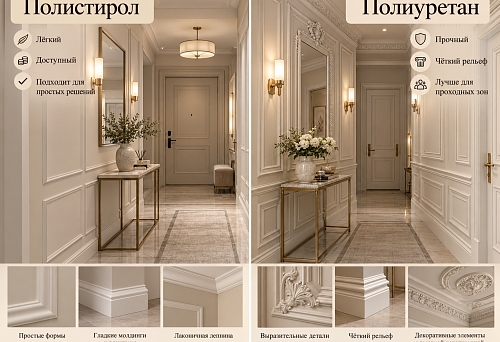
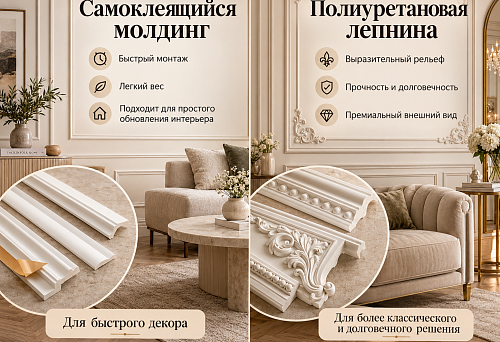
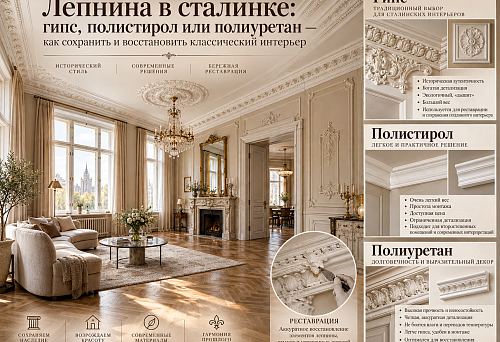
Polyurethane brackets — third option: they are lighter than wood and better for purely decorative areas where load is minimal. But for a real shelf with weight, wood is more reliable.
How to choose the size of a wooden bracket — the logic you need to know
Bracket size is not an arbitrary detail. It is the result of several measurements.
Shelf depth = bracket projection
Main rule: the bracket projection (horizontal part) should equal the shelf depth or be 10–20% less. If the shelf is 25 cm deep, the bracket with a horizontal part of 22–25 cm. If the bracket's horizontal part is significantly smaller than the shelf depth, the shelf will overhang forward and look unstable (even if it holds securely).
Practical sizes:
-
Shelf depth 15–20 cm (narrow, for decor): bracket with projection 12–18 cm.
-
Shelf depth 22–28 cm (standard kitchen, bookshelf): bracket with projection 20–25 cm.
-
Shelf depth 30–35 cm (working, for dishes): bracket with projection 28–32 cm.
-
Shelf depth 40+ cm (wide, for appliances): bracket with projection 35–40 cm, reinforced design.
Height of the vertical part of the bracket
The height of the vertical part (the one attached to the wall) determines the rigidity of the structure. Optimal proportion: the vertical part is equal to or slightly smaller than the horizontal projection. Example: projection 25 cm → vertical part 20–25 cm. If the vertical part is significantly smaller than the projection, the bracket experiences increased load moment, which reduces the durability of the fastening.
Shelf thickness and mounting groove
A wooden bracket often has a groove or platform on top where the shelf rests. If your shelf is 25 mm thick, the bracket groove should be 25–28 mm. If the shelf is 40 mm thick solid wood, the bracket must be substantial: both in the groove on top and in overall proportions. A thin bracket under a thick solid wood shelf is an imbalance that is immediately visible.
Distance between brackets
-
Light decorative shelf (up to 10 kg per meter): spacing up to 70 cm.
-
Kitchen shelf with dishes (15–20 kg per meter): spacing 50–60 cm.
-
Bookshelf (25–35 kg per meter): spacing 40–50 cm, sometimes 3 brackets per 120 cm long shelf.
-
Shelf for heavy appliances: 3 brackets mandatory, spacing up to 40 cm.
Rule: when in doubt, add another bracket. An extra bracket is an additional decorative accent, not redundancy.
Visual proportion: the bracket should not look "weak"
This is an aesthetic criterion that is often ignored. A small, thin bracket under a massive 40×4 cm oak shelf is a visual imbalance. The bracket looks insufficient, even if it technically holds up. The proportion must be honest: a massive shelf — a massive bracket. An elegant narrow shelf — a compact, neat bracket.
Styles of wooden brackets: from smooth to carved
The shape of the bracket is the language of the interior. Let's break down the style directions.
Smooth wooden bracket
Straight lines, no relief, smooth surfaces. Suitable for Scandinavian style, modern minimalism, "Japanese" interior. Painting: white, light gray, natural beech without tinting. Or conversely — dark oak, graphite, almost black. Contrast with a white wall is a graphic technique.
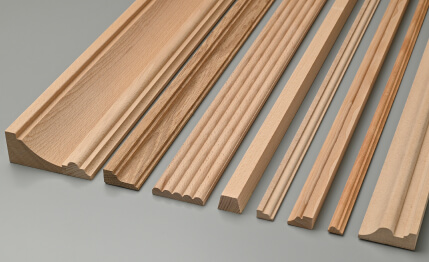
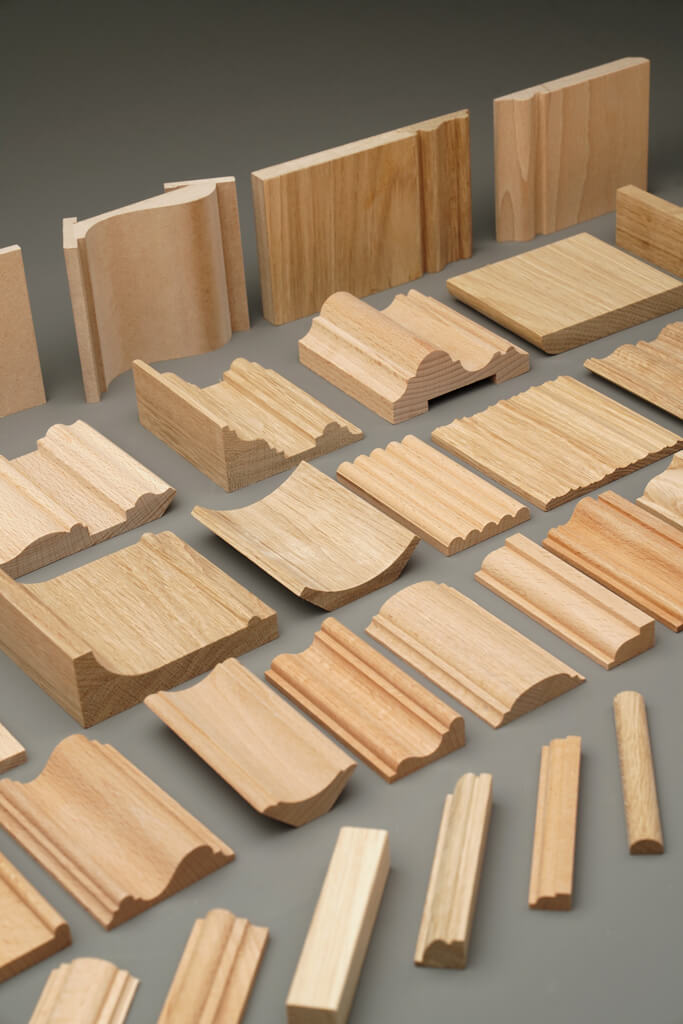
Wooden trim and brackets in one style is a systemic solution: when the baseboard, trim, and shelf brackets are made of the same material and in the same tint — the interior "comes together" as a whole.
Profiled bracket with relief
The lower edge of the bracket has a chamfer, a quarter-round, a cyma. This is already neoclassicism: not carved decor, but also not just a straight beam. Suitable for interiors where wooden moldings, cornices, and baseboards already in use — a bracket with the same profile on the bottom edge continues their tongue.
Carved bracket — for classic and neoclassical styles
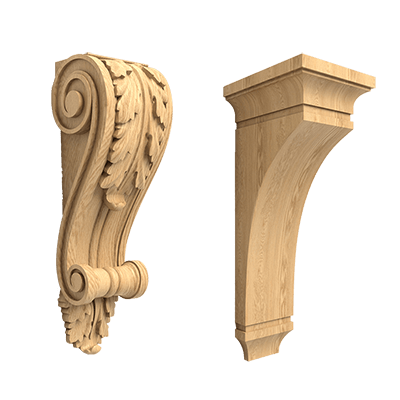
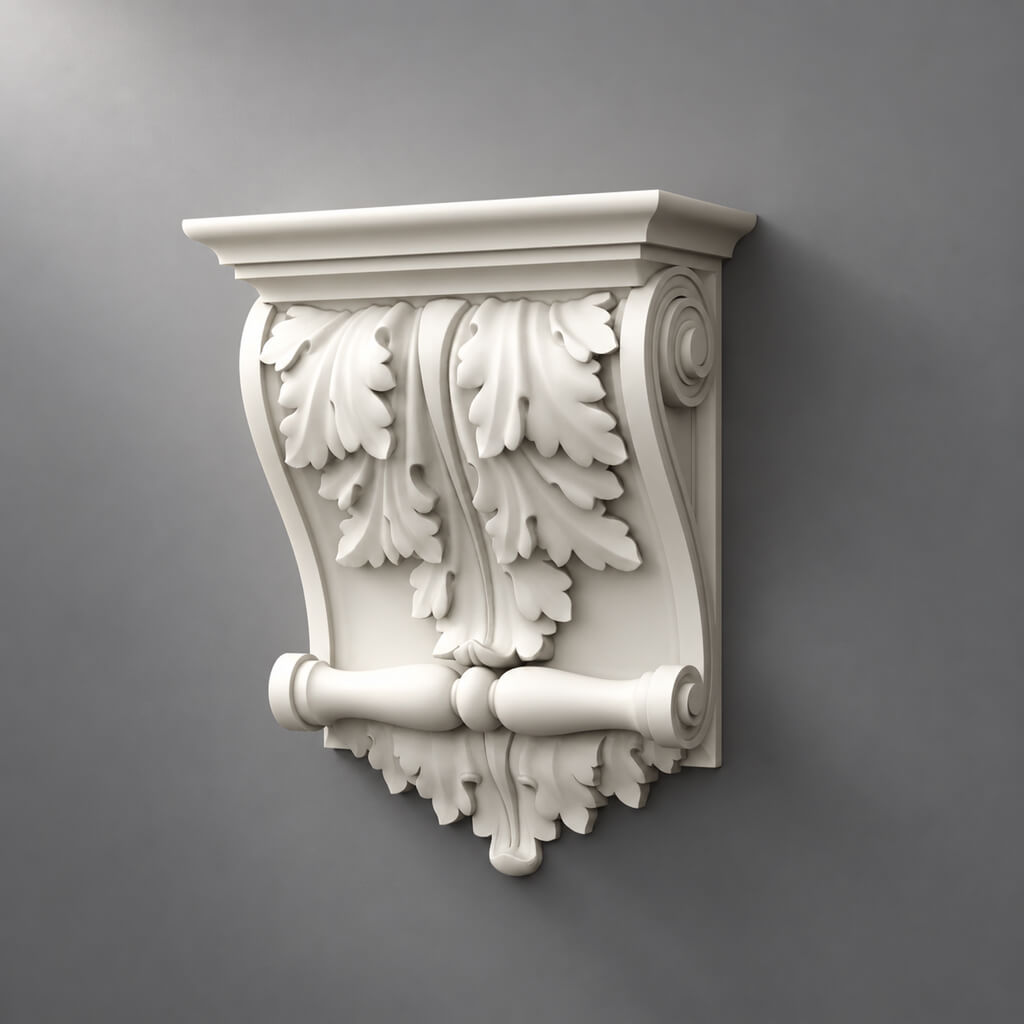
Wood carving on a bracket is a classic architectural technique. The console (caryatid bracket, volute bracket, leaf bracket) is an element known since ancient architecture. In modern interiors, carved bracket for shelf in a classic style — in a solid wood kitchen, library, classic living room — it is a detail that elevates the interior to a higher level.
STAVROS manufactures Carved brackets made of solid oak and beech with various decor options: classic volute, acanthus leaf, simple stepped console. For painting or tinting in walnut, oak, mahogany.
Massive bracket for heavy shelves
Solid block bracket — large cross-section (50×50 mm and more), simple L-shape, maximum strength. For fireplace areas, library shelves, shelves for heavy equipment. Finish: oil or varnish — to show the natural texture of oak. Scale: 30×30 cm and larger. This is not an "invisible" bracket — it is an architectural accent.
Compact bracket for hallway and corridor
Small bracket with a projection of 15–20 cm and height of 15–20 cm — for narrow spaces. Shape: simple, without frills. Finish: matching the color of hallway furniture or doors. Function: shelf for keys, decor, small items.
Wooden, metal, or polyurethane — comparing honestly
The market offers three materials for decorative brackets. Let's break down each one without advertising clichés.
A solid wood bracket is the best choice when you need a combination of real load-bearing capacity and decorative appearance. Oak — density 650–750 kg/m³, Brinell hardness 3.7 units — is a durable, long-lasting material. A solid oak bracket can withstand significant loads without deformation when properly installed. The wood texture is lively and warm — and no coating can take that away.
A metal bracket offers higher strength (with equal cross-section), but decorative possibilities are limited. Metal is visually and tactilely cold. In an interior with wood, it creates a contrast that must be used intentionally (industrial style, loft). In a natural interior, it creates dissonance.
A polyurethane bracket is lightweight, cheaper than wood, and takes paint well. Externally, it can imitate wood or carving. However, its load-bearing capacity is significantly lower. Polyurethane brackets — for decorative areas with minimal weight (decorative shelves, architectural accents without real load). For books or dishes — no.
Conclusion: for a real shelf in an interior with natural wood — a solid wood bracket. This is the only solution that is both functional and organic.
Ready-made selection scenarios — specific and to the point
Scenario 1. Open shelves in a classic kitchen
Kitchen made of solid oak, facades with frame profile. Open shelves — for spices, oils, small jars. Shelf depth: 22 cm. Item weight: up to 12 kg per shelf.
Solution: carved wooden bracket Made of solid oak with a profile relief. Projection 20 cm, height 20 cm. Tinted to match the kitchen color (walnut or natural oak). Two brackets per shelf up to 80 cm long. Fasteners: dowel screw 8×60 mm into a concrete wall or 6×50 mm into brick. Distance between brackets: 50–60 cm.
Additional: shelf made of the same wood species as the kitchen — solid oak or beech. Coating: oil or 2K polyurethane varnish (for the kitchen, must be moisture-resistant). Solid wood products in a single material and tint — the bracket and shelf are "from the same family."
Scenario 2. Shelf in the hallway under the mirror
Hallway with a mirror in wooden frame on the wall. Under the mirror — a small shelf for keys, stationery, a candle. Shelf depth: 15 cm. Weight: up to 5 kg.
Solution: Compact wooden bracket with a neat profile. Projection 13–15 cm, height 15 cm. Two brackets per shelf 60–70 cm long. Coating: in the color of the wooden frame of the mirror — a unified system. Installation: glue + screw. For plasterboard walls — Molly or Metal Driva anchors.
Tip: if the mirror has a dark walnut frame — brackets in the same tint. Frame, brackets, shelf — one material. A hallway with this solution looks like a well-thought-out furniture zone, not a collection of random items.
Scenario 3. Bookshelves in the study
Cabinet with dark wood panels. Three shelves above the desk, each 100 cm long, 25 cm deep. Books — approximately 25 kg per shelf.
Solution: Massive furniture bracket made of solid oak. Overhang 23–25 cm, height of vertical part 25 cm, beam cross-section at least 50×40 mm. Three brackets per shelf (spacing 40–45 cm). Fasteners: into concrete — dowel 10×80 mm, anchor bolt. Tinting: dark oak, wenge, or stained oak.
Additional Items: wooden furniture appliqués — on the ends of the shelves. wooden moldings, cornices, and baseboards in the same tinting — a unified cabinet system. Brackets are not separate parts, but part of the wood finishing program.
Scenario 4. Accent wall in the living room
Living room in neoclassical style. Accent wall with shelves — three shelves of different lengths (120, 90, and 60 cm), arranged in a staggered pattern at a height of 160–220 cm.
Solution: Decorative brackets for shelves with a profile relief. Two brackets for a 120 cm shelf (spacing 80 cm), two for a 90 cm shelf, one or two for a 60 cm shelf. Coating: ivory enamel — matching the walls and trim. Brackets blend with the architecture, making the shelves themselves and what is on them the accent.
Tip: how to make a wooden shelf with your own hands — a detailed guide that will help not only with choosing brackets, but also with the shelf itself.
Scenario 5. Corner shelf in a children's room or bathroom
A corner is a "dead" zone in most rooms. A corner shelf activates it. Three support points: two brackets on the walls (corner or standard), one in the middle (if the shelf is long).
Solution: Compact wooden bracket with a 20 cm projection. Two brackets installed on different walls of the corner. The shelf is triangular or rounded — made of beech wood. Coating for the bathroom: oil with wax (moisture-resistant). For the children's room: solvent-free, eco-friendly enamel.
Wall material and fasteners — practice without theorizing
The most beautiful bracket is useless if it doesn't hold in the wall. The foundation is the correct fastener.
Concrete wall (monolith, panel house). Hammer drill, dowel 8×60 mm or 10×80 mm (for heavy shelves). Anchor bolt — for bookshelves and loads over 20 kg per bracket. Hole depth: at least 60 mm.
Brick wall. Dowel 6×50 or 8×60 mm, aim for the brick body (not the joint). The joint is weaker than the brick; a bracket in the joint holds poorly. If it's a joint, shift the fastener hole.
Drywall on a frame. Molly (butterfly) dowel or Metal Driva. For heavy shelves — only into the profile or the wooden frame beam. Find the metal profile: magnet or metal detector. Load on drywall without hitting the profile — no more than 10–12 kg per fastening point.
Wooden wall (timber, log). Self-tapping screw 5×70 or 6×80 mm. Pre-drilling — to avoid splitting the timber. Depth: at least 50 mm into the timber body.
Number of bracket attachment points to the wall: at least 2 screws per bracket, for large brackets (projection 30+ cm) — 3 points.
Errors in selecting and installing shelf brackets
Practice is the best teacher. But it's better to learn from others' mistakes.
Choosing by picture without checking the size. The bracket in the photo looks "suitable," but the projection turns out to be 18 cm, and the shelf depth is 25 cm. Result: the shelf overhangs, the bracket "hides" under it. Always check the dimensions before ordering.
Installing two brackets where three are needed. A shelf 120 cm long with books is a load of 25–30 kg. Two brackets with a spacing of 100 cm hold, but the shelf sags in the center. Three brackets with a spacing of 50–55 cm — no sagging, even load distribution.
Ignoring the wall material. A self-tapping screw in drywall without a dowel is a temporary solution. Under a load of 8–10 kg, it will pull out. Proper fastening is a condition of safety, not just durability.
Mixing incompatible styles. A carved classic bracket with an IKEA shelf made of white MDF and minimalist metal light fixtures is three different languages in one spot. The bracket should match both the shelf and the nearby furniture.
Choosing a decorative bracket without considering the load. A small decorative bracket rated for 5–8 kg, under a bookshelf weighing 30 kg — a risk. Not visual, but physical. The bracket won't break immediately, but it will deform after a few months.
Not coordinating the bracket's finish with the shelf and furniture. A "oak" bracket + a "pine" shelf + a "wenge" cabinet = material chaos. One wood species or one tone — one choice.
Installing a bracket without a level. A bracket installed with a 2° tilt means a shelf with a 2° tilt. Seems minor. In practice, everything on the shelf slides off. A level is a mandatory tool.
How to order a wooden bracket: what to check before purchasing
Checklist for confident selection:
-
The depth of your shelf — the bracket projection must match.
-
Shelf length — determines the number of brackets (spacing 40–70 cm depending on load).
-
Weight of items — approximate load on the shelf. Add the weight of the shelf itself.
-
Wall material — this determines the fasteners.
-
Interior style — smooth, profiled, carved. Classic, neoclassical, minimalism.
-
Bracket material — oak, beech. Both durable; oak is denser, beech is slightly lighter and softer in texture.
-
Is sanding and painting needed — or order already in the desired color. Wooden brackets for shelves STAVROS are supplied for customer coating or with factory coating.
-
Number of brackets — calculate with a small margin.
Wooden brackets in the interior decor system
A single bracket is a detail. A system of wooden elements is an interior. How to build this system?
Baseboard + bracket + casing = a unified language. If Wooden baseboard near the floor in natural oak — brackets on shelves made of the same oak. If door casings with a chamfer — brackets with the same chamfer. A system is the repetition of one language at different levels.
Frames + brackets. Mirror in a solid wood frame next to a shelf on wooden brackets — this is not a random pairing. It is a deliberate choice of one material. The frame and bracket are partners in the wall's wooden program.
Overlays + brackets. Decorative appliqués for furniture on cabinet facades next to an open shelf on wooden brackets — the cabinet and shelf 'speak' the same language of decor.
Carved decor + carved bracket. Carved wooden decoration On facades and carved brackets on shelves — this is a classic program that has been built for centuries. Carving on furniture, carving on brackets, carving on cornices — one ornamental motif reproduced on different objects.
Wooden shelf bracket: the essentials in brief
Before wrapping up, let's consolidate the key principles into one logical block.
A shelf bracket is not just a support. It's the point where the interior either comes together or falls apart. A metal angle bracket solves the technical task. wooden bracket solves both the technical and the aesthetic.
It should be chosen along four axes:
-
Size — the projection matches the shelf depth, the height ensures rigidity.
-
Load — the material and cross-section correspond to the weight of the items.
-
Style — the bracket's shape complements the furniture, wooden decor, and interior style.
-
The system — the bracket is part of a unified wooden program: baseboard, molding, casing, frame.
This is exactly how a high-quality solid wood bracket works — as a system element, not as a random part.
FAQ — answers to the most frequently asked questions
How many brackets are needed for one shelf?
For a shelf up to 80 cm long — two bracket for shelf. For a shelf 80–120 cm with a load up to 20 kg — two with a spacing of 60–70 cm. For a bookshelf 100–120 cm — three brackets with a spacing of 45–50 cm. For a shelf longer than 150 cm — three to four brackets with even spacing.
Can a wooden bracket be used for a bookshelf?
Yes. Solid oak with the right cross-section (50×40 mm or more) and proper installation can withstand a load of 25–35 kg per bracket. The key is: correct wall fasteners (anchor or dowel 8–10 mm in concrete/brick) and three brackets for a long shelf.
How is a decorative bracket better than a metal angle bracket?
A metal angle bracket is a technical part without aesthetics. Wooden decorative bracket — it's a function plus decor: it's visible, it's readable, it becomes part of the interior's architectural language. In a natural interior with wood, there is no alternative.
Is a wooden bracket suitable for the kitchen?
Yes, especially for solid wood kitchens, classic and neoclassical kitchens, interiors in Provence or country style. The coating for the kitchen is moisture-resistant: 2K polyurethane varnish or two-component enamel.
Can a wooden bracket be painted?
Yes. Brackets made of solid oak and beech are painted with acrylic or alkyd enamel, tinted with stain, or coated with oil. The coating is applied after installation — so the joints and fastener heads are hidden under the final layer.
How to choose a bracket for an oak shelf?
A bracket made of the same material — oak. Tinting: the same species and the same shade. Projection — matches the depth of the shelf. Profile or shape — in the style of other wooden elements in the room: molding, baseboards, trim.
At what distance from the wall should the bracket be?
Standard Wall bracket for a shelf It is attached with the vertical part flush against the wall. The horizontal part is the projection from the wall. The shelf rests on the horizontal parts of the brackets. Additionally, the shelf is secured from below through the brackets with screws or wooden dowels.
A wooden bracket is a small detail with great responsibility. It carries the shelf, holds the load, and is in plain sight every day. Chosen correctly, it turns an open shelf from a functional detail into an architectural element. Chosen hastily, it reveals haste where thoughtfulness should be.
STAVROS manufactures Wooden brackets for shelves made of solid oak and beech: smooth and profiled, compact and massive, carved and minimalist. In one catalog — Wooden trim, Moldings, Baseboards, Frames и Decorative Inserts — everything for a unified wooden interior system. Manufacturing in Russia, warehouses in St. Petersburg and Moscow, delivery across the country. STAVROS — when the detail works for the image.