Article Contents:
- Short answer: when you need a wooden cornice and when a molding
- What is a wooden cornice
- Where is a wooden cornice used
- Wooden cornice for the ceiling
- Wooden cornice for walls
- Wooden cornice for furniture
- Wooden cornice for a classic kitchen
- Wooden cornice for a study and library
- How a cornice differs from a molding, baguette, and layout
- How to choose a wooden cornice by size
- How to choose a profile by style
- Classical and Empire
- Neoclassicism
- Modern classicism
- Office and Library
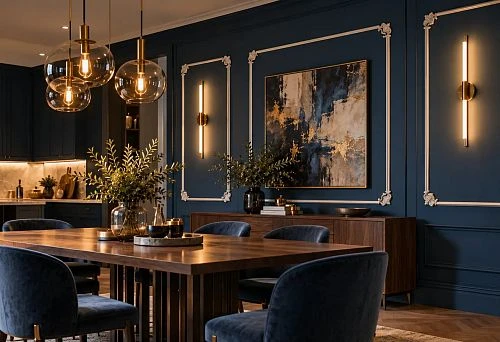
- Living room: wall decor system
- Wooden molding: when it is better than a cornice
- Material and coating: what is important before purchasing
- How to combine a wooden cornice with a baseboard and baguette
- Mistakes when choosing a wooden cornice and molding
- What to buy together with a wooden cornice
- FAQ: Answers to Popular Questions
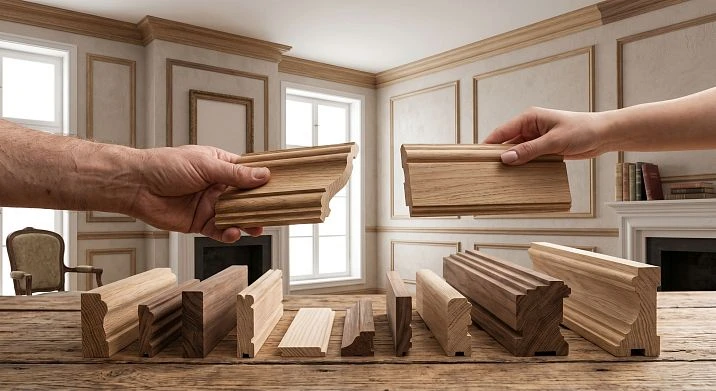
There is a moment in interior design when everything is already done — walls are painted, furniture is arranged, lighting is adjusted — but something still feels off. The space looks unfinished, the wall "floats," the ceiling seems disconnected from the rest. In most cases, the reason is one: there are no transitions. No horizontal accents that organize the space vertically, connect the wall to the ceiling, furniture to architecture, floor to decor. This is exactly the role played by wooden cornice и Moldings from solid wood — and this role is much more significant than it seems at first glance.
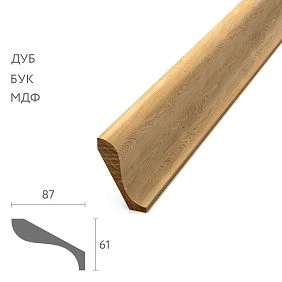
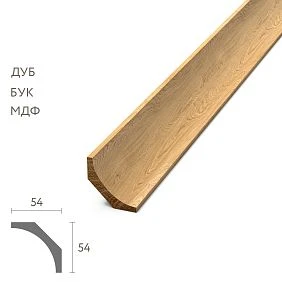
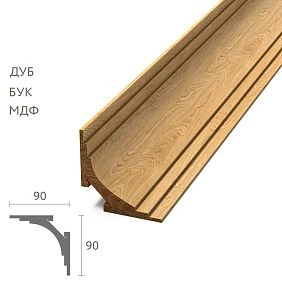
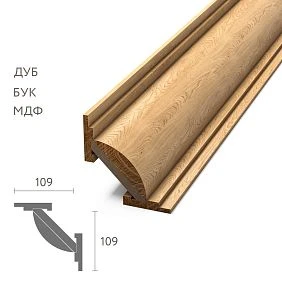
Short answer: when you need a wooden cornice, and when a molding
First of all, let's distinguish the tasks, because cornice, molding, baseboard, baguette, and batten are not synonyms, but different tools with different functions.
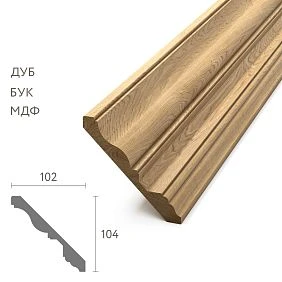
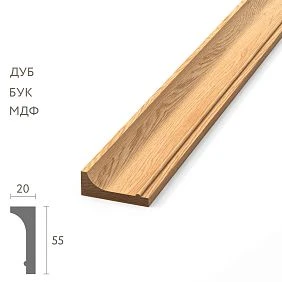
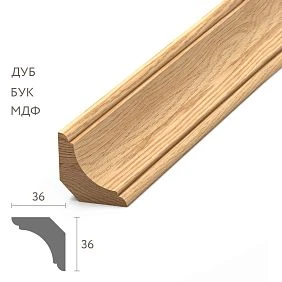
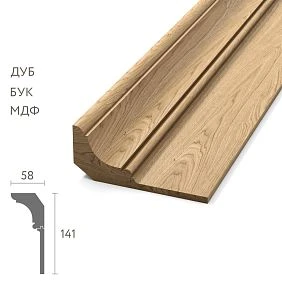
wooden cornice — an expressive finishing profile for the upper part of a composition. It is used where a weighty, readable horizontal accent is needed: at the ceiling, on top of a cabinet, on the upper part of kitchen modules, in classic wall panels. The cornice 'puts a full stop' — it indicates that the top has ended, and beyond is a different space.
wooden molding — a more versatile and subtle tool. It is suitable for decorative lines on walls, frame panels, furniture facades, structuring surfaces. Molding does not necessarily finish — it divides, accentuates, frames. It is a profile of medium decorative strength: noticeable, but not monumental.
with a classic profile creates a sense of solidity, reliability. — the lower horizontal of the space, covering the joint between the wall and the floor. It should be coordinated with the cornice in style — together they form the vertical architectural frame of the room.
Wooden Picture Frame — a decorative profile for frames, mirrors, paintings, and panels. Its element is a closed contour, framing. It does not stretch as a horizontal line; it creates a rectangle.
Wooden molding и Wooden plank — lighter solutions for joints, finishing lines, rhythmic patterns on walls and in furniture. Less decorative 'mass', more functional precision.
Understanding these differences is the starting point for any competent choice of wooden solid wood trim.




What is a wooden cornice
The word "cornice" comes from architecture — and there it means a very specific element: a protruding horizontal profile that crowns a wall, column, or entablature. A cornice is a horizontal finish. It doesn't just decorate: it organizes the space from above, creates a shadow beneath itself, and forms a visual boundary.
In interiors wooden cornice has fully retained this role. It finishes the wall at the ceiling — and thereby "closes" the vertical plane, creating a sense of architectural completeness. Without a cornice, the wall seems to "flow" into the ceiling without stopping — the space loses structure. With a cornice, a clear boundary appears, and the interior gains scale.
But a wooden cornice is not just a ceiling profile. In furniture, it performs a similar function: it crowns a cabinet, completes the top of a sideboard, and forms a horizontal line above kitchen modules. Furniture with a good cornice is perceived as an architectural object, not just a set of drawers.
What is important to understand about wooden cornice as a material: it can be coated with any finish. White matte enamel — for classic and neoclassical styles. Stain for dark walnut — for a study style. Clear varnish — for natural texture. Oil — for furniture made of valuable species. Before purchasing buy a wooden cornice choosing the right species means already solving half the issue with the coating.
Another important property is adaptability. A wooden cornice can be sawed, milled, and adjusted to any angle. Unlike plaster counterparts, it does not crumble when trimmed, does not crack during installation, and does not change shape with humidity fluctuations — if the species is chosen correctly.
Our factory also produces:
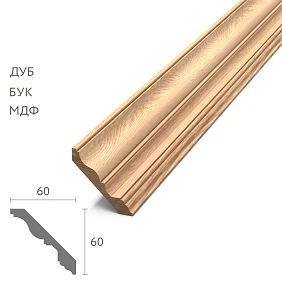
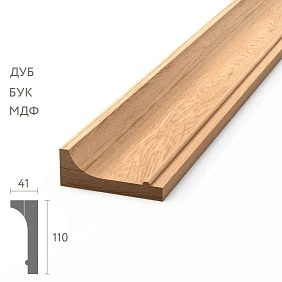
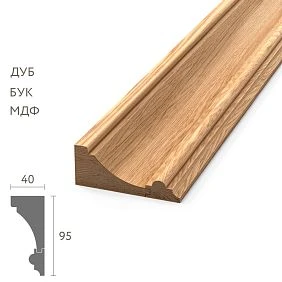
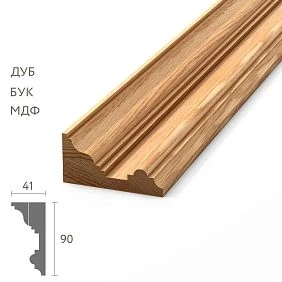
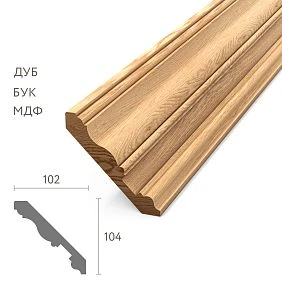
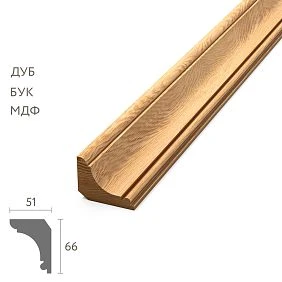
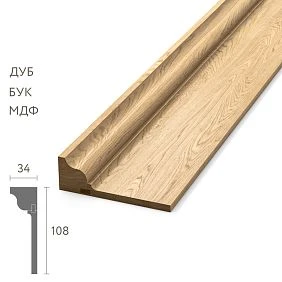
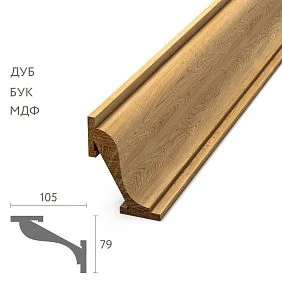
Where is wooden cornice used
Get Consultation
Wooden cornice for the ceiling
The transition between wall and ceiling is an area that professional designers call the "third dimension of the interior." This is where most mistakes and missed opportunities occur. A simple plaster joint is the poorest possible solution. A plaster ceiling cornice is better, but lacks the warmth of natural material. A wooden cornice at the ceiling brings warmth, scale, and style all at once.
For high rooms with ceilings from 3 meters wooden cornice for the ceiling can be massive and multi-layered: a main profile plus an additional decorative shelf, with possible backlighting behind the cornice. In classic interiors with stucco, a wooden cornice harmoniously coexists with a painted ceiling and readily accepts gilded coating.
For rooms with ceilings of 2.5–2.7 m, the wooden cornice should be more delicate: not too high and not too deep, so as not to create a feeling of pressure. A profile with a height of 60–80 mm and a projection of 40–60 mm is the optimal range for standard rooms.
In country houses with wooden beam ceilings or open rafters, the wooden cornice transitions into a connecting element between the log or timber wall and the lined ceiling. Here, the wood species is important: it is better to choose the same as that of the main structures.
Wooden cornice for walls
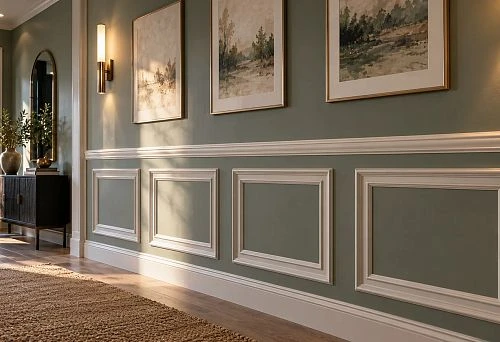
A cornice on the wall is not only near the ceiling. In classic interiors, horizontal wooden profiles are used to create multi-level wall decor: the lower belt limits the baseboard zone, the middle one the wall panel zone, and the upper cornice completes this system.
This division of the wall into horizontal zones is a classicism technique actively used in modern neoclassicism. wooden cornice as a horizontal belt on the wall creates visual rhythm, divides the height into readable proportions, and gives the room architectural solidity unattainable with wallpaper or paint alone.
For wall decorative frame panels, a wooden cornice is used as the top horizontal strip completing the frame. In such a system, usually used Moldings from solid wood for the side and bottom strips, and the cornice only on top, adding the necessary weight to the top horizontal line.
Wooden cornice for furniture
Furniture cornice is a separate big topic. Any wardrobe, bookcase, sideboard, display cabinet, kitchen cabinet — all these items in a classic design have a cornice as a mandatory top element. Without it, the furniture looks unfinished: the top lid simply breaks off into space.
wooden cornice for furniture It is attached to the front and side edges of the top lid of the body. It extends beyond the body by 20–50 mm (depending on the scale of the furniture) and adds a decorative "crown" to the top part of the product, turning a simple wardrobe into a wardrobe-bookcase, a simple sideboard into a classic credenza.
For MDF furniture covered with film or enamel, an overlay wooden cornice is the most affordable way to add a classic character. A white beech cornice on a white MDF body is visually indistinguishable from handmade solid wood furniture if the profile is correct and the coating is of high quality.
Wooden cornice for a classic kitchen
A classic-style kitchen set requires a wooden cornice as a mandatory completion of the top row of modules. Without it, wall cabinets look like separate blocks attached to the wall. With a cornice, they turn into a single architectural row with an expressive top line.
For a kitchen in a classic or neoclassical style, the wooden cornice must be coordinated with the facade decor: with the door profile, with the facade frames, with wooden furniture handles. All these elements must speak the same decorative language — then the kitchen looks like a single design solution.
For open shelves above the countertop in a classic kitchen, the cornice and Decorative Bracket work in pairs: the brackets support the shelf from below, the cornice completes the top part of the storage system from above. Together they form that very "furniture architecture", without which a classic kitchen remains just a set.
Wooden cornice for a study and library
This is the most favorable environment for a wooden cornice. A study with wooden bookshelves, leather armchairs, and parquet flooring finished with dark oil — a space where dark wood, heavy horizontals, and a sense of solidity reign.
A cornice in a library study can be massive: profile height 80–120 mm, pronounced projection, deep shadow beneath the profile. Wood species — oak or ash with dark stain or oil. No white enamel: in a study, the wooden cornice should be natural, alive, with visible texture.
For built-in shelving systems "from floor to ceiling," the cornice completes the upper part of the system while simultaneously hiding the gap between the shelving and the ceiling. This serves both a decorative and structural function at the same time.
How a cornice differs from a molding, baguette, and trim
This is one of the most common questions from customers — and rightly so, because in stores these terms are often used interchangeably, which creates confusion.
Element | Where it is used | Main function
---|---|---
wooden cornice | Top of wall, ceiling, furniture, cabinets | Completion, crowning, creating an expressive upper horizontal
wooden molding | Walls, frames, panels, facades | Decorative lines, framing, structuring surfaces
Wooden Picture Frame | Paintings, mirrors, panels | Creating a closed decorative contour — a frame
Wooden molding | Joints, inserts, furniture lines | Closing gaps and transitions, decorative joining
Wooden plank | Decorative walls, partitions, furniture | Rhythmic pattern, vertical or horizontal division
Wooden baseboard | Bottom joint of wall and floor | Finishing the bottom line of the wall, closing the technical gap
The main practical rule: cornice for the top, baseboard for the bottom, molding for the middle. The remaining elements are auxiliary. When all three main profiles are selected in a unified system, the interior acquires architectural integrity.
Now, an important nuance about scale. The cornice is always larger than the molding. This is not a matter of taste — it is proportional logic: what completes must be more expressive than what divides. If the cornice and molding are the same size, they compete, and the space loses hierarchy.
Molding is a subtle argument. The cornice is a loud statement. Use them together, but with the accents placed correctly.
How to choose a wooden cornice by size
Size is the most technical issue, but it is here that mistakes are most often made, which later cannot be corrected without dismantling.
Room height and cornice scale. For rooms with ceilings of 2.4–2.7 m — profile height 50–80 mm and projection 35–50 mm. This is a "medium" scale: readable, sufficiently decorative, but not overwhelming. For rooms with ceilings of 3–3.5 m — profile height 80–120 mm, projection 60–80 mm. For formal halls with ceilings from 4 m — multi-part cornices up to 200 mm high and more, sometimes with an additional belt of moldings below.
Projection depth. This is the distance the cornice protrudes from the wall. The larger the projection, the deeper the shadow under the profile and the more monumental the transition appears. The minimum projection for a readable decorative effect is 25 mm. For classic interiors — from 40 to 80 mm.
Furniture scale. For a small cabinet or wall-mounted cupboard, a cornice 120 mm high looks absurd — it "eats" the body itself. The rule of proportion: the height of the cornice should not exceed 1/8–1/10 of the height of the furniture body. For a cabinet 2200 mm — cornice 80–110 mm. For a sideboard 1600 mm — 60–80 mm. For a small wall-mounted cabinet 400 mm — 30–40 mm.
Furniture width. A long horizontal row of cabinets requires a more massive cornice than a single element: a long horizontal line visually "eats up" a thin profile. A kitchen row of 3.6 m requires a cornice at least 60 mm high, otherwise it will be barely noticeable.
Kitchen cabinets are a special case. Standard wall-mounted kitchen cabinets with a height of 700 mm need a cornice of 40–60 mm. Tall cabinets with a height of 2,100–2,400 mm need a cornice of 70–100 mm. For a kitchen that "reaches the ceiling", the cornice performs a dual function: it completes the furniture row and closes the gap between the cabinets and the ceiling.
Library and study. Built-in shelving up to the ceiling requires a cornice of 80–150 mm, preferably with a groove for lighting or a ventilation gap. This creates not only a decorative but also a functional effect.
The "wall test": place a section of the cornice vertically next to the intended installation location and look at it from a distance of 3–4 meters. If it seems large, choose a smaller size. If it is almost invisible, choose a larger one. This is a simple but reliable method for checking scale.
How to choose a profile by style
The shape of the profile is an artistic choice. This is where the interior solution acquires character: strictness or luxury, conciseness or ornamentation, historical recognizability or neutral elegance.
Classic and Empire
Classic wooden cornice This is a complex profile with alternating convex and concave elements, chamfers, shelves, and fillets. At least two or three profile transitions. Pronounced projection, deep shadow. The profile should be readable at a distance of 5–7 meters.
Empire style is characterized by strictness combined with monumentality: the profile is powerful, but without rococo playfulness. Sharp transitions, right angles, minimal rounding. The finish is white enamel, cream tone, possibly gilding on the relief.
Classic Furniture STAVROS is made with exactly such cornices: figured profiles, strict symmetry, enamel or lacquer finish. The unity of style of the cornice, legs, handles, and overlays is what makes furniture truly classic.
Neoclassicism
A calm, confident profile without excess. One or two decorative transitions, soft rounding, neat projection. Neoclassicism does not shout — it speaks in a low voice. White matte enamel, a delicate gray-white palette is possible, minimal patina on the edges.
For a neoclassical interior Moldings from solid wood play a special role: they create wall frame panels, which are a hallmark of the style. The cornice completes the system from above, the moldings form the frames, Wooden baseboard closes it from below — the vertical architecture of the wall is assembled.
Modern classic
This is the most sought-after style today. Not historical, not strict, but with clear classical roots. The cornice profile is sharp, with one or two transitions, without decorative overload. A straight projection with a chamfer is possible — this gives a clear shadow without a complex silhouette.
Coating for modern classics: white enamel, light cream tone, neutral shades of gray. Sometimes — natural oak without colored coating, only oil. The main thing is that the cornice and Wood skirting board must be from the same decorative system.
Office and library
Here, dark wood, massiveness, and solidity dominate. wooden cornice for the study — made of oak or ash, stained in wenge, dark walnut, or natural tone with matte varnish. The profile shape is strict, with sharp transitions, a minimum of decorative elements. The size is quite large: the dark profile must be massive to be noticeable.
In the library, the cornice carries an additional task: it connects the cabinets into a single architectural system. The same cornice on all cabinets turns a set of individual pieces into a unified wall library.
Living room: wall decoration system
The living room is the most challenging space in terms of decorative wooden moldings. The entire system works here: the cornice at the ceiling — Wooden molding for wall panels — with a classic profile creates a sense of solidity, reliability. — Wooden Picture Frame on picture frames. All these elements must be coordinated in terms of wood species, finish, and profile style. Then the living room becomes not just a room with furniture, but an architectural statement.
Wooden molding: when it is better than a cornice
Molding is the younger brother of the cornice in the decorative hierarchy. But "younger" does not mean less important. In a number of tasks, it is molding that works more precisely and appropriately.
When a thin decorative line without monumentality is needed. For dividing zones within a wall panel, for framing a niche, for creating a horizontal belt on the wall at a height of 1.0–1.2 m — wooden molding it handles better than a cornice. Its smaller size creates a more delicate accent.
When framing wall panels are being designed. Molding is the main tool for creating frames: side and bottom strips from molding, the top from a more massive profile or cornice. Such frames on walls are a classic technique that is currently experiencing an obvious renaissance in interior design.
When you need to highlight a furniture facade. On cabinet doors, on a display case facade, on the side walls of a sideboard — decorative wooden profile as a frame insert, it creates depth and character without adding significant volume. A cornice in this role would be too loud.
When the interior is light and should not look heavy. A light bedroom in neutral tones, a children's room, a classic-style bathroom — here a cornice can add unnecessary 'weight'. Molding creates the needed decorative accent without weighing down the space.
When the room is low. With ceilings of 2.4 m or lower, a monumental cornice 100+ mm high will literally 'lower' the ceiling. Molding 30–50 mm high creates the necessary decorative finish without visually collapsing the ceiling.
When a transition between different materials is needed. Wooden corner veneer and molding handle transitions where a cornice is excessive: between paneling and plaster, between wood and tile, between painted wall and wallpaper.
Conclusion: molding is a universal tool. Cornice is the final chord. They can work together and separately, but never completely replace each other.
Material and coating: what matters before purchase
Choosing the wood species for a cornice or molding is both a technical and aesthetic decision. The wrong species for a specific coating can ruin the result even with perfect painter work.
Beech. Dense, fine-pored structure without pronounced grain — an ideal base for enamel. A beech cornice under white or cream enamel gives a smooth, laconic surface without the texture 'showing through'. That's why beech is the standard species for molding and cornices for painting. Beech density of 620–680 kg/m³ ensures geometric stability during installation and use.
Oak. Open-pored structure with expressive grain — for transparent coatings. Oak wooden cornice under varnish or oil reveals all the advantages of the species: medullary rays, pearlescent sheen, warm honey tone. Under enamel, oak requires a pore filler — otherwise open pores will create noticeable surface unevenness. Oak hardness is 3.7–3.9 on the Brinell scale — high resistance to mechanical stress.
Ash. Straight grain, high bending strength. Performs well in rooms with variable humidity. For cornices installed in wet areas (bathroom, kitchen near the sink) — ash is preferable to beech. Under a transparent coating, ash gives a restrained, elegant result.
Pine. Affordable species with a characteristic resinous smell and large grain. For country, rustic, suburban style — it is organic. For classic and neoclassical styles — problematic: resin may seep through the enamel, especially in warm rooms. Before applying any coating to pine — mandatory treatment with an anti-resin compound.
The quality of sanding is a parameter that cannot be checked from a photo, but which determines the quality of the final coating. Good Pogonazh iz massiva sanding is done sequentially with several grits: from coarse (80 grit) to fine (150–180 grit). The final surface should be matte, without scratches, with clear profile edges.
Geometric stability is the second most important parameter after sanding. The cornice must be straight without axial deflection. Check: place the profile on a flat surface and look along it. Any deflection along the length will cause the cornice line to "wave" after installation — and this can only be corrected by replacement.
Relief depth and profile clarity. For classic cornices with expressive relief, it is important that all profile transitions are clear and uniform along the entire length. A blurred, unclear profile indicates poor-quality tooling during manufacturing — and this will become obvious when painted.
For a furniture cornice, the thickness of the mounting zone wall is especially important. If the profile is too thin at the attachment point, it will break when tightening the screw. The optimal mounting zone thickness is from 12 mm for small cornices and from 18 mm for massive ones.
How to combine a wooden cornice with a skirting board and baguette
This is a matter of systemic thinking. A beautiful interior is created not by individual beautiful details, but by the consistency of all elements. Wooden moldings are precisely the system where consistency is instantly visible.
Cornice and baseboard: the vertical frame of the space. The cornice at the ceiling and with a classic profile creates a sense of solidity, reliability. — these are the upper and lower horizontal lines of the room. They must be consistent in profile style, wood species, and finish. The classic rule: the baseboard should be less massive than the cornice. If the cornice is 100 mm, the baseboard is 60–70 mm. If the cornice is 60 mm, the baseboard is 40–50 mm. This creates the correct visual hierarchy: heavier at the top, lighter at the bottom.
Cornice and molding: levels of decor. Between the cornice at the ceiling and the baseboard at the floor, moldings work. They create horizontal bands, framed panels, and structure the wall vertically. The rule: the molding is always thinner than the cornice. If the profiles are identical, they compete and destroy the hierarchy.
Cornice, molding, and Wooden Picture Frame: three levels of decor. In a classic living room, the system looks like this: cornice at the ceiling (top), molding framed panels (middle), baseboard (bottom), and picture frames made of wooden molding fit into the framed panels or are placed above them. All from the same wood species, all with the same finish — the space speaks a single architectural language.
A unified code for the finish. White enamel on all wooden elements — cornice, molding, baseboard, frames, furniture handles — creates a monochrome classic system. This works well in neoclassical interiors, French style, and modern classic. Different shades of white on different elements are a disaster. Before purchasing, ensure that all elements can be coated with the same enamel.
Combining cornice with wooden furniture handles. Handles are the most frequently touched parts of furniture. If they are made of the same wood species and with the same finish as the cornice, molding, and baseboard, this creates material unity at all levels of the space: from the ceiling to the furniture.
Combination with wooden decor on facades. Overlay rosettes, ornaments, relief inserts on furniture facades — from the same breed as the cornice, create a connection between the architectural elements of the walls and the furniture. The space becomes integral: the wall and furniture "talk."
Mistakes when choosing a wooden cornice and molding
Some mistakes are only discovered after installation — and then it's too late. Let's analyze them in advance.
Choosing a cornice only by picture, without considering the room height. This is the first and most dangerous mistake. A cornice that looks beautiful in a photo in a grand hall with 4-meter ceilings, in an ordinary apartment with 2.5 m ceilings will be oppressive and create a claustrophobic effect. Always correlate the profile size with the actual parameters of the room.
Installing a massive cornice in a small room. A small room of 12–14 sq.m with a cornice 120 mm high is like a hat three times larger than the head. Monumentality is good in monumental spaces.
Using too thin molding on a large wall. The opposite mistake: a delicate 20 mm molding on a wall 3 m high and 6 m wide — visually it's a thread, not an architectural accent. The scale of the profile should match the scale of the surface.
Not considering the color of the doors. Doors are the largest wooden element in the interior. Their wood species and finish set the tone for the entire system. If the doors are beech under white enamel, and the cornice is pine under dark stain, the conflict is obvious. Start the decor system with the doors.
Forgetting about the baseboard when choosing a cornice. A cornice without a coordinated baseboard is half the system. Even the most beautiful cornice looks incomplete if the wall below ends with a cheap plastic baseboard. Buying a wooden baseboard in the same system — a mandatory step.
Mixing cornices, baguettes, and moldings from different styles. A classic cornice with scrolls, a strict geometric molding in Art Deco style, and a Provencal baguette are three different interior languages. In one space, they create noise, not harmony.
Don't plan the coating before installation. Painting the cornice after installation on the ceiling is extremely inconvenient: it's difficult to get an even layer, the ends remain unpainted, and the slightest inaccuracy leaves marks on the ceiling. Paint the profiles before installation. The final layer — a thin touch-up of the joints — is applied afterwards.
Choose a construction profile instead of decorative molding. Cheap MDF profiles from a hardware store are not decorative molding. They are structural elements designed for hidden installation or painting with construction paint. decorative wooden profile Solid wood is a different class of product: different precision, different sanding quality, different result after painting.
Buy cornices from different batches. Profiles from different batches of the same article may differ slightly in wood shade. This will be noticeable under a transparent coating. Purchase the entire required volume from one batch with a 10–15% reserve for trimming.
What to buy together with a wooden cornice
One cornice is a detail. A system of several coordinated elements is an interior. Here's what is worth purchasing in one order.
Wooden moldings. Moldings from solid wood Of the same species — for wall frame panels, furniture facades, horizontal belts. Buy together with the cornice, from one batch.
Solid wood baseboards. with a classic profile creates a sense of solidity, reliability. — the lower completion of the vertical decoration system. From the same species, with the same coating. The baseboard profile should be coordinated with the cornice profile.
Bagette slats. Picture frame strip for frames, panels, and mirrors. When picture frames and cornices are made from the same wood species, the living room or study acquires a complete decorative system.
Moldings. Wooden molding for joints and transitions, Wooden corner veneer for external corners. Required when installing wall frame panels.
Wooden slats. wooden plank for decorative patterns on walls, horizontal bands, furniture inserts. From the same wood species — for system unity.
Decorative furniture overlays. decor for furniture — rosettes, ornaments, relief inserts — connect furniture facades with architectural wooden interior elements.
Decorative brackets. Decorative Bracket paired with a cornice, it creates a complete system for open shelves and consoles: a cornice on top, a bracket as a support — a classic solution.
Wooden furniture handles. wooden furniture handles made from the same wood species as the cornice — the final touch that ties architectural decor to furniture.
All Pogonazh iz massiva — baguettes, trims, slats, cornices, moldings, baseboards — are presented in the STAVROS catalog as an interconnected system, allowing you to form a complete set for the interior without the risk of mismatched species and profiles.
FAQ: Answers to popular questions
How is a wooden cornice different from a molding?
wooden cornice — a more massive finishing profile used to create an expressive upper horizontal line: at the ceiling, on furniture, in wall panel systems. wooden molding — a more versatile and thinner profile for decorative lines, frames, and structuring surfaces. The cornice 'finishes' — the molding 'organizes'.
Where can a wooden cornice be used?
wooden cornice used at the ceiling to finish the wall, on furniture (cabinets, sideboards, display cases, kitchen sets), in classic wall decor systems, to finish bookshelves and library furniture, in fireplace portals and niche compositions.
Can you paint a wooden cornice under enamel?
Yes. The best wood for enamel is beech: fine-pored, uniform, without a large pattern. Technology: sanding to 150–180 grit, acrylic primer, 2–3 coats of enamel with intermediate sanding. Oak under enamel requires an additional pore primer. It is more convenient to paint before installation, finishing joints — after.
How to choose a wooden cornice to match the baseboard?
The wood species is the same. The finish is the same. The profile style is from the same decorative system. Size: the cornice is larger than the baseboard. For a 100 mm cornice — a 60–70 mm baseboard. For a 60 mm cornice — a 40–50 mm baseboard. If these conditions are met with a classic profile creates a sense of solidity, reliability. and the cornice will create a unified vertical architecture of the room.
What to choose for the wall: cornice, molding, or batten?
For finishing the upper part of the wall at the ceiling — wooden cornice. For creating frame panels and decorative horizontal belts — wooden molding. For rhythmic vertical or horizontal decor — wooden plank. All together in one system — a full-fledged classic interior decor.
What type of wood should I choose for a cornice?
For enamel and painting — beech: smooth surface, minimal grain, holds paint well. For varnish and oil — oak or ash: expressive texture, natural look. For country style — pine, but with anti-resin treatment. For damp rooms — ash: more stable under variable humidity than beech.