































































Article Contents:
- Buy wooden stair posts
- What is a stair post and why is it needed
- How stair posts differ from balusters
- Types of wooden stair posts
- Starting (entry) posts
- Support columns
- Turn posts
- Square stair posts
- Carved stair posts
- How to select posts for balusters and handrails
- The style must match
- The height must match the railing
- The cross-section must be proportional
- The handrail must join correctly
- Material and color from the same source
- Square or carved posts: what to choose
- Square posts: arguments in favor
- Carved posts: arguments in favor
- How to calculate the number of posts for a staircase
- Material: oak, beech or ash
- Finish: tinting, enamel, oil
- What affects the price of wooden stair posts
- Mistakes when buying wooden stair posts
- Wooden stair posts: where to buy
- FAQ: answers to popular questions about wooden stair posts




Buy wooden stair posts
There are details that are invisible while they are in place — and deafeningly noticeable when they are missing. A stair post is exactly that. It stands at the start of the flight, at the turn, on the second floor landing — and supports not only the handrail but the entire visual structure of the staircase. Remove it — and the railing turns into a fence. Install the right one — and the staircase becomes an architectural event.
Buying wooden stair posts means choosing not just a support element, but a dominant feature of the interior. The starting post is the first thing the hand touches at the entrance to the staircase. It sets the tone. It speaks of the owner's taste before any other item in the house. And that is why the selection of wooden stair posts should be approached with the same seriousness as the choice of the staircase itself.




What is a stair post and why is it needed
Before moving on to specific types and characteristics, it is important to understand the logic of this element. Stair railing posts are load-bearing vertical supports installed at key structural points: the beginning of the flight, the end of the flight, turns, intermediate landings. Unlike balusters for staircase, which work as ordinary railing elements, posts bear the structural load: handrails are attached to them, and they provide rigidity and stability to the entire railing system.
The difference between a post and a baluster is fundamental. A baluster is one of many. A post is one of the few, but each is irreplaceable. If one baluster is missing, the railing holds. If there is no post at the starting point, the entire structure loses its logic.
According to standard building regulations, stair railings must withstand a horizontal load of at least 100 kg per linear meter of handrail. It is the posts that are the main bearers of this load. Therefore, their cross-section, method of attachment to the step or floor, and type of wood are not just design parameters, but also a matter of safety.
Our factory also produces:


How stair posts differ from balusters
The answer to this question is often confused, especially by those who are designing stair railings for the first time.
Balusters are ordinary vertical elements installed at equal intervals along the entire flight. Their task is to fill the railing space, create a visual rhythm, and prevent falls. The cross-section is small: 45×45, 50×50, 60×60 mm.
Posts are load-bearing support elements at nodal points. Their cross-section is larger: 100×100, 120×120, 150×150 mm. Height ranges from 900 to 1500 mm depending on type and location. They are attached to the step, floor, or stringer using an anchor bolt with a metal embedded part.
wooden balustrade as a system, it is always a combination of posts and balusters. Posts set the structural foundation, balusters form the decorative plane between them.
Get Consultation
Types of wooden posts for stairs
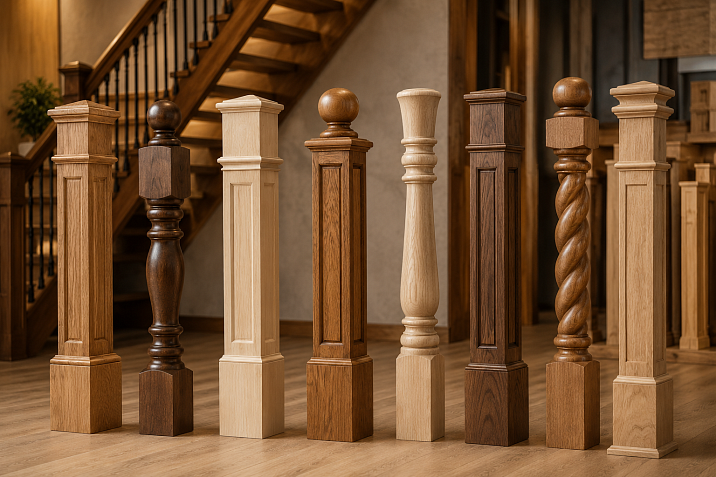
Catalog staircase posts includes more than 30 models — from laconic square to monumental carved columns. Classification by function and shape will help to understand this diversity.
Starting (entry) posts
The starting post is the business card of the staircase. It stands at the first step and is the first object a person contacts when starting the ascent. The hand rests on it, the gaze stops — and this is where the first impression of the railing as a whole is formed.
By design, the starting post differs from others in that its decorative part is located not only on the side faces, but also on the top — where the finial is installed. The most expressive STAVROS starting posts are equipped with shaped finials: spherical, pyramidal, carved lanterns.
Typical dimensions of a starting post: height 900–1500 mm (from floor to top of finial), cross-section 100×100 or 120×120 mm. For grand staircases — 150×150 mm and above. In the STAVROS catalog, starting posts made of solid oak and beech start from 12,360 rubles, monumental carved models with acanthus decor reach 79,820 rubles and above.
Entry post for a staircase is a stable professional term used in furniture and construction production as a synonym for starting post. Both concepts denote the same thing: the post at the entry point of the flight.
Supporting posts
A support post for a staircase performs a structural function on long sections of railing. If the flight is longer than 3.5–4 meters, the handrail without intermediate support begins to "wander" under load — this is not only uncomfortable but also unsafe. The support post is installed in the middle of a long flight and takes part of the horizontal load.
In addition, a post installed at the top point of the flight — where the railing "enters" the structure of the second floor landing — is also called a support post. This is the end point of the flight railing, and it is as structurally important as the starting one.
Visually, support posts are usually made in the same style as starting posts, but may be somewhat more modest in decoration — the emphasis is on the entry point of the flight.
Turning posts
A turning post for a staircase is an element found in staircases with landings and changes in flight direction. Where a straight railing turns 90° or 180°, a special post is needed to which handrails can be attached from two sides at the required angle.
Structurally, the turning post is installed on the corner part of the landing. Its height and cross-section are similar to starting and support posts — 100×100 or 120×120 mm. A feature is a double-sided groove or overlay transition elements for attaching the handrail from different sides.
Turning posts are an element that is often forgotten during initial calculations. The result is a shortage during installation. Therefore, when planning a staircase with a landing, the number of turning posts should be accounted for in advance.
Square posts for stairs
Buying wooden square posts for stairs is one of the most popular queries in this category. The square cross-section shape is universal and most common. It fits organically in classic, neoclassical, and country styles.
A square wooden post for a staircase is not a primitive rectangular support. A well-designed square post has a complex profile in height: a square base pedestal, a profiled belt, a transition to a shaft with chamfers or grooves, a profiled upper tier, and a finial. Each of these elements is turned on a lathe or CNC-milled.
It is worth buying wooden square posts for stairs for those who are building or renovating:
-
a country house in classic or neoclassical style
-
an apartment with a two-level space and a wooden flight staircase
-
a townhouse with a straight staircase flight
-
commercial property — restaurant, hotel, office with wooden staircases
Dimensions of STAVROS square posts: 100×100×900 mm (compact), 120×120×1000 mm (standard), 150×150×1200 mm (for grand staircases). Material — solid oak or beech.
Carved stair posts
A carved stair post is a transition from the category of building components to the category of decorative art pieces. Here, the post ceases to be just a support — it becomes a decorative column with its own character and history.
Carved wooden decoration on posts can be done in several ways:
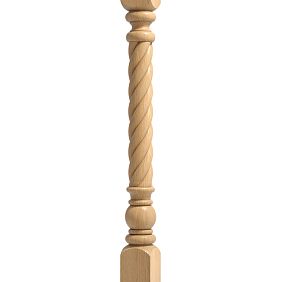
Turned-carved processing — a combination of a turned shape with carved ornaments applied on top. Acanthus leaves on the lower belt, fluting on the shaft, a relief cartouche in the upper part — all this is done on a CNC machine with final hand finishing.
Milled three-dimensional carving — complex three-dimensional ornaments: weaves, grapevines, climbing leaves. This is CNC milling with a relief depth of up to 15–20 mm.
Hand carving — custom work by a master carver. Used for bespoke orders and restoration. Price — accordingly.
Decorative stair posts with carved decor are used in interiors:
-
Baroque and Rococo — rich polychrome carving
-
Empire and classicism — a strict fluted column
-
Russian style — ornamental overlay elements
-
Neoclassicism — moderate decor, emphasis on form
carved balusters Paired with carved posts, this is a classic composition. It is important that the decorative language of the carving matches: identical motifs, similar scale of ornament.
How to choose posts to match balusters and handrails
Solid wood stair posts are an excellent investment, but only if they are correctly matched to the other railing elements. An inconsistent set is a common cause of disappointment after installation.
The style must match
This is the first and unconditional principle. If you have chosen carved balusters with acanthus decor — the posts must carry a similar decorative language. If the balusters are laconic turned — square posts with minimal profile will create a unified restrained system. Mixing decoratively rich balusters with geometrically simple posts always looks like an accident, not a decision.
The height must match the railing
The height of the post to the handrail is the same as the height of the railing: 900–1000 mm from the step surface. If the post has a decorative finial on top, its height consists of the shaft height plus the finial. Be sure to consider this when ordering: a post with a 120 mm finial may exceed the handrail if proportions are not recalculated.
The cross-section must be proportional
The rule is simple: the wider the step and the heavier the staircase structure, the larger the posts should be. For a compact straight staircase in an apartment — 100×100 mm. For a monumental two-flight staircase in a country house — 150×150 mm or more.
Posts 80×80 mm on a wide grand staircase look weak and disproportionate — like thin legs on a heavy table.
The handrail must connect correctly
Posts for the handrail are designed considering the handrail type. In the standard version, the handrail rests on the top end of the post and is secured with a screw through a technological hole from below. Important: the handrail width should match the post width or be slightly wider — for visual integrity.
When installing a curved handrail on a corner post, special transition elements — roguli — are used, or the handrail is bent on a steam bench. This must be considered in advance, otherwise the corner unit will require a custom solution.
Material and color — from one source
Wooden railings and balusters from the same wood species, with the same finish — this is an axiom, but it is surprisingly often violated. Oak after varnishing gives a warm golden-brown tone. Beech is lighter. Pine is more yellowish. Ash has a pronounced texture with a greenish tint. Order the entire set — posts, balusters and posts, handrail — from the same wood species.
Square or carved pillars: which to choose
The buyer often faces this choice and cannot decide which is more appropriate. Let's break it down by situation.
| Pillar type | Interior style | Staircase type | Features |
|---|---|---|---|
| Square turned | Classic, neoclassical, country house | Straight flight, U-shaped staircase | Versatility, good for painting |
| Carved | Baroque, Empire, formal interiors | Formal wide flights | Expressive decor, hand finishing |
| Turned round | Traditional classics, wooden houses | Any brand | Harmony with turned balusters |
| Square with chamfers | Modern classic, neoclassical | Apartment stairs | Strictness without excessive decor |
| Decorative column | Baroque, Empire, luxurious interior | Grand staircases, halls | Monumentality, high price |
Square posts: arguments in favor
Buying wooden square stair posts is a reasonable solution in most residential projects. Why are square wooden stair posts so popular?
First, the square cross-section is technologically advanced. It is easier to attach to the step — the anchor bolt is installed strictly along the center axis. It is harder to make a mistake with orientation during installation.
Second, a square post is visually stable. It reads the same from any viewpoint. This is important for spaces where the staircase is visible from different sides.
Third, the square shape accepts paint well. Stair posts for painting in white, cream, or RAL colors are a popular solution for modern classic interiors. It is the MDF-prepared surface of beech that provides an ideal base for enamel.
Carved posts: arguments in favor
A carved wooden stair post is a different level of aesthetics. If a square post is correct, then a carved one is beautiful. For grand staircases in country houses, for restaurants, for interiors in Baroque or Classicism style — a carved post is indispensable.
A decorative post with acanthus decor at the base, a fluted shaft, and a carved finial is an object that reads as part of the architecture, not as a railing detail. It is precisely such posts that STAVROS produces — with the possibility of applying patina, gilding, or translucent tinting.
How to calculate the number of posts for a staircase
This section is important for those planning an order and wanting to avoid extra charges and reorders. The algorithm for calculating posts is simple but requires attention.
Step 1. Determine the number of flights.
Straight staircase — one flight. U-shaped — two flights with a landing between them. L-shaped — two flights with one turn. Spiral — a special case.
Step 2. Assign the starting post of each flight.
The start of each flight = 1 starting (entry) post. For a single-flight staircase — 1 starting post.
Step 3. Assign a support post at the end of each flight.
The end of each flight, where the railing goes into the ceiling or landing = 1 support post. For a single-flight staircase — total 2 posts (starting + support).
Step 4. Add turning posts.
For each change of direction point — 1 turning post. L-shaped staircase: 1 turn = 1 turning post. U-shaped: 2 turns = 2 turning posts. Total for a U-shaped staircase: 2 starting (one for each flight) + 2 turning + 1 top support = 5 posts.
Step 5. Check the need for intermediate supports.
If the length of the horizontal section of the handrail on the landing exceeds 2 m — an intermediate support post is recommended for rigidity.
Step 6. Check the baluster spacing.
Stair balusters are installed between posts with a spacing of 120–150 mm. Calculate the number of spans between posts and ensure the spacing fits without rhythm distortion.
Step 7. Add a reserve.
For non-standard staircase configurations, add 1 spare post for every 4–5 main posts. An installation error when setting the anchor into a step can render a post unusable before final finishing.
Material: oak, beech, or ash
Solid wood posts for stairs are made from several species—each with its own strengths.
Oak. The most popular choice for stair posts. Brinell hardness: 3.7–4.0 kN/mm². Density: 750–880 kg/m³. Resistant to mechanical loads, holds anchor fastening well. Does not deform under stable indoor humidity. The best oak species for stairs are pedunculate oak and sessile oak. After tinting, it gives a noble brown shade with a pronounced texture.
Beech. Fine-grained, uniform, ideal for enamel. Hardness slightly lower than oak—3.2–3.5 kN/mm². For painting with white or colored enamel, it is the best choice. It is on beech that the flawless surface smoothness required for an expensive paint system is achieved.
Ash. Hardness comparable to oak—4.0–4.5 kN/mm². More flexible, lighter, with an expressive coarse-grained pattern. Popular in Scandinavian, Nordic, and modern classic styles. Pairs well with ash steps and flooring.
Pine. Significantly softer—1.8–2.2 kN/mm². For residential interiors with moderate load and proper impregnation, it is applicable. For heavily used grand staircases, it is not recommended.
Finishing: tinting, enamel, oil
Choosing the finish for wooden posts is a separate decision that must be made before ordering. Because it determines which sanding category to order.
Transparent tinting — preserves the wood texture, gives the desired shade. Used for oak and ash. Processing category — «Standard» (machine sanding) or «Prestige» (hand sanding). For tinting, «Prestige» is better: sanding irregularities cause uneven absorption.
White or colored enamel — for beech or MDF-prepared solid wood. Category — «Standard» with mandatory self-priming before painting. Or «Prestige» — if you want a result without extra effort.
Oil or oil wax — a natural, penetrating coating. Ideal for oak — enhances the natural texture, does not create a film effect. Durable with proper care: renewal every 3–5 years.
Patina with gilding — used for carved posts in Baroque style. Gold patina is applied to the protruding parts of the relief by hand. Creates the feel of an antique piece.
What affects the price of wooden stair posts
Buying wooden stair posts price — an issue that requires understanding of pricing. The range in the STAVROS catalog is from 12,360 to 79,820 rubles per post. Why such a range? Here are the specific factors.
Wood species. Oak and ash are more expensive than beech. The difference in the cost of a cubic meter of raw material is up to 30–40%. Plus: harder wood requires more processing time.
Post height. A 900 mm post uses less material than a 1500 mm post. Each additional centimeter is material volume and processing time.
Section. A 150×150 mm post is heavier and more expensive than a 100×100 mm one. During turning, a large section requires more powerful equipment.
Shape: square, turned, or carved. A square post with chamfers is simpler to manufacture and cheaper. A turned post requires a turning pass. A carved post requires CNC milling plus manual finishing. These are three different levels of labor intensity.
Complexity of carving. One belt of acanthus leaves around the perimeter of the shaft is one cost. Full-height relief decoration on four faces with a depth of 20 mm is a completely different matter.
Sanding category. "Standard" — machine processing, ready for finishing with priming. "Prestige" — manual sanding, higher price, but ready for applying the final coating without additional operations.
Quantity in the order. For a batch order — from 10 posts of the same model — the unit cost decreases. STAVROS works with construction companies, restaurants, and hotels, where the batch size significantly affects the price.
Custom sizes. Non-standard height, section for a specific embedded part, custom shape — a separate calculation. Possible for orders of 4–6 pieces.
Delivery. Posts 150×150×1500 mm are oversized and heavy cargo. Delivery by transport companies CDEK or DPD adds 800–2500 rubles to the order, depending on the region and weight of the batch.
Mistakes when buying wooden stair posts
Here are eight mistakes that are most often made. Check yourself before placing an order.
They buy posts separately from balusters and handrails. The most costly mistake. The post is selected, but the balusters do not match it in style. Or the handrail does not align with the top end. Order the entire set as a system: buy staircase components from one manufacturer.
They do not account for the height of the railing. A post with a finial may end up higher than the handrail line — or lower. Always clarify: the height of the post to the top of the rod plus the finial should equal the height of the handrail from the step (900–1000 mm).
They choose too thin a cross-section. An 80×80 mm post on a wide staircase in a country house looks helpless. Proportion: a step width (e.g., 900 mm) and a post cross-section of 100–120 mm is the correct ratio.
They do not count turning posts. When planning a U-shaped staircase, they forget about two turns on the landing. As a result, during installation, it turns out that two posts are missing — and the order must be repeated.
They mix styles. Carved balusters with rich decor and minimalist rectangular posts are a stylistic conflict that cannot be hidden by tinting or installation.
They do not check the connection with the handrail. Different widths of the post and handrail, incorrect groove orientation — and installation turns into fitting with a saw and chisel.
They do not account for the coating. If ordering for white enamel, you need machine sanding "Standard" plus primer. If for clear varnish, "Prestige" without additional sanding. This choice must be made before ordering, not after receiving the products.
They compare only the price of one post. 2 starting posts at 30,000 rub. + 4 turning posts at 15,000 rub. + 2 support posts at 12,000 rub. = 164,000 rub. just for posts. Add balusters for staircases and handrails — and the budget adds up to a completely different amount. Plan the full cost of the set.
Wooden staircase posts: where to buy
Where to buy components for wooden staircases is a question best resolved through a manufacturer with a full range. It is the manufacturer who guarantees compatibility of elements, a single wood species in the set, and precise execution of dimensions.
Posts for staircase STAVROS — over 30 models made from solid oak, beech, and ash, available for order from 1 piece, with Contact us to confirm shipping to your destination. St. Petersburg, Novosibirsk, Krasnodar, Tver, Voronezh — address delivery by transport companies is available everywhere.
STAVROS production was founded in 2002. The company participated in the restoration of the Konstantinovsky Palace, Alexander Palace, and the Hermitage. For projects with historical staircases, this is fundamentally important experience: the ability to reproduce historical profiles, select appropriate materials, and maintain dimensional accuracy.
Along with posts for wooden railings, it is worth ordering immediately balusters for staircases, Flat balusters for non-standard solutions, Carved Decor for railing junction points and consultation on quantity calculation. This way, you will get a unified staircase system — structurally reliable and impeccably beautiful.
FAQ: answers to popular questions about wooden stair posts
Which wooden stair posts should I buy?
The choice depends on the staircase design and interior style. For the start of the flight — starting (entry) posts, for turns — turning posts, for long sections — intermediate support posts. By shape: square posts — for classic and neoclassical styles, carved — for grand and historical interiors.
How is a stair post different from a baluster?
A post is a load-bearing support element at key points of the railing (start, end, turns). A baluster is a regular element filling the space between posts. Posts are larger in cross-section (100–150 mm vs. 45–60 mm) and bear the main structural load.
How many posts are needed for one staircase?
For a straight flight — at least 2 (starting + support). For a U-shaped staircase with a landing — 4–5 (2 starting + 2 turning + 1 top support). For flights longer than 3.5 m, an intermediate post is recommended.
When to choose square posts for a staircase?
Square wooden stair posts are a versatile choice for classic, neoclassical, and country interiors. They are easy to install and accept any finish — tinting, enamel, or oil.
What affects the price of wooden posts?
Wood species (oak, beech, ash), height, cross-section, shape (square/turned/carved), decor complexity, sanding grade, order quantity, non-standard sizes, and delivery. In the STAVROS catalog, posts start from 12,360 rubles.
Should posts be ordered together with balusters?
Yes, it is strongly recommended. Posts for balusters from the same collection ensure compatibility in style, material, and dimensions. This eliminates installation errors and guarantees visual integrity of the entire stair railing.