

























Article Contents:
- Ton HL-058-1M or HL-058-2M: short answer
- What is the Ton knob handle
- The front part works as a decorative insert
- Depth determines grip
- Large knob may have two attachment points
- Compact version is not declared single-screw without verification
- Ready-made coating reduces finishing work
- The large version is almost twice as noticeable in area
- On a narrow door, 20 mm reduces the free space
- On a wide facade, a small model may get lost
- The depth is almost the same
- Hand size does not replace facade size
- Use the exact size
- Add a conditional metal outline
- Check the facade with the door open
- View from working distance
- Compare the same version
- Leave the template for 24 hours
- Why two posts
- Center distance must be obtained before drilling
- Existing holes may not fit
- Template must account for orientation
- HL-058-2M is checked separately
- One HL-058-1M
- Two HL-058-2M
- Functional check
- Visual rhythm of the chest of drawers
- Calculating Quantity
- Upper cabinets
- Lower hinged fronts
- Wide drawers
- Tall pencil case
- Same handles throughout the kitchen
- Two sizes in one set
- Color options in the kitchen
- Wide hinged door
- Narrow door
- Paired handles on a double-door cabinet
- Upper and lower sections
- Built-in wardrobe
- Walk-in closet
- Compact chest of drawers
- Wide chest of drawers
- Bedside table
- Sideboard
- Furniture portal
- One size throughout the product
- Keep one execution option
- Keep the same metal finish
- Define facade groups
- Same installation height
- Do not mix mounting templates
- Create a specification
- Make a list of fronts
- Assign one or two handles
- Separate HL-058-1M and HL-058-2M
- Add a reserve
- Don't forget internal and rarely used facades
- Order one production batch
- Zebrano
- Wenge
- Rosewood
- Walnut
- Carbon
- One option for the entire room
- Mixing two finishes
- White facade
- Gray facade
- Dark facade
- Wood-look facade
- Colored facade
- Glossy surface
- Matte surface
- Wood changes under different lighting
- Steel reflects surrounding colors
- Material contact in the kitchen
- Scratches
- Insert repair
- Actual handle as reference
- Center lines
- Control facade
- Article marking
- Left and right door
- Measure thickness at drilling point
- Consider countersunk head
- Screw too short
- Screw too long
- Stainless steel handle and fastener material
- Where to find fasteners
- MDF under enamel
- Laminated Particle Board (LDP)
- Solid wood front
- Veneered front
- Milled panel
- Glass facade
- Handle must fit without wobbling
- Square orientation check
- Washers and gaskets
- Recheck
- Regular gentle cleaning
- No abrasives
- Household chemicals
- Area near the sink
- Keeping one spare handle
- HL-058-1M and a regular single-screw button
- HL-058-2M and a reduced copy of the HL-058-1M mount
- Ton and decorative insert HL-070-1M
- Ton and long Atlas
- Handles with coating and blanks without finishing
- Facade about 300 mm wide
- Tall kitchen cabinet
- Small upper cabinet
- Wide lower kitchen drawer
- Double-door cabinet
- Chest of drawers with small upper and wide lower drawers
- Restoration of an old sideboard
- Modern kitchen with gray facades
- Classic sideboard in a warm shade
- Furniture for commercial interior
- Choosing Only by Photo
- Consider HL-058-1M as a single-screw button
- Assume HL-058-2M mounting
- Do not check the center distance
- Buy screws by eye for thickness
- Mix sizes without rule
- Mix design variants on one headset
- Consider names as array variants
- Ignore adjacent handle
- Ignore internal guides
- Order exact quantity without reserve
- Overtighten screws
- Use aggressive chemicals
- How is HL-058-1M different from HL-058-2M?
- What size does the large Ton have?
- What size does the compact Ton have?
- How noticeable is the 20 mm difference?
- What materials are the handles made of?
- What to choose: zebrano, wenge, rosewood, walnut or carbon?
- How many attachment points does HL-058-1M have?
- How is HL-058-2M attached?
- What is the center-to-center distance of the handles?
- Are screws included in the set?
- Will the handles fit the old holes?
- Which option should I choose for the kitchen?
- Which handle is suitable for a wide drawer?
- What is better for a small cabinet?
- Can I use both sizes in one set?
- How many handles should I order for the kitchen?
- Is a spare handle needed?
- How to care for wood and stainless steel?
- Can I install Ton on MDF?
- Can I install on laminated chipboard?
- Can I put a handle on glass?
- Why might a square handle rotate?
- Where to buy HL-058-1M?
- Where to buy HL-058-2M?
- Where to see other wooden handles?
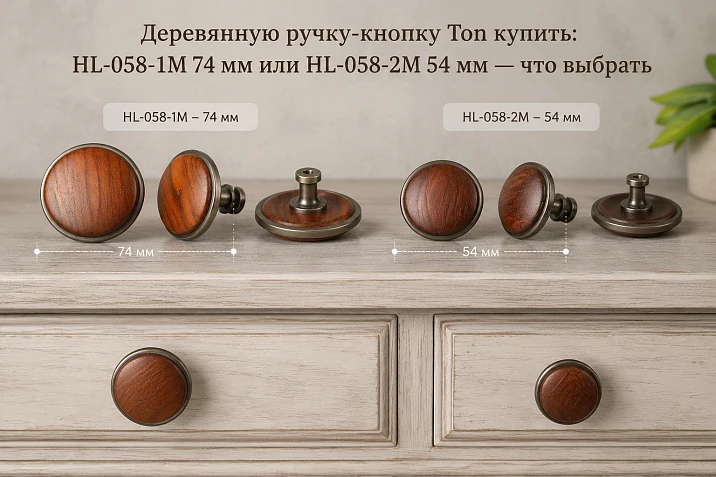
Two furniture handles from the same series made of natural wood and stainless steel — for large and compact facades
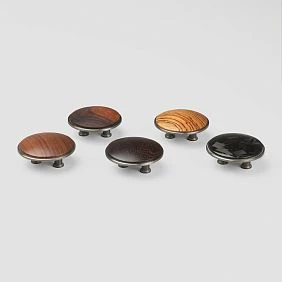
Ton HL-058-1M or HL-058-2M: short answer
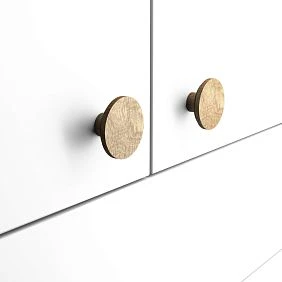
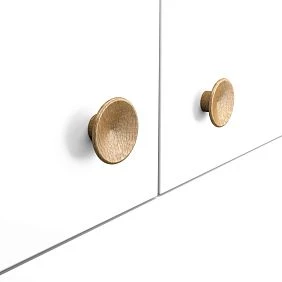
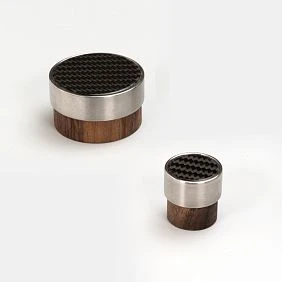
The large Ton HL-058-1M handle is worth buying for a tall cabinet, wide drawer, sideboard, kitchen pantry, or accent furniture facade. Its size is 74 × 74 × 35 mm, the front part is noticeable even on a large door, and the two-post mounting requires precise checking of the center distance and marking of two holes. The compact Ton HL-058-2M, measuring 54 × 54 × 34 mm, is better chosen for a standard kitchen door, small drawer, chest of drawers, bedside table, and narrow wardrobe section. It retains the character of the series but dominates the facade less. The number of mounting points, center distance, screws, and allowable facade thickness for HL-058-2M should be checked before ordering.
Buy the large Ton HL-058-1M handle Buy the compact Ton HL-058-2M handle buy ready-made wooden furniture handles Order handle layout for facades
HL-058-1M: 74 × 74 × 35 mm. Face area of the conditional square — 5476 mm². Mounting confirmed as two-post.
HL-058-2M: 54 × 54 × 34 mm. The face area of a conventional square is 2916 mm². The exact mounting pattern needs to be checked.
Scale difference: the large version is 20 mm wider and taller, and its face area is approximately 1.88 times larger.
Materials of both models: natural wood and stainless steel.
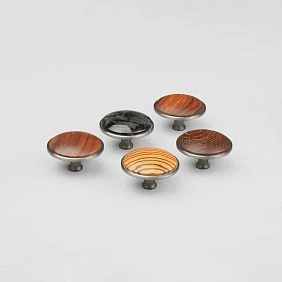
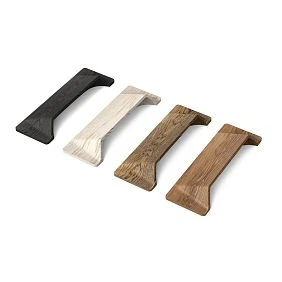
Available finishes: zebrano, wenge, rosewood, walnut, and carbon. Before ordering, you need to clarify whether these names refer to the wood species, decorative finish, inlay, or another processing option; they cannot be automatically considered as solid wood of the corresponding species or carbon fiber.
Buying wooden furniture handles is easy only when the fronts are already marked, the fasteners are known, and the scale is checked on the furniture. In other cases, the buyer sees two similar Ton handles and chooses by eye: the large one seems more impressive, the compact one more versatile. After installation, it may turn out that the 74 mm handle is too tight on a small door, while the 54 mm model gets lost on a tall cabinet.
The 20 mm difference sounds modest, but on the face plane it almost doubles the visual area. A 74 × 74 mm square occupies 5476 mm², a 54 × 54 mm square occupies 2916 mm². The large Ton is approximately 1.88 times more noticeable in area, although the models differ in depth by only one millimeter. Therefore, HL-058-1M and HL-058-2M provide two different scales of the same design idea.
The series combines natural wood and stainless steel. It is suitable for furniture where the handle should look not like a technical button, but like a finished detail of the facade. Five finish options allow you to match the hardware with the countertop, body, wooden panels, dark or light facade. But the names "zebrano", "wenge", "rosewood", "walnut", and "carbon" should be perceived as product variants, and the exact composition and coating type should be checked in the product card.
For purchase, use the main product addresses: handle 74 × 74 mm made of wood and steel и handle 54 × 54 mm for kitchen and dresser. If the Ton shape is not suitable, you can View the full catalog of furniture handles.

What is the Ton knob handle
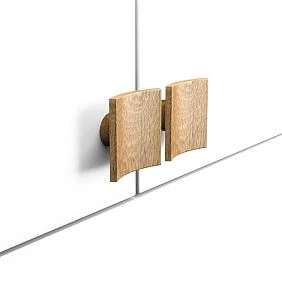
Ton refers to compact surface-mounted furniture hardware with a square face and a combination of wood with a metal base. The name "knob handle" describes the shape and grip method, but does not guarantee a single attachment point. For HL-058-1M, a two-post mounting is explicitly specified, so it cannot be installed as a regular single-screw knob.
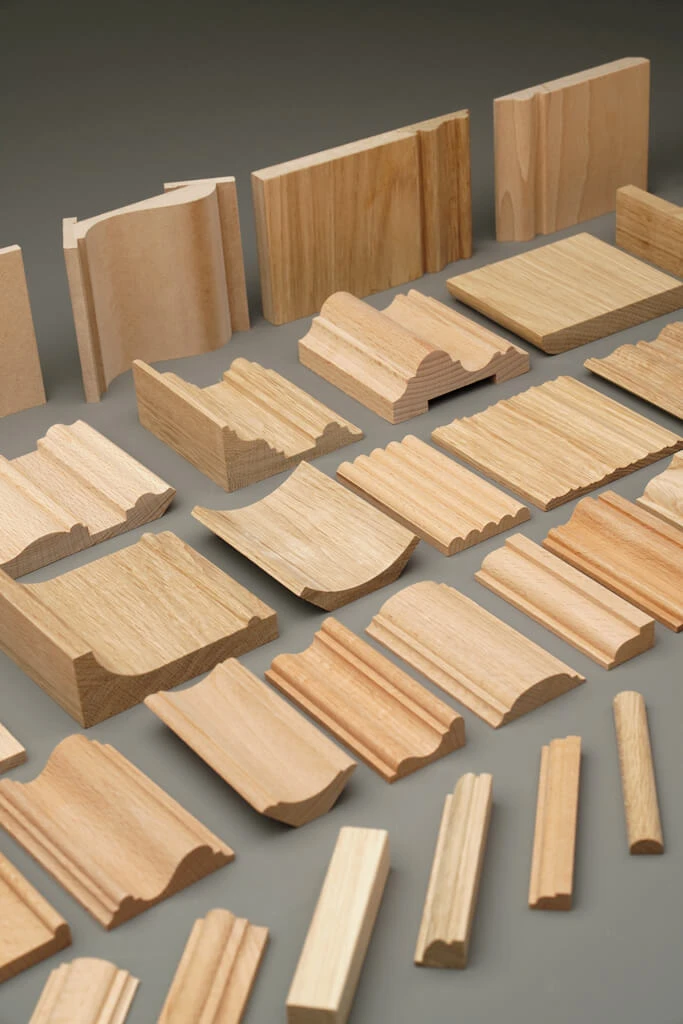
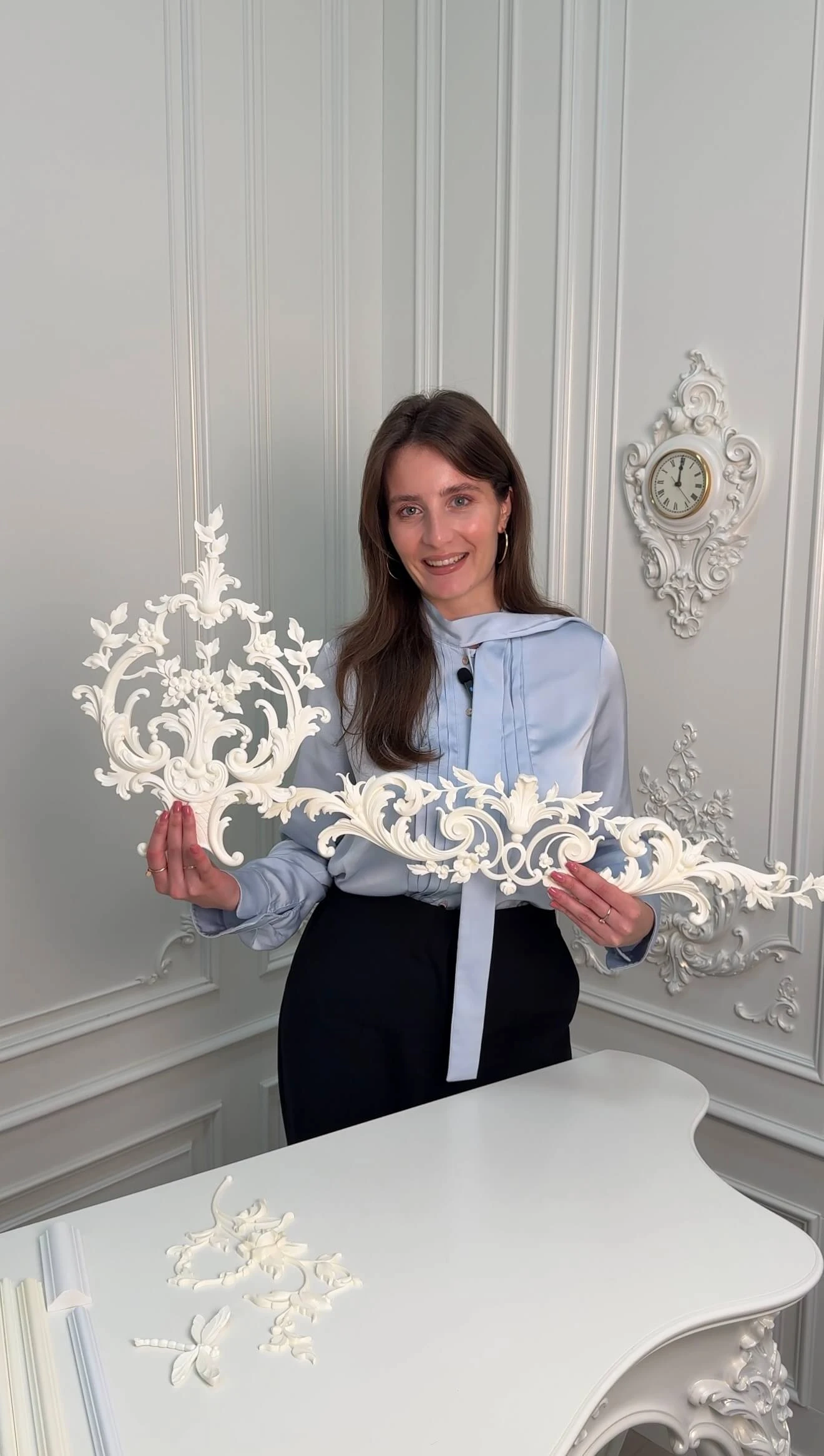
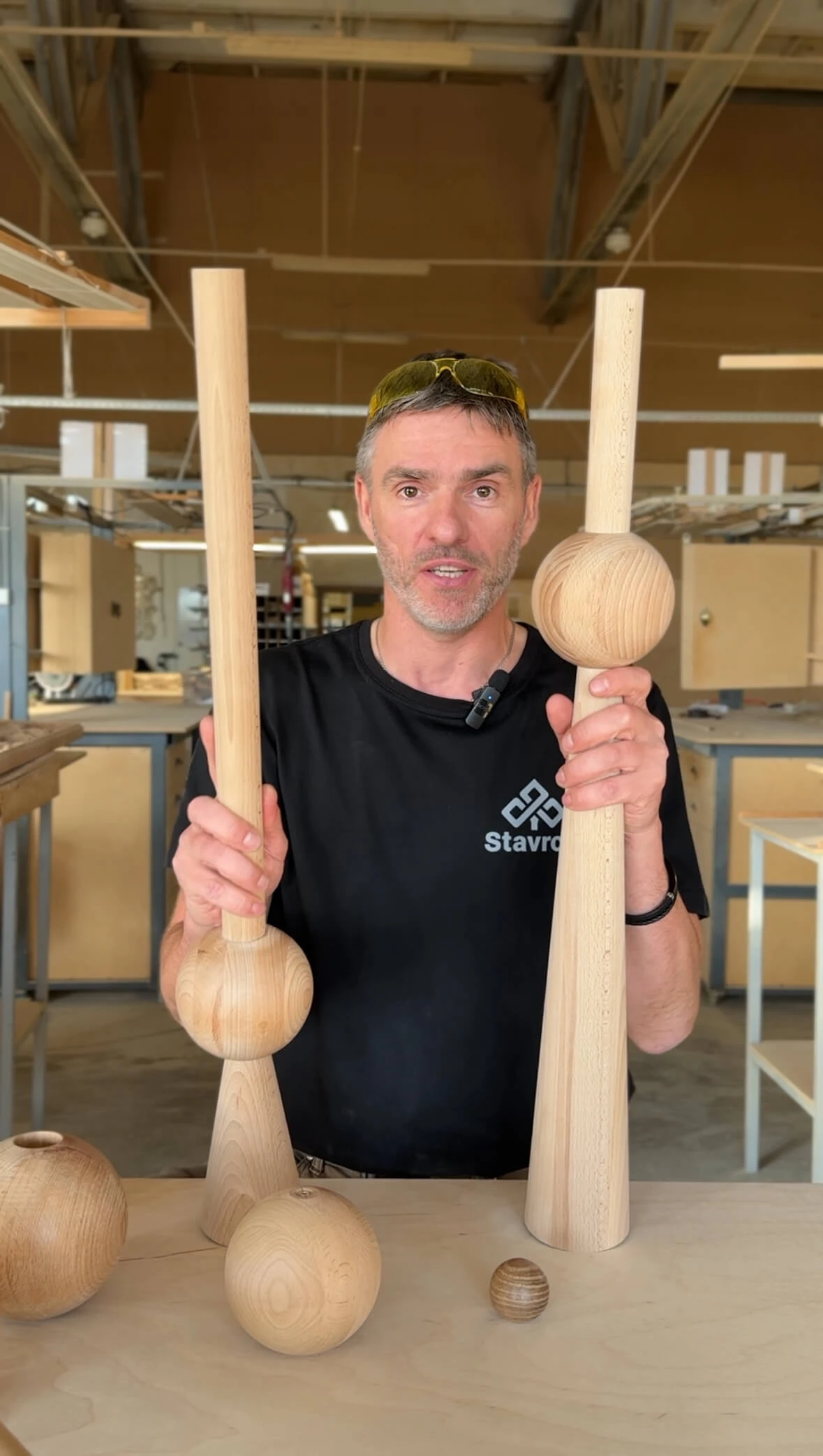
Our factory also produces:
The face part works as a decorative insert
The square wooden plane reads well on a monochrome facade. It can match the wood grain of the body, contrast with light enamel, or repeat the dark color of the countertop. The metal part separates the wood from the facade and adds a modern character.
Get Consultation
The depth is responsible for the grip
HL-058-1M protrudes by 35 mm, HL-058-2M by 34 mm. The difference is minimal. Therefore, models are chosen primarily by face scale and mounting, not by depth. Grip comfort should be checked by hand on a sample, especially for heavy or frequently opened facades.
A large button can have two mounting points
The large version is confirmed to be two-post. This helps keep the square handle in a given orientation, but creates marking requirements. The center distance cannot be guessed from a photo. It must be taken from the card or drawing.
The compact version is not declared single-screw without verification
HL-058-2M visually resembles a regular button, but the number of mounting points in the source data is not confirmed. A diagram must be obtained before drilling. The error is especially critical when replacing an old handle when there are already holes on the facade.
The finished coating reduces finishing work
Both models are in the category of handles with coating and are offered in five finished versions. The buyer chooses a finished appearance, not an untreated wooden blank for self-toning. The current color is best assessed from a sample because the screen and room lighting change perception.
Confirmed characteristics of two models
| Parameter | Ton HL-058-1M | Ton HL-058-2M | Practical significance |
|---|---|---|---|
| Type | Large furniture button handle | Compact furniture button handle | The models retain one design but are designed for different visual scales of facades. |
| Size | 74 × 74 × 35 mm | 54 × 54 × 34 mm | Templates must be attached to the furniture before ordering. |
| Conditional area of the front part | 5476 mm² | 2916 mm² | The large model is approximately 1.88 times more noticeable in area. |
| Materials | Natural wood and stainless steel | Natural wood and stainless steel | Wood provides color and pattern, metal provides modern contrast and base. |
| Design options | Zebrano, wenge, rosewood, walnut, carbon | Zebrano, wenge, rosewood, walnut, carbon | Two sizes can be combined into one execution option. |
| Mounting | Two-post | Number of points requires verification | Cannot transfer a template from one model to another. |
| Center-to-center distance | Check in the card or drawing | Check if there are two mounting points | The parameter determines compatibility with old holes and drilling template. |
| Screws | Specify configuration and length | Specify configuration and length | The screw is selected according to the thickness of the specific facade. |
| Main scenarios | Tall cabinet, sideboard, wide drawer, pencil case, large facade | Kitchen door, chest of drawers, bedside table, wardrobe, small drawer | Preliminary scenarios: the final choice is confirmed by the pattern on the facade. |
The characteristics provide a clear commercial fork. HL-058-1M is not just an enlarged picture of the same button, but hardware with a confirmed two-post mounting and almost double the face area. HL-058-2M retains the depth and materials of the series, but is easier to repeat on a large number of small facades.
Why the 20 mm difference is more noticeable than it seems
In the drawing, 74 and 54 mm differ by only two centimeters. On furniture, this difference is immediately noticeable because the area of the front part, the free space around the handle, and the ratio of the hardware to the width of the facade change. The large model attracts the eye more strongly and quickly becomes the compositional center. The compact one retains the function of an accent but leaves more air around.
The large version is almost twice as noticeable in area
Comparing the squares gives 5476 and 2916 mm². The difference is 2560 mm². Therefore, HL-058-1M is perceived not as a third, but almost twice as large. This is especially important on plain enamel, where the shape of the handle does not compete with the facade pattern.
On a narrow door, 20 mm reduces the free field
Let's imagine a facade with a width of 250 mm. If the handle is placed exactly in the center, there will be approximately 88 mm from the edge of the large front part to the side edges. For the compact one, it's about 98 mm. The difference of ten millimeters on each side can determine whether the handle looks calm or excessively tight.
On a wide facade, a small model can get lost
On a door with a width of 600–800 mm, HL-058-2M remains functional but may look too small, especially if the facade is tall and smooth. HL-058-1M better maintains scale and turns the hardware into a noticeable design element.
The depth is almost the same
35 and 34 mm are practically the same projection level. Therefore, the compact version cannot be considered significantly flatter. If there is a wall, adjacent facade, or pull-out drawer nearby, both models should be checked based on the actual opening trajectory.
Hand size does not replace facade size
A large handle is often considered more comfortable to grip, but this needs to be tested on a sample. Comfort depends on the edge shape, distance to the facade, and opening force. Visually, a large model may suit the cabinet, but for a specific person, it may be less comfortable than a compact one.
Comparative selection table
| Criterion | HL-058-1M, 74 mm | HL-058-2M, 54 mm | Practical conclusion |
|---|---|---|---|
| Visual scale | Large accent | Moderate accent | Choose based on facade area, not just personal preference. |
| Tall cabinet | Preferable on wide doors | Suitable for narrow sections | Different sizes can be distributed across groups of facades. |
| Standard kitchen door | May look too large | More often suitable | Make a paper template before purchasing the entire batch. |
| Wide bottom drawer | One noticeable handle | One or two, after calculation | Check the guides and symmetry of the two placement points. |
| Small cabinet | May dominate | Preferable | The free space around the handle should remain noticeable. |
| Buffet | For large doors and central facade | For small doors and drawers | Both sizes can work in one product with a clear hierarchy. |
| Number of facades | Better with a small number of large accents | Easier to repeat on many doors | The more handles, the stronger the total decorative saturation. |
| Mounting | Confirmed two-post | Requires verification | Do not drill the facade using another model's template. |
| Replacing old hardware | Only suitable if mounting points match or with new markings | Compatibility depends on the pattern | Old holes are measured before ordering. |
| Mixed set | Lower wide drawers, tall cabinets, large wardrobes | Upper cabinets, small drawers, cupboards | Keep one design variant and the overall layout logic. |
How to make 74 and 54 mm templates
The most useful check before ordering does not require complex software. Just cut two squares from thick paper or cardboard: 74 × 74 and 54 × 54 mm. The template shows the scale on the actual facade and helps compare several installation options.
Use the exact size
Do not draw a square "approximately seven centimeters." An error of five millimeters changes the perception of a compact model. Mark with a ruler, cut along the outer contour, and label the article.
Add a conditional metal contour
If the photo shows that the metal is visible around the wooden part, you can print the product image to scale. A simple square is needed for the area, and a photographic template is for the color and material impression.
Check the facade with the open door
The template is applied not only to closed furniture. Open the adjacent door, pull out the drawer, bring your hand to the intended grip point. This shows whether paired handles collide and whether a large model interferes with the adjacent plane.
Look from the working distance
For a kitchen, step back two or three steps; for a tall cabinet, go to the center of the room. From a close distance, any handle looks larger. The solution should work with the overall appearance of the furniture.
Compare the same execution option
A dark insert visually appears more massive than a light one. Therefore, it is better to choose the size first on neutral templates, and then compare zebrano, wenge, palisander, walnut, and carbon.
Leave the template for a day
Temporary attachment with painter's tape allows you to get used to the scale. In the morning and evening, the lighting will change, and a large handle may start to be perceived differently. This check is especially useful for a series of dozens of facades.
HL-058-1M cannot be considered an ordinary single-screw button
Confirmed two-post mounting is a fundamental characteristic of a large model. The buyer may expect a single central hole because the shape resembles a button. In practice, the layout is closer to a small handle with two fixation points.
Why two posts
The square face must maintain precise orientation. A single point could allow rotation, especially with regular gripping. Two posts fix the position but require accurate center distance.
The center distance must be obtained before drilling
It cannot be determined from the overall width of 74 mm. The mounting points are located within the overall dimension, and the exact value depends on the design. Use a card, drawing, or actual sample.
Existing holes may not fit
Even if the old handle was also attached with two screws, the center distance may differ. An extra hole on a finished facade is difficult to conceal, especially under a transparent or glossy finish.
The template must account for orientation
The two drilling points define the horizontal or vertical. Before working, decide how the handle is oriented relative to the insert pattern and the facade. All products in one group are marked identically.
HL-058-2M is checked separately
The compact model cannot be automatically considered single-screw or two-post by analogy with the larger one. The number of points and center distance must be confirmed by its own card.
One large or two compact handles on a wide drawer
The query "wooden drawer handle" often leads to the main practical fork. On a long facade, you can place one HL-058-1M in the center or two HL-058-2M symmetrically. The choice depends on the drawer width, opening force, internal structure, and the overall composition of the dresser or kitchen.
One HL-058-1M
Creates a clear central accent and reduces the number of holes compared to two separate handles, although the model itself is mounted with two posts. This option suits a facade that opens without skewing when gripped centrally.
Two HL-058-2M
Distribute grip points across the width and may look better on a very long drawer. But you need to check where the guides, ties, and internal elements run. Two handles require absolutely symmetrical marking.
Functional check
A wide drawer is best tested with a prototype. If the facade moves smoothly when gripped in the center, one large handle may be sufficient. If the user intuitively pulls with two hands, a paired scheme is more convenient. The decision should not be made based solely on a photo.
Visual rhythm of the dresser
On the upper small drawers, you can use HL-058-2M, on the lower wide one — HL-058-1M. This hierarchy is clear if repeated throughout the furniture. Random alternation of sizes creates a sense of part replacement.
Quantity calculation
One large handle on each of the four drawers — four HL-058-1M. Two compact ones on each — eight HL-058-2M. The price of the entire scheme depends on the quantity, so you need to compare the set, not a single card.
How to choose Ton for the kitchen
The kitchen combines facades of different sizes: small upper doors, wide lower drawers, a tall cabinet, a dish cabinet, and narrow pull-out sections. One handle model can unify the set, but sometimes two sizes of the same series provide a more precise hierarchy.
Upper cabinets
HL-058-2M usually fits more easily into a small door. It does not overload a row of identical facades and leaves more free space. On very wide upper sections, the large version is possible, but its scale needs to be checked with a paper template.
Lower swing fronts
Both models can work. HL-058-2M creates a calm repetition, HL-058-1M highlights the lower row more strongly. If the lower doors are noticeably larger than the upper ones, a mixed set looks logical.
Wide drawers
For a large lower facade, HL-058-1M becomes a central accent handle. Two HL-058-2M are needed when the facade is long, one-handed grip is inconvenient, or the composition requires paired symmetry. Internal guides are checked before drilling.
Tall pencil case
On a door as tall as several furniture modules, a compact button can get lost. HL-058-1M visually holds the scale better. The installation point is chosen based on hand convenience, not just the geometric center of the tall facade.
Identical handles throughout the kitchen
Only HL-058-2M is suitable for a calm composition with many facades. Only HL-058-1M is appropriate if the set is large, there are few doors, and the hardware should be a noticeable part of the design. Before placing a bulk order, install one handle on a test facade.
Two sizes in one set
Convenient scheme: compact handles on upper cabinets and small drawers, large ones on tall cabinets and wide lower facades. To make the system look cohesive, keep one execution variant, the same metal, and common installation lines.
Color options in the kitchen
Walnut can support a warm wooden countertop, wenge provides a dark contrast, zebrano offers an active striped pattern, rosewood gives a rich dark palette, carbon creates a more technological look. These names should not be interpreted as exact material without a card; choose based on the sample and actual facade.
For a project pairing, you can select Ton handles for kitchen facades and prepare a specification for each door and drawer in advance.
Selection for tall cabinets and wardrobes
A tall facade amplifies the importance of the handle. A small knob may look like a random dot, while an overly large one may appear as a heavy square on a narrow door. In cabinets, the width of the section, the distance between paired doors, and the ease of grip at the same height are important.
Wide double door
HL-058-1M usually fits a large field better. It is visible from afar and supports the scale of the cabinet. The two-post mount helps maintain the orientation of the square shape but requires precise marking.
Narrow door
HL-058-2M leaves more free space and does not fit close to the inner edge. This is especially important on paired doors where two handles are next to each other.
Paired handles on a double-door cabinet
Check the distance between the front faces in the closed position and the trajectory when opening. Two HL-058-1M can create a strong central block. Two HL-058-2M look lighter and reduce the risk of visual collision.
Upper and lower sections
If the cabinet is divided into a mezzanine, main door, and lower drawer, you can use compact handles on small sections and a large one on the main door. The logic should be repeated on all modules.
Built-in wardrobe
Facades are often tall and monochrome, so the handle becomes a noticeable accent. HL-058-1M is appropriate on wide doors, but the installation point should be coordinated with user height and internal structure.
Wardrobe
A large number of identical sections are easier to unify with HL-058-2M. Large handles on each facade will create a dense rhythm. They can be left only on central cabinets or large drawers.
Useful for different types of cabinets choose wooden handles for the cabinet and to check the scale on real facades.
Ton handles for a chest of drawers, nightstand, and sideboard
Compact chest of drawers
On low-height facades, HL-058-2M usually looks more proportional. It suits a series of three to four drawers and does not turn each row into a large decorative strip.
Wide chest of drawers
One HL-058-1M in the center creates a clear accent. Two HL-058-2M on the sides help visually stretch the facade. The choice is verified by ease of opening and the guides.
Bedside table
The facade is small, so a large Ton may take up too much attention. HL-058-2M is usually a better fit. If the nightstand is massive and the handle should support large legs or a countertop, HL-058-1M can be considered.
Sideboard
This is a convenient object for a mixed set. On large doors — HL-058-1M, on top drawers and narrow sections — HL-058-2M. The same finish option unites the two sizes.
Furniture Portal
The central tall front can feature a large handle as a standalone accent. The side small drawers are compact. This hierarchy supports the furniture architecture.
One size across the entire piece
A single HL-058-2M creates a calm modern rhythm. A single HL-058-1M suits a large buffet with few fronts. On a compact cabinet, a series of large squares quickly overloads the composition.
Furniture examples will help choose handles for a dresser, buffet, and cabinet.
How to combine two Ton sizes in one project
A mixed set works when sizes are distributed by function and scale, not alternated randomly. The buyer should be able to articulate the rule in one sentence: "large handles on wide lower drawers, compact on upper doors" or "74 mm on main cabinets, 54 mm on secondary sections."
Keep one finish option
Walnut on the large model and wenge on the compact create two differences at once: size and color. Such a combination is only possible in a special project. For a calm set, it's better to choose one option for both models.
Keep the same metal
Stainless steel unifies the series. If other handles, hinges, or decorative elements are used nearby, compare the shade and gloss level of the metal under actual lighting.
Define groups of facades
Kitchen upper cabinets are one group, lower drawers are another, tall cabinets are a third. Within each group, one size must be repeated. Exceptions only highlight the main facade.
Same installation height
On adjacent doors, the centers of handles should be on the same line, unless the design dictates a different solution. The difference in size should not turn into a difference in height.
Do not mix mounting templates
HL-058-1M has a two-post mounting. For HL-058-2M, the scheme is checked separately. In production, facades are marked by article numbers to avoid drilling holes for a large model in the place of a compact one.
Create a specification
The table should contain the facade number, facade size, handle article number, execution variant, quantity, and mounting. Such a document is especially important for kitchens and wardrobes with dozens of elements.
How to calculate the number of handles
The quantity is counted not by the number of furniture modules, but by the number of opening facades and the selected scheme. One cabinet may have two doors, three drawers, and a mezzanine — meaning not one handle will be needed, but at least six or more if pairs are installed on wide drawers.
Make a list of facades
Record each door and each drawer on a separate line. Even identical fronts are better numbered to avoid missing an inner section or lower drawer.
Assign one or two handles
Usually one handle is placed on one swing front. Two handles are possible on a very wide drawer. This decision should be made before counting the batch.
Separate HL-058-1M and HL-058-2M
For example: four tall cabinets and six wide drawers receive ten large handles; twelve upper doors and eight small drawers receive twenty compact handles. The final order is 10 HL-058-1M and 20 HL-058-2M.
Add a reserve
For a large set, it is useful to provide a spare handle of each used size and finish. It is needed in case of damage, loss during installation, or future replacement. It is better to clarify the current possibility of reordering the same batch in advance.
Do not forget internal and rarely used fronts
A hidden bar, technical cabinet, or internal door also requires hardware. They are often missed in the preliminary specification.
Order one batch of finish
Natural wood parts and decorative options may differ slightly in perception. Simultaneous ordering reduces the risk of noticeable variation between fronts in the same room.
Example calculation for a kitchen
Suppose the kitchen has eight upper doors, four lower swing doors, four small drawers, two wide drawers, and one tall tall cabinet. A mixed scheme is chosen: HL-058-2M on the upper doors, small drawers, and lower doors; HL-058-1M on the two wide drawers and the tall cabinet.
- upper doors: 8 HL-058-2M;
- lower swing doors: 4 HL-058-2M;
- small drawers: 4 HL-058-2M;
- wide drawers: 2 HL-058-1M;
- tall cabinet: 1 HL-058-1M.
Total — 16 compact and 3 large handles. With a reserve, you can order 17 HL-058-2M and 4 HL-058-1M. If two compact handles are installed on each wide drawer instead of one large one, the specification will change: four HL-058-2M will be added, and two HL-058-1M will be removed.
Zebrano, wenge, rosewood, walnut, or carbon
Five design options allow using one series in different interiors. However, the names cannot be automatically interpreted as the type of solid wood. The product card should clarify what the decorative part actually is: natural wood of a specific species, veneer, painting, tinting, textured insert, or another type of finish. For the buyer, what matters is not the term itself, but the actual color, pattern, gloss, and surface durability.
Zebrano
This option is usually chosen for its active striped pattern. On a light, solid-colored facade, it becomes a noticeable graphic accent. On furniture with an already pronounced wood texture, two active textures can clash. Before ordering, hold the sample against the facade and check if the pattern direction matches on several handles.
Wenge
The dark finish helps create contrast on white, gray, beige, or light wood furniture. HL-058-1M in wenge will look particularly massive due to its large face area. On a small facade, the compact HL-058-2M provides a calmer dark spot.
Rosewood
The rich dark pattern is appropriate on furniture where the handle should support a noble, deep color scheme. It is best compared with warm and cool shades of the facade under real lighting. Do not claim that the insert is made of solid rosewood unless confirmed by the product card.
Walnut
The walnut option usually pairs more easily with a classic sideboard, chest of drawers, wooden countertop, and warm kitchen. It creates a soft contrast on a light facade and can complement furniture edging or decorative panels. The exact shade is checked on a sample.
Carbon
Carbon is visually oriented towards a modern, high-tech look. However, the name does not prove that the decorative part is made of carbon fiber. It could be a pattern or coating option. Before publishing technical claims and before ordering, the material should be clarified.
One option for the entire room
This approach creates a calm integrity. Even if two sizes are used, the same finish ties together the kitchen, buffet, and cabinet. It is especially useful to keep a uniform option on furniture that is visible at the same time.
Mixing two finishes
Perhaps, if it supports functional zones: for example, walnut on a wooden buffet and carbon on a minimalist kitchen. On a single set, random alternation of shades looks like a batch replacement, not a design technique.
How to choose an option for the facade color
White facade
On a white background, any option reads clearly. Wenge, rosewood, and carbon create a strong contrast. Walnut looks warmer, zebrano more active. Large HL-058-1M turns into a noticeable square accent, so on many white doors it can create too dense a rhythm.
Gray facade
Carbon and dark options support a modern monochrome palette. Walnut adds warmth. Stainless steel can tie handles to appliances, but the exact match of shade and metal sheen is checked visually.
Dark facade
Wenge or rosewood can almost dissolve, leaving the accent on the metal part. Walnut and zebrano provide a more readable contrast. On a dark facade, actual lighting is important: in a deep niche, a wooden insert may look significantly darker than on the card.
Wood-effect facade
The handle can either match the main tone or contrast. Exact matching of different wood patterns is rarely perfect. It is better to seek harmony in color temperature and texture scale rather than trying to achieve a complete match based on a photo.
Colored facade
On green, blue, burgundy, or other rich enamel, walnut and rosewood create a warm classic connection, carbon fiber a more modern one, wenge a strict one. A large model enhances any contrast, a compact one keeps the facade color dominant.
Glossy surface
It reflects the metal part more strongly and highlights fingerprints. The handle must be installed evenly: a square shape immediately shows rotation relative to the facade edge. For gloss, an accurate drilling template is especially important.
Matte surface
A matte facade interacts more softly with the wooden insert. Steel creates a slight contrast in gloss. Both sizes look calmer, but the 74 mm area still remains noticeable.
Natural wood and stainless steel
The combination of two materials allows linking furniture with interior wood and metal details. The wooden part adds a warm visual layer, the steel forms a modern base. At the same time, care and use must account for both surfaces.
The wood changes under different lighting
Warm light enhances reddish and nutty tones, while cold light can make them grayer. Before a large order, the sample is examined during the day and in the evening. The screen does not accurately convey the texture and depth of the coating.
Steel reflects surrounding colors
The metal part may appear colder next to white appliances and warmer near a wooden facade. Compare it with hinges, faucets, appliance frames, and other visible hardware only in the actual interior.
Contact of materials in the kitchen
The handle is regularly touched with wet hands, but the suitability for specific use near the sink and cleaning rules depend on the protective coating. Universal durability cannot be guaranteed without data from the product card. Place the hardware so that water does not remain on the wooden part.
Scratches
Abrasive sponges, powders, and stiff brushes can damage wood and metal. For regular cleaning, use a soft cloth and compatible products. Specific recommendations should be checked in the operation section.
Insert repair
The ability to remove or separately replace the decorative part has not been confirmed. Do not disassemble the handle without a diagram. If a spare insert is needed, you can view decorative insert 74 × 74 mm in the same finish options, but its compatibility with Ton needs to be confirmed separately.
Description of materials and finish options is worth of the complete furniture handle catalog.
How to measure the center distance and prepare a template
An accurate template protects a series of facades from error accumulation. For HL-058-1M, it must account for two posts and the orientation of the square face. For HL-058-2M, the template is created only after confirming the mounting.
Actual handle as a reference
The most reliable method is to obtain a sample, measure the posts with a caliper, and compare with the drawing. If the data differs, do not start mass drilling until clarification.
Center lines
On the template, mark the vertical and horizontal axes of the handle. They help align the square parallel to the edges of the facade. Even precise holes can cause visual rotation if the posts have slight manufacturing play.
Control facade
The first drilling is performed on a material sample or on the least noticeable part after approval. Install the handle, check orientation and convenience, then transfer the template to the remaining facades.
Article marking
If the project has two sizes, the templates are labeled large. An error between HL-058-1M and HL-058-2M can ruin the facade because the mounting patterns should not be considered identical.
Left and right door leaf
The position from the inner edge must be mirrored. One template can be flipped only when its axes and stops are truly symmetrical. For complex facades, separate left and right templates are made.
How to select screws for facade thickness
The completeness of screws and their length are not confirmed. Even if the fasteners are included in the delivery, they may not suit the non-standard thickness of the facade. The screw must pass through the material, securely enter the post, and not hit an obstruction prematurely.
Measure the thickness at the drilling point
Nominal 16, 18, or 22 mm do not always match reality after cladding and milling. Measure the actual thickness where the handle will be.
Consider the countersunk head
If there is a countersink or washer on the inside, the working length changes. The specific scheme depends on the fastener and the facade.
Screw too short
It does not go deep enough into the post, and the handle may loosen. This cannot be compensated by excessive tightening force.
Screw too long
It may hit the inside of the handle without pressing it against the facade, or damage the structure. The length is checked on one sample.
Stainless steel handle and fastener material
The type and coating of the screw must be compatible with the product and usage conditions. Do not select random fasteners only by diameter.
Where to find fasteners
For the project, you can select screws and furniture fasteners, but the specific thread, length, and head are confirmed by the handle and facade.
Installation on MDF, laminated chipboard, and solid wood
The handle contacts the front side, and the screw passes through the entire facade. Therefore, the quality of installation depends on the material inside, the condition of the hole, and the tightening force. The same template can only be used for facades of the same thickness and construction.
MDF under enamel
The material allows for a precise hole, but the coating around the drilling needs to be protected from chipping. Drill with a suitable tool through a backing, do not press on the enamel, and first test the technique on a sample. The large HL-058-1M covers a large area, but this does not justify a sloppy hole.
Laminated chipboard
The laminated layer can chip at the drill exit. A backing on the exit side and a sharp tool help achieve a clean edge. The screw must not be overtightened: the material around the hole can be damaged, and the handle will start to wobble.
Solid wood facade
The direction of the fibers and moisture condition affect drilling. The hole should not be placed too close to a thin edge. For the two-post HL-058-1M, it is especially important that both points are in a stable area of the wood.
Veneered facade
The face veneer is sensitive to chips and scratches. Before marking, protect the surface, and the template should not rub the finish. If the old holes do not match, the repair may remain visible.
Milled panel
The handle must rest on a flat surface. Do not place the metal base partially on a relief and partially on a recess. Choose an area for the template where the entire contact surface lies flat.
Glass facade
Installation on glass requires a special scheme, gaskets, and confirmed compatibility. Standard recommendations for MDF are not suitable. Without Ton card data, installation on a glass door cannot be guaranteed.
How not to overtighten the fastener
Excessive tightening does not make the handle more reliable. It can dent the face covering, deform the inner surface of the facade, strip the thread, or create stress in the decorative part.
The handle should fit without wobbling
First, the screws are evenly started. For the two-post HL-058-1M, you cannot fully tighten one side while leaving the other loose: the base may sit at an angle.
Checking square orientation
Before final tightening, align the face part with the edges of the facade. After fixing, check the level and distance to adjacent handles.
Washers and gaskets
Their necessity depends on the fastener and the inner side of the facade. You cannot add a random washer if it reduces the working length of the screw or interferes with closing the drawer.
Re-checking
After the first few days of use, the handle is inspected. If the fastening is loose, the cause is determined, rather than simply tightening it further. The screw may be the wrong length, or the hole may have excessive clearance.
Care for wood and stainless steel
Regular gentle cleaning
Dust and fingerprints are removed with a soft, dry or slightly damp cloth, if the coating allows. After damp cleaning, the surface is wiped dry, especially at the junction of wood and metal.
No abrasives
Powders, hard sponges, and metal brushes can scratch the decorative part and alter the steel's luster. A small scratch is especially noticeable on the large HL-058-1M.
Household chemicals
The suitability of a specific product depends on the protective coating. Strong solvents and alkaline compounds must not be used without confirmation. First, test an inconspicuous area.
Area near the sink
Do not leave the handle wet. Water and detergent should not constantly accumulate along the edges of the wooden insert. When designing the kitchen, it is convenient to position the handle so that the stream and splashes do not hit it directly.
Keeping one spare handle
The spare is stored in packaging, away from moisture and direct sunlight. It will be useful for replacement and simultaneously serves as a sample of the finish for future furniture repairs.
General rules can be checked in the recommendations for storage and use of furniture fittings.
What to buy together with Ton handles
The handle becomes part of the finished assembly only together with suitable screws, precise markings, and a coordinated furniture composition. For a large project, a sample of the finish, a spare handle, and a general list of facades are also useful.
| What to add to the purchase | Why | For which project | What to Check |
|---|---|---|---|
| Screws and furniture fasteners | Secure the handle on a facade of the required thickness | New furniture and replacement of old fittings | The thread, length, head, and compatibility with the handle |
| Materials for installation and care | Prepare tools, protection, and care products | Kitchen, cabinet, chest of drawers, sideboard | Compatibility with facade coating and handle |
| decorative insert HL-070-1M | Compare format 74 × 74 mm and design options | Project with a large square decorative part | Compatibility with Ton is not assumed without confirmation |
| Long handle bracket Atlas HL-071M | Compare button with long grip | Heavy drawers, wide facades, different ergonomics | Sizes, center distance and style |
| Modern handles and furniture decor | Group adjacent elements of the same style | Modern kitchen, wardrobe, living room | Do not mix random metals and scales |
| Ready-made wooden furniture handles | Compare other shapes and sizes with Ton | Ton does not fit in terms of mounting or scale | Coating, size, mounting points and purpose |
| Layout of handles on facades | Distribute 74 and 54 mm across the furniture set | Kitchen, large cabinet, sideboard, walk-in closet | Dimensions of all fronts, quantity and installation height |
| Guide to selecting, marking, and installing handles | Check the overall process of preparing fronts | Self-assembly and furniture production | Use only specific dimensions from Ton cards |
How not to confuse Ton with similar solutions
HL-058-1M and a regular single-screw button
Large Ton has a two-post mount. It requires two holes and precise orientation. A regular single-screw button is easier to replace but may hold the square shape differently.
HL-058-2M and a reduced copy of the HL-058-1M mount
The size is reduced, but the mounting scheme is not confirmed. The center distance cannot be proportionally recalculated or a single drilling template used.
Ton and decorative insert HL-070-1M
The insert is not equal to the finished handle. Even a size match of 74 × 74 mm does not prove that it fits on the Ton base. This is a separate product for separate verification.
Ton and long Atlas
Atlas is a pull handle with a different grip method and mounting scheme. It may be more convenient for a heavy drawer or front where fingers need more space. Ton is chosen for the square accent and compact shape.
Handles with coating and blanks without finish
Ton is offered in finished versions. The buyer does not plan to independently tint the natural blank. If an exact color for a furniture project is needed, another category should be compared, rather than repainting the finished handle without checking the coating.
Practical choice for specific situations
Front width about 300 mm
Start with HL-058-2M. The 54 mm square leaves more free space and is easier to perceive on a narrow door. HL-058-1M is possible as a deliberate accent, but a paper template should show that the handle has not come too close to the edges and moldings.
Tall kitchen cabinet
Large HL-058-1M is more often suitable for the scale. It is not necessary to place it strictly at the geometric center of the height: the grip point should be convenient. Coordinate the position with the handles of adjacent lower and upper fronts.
Small upper cabinet
HL-058-2M retains the character of Ton without an excessive square spot. If there are many such doors, the compact size creates a calmer rhythm.
Wide lower kitchen drawer
Compare one HL-058-1M in the center and two HL-058-2M. Check the actual opening, guides, hand position, and cost of the entire scheme. Do not choose two handles just because the front is long.
Double-door cabinet
Two large handles can almost touch visually. For narrow doors, HL-058-2M is better. For wide massive doors, HL-058-1M creates a convincing central accent. Leave enough space between the handles for fingers.
Chest of drawers with small upper and wide lower drawers
Use two sizes in a vertical hierarchy: HL-058-2M on top, HL-058-1M on bottom. Keep one finish option and a common central axis.
Restoration of an old sideboard
First, measure the old holes. HL-058-1M can cover more marks thanks to its 74 mm face, but its two-post design must match, or the facade will need repair. The finish is chosen based on a sample next to the existing wood.
Modern kitchen with gray facades
Carbon or wenge can support a graphic palette, while the steel part supports appliances. The compact size fits many facades, the large one fits a tall cabinet and wide drawers.
Classic sideboard in a warm shade
Walnut or rosewood initially look more natural, but the exact color is checked physically. Use HL-058-1M on large doors, HL-058-2M on small drawers.
Furniture for commercial interiors
In a hotel, salon, restaurant, or showroom, handles are used frequently. Before a series order, install a sample, check grip comfort, cleaning, and coating durability. A spare batch is especially important for identical facades in multiple rooms.
Mistakes when choosing and buying
Choosing only by photo
On screen, the large and compact models may look almost identical. The actual 74 mm square is almost twice the area of 54 mm. Paper templates are mandatory.
Consider HL-058-1M a single-screw button
She has a confirmed two-post mounting. An error will lead to incorrect marking and the inability to install the handle on one old hole.
Assume mounting HL-058-2M
The number of points is not confirmed in the source data. Obtain a drawing or sample before drilling.
Do not check the center distance
The overall width of the handle does not provide the mounting size. Even two two-point models may have different center distances.
Buy screws by thickness "by eye"
A screw that is too short is unreliable, too long will not press the handle. Measure the actual front and check the thread.
Mix sizes without a rule
Alternating 74 and 54 mm should correspond to groups of fronts. Randomly replacing one handle with another looks like a configuration error.
Mix design options on one set
Zebrano, wenge, rosewood, walnut, and carbon differ noticeably. Without design logic, the furniture will lose integrity.
Consider names as array variants
The product designation does not confirm the wood species. Also, 'carbon' should not automatically be called carbon fiber. The material is specified in the card.
Do not consider the adjacent handle
On paired doors, two large Ton handles may interfere with grip or collide. Check both closed and open positions.
Do not consider internal guides
Holes on the drawer may hit the metal system or tie. Inspect the internal structure before drilling.
Order the exact quantity without reserve
In case of damage or future repair, a matching finish may be unavailable. For a large project, a spare handle of each used size is useful.
Overtighten screws
This damages the facade and threads. Tighten the two HL-058-1M posts evenly.
Use aggressive chemicals
Wood and metal require careful maintenance. Abrasives can alter the coating and shine.
Who is HL-058-1M suitable for
- a tall cabinet front;
- a wide buffet door;
- a large dresser or kitchen drawer;
- a kitchen tall cabinet;
- a central furniture portal front;
- a set with a few large accents;
- a project where the handle should be a noticeable part of the design;
- replacing hardware after confirming two mounting points;
- to a mixed set with HL-058-2M;
- furniture where the 74 mm square is confirmed by a template.
When it's better not to choose HL-058-1M
- a small door leaves too little free space;
- need to preserve one old hole;
- the center distance does not match and the facade cannot be repaired;
- there is no flat area on the facade for the base;
- two paired handles are located too close;
- the set has many small facades and a large rhythm overloads the furniture.
Who HL-058-2M is suitable for
- standard kitchen door;
- upper cabinet;
- small drawer;
- nightstand;
- compact dresser;
- narrow wardrobe door;
- series of identical facades;
- calm modern furniture project;
- mixed set with large HL-058-1M on main facades;
- furniture where the 54 mm square better preserves the free field.
When it's better not to choose HL-058-2M
- the handle visually gets lost on a tall wide facade;
- a heavy drawer requires a different type of grip;
- the mounting pattern is not confirmed;
- the old holes do not match;
- a strong decorative center is needed;
- two compact handles complicate the layout without functional benefit.
What to Check Before Ordering
- article HL-058-1M or HL-058-2M;
- size 74 × 74 × 35 or 54 × 54 × 34 mm;
- paper template on each type of facade;
- number of mounting points;
- center distance;
- hole diameter;
- presence and length of screws;
- actual facade thickness;
- facade material;
- internal guides and ties;
- existing holes;
- position relative to edge and molding;
- collision of paired handles;
- grip comfort;
- one or two handles per wide drawer;
- zebrano, wenge, rosewood, walnut or carbon option;
- exact meaning of the execution name;
- number of handles per specification;
- a spare handle of each size;
- current ordering and delivery conditions.
How to buy Ton on STAVROS
First, make a list of all facades. Record the width, height, opening type, and number of handles. Then apply the 74 and 54 mm templates and determine where a large Ton is needed and where a compact one is.
For wide doors, tall cabinets, and large drawers, open the card and buy the large Ton handle HL-058-1MBefore ordering, specify the center distance, screws, and facade thickness. For standard kitchen doors, cabinets, and small drawers, you can Buy the compact Ton HL-058-2M handle, after first checking its mounting pattern.
If two Ton sizes do not fit the holes or shape, compare Ready-made wooden furniture handles и Modern handles and furniture decorFor a complex kitchen or wardrobe, it is useful to Order handle layout for facades.
Before payment, confirm the version, quantity, mounting hardware, and stock. Terms of receipt are collected on the page payment and delivery terms.
FAQ: questions about Ton handles HL-058-1M and HL-058-2M
How does HL-058-1M differ from HL-058-2M?
The main difference is size and scale. HL-058-1M has 74 × 74 × 35 mm and a two-post mounting. HL-058-2M is 54 × 54 × 34 mm, and its mounting pattern needs to be clarified.
What size is the large Ton?
Confirmed size of HL-058-1M is 74 × 74 × 35 mm.
What size does the compact Ton have?
HL-058-2M has a size of 54 × 54 × 34 mm.
How noticeable is the 20 mm difference?
The front area of the large version is approximately 1.88 times larger. On the facade, the difference looks significantly stronger than just two centimeters.
What materials are the handles made of?
Natural wood and stainless steel are confirmed for both models.
What to choose: zebrano, wenge, rosewood, walnut, or carbon?
Choose based on the facade, countertop, and adjacent metal. The exact material and coating type of each finish should be checked in the product card; names cannot be automatically considered as solid wood species.
How many attachment points does HL-058-1M have?
The mounting is confirmed as two-post, so two points and the exact center distance are needed.
How is HL-058-2M mounted?
The number of points and center distance must be clarified from the card or drawing before drilling the facade.
What is the center distance of the handles?
The exact values are not confirmed in the initial data. They cannot be calculated from the overall width; use the drawing or an actual sample.
Are screws included in the kit?
The completeness needs to be checked. Even a complete screw must match the facade thickness.
Will the handles fit the old holes?
Only if the number of points, center distance, and diameter match. The old handle is removed and the holes are measured before ordering Ton.
Which option should I choose for the kitchen?
HL-058-2M is more suitable for standard and upper doors. HL-058-1M is for tall cabinets and wide lower drawers. In one set, you can use both sizes according to a clear scheme.
Which handle is suitable for a wide drawer?
One HL-058-1M creates a central accent. Two HL-058-2M are suitable for a paired scheme. The choice is confirmed by the opening test and guide rail check.
What is better for a small cabinet?
Usually HL-058-2M, because the 54 mm square leaves more free space. The larger version is possible on a massive accent cabinet.
Can both sizes be used in one set?
Yes. Keep one finish and distribute sizes by groups: compact on small fronts, large on tall cabinets and wide drawers.
How many handles to order for a kitchen?
Count each opening door and drawer, then account for paired handles on wide fronts. Add a reserve of each used size.
Is a spare handle needed?
For a large set — it is advisable. It will be useful for repairs and will maintain the exact finish of the batch.
How to care for wood and stainless steel?
Use a soft cloth, do not use abrasives, and wipe the surface dry. The suitability of household chemicals depends on the coating.
Can Ton be installed on MDF?
Yes, after checking the thickness, fasteners, and careful drilling without chipping the enamel or coating.
Can it be installed on laminated chipboard?
Yes, if the holes are made cleanly and the screw does not damage the material by overtightening.
Can the handle be installed on glass?
Only if a special confirmed scheme is available. Regular installation through glass should not be assumed.
Why might a square handle rotate?
The cause could be hole play, weak tightening, or unsuitable fasteners. For HL-058-1M, two posts should maintain orientation when properly installed.
Where to buy HL-058-1M?
In the main card you can Buy the large Ton HL-058-1M handle.
Where to buy HL-058-2M?
In the card, you can Buy the compact Ton HL-058-2M handle.
Where to see other wooden handles?
You can Buy wooden furniture handles of a different shape, size and mounting.
Result: 74 mm for a large accent, 54 mm for a calm rhythm
The Ton HL-058-1M and HL-058-2M allow you to choose two scales of the same design series. The large handle measuring 74 × 74 × 35 mm is suitable for tall cabinets, pencil cases, sideboards and wide drawers. The compact 54 × 54 × 34 mm is more convenient for standard kitchen doors, bedside tables, small drawers and a series of facades.
The decision cannot be made based solely on a photo. The 74 mm square is almost 1.9 times larger in face area, and the HL-058-1M has a two-post mounting. Before ordering, templates on the furniture, checking holes, center distance, facade thickness and screws are required. For the HL-058-2M, the mounting scheme is confirmed separately.
STAVROS offers both models in five finishes — zebrano, wenge, palisander, walnut and carbon. One option and two sizes help build a clear hierarchy: large handles on main facades, compact ones on secondary ones. This approach makes furniture cohesive, simplifies batch calculation and reduces the risk of accidental selection of fittings.