


































































Article Contents:
- Oak plate KU-004: we fix the execution, not just the article number
- Why it is more profitable for a cafe to start with one size and one specification
- Logo on wooden tableware: what is allowed and what the product card does not promise
- Three logo layouts: center, end, or side zone
- Template 300×180 mm: how to check the scale without a printing error
- Why an 80 mm sign cannot be assessed as an enlarged version of a 25 mm sign
- Can I order some plates with a Russian name and some with an English one?
- Will a QR code work instead of a regular logo?
- Will a logo on the back side solve the food zone issue?
- Can I buy plates from STAVROS and have the logo applied in another workshop?
- Does it make sense to first get a regular KU-004 without a logo?
- Can I test the 250×130 mm size and order 300×180 mm?
- Is a sample video enough if there is little time before the opening?
- Is the price of the sample counted toward the cost of the main order?
- Do twenty-four pieces count as a wholesale order?
- Can the finished batch be split between two cafes?
- What to do if the name of the establishment has changed after the sample was approved?
- Can the engraving be removed later and the plates used under a different brand?
- Can an additional reserve be ordered after a few months?
- Is it necessary to photograph all 24 plates individually?
- Can dessert plates be pre-chilled in advance?
- What to do if the logo looks different after the permitted treatment?
- Can the dish be left on KU-004 longer than during the test?
- Can the same set be used at an off-site event?
- Does it make sense to give guests plates from the working reserve?
- What materials should be left for the manager after the batch launch?
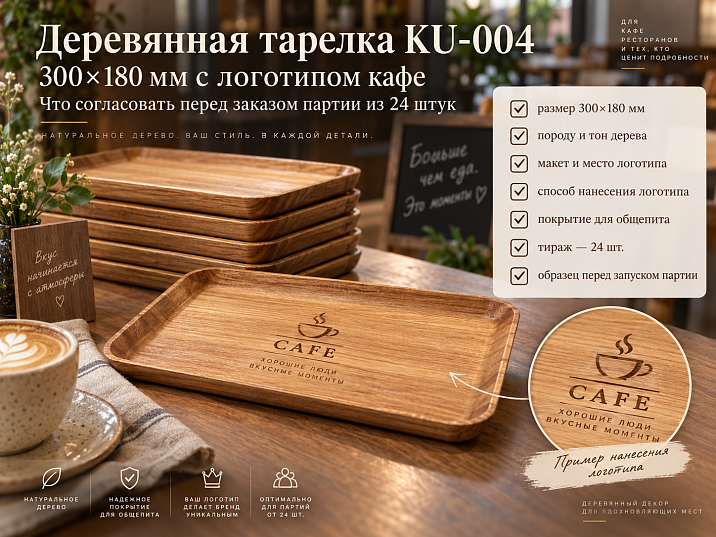
The cafe is preparing to open in three weeks. For the signature appetizer, an oval oak plate KU-004 measuring 300×180×22 mm has been chosen; 24 pieces with a logo are needed by the first working day. The order seems simple until the question arises: where will the mark end up after plating, and can the selected surface be treated with the method required by the restaurant?
You should start with an approved mockup and one finished sample, not with applying the logo to the entire batch. The manufacturer states the possibility of engraving, but the location, technology, combination with the coating, and food contact conditions must be confirmed for the specific execution. In parallel, the compatibility of the tableware with the cafe's sanitary treatment is checked. Without this, a successful design does not yet mean readiness for daily work.[1][2]
Below is a conditional opening project analyzed, not a story of a real completed order. The number 24 is the initial need for working plates, three weeks is the client's deadline. The possibility of meeting it is not confirmed. The practical result of the preparation is a specification by which the manager, manufacturer, designer, chef, and manager understand the same order.

Oak plate KU-004: fixing the execution, not just the article number
In the current table of the KU-004 card, four sizes are presented. For the project in question, the second one is selected; the rest are enough to know as alternatives, without mixing them in one order item.
| Size, mm | Material in the product table | Quality designation |
|---|---|---|
| 250×130×22 | Oak | Prestige Transparent |
| 300×180×22 | Oak | Prestige Transparent |
| 360×240×22 | Oak | Prestige Transparent |
| 430×310×24 | Oak | Prestige Transparent |
This is card information as of September 5, 2026. The detailed description mentions beech, but the verified table of options specifies oak. For a batch, you cannot substitute the selected finish with material from the general text. Also, the name "Prestige Transparent" does not reveal the specific coating composition.[1]
Before buy wooden plate KU-004, keep the line of the selected configuration. Order "KU-004, 24 pieces" is incomplete: the article number is common, but the sizes differ. The designation 22 mm refers to the dimension along the third axis; it does not indicate the depth of the internal recess or the height of the rim above the working surface.
In this project, the size has already been selected for one serving. A comparison of different shapes is covered in a separate article about which wooden plate to choose for appetizers — KU-001 or KU-004. Here the task is as follows: turn the selected oval model into a repeatable restaurant configuration with personalization.
In your own specification, create separate fields for model, size, material, surface quality, and actual coating. Then changing one field will be a noticeable decision, not an accidental replacement with a "nearly identical" plate during batch assembly.




Why it is more profitable for a cafe to start with one size and one specification
The same size is needed primarily by the team. The chef repeats the agreed plating, the waiter recognizes the position of the mark, the dishwasher works with a clear unit of tableware, and the manager can replace a missing item without re-shooting the dish. These advantages appear only when not just the external dimensions are standardized.
Suppose two plates of the same model received a logo at different ends. For the warehouse, they are identical, but when serving the same appetizer, on one the sign is visible, on the other it is hidden by the sauce boat. Thus, a seemingly insignificant production difference turns into two serving options. Therefore, personalization should be part of the order item, not an optional comment to it.
| Specification field | What to write for the project |
|---|---|
| Product | KU-004, oval wooden plate |
| Finish | 300×180×22 mm, oak, Prestige Transparent |
| Purpose | Serving specific approved dishes in a cafe |
| Working quantity | 24 units suitable for operation |
| Branding | Logo according to the approved file version and dimensional layout |
| Technology and coating | Upon written confirmation from the manufacturer |
| Control | Finished sample and batch acceptance criteria |
| Lead time | Date of receipt of the finished set, not just shipment |
One size does not oblige you to switch the entire menu to it. If a hot dish or dessert requires different tableware, keep it. Standardization is useful as long as it does not force you to reduce portions, use an unstable sauce boat, or apply unverified treatment.
Do not directly link the number of plates to the number of chairs. One table may order a shared appetizer, another may order several individual dishes. While the first items are in use by guests, the next ones are already needed at the serving line. Checking plate turnover will be a separate stage, and the initial 24 pieces are a testable hypothesis, not a restaurant standard.
Our factory also produces:




Logo on wooden tableware: what is allowed and what the card does not promise
The possibility of engraving with logos is indeed mentioned by the manufacturer. However, there is no detailed technological map for personalizing KU-004 in the open card. From this phrase, you cannot obtain permission for any surface area, a specific treatment method, or depth parameters.[1]
The task is divided into graphic and technological parts. The designer determines how the mark should look. The manufacturer confirms the method by which it can be reproduced on the selected item and preserve the required purpose of the finished surface. The cafe checks whether the result is compatible with its dishes and treatment. Approving the image does not replace the other two decisions.
In the request, it is better to describe the result: a readable mark of a specified size, an agreed position, and the suitability of the finished item for the stated use. Do not assign laser just because it is often associated with engraving. The manufacturer may use a different technology; its capabilities and limitations must be known before approving the layout.
Particular caution should be exercised regarding the center of the serving area. There, the mark may end up under food, under utensils, or in an area of intensive cleaning. However, moving it to the rim also does not automatically create a non-food-contact zone: sauce may spread, a guest may move food, and an adjacent plate may touch the surface during storage.
An answer is needed about the finished item after personalization, not just about the safety of the original wood or separately purchased finishing material. Clarify what information and documents the manufacturer provides specifically for the agreed configuration, including handling of the treated area. Missing data cannot be replaced with the phrase "natural wood".
If only a variant that visually does not suit the cafe is technologically possible, this is a reason to change the branding. Making the sign smaller, removing the inscription, or moving the identity to another item is cheaper than getting 24 beautiful but unsuitable plates for the chosen process.
Get Consultation
Three logo mockups: center, end, or side area
For the first discussion, prepare three schemes of the same presentation. The logo position changes, while the portion, sauce boat, and used utensils remain the same. Otherwise, different dishes will be compared, not personalization options.
| Option | What to check in the composition | Where a problem may arise |
|---|---|---|
| A. In the central part | Visibility of the sign between dish elements | Products cover the inscription; the area is actively used |
| B. Closer to the short end | Is space preserved for the logo and grip | The sign approaches the edge or falls under the hand |
| B. Small sign on the side | Is it readable from the guest's seat | The brand gets lost on the texture or is hidden by the utensil |
These are options for approval, not a list of permitted zones for KU-004. The outer contour, available surface, and application restrictions are checked against the actual product and manufacturer data. An arbitrary indent from the edge cannot be presented as a technological minimum.
The chef evaluates the layout with a full portion, not with an amount of food convenient for photography. The waiter checks where they place their fingers when carrying. The designer looks at the recognizability of the sign. A production representative filters out unfeasible or unacceptable solutions. The final choice is made among options that have passed all checks.
The logo must retain a clear purpose. A small cafe may want a recognizable sign in the guest's photo; a restaurant may want calm marking without an advertising effect. In the first case, a readable angle is important; in the second, less visibility is acceptable. But you cannot simultaneously demand a large inscription, a surface completely filled with food, and the absence of visual competition.
Also check the presentation after the first movement of the utensil. If the sign looks good only before the guest starts eating, personalization may still fulfill the photo task, but not constant visibility. This is not necessarily a drawback — it is important to align the expected result rather than discover a discrepancy after manufacturing the series.
Template 300×180 mm: how to check scale without a printing error
A full-size mock-up helps before ordering a sample. However, an arbitrarily drawn 300×180 mm ellipse shows only an approximate outer dimension. It does not confirm the exact shape of KU-004, the dimensions of the flat working part, the rim, and transitions. For the final layout, the manufacturer's contour or measurements of the received specimen are needed.
There is a simple technical nuance: the long side of an A4 sheet is 297 mm. A contour of 300 mm in length does not fit on it entirely even without margins. Use a larger format or tiled printing, and place a 100 mm control segment nearby. After assembly, measure it and both sides of the dimension. The inscription "scale 100%" in the print dialog does not by itself replace verification.
On the preliminary template, the intended serving area, logo, and serving items are marked. Products are replaced with paper contours or other clean mockups: food is not placed directly on an office printout with ink. A full food test is conducted on the prepared product with confirmed usage conditions.
Why the 80 mm mark cannot be assessed as an enlarged version of the 25 mm mark
On a length of 300 mm, a logo 80 mm wide occupies about 26.7%, while one 25 mm wide occupies about 8.3%. While maintaining proportions, increasing the width by 3.2 times increases the area of the bounding rectangle by 10.24 times. In composition, these are significantly different elements.
These numbers illustrate scale, not recommend engraving sizes. A small variant may lose fine details; a large one may require free space at the expense of the dish. If the mark is complex, it is more useful to test a simplified branded version than to endlessly reduce the original composition.
For final positioning, use an agreed dimensioning system: product axes, center position of the mark, and rotation angle, or another method suggested by the manufacturer. The dimensional notation must unambiguously reconstruct the layout. Phrases like "approximately at the edge" and "as in the photo" leave different execution options. If tolerances are not yet agreed upon, do not enter arbitrary values into the final specification.
Approve the size of the visible artwork itself, not the page on which it is located. A file 80 mm wide with large empty margins may contain a logo of only 40 mm. In the production layout, the image size, its position on the plate, and the document's service margins must be distinguished.
Orientation KU-004: how the guest should see the cafe name
An oval plate can easily be rotated 180° without noticing the change in shape. With a horizontal inscription, this becomes a serving error: the products are placed correctly, but the establishment's name is upside down facing the guest. Correcting such a position at an occupied table is inconvenient.
Define a clear reference system. For example: the long axis of the plate is directed from left to right relative to the seated guest; the bottom side of the letters faces them; the sauce boat is located in a specific part of the diagram. This is an example description, not the only correct orientation. For a shared dish in the center of the table, a different solution will be needed, since it has multiple viewers.
The phrase "logo on the right" is not enough. To the right of the cook at the serving line and to the right of the guest sitting across are different sides. Use a top-down plan labeled "guest location" with an arrow indicating the reading direction. Such a file is attached both to the order and to the internal serving standard, leaving staff without two incompatible images.
In the dish's technical card or its appendix, record the plate model, a photo of the full portion, component placement, and orientation. Also specify which elements may be rearranged and which cover the brand zone. For shift training, it is useful to place the correct and flipped versions side by side: the difference becomes obvious without a long instruction.
At the same time, do not add homemade marker marks or stickers to the product for kitchen convenience. A diagram and training are sufficient initially. Any additional permanent marking on the plate requires the same approval of materials and placement as the main logo.
Logo file: provide one approved version
Before sending the layout, request the contractor's requirements for format, preparation method, and dimensional notations. You cannot promise that STAVROS accepts a specific file extension if it is not confirmed for the service. Having a vector original from the designer is useful, but the final package is prepared according to the actual production requirements.
Separately check Cyrillic characters, small slogans, thin lines, and internal letter gaps. What reads on screen with magnification may be unsuitable for the chosen physical scale and application method. The minimum line thickness or letter height is set by the manufacturer; the designer should not guess them based on someone else's technology.
A colored logo also requires a decision. If the approved method does not reproduce brand colors, approve a corresponding monochrome version. Converting to a single tone may remove the difference between adjacent details. Such a variant is first approved with the brand owner, not considered an automatic technical operation.
Name the file so it is clear which version is released into production: model, size, project name, revision number, date. Store a preview image and a dimensional layout nearby. Approval should apply to the entire package; otherwise, production will receive a new design with old placement.
After approval, assign one person who communicates changes. If the cook separately asks to shift the mark while the designer simultaneously sends an enlarged version, the final combination may fail all tests. Changing scale, text, position, or coverage returns the order to the corresponding review stage; the word "minor edit" does not cancel its consequences.
One sample before the series: when the "1 plus 23" scheme works
The website states that shipment of products starts from one piece. However, this does not automatically confirm the production of a single unit with your logo under the same conditions. The cost, timeline, and availability of a personalized sample must be obtained via a separate response.[1]
For verification, a finished version is needed: approved engraving, final coating, and preparation, after which the intended use is permitted. A raw section with a test inscription shows the application result but does not represent a finished plate. A photo of such a section does not replace a sample of the full configuration.
The scheme of 'one plate for testing, then 23 more' is only suitable if several conditions are met. The first unit is accepted without changes, matches the future series, remains suitable for use, and is included in the working set. If the logo was reduced after the test, the sample with the old mark is no longer one of the 24 identically decorated items.
| Fate of the sample | What counts in the order |
|---|---|
| Accepted, kept suitable, included in the work | 1 sample + 23 series units = 24 working |
| Stored separately as a control reference | 1 sample + 24 working units |
| Removed from service after testing | 1 test unit + 24 working units |
| The layout or technology had to be changed | The number of repeat samples is agreed separately |
Do not send the reference sample simultaneously for intensive testing and to the archive for comparison of future deliveries. These tasks have different preservation requirements. You can agree on a control set of photos and a production sample at the manufacturer, but then you need to understand which properties are checked remotely and which only by physical comparison.
Sample acceptance must end with a decision: "into production", "refine", or "reject this version". A letter saying "looks nice" does not fix either the version or the conditions. Specify exactly what is approved: graphics, position, surface condition, completeness, and applicability to the agreed operation. Testing in a cafe does not replace the necessary safety confirmations.
Cafe test: three dishes, transfer, and full return to operation
The sample is tested on the real operation it will perform after opening. For a cheese snack project, start with it. If the same model is planned for a burger and dessert, each serving is checked separately: they differ in product placement, accompanying containers, and soiling after service.
First conduct a dry rehearsal of the layout, then the permitted test with products. Record the composition and quantity of components, actual contact time, transfer method, and cleaning result according to the agreed procedure. Otherwise, a subsequent remark like "everything was fine on the first plate" cannot be compared with another serving.
| Check | What to observe | What decision to make |
|---|---|---|
| Full portion | Are the sign and capture point closed | Change layout or personalization |
| Transfer to the table | Are the products and sauce boat not shifting | Clarify the set and serving method |
| Dish with fatty sauce | Where the contamination ends up | Check the suitability of the selected surface |
| Berry dessert | Are traces left after permitted treatment | Assess the acceptability of this serving |
| Return after washing | Condition of the mark, surface, and availability of clean dishes | Confirm the work cycle or stop the start |
Do not start with an artificially gentle option if a different one is planned on the menu. A burger without sauce does not test serving with sauce, and dry berries do not test a dessert with berry puree. At the same time, there is no need to conduct unsystematic "stress tests" with acid, boiling water, or a knife: unconfirmed impacts do not help assess normal operation.
After each intended cycle, note changes and their location. Distinguish between an aesthetic issue, such as a pattern shade, and signs requiring cessation of use: surface damage, peeling, cracks, chips. A disputed item is not returned to circulation until the cause and acceptable solution are determined.
Simple visual inspection does not prove microbiological safety and does not guarantee a long service life. Its task is to identify incompatibility of serving, personalization, and workflow before serial ordering. Sanitary treatment assessment is carried out separately, according to applicable requirements and documents, not by the absence of visible food traces.
Manual washing KU-004 and cafe sanitary treatment are not the same thing
The manufacturer's recommendations specify hand washing with warm water, avoiding soaking, timely removal of moisture, and dry ventilated storage. A dishwasher cannot be included in the KU-004 process by default. But the household instruction "wash by hand" is not a ready-made sanitary regulation for a food service enterprise.[1]
As of September 1, 2026, SanPiN 2.3/2.4.4282-26 is in effect. Clause 37 requires issuing washed and dried dishes and utensils; it provides for final machine processing with disinfection and maximum temperature regimes. In the absence of a dishwasher, manual processing of all dishes and utensils with disinfectants according to instructions is established.[2]
Consequently, the machine available in the cafe and the restriction on a specific plate may create a conflict. An exception to the sanitary rule cannot be derived from the product card. Turning off the hot cycle, choosing a short program, or simply moving the wood to a separate sink is not a confirmed way to resolve this conflict.
Before purchase, the person responsible for production control must compare applicable requirements, the cafe's actual equipment, documentation on agents, and restrictions of the finished plate after marking. The manufacturer is given a specific intended regime, not a question like "can it be used in a restaurant at all." If it is impossible to confirm a compatible procedure, this configuration is not put into operation.
It is useful to create a working table: operation, agent, concentration specified by the instructions, exposure time, temperature, rinsing, drying, responsible person. Values are taken from current requirements and documentation, not from an article about wooden dishes. The plate manufacturer must confirm the compatibility of the material, coating, and personalization with such exposure; this does not give it the right to cancel mandatory requirements.
Separately check the end of the shift. Even if the intermediate return of plates is organized successfully, evening processing may turn out to be incompatible. Testing only daytime washing will leave the main conflict unnoticed.
It is not allowed to reduce the prescribed processing time for quick turnover, mix agents according to your own recipe, or consider natural oak as a substitute for disinfection. If no acceptable process is found for the selected product, the cafe needs different dishes for serving. Personalization can be postponed; service safety cannot.
Coating "Prestige Transparent": we find out what exactly will be on the batch
The extended description of KU-004 mentions food oil or a special varnish designed for food contact. This is a description of possible solutions, not an identification of the coating of the selected batch. Before personalization, it is necessary to establish the specific system and rules for handling it.[1]
The combination of "engraving plus coating" must be considered as a whole. The manufacturer determines the sequence of operations, the state of the processed area, and readiness for use. One should not independently assert that the mark must first be applied, then oil, or that a finished plate can be engraved over an existing finish without further operations.
Ask to distinguish between care, restoration, and repair. Care applies to a sound surface. Restoration is performed according to the prescribed technology. Repair of damage may require removing the plate from service and an assessment by the manufacturer. These actions cannot be combined with the advice "periodically oil the wood."
For the oil system, request the recommended material, signs of the need for renewal, the preparation procedure, and the point of return to food use. For the lacquer one, permissible actions when changing the coating. Advice from the general description about oil does not prove that it can be applied over any lacquer.
Do not use regular kitchen oil just because it is edible. The suitability of a product for consumption and its suitability as a protective coating are different matters. Do not promise staff universal restoration with a napkin in a few minutes: requirements are determined by the actually supplied system.
For a cafe, it is useful to designate in advance a place for temporary storage of removed tableware. Items awaiting assessment or restoration should not accidentally return to the serving line with a clean batch. Their quantity is counted in the reserve separately; a beautiful, well-preserved logo does not mean the entire surface is ready for use.
Hot serving, table knife, and staining foods
Choosing KU-004 for one cold appetizer does not confirm suitability for all subsequent dishes. When expanding the menu, the new mode is checked, even if the plate, its dimensions, and logo remain the same. This especially applies to heating, mechanical impact, and more complex cleaning.
Mentioning hot dishes in the description cannot be turned into a specific maximum temperature. For very hot serving, provide the manufacturer with the dish composition, temperature at plating, and expected contact time. Do not substitute them with room temperature or the words "usually not very hot." If the necessary confirmation is absent, use different tableware for this item.
Serving ready-made food also does not make the plate a baking mold, a surface for reheating, or a stand for a scorching hot frying pan. For the microwave, the card explicitly states a restriction. Do not transfer the temperature capabilities of another board, tray, or hot accessory to KU-004.[1]
A steak creates a separate task: the guest works with a table knife across the surface. The purpose of a serving plate is not the same as that of a cutting board. The resistance of the specific coating and treated mark to the intended use of utensils must be confirmed, not tested after launching twenty-four units.
A sauce boat can help organize plating, but it does not provide a universal solution. Check its stability, position during transport, and placement after the guest has started eating. Oil, beets, berries, and thick sauces require their own serving and permitted cleaning tests; the absence of bread traces says nothing about berry puree.
Switching to a liner is also a change in configuration. It must be suitable for the specific food contact and mode, not interfere with utensil use, and not create a false assumption that wood no longer needs treatment. Visually successful serving is evaluated together with the entire service process.
Will 24 plates be enough for a shift: counting occupied states
The number of working plates is checked by maximum simultaneous occupancy. The calculation includes not only items on tables: some are at the serving station, returned with food leftovers, being processed, or drying. Until the full cycle is completed, these items are unavailable for the next serving.
Below is a conditional snapshot of the cafe's operation. It does not describe the standard performance of KU-004 and does not set washing time.
| State at the selected moment | Quantity |
|---|---|
| With guests | 10 |
| Occupied with assembling and serving dishes | 4 |
| Being processed | 3 |
| Drying | 5 |
| Clean and ready for serving | 2 |
| Total in circulation | 24 |
Formally, the set is in place, but only two plates are immediately available. If eight new orders come in before the first completed return, six will be missing. Purchasing additional units is one option, but first you need to check whether the staff and equipment can handle processing them.
For observations, it is convenient to use the formula:
Required quantity = peak occupancy + required ready stock + units out of circulation.
States must be mutually exclusive. A plate on the drying rack is not simultaneously counted as clean and available, nor is a control standard counted as working reserve. For example, with a peak of 22 occupied, four required ready, and two withdrawn units, the calculation gives 28. This is the result of the specified conditions, not a recommendation for all cafes to buy exactly that many.
Observe not the average quiet hour, but the expected peak. For a new cafe, it can be reproduced by rehearsing orders with identical initial conditions. Separately check the simultaneous serving of a shared appetizer to several tables: such events create different demand for dishes than a uniform flow of single orders.
If the bottleneck is mandatory processing, extra plates will only delay the shortage. Increase the set along with checking the working capacity and drying space. The reserve percentage cannot be assigned without data on load, replenishment availability, and actual withdrawal of items from service.
Drying and storing a batch: why 528 mm does not equal the shelf height
For the selected version, the thickness dimension is 22 mm. Multiplying 24×22 gives 528 mm, but this figure is the sum of dimensions, not the measured height of the KU-004 stack. The geometry of the items and their mutual position can change the actual pitch. Wet dishes cannot be designed as a tightly packed warehouse stack at all.[1]
For storage, the permitted dry stacking is measured separately; for drying, the required arrangement after the prescribed processing is measured. There is no need to assign the same number of plates on one shelf for both processes. Compact storage and air access solve different tasks.
Practical testing begins with a sample and the rack that will be installed at the site. Make sure the plate fits in the cell, does not jam, does not fall when the adjacent one is removed, and does not touch contaminated surfaces. Required gaps and permissible stacking are determined by the equipment design and the confirmed mode, not by an arbitrary "gap just in case."
You need to count the peak number of items on the dryer. If there are five at the calculation moment, and after a group return there will be twelve, five slots will not ensure continuous operation. Write down where each next plate goes. The answer "we'll temporarily put it nearby" means the process is not yet designed.
The full load weight is also determined separately. The weight from a general description of another size cannot be multiplied by 24 and used for shelf calculation. You need data for the selected item or actual weighing, as well as the shelf's own limitations.
Convey to staff a clear distinction between zones: received for processing, undergoing drying, ready for serving, moved to inspection. Labels are placed at storage locations, without adding unconfirmed materials to the dishes themselves. Such organization helps avoid returning a wet or questionable item to work for the sake of another order.
Three weeks before opening: how to verify the actual batch timeline
As of September 5, 2026, the product table showed two pieces in Moscow and four in Saint Petersburg for the selected size. Six displayed units do not equal a finished batch of twenty-four. Moreover, this is not a reserve for your order or confirmation of the required personalization's availability.[1]
The general terms on the page state warehouse item shipment within three business days and average production of out-of-stock items in 5–10 business days. These timelines cannot be automatically applied to a sample with a logo and the subsequent series. The order gains layout preparation, technical approval, testing, and additional handoffs between participants.[1]
The work schedule is built from the date when the cafe must receive a usable set. The latest shipping date will be earlier: delivery, acceptance, and preparation for use are still needed. For the first sample, a separate shipment is also required if the client does not accept it at the production site.
| Stage | What must be obtained before moving forward |
|---|---|
| Task approval | Configuration, technology, limitations, and sample cost are confirmed |
| Preparing the layout | One approved version with dimensions and orientation |
| Sample production | Fully finished specimen, not just a photo of the blank |
| Cafe check | Decision on submission, processing, and series launch |
| Batch production | Confirmed quantity per accepted standard |
| Delivery and acceptance | Completed set actually received and verified |
Let's consider conditional arithmetic, not the STAVROS chart. If two calendar days are allocated for approval, seven for the sample with delivery, three for checking, ten for the series with delivery, and two for acceptance, that totals 24 days. Such a route does not fit into the original 21 days. Substituting working days with calendar days will only hide the problem.
Some actions can be performed in parallel: preparing the internal submission scheme, checking the drying location, clarifying delivery conditions. But launching all engraving before sample acceptance defeats the purpose of preliminary verification. The permissibility of reserving blanks or other preparation without final application is discussed separately with the contractor.
Set the date for the backup option decision. If critical confirmations are not received by then, the launch is done with other suitable tableware, and the branded series is introduced later. There is no need to compensate for the tight timeline by skipping the coating check or sanitation treatment.
How much does the set cost: base plates and personalization are priced separately
The price for the 300×180×22 mm version in the verified product line as of September 5, 2026, is 1,910 RUB per piece. The price of 1,410 RUB, which can also be seen on the page, refers to the smaller 250×130×22 mm option. For the budget of the selected batch, the required configuration is used, not the model's minimum price.[1]
Base calculation for 24 plates:
24 × 1 910 ₽ = 45 840 ₽.
This is arithmetic based on the published price of the standard version. It does not confirm the cost of the logo, layout preparation, additional operations, delivery, or a quantity discount.
| Purchase composition | Number of items | Base amount at 1,910 RUB/piece |
|---|---|---|
| Sample accepted into the working set + 23 pieces | 24 | 45 840 ₽ |
| Separate sample + 24 working pieces | 25 | 47 750 ₽ |
| One sample + 24 working + 2 reserve | 27 | 51 570 ₽ |
Two reserve units in the last line are an example of calculation, not a recommended stock for any cafe. The price of a personalized sample may differ from the price of a serial unit. If several samples are needed, they are counted based on the actual
Batch reference and natural oak texture: what to consider identical
Twenty-four plates made of natural oak will not be copies of each line of the wood grain pattern. A unified set means consistent model, finish, sign placement, and surface character. Expectations of absolute texture identity should be discussed before payment, not turned into a dispute upon receipt.[1]
Ask to see the acceptable variability on several items if possible. One beautiful specimen does not describe the range of shades across the entire series. At the same time, natural grain cannot be used as a universal explanation for any difference: logo position, completeness, and execution are checked against the specification.
For acceptance, divide features into measurable and visual. The size and position of the sign are compared with the approved drawing, and allowable deviations are agreed with the manufacturer. Surface character is compared under the same lighting. Do not introduce your own production tolerance in millimeters after the order has already been manufactured.
Upon receipt, all 24 working units are inspected. Photos of the packaging and the overall set help record the delivery condition, and a photo of the disputed plate next to a ruler allows for a specific discussion of the difference. Keep the batch marking and documents until acceptance is complete.
If several items raise doubts, separate them from the accepted part and notify the supplier before making any independent corrections. Sanding the logo, adding extra oil, or attempting to even out the shade will alter the condition that needs to be assessed. The question of batch readiness is decided by the number of accepted working items, not by the number of boxes.
Additional reserve can be ordered together with the main series if its volume is justified. A repeat delivery after six months may differ in texture, but even a single joint order does not guarantee wood identity. For replenishment, keep the graphics version, dimensions, coating, and details of the accepted execution.
How to photograph a plate with a logo for a menu
For approval and for advertising, different photos are needed. A control shot should show the position, scale, and surface condition. An advertising shot should show the dish in the presentation the guest will receive. Do not replace the former with an artistic shot with soft lighting that hides fine details.
For control purposes, a top-down view without perspective distortion, a close-up of the mark, and an overall view with a ruler are useful. For the menu, place a full, consistent portion on the plate and shoot it from the actual guest's angle. Additionally, check the small image size on a phone: a large photo on a monitor can overestimate logo readability.
If, for the sake of a beautiful shot, the chef removes half of the components, the photo does not confirm the working plating. Keep a separate shot of the full presentation as an internal reference. Its task is to help the next shift replicate the result, not to win an artistic contest.
A too-prominent mark does not require immediately replacing the plate model. First, compare a reduced version, another agreed position, or a brand symbol without a long name. Change one parameter at a time: then it is clear what improved the composition. After selection, the changes undergo the necessary technological verification.
Do not draw engraving on a photo as if such an item had already been produced. Visualization is acceptable for discussion but must remain labeled as a visualization. Otherwise, staff, the supplier, and the client will start comparing the physical batch with an effect that existed only in a graphics editor.
Errors due to which the batch is not ready for opening
Most problems begin with uncertainty among participants: the designer considers the image approved, the manager considers the whole plate approved, and production considers only the technological test approved. A summary table helps check precisely the transitions between tasks.
| Mistake | Why it is easy to miss | What to do before the series |
|---|---|---|
| Order cards at the minimum price | The page has several sizes | Save string 300×180×22 mm |
| Approve sign on empty plate | Dish is not prepared yet | Check full portion and utensils |
| Send multiple files with the same name | Edits are in different conversations | Release one package with version number |
| Count tested sample as working | In procurement, only the total number matters | Record its final status |
| Consider manual washing a ready restaurant process | The card describes care, not the entire sanitary regime | Check regulatory and technical compatibility |
| Schedule delivery for opening day | The shipping date is taken as the readiness date | Leave time for receiving and acceptance |
It is better to refuse purchasing a batch specifically for this launch if its mandatory conditions do not align. For example, the kitchen cannot organize acceptable processing, the selected dishes require unconfirmed knife or temperature impact, and the deadline leaves no time for a finished sample.
There is also a commercial limitation: the establishment has not yet approved the name or identity. In this case, permanent marking turns ordinary tableware stock into items with outdated design. First complete the brand decision or use another suitable medium that does not alter the food contact surface.
Refusing personalization does not equal refusing KU-004. The model can be considered without a mark, but only with confirmed suitability for the chosen serving and processing. If the issue relates to the operation of the plate itself, removing the logo does not fix it.
What to send to the STAVROS manager: a completed calculation assignment
It is convenient to divide the request into known parameters and questions. Do not fill in unknown details with assumed answers, especially coating, application technology, and production file format. The manufacturer should have room to confirm the decision or explain the limitation.
A calculation is required for an order of wooden plates KU-004 for a cafe. Execution: 300×180×22 mm, oak, Prestige Transparent. The need is 24 working units with identical personalization. Use: serving dishes according to the attached photos and description.
First, one finished sample with the logo is needed. We ask to confirm the possibility of its production, price, and timeline. Separately indicate the cost of the series and the option with a reserve, if it is approved. The fate of the sample—whether included in the working set or stored separately—will be recorded after inspection.
We ask to inform us of the requirements for the source file, acceptable method and area of application, necessary layout restrictions, specific coating, and care procedures after personalization. It is necessary to confirm the suitability of the finished surface for the specified food contact and the cafe's processing regime; a description of the regime will be attached for compatibility verification.
We ask to specify the timeline for receiving the sample and the finished batch at our address, conditions for starting work, acceptance criteria, allowable deviations, and the procedure for approving changes. The desired readiness date for operation is [date]. Until the sample is approved in writing, application to the entire batch will not be initiated.
Attach to the letter a layout with the guest orientation, the current logo, a description of the dishes, the delivery address, and the contact of the person responsible for approval. A phone screen image without dimensions can be left as an additional reference, but not as the sole production assignment.
Before payment, compile the answers into a single specification. It must match the file name, quantity of working and test units, size, material, coating, sign position, operating conditions, final cost, and timelines. The manager's letter about the possibility of engraving and separate price approval do not replace the overall order description.
Under confirmed conditions oak plate KU-004 it becomes a specific procurement item. Until then, it remains a selected model for which personalization and the restaurant process still need to be agreed upon.
FAQ: additional questions about a batch of wooden plates with a logo
Can I order some plates with a Russian name and some with an English one?
Such a task is set up as two versions of personalization, even if the model and sizes are the same. Each requires its own file, layout, quantity, and approval. Check the length of the inscriptions: the same letter height does not mean the same occupied area. Also clarify how staff will distinguish between versions at the serving line and whether it is truly necessary for guests. Two options can complicate finding clean dishes during peak hours. The manufacturer confirms the production conditions and cost of each version.
Would a QR code work instead of a regular logo?
This is a separate technical specification, not a simple image replacement. It is necessary to check the admissibility of application, physical size, integrity of elements, and readability on the finished surface under normal lighting. The test is conducted from several real angles and devices, without promising universal readability based on a screen mockup. Also consider the lifespan of the destination page. A permanent engraving with a non-working address will remain on the entire batch; for frequently changing menus, another medium may be more convenient.
Will a logo on the back side solve the food contact zone issue?
It will change the location of the mark, but it will not eliminate the need to check the finished product, the application method, and the treatment. The back side is involved in handling, washing, and storage; its condition also matters. Additionally, assess the commercial goal: the guest usually does not see the bottom of the plate during a meal. This option may be suitable for identifying a set, but not for a recognizable mark in a photo of the dish. It cannot be declared automatically safe just because food is usually placed on top.
Can I buy plates from STAVROS and have the logo applied in another workshop?
The possibility of such a scheme requires prior approval. It is necessary to determine who is responsible for the treated area, the final coating, food contact conditions, and documentation after the intervention. The original product's instructions may not describe the result of a third-party modification. Before transfer, record the condition of the plates and the scope of work of the second contractor. You should not start by purchasing the entire batch, expecting to choose the technology later: unapproved modification can make the original configuration unsuitable for the intended use.
Does it make sense to first get a regular KU-004 without a logo?
Yes, for checking the shape, capacity for a specific serving, transfer, and placement on equipment, if the application conditions are confirmed. Such a stage helps avoid spending money on personalizing an unsuitable model. But it does not replace checking the finished branded version: the treated area and altered finish remain separate issues. In the schedule and budget, distinguish between a regular unit for preliminary fitting and the final sample against which the series will be accepted. Do not treat them as one operation without approval.
Can we test the 250×130 mm size but order 300×180 mm?
A smaller version will not verify the actual layout, grip, logo placement, or positioning of the chosen plate on the rack. It may give a limited idea of the material or the visual character of the item, but it does not serve as a reference for the required size. It is especially wrong to scale the sauce boat and cutlery along with the plate: in a cafe they will remain the same. For a final decision, the chosen version is required, or an agreed intermediate mock-up followed by verification of the actual unit.
Is a video of the sample enough if there is little time before opening?
Video is useful for assessing appearance and clarifying details, but it does not reproduce the operation of your kitchen. It cannot reliably verify the transfer of a full portion along your route, the place on the rack, or compatibility with sanitary treatment. Remote approval of individual parameters is possible, but you need to list which checks remain unperformed. Do not mark them as passed for the sake of the schedule. If time is critically short, it is wiser to change the implementation date of personalization than to substitute a physical check with a nice video.
Is the sample price credited toward the cost of the main order?
This is a commercial condition that must be obtained in the supplier's quote. In the standard product card, there is no basis to consider trial personalization free or automatically credited. Clarify separately the cost of the unit itself, file preparation, application, and possible retesting. If a credit is provided, record its terms and the moment of application. Then the final payment for the series can be verified without assumptions, and comparison of several quotes will not be distorted by different methods of accounting for preparatory work.
Does twenty-four pieces count as a wholesale order?
The number itself does not confirm a specific pricing regime. The name "wholesale" does not indicate whether the sample, personalization, packaging, and preparation are included. Request a quote for the specific composition, as well as terms for reordering. Do not transfer STAVROS minimum order quantities and discounts from another workshop. For decision-making, the final amount and responsibility for the agreed result matter more than the presence of the word "wholesale" in correspondence. Savings are assessed on the same configuration and the same scope of work.
Can a finished batch be split between two cafes?
In the request, you can set such a task, and the supplier will confirm the possibility and conditions. Specify the quantity for each address, the recipient, and the acceptance procedure. Count the working reserve separately: stock in one establishment is not always available to another at the right moment. For both locations, keep one approved version of the layout and identical documentation. If equipment and processing modes differ, the suitability of the tableware is checked for each cafe, despite the common model and unified brand.
What to do if the establishment's name changed after the sample was approved?
Stop further approvals and find out the actual stage of the order. A new name may require a different size, layout, and a repeated sample. Do not send a new file with the comment "replace only the text" if the line length or character style has changed. The conditions for changing the cost and deadline are agreed separately. Within the team, explicitly cancel the old version so it does not return to work from previous correspondence or a folder with photos. One responsible person must confirm the new set of materials.
Can the engraving be removed later and the plates used under another brand?
Do not count on this as a standard option. Removal may require intervention in the geometry and coating, and the admissibility of such work for KU-004 is not confirmed by an open card. Even the disappearance of the visible pattern will not prove the suitability of the restored item for its previous purpose. The issue is resolved with the manufacturer based on the specific condition. If rebranding is likely, assess the feasibility of permanent marking before ordering: a replaceable identity carrier may better match the project's lifecycle.
Can I order an additional reserve after a few months?
Such a need should be anticipated, but availability, price, and delivery time for a repeat supply are confirmed at the time of the request. Keep not only the photo: you need the model, dimensions, coating, file version, and sign position. A new batch may have natural differences in wood; matching the article number does not mean full visual identity. If the reserve is critical for uninterrupted service, do not base your plan on the assumption of immediate replenishment. Compare the procurement time with how many suitable items actually remain in circulation.
Do I need to photograph all 24 plates individually?
For a small batch, this may facilitate acceptance and further identification of disputed items, but the control format should be agreed in advance. A general shot shows completeness, an individual one shows details of the sign and surface. The number can be placed nearby on a separate card, without marking the food contact surface itself. Shoot under comparable lighting and maintain a link to the packaging or batch. Photos supplement inspection and measurements, not replace checking properties not visible in the frame.
Can dessert plates be pre-chilled?
The conditions for such use must be agreed upon separately from regular service. Provide the intended temperature, duration in the equipment, and sequence of further actions. The card warns about sharp temperature changes but does not set a universal refrigeration mode for your scenario.[1] Do not determine it experimentally on the entire batch. If the dessert requires pre-chilled dishes, choose a confirmed suitable solution; do not change the dish technology for an unconfirmed possibility of a wooden plate.
What to do if the logo looks different after permitted processing?
Record the change and the conditions under which it was detected. Compare the item with the accepted standard under the same light, then contact the contractor. Do not try to enhance the color, cut lines, or treat the mark with another agent yourself. First, you need to understand whether the change falls within expected variability, a mode violation, or a defect. If the surface is affected and its suitability is in doubt, remove the item from use until a decision is made. Updated instructions are passed to the entire shift, not just one employee.
Can a dish be left on KU-004 longer than during the test?
The conducted check applies to specific conditions and does not confirm arbitrary extension of contact time. Long general service, buffet, or display case may differ from a quickly served appetizer. Agree on a new scenario, including the dish composition and further cleaning; requirements for the food product itself also remain. Do not infer universal coating durability from a short successful experience. If the mode is not defined, use other suitable dishes for it, not extending the test result beyond its scope.
Can the same set be used at an off-site event?
First, check the conditions of transport, service, collection, and subsequent processing. Outside the cafe, there may be no designated places for clean and used dishes, and return to service will take different time. Therefore, quantity calculation and logistics are done anew. The same model and logo do not make an off-site event a continuation of a regular shift. If the required process cannot be ensured, another set suitable for the event's conditions is needed. Do not plan simplified washing just for mobility.
Is there any point in giving guests plates from the working reserve?
Such a promotion reduces the actual stock and should be accounted for separately from service. Do not give away the reserve that the peak turnover calculation relied on. For a gift program, it is wiser to provide a separate quantity of new items and pass clear information about the product and care to the recipient. The possibility of appropriate configuration is discussed with the supplier. Do not mix test items, items previously used in operations, and new gift items merely because they bear the same mark.
What materials should be left for the manager after launching the batch?
Keep the specification, approved layout, and logo file, photos of the reference sample, delivery documents, coating details, and confirmed operating conditions. Separately provide work instructions for serving, handling, storage, and removal of disputed items. Access to this information should not depend on the phone of the employee who managed the order. When the responsible person changes, the new person must understand which version to reorder and which actions are unacceptable. This is more useful than a verbal promise that the supplier "remembers everything."
Where to buy wooden plates KU-004 for a cafe
After agreeing on the sample, sanitary compatibility, quantity, and schedule, you can buy KU-004 in the selected version. The full specification is transferred to the order, not just a model reference. The section of wooden home goods will be useful for general configuration; a broader catalog allows buy solid wood items for other agreed interior tasks.
For a cafe opening in three weeks, the priority is to get 24 usable working items by the required date. This requires agreeing not only on the logo appearance but also on the sample status, finished surface, treatment, reserve, and acceptance. If the conditions align, personalization becomes part of sustainable service. If not, it is better to change the configuration or implementation timeline than to launch an untested batch.