Article Contents:
- Wooden slat and lamella: what is the difference
- Why a regular slat cannot be placed under a mattress without calculation
- Where a straight slat is truly appropriate
- How to determine that it is yours that is broken
- Support strip along the side rail
- Cross brace
- Center reinforcement
- Side panel, frame or decorative border
- Repair of a straight part of an old frame
- Support for the decking or soft package
- Furniture frame spacer
- Upholstery attachment strip
- Transformation mechanism element
- Thin cross-sections 15 × 5, 24 × 5 and 40 × 5 mm
- Cross-section 70 × 7 mm
- Cross-section 90 × 10 mm
- Cross-sections 60 × 23 and 80 × 23 mm
- Free span length
- Support step
- Number and location of fasteners
- Nature of load
- Condition of the entire frame
- When to consult a furniture maker
- When beech is convenient
- When oak is chosen
- For enamel or tinting
- Measure the original part
- Check the mounting location
- Add machining allowance
- Create the cutting layout for the entire strip
- Purchase spare material for complex repairs
- Trim to actual size
- Pilot hole drilling
- Countersink and seat the head
- Sanding after processing
- Finishing Before or After Installation
- Repeat node or upgrade
- Fastening along the grain
- Glue and mechanical fasteners
- Post-assembly inspection
- First determine the part's role
- Check adjacent elements
- Do not change the geometry of the soft part
- Consider reupholstery
- When local repair is justified
- When it's better to replace the frame
- Need to replace the inner support bar of the bed
- Need to reinforce a loose side panel
- Need to make short spacers
- Need to repair the sofa base
- Need a visible oak bar
- Need a white slat for the existing frame
- Slat and spring lamella
- Slat and beam
- Planed slat and raw workpiece
- Support slat and decorative overlay
- Slat and finished furniture frame
- Selecting a batten only by width
- Considering the largest cross-section as the most reliable
- Replacing a lamella with a straight batten without checking
- Fastening without pre-drilling
- Reusing a damaged hole
- Copying a deformed old part
- Not considering the installation direction
- Painting before full fitting
- Ignore adjacent damage
- Buy only one strip for a complex project
- Count parts, not linear meters
- Do not mix different sections in one calculation
- Consider paired replacement
- Add test segments
- Inspection without operational load
- Gradual loading
- Sound and displacement monitoring
- Re-inspection
- Single bed
- Double bed
- Bed with lifting mechanism
- Folding sofa
- Stationary sofa
- Ottoman and bench
- Headboard and decorative frame
- How is a wooden slat different from a bed lamella?
- Can a broken lamella be replaced with a regular slat?
- What cross-section should I choose for a bed?
- Will a 60 × 23 mm slat work as a support bar?
- How does 80 × 23 mm differ from 60 × 23 mm?
- What is a 90 × 10 mm batten suitable for?
- What to choose for furniture — oak or beech?
- How to determine the length of a new slat?
- How many slats should I buy?
- Do I need to drill the batten before fastening?
- Can I screw a slat to a damaged spot with an old screw?
- How to choose a slat for a sofa?
- Can I use a thin batten for attaching fabric?
- What does preparation for enamel mean?
- What does preparation for tinting mean?
- When is it better to replace the entire frame?
- Can a new bed be made from RK-001?
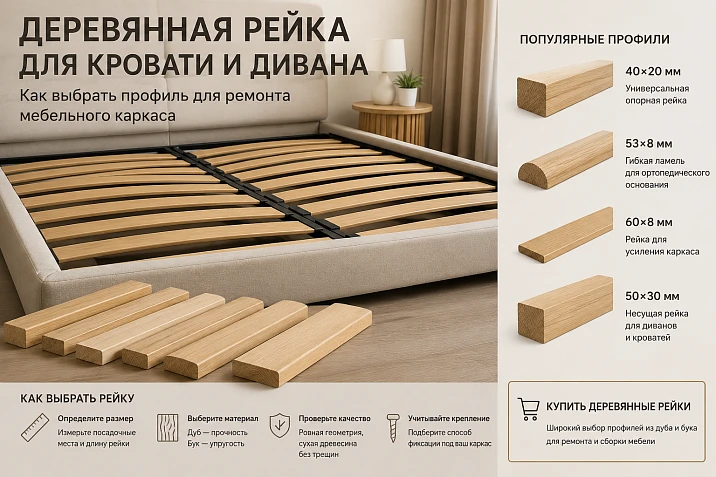
Buy wooden batten for bed — a query that usually hides not decorative wall finishing, but a specific furniture problem: a side element has loosened, a support slat has cracked, the frame has weakened, a new spacer is needed, or a part for a sofa, ottoman, or bed frame needs to be made. In such a situation, the buyer is looking for a straight planed solid wood profile that can be cut to size, drilled, fitted, and finished to match existing furniture.
The main mistake starts with calling any wooden plank a lamella. A straight slat and a spring bent-laminated lamella for a mattress work differently. A lamella is designed for bending and is installed in a system with a specific spacing and supports. The straight slat RK-001 has a rectangular cross-section and can be used as a support bar, spacer, side element, furniture frame reinforcement, or decorative trim. But it cannot automatically replace a spring lamella and promise the same load-bearing capacity without calculation.
Choosing the cross-section depends not only on the width of the old part. You need to understand what function it performs, what the length of the free span is, where the fasteners are located, how many support points the frame has, and what loads are transferred to the slat. A thin profile 15 × 5 mm is suitable for some tasks, a massive slat 60 × 23 or 80 × 23 mm for others. Even the largest cross-section does not become a universal load-bearing beam if it is incorrectly fastened or works on too long a span.
The STAVROS range includes the RK-001 slat, 2400 mm long, in seven cross-sections, made of beech and oak, prepared for enamel or tinting. For initial selection, you can buy wooden slats for furniture, and then proceed to the specific product page, compare the drawing and the selected execution line. Below we will analyze how a slat differs from a lamella, how to choose the size for a bed or sofa, when beech or oak is needed, how to calculate the quantity, and in which cases local repair is more reasonable than replacing with a new furniture frame.
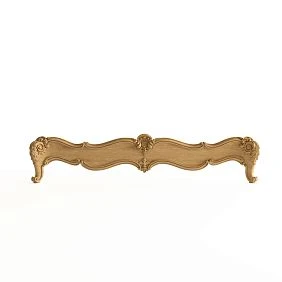
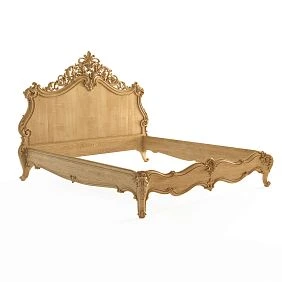
Wooden batten and lamella: what's the difference
Both parts look like long wooden planks, so they are easy to confuse. But the shape itself does not reveal the principle of operation. A spring lamella is usually a bent-laminated element that slightly deflects under load and supports the mattress together with adjacent lamellas. Its properties depend on the material, curvature, width, thickness, holders, and distance between supports.
The straight slat RK-001 does not have a predetermined spring bend. It is a rectangular profile made of solid beech or oak. It can bear load as part of a frame, serve as a support for another element, connect frame parts, or work as a facing detail. Its load mode is different: the slat can work in bending, compression, tension, or hold fasteners, but the permissible scenario is determined by the furniture design.




Why a regular slat cannot be placed under a mattress without calculation
When one lamella breaks, there is a temptation to cut a straight plank of suitable length and put it in the same place. Externally, the repair seems logical, but the behavior of the base changes. The new part may be too rigid, too thin, insufficiently supported, or begin to concentrate load on adjacent elements.
The danger does not always appear immediately. The slat holds for a few days, then cracks at the fastening or bends in the center. Sometimes it is not the slat that gets damaged, but the side of the bed, because the rigid part transmits force differently. Therefore, slat replacement is coordinated with a furniture specialist, or a slat of the same type, size, and construction is used.
Our factory also produces:




Where a straight batten is truly appropriate
A straight wooden slat is suitable for support planks that are fixed along the inner sides of the side rails and support a separate base; for short spacers between frame elements; for reinforcing an area near a joint; for replacing a straight part that was not originally springy; for making a decorative frame or edge; for local repair of a sofa or ottoman frame.
It is also convenient in custom furniture, when the designer pre-calculates the cross-section, spans, and attachment points. But the article does not replace calculation. The closer the task is to the load-bearing base of the bed, the less permissible the choice "by eye".
Get Consultation
How to determine what exactly is broken in your case
Remove the mattress and inspect the base. If the part is slightly curved upward, installed in plastic or rubber holders, and repeats at regular intervals, it is most likely a slat. If the plank is straight, rigidly screwed along the side, or connects frame parts, it is a support rail or spacer.
Look at the failure point. A crack at the fastening hole indicates overload of the joint, insufficient edge distance, or incorrect drilling. A bend in the center indicates too large a span or insufficient cross-section. Loosening without a crack may be related to the fasteners, the base, or deformation of the entire frame.
Characteristics of slat RK-001
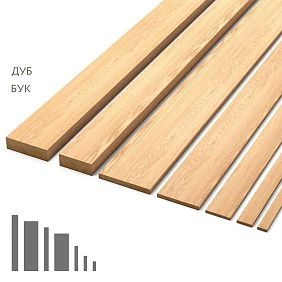
RK-001 is a planed rectangular profile with a length of 2400 mm. The card offers seven cross-sections from thin decorative options to massive planks of 60 × 23 and 80 × 23 mm. Materials are beech and oak. The sanding quality is designated as "Prestige." For finishing, options are available for preparation for enamel and for tinting.
| Parameter | Confirmed data RK-001 | Practical significance for furniture |
|---|---|---|
| Product type | Straight wooden rail of rectangular cross-section | Suitable for manufacturing and repairing straight parts; not a spring slat |
| Length | 2400 mm for all listed cross-sections | Allows cutting one long or several short furniture parts after layout planning |
| Cross-sections | 15 × 5; 24 × 5; 40 × 5; 70 × 7; 90 × 10; 60 × 23; 80 × 23 mm | The choice depends on the function, span, fasteners, and existing node |
| Material | Beech or oak | Can be coordinated with the existing frame, visible texture, and future finishing |
| Sanding | «Prestige» | The surface is prepared more thoroughly, but the ends and holes after cutting still require processing |
| Preparation for finishing | For enamel or tinting | You need to choose an option for an opaque color or preserving the wood grain |
| Purchase | Add to cart and purchase in one click | Before ordering, select the exact line of size, material, and finish |
The table helps quickly see the assortment but does not assign a cross-section. For example, 80 × 23 mm looks massive, but its suitability for a bed side depends on the load direction, part length, and connection to the rest of the frame. A 90 × 10 mm slat is wide but relatively thin: in one node it works as cladding, in another it may require frequent supports.
Where a straight slat is used in a bed
Support plank along the side rail
In many beds, an inner slat is attached along the rail and supports the base, deck, or lamella holders. Here, the installation height, support shelf width, and number of attachment points are important. The new part must replicate the function of the old one, not just fit between the walls.
If the support rail has torn off along with the fasteners, simply replacing the rail does not solve the problem. It is necessary to restore the attachment point in the side rail, check the wood around the holes, and determine why the joint failed. A thicker rail will not help if the bed base is already split.
Cross brace
The brace maintains the frame geometry and reduces the spreading of the long sides. It can be short, with its ends resting on the side rails, or connect to a central beam. Here, the exact length and attachment method are critical: a part that is too short will not tie the frame together, while one that is too long will spread it and create tension.
Central reinforcement
For wide double beds, the center line often requires a separate support. A straight rail can be part of such a system, but by itself does not replace a properly designed central beam and support legs. If the existing structure has sagged, the entire assembly needs to be checked: the longitudinal element, foot pads, and attachments to the headboard and footboard.
Side panel, frame, or decorative trim
The visible rail can cover a joint, form a trim, or continue the pattern of a wooden bed. Here, the load is lower, and the cross-section, wood species, and finish come to the forefront. Thin options of 15 × 5, 24 × 5, or 40 × 5 mm are more often considered for cladding and decorative tasks, rather than as independent load-bearing parts.
Repair of a straight part of an old frame
If the broken part was straight and its function is clear, RK-001 can be used as a blank for reproduction. The old rail is kept as a template; not only the width and thickness are measured, but also the position of holes, grooves, and end joints. Any traces of old deformation are taken into account: copying a bent length is not allowed.
Where is the slat used in a sofa, ottoman, and armchair
The frame of upholstered furniture is hidden under the upholstery, so accidental replacement is especially risky. The batten can serve as part of the seat frame, a spacer, a support for the decking, a fastening strip for fabric, or a decorative element. Before repair, it is necessary to determine whether springs, straps, transformation mechanisms, or upholstery are attached to it.
Support for decking or soft package
A straight strip can support plywood, a panel, or other rigid decking. In this case, the load is distributed through the plane, but the edge of the batten experiences force at the attachment points. The cross-section is selected based on the original design and the actual span.
Furniture frame spacer
The spacer connects the front and back parts of the frame, helps maintain rectangular geometry, and reduces wobbling. When replacing, it is important to replicate the length and location of the fasteners. A new batten made from a different wood species may behave differently, so the craftsman checks compatibility with adjacent parts.
Strip for attaching upholstery
Staples, fabric, technical material, or decorative trim can be attached to the wooden batten. Here, sufficient thickness to hold the fasteners and the absence of cracking are important. A strip that is too thin may split from a row of staples, while one that is too wide may change the shape of the soft part.
Transformation mechanism element
If the batten is connected to a folding mechanism, repair cannot be performed based solely on external similarity. The loads change with each fold, and incorrect thickness can interfere with the movement of metal parts. Such an assembly is best left to a furniture craftsman.
How to choose the slat cross-section
Cross-section is the width and thickness of the profile. In the RK-001 card, dimensions are written as A × C × L, where A and C form a rectangular cross-section, and L is the length of 2400 mm. It is important for the buyer not to confuse a wide but thin plank with a massive slat. For example, 90 × 10 mm and 60 × 23 mm have different geometries and behave differently in a frame.
Thin cross-sections 15 × 5, 24 × 5, and 40 × 5 mm
These options are convenient for decorative framing, spacers, facing parts, lightweight frames, and areas where the load is transferred to a solid base. The 5 mm thickness limits the ability to hold large fasteners and withstand significant bending. Such a slat should not be considered as an independent beam for a mattress or seat.
In bed repair, a thin strip can cover the edge, align the fit of a decorative part, serve as an overlay, or replicate an original element of small thickness. In a sofa, it can be used as a strip under the fabric or as a facing if the structure is originally designed for such a cross-section.
Cross-section 70 × 7 mm
A width of 70 mm provides a noticeable support or decorative plane, but the thickness of 7 mm remains small. The strip can be useful as an overlay on an existing frame, a side element, a face strip, or part of a multi-layer assembly. It is not suitable for a long free span without calculation.
If the old part had 70 × 7 mm, it is necessary to find out whether it worked independently or was glued to a thicker base. Copying only the visible layer without the hidden base leads to a weakened repair.
Cross-section 90 × 10 mm
A wide plank 90 × 10 mm can cover a large area and serve as a side overlay, decorative border, support strip on a solid surface, or part of a frame with frequent attachment points. The 10 mm thickness provides more material for fasteners than the 5–7 mm options, but does not make the part a universal load-bearing beam.
In a furniture frame, such geometry is sometimes convenient when it is important to distribute contact across the width, but the depth of the structure is limited. Before choosing, check whether the wide strip will interfere with the mechanism, mattress, upholstery, or adjacent parts.
Sections 60 × 23 and 80 × 23 mm
These are the most massive variants of RK-001. The 23 mm thickness allows forming more substantial support and frame elements, holding fasteners with sufficient edge distance, and creating rigid spacers. Such profiles should logically be considered for side elements, reinforcements, crossbars, and furniture frames, but only after load verification.
The cross-section of 60 × 23 mm is more compact and fits more easily into an existing structure. The 80 × 23 mm option provides greater width, which can be useful for supporting the deck or connecting to another part. However, increasing the width does not always enhance strength in the required direction: it is important which side the profile is installed on and where the load is applied.
To compare these options in one card, you can select a batten 60 × 23 or 80 × 23 mm. Before adding to the cart, you need to check the material, preparation for finishing, and the actual length of the part after trimming.
| Section RK-001 | Reasonable consideration scenario | What cannot be assumed without calculation |
|---|---|---|
| 15 × 5 mm | Thin overlay, decorative strip, gasket, lightweight frame | That the slat will support the independent load of the bed base |
| 24 × 5 mm | Facing, fastening or finishing strip on a solid base | What thickness is sufficient for any furniture fastener |
| 40 × 5 mm | Wide decorative batten, overlay, frame element | That the width compensates for the small thickness over a long span |
| 70 × 7 mm | Edge, face strip, part of a multi-layer furniture assembly | What a batten will replace a crossbar or mattress slat |
| 90 × 10 mm | Wide support strip for frequent fastening, side overlay | That a profile will withstand a large free span |
| 60 × 23 mm | Spacer, support bar, frame element after design verification | What a single large cross-section is sufficient without supports and proper fasteners |
| 80 × 23 mm | Massive bar for frame, reinforcement, or wide support | That it is automatically safe for any sofa or bed |
How to check the load before purchase
The reliability of a furniture part is determined not by one wood species or one cross-section. The entire system matters: span length, grain direction, number of fasteners, distance between them, quality of adjacent parts, presence of central supports, and load type. Two identical profiles can perform completely differently in different frames.
Free span length
Free span — the section between support points. The longer it is, the more the part tends to bend. A slat that works reliably on a short section may be insufficient on a long crossbar. Therefore, you cannot choose the cross-section based only on the width of the bed: you need to know exactly where the ends lie and whether there is support in the center.
Support spacing
If several slats are installed side by side, the load is distributed among them. But the spacing must match the base, mattress, and construction. Sparse installation increases the force on each part. Frequent installation does not always solve the problem if the slats are not properly secured or are not designed for bending.
Number and placement of fasteners
Two self-tapping screws at the very end can split even a massive slat. A large number of fasteners also does not guarantee reliability if the holes are too close together or coincide with a weakened area of the wood. The craftsman determines the diameter, length, pre-drilling, and distance from the edge.
Load type
The static load from the mattress differs from the dynamic load when sitting, standing up, or unfolding a sofa. The impact force at one point can be significantly higher than the average weight. A part connected to the transformation mechanism receives cyclic loads and friction.
Condition of the entire frame
If the bed is loose, the corners are spreading, the side rails are cracked, and the central support has sagged, replacing one slat will not restore the structure. A new profile may simply transfer the failure to an adjacent joint. Before purchasing, inspect the connections, legs, headboard attachments, and the condition of the base.
When a furniture specialist's consultation is needed
Professional calculation is mandatory when the slat will support a mattress or seat on a free span, replaces an element of unknown purpose, is connected to the sofa mechanism, must bear the weight of several people, or is installed in children's furniture. Safety is more important than trying to select a profile from a photo.
Beech or oak for a furniture frame
RK-001 is made from beech and oak. Both species are suitable for furniture parts, but the choice depends on the existing structure, future finish, and visibility of the element. Oak cannot be automatically considered the only correct choice for load-bearing, and beech only a decorative material. Specific reliability is determined by the cross-section and joint.
When beech is convenient
Beech has a calm grain and is well suited for opaque enamel. If the repaired slat will be painted together with the frame, beech helps achieve a smooth surface without the need to emphasize the texture. It is also logical when the existing furniture is made of beech or a material similar in appearance.
For a hidden support strip, the visual difference between species may be insignificant. Then the choice is based on the availability of the required cross-section, finish, and coordination with the craftsman.
When oak is chosen
Oak is needed when the rail remains visible and must match the oak frame, headboard, legs, or other elements. Under tinting, a pronounced texture appears, and the new part can be matched in color with the existing furniture.
But matching the wood species does not guarantee matching the shade. Old oak darkens and changes under the coating. Before finishing, a test is done on a scrap piece, and visible slats are arranged according to the pattern.
For enamel or for tinting
For enamel, choose a profile that will be covered with an opaque color. For tinting — when the wood grain should remain visible. You cannot buy a random option and expect any finish to apply equally to the surface. In the card, you need to select the corresponding line.
After cutting, new ends and holes appear. Even with "Prestige" sanding, they are processed separately. The final coating must protect the part according to the furniture design, especially if it is near the floor, wet cleaning, or an open edge of upholstery.
How to calculate the length and number of slats
Measure the original part
Do not throw away a broken slat until the repair is complete. It serves as a template for length, cross-section, holes, and end connections. Measure at several points because the old part may have been trimmed at an angle or have a cutout.
Check the mounting location
The distance between supports may differ from the length of the old rail due to frame deformation. First, restore the correct geometry of the frame, then take the final measurement. Otherwise, the new part will lock in the misalignment.
Add a machining allowance
A 2400 mm long rail allows you to cut a part with a small margin, try it on, and finish the end. Do not cut to the minimum size immediately. An allowance is especially useful if the end fits into a groove or connects at an angle.
Plan the cutting layout of the entire strip
Several parts can be obtained from one rail. For example, two short spacers and one support strip. Before the first cut, write down all dimensions and arrange them along a length of 2400 mm, considering the kerf width and technological allowance.
Buy spare for complex repairs
One extra plank is reasonable if the assembly is complex, several identical parts are required, or future finishing must match. Reordering a single batten can increase shipping costs and lead to differences in wood grain.
How to prepare the rail for installation
Buying the right cross-section is only half the repair. The new strip needs to be properly marked, cut, have its ends processed, and holes prepared. Even a well-sanded rail can crack if a screw is driven without pre-drilling near the edge or if the part is forcibly pulled to a warped frame.
Trimming to actual size
Marking is done after restoring the frame geometry. If the bed or sofa is skewed, the distance between supports will be incorrect. First, check the diagonals, angles, and position of the side panels. Then, place the new slat at the installation site and refine the length.
The cut must be straight, without tear-outs or a skewed end, unless the design requires an angle. An uneven end creates point contact: the load is transferred to a small area, and the batten begins to shift or split. After cutting, sand the end and remove sharp edges as much as the assembly allows.
Pre-drilling
A hole for the fastener reduces the risk of cracking the solid wood. Its diameter, depth, and position are chosen for the specific screw or bolt. The drill should not come too close to the side surface. On thin sections, the margin to the edge is especially small, so an accidentally large fastener can destroy the batten even before installation.
If the old hole in the frame is broken, you cannot simply screw in a thicker self-tapping screw. Sometimes it is necessary to restore the base, change the attachment point, or use a different furniture joint. The decision is made by the technician after inspection.
Countersinking and head seating
The fastener head should not protrude where it could damage the mattress, upholstery, or adjacent part. But deep countersinking weakens a thin slat. The balance depends on the profile thickness and type of fastening. On a 5 mm slat, hiding a large head is especially dangerous.
Sanding after processing
The "Prestige" quality refers to the original surface. After cutting, drilling, and possible routing, new untreated areas appear. They are sanded by hand without changing the seating geometry. A rounded edge where a tight straight contact is needed can create a gap.
Finishing before or after installation
It is more convenient to pre-paint or tint the visible rail, leaving the possibility to treat the joints after installation. The hidden support bar is also protected according to the design. However, the coating should not interfere with the adhesive bond or precise fit into the groove. The technology is agreed upon before applying the compound.
How to secure a support rail inside the bed
The method of attachment depends on the original design. The rail can be screwed to the side panel, glued into a groove, connected with dowels, rest on metal brackets, or be part of a prefabricated furniture assembly. There is no universal fastener for all beds.
Repeat the joint or modernize
If the original joint has served reliably for many years and only the rail itself has broken, the new element usually follows the old scheme. If the fastener is torn out, the wood is delaminated, or the load was distributed incorrectly, blind copying reproduces the weak point. Then the craftsman modernizes the assembly: adds supports, changes the location of fasteners, or reinforces the adjacent part.
Fastening along the grain
Solid wood splits more easily when the fastener is located close to the end along the grain direction. Pre-drilling, sufficient offset, and proper tightening reduce the risk. The screw should not turn the rail into a clamp that forcibly straightens a curved side panel.
Glue and mechanical fasteners
Glue can increase the joint area, but its choice depends on the materials and surface condition. It does not replace a properly designed assembly and does not fix a dirty, painted, or damaged base. If the part needs to be disassembled, a permanent adhesive joint may complicate future repairs.
Post-assembly inspection
After installation, check whether the base lies flat, whether a step has appeared, whether the mattress is pinched, and whether the frame diagonals have changed. The load is increased gradually, observing the fasteners and sounds. Creaking, shifting, or a new crack indicates that the problem is broader than a single slat.
How to repair a sofa or ottoman with a slat
In upholstered furniture, access to the frame often requires partial removal of the upholstery. Before disassembly, photograph the layers, position of the fabric, staples, straps, and mechanisms. This helps restore the structure to its original appearance and avoid confusing the slat with a technological strip that holds the upholstery.
First, determine the role of the part
A strip under the seat may support the decking, hold the spring block, serve as a fabric attachment, or tie the frame together. Replacing it with one of the same size without understanding its role is dangerous. For example, a slat for staples works differently than a load-bearing crossbar.
Check adjacent elements
A broken slat is sometimes the result of sagging springs, a skewed mechanism, or weakened sofa corners. If only the slat is replaced, the load will again concentrate in the same spot. Inspect the entire frame, metal parts, leg fasteners, and the condition of the wood under the upholstery.
Do not change the geometry of the soft part
A wider or thicker slat can raise the decking, change the cushion fit, and alter fabric tension. Even reinforcement must fit within the original volume. Therefore, the cross-section is chosen not by the principle of 'the bigger, the better,' but according to the repair drawing.
Account for reupholstery
If staples return to the slat, sufficient material around each fastener is needed. Old holes should not align with new ones in a weakened area. The fabric is tensioned evenly so it does not bend the thin slat.
Repair with a batten or replacement of the entire furniture frame
Local repair is beneficial when one clear part is damaged, other joints maintain geometry, and the frame material is not destroyed. Replacing the slat restores function without full disassembly of the furniture. But sometimes it only delays the inevitable replacement of the base.
When local repair is justified
- one straight slat is broken, but its purpose and dimensions are clear;
- adjacent side rails, corners, and supports are intact;
- the mounting base can be restored;
- the sofa mechanism is functional;
- a new slat does not require changing the entire structure;
- the cost of work is proportional to the condition of the furniture.
When it's better to replace the frame
Full replacement is more reasonable with multiple cracks, misaligned corners, rot or serious moisture, destruction of several fastening zones, deformation of the central support, and repeated breakdowns after previous repairs. If the furniture frame has lost its geometry, a single slat won't restore its reliability.
When making new furniture, a ready-made base can be safer than a random set of parts. In the category, you can select a solid wood furniture frameAmong the filters are bed frames, ottoman frames, armchair frames, chair frames, and other furniture bases. Sofa frames are not listed in the confirmed filter, so the article does not guarantee their availability.
| Furniture condition | Local repair with a slat | New frame |
|---|---|---|
| One broken straight plank | Usually reasonable after checking load and node | Often excessive |
| Several cracks in stiles and corners | Risk of transferring damage to adjacent parts | May be more reliable and economical than repeated repairs |
| Mounting point destroyed | Only possible together with base restoration | Considered for serious material damage |
| Frame is skewed | A new batten may fix incorrect geometry | Preferred if the frame cannot be straightened |
| New furniture is being manufactured | Batten is used as a calculated component | The ready-made base reduces the volume of joinery work |
What not to make from scratch if there are ready-made STAVROS elements
The repair theme is close to self-assembly, but the buyer does not have to turn the apartment into a carpentry workshop. The finished slat already has a straight cross-section, a specified length, a treated surface, and a material selection. This allows focusing on precise measurement, cutting, drilling, and installation, rather than planing a random board to the required geometry.
There is no need to look for unprocessed timber with unknown humidity, align it on all four sides, and try to obtain a stable cross-section with hand tools. For visible parts, there is no need to independently select the texture from construction scraps. RK-001 is produced in seven sizes, so first check the ready-made option, and manufacture a non-standard part only when truly necessary.
In case of serious bed damage, it is not necessary to assemble a new frame from scattered slats. The furniture frame category helps compare a ready-made base with local repairs. The commercial route looks like this: furniture diagnostics → selection of a ready-made slat or frame → checking material and dimensions → preparing the finish → professional installation or assembly.
Practical selection for different tasks
Need to replace the inner support plank of the bed
Keep the old part, measure the cross-section and length, check the condition of the side rail. If the original slat was massive and rigidly fixed, consider 60 × 23 or 80 × 23 mm only after comparing with the original. The new cross-section should not reduce the space for the base or mattress.
Need to reinforce a loose side panel
First, find the cause of the loosening. An overlay slat can increase the fastening area, but will not replace the restoration of the corner joint. A thin slat is suitable as cladding, a massive one as part of reinforcement, if the master designed the assembly.
You need to make short spacers
Length 2400 mm is convenient for cutting several identical parts. Choose the cross-section based on the original structure, add a sawing allowance, and make a hole template. All spacers must have the same length, otherwise the frame will become skewed.
You need to repair the sofa base
Determine whether the slat supports the decking, springs, straps, or fabric. If it is connected to the transformation mechanism, hand the repair over to a master. For a simple frame part, consider RK-001 as a blank after checking the attachment point.
Need a visible oak plank
Choose oak for tinting, select the grain, and make a test coat. The new part may differ in shade from the old furniture, so it is sometimes better to finish the entire visible unit rather than trying to locally match the old finish.
Need a white batten for the existing frame
Beech under enamel is often convenient for an even opaque color. First, match the gloss and shade with
What to buy together with a wooden slat
The article uses only confirmed internal pages, so the section doesn't turn into a list of random fasteners. The main accompanying purchase is additional battens of the same cross-section for paired replacement, spare, and test finishing. The second is a ready-made furniture frame if local repair no longer solves the problem.
| What to add to the purchase | Why this is needed | For which scenario | What to Check |
|---|---|---|---|
| Second slat of the same cross-section | Reserve for cutting error or paired replacement | Old frame, several identical spacers, complex cut | Match of species, size, and preparation for finishing |
| Offcut for test finishing | Check the enamel or tint before processing the main part | Visible oak or beech batten | Color, gloss, and compatibility with the old coating |
| Batten RK-001 60 × 23 or 80 × 23 mm | Compare solid profiles for frame and support tasks | Bed, bench, rigid furniture frame after calculation | Buy wooden batten RK-001 made of beech or oak in the required execution line |
| Ready-made furniture frame | Replace the base in case of multiple damages | New bed, bench, armchair or other furniture structure | Buy a wooden furniture frame of the appropriate type and size |
How not to confuse a furniture batten with similar products
Batten and spring lamella
The lamella has a specified elasticity and usually works with holders. The straight batten RK-001 is not a ready-made spring system for a mattress. If a curved lamella has broken in the base, the correct approach is to select a compatible lamella or order a calculation for a new base, rather than installing the first straight plank of suitable length.
Lath and beam
A beam is usually a more massive workpiece, but the boundary between terms in stores can be blurred. The buyer should look not at the name, but at the exact dimensions. RK-001 80 × 23 mm is significantly more massive than the 15 × 5 mm option, although both items are called laths. For a furniture project, the cross-section remains decisive.
Planed slat and raw workpiece
A planed profile has a specified geometry and a finished surface. An unprocessed board may be cheaper, but it will require leveling, calibration, and sanding. In a furniture joint, a deviation of a few millimeters can change the fit, so a random construction workpiece does not always save money.
Support lath and decorative overlay
The same geometry may look similar, but the function differs. The overlay rests on a stable base and bears almost no load. The support strip participates in the frame's operation. The experience of decorative installation cannot be transferred to a load-bearing joint.
Lath and finished furniture frame
A slat is a component from which a craftsman creates a specific part. A frame is a system of already connected elements. If one slat is broken, the component saves the budget. If the entire frame is damaged, a finished frame reduces the risk of endless local repairs.
Mistakes when buying and repairing
Choosing a slat only by width
The buyer sees an old part 60 mm wide and orders 60 × 23 mm without measuring the thickness. The new slat does not fit into the groove, lifts the base, or interferes with the upholstery. Always measure both sides of the cross-section and the length.
Considering the largest cross-section as the most reliable
A massive slat may not fit, change the geometry, and transfer force to weak parts of the frame. Reliability is achieved not by the maximum size, but by correct alignment with the structure.
Replacing a lamella with a straight slat without checking
This is a key mistake. The base becomes uneven in stiffness, changing mattress support and load distribution. Replacement is only permissible after an engineering assessment of the joint.
Fasten without pre-drilling
The screw pushes fibers apart and can split solid wood, especially near the end. The crack sometimes remains hidden and opens under load. The hole diameter and edge distance are determined for the specific fastener.
Reuse a damaged hole
If the fastener is torn out, a new self-tapping screw in the same place does not restore strength. The base is repaired or the connection scheme is changed. A longer fastener may come out or split the side rail.
Copying a deformed old part
A broken slat may have shortened, warped, or delaminated. It is used as a guide for cross-sections and holes, but the final length is taken from the restored frame.
Do not consider the installation direction
A profile 80 × 23 mm has different rigidity when installed with the wide or narrow side facing the load. The part cannot be flipped without a project: the node height, support area, and fastener position change.
Paint before full fitting
After the final coating, trimming and drilling create unfinished edges, and a size error leads to the loss of a finished part. First, perform a trial assembly, then finish according to the chosen technology.
Ignore adjacent damage
One crack may result from the entire bed frame being skewed. If the corners are loose, the central support has sagged, and the side rail has separated, a new slat will quickly experience the same overload.
Buy only one plank for a complex project
With multiple parts, visible tinting, or complex connections, a spare reduces the risk of repeat delivery. But the reserve must be meaningful: the same cross-section, wood species, and surface preparation.
How to store and transport a 2400 mm long slat
A long thin plank can be damaged even before installation. It is transported with support along its length, without leaving a significant part hanging freely. The package must not be tightly cinched at a single point or used as a support for heavy objects.
Before cutting, the strip is stored horizontally on a flat surface with several supports. This is especially important for thin sections of 15 × 5 and 24 × 5 mm. Prolonged vertical storage with support on one end can lead to bending or edge damage.
Upon receipt, the ends, edges, straightness, and compliance with the selected section are checked. If the strip will be visible, the pattern and shade of several planks are compared. Sawing begins only after acceptance is complete.
Who is batten repair suitable for
This approach is suitable for furniture owners who have one or more straight parts damaged, while the overall frame remains intact. It is convenient for furniture makers, manufacturers of custom beds and benches, restorers, and buyers who need a precise planed blank made of beech or oak.
The batten is useful when the original section matches one of the seven RK-001 options or can be correctly adapted. The length of 2400 mm allows obtaining a large part or several spacers. The choice for enamel or tinting helps match the repair with the existing finish.
Who this strip may not suit
It is not suitable as an unconditional replacement for bent-laminated lamellas, metal parts of the sofa mechanism, and engineering beams of unknown load. It also will not solve the problem of a completely destroyed or skewed frame.
If a non-standard section, complex groove, curved part, or factory spring characteristic is required, a ready-made straight strip can only be a starting material or may not be suitable at all. In such a case, an individual joinery part or specialized component is needed.
How to buy a wooden strip for furniture on the STAVROS website
Start with diagnostics: photograph the assembly, save the old part, record the length, width, thickness, and location of fasteners. Then open the category and select a wooden batten for the furniture frame based on available sizes.
In the RK-001 card, select the exact line: cross-section, beech or oak, preparation for enamel or tinting. Do not rely solely on the starting price — it may refer to the thinnest option. For repairing a bed or sofa, a specific profile is needed, not just a product named "slat."
If the slat will serve a load-bearing function, provide the master with a drawing or dimensions before ordering. Specify the span, attachment points, and the need for central supports. For a decorative part, agree on the color and pattern. If there are multiple damages, compare local repair with the furniture frame section.
After selection, you can buy a planed wooden slat 2400 mm long in the appropriate finish. Check current availability, production times, and delivery conditions in the card before payment. For long-length molding, it is important to plan ahead for entry and storage space.
What to check in the order before payment
- exact cross-section A × C and length 2400 mm;
- wood species — beech or oak;
- the option for enamel or tinting;
- number of whole planks per cut;
- whether the slat will be load-bearing, supporting, or decorative;
- whether the thickness matches the groove and adjacent parts;
- whether there is enough space for fasteners;
- Is additional processing of the ends required?
- Can the 2400 mm profile be safely transported and stored?
- Wouldn't it be more cost-effective to replace the entire frame?
How to calculate the full order, not just one part
Repairs often start with one cracked slat, but after disassembly it turns out that adjacent elements have the same wear. Therefore, before purchasing, it is useful to make a small list: part name, finished length, cross-section, quantity, wood species, finish, and installation location. Such a list helps to understand how many 2400 mm long blanks are actually needed.
Count parts, not linear meters
The total footage alone is not very useful. Three parts of 750 mm take up 2250 mm and theoretically fit into one RK-001 plank. But you need to account for the kerf width, allowance for end trimming, and possible edge defects. If each spacer must have an exact length, cutting to the limit creates the risk of losing the entire set due to a single mistake.
Parts of different sizes are laid out on the diagram from longest to shortest. A remainder of 300–500 mm can be used for test drilling, finishing, or minor reinforcement, but it should not be counted in advance as a full-fledged load-bearing part without a separate purpose.
Do not mix different cross-sections in one calculation
A 60 × 23 mm and 80 × 23 mm batten have the same thickness but are not interchangeable in width. Similarly, a 90 × 10 mm cannot be replaced by two thin overlays without a design solution. Each cross-section requires its own cutting plan and its own allowance.
Consider paired replacement
If two symmetrical support slats work equally, but one is heavily worn, the technician may recommend replacing both. This helps maintain consistent geometry, material, and fasteners. The decision is especially appropriate when the old second part has cracks, deflection, or numerous holes.
Add test pieces
Before drilling the main part, it is useful to check the fastener on a scrap of the same cross-section. This allows you to select the pilot hole diameter, countersink depth, and behavior of enamel or tint. A test piece reduces the risk of ruining a long slat.
How to check repair quality after installation
Repair cannot be considered complete just because the new slat is in place. You need to ensure the frame retains its geometry, the fasteners do not create cracks, the base lies evenly, and the furniture does not receive new stresses.
Inspection without operational load
First, inspect the connections when the bed or sofa is empty. The slat should fit against the supports without gaps, not bend due to excessive length, and not wobble. The heads of the fasteners should not protrude into the mattress or upholstery area. There should be no fresh cracks at the drilling points.
Gradual loading
The load is increased gradually and only within the scenario confirmed by the specialist. First, return the base and mattress, then check the furniture without sudden movements. Impacts, jumps, and attempts to immediately test "to the max" do not demonstrate the quality of the repair but can destroy a yet-unverified component.
Sound and offset control
A creak does not always mean a breakdown, but its appearance after repair requires attention. It may indicate friction, loose contact, or movement of fasteners. Mark the position of the rail with a pencil on the hidden side: if the line shifts after a few days, the assembly is not working correctly.
Re-inspection
After a few days of use, the furniture is disassembled again as much as possible without damaging the upholstery, and the fasteners are checked. If the screws have loosened, you cannot keep tightening them indefinitely without finding out the cause. The wood may have crushed, the hole may have widened, and the frame may have continued to deform.
| Inspection stage | Normal result | Alarming sign |
|---|---|---|
| Immediately after installation | Tight fit without forced bending | Gap, misalignment, need to tighten with fasteners |
| After installing the base | Even support and level retention | Step, point contact, new deformation |
| During soft check | No cracking, movement, or sharp deflection | Crunch, rail movement, crack opening |
| In a few days | Fasteners maintain position | Loosening of screws, shifting, or new squeak |
Choosing a slat for different types of furniture
Single bed
A small bed width reduces some spans but does not eliminate the calculation. The support slat along the side rail and the cross piece serve different functions. If a child's bed is being repaired, any load-bearing changes must be checked especially strictly: safety margin is more important than material savings.
Double bed
A wide base often uses a central beam and additional legs. A broken side slat may be just part of the system. Before ordering a large cross-section, check the center line, connection to the headboard, and slat distribution.
Bed with lifting mechanism
Here, the wooden frame interacts with metal and moving parts. A new slat should not restrict the mechanism's movement, block fasteners, or change the distance to the base. Any reinforcement must be coordinated with the lifting device.
Folding sofa
Slats near the mechanism experience repeated loads. The cross-section and position of the new part must fully match the repair plan. Installing a wider slat on your own may block folding or damage the metal lever.
Stationary sofa
In a sofa without transformation, it is easier to identify frame and support parts, but springs, straps, or padding may be under the upholstery. Before choosing a slat, inspect the soft package fasteners and check if the crack is due to seat sagging.
Ottoman and bench
Short spans allow for compact frame parts, but the load during sitting remains dynamic. A slat can serve as a side rail, spacer, or deck support only in a calculated frame. For new furniture, a ready-made base often saves more time than assembling from individual slats.
Headboard and decorative frame
Here, the main task is geometry, finishing, and safe edges. Thinner sections can be used if they rest on a base or form a light frame. Visible ends are carefully sanded, and the color is coordinated with the bed and wall.
Frequently asked questions
How does a wooden rail differ from a bed slat?
The RK-001 rail is straight and has a rectangular cross-section. A spring slat is usually bent-laminated and designed for elastic deflection in a special base. They are not automatically interchangeable.
Can a broken slat be replaced with a regular rail?
Only after a structural calculation by a specialist. The span, spacing, holders, stiffness, and load must be checked. In most cases, it is safer to select a lamella of the same type.
What cross-section should be chosen for a bed?
Refer to the original part and its function. For frame tasks, more massive 60 × 23 or 80 × 23 mm are considered, but their suitability must be confirmed by a furniture craftsman.
Is a 60 × 23 mm rail suitable as a support strip?
It can be considered for such a role if it matches the assembly, span length, and fastening. The size alone does not guarantee the permissible load.
How does 80 × 23 mm differ from 60 × 23 mm?
The thickness is the same, but the width is 20 mm larger. This changes the support area, weight, and fastener placement. A wider rail is not always better if it interferes with other parts.
What is a 90 × 10 mm batten suitable for?
It can be considered as a wide overlay, edge, or support strip for frequent fastening. For a long free span, a separate calculation is needed.
What to choose for furniture — oak or beech?
Beech is convenient for smooth enamel and a calm texture. Oak is chosen for a visible natural surface and combination with an oak frame. Reliability depends not only on the species.
How to determine the length of a new slat?
Restore the frame geometry, measure the mounting location, and compare with the old part. Add a small allowance for precise fitting.
How many rails to buy?
Create a cutting plan for a 2400 mm strip. Account for kerf width, test pieces, and reserve. An additional strip is useful for paired replacement or complex repairs.
Do I need to drill the batten before fastening?
For solid wood, pre-drilling usually reduces the risk of cracking. Hole parameters and edge distance are selected based on the specific fastener and cross-section.
Can I screw the batten to a damaged spot with an old self-tapping screw?
If the hole is stripped or the wood is cracked, re-fastening is unreliable. The base needs to be restored or the joint modified.
How to choose a batten for a sofa?
First, determine the role of the broken part: deck support, spacer, upholstery strip, or part of a mechanism. For a transformation mechanism, consult a specialist.
Can I use a thin batten for attaching fabric?
Only if it is thick enough for staples and if the design is intended for such a strip. Staples too close to the edge can split the wood.
What does preparation for enamel mean?
This is an option for opaque painting. It does not necessarily mean a ready finish coating. Finishing conditions are checked in the product card.
What does preparation for tinting mean?
It is intended for finishing while preserving the visible wood texture. Before the main work, a test is done on a scrap piece.
When is it better to replace the entire frame?
In case of multiple cracks, warping, corner destruction, and repeated breakages, a local slat does not restore reliability. Then, compare repair with a ready-made furniture base.
Can a new bed be made from RK-001?
A slat can be one of the components, but the entire bed requires a project with calculated joints and supports. You cannot build a load-bearing frame based only on a list of available cross-sections.
Conclusion: first determine the function, then choose the size
A wooden slat for a bed or sofa is not a universal stick for any repair. It can restore a support bar, spacer, frame element, fastening base, or decorative trim if the part's function is clear and the structure remains sound. But a straight slat does not replace a spring lamella without calculation.
RK-001 gives the buyer a choice of seven cross-sections 2400 mm long, beech and oak, options for enamel and for tinting. Thin profiles are suitable mainly for facing and light tasks, massive 60 × 23 and 80 × 23 mm can be considered for frame and support elements after load checking.
Before ordering, measure the original part, restore the furniture geometry, determine the span and fastenings, plan the cutting, and decide if a reserve is needed. If the frame is damaged in several places, it is better to move from a local patch to a ready-made furniture base. STAVROS allows you to choose a planed solid wood slat or compare it with furniture frames, so the repair is not only neat but also structurally justified.