








































































Article Contents:
- What is a wooden console: rethinking a familiar item
- Wooden console in the hallway: three scenarios and how to assemble them
- Narrow console against the wall in the hallway
- Console under the mirror in the hallway
- Decorative console frame without a tabletop
- Wooden console in the living room: from classic to modern neoclassicism
- Console behind the sofa
- Console area in a classic living room with boiserie
- Accent console area by a separate wall
- Wooden TV console: TV zone as a console system
- Wooden console in the hall and study: architectural scale
- Classic console group in the hall
- Console in the study: dark wood and expressiveness
- Floating wooden console: visual lightness and compactness
- Wooden console on legs: how to choose supports
- Types of furniture legs for a console
- Height of legs for a console
- Proportions of legs and console
- Carved wooden console: when and why
- How to choose a console style: decision table
- How to calculate the console area: a step-by-step approach
- Wall behind the console: moldings, trims, and decor
- Frames made of moldings
- Trim as a horizontal belt
- Decorative Elements as Accents
- Typical mistakes when choosing a wooden console
- Mistake 1: Not accounting for passage width
- Mistake 2: Too massive frame for a narrow wall
- Mistake 3: Mismatched legs and frame
- Mistake 4: Mirror chosen without considering the frame
- Mistake 5: Different carving styles
- Error 6: Electrical wiring not thought through
- Error 7: Height of legs not calculated
- Where to buy elements for a wooden console: full list STAVROS
- Frequently Asked Questions
- About the Company STAVROS
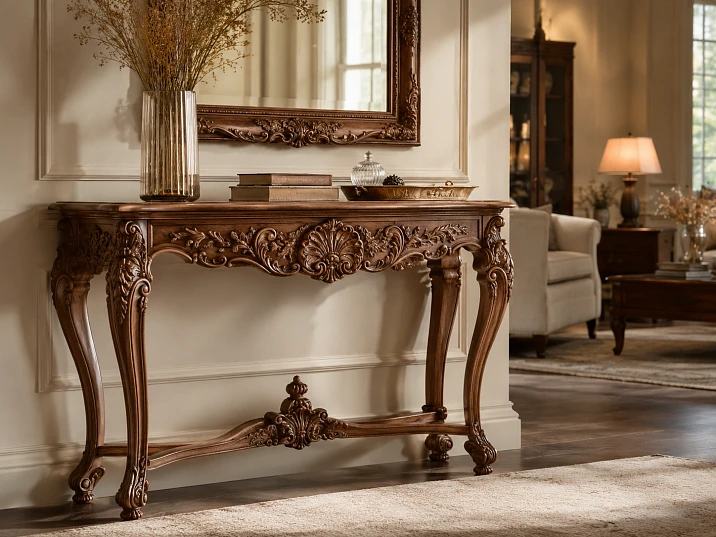
The first thing a guest sees when entering a home is the hallway. And if there is a properly assembled console zone: a narrow wooden frame, a mirror in a baguette frame, carved legs or decorative supports, moldings on the wall behind it — this says more about the owner than any design manifesto. It says: here they think about details.
Wooden console in the interior — it's not just a narrow table by the wall. In a professional sense, a console zone is a whole architectural scene: a frame, legs or supports, wall decor behind it, a mirror or panel above it, moldings and trim that tie everything into a single composition. It is this approach that STAVROS uses in its interior solutions.
How to choose elements for a console zone? What is needed for a hallway, and what for a living room or TV area? Where is a carved wooden console appropriate, and where are calm moldings and a hanging frame enough? Let's break it down in detail — with examples, proportions, and specific solutions.
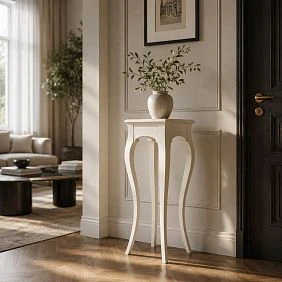
What is a wooden console: rethinking a familiar object
Most people, when they hear "console," imagine a narrow rectangular table. And that's not a mistake — it's one of the options. But in interior design, the concept of a console is much broader.
Console as a decorative zone by the wall. This is not a separate object, but a system: a horizontal surface + vertical decor behind it + side accents. The surface can be a tabletop on legs, a hanging shelf, or a frame system built into a wall panel.
Console as a frame and portal. In classic and neoclassical interiors, the console zone is often built as an architectural portal: Wooden pilasters On the sides + horizontal cornice + mirror or decorative panel inside. This is no longer furniture — this is architecture.
Console as a boiserie element. In the system wall panels and boiserie The console area is integrated into the overall decorative program of the wall: a section with a niche, lighting, shelf or surface for decor — as an organic part of the wall system.
How is a console different from a shelf? A shelf is a horizontal storage element. A console is a decorative zone that may include a shelf but is not limited to it. It is a stage, not an object.




Wooden console in the hallway: three scenarios and how to assemble them
The hallway is the most demanding space for a console. There is little space, high traffic load, and yet this is where the interior must make the first impression.
Our factory also produces:
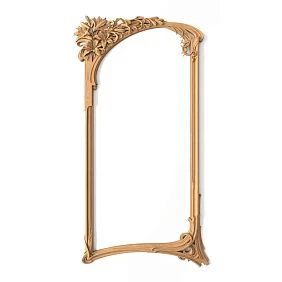
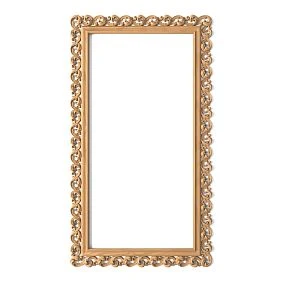
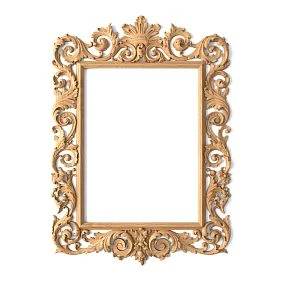
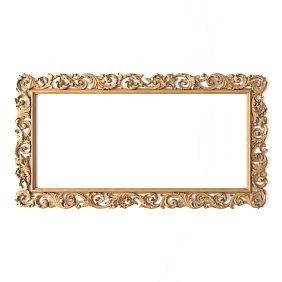
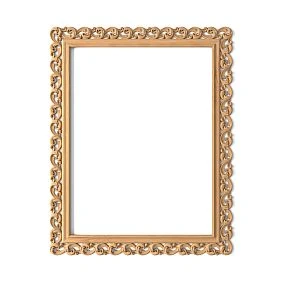
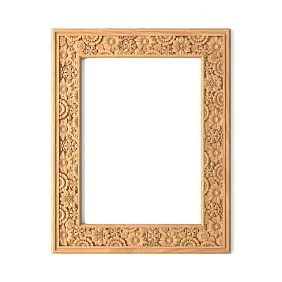
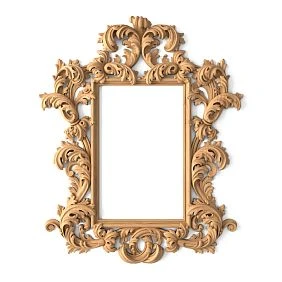
Narrow console against the wall in the hallway
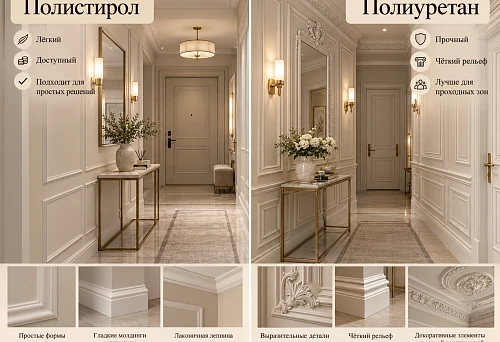
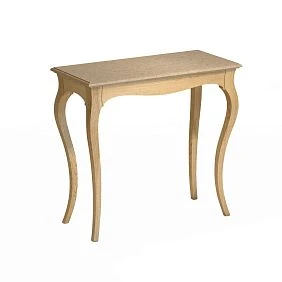
Wooden console table for the hallway In the 'narrow' version, this is a tabletop 25–35 cm deep on decorative legs. This depth does not obstruct passage but provides enough surface for a key holder, vase, candles, or a small mirror.
Key elements:
-
wooden furniture legs — console supports. Height: 70–85 cm (standard console table height). Shape: turned, carved, or straight with decorative fluting. For classic style — carved legs with decor, for neoclassical — a more restrained form.
-
Horizontal frame — framing of the upper part. From wooden molding or molding.
-
Wall moldings — frames behind the console. They create a "background" that makes the area feel complete even without a mirror.
Minimum width of a narrow console for a hallway: 60 cm. Optimal: 80–100 cm. This is the width at which the console visually "holds" the wall and doesn't look like a random object.
Get Consultation
Console under a mirror in the hallway
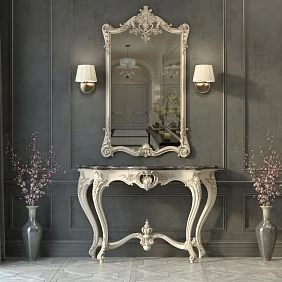
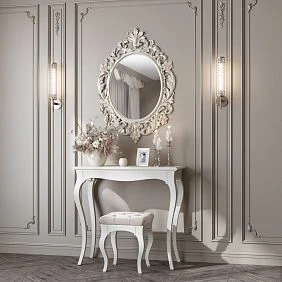
This is perhaps the most classic console situation. A mirror + a console beneath it — a composition with centuries of history. In a modern classic interior, it works just as flawlessly as before.
How to assemble it:
-
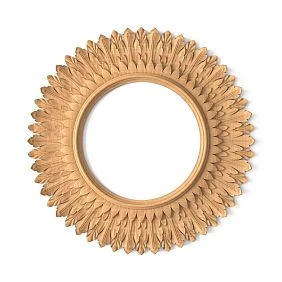
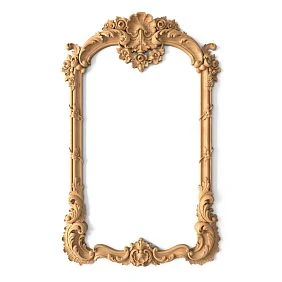
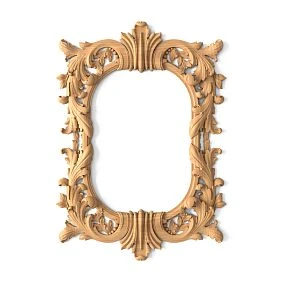
The mirror is framed wooden cornice — a frame around the mirror made of carved molding.
-
Under the mirror — a console on wooden furniture legs.
-
The wall behind the console — in frames made of molding.
-
On the sides of the mirror and console — pilasters or vertical profiles from millwork.
-
In the center of the upper horizontal above the mirror — a decorative element: rosette, cartouche, or ornamental appliqué.
Distance from the top edge of the console to the bottom edge of the mirror: 10–15 cm minimum. This is the "air" that prevents the mirror from "weighing down" on the console.
Decorative console frame without a tabletop
Sometimes the hallway is so narrow that even a 25 cm deep tabletop gets in the way. The solution is a console frame without a physical surface. This is a decorative architectural structure on the wall: pilasters + cornice + mirror or panel — without a protruding horizontal.
Visually, this works the same as a full console. The interior effect is the same. But the passage remains clear.
For such a frame: Wooden pilasters on the sides + a horizontal profile from wooden molding on top + a mirror in a frame inside. At the bottom — a baseboard strip made of molding as the "base" of the portal.
Wooden console in the living room: from classic to modern neoclassicism
In the living room, the console works differently. There is more space, higher ceilings, and the console area can be more expansive and expressive.
Console behind the sofa
Console behind the sofa — a space divider. In open-plan layouts, it separates the sofa area from the walkway or dining area. The height of such a console: 85–95 cm (slightly above the sofa backrest).
Decorative program: the console itself + the wall above it. Above the console — frames made of moldings, decorative inserts, shelves, paintings in wooden baguette frames. This creates a "wall picture" above the sofa.
Materials: Wooden trim for horizontal wall bands + Moldings for frames + decorative elements as accents in the centers of frames.
Console area in a classic living room with boiserie
When the living room walls are designed in the system Boiserie, the console area should be organically integrated into this system. It is not placed "on top" of the boiserie as a separate item — it becomes part of the wall architecture.
Option: one of the boiserie sections expands and gets a built-in console niche. Below is a decorative framed "skirt" with legs or carved brackets. Inside the niche is a mirror or decorative panel. This is a "built-in console" — integrated into the wall, not placed next to it.
Accent console area at a separate wall
In a living room without boiserie, a console with a mirror at an accent wall is a strong decorative move. Especially if the wall is framed with molding frames behind the console, and the console itself stands on carved legs.
Size for the living room: width 120–160 cm. Legs: turned, with carved decor, height 75–85 cm. Above the console: a mirror in a baguette frame or a decorative panel with width = width of the console (or slightly narrower).
Wooden console under the TV: TV zone as a console system
This scenario is underestimated — and completely in vain. Wooden console under the TV — this is the lower decorative zone of the TV wall, which connects the TV with the floor space.
How it works:
The TV hangs on the wall. A baguette frame surrounds it (more on this in a separate article about frames for the TV zone). The console zone below is a narrow decorative surface under the TV at a height of 30–50 cm from the floor. It "holds" the lower edge of the TV zone and creates a visual "base" for the TV.
Elements for the console in the TV zone:
-
Furniture legs — for a console on legs or a decorative TV stand
-
Wooden brackets made from solid wood — for a wall-mounted TV console
-
Pogonazh iz massiva — for horizontal rails and transitions
-
Moldings — for frames and trims
Color consistency: the console area under the TV should be in the same tint or enamel as the TV frame. This ties all elements into a unified decorative system.
About the complete TV zone solution — in the section TV Zone Frames.
Wooden console in the hall and study: architectural scale
A country house hall or a study with high ceilings is the territory of a "large console." Here, the scale of the console area can be significantly larger than in a city hallway.
Classic console group in the hall
Hall with ceilings 3–3.5 m: a console 150–200 cm wide on carved legs + a mirror in a carved frame 120–150 cm high + pilasters on the sides + a horizontal cornice above the mirror = a full-fledged architectural portal.
This is not just furniture — it's an interior scene that welcomes guests. For such a scene you need:
-
wooden pilasters and columns — on the sides of the portal
-
Wooden Picture Frame — for the mirror frame
-
Carved Decor — for accent elements of the portal
-
decorative elements — rosettes, cartouches, corner overlays
-
Carved brackets — if side decorative supports are needed
Console in the study: dark wood and expressiveness
The study style requires dark tinting, restrained but rich relief, strict symmetry. The console area in the study is typically a secretary, a side console shelf, or a buffet surface against the wall with a decorative mirror.
Elements: Furniture legs with dark tinting + Carved brackets as side decorative supports + dark Wooden Picture Frame for the mirror frame.
The wall behind the console — in Boiserie or within molding frames. This creates a 'cabinet depth' effect.
Suspended wooden console: visual lightness and compactness
Wooden suspended console — a solution for cases where legs are impossible or undesirable.
The suspended console is attached to the wall without support legs. Visually, it 'floats' — creating a sense of lightness and airiness that a console on legs lacks.
When to choose a suspended console:
-
Narrow hallway where legs obstruct passage
-
Room with tiled or wooden flooring where you need to maintain 'cleanliness' of the floor space
-
Minimalist neoclassical, where the console should be delicate
-
TV area, where the lower zone should look light
For a hanging console, use Wooden brackets made from solid wood or Carved brackets — depending on the style.
Solid wood brackets are more concise, suitable for neoclassical and modern classic styles.
Carved brackets with ornamental relief, for classical and baroque solutions. Here the bracket is not a technical fastening, but a decorative element that is visible and must be beautiful.
Distance between brackets: should be at least 60% of the console width. This ensures stability and correct proportions.
Wooden console on legs: how to choose supports
A console on legs is a furniture scenario. Here the legs are not a technical element, but a full-fledged decorative detail.
Types of furniture legs for a console
Turned legs. Classic shape: round cross-section with alternating grooves and thickenings. Suitable for classic, neoclassical, and Provence styles.
Carved legs. Leg with ornamental relief: acanthus leaves, floral decor, geometric motifs. For classic and baroque consoles.
Square legs with fluting. A stricter form. Fluting (vertical grooves) gives an "architectural" look. Suitable for neoclassicism and cabinet style.
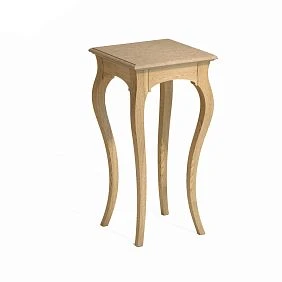
Cabriole. Curved leg in an S-shaped profile — characteristic of French Rococo and Provence. Light, elegant.
Full range of wooden furniture legs — in the STAVROS catalog.
Leg height for console
Standard console table height: 75–85 cm. This is a level at which the console is convenient for use (keys, decor, phone) and correlates well with the height of the mirror above it.
For TV area: console height under the TV — 35–50 cm. This is a "sideboard" level that does not overlap the lower part of the screen.
Proportions of legs and console
The width of the leg (at the base) should be 4–6% of the console width. For a console 100 cm wide — a leg with a diameter of 40–60 mm at the base. Thinner legs give a "light" look, more massive ones — a "heavy", classic look.
Carved wooden console: when and why
Carved wooden console — this is a level of decor where each element carries ornamental content. Carved legs, carved brackets, carved decor on the horizontal frame — this is no longer just "furniture against the wall," but an interior object.
When to choose a carved console:
-
Classic or Baroque interior with rich decor
-
Hall with high ceilings, where the scale allows for large details
-
Study with dark tinting and expressive wall panels
-
Living room with boiserie, where the console must be "on par" with the wall system
-
Any interior where "restraint" has already been achieved and an accent point is needed
For carved consoles, the principle of consistency is important: the ornament of the carved legs should echo the ornament carved decor elements on the wall, with the pattern of the overlays on the furniture and with ornament of decorative elements.
How to choose a console style: decision table
| Style | Elements | Finish | Where to use |
|---|---|---|---|
| Classic | Carved legs, pilasters, baguette, decorative elements | Walnut tinting, patina | Hall, study, living room |
| Neoclassical | Turned legs, moldings, calm trim | Enamel matching the wall color | Entryway, living room, bedroom |
| Provence | Cabriole legs, light carved decor | White or cream enamel | Hallway, bedroom, dining room |
| Cabinet style | Square legs with fluting, boiserie, dark baguette | Wenge, dark walnut | Study, library |
| Modern Classic | Narrow profiles, minimal carving, symmetry | Matte enamel | Living room, hallway |
How to calculate the console area: a step-by-step approach
This is not an abstract method — these are real steps you need to go through before ordering.
Step 1: Measure the wall.
Wall width, ceiling height, location of doors, outlets, switches. Console width = no more than 80% of the wall width. Otherwise, the console "overwhelms" the wall.
Step 2: Determine the type of console.
On legs or wall-mounted? With or without a mirror? Part of the boiserie or standalone? The answers to these questions determine the set of elements.
Step 3: Choose the height.
75–85 cm is the standard for hallways and living rooms. 35–50 cm is for a console in the TV area.
Step 4: Calculate the vertical zone above the console.
If it's a mirror — mirror height + distance from console to mirror (10–15 cm) + 'air' to the ceiling (at least 20 cm from the top edge of the mirror). Everything must fit.
Step 5: Choose the width of moldings and baguette.
Moldings on the wall behind the console: profile width 25–40 mm is optimal. Moldings that are too wide for a narrow wall create a feeling of heaviness.
Step 6: Calculate the legs.
Leg height = console height minus tabletop thickness. Wooden console tabletop thickness: 25–40 mm.
Step 7: Check the passage width.
In the hallway, the console depth (including legs) should not reduce the passage below 80 cm. Optimal passage: 90–100 cm.
Step 8: Coordinate the finishing.
Tinting or enamel — before installation. After: final seams, joints, touch-ups.
Wall behind the console: moldings, trim, and decor
One of the most common miscalculations: the console itself is carefully planned, but the wall behind it is left as is. This is a mistake. The wall behind the console is the background that either supports or ruins the entire composition.
Molding frames
wooden moldings, cornices, and baseboards create a frame structure on the wall behind the console. This is the simplest and most effective way to 'make' a background: one frame the width of the console + one frame the height of the mirror — and the wall already has character.
Trim as a horizontal belt
Wooden trim in the form of a horizontal strip at the height of the console's top edge — this is the 'dividing line' of the wall. Below the line — one design (or just a background). Above — the mirror or decor zone.
Decorative elements as accents
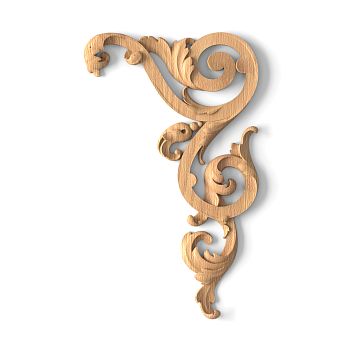
wooden decorative elements — rosettes, cartouches — are installed in the centers of frames on the wall behind the console. Or — one central element along the axis of symmetry above the console, at the 'assembly point' of the entire vertical composition.
Typical mistakes when choosing a wooden console
Mistake 1: Not accounting for the width of the passage
This is the first and most practical mistake. A console 40 cm deep in a hallway 120 cm wide leaves only 80 cm of passage. If there are children, elderly people, or simply those who value comfort in the family, this is insufficient.
Mistake 2: Frame too massive for a narrow wall
An elaborate portal with pilasters and a cornice on a wall 100 cm wide is overload. The scale of the frame should match the scale of the space.
Mistake 3: Mismatched legs and frame
Legs in a 'Provence' style, but the frame in strict neoclassicism. This is a style conflict that is immediately visible.
Mistake 4: Mirror chosen without considering the frame
A mirror without a frame above a console in a classic interior feels incomplete. The mirror should be in a picture frame, coordinated in style and finish with the legs and moldings of the console area.
Mistake 5: Different carving styles
Carved legs from one series + carved brackets from another + decorative elements from a third — they don't work together. All carved decor in the console area must be from a single stylistic system.
Mistake 6: Electrical planning not thought through
Sockets on the wall behind the console, switches — they should either be integrated into the concept or relocated in advance. A socket sticking out of a molding frame is a disaster.
Mistake 7: Leg height not calculated
Legs bought 'by eye', and the tabletop turned out too high or too low for the mirror. Calculation: console height - tabletop thickness = leg height.
Where to buy elements for a wooden console: full list STAVROS
-
STAVROS consoles and frames — solutions for console areas
-
wooden furniture legs — supports for consoles
-
Carved wooden brackets — decorative supports
-
Wooden brackets made from solid wood — for hanging consoles
-
Wooden Picture Frame — for mirror frames and portals
-
wooden moldings, cornices, and baseboards — frames and belts
-
solid wood millwork — moldings and transitions
-
wooden decorative elements — accents and corner elements
-
wooden pilasters and columns — for portals and halls
-
STAVROS carved decor — for classic consoles
-
Boiserie and wall panels — for the wall behind the console
-
furniture solutions — furniture projects
-
TV Zone Frames — for consoles under the TV
Frequently asked questions
What is a wooden console in the interior and how is it different from a shelf?
A console is a decorative area against a wall: a surface on legs or brackets + a decorative program above and behind it. A shelf is only a horizontal storage element. A console is broader in meaning: it's a stage, not an object.
Which console is better for a narrow hallway — on legs or wall-mounted?
For a very narrow hallway (less than 130 cm) — wall-mounted. It doesn't take up floor space and visually 'lightens' the area. For a more spacious hallway — you can use one on legs, provided the tabletop depth is no more than 30–35 cm.
How to choose legs for a wooden console?
The style of the legs should match the interior style: carved for classic, turned for neoclassical, cabriole for Provence. Leg height = console height minus tabletop thickness. Optimal console height: 75–85 cm.
Is a mirror needed above a wooden console?
Not necessarily, but it's desirable in a hallway. A mirror is functional (check appearance before leaving) and decorative (enlarges the space, creates a vertical axis). The mirror should be in a wooden baguette frame, consistent in style with the console.
Can a console be used in a TV area?
Yes. A console area under the TV creates a 'base' for the TV wall. This is either a cabinet on decorative legs or a wall-mounted shelf on brackets, designed in a unified style with the TV frame and wall moldings.
What to pair a wooden console with in a classic interior?
With boiserie on the walls, decorative moldings, wooden frames for mirrors, pilasters on the sides of the portal, carved brackets and decorative elements as accents.
About the company STAVROS
The console area is one of those interior objects that requires systemic thinking: here it is important to choose not one item, but a set of elements that work together. The right legs. The right frame for the mirror. The right moldings on the wall. The right scale and the right finish.
It is this systemic approach that is the principle of STAVROS. A Russian manufacturer of wooden interior and furniture decor from solid wood. Furniture legs, brackets, moldings, baguettes, linear moldings, pilasters, carved decor — everything to ensure that the wooden console in your home is not just an object, but an interior event.
STAVROS — the details that make up the interior.