
























Article Contents:
- Wooden pull handles for furniture: how to choose long handles for kitchen, cabinet, and dresser
- What is a pull handle: shape, function, difference from other types
- Pull handle vs knob handle
- Pull handle vs rail handle
- Anatomy of a wooden pull handle: what you need to know before choosing
- Handle length
- Center-to-Center Distance
- Handle shape
- Where wooden pull handles for furniture are used
- Kitchen: handles for fronts and drawers
- Cabinet: handles for swing doors and built-in systems
- Dresser: handles for horizontal drawers
- Nightstand: handles for small fronts
- Sideboard and display cabinet: handles for classic wooden fronts
- How to choose the length of a pull handle: precise criteria
- Proportion rule: pull handle to front
- Placement of the pull handle on the front
- Symmetry with multiple drawers
- Pull handle shape: style selection table
- Wooden pull handle finish: unfinished or finished
- Uncoated handles: maximum flexibility
- Coated handles: ready for installation
- Enamel for handles
- Varnish for handles
- Tinting for handles
- Patina for handles
- Wooden handle brackets for kitchen: detailed review
- Handle coating for kitchens
- Placement of handles on kitchen fronts
- Matching handle brackets with kitchen decor
- Wooden handle brackets for cabinet: verticality and symmetry
- Rhythm of handles on the cabinet
- Matching with cabinet decor
- How to combine wooden pull handles with STAVROS decor
- Handles + overlays
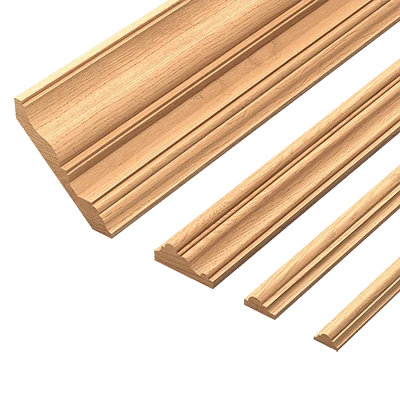
- Handles + moldings
- Handles + millwork
- Handles + furniture legs and base
- Handles + carved decor
- Typical mistakes when choosing pull handles for furniture
- Mistake 1: Too long pull for a small drawer
- Error 2: Bracket too short for a wide drawer
- Error 3: Different bracket lengths on the same dresser or cabinet
- Error 4: Handle overlaps the overlay
- Error 5: Mismatched finish of handles and facades
- Error 6: Inconsistent style of handle and decor
- Error 7: Center distance not checked
- Error 8: Ignoring the opening of adjacent facades
- Where to buy STAVROS wooden pull handles
- Frequently Asked Questions
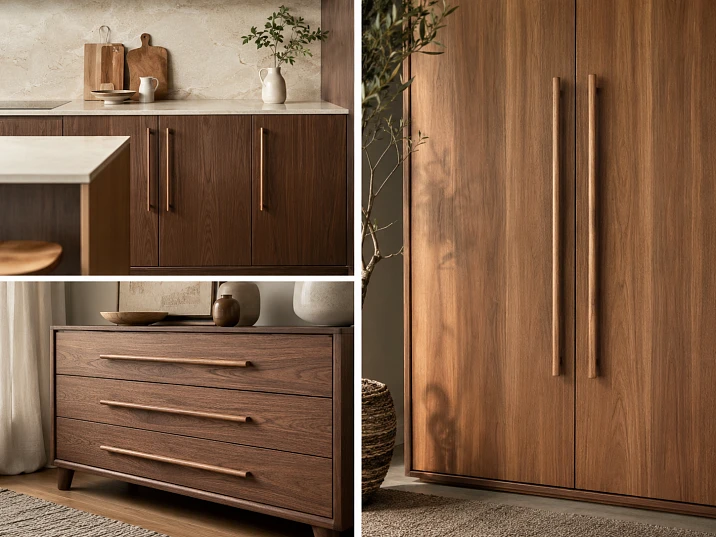
Wooden pull handles for furniture: how to choose long handles for kitchen, cabinet, and dresser
There are details that are almost overlooked when choosing furniture — and it is they that create that very feeling of a "right" or "wrong" interior. A handle is one such detail. A small element that is touched dozens of times a day. That is always visible — in any lighting, from any angle. And that either fits organically into the furniture's image or stands out so much that the eye catches it with every glance.
Wooden pull handles are a separate world within the vast topic of furniture fittings. Not a knob. Not a metal rail. Not a plastic handle from a chipboard set. A solid wood pull handle is both a functional and decorative element. An elongated shape, two attachment points, a comfortable grip along the entire length, natural material.
Let's clarify right away: this article is about furniture pull handles — for facades of kitchen modules, cabinets, chests of drawers, nightstands, sideboards, and furniture compositions. If you are looking for handles for entrance or interior doors, you are slightly off track. This is a different conversation: about wood, about style, about grip, about proportion, and about how STAVROS wooden furniture handles they become part of a unified decorative program of furniture.
What is a pull handle: form, function, difference from other types
Let's start with the basics. A pull handle — what is it and how does it differ from other forms of furniture handles?
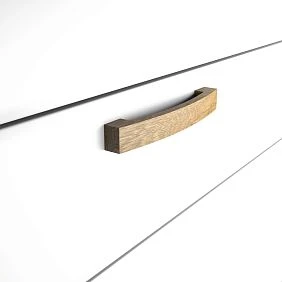
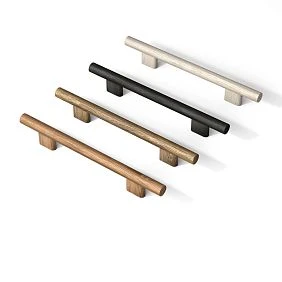
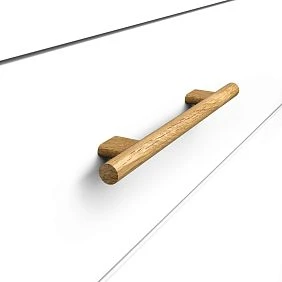
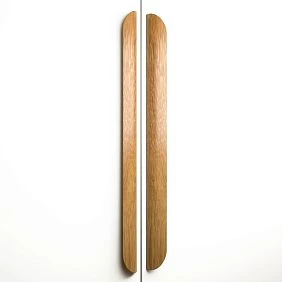
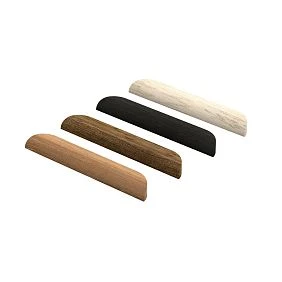
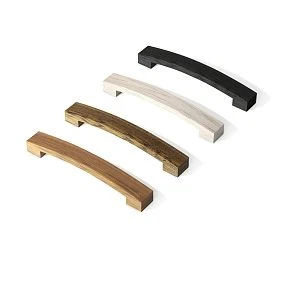
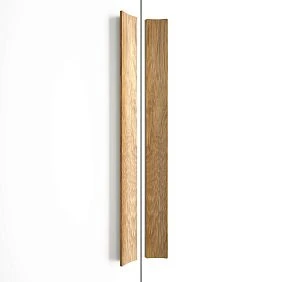
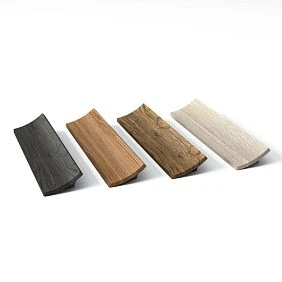
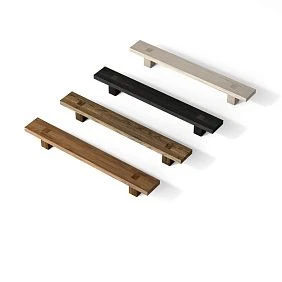
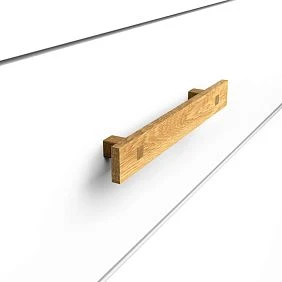
A pull handle is a U-shaped or elongated handle with two attachment points. Between the two mounting pins runs the handle — straight, slightly curved, or shaped. It is this part that fingers grasp when opening a drawer or door.
Our factory also produces:
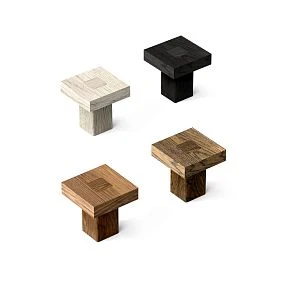
Pull handle vs. knob
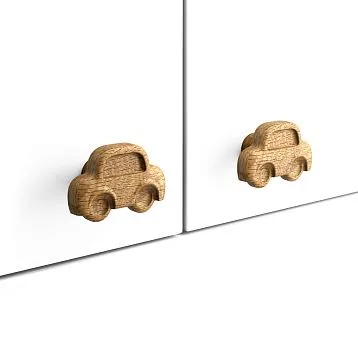
A knob is small, round or multi-faceted, with a single attachment point. It is used on small drawers and lightweight doors. It is compact and takes up almost no space on the facade.
A pull handle is longer, horizontal or vertical on the facade, and occupies a noticeable area. Its advantages:
-
Comfortable grip: the handle is grasped with the whole palm or several fingers — depending on the length
-
Stability: two mounting points are more reliable than one
-
Decorative horizontal or vertical: the bracket creates a line on the facade that emphasizes the direction
On a kitchen drawer 80 cm wide, a knob looks lonely and random. A 160 mm long bracket creates an expressive horizontal line that "holds" the facade.
Get Consultation
Bracket handle vs. rail handle
Rail handles are typically metal (aluminum, chrome, stainless steel). They are often used in modern kitchens and minimalist interiors.
Wooden bracket handles are a different style, a different material, a different aesthetic. They are appropriate where metal would look alien: in a classic solid wood kitchen, in a cabinet with moldings and overlays, in a carved chest of drawers for tinting or enamel.
Wooden furniture bracket handles made of solid wood accept any finish — varnish, tinting, enamel, patina. This is a fundamental advantage over metal: wood organically merges with the wooden facade into a single system.
Anatomy of a wooden bracket handle: what you need to know before choosing
Before moving on to application scenarios, let's break down the technical parameters. There are three: length, center distance, and handle shape.
Handle length
The total length of the bracket handle is from end to end, including the side pins. This is what you see on the facade.
-
Short brackets: 80–128 mm — for small drawers and compact cabinets
-
Medium brackets: 128–192 mm — a universal option for most kitchen and cabinet fronts
-
Long brackets: 192–320 mm — for wide drawers, tall doors, and tall cabinets
Long wooden handle brackets create a more expressive horizontal line. On a wide kitchen drawer (900–1200 mm), a 256–320 mm bracket looks proportional. The same bracket on a 400 mm drawer would be too large.
Center-to-center distance
Center-to-center distance — the distance between two mounting points (center of pin to center of pin). This parameter is used to select holes in the facade.
Standards: 64, 96, 128, 160, 192, 256 mm. Before ordering a handle, you need to know the center-to-center distance of the holes already drilled in the facade — or plan drilling for the selected handle.
Handle shape
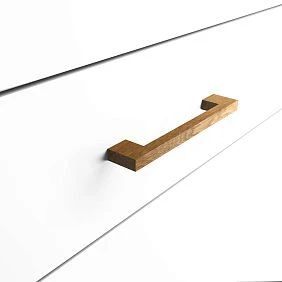
Straight handle — a horizontal bar without curves. Strict, geometric look. For neoclassical and cabinet style.
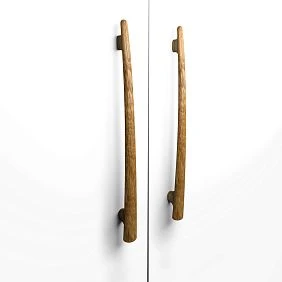
Rounded handle — with a slight profile or rounded edges. Softer, 'Provencal' look. Pleasant to the touch.
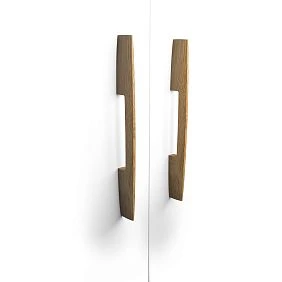
Shaped handle — with breaks, profile, and ridges. For classic furniture and carved facades. The handle becomes a decorative element — not just a functional item.
Where are wooden handle brackets for furniture used?
Wooden handle brackets are a versatile furniture element. But each application scenario has its own specifics.
Kitchen: handles for fronts and drawers
The kitchen is the most intensive "field" for furniture handles. They are touched hundreds of times a week. Here, convenience, durability, and aesthetics are all important.
STAVROS kitchen solutions include classic and neoclassical systems, where wooden handle brackets are an organic part of the decorative program.
Lower kitchen drawers (width 400–900 mm). The most used ones. The handle bracket here is the main gripping element. For drawers 400–600 mm — a bracket with a center distance of 96–128 mm. For drawers 600–900 mm — 128–192 mm.
Tall fronts (pantries, columns, tall cabinets). On tall doors, the handle bracket is placed vertically or in the lower third of the front — where the hand naturally reaches. Bracket length: 128–192 mm.
Upper wall cabinets. The handle should be convenient for gripping from below-upwards. For upper cabinets, medium-sized brackets (96–128 mm) are often used, oriented at the bottom of the front.
Solid wood kitchen under lacquer or tinting. handles without coating — the right choice: can be tinted in the same color as the front, emphasizing the naturalness of the material.
White enamel kitchen. Handles with Finish White enamel provides a unified color scheme. Or handles without coating for self-painting to match the kitchen color.
Cabinet: handles for hinged fronts and built-in systems
On a cabinet, a pull handle works differently than in a kitchen. Here the movement is different: the door is pulled towards you, and the handle must provide a secure yet unobtrusive grip.
for STAVROS cabinet system solutions Pull handles are part of the decorative program, alongside moldings, overlays, and cornices.
Wardrobe for clothes (2–4 doors). The pull is placed in the lower third of a tall door — or in the center if the door is not too tall (up to 180 cm). Pull length: 128–160 mm. Orientation — vertical or horizontal as needed.
Built-in floor-to-ceiling wardrobe. Door height 220–260 cm. Handle in the lower third. For convenience, a vertically oriented pull: it is grasped when moving from top to bottom.
Sliding wardrobe. For sliding doors, the handle must be flush-mounted or have minimal protrusion to avoid interfering with rail movement. A wooden pull with a slight protrusion (20–30 mm) is a suitable solution.
Bookcase with carved decor. Here, pull handles are often small (96–128 mm) and vertical — to maintain the vertical rhythm of the bookcase.
Chest of drawers: handles for horizontal drawers
On a chest of drawers, a pull handle always works horizontally: the drawer pulls forward, and the grip is crosswise. A horizontally oriented pull is the classic choice for a chest of drawers.
for chests of drawers and cabinets STAVROS wooden pull handles are selected according to the width of the drawer.
Wide drawer (600–900 mm). Pull length 160–256 mm centered on the drawer. Creates an expressive horizontal line.
Compact drawer (300–500 mm). Pull length 96–128 mm. Does not overload a small front.
Carved chest of drawers with overlays. The pull should not cover the central overlay. Placement: below the overlay or next to it — considering symmetry.
Cabinet: handles for small fronts
A cabinet is a small piece of furniture. Here, a mistake in handle size is especially noticeable: a pull that is too long on a small cabinet 'takes over' the entire front.
For a bedside cabinet (front width 400–500 mm) — pull 80–96 mm. Compact, neat, proportional.
For a TV stand or console (width 800–1200 mm) — one central bracket 160–192 mm or paired brackets of 96–128 mm each.
Sideboard and display cabinet: handles for classic wooden fronts
A sideboard is already 'serious' furniture with architectural pretensions. Here, bracket handles should be coordinated with the overall decor: cornice, moldings, overlays.
For a classic-style sideboard — brackets with shaped or rounded handles. For lower solid doors — horizontal brackets in the lower third. For upper glass doors — compact brackets in the center or at the bottom.
How to choose the length of a bracket handle: precise criteria
Length is the first question when choosing. And there is no universal answer: 'the longer the better' is as wrong as 'the shorter the neater'. Length is proportion.
Proportion rule: bracket to facade
A wooden bracket handle should not exceed 30–35% of the facade width of a drawer or door. Otherwise, it will 'overpower' the entire facade.
Examples:
-
Drawer width 400 mm → bracket up to 128 mm
-
Drawer width 600 mm → bracket up to 192 mm
-
A box 900 mm wide → bracket up to 256–288 mm
Bracket placement on the front
Center of the front — universal placement for most fronts.
Lower third — for tall cabinet doors. The hand naturally reaches there when opening.
Upper third — rarely used, but for lower drawers if the drawer front is low and the lower third is too close to the floor.
Symmetry with multiple drawers
If a chest has 3–4 drawers of different widths — the handles on each drawer should be the same length or proportionally matched. You cannot install brackets of different lengths on drawers in the same row: this disrupts the visual rhythm.
Bracket handle shape: style selection table
| Handle shape | Furniture style | Suitable furniture | Feeling |
|---|---|---|---|
| Straight smooth | Neoclassical, study | Cabinet, strict kitchen | Restraint, clarity |
| Straight with chamfer | Modern Classic | Kitchen, cabinet | Laconic with character |
| Rounded | Provence, soft classic | Dresser, nightstand, kitchen | Softness, naturalness |
| Shaped with belts | Classic, Baroque | Carved chest, sideboard | Decorativeness, "story" |
| Turned with profile | Neoclassical, study | Bookcase, sideboard | Elegance, strictness |
| Compact button bracket | Any style | Chest, small drawer | Neatness |
Coverage of wooden handle brackets: without coating or with coating
The coverage question is about who holds the final decision on color and finish.
Uncoated handles: maximum flexibility
handles without coating — this is a "blank canvas." Wood without varnish, without tinting, without enamel. They are used when handles need to be coated in the exact color of the project:
-
Paint with white enamel to match a white kitchen
-
Tint to walnut — to match the oak facade
-
Coat with matte varnish — to match natural wood
-
Apply patina — to match a carved classic chest of drawers
Uncoated handles accept any finish you apply to a wooden facade. One color, one can, one day — and the handles are indistinguishable from the facade in color.
This is the ideal choice for projects where the craftsman paints all wooden parts systematically: facades, overlays, moldings, and handles in one finish.
Handles with coating: ready for installation
Handles with Finish — this is a ready-made solution. The handle is already painted or tinted: it can be installed immediately upon receipt.
Suitable when:
-
The furniture is already ready and you need to choose a handle to match the existing color
-
There is no opportunity or desire to paint the handles yourself
-
A quick ready-made solution for a specific interior is needed
Enamel for handles
Enamel is the most popular coating for handles of classic and neoclassical furniture. Matte or semi-matte white enamel on a wooden bracket is a uniform smooth surface without a visible wood grain pattern.
Advantage: when painted together with facades — complete color unity. A defect in one is a defect in the other: both the handle and the facade are painted simultaneously.
Varnish for handles
Transparent or semi-transparent varnish preserves the wood texture. A natural oak handle under matte varnish + an oak facade under the same varnish = a living unity of natural material.
Important: the type of varnish (matte, semi-matte, glossy) must match the coating of the facades.
Tinting for handles
Stain in walnut, oak, cherry, or wenge + clear topcoat varnish. Changes color, preserves texture. For classic and office furniture — one of the best options.
Patina for handles
Patina on a wooden pull handle with a shaped profile is a "living surface" with history. Dark recesses of the relief + light protrusions. It reads especially well on shaped pulls with belts and breaks.
Wooden pull handles for the kitchen: detailed analysis
The kitchen is a special place for handles. Here they are exposed to moisture, grease, and temperature changes. Therefore, a wooden handle for the kitchen must be not only beautiful but also properly protected.
Finish of handles for the kitchen
For the kitchen, a closed coating is recommended: oil enamel or acrylic-polyurethane varnish. They form a protective layer that does not allow moisture inside the wood.
Pure oil (without varnish) is not the best choice for kitchen handles: the surface remains open and absorbs grease. Patina without a topcoat varnish — the same.
Placement of handles on kitchen facades
This is a topic that sparks debate. There are no uniform standards — but there are practical guidelines:
Lower drawers. Handle centered horizontally, in the upper quarter of the facade vertically. When opening, the hand pulls down and toward itself — the handle should be comfortable for this movement.
Tall facades (tall cabinets). Handle in the lower third — at about 1/3 from the floor. The hand reaches there in a normal standing position.
Upper wall cabinets. Handle at the bottom of the facade — for grip when opening downward and toward yourself.
Coordinating pull handles with kitchen decor
If the kitchen is designed in a classic style with wooden moldings and cornices, carved inlays и molding strips — the pull handles should be "from the same language."
A shaped pull with a profile + facade moldings with a similar profile = decorative consistency.
A straight pull without a profile + intricate carved overlays = contrast (possible if intentional).
Wooden handle brackets for cabinet: verticality and symmetry
A cabinet in the bedroom, dressing room, or hallway is a long horizontal volume divided into sections. Each door has a handle. And the placement of handles on all doors should form a proper rhythm.
Rhythm of handles on the cabinet
If the cabinet has three doors, all three handles should be at the same height — either in the center of each door or at the same distance from the edge. Breaking this rhythm creates a sense of chaos.
A vertical bracket on a tall door reads as an accent on verticality — and supports the 'tall' character of the cabinet. A horizontal bracket on the same door visually 'lowers' the door.
Coordination with cabinet decor
If the cabinet is decorated with wooden pilasters и cornices — the handles should be stylistically consistent. A strict cabinet with geometric moldings → a strict straight bracket. A classic cabinet with stucco overlays → a shaped bracket with a profile.
How to combine wooden handle brackets with STAVROS decor
Solid wood handle brackets are part of a large decorative system. They do not exist separately from the rest of the furniture decor.
Handles + overlays
Carved decorative inserts for furniture create a central accent on the facade. The handle bracket should be positioned so as not to overlap the overlay or 'compete' with it.
Scheme: overlay in the center of the facade → handle below the overlay. Or: handle in the center → overlay above, in the upper zone of the frame.
The style of the bracket handle should be 'of the same family' as the style of the overlay. A floral overlay + a rough straight bracket is a dissonance. A floral overlay + a bracket with soft curves is harmony.
Handles + moldings
Wooden moldings on the facades create a frame system. The bracket handle should fit into this frame field — not extend beyond the moldings, not disrupt the frame.
If the molding frame has a profile with three bands — a bracket with a similar profile creates a 'rhyme'. This is a subtle decorative technique that is not consciously perceived but creates a feeling of 'correctness'.
Handles + trim
solid wood millwork on vertical layouts of the body creates vertical lines. A handle bracket in a vertical orientation on the door continues this vertical rhythm.
Handles + furniture legs and base
In the system solid wood STAVROS products Handles, legs and plinth create the top and bottom "strapping" of furniture. Handles are a decorative element at eye and hand level. Legs and plinth are near the floor.
Consistency: a shaped bracket + shaped legs with a profile = a unified decorative language of the furniture.
Handles + carved decor
If the furniture is styled with STAVROS carved decor — acanthus leaves, garlands, cartouches — the handle should not be too "quiet." A plain straight bracket against a background of rich carved decor looks out of place. Here, a shaped bracket with relief is needed.
Typical mistakes when choosing bracket handles for furniture
Mistake 1: Bracket too long for a small drawer
A bracket occupying more than 40% of the facade width overloads it. The facade "works" for the handle, not for the furniture decor.
Mistake 2: Bracket too short for a wide drawer
A small bracket on a large drawer looks lonely and is functionally inconvenient. The grip is inadequate — you have to "hook" it with your fingertips.
Error 3: Different length of brackets on one dresser or cabinet
On all drawers of the same size — identical handles. On drawers of different sizes — proportionally selected brackets. But different handle models in one item — only an intentional design technique, not a coincidence.
Error 4: Handle overlaps the overlay
If a bracket handle is placed directly above the central overlay, it "covers" the decor. Plan the placement of the handle and overlay together, before installation.
Error 5: Different finish of handles and facades
The handle is painted with white enamel, the facade is beige. Or the handle is dark walnut, the facade is light oak. All this is the result of unplanned selection. The finish of handles and facades should be one color, one day.
Mistake 6: Mismatched style of handle and decor
A straight minimalist bracket on a richly decorated classic dresser with carved overlays is a stylistic break. A shaped bracket with at least a minimal profile is needed.
Mistake 7: Center-to-center distance not checked
Ordered handles with a center distance of 128 mm, but the holes in the facade are 96 mm. Result — mismatch. Always check the center distance before ordering.
Error 8: Ignoring the opening of adjacent facades
In a kitchen, adjacent doors can interfere with each other when opening if the handles protrude too far. Check the bracket projection in combination with the kitchen unit geometry.
Where to buy STAVROS wooden pull handles
All wooden furniture handle brackets made of solid wood — in the STAVROS catalog:
-
STAVROS wooden furniture handles — full catalog of furniture handles
-
handles without coating — for painting, tinting, and varnishing for your project
-
Handles with Finish — ready-made color and finish solution
-
Carved decorative inserts for furniture — for joint selection with handles
-
wooden moldings, cornices, and baseboards — front frames and profiles
-
solid wood millwork — trims and horizontal elements
-
wooden decorative elements — sockets and corner accents
-
STAVROS carved decor — for classic furniture projects
-
Solid Wood Items — full catalog of wooden elements
-
Kitchen solutions — system solutions for kitchen projects
-
Solutions for cabinets — for cabinet systems and built-in furniture
-
STAVROS chests of drawers and cabinets — for storage solutions
Frequently asked questions
What are wooden pull handles?
These are elongated furniture handles made of solid wood with two mounting points. They are used on the fronts of kitchen modules, wardrobes, chests of drawers, cabinets, sideboards, and furniture compositions. STAVROS produces pull handles from solid wood in various shapes and sizes.
How is a bracket handle different from a knob handle?
A knob handle is compact, with one mounting point. A bracket handle is elongated, with two mounting points. The bracket is more convenient for wide drawers and creates a horizontal decorative line on the facade.
What length of pull should I choose?
The length should not exceed 30–35% of the facade width. For 400 mm drawers — up to 128 mm, for 600 mm — up to 192 mm, for 900 mm — up to 288 mm.
What to choose: handles without coating or with coating?
Handles without coating — for painting in the project color. Handles with coating — for a ready-made solution. If you paint all the furniture yourself — choose without coating.
Can wooden pull handles be painted?
Yes. Solid wood handles accept enamel, tinting, varnish, patina, and oil. Painting should be done before installation, simultaneously with the fronts.
How to coordinate pull handles with carved overlays?
The handle should not overlap the overlay. Place the handle below the overlay or next to it — considering symmetry. The style of the pull handle should be from the same decorative family as the style of the overlay.
Are wooden pulls suitable for a sliding wardrobe?
Yes, if the pull protrusion is minimal (20–30 mm). For sliding wardrobes, you cannot use bulky pulls with a large protrusion: they will interfere with the movement of doors along the rails.
How to determine the required center-to-center distance?
Measure the distance between two holes on the facade (from center to center). Standards: 64, 96, 128, 160, 192, 256 mm. Or plan drilling for the selected handle.