









































































Article Contents:
- What is a wooden decorative beam
- Why a decorative beam is a full-fledged design tool
- Where wooden ceiling beams are used
- Living Room
- Kitchen-living room
- Attic
- Country house
- Hall and Foyer
- Restaurants, cafes, hotels
- Office and Library
- How a faux beam differs from a real one: an honest breakdown
- Real solid wood beam
- Decorative faux beam
- Hidden communications inside a false beam
- How to choose the size of a wooden beam
- Ceiling height — first filter
- Room area — second filter
- Spacing between beams
- Beam length
- Wooden beam for the living room: creating a ceiling with character
- Transverse arrangement
- Longitudinal arrangement
- Caisson grid
- Beam above the fireplace area
- Combining beams with lighting fixtures
- Beams for a kitchen-living room: zoning without partitions
- How to arrange beams in a kitchen-living room
- Color of beams in a kitchen-living room
- Wooden beam for a country house and attic
- High ceilings and open space
- Combination with wooden elements
- Beams in the attic: a special scenario
- Beams and fireplace
- How to choose the color and finish of a wooden beam
- Natural light wood
- Dark tinting
- Beams matching the ceiling color
- Painting in an accent color
- Coordinating with wooden interior details
- What to pair wooden ceiling beams with
- Wooden moldings and cornices
- Wall moldings
- Wooden doors and architraves
- Wall Panels
- Lighting
- Fireplace area
- Installing a wooden faux beam: what you need to know
- Method of mounting
- Work sequence
- Important details
- Mistakes when choosing a wooden beam
- Where to buy a wooden beam for the ceiling
- FAQ: Answers to Popular Questions
- About the manufacturer
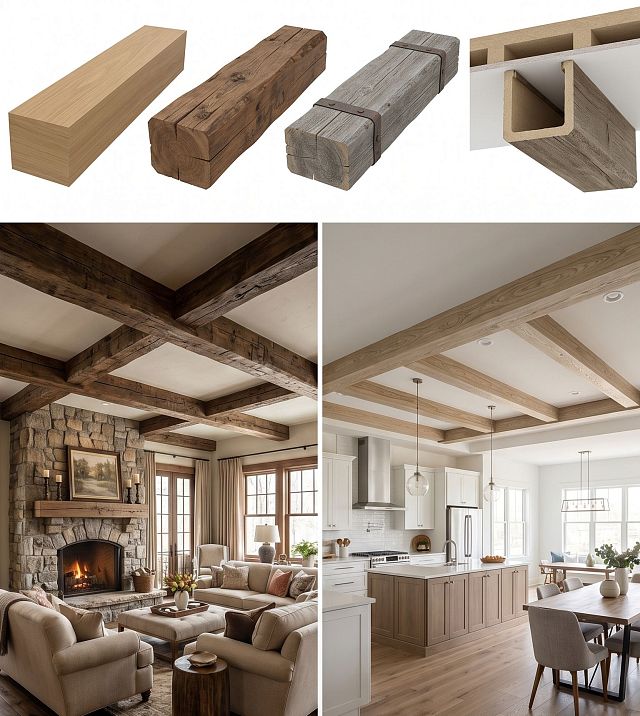
A ceiling with beams is not just an interior technique. It is an architectural statement. When dark wooden beams run overhead, the space instantly acquires character: solid, lively, warm. This is exactly what most modern apartments and houses lack with their perfectly white, absolutely smooth, completely faceless ceilings.
Wooden beam for the ceiling — is one of those elements that radically change the perception of space. Not pointwise, not delicately, but radically: a room with beams and a room without beams are two different interiors. One is functional. The other has a soul.
But how to choose correctly? What size is needed for your ceiling? How many beams are enough, and how many is already overload? What coating to choose so that the beams match the floor, furniture, and doors? And what is generally better: a real solid wood beam or a decorative faux beam? This article answers all questions. Exhaustively and to the point.


What is a wooden decorative beam
Let's start with a definition, because confusion here is common.
A structural beam is a load-bearing element of the roof, floor, or house frame. It takes the load from the structures above and is a mandatory engineering element. It cannot be replaced or removed without calculation and approval.
A decorative faux beam is a purely aesthetic element. It carries no load: it is a wooden profile of U-shaped or rectangular cross-section that is put on or attached to the ceiling to create the effect of a beam ceiling. This article is about it.
decorative wooden beam — is a ready-to-install element made of solid or glued wood. It can be open at the top (U-shaped profile that fits over a mounting beam) or closed (full rectangle that is attached entirely). Inside a hollow U-shaped beam, it is convenient to hide electrical wiring, LED strips, or other communications.




Why a decorative beam is a full-fledged design tool
Some believe that a "fake" beam is a compromise. In reality, it is not. A decorative false beam solves the same visual tasks as a structural one, while:
-
weighs many times less — no load on the ceiling;
-
installed without construction work — only fasteners;
-
allows you to choose any size, shape, and finish;
-
can be replaced or removed without damaging the structure.
This is pure aesthetics with full control over the result.
Our factory also produces:




Where wooden ceiling beams are used
The scope of decorative beams is wider than commonly thought.
Get Consultation
Living Room
The main room of the house — the main potential for beams. Beams in the living room create a ceiling rhythm, visually structure the space, make a high ceiling cozy rather than intimidating. They can run across the room, along it, or form a coffered grid.
Kitchen-living room
An open kitchen-living room space is an ideal field for beams. Two or three beams placed across the combined space create zoning without partitions: under one beam — the kitchen, under another — the dining area, under the third — the living room. This is not just beautiful — it is smart.
Attic
The pitched roof of an attic almost always has structural rafters. Decorative beams that follow the roof slope or run horizontally enhance the character of the space. An attic with beams is a separate architectural world, intimate and expressive.
Country house
This is where beams are most organic. High ceilings, wooden details, a fireplace, open space — and beams as an architectural constant of the entire interior. wooden ceiling beam in a country house — it's not decor. It's character.
Hall and Entrance
In a spacious hall, beams set the direction — they guide the gaze deep into the space. One or two beams in the center of the hall create a corridor of attention.
Restaurants, cafes, hotels
Commercial interiors actively use wooden beams to create an atmosphere: coziness, warmth, "homeliness" — exactly what a restaurant visitor or hotel guest is looking for. Beams in a restaurant are a style that works for the establishment's reputation.
Office and library
An office with dark wooden beams, bookshelves, and leather furniture is an archetype of a wealthy space. Here, beams create a feeling of solidity and seriousness.
How a faux beam differs from a real one: an honest breakdown
This question arises for everyone who starts thinking about beams. We answer honestly.
Real solid wood beam
A full wooden beam installed as a structural or visible decorative element. Heavy — 5–15 kg per linear meter depending on the cross-section. Requires reliable fastening in load-bearing structures or a wooden frame. Suitable for houses with open frames, log cabins, and houses with visible rafters.
In an apartment or a house with a concrete floor, installing real solid wood beams is a serious construction job.
Decorative faux beam
A U-shaped wooden profile that fits over a mounting beam and is fixed with glue and screws. The front and side faces are made of natural wood, so visually the faux beam is almost indistinguishable from a real one. Weight — 1–3 kg per linear meter.
Installed on any type of ceiling: concrete, drywall, wood. No special construction work required.
Conclusion: for most residential interiors — apartments, townhouses, country houses with concrete floors — decorative wooden beam is the optimal solution in all respects: weight, installation, aesthetics, price.
Hidden utilities inside the faux beam
An important practical bonus: the hollow U-shaped faux beam is a channel for concealed electrical wiring. LED strip lighting along the beam, wires for recessed lights, smart home system cables — all neatly hidden inside.
How to choose the size of a wooden beam
Beam size is not just about aesthetics. It's a balance between the scale of the element and the scale of the space. A mistake here creates either an unnoticeable decor or an oppressive ceiling.
Ceiling height is the first filter
Ceiling height determines the allowable height of the beam profile.
| Ceiling Height | Recommended beam height | Beam width |
|---|---|---|
| 2.4–2.6 m | 80–100 mm | 60–80 mm |
| 2.6–2.8 m | 100–130 mm | 80–100 mm |
| 2.8–3.2 m | 120–180 mm | 100–140 mm |
| 3.2–4.0 m | 160–250 mm | 140–200 mm |
| Above 4.0 m | 250 mm and more | 200 mm and more |
There is no strict rule — but there is a principle: the higher the ceiling, the larger the beam can be. With a ceiling of 2.4 m, a beam 200 mm high creates visual pressure.
Room area is the second filter
In a large space, a thin beam gets lost. In a small room, a massive beam feels oppressive. Optimal ratio: beam width in centimeters = 1–1.5% of the long side of the room in centimeters.
Room 800 cm long — beam width 80–120 mm. Room 400 cm — beam width 40–60 mm.
Spacing between beams
The distance between beams determines the rhythm of the ceiling. Too frequent spacing — the ceiling becomes heavy and fragmented. Too sparse — beams look random. Optimal spacing: 80–150 cm depending on room size and ceiling height.
For a room 5×6 m with a ceiling of 3 m: 3–4 beams with a spacing of 100–120 cm — an expressive rhythm without overload.
Beam length
The beam should span the room from wall to wall or lie within a designated zone. Joints in the middle of the span are acceptable but must be executed neatly: a connecting plate is used at the joint, or the joint is covered with an additional detail.
Purchase beams with a 5–10% margin for trimming and unforeseen circumstances.
Wooden beam for the living room: creating a ceiling with character
The living room is the most advantageous place for ceiling beams. It is here that beams provide maximum visual effect with minimal cost.
Transverse placement
Classic: beams run across the long axis of the living room. They create rhythm and make the ceiling "alive." With a high ceiling (from 2.8 m), transverse beams reduce the feeling of height — the room becomes cozier.
Longitudinal placement
Beams along the long axis of the room "lead" the gaze deep into the space. This is a technique that visually lengthens the room. It is good for elongated living rooms.
Caisson grid
The intersection of longitudinal and transverse beams creates a caisson ceiling — a system of rectangular cells. This is a formal, monumental technique. For high ceilings from 3.0 m. For a small room, it is too complex.
Beam above the fireplace area
One accent beam above the fireplace or above the sofa area is not a system, but a single accent. It fixes the zone, creates a "ceiling above the fireplace" — a very expressive technique in a country interior.
Combination of beams with lighting fixtures
Wooden beam perfectly combined with built-in spotlights directed between the beams. Or — with pendant lights mounted on the beams. Or — with hidden LED lighting along the bottom edge of the beam.
Beams for a kitchen-living room: zoning without partitions
An open kitchen-living room is a space where everything is visible at once and simultaneously. Zoning it is difficult: partitions disrupt openness, furniture does not always set a clear boundary.
Beams solve this problem elegantly. One or two beams placed across the combined space at zoning points create 'invisible walls' — they are not physically there, but the eye perceives them.
How to arrange beams in a kitchen-living room
Option 1. One beam above the dining table. It separates the dining area from the kitchen and the living room. Above the table — the space is 'marked'.
Option 2. Two beams: one above the kitchen/dining transition, the second above the dining/living room transition. Three zones — two 'boundaries'.
Option 3. A series of beams only above the kitchen area. The living room remains with an open ceiling — a contrast effect.
Color of beams in a kitchen-living room
In a kitchen-living room, beams should 'get along' with the kitchen furniture. If the kitchen is in dark veneer — beams in dark tint. If the kitchen is white or gray — beams in light oak or white enamel. Contrast between beams and ceiling is appropriate — it creates expressiveness.
Wooden beam for a country house and attic
A country house is where wooden beams feel at home. Literally.
High ceilings and open space
In houses with ceilings of 3.5–5 m, beams are not just decor — they are an architectural necessity. Without them, the high space feels empty and cold. With beams, it feels grand yet cozy. This is an important psychological balance.
Combination with wooden elements
A country house typically has wooden doors, wooden baseboards, wooden furniture. Wooden trim, wooden cornice and beams with the same tint create a unified wooden ensemble where each element supports the others.
Beams in the attic: a special scenario
An attic with a pitched roof is a space where beams appear naturally as part of the structure. Decorative false beams in the attic can:
-
follow the slope of the rafters, creating a cascading effect;
-
go horizontally, contrasting with the roof slope;
-
make "cells" between the rafters if the attic is wide enough.
In the attic, beams are almost always appropriate — the question is only about size and tint.
Beams and fireplace
Wooden beams above the fireplace wall — a classic scenario. The fireplace, wooden cornice fireplace portal, wooden beams on the ceiling — this is a warm, archetypal image of a country house.
How to choose the color and finish of a wooden beam
The color of the beams is perhaps the most crucial choice. It determines how the beams will fit into the interior.
Natural light wood
Light oak, ash, pine in natural tone — for Scandinavian style, light interiors, kitchens with white furniture. The beams do not dominate but are present — adding warmth without weight.
Dark tinting
Stain in dark walnut, wenge, or "aged wood" — for rustic interiors, chalet style, country houses with dark furniture. Dark beams on a white ceiling — a powerful visual contrast.
Rule: if the floor is dark, the beams can match the floor tone. This creates a sense of a "frame" of space at the top and bottom.
Beams in the color of the ceiling
A wooden beam painted white or cream—matching the ceiling color—creates a restrained architectural relief without sharp contrast. The ceiling gains structure but doesn't become "heavier." This is the right choice for low rooms.
Painting in an accent color
A non-standard but striking technique: beams in graphite, anthracite, or even dark green. Used in modern interiors with accent colors.
Coordination with wooden interior details
Beams should be coordinated with wooden skirting board, door trims, wooden moldings and furniture. One tint tone for all wooden elements is a sign of a well-thought-out interior.
What to pair wooden ceiling beams with
Beams work in a system. In isolation — expressively. In a system — architecturally.
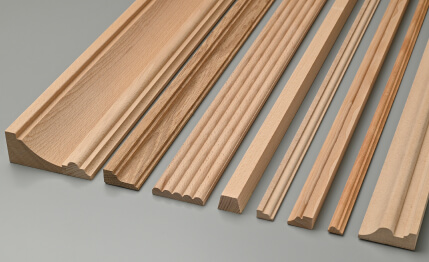
Wooden moldings and cornices
If the beams are in a dark tone — wooden cornice around the perimeter of the ceiling in the same tone creates a "frame" for the beam ceiling. Beams + cornice — this is already a complete ceiling composition. Add to this Wooden baseboard in the same tone near the floor — and the entire room receives a unified wooden ensemble.
Wall moldings
Wooden moldings on the walls in combination with beams on the ceiling — this is an interior level that visually reads as an expensive architectural object. Moldings and beams made of the same material and the same tint create a unified wooden framing of the space.
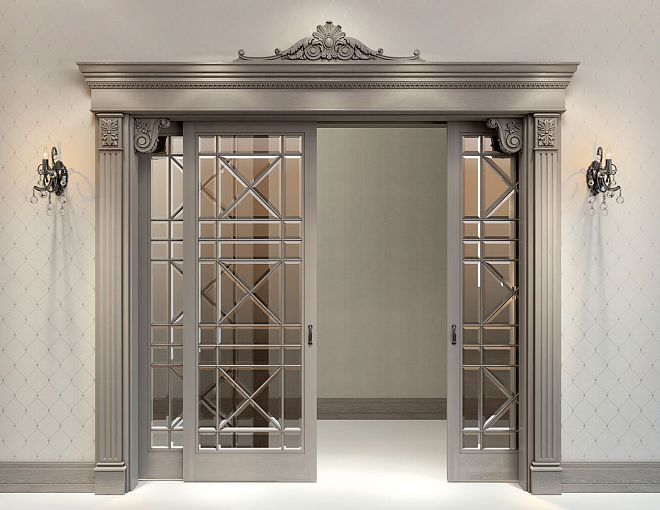
Wooden doors and architraves
Wooden doors with a tint matching the tone of the beams — this is a "connection" between vertical and horizontal elements. Beams on the ceiling echo the doors — and the space gains unity.
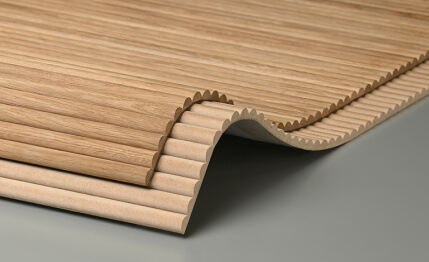
Wall panels
Wooden wall panels (slats or wide boards) in combination with wooden beams — a popular technique in country, chalet, and modern classic styles. Beams continue the "wooden note" set by the walls.
Lighting
Beams and lighting — a separate topic. Main options:
LED strip lighting along the beam. The tape is placed in the lower or side groove of the beam. The light spreads along the ceiling — softly, atmospherically.
Pendant lights on a beam. Track or pendant lights are mounted directly to the beam. This is appropriate above a dining table or a work area.
Recessed lights between beams. Spotlights or recessed lights are installed in the ceiling between beams. The beams create "cells" in which the lighting operates.
Fireplace zone
A fireplace and wooden beams are a time-tested pair. Beams above the fireplace complete the fireplace composition, giving it a ceiling dimension. Add wooden cornice above the fireplace portal — and the fireplace wall becomes a complete architectural feature.
Installing a wooden false beam: what you need to know
Installing a decorative false beam is not construction work, but finishing work. It is accessible to a person with a standard set of tools.
Fastening method
Wooden mounting block. A wooden block of the required length and cross-section (40×40 mm or 50×50 mm) is attached to the ceiling. A U-shaped false beam is placed over the block and fixed with self-tapping screws through the side edges from the inside.
Direct mounting. Some beam structures are attached directly to the ceiling through holes in the internal flanges of the profile. For a concrete ceiling — dowels.
Adhesive mounting + self-tapping screws. For lightweight beams — construction adhesive along the perimeter of the top edge + a few self-tapping screws through the mounting element.
Work sequence
-
Marking the positions of beams on the ceiling
-
Installation of embedded beams
-
Electrical wiring (if needed)
-
Putting on and fixing false beams
-
Sealing ends (plugs or wall finishing)
-
Painting or tinting (if beams are not pre-painted)
Important details
The ends of the beams at the wall must be beautifully closed: either with a plug matching the beam tone, or decorated with a decorative element. An unclosed end with a visible beam is a mistake that ruins the impression.
Joints of beams in the middle of the span (if the beam length is less than the span) must be made neatly: a 90° cut with precise texture matching, or the joint is covered with a decorative belt.
Mistakes when choosing a wooden beam
Let's look at the mistakes that are made most often. Some of them are only discovered after installation.
Using too massive a beam for a low ceiling. A beam 200 mm high with a ceiling of 2.5 m visually "lowers" the ceiling and literally presses down. For low ceilings — maximum 80–100 mm high and a light tint tone.
Not considering the room scale. A thin beam of 60 mm in a living room 8×10 m will get lost. A wide beam of 180 mm in a room of 15 m² will overload. Scale is always relative.
Choosing the color separately from furniture and flooring. Dark beams with light parquet and light furniture — dissonance. First determine the overall color scheme of the interior, then choose the beam tone.
Making the spacing between beams too frequent. A spacing of 50–60 cm with a height of 2.7 m creates a feeling of a cage, not an architectural rhythm. The optimal spacing is 80–150 cm.
Not planning the lighting. Beams affect light distribution: they create "cells" between themselves. If lighting is not coordinated with the beams — part of the room will be in shadow.
Confusing a structural beam with a decorative one. In a house with real structural beams, adding decorative false beams should be coordinated in size: all beams should look the same — or decorative ones should clearly differ.
Not calculating the quantity and length in advance. Calculate the exact footage with a 10% margin. Order everything at once — a repeat order may give a different shade.
Forgetting about ends, corners, and joints. Installation without finishing the ends is unfinished work. Plan plugs and corner elements even before ordering the beams.
Where to buy a wooden beam for the ceiling
Buy a wooden beam for the ceiling in the interior, it is important to have precise dimensional characteristics and real photos of products from the manufacturer.
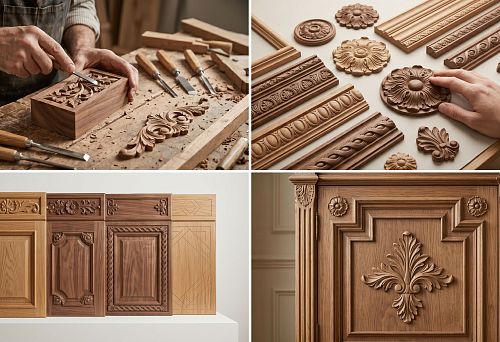
In the Stavros catalog — decorative wooden beam for a solid wood ceiling. Nearby in the catalog is a complete system of wooden decor for a coordinated interior: Wooden trim, Wooden cornices, Wooden Skirting Boards, Wooden moldingsAll elements are in coordinated tints, a unified material and style system.
Full catalog wooden products for interiors — from beams to frames and overlays.
FAQ: Answers to popular questions
How to choose a wooden beam for the ceiling?
Determine the ceiling height — it sets the allowable beam size. Determine the room area — it sets the profile width and spacing between beams. Choose a tint in accordance with the color of the furniture and floor.
How is a decorative false beam different from a real one?
A false beam is a decorative element without a load-bearing function. It weighs 3–5 times less than a real beam, is installed without construction work, and allows you to choose any size and finish.
Is a wooden beam suitable for an apartment?
Yes. A decorative wooden false beam is installed on any type of ceiling — concrete, drywall. It does not require structural changes and creates an expressive interior even in a city apartment.
Where is it best to use wooden ceiling beams?
Living room, kitchen-living room, attic, country house, hall, study, restaurant. Anywhere you need to create character and ceiling architecture.
What beam size should I choose for a living room?
With a ceiling height of 2.7–3.0 m: beam height 120–160 mm, width 100–130 mm. Spacing between beams — 100–130 cm. 3–4 beams for a room 5×6 m.
Can a wooden beam be painted?
Yes. A beam without factory coating can be painted with acrylic enamel, stain, or clear varnish in any color.
Are beams suitable for a kitchen-living room?
They are perfect — especially for zoning an open space. 2–3 beams across the kitchen-living room create invisible zones without partitions.
How to combine wooden beams with baseboards and cornices?
Unified tinting or wood species. Beams, cornice, and baseboard in the same tone create a unified wooden system of the space.
Can wiring be hidden inside a false beam?
Yes. A U-shaped hollow false beam is a convenient channel for electrical wiring, LED strips, and smart home system cables.
Where to buy a decorative wooden beam?
In the STAVROS catalog: wooden ceiling beam made of solid wood — with delivery across Russia.
About the manufacturer
STAVROS is a Russian manufacturer of wooden interior products. The company's catalog includes decorative wooden beams for the ceiling, Wooden trim, Crown Molding, Baseboards, Moldings — a complete system of wooden decor for a coordinated interior. If you are looking for a wooden beam for the ceiling — in the catalog STAVROS you will find the right size, style and finish with the quality guarantee of natural wood.