










































































Article Contents:
- What is a decorative polyurethane grille: material, size, and application logic
- Where to use a polyurethane grille: five interior scenarios
- On Furniture Facades
- On interior doors
- On wall panels
- In niches and portals
- In decorative partitions
- How a grille differs from other decorative elements
- How to choose the grille size: ten parameters
- Width of the facade or door
- Height of the grille field
- Is a molding frame needed
- Grille thickness and relief depth
- Distance to handles, hinges, and hardware
- One large grille or several identical ones
- Symmetry
- Ornament pattern
- Painting: in base color or contrast
- Will the grille be an insert or an overlay decor
- How to choose a grille style
- Classic
- Neoclassicism
- Modern classicism
- Art Deco
- Commercial interior
- What to pair the decorative grille with: interior decor system
- Installing the decorative grille: precisely and reliably
- Surface Preparation
- Marking
- Applying adhesive
- Clamping and fixation
- Drying and painting
- How to assemble a purchase kit: an error-free algorithm
- Mistakes in selection and installation: what goes wrong
- FAQ: Answers to Key Questions
- STAVROS: when openwork becomes architecture

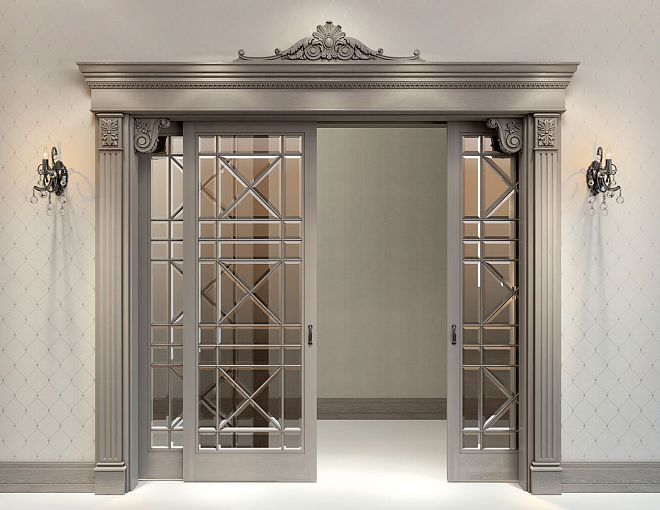
There are surfaces that remain silent. A blank cabinet door, a flat dresser facade, a plain interior door — they serve a function but say nothing about the interior they inhabit. Now imagine the same door, but with a large openwork polyurethane grille at its center. Light glides across the pattern, shadows trace the design, the surface comes alive. This is not just decor — it is a solution that transforms the perception of the entire room.
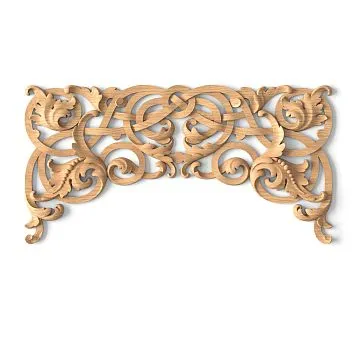
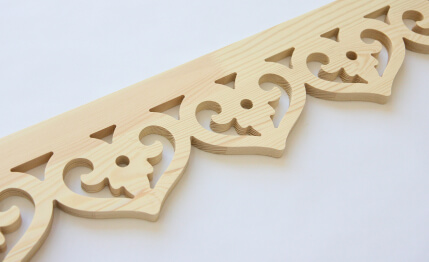
Decorative polyurethane grilles — are a broad class of openwork inserts for furniture facades, door panels, wall panels, niches, and decorative partitions. Unlike a small overlay, a grille occupies a significant portion of the surface: it spans the field, structures the plane, and adds air and ornament where there was once only paint.
A characteristic example from the STAVROS catalog is the RSHPU-007 grille: dimensions 434 × 1055 × 7 mm, material — durable and lightweight polyurethane, purpose — furniture facades and door panels. A height of over a meter is no longer just an accent; it is surface architecture. Such an element changes not a detail, but the entire logic of the facade.
For such decor to fall into place, it must be chosen thoughtfully: considering dimensions, thickness, ornament pattern, molding frame, hardware placement, and future painting. All of this — in detail and in order.


What is a decorative polyurethane grille: material, size, application logic
A polyurethane decorative grille is not a mesh or perforation. It is a cast relief element with an openwork pattern, cast in a factory mold with high precision of detail reproduction. The grille can be geometric (diamond, square, rectangular grid), floral (leaves, curls, intertwining branches), or classically architectural (cartouches, frieze ornaments, vertical panels).
Technical specifications:
-
Material: cast interior polyurethane with a density of 350–400 kg/m³
-
Element thickness: 7–25 mm (for most models — 7–15 mm)
-
Surface: white matte, factory-primed
-
Ready for painting: without additional treatment
-
Weight: light — due to the openwork structure, the pattern removes excess mass
-
Installation: special adhesive for polyurethane, if necessary — hidden fastening
The key difference between a grille and a regular overlay is in scale. An overlay is an accent: a point, a detail, an ornament on the background of a surface. A grille is the surface itself, which replaces a solid plane or structures it from edge to edge of the field. It is not placed 'on top' of decor — it is the decor itself.
In the PU overlays STAVROS grilles occupy a separate niche: these are large vertical and horizontal panels with an openwork pattern, used where not a point decorative detail is needed, but a full-fledged ornamental facade.




Where to use a polyurethane grille: five interior scenarios
Our factory also produces:


On furniture facades
A wardrobe, chest of drawers, sideboard, display cabinet, kitchen upper facade, cabinet, shelving unit with closed sections — this is the natural context for a decorative openwork grille. A solid furniture facade is the most common "silent" place in an interior. The grille turns it into a statement.
The most expressive application scheme: a sideboard or chest of drawers with two vertical facade sections, each fitted with an RSHPU-007 grille or a similar model of comparable size. A frame of of polyurethane moldings frames each grille — and the facade acquires the completeness of classic 18th–19th century furniture.
For kitchen facades, the grille is especially interesting above the work area: upper cabinets with grille decor create the feel of display cases, making the kitchen more lively and less "monolithic." At the same time, the grille remains closed — the contents are not visible, but the openwork structure removes the feeling of a solid box.
It is important to consider when choosing for furniture: the height of the grille should be at least 60–70% of the facade height so that it "works" as an independent element and does not look like a small insert on a large field.
Get Consultation
On interior doors
An interior door is the largest vertical "screen" in an interior. Height 2000–2200 mm, width 700–900 mm — this is a huge potential for decor. A grille measuring 434 × 1055 mm takes up just under half the height of a standard door — this format creates an expressive central accent without overloading.
Application schemes for interior doors:
-
One central grille along the vertical axis of the door, in the middle third of the panel
-
A pair of smaller grilles — symmetrically at the top and bottom
-
Grille as a top insert with a frame of moldings + smooth bottom panel
The grille on the door should be placed considering the handle and hinges. The gap from the grille to the handle axis must be at least 80–100 mm on each side. If the door is hinged, check that the grille does not protrude beyond the plane of the leaf into the casing area when closing (critical if the grille thickness exceeds 15 mm).
molded decoration made of polyurethane STAVROS — including grilles and overlays — is made of interior polyurethane, which does not warp with humidity changes, does not crack from mechanical stress when opening and closing the door, and can be painted in any color without losing relief.
On wall panels
Decorative wall panels with frames made of moldings are one of the main tools of classic and neoclassical interiors. Traditionally, an overlay is placed inside such a frame, or the field is left smooth. A grille is a bolder and more effective solution: it fills the field not with a dotted ornament, but with a continuous openwork pattern.
Best formats for a wall panel:
-
Vertically elongated panel 1200–1500 mm high with a large grille inside the frame — for tall rooms (from 3 m)
-
Horizontal panel 800–1200 mm wide with a grille in the center — for wide piers
-
Double or triple panel with identical grilles — a rhythmic accent along an entire wall
Polyurethane wall decor STAVROS includes both moldings for frames and large ornamental elements — it is from this system that adjacent elements should be selected when designing wall panels.
In niches and portals
A decorative niche in the wall, a door portal, an arched opening, a mirror area, a fireplace with decorative framing — in each of these places, the grille can become a back wall or side insert. The openwork pattern at the depth of the niche creates the illusion of double volume: the surface of the grille + the space behind it.
For a niche, it is important: the grille must be self-supporting in the vertical plane — that is, fixed at four points (two upper and two lower fastenings) plus glue along the contour. For horizontal installation (niche bottom) — glue with a reinforced compound.
Decor for Molding STAVROS — corner rosettes, locking elements, central inserts — perfectly complement the grille in the niche: they cover the joints of the frame, corner areas, and transitions between the molding and the plane of the niche.
In decorative partitions
This is a non-standard but very effective scenario. If you need not a solid drywall partition but a visually light ornamental screen — a decorative polyurethane grille is mounted into a wooden or metal frame and becomes an independent openwork panel. Such solutions are used in zoning the living room and dining room, in the hall, in the corridor between zones.
Important: in partitions, the openwork grille does not provide sound or visual insulation — it only visually zones the space and creates an ornamental screen. For full zoning, additional structural solutions are needed.
How the grille differs from other decorative elements
Often the buyer is confused: what exactly does he need — a grille, an overlay, a molding, or a cartouche? Let's be honest.
| Element | Main task | Typical size | Scale of impact |
|---|---|---|---|
| Decorative grille | Large openwork insert, replacing a blank panel | 400–600 × 800–1200 mm | Entire facade / large field |
| PU overlay | Point relief accent | 80–350 mm | Focal point |
| Molding | Frame, line, division | Linear | Surface structure |
| Decor for moldings | Corner, center, side frame element | 50–150 mm | Joint, corner |
| Molding | Long decorative strip | Linear | Horizontal or vertical |
| Cartouche | Ornamental medallion | 150–400 mm | Central accent |
The grille occupies a special place in this hierarchy: it is self-sufficient as a large element, but is most fully revealed in combination with a frame made of molding, corner elements made of decoration for moldings and point-like PU overlays nearby.
How to choose the size of the grille: ten parameters
Width of the facade or door
The width of the grille is no more than 70% of the facade width. For a door 700 mm wide, the grille is no wider than 490 mm. For a cabinet facade 450 mm, the grille is 300–320 mm. The gap from the edge of the grille to the edge of the facade (or to the molding) is at least 50–70 mm on each side.
RSHPU-007 with a width of 434 mm is optimal for facades 600–700 mm wide and doors 750–900 mm wide.
Height of the field for the grille
The height of the grille is 60–85% of the free field height. For a door 2000 mm high with a frame of moldings leaving a free field of 1400 mm, the grille height is 840–1190 mm. RSHPU-007 with a height of 1055 mm fits exactly into this range for standard interior doors.
Is a frame of moldings needed
A grille without a frame is possible if the pattern is sufficiently "self-sufficient" at the edges. A grille inside a frame is a more complete solution: the molding provides a clear outline, separates the grille from the background, and enhances its visual weight.
A frame is mandatory:
-
If the grille is less than 70% of the facade width (gaps need to be 'covered')
-
If the style is classic or neoclassical (the frame is an element of the order system)
-
If the facade is lacquered or painted in a dark color (the frame highlights the grille area)
Grille thickness and relief depth
7 mm (like RSHPU-007) — minimum working thickness. Such an element sits almost flush with the surface — a feeling of 'integration' into the plane. Ideal for doors: does not protrude into the casing area.
15–25 mm — more voluminous relief, noticeable shadow. For wall panels and furniture — more expressive, but requires more attention during installation in the hardware area.
Distance to handles, hinges, and hardware
For doors: gap from the edge of the grille to the handle axis — at least 80 mm. To the hinge — at least 50 mm (from the top or bottom edge of the grille). For furniture: gap to the handle — from 60 mm. To the hinge — the grille must not cover the hinge (this is a kinematic element requiring free access).
One large grille or several identical ones
For a wide facade (over 900 mm) — two identical grilles symmetrically. For a three-section buffet — three grilles of the same size. Precise symmetry and identical elements from the same series are the key to a "furniture-grade" quality result.
Symmetry
The central axis of the facade or door is the reference point. The grille (or pair of grilles) must be aligned along this axis. For paired grilles — the gap between them is strictly equal to the gap from each grille to the edge of the facade (or molding).
Ornament pattern
Geometric pattern (diamond, square, rectangular grid) — strict, neutral, works in Art Deco, modern classicism, neoclassicism.
Floral or architectural ornament — for classicism, Baroque, Empire, palace style.
Mixed (geometry with floral inserts) — for eclecticism and modern classicism.
Rule: the grille pattern must match the style of the moldings and overlays. A geometric grille with floral moldings is a stylistic conflict.
Painting: in the base color or contrast
White grille on a white facade — only relief, only shadow. The effect is delicate and refined.
White grille on a colored facade (gray, blue, green, dark brown) — a contrasting accent that makes the ornament maximally readable.
Grille in the color of the wall or ceiling (under enamel) — integrated into the space, does not stand out from the overall tone.
Gilding or patina on the grille — a baroque accent; used selectively, in combination with the corresponding style of the entire interior.
Will the grille be an insert or an overlay decor
Insert: the grille is mounted flush into a specially selected recess or milled groove in the surface. Requires carpentry preparation, but gives a "built-in" result — the grille is part of the facade.
Overlay decor: the grille is glued onto the surface of the facade or door on top. Easier to install, but creates a slight protrusion on the surface (grille thickness). For most household applications, this is the option.
How to choose the grille style
Classic
A classic interior requires ornamental richness. A decorative openwork grille in classic style is a floral or cartouche pattern, symmetry, three-dimensional relief, a frame made of molding with corner elements.
Where it is used in classic style: sideboards, display cases, double-door cabinets, library or study doors, wall panels in the living room or dining room. Painting — most often white or ivory, gilding on the ornament is possible.
Additional elements next to the grille: Decor for Molding in the corners of the frame, point PU overlays above the frame or along its sides, Polyurethane trim as a horizontal division of the facade.
Neoclassicism
In neoclassicism, everything is stricter and calmer. A geometric grid pattern, minimal ornamental details, moderate relief depth. The frame is a thin molding without stucco ornament. Color matches the wall or furniture.
Where it is used: interior doors, built-in wardrobe facades in the bedroom, wall panels in the hall, decorative partitions in the living room.
Modern classic
An openwork grille as the only accent on a completely smooth facade. No moldings, no additional overlays — just the grille on a clean field. This approach requires maximum attention to size: the grille must be precisely proportional to the facade.
Color: typically matching or close to it — a delicate accent, not a contrast. A thin relief of 7–10 mm works especially well for this style.
Art Deco
Geometric grille pattern — diamond, hexagon, rectangular grid with a repeating motif. Contrasting two-color painting: black grille on a white facade or gold on black. Symmetry is absolute.
Art Deco requires precision of proportions: the grille occupies a strictly defined portion of the field, gaps are identical on each side. Any misalignment in Art Deco reads as an error.
Commercial interior
Boutique, restaurant, hotel, showroom, beauty salon, classic-style office — everywhere where the interior should speak of taste and level. A decorative polyurethane grille on a reception panel, on display doors, on decorative partitions is a powerful tool for creating a "luxurious" feel without a luxurious budget.
In commercial interiors, grilles are often used in combination with lighting: LED backlighting behind or below the pattern greatly enhances the visual effect of the openwork design.
What to pair with a decorative grille: an interior decor system
A grille doesn't work in isolation. Its strength lies in the system.
Grille + moldings. Moldings made of polyurethane form a frame around the grille. Molding width: from 30 mm for delicate solutions to 80 mm for rich classic styles. The molding and grille are from the same STAVROS series.
Grille + PU overlays. Decorative Inserts are placed above or below the frame with the grille as additional ornamental accents. For example: a frame with a grille at the bottom of the facade + a horizontal "crown" overlay at the top.
Grille + molding decor. corner and center elements at the intersection points of the moldings around the grille — this is a professional detail that distinguishes a "designer" result from a DIY one.
Grille + linear profiles. Polyurethane trim — long profiles that can divide the facade horizontally. The upper section of the facade is smooth; the lower section has a grille in a frame. A thin linear profile divider between them is the finishing touch.
Grille + enamel coating. The polyurethane grille is ideal for painting to match the color of furniture or walls. The absence of pores on the surface, factory primer, and pure white base color ensure a perfect paint coating without gaps or drips.
Installation of the decorative grille: precise and reliable
Surface preparation
The surface must be dry, clean, and degreased. For painted MDF or particleboard, sand the installation area with P180–220 grit sandpaper. For varnished surfaces, use more aggressive sanding or a special adhesion primer.
Not allowed: installation on silicone coating, wax polish, or oily oil-based varnish. The glue will not provide adhesion — the grille will fall off.
Marking
Mark the central vertical and horizontal axes of the facade or door with a pencil. Position the grille outline from these axes. Check the symmetry of the gaps on each side. For paired grilles, add an additional vertical line at the center between them.
Mandatory step: cut out a paper template of the grille and secure it with masking tape on the facade. Step back 2–3 meters to assess the proportions. Adjust the position if necessary.
Applying adhesive
Apply special glue for polyurethane decorative elements (acrylic or MS polymer-based) in a zigzag pattern along the contour of the grille's back surface. For openwork elements: apply glue only to the visible back bridges of the pattern — not to the voids.
Important: do not use mounting foam — it expands and deforms the thin element. Do not use solvent-based "liquid nails" on painted surfaces without checking compatibility.
Pressing and fixation
Press the grille against the surface, align it with the marking axes, and press evenly over the entire area. Use masking tape around the perimeter to hold it in place during polymerization (30–60 minutes).
For large grilles (height over 700 mm): additional point fixation with a thin self-drilling screw through the back bridge at the top and bottom — in the hidden area of the molding frame. Putty over the screw heads.
Drying and painting
24 hours before painting begins. Fill gaps along the grille contour with acrylic sealant, level with a wet finger, dry, sand with fine sandpaper.
Painting: two coats of water-based acrylic paint. Use a thin brush for ornament recesses. The openwork structure requires thorough painting of all internal surfaces — that's where the shadow forms, making the pattern come alive.
How to assemble a purchase set: error-free algorithm
Step 1. Determine the location: furniture, door, wall, niche, partition.
Step 2. Measure the free space: width and height of the area for the grille.
Step 3. Check the size of the selected grille: does it fit in the space with a gap of at least 50 mm on each side.
Step 4. Decide if a frame is needed from molding: if yes — choose a molding from the same series.
Step 5. Select corner elements for the frame from decoration for moldings.
Step 6. Check the position of handles, hinges, and fittings: the gap from the edge of the grille must be at least 60–80 mm.
Step 7. Decide on the color: matching the facade, white on a colored facade, or contrasting.
Step 8. Select adhesive, sealant, primer — from the range compatible with polyurethane.
Step 9. Make a paper template and a dry layout before installation.
Step 10. Order the grille, moldings, corner elements, and adjacent overlays in one batch — from the same STAVROS series.
Mistakes when choosing and installing: what goes wrong
They buy without measuring. "I'll buy a medium one" — there is no standard "medium." Each facade requires a specific size.
They don't account for the grille needing free space. They place the grille flush with the edges of the facade — no air, no frame, visually "cramped."
They confuse a grille with a small overlay. They order an overlay 100 × 150 mm instead of a grille 434 × 1055 mm — the result is incomparable.
They don't check the thickness. A 25 mm grille on a door interferes with the trim when closing. For doors — maximum 15 mm.
They don't account for the hardware. The grille overlaps the hinge or handle axis — after installation, the door cannot be opened.
They install a large grille on a small facade. A 434 mm grille on a 380 mm wide facade — no gaps, no air, no frame.
They don't think through the frame. The grille without a molding "floats" on the surface. In a classic interior, a frame is mandatory.
They paint the grille before installation — and cannot adjust the gaps and joints, which then have to be puttied over the paint.
They skip marking the central axis. A 10 mm offset is noticeable to everyone looking at the facade.
They take a grille from one series and moldings from another. Different profiles, different relief heights — and everything falls apart.
FAQ: Answers to Key Questions
What is a decorative polyurethane grille?
It is a large, openwork, relief insert made of cast polyurethane for furniture facades, door panels, wall panels, and niches. It replaces a solid plane with ornamental decor, adding volume, pattern, and visual lightness.
Where are polyurethane grilles used?
On cabinets, chests of drawers, sideboards, kitchen facades, interior doors, wall panels, in niches, in decorative partitions, and in commercial interiors.
Is a polyurethane grille suitable for a furniture facade?
Yes. It is mounted on MDF, painted chipboard, plywood. Polyurethane glue ensures reliable fixation. It can be painted any color without losing the relief.
Can the grille be used on an interior door?
Yes. Important: thickness no more than 15 mm, gap from handle and hinges at least 80 mm. Installation: glue + hidden fastening if necessary.
How does the grille differ from a PU overlay?
In scale and function. The overlay is a point ornamental accent (80–350 mm). The grille is a large openwork insert (400–600 × 800–1200 mm) that occupies a significant part of the facade.
Can a polyurethane grille be painted?
Yes, it must be. The surface is primed, ready for painting with acrylic paint. Two coats, a thin brush for recesses of the ornament. Paint after installation and puttying of joints.
How to choose the size of a decorative grille?
The width of the grille is no more than 70% of the field width. The height is 60–85% of the free field height. The gap from the molding or edge of the facade is at least 50 mm.
Is a molding frame needed around the grille?
In a classic and neoclassical interior — yes, a frame is mandatory. It completes the boundaries of the grille and connects it with the rest of the decor. In a modern minimalist solution — it is not mandatory.
How to attach a polyurethane grille?
Special glue for polyurethane along the contour of the back surface + painter's tape while it sets. For large elements — additionally a hidden screw at the top and bottom through the back bridge of the ornament.
Where to buy a decorative polyurethane grille?
In the Stavros catalog — RSHPU-007 grille and other models in the section PU overlays. Delivery across Russia.
STAVROS: when openwork becomes architecture
A small overlay decorates a detail. A large grille changes the surface. These are fundamentally different levels of decorative expression. And it is for the second — for a bold, large-scale, architecturally justified solution — that STAVROS created a line of decorative polyurethane grilles.
RSHPU-007 grille, PU overlays, Moldings, Decor for Molding, Trim и Wall Decor — all these are parts of a unified interior system, in which each element is coordinated with the others in proportion, style, and scale.
You are not choosing a grille—you are choosing the character of your interior.
STAVROS — stucco decor where emptiness becomes an ornament, and the ornament becomes architecture.