Article Contents:
- Buy decorative slatted wall panels
- Which decorative slatted wall panels to buy: we answer right away
- What are decorative slatted panels: the nature of the product
- Relief as the main property
- Rhythm and its role in the interior
- How decorative panels differ from regular wall panels
- Where to use decorative slatted panels: application scenarios
- In the living room
- In the entryway
- In the bedroom
- In the study
- In commercial interiors
- Decorative slatted panels for interior wall decoration: a complete breakdown
- Which materials are suitable for the interior
- Why panel geometry matters more than it seems
- How to choose color: three strategies
- Combination with floor, doors, and furniture
- Baseboard, moldings, and lighting — a system, not options
- Which types of decorative slat panels to choose: comparison table
- Decorative slat relief and light: an inseparable pair
- How light reveals the relief
- Color temperature and panel tone
- Slat decor for the wall: accent zone as an architectural solution
- Frame System Principle
- Buying Accent Wall Panels: What to Look For
- What Affects the Price of Decorative Slat Panels: The Full Picture
- Base material
- Type of finish
- Slat Width and Relief Depth
- Panel size
- Order volume
- Trim elements
- Installation
- Delivery
- How to Choose Decorative Slat Panels Before Buying: A Checklist
- Slat Panels for TV Zone, Hallway, Living Room: Specific Tips
- Buying Slat Panels for TV Zone: What Matters
- Buying Decorative Panels for Hallway: What Matters
- Buying Decorative Panels for Living Room: What Matters
- Mistakes When Buying Decorative Slat Panels: Top 9
- Decorative wall system: how to assemble it correctly
- Where to buy decorative slatted wall panels
- About the Company STAVROS
- FAQ: Answers to Key Questions
Buy decorative slatted wall panels
A wall is not just a building structure. It is a surface that a person talks to every day without saying a word. It either creates a mood or remains a neutral background. It either works for the interior or exists on its own. Decorative slatted panels are a way to make the wall speak. The rhythm of vertical slats, the play of shadows in the grooves, the natural or laconic tone of the surface — all this turns an ordinary plane into an architectural statement.
If you want to buy decorative slatted wall panels, this article will help you make an informed choice. Without unnecessary words, with specifics and respect for your time.




Which decorative slatted wall panels to buy: we answer right away
The first question is always the same: where to start? Not with flipping through a catalog or studying technical specifications. Start with the task.
Is the task a visual accent behind the TV?
Choose wood-look slatted panels with moderate relief and a warm tone. Vertical slats 80–120 mm wide — a balanced rhythm, well readable on the screen wall.
Is the task a design project with a precise color?
Paintable lath panels — the only way to hit a specific RAL, NCS, or Farrow & Ball shade. The texture stays, the color is yours.
The goal is a natural texture in a country house or premium interior?
wooden lath panels made of solid wood with a live edge — a choice for those who don't want compromises.
The goal is stable geometry for a commercial space?
Decorative slatted wall panels made of MDF with a smooth coating — a predictable result without surprises.
You should buy decorative slatted wall panels when you clearly understand: what room, what style, what shade, and what budget. Answer these four questions — and half the choice is already made.
Our factory also produces:


What are decorative slatted panels: the nature of the product
Before talking about choice and price — let's understand what exactly we are choosing. The term 'decorative slatted panels' is used widely, but not always accurately.
Get Consultation
Texture as the main property
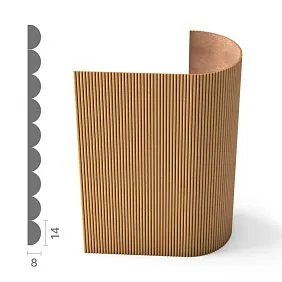
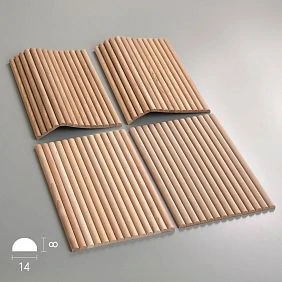
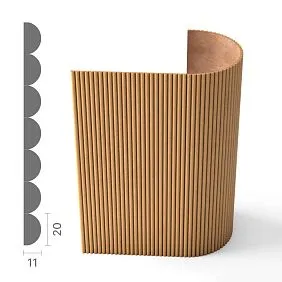
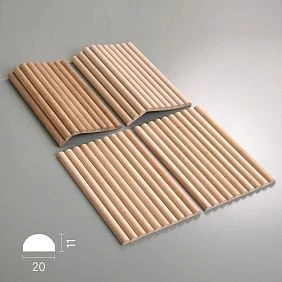
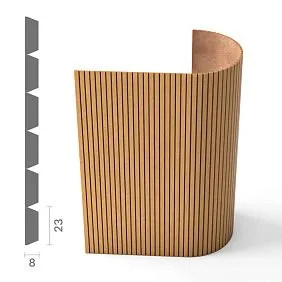
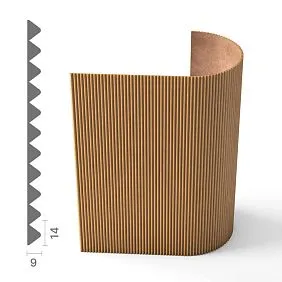
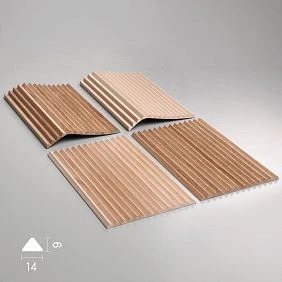
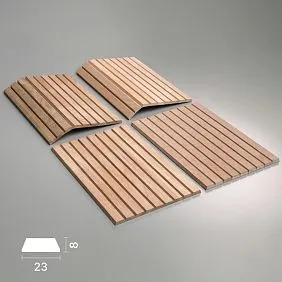
A decorative slatted panel is a wall product with a milled relief in the form of alternating protruding ribs (slats) and recessed grooves. It is this relief that makes such a panel 'decorative' in the strict sense: it doesn't just cover the wall, but creates a structure on it.
The width of the slats, the depth of the groove, the angle of the edges — three parameters that determine the entire visual character of the panel. Narrow slats with a deep groove — a dense, almost textile rhythm. Wide slats with a shallow groove — a calm, monumental surface. Between these extremes lies a vast range of expressive possibilities.
Rhythm and its role in the interior
Rhythm is a basic tool for visual organization of space. The slatted rhythm on a wall does several things at once:
-
Stretches the space. Vertical slats visually raise the ceiling. Horizontal ones widen the wall. This is not a metaphor — it's the work of optical perception.
-
Creates depth. The gaps between slats cast shadows with side lighting. Shadow is perceived depth. A flat wall becomes three-dimensional.
-
Zones the space. A slatted panel as a vertical divider in an open space — a light architectural boundary without a partition.
-
Sets the mood. Natural wood tone — warmth and coziness. Neutral gray — restraint and professionalism. White relief — purity and air.
How decorative panels differ from regular wall panels
A regular wall panel is a cladding surface. Its task is to cover the surface and give it the desired color. A decorative slatted panel works differently: it creates relief, play of light and shadow, a rhythmic structure. This is a product with an interior function, not just a finishing material.
Where to use decorative slatted panels: application scenarios
In the living room
The living room is the main space for decorative slatted wall panels. This is where they truly come into their own.
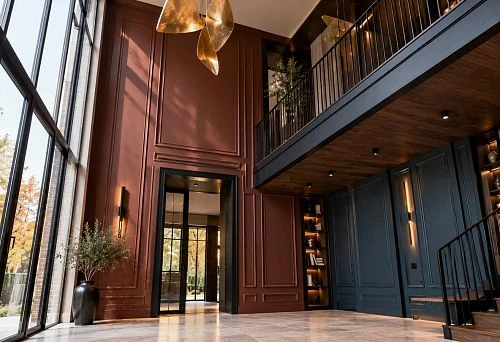
TV area. A slatted wall behind the television is one of the most sought-after interior techniques of recent years. The reason is simple: the TV dominates the wall when turned off. A slatted backdrop with the right tone shifts the focus from the screen to the space — the screen becomes part of the wall, not its master. Add hidden LED lighting in the gaps, and in the evening the TV area takes on a completely unique character.
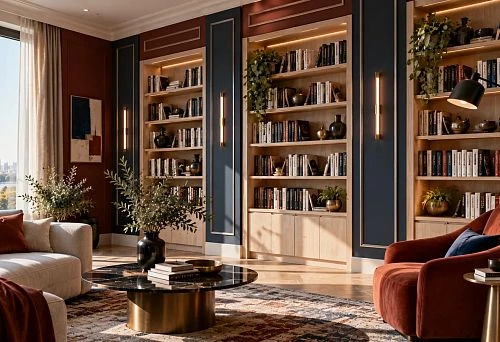
Sofa wall. Behind the sofa, a slatted panel works as an architectural frame for the seating area. Moldings made of polyurethane around the perimeter of the slatted section turn a section of wall into a finished panel — self-sufficient and complete.
Accent wall. In modern interiors, there is no rule that "all walls must be the same." One accent surface with a slatted relief does not disrupt balance — it creates it. The other walls become the background. The slatted one becomes the main character.
Zoning in an open space. If the living room is combined with a kitchen or dining area, a vertical slatted panel on the living room side creates a visual boundary without a physical wall. This is a light and elegant solution that works even in small spaces.
In the hallway
The hallway is a space with two conflicting requirements: beauty at first glance and durability under constant use.
Decorative slatted panels for the hallway solve both tasks. The textured MDF surface with a lacquer or enamel coating is resistant to touch, withstands accidental mechanical impacts, and maintains its appearance significantly longer than painted plaster.
Vertical slats in the corridor are a proven optical trick. A narrow corridor 1000–1200 mm wide with vertical slats feels visually more spacious. The ceiling height seems to increase. This works in any conditions — under daylight, evening, and artificial lighting.
The bottom junction with a high baseboard matching the panel, the top junction with polyurethane moldingThe system must be closed on both sides — only then does the hallway look like the result of a design concept, rather than "they put up panels and forgot about it."
In the bedroom
In the bedroom, everything works more subtly. There is no need for a dominant relief or bright tone. What is needed is a surface that creates coziness without disturbing rest.
A bed headboard with decorative slatted panels is one of the most delicate yet expressive application scenarios. Wide slats (100–140 mm), moderate groove depth, warm neutral tone — all this creates a soft natural backdrop that functions as an architectural headboard.
It is worth buying decorative panels for the bedroom in tones coordinated with the textiles and flooring. Light ash + linen bedding + oak parquet — natural harmony. Stained oak + dark parquet + white textiles — expressive contrast for an adult interior without unnecessary words.
Lighting in the bedroom: hidden LED strip behind the molding at the top — soft diffused glow instead of direct light. A calm lighting atmosphere that helps rather than hinders.
In the study
An office is a space of concentration and status. A slatted wall behind the workspace visually organizes the space and creates the right backdrop for work and meetings.
Paintable lath panels In a neutral tone behind the desk — relief without color dominance. The wall is structured but not distracting.
Wooden slatted panels made of solid wood — a status solution for an office with a classic or natural character.
Polyurethane wall decor — pilasters, overlay elements, frames — on a slatted background create a multi-level system that turns the office into an architecturally complete space.
In commercial interiors
Reception. Meeting room. Waiting area. Executive office. In a commercial space, the interior is not decoration, but communication. It communicates the company's standards, its character, and level without a single word.
Slat decorative panels for interior wall finishing in commercial areas work exactly like this: they speak of thoughtfulness and quality before the conversation even begins.
decorative polyurethane elements at the corner points of molding frames, Moldings and pilasters on a slat background — a system with details that creates a professional interior, not just a "finished office."
Decorative slat panels for interior wall finishing: a complete breakdown
Buying decorative slat panels for interior wall finishing is not just a commercial query. Behind it lies a specific task: to find a product that will work in a residential or commercial interior, look beautiful, hold securely, and fit into the finishing system.
Which materials are suitable for interiors
MDF is the main material for wall decorative panels. Density 720–880 kg/m³, stable geometry, excellent machinability. Suitable for all living spaces without constant high humidity.
Solid wood — for premium interiors and country houses. Maximum naturalness, unique grain, durability with proper care.
MDF with decorative coating — a wide range of tones and textures. Wood-look, concrete-look, solid neutral. A practical and affordable choice for most tasks.
For bathrooms with constant high humidity, MDF panels are not used — specialized moisture-resistant materials are needed.
Why panel geometry matters more than it seems
The evenness of edges, consistency of slat width, precision of milling angle — these are all production quality parameters that directly affect the installation result.
A panel with inconsistent slat width will create an uneven rhythm on the wall. Beveled or "ragged" edges — an irregular shadow shape under side lighting. That's why decorative slatted wall panels from a manufacturer with controlled production are not an excessive luxury, but a reasonable investment.
How to choose color: three strategies
Strategy 1: tonal unity.
A panel in the tone of the wall or slightly darker. The relief is readable, the color contrast is minimal. A monochrome effect with volume. Suitable for minimalist and Scandinavian interiors.
Strategy 2: natural tone.
Warm oak, ash, walnut — in any interior with wooden floors, wooden doors, or wooden furniture. Natural material to natural — this is not duplication, but a system.
Strategy 3: contrasting accent.
Dark slats on light walls — an expressive modern technique. Requires confidence in the concept and proper work with light. When executed well, it is one of the strongest interior statements.
Combination with floor, doors, and furniture
First rule: the tone of the panel and the tone of the floor are from the same "climate zone." Both warm or both neutral. A warm panel with a cold floor is a visual conflict that is difficult to "fix" without replacing one of the elements.
Second rule: doors are the intermediary between the floor and the wall. If the doors are warm oak and the panel is cold gray, a transitional element is needed: molding, baseboard, or furniture that connects them.
Third rule: furniture is the last layer, not the first. Do not choose panels "to match the sofa." Choose panels to match the architecture — floor, doors, light. The furniture will follow.
Baseboard, moldings, and lighting — a system, not options
A mistake that occurs regularly: buying panels without system elements. They install them on the wall — and see incompleteness. An open top edge without molding, an open bottom without baseboard. The wall looks "unfinished."
The correct system always includes:
-
Polyurethane molding along the top edge
-
Baseboard along the bottom edge
-
Side moldings if there is a separate accent panel
-
decorative corner elements at intersections
Backlighting — if provided — is installed before assembly. LED strip in the niche of the upper molding or in the gaps between the slats. Electrical work — before panel installation. Not after.
Which types of decorative slatted panels to choose: comparison table
Material selection is the main decision. Everything else is details.
| Appearance | Where to use | Strengths | What to pay attention to |
|---|---|---|---|
| MDF for painting | Living room, study, commercial interior | Any color, precise geometry | No natural texture |
| Wood-look MDF | TV area, bedroom, hallway | Natural tone, practicality | Imitation, not solid wood |
| Wooden (solid wood) | Country house, premium interior | Lively pattern, uniqueness | More expensive, requires maintenance |
| Veneered | Study, living room, reception area | Natural layer + stability | More difficult to match the tone |
| Combined series | Designer projects | Non-standard effect | Custom format |
There is no universally 'best' option. There is the right choice for a specific task.
Decorative slatted relief and light: an inseparable pair
Lighting deserves a separate discussion because it is a topic that is underestimated when choosing panels.
How light reveals the relief
Any relief is a form. Any form is revealed by light. Without properly organized lighting, a deep slatted profile looks almost flat. With side lighting, the same panel turns into a play of light and shadow.
Directional light (spots, track lights) at an angle of 30–45° to the wall surface is the optimal option. The shadow in the grooves becomes expressive. The slats appear three-dimensional. Even a small relief depth (5–8 mm) with such lighting produces a noticeable effect.
Diffuse uniform light (ceiling panel lights, chandeliers with frosted shades) is a neutral option. The relief is readable, but without a pronounced play of shadows. Suitable for bedrooms and relaxation areas where drama is not needed.
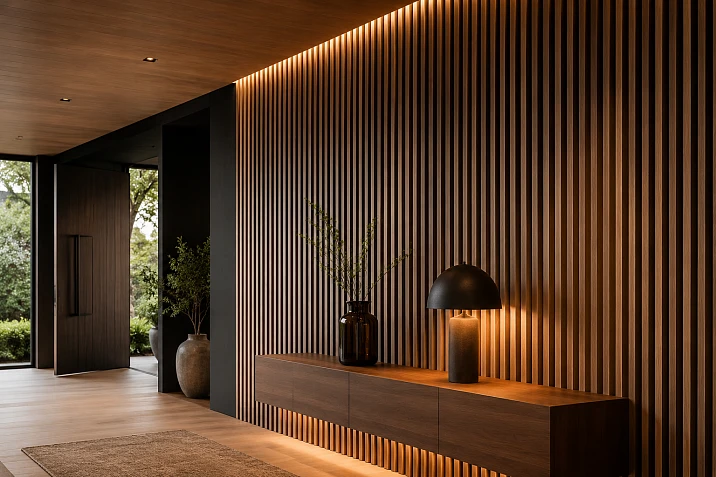
Hidden lighting behind the top molding is a vertical stream of soft light that washes the slatted surface from top to bottom. An atmospheric evening effect. Shadows in the grooves are soft, without sharpness. Works especially well with warm panel tones.
Lighting in the gaps between the slats creates horizontal glowing lines between the dark slats. A 'floating' rhythm effect. Technically more complex, but visually one of the most powerful techniques.
Color temperature and panel tone
2700K — warm light. Enhances warm tones (oak, ash, beige). Creates a cozy atmosphere. For living room and bedroom.
3000K — neutral warm. Universal. Suitable for most panel tones.
4000K — cool working light. For offices and commercial spaces. With warm panel tones, it can 'dampen' the warmth of the material — consider this when selecting.
A fundamental rule: do not mix warm and cool light in the same area. This creates discomfort that is hard to explain in words but is immediately noticeable when looking at the wall.
Slatted wall decor: accent zone as an architectural solution
A decorative wall made of slatted panels is not just "beautiful." It is a functional architectural solution that organizes the space.
The principle of the frame system
A slatted section in a molding frame is the most complete version of an accent wall. Moldings made of polyurethane along the perimeter create a border that makes the slatted section a self-sufficient object. Inside the frame — relief and texture. Outside — a neutral wall.
This solution works even in small spaces where a full slatted wall covering would be overwhelming. An accent panel in a molding frame is a targeted yet convincing design move.
Buy panels for an accent wall: what to pay attention to
When choosing panels for an accent wall, three parameters are important:
Proportions. The width of the slatted section should correspond to the width of the object it frames (sofa, bed, TV). A panel that is too narrow is insufficient. Too wide — overwhelming.
Scale of the relief. The width of the slat should match the size of the wall. For a small accent area (1000–1500 mm) — medium slats 80–100 mm. For a wide wall (2400–3600 mm) — wider can be used.
Tone. In a frame system, the tone of the panel should contrast with the molding or be in tonal unity with it. Both work — provided the choice is deliberate.
What affects the price of decorative slatted panels: the full picture
Price is a topic that cannot be avoided. Let's break down each factor without oversimplification.
Base Material
MDF of different densities — different prices. High-density MDF 880 kg/m³ for a clean profile — more expensive. Standard 720 kg/m³ — base level. Solid wood — several times more expensive than MDF, depends on the species.
Type of finish
Basic white primer — the lowest price level. Double primer with hand sanding "Prestige" — higher. Decorative wood-look film — depends on the collection. Factory painting in color — a separate item.
Slat width and relief depth
Wide slats — fewer milling passes per unit area. Narrow ones — more. Deep profile — longer, more precise, more demanding on equipment. This is reflected in the cost.
Panel size
Non-standard lengths and widths — custom format with a markup. Standard length 2700 mm — optimal and economical.
Order volume
A large order allows production optimization. A small batch — more expensive per unit.
Fitting elements
Moldings, baseboards, Corner decorative elements, PU overlays — separate budget items. In projects with a developed molding system, this can amount to 25–40% of the cost of the panels.
Installation
The cost of work depends on the area, complexity of geometry, presence of frame installation, and number of additional elements. Plan ahead.
Delivery
Long-length product. Special packaging. When ordering to another region — a mandatory budget item.
How to choose decorative slatted panels before purchasing: a checklist
This list is a practical tool. Go through each item before placing an order.
1. Determine the room.
Each room has its own requirements for material, tone, and type of coating.
2. Measure the wall.
Width × height exactly. Not 'approximately' — exactly, taking into account the baseboard and cornice.
3. Determine the purpose of the zone.
TV zone, headboard, sofa wall, accent surface — each has its own requirements for relief and color.
4. Choose the material.
MDF, solid wood, veneer — depending on the task and budget.
5. Order samples.
View under your lighting. In the morning and evening. With curtains closed and open. Next to a floor sample.
6. Determine the direction of the slats.
Vertical or horizontal. Diagonal — rare, but possible.
7. Assess the depth of the relief.
With your type of lighting — what will cast shadows? Spotlights → deep relief is revealed. Uniform light → depth is less critical.
8. Mark the sockets and switches.
On the diagram — before ordering. This affects the panel layout.
9. Choose the baseboard.
From the same catalog. Before ordering — not after.
10. Select moldings.
Top, side, corner elements — a system order from one supplier.
11. Calculate the allowance.
Flat wall — +12%. Openings, non-standard geometry — +15–20%.
12. Clarify delivery conditions.
Production time + delivery time = actual start date of installation.
Slatted panels for TV zone, hallway, living room: specific tips
Buy slatted panels for TV zone: what matters
The TV zone requires a delicate balance. Too active a panel pattern competes with the screen. Too neutral — it gets lost. The optimum: moderate relief with a depth of 8–12 mm, a shade slightly darker or contrasting to the walls. With backlighting — warm 2700K strip in the molding niche.
The width of the slatted section — the width of the TV stand or slightly wider. Too narrow — the proportion is lost. Too wide — the accent is lost.
Buy decorative panels for hallway: what matters
Coverage is touch-resistant. Lacquer or enamel. Panel height — from floor to ceiling or to mirror height. Vertical rhythm is mandatory. High baseboard, matching tone. Lighting outlets — in the pre-installation scheme.
Decorative panels for living room buy: what matters
Relief scale — matching wall scale. Tone — coordinated with floor and doors. Molding frame for accent zone — a mandatory element of completeness. Lighting — optional, but strongly recommended for evening use.
Mistakes when buying decorative slat panels: top 9
Mistake 1: choosing only by photo.
No monitor conveys the real color, texture, and depth of relief. A sample is the only reliable way to make a decision.
Mistake 2: not considering wall scale.
Narrow frequent slats on a small wall — visual noise. Wide slats in a small hallway — space "shrinks." The rhythm scale must match the plane scale.
Mistake 3: not matching tone with floor and doors.
Tone conflict is the most common and hardest to fix mistake. It can only be corrected by replacing one of the elements.
Error 4: not accounting for cutting allowance.
"I'll buy by the meter" is a classic. Result: shortage during installation. A 12–20% allowance is mandatory.
Error 5: not planning outlets.
An outlet that "appears" in the panel area during installation is a problem that's expensive to fix later.
Error 6: not selecting baseboards in advance.
They buy panels now, baseboards later. Result: the baseboard tone doesn't match the panel tone, the profile doesn't fit geometrically.
Error 7: forgetting about lighting.
"We'll add it later" means chasing already installed panels. Electrical work always comes before installation.
Error 8: taking elements from different suppliers.
Panels from one, moldings from another. Profile mismatch, tone conflict, headache during installation. A system order from one manufacturer is not a whim, but a practical necessity.
Error 9: they buy from another batch without warning.
Decorative coatings from different production batches may differ in tone. Order with a reserve immediately — a reorder from a new batch may not match.
Decorative wall system: how to assemble it correctly
A slatted panel is not a separate item. It is the central element of the system. Only in the system does it fully reveal itself.
System center: slatted panel.
Decorative slatted wall panels — the main surface. Relief, tone, rhythm.
Perimeter: molding frame.
Moldings made of polyurethane at the top, bottom, sides. Cover the ends, frame the zone boundaries, create an architectural contour.
Corner accents: decorative elements.
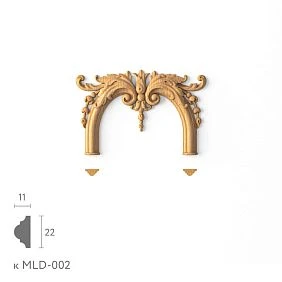
decorative polyurethane elements at the corner points of molding frames — rosettes, corner blocks. Point accents that give the system a finished and professional look.
Additional decor: overlays.
Polyurethane wall decor — pilasters, overlays, inserts — work on a slatted background as an ornamental layer over natural or geometric patterns.
Four levels of the system. One consistent geometry. A single tone or deliberate contrast. STAVROS produces all elements — and this is no coincidence.
Where to buy decorative slatted wall panels
If you've read this far — you understand: you need to choose not panels separately, but the system as a whole. This means the right supplier is one who offers this system completely.
Criteria:
-
In-house production with quality control
-
Full range: panels + moldings + decor + baseboards
-
Samples for live evaluation
-
Calculation based on your measurements — free of charge
-
Transparent delivery terms across Russia
-
Consultation with specific answers, not general phrases
Catalog STAVROS slatted panels includes several series with different characteristics of relief, coating, and tone. System elements — Moldings, decorative corner elements, Wall decor — are produced with geometric compatibility with panels. One manufacturer — one system without mismatches.
About the company STAVROS
STAVROS is a manufacturer of decorative interior products, founded in St. Petersburg in 2002. The historical starting point is the restoration of iconic sites: the Hermitage, the Konstantinovsky Palace, the Alexander Palace. It is the work with such spaces that set the standard of precision and quality that is transferred to every product regardless of the scale of the order.
Today STAVROS produces a complete system of decorative finishing: Rafter panels in several versions — For painting, wood-like, in author series, Polyurethane moldings and cornices, decorative elements, Wall decor.
Production — St. Petersburg, controlled microclimate. Manual finishing sanding "Prestige". Samples — available. Calculation and consultations — free. Contact us to confirm shipping to your destination.
If you want to buy decorative slatted wall panels with quality assurance, a systematic approach, and support from sample selection to installation — STAVROS is ready to work on your project.
FAQ: Answers to Key Questions
Which decorative slatted panels to buy for walls?
For an accent wall in the living room — MDF with wood finish or for painting. For the bedroom — wide slats with moderate relief in a warm neutral tone. For the study — strict geometry in a neutral tone or for painting in a corporate color. For a commercial interior — MDF with precise geometry and professional coating.
How do decorative slatted panels differ from regular wall panels?
Regular wall panels cover the surface and provide color. Decorative slatted panels create relief — rhythm, shadow, volume. This is a product with an interior function: accent, zoning, visual elongation of space.
What affects the price of decorative slatted panels?
Base material, type of coating, depth of relief, size, order volume, additional elements (moldings, baseboards, decor), installation, and delivery.
Are decorative slatted panels suitable for interior finishing?
Yes, that is their primary application. Living room, bedroom, hallway, study, commercial spaces — anywhere without constant high humidity.
Which panels are better for a TV zone?
MDF with wood finish or for painting is a practical and reliable choice. Veneered or wooden panels are for a more natural and premium effect. Key conditions: moderate relief, correct geometry, lighting in the plan.
Are moldings and baseboards needed for decorative slatted panels?
Absolutely. Without them, a slatted panel looks like an unfinished structure. A molding at the top and a baseboard at the bottom is the minimum system. With corner elements, it becomes a full architectural finish.
How to calculate the number of decorative panels for a wall?
Finishing area ÷ panel area = quantity (round up). Add 12–20% spare. Calculate additional elements separately along the zone perimeter.