








































Article Contents:
- What is a decorative polyurethane panel
- Panel as a concept, not as a slab
- What does a polyurethane wall panel consist of
- Sizes and proportions
- Why polyurethane is convenient for decorative panels
- Lightness
- Ease of installation
- Paintability
- Durability
- Compatibility with moldings and cornices
- Ready-made kit or individual elements: what to choose
- Arguments in favor of a ready-made kit
- When choosing individual elements
- Types of decorative wall panels
- Frame panels made of moldings
- Vertical decorative panels
- Panels with stucco decor and overlays
- Minimalist panels for modern interiors
- Where to use decorative polyurethane panels
- In the living room
- In the bedroom
- In the hallway and corridor
- How to choose the style of a decorative panel
- Neoclassicism
- Neoclassic Light
- Jatoba
- Versailles Light
- How to calculate a decorative panel for a wall
- Calculation algorithm — step by step
- Table of approximate sizes for decorative panels
- Errors when choosing decorative panels
- Error 1: Panel is too small for the wall
- Error 2: Moldings do not match the style
- Error 3: No layout scheme
- Error 4: Panel conflicts with furniture
- Error 5: Outlets and switches not considered
- Error 6: Too much ornament in a small room
- Error 7: Buying individual elements without understanding the final composition
- Where to buy decorative wall panels made of polyurethane
- FAQ: Answers to Popular Questions
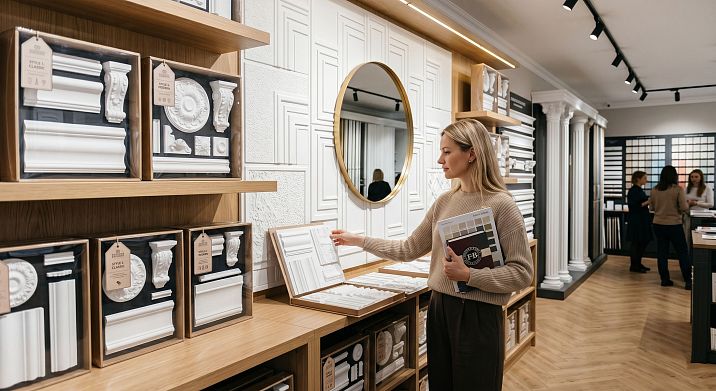
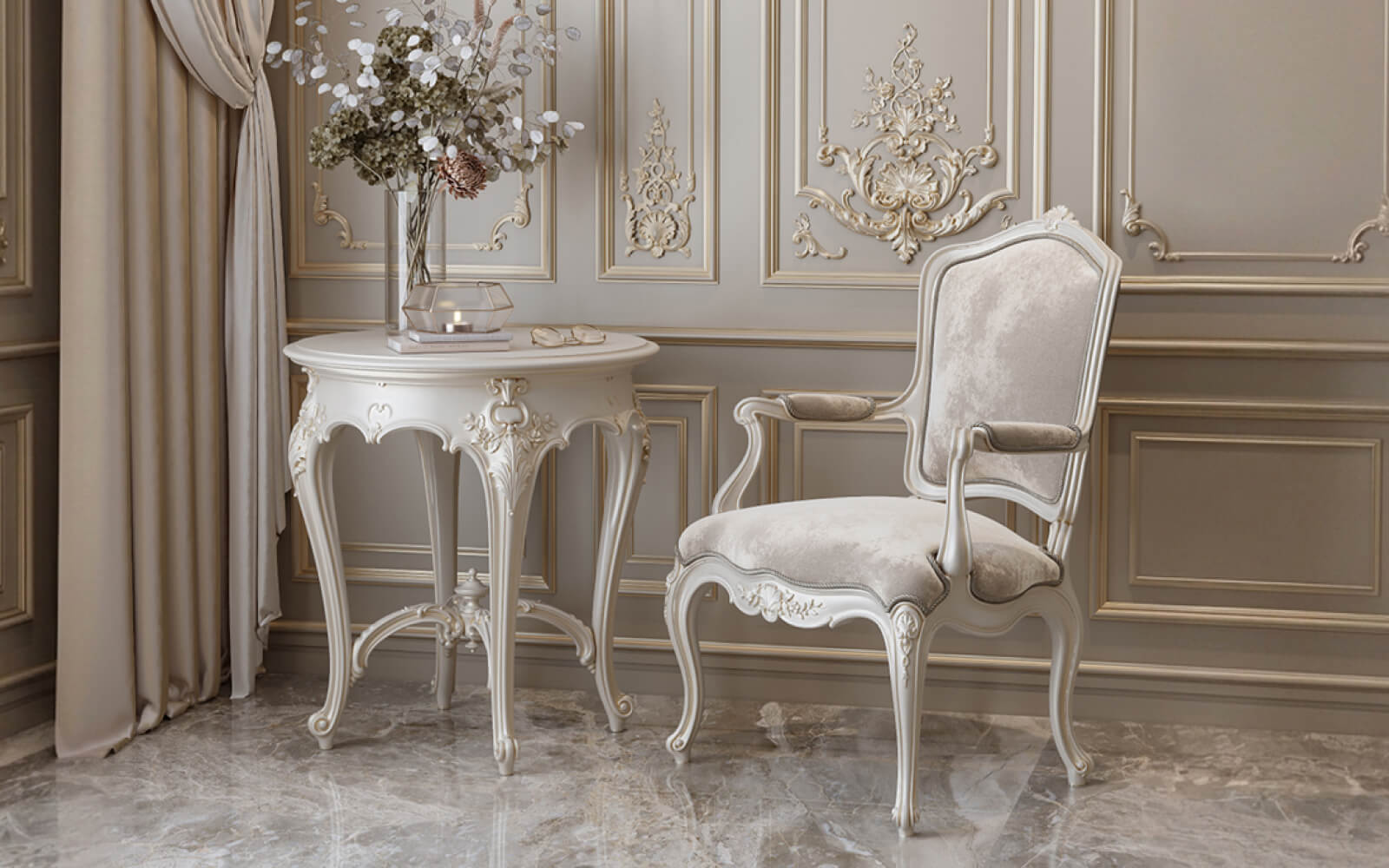
When people say "decorative wall panel" — most imagine heavy MDF boards, expensive joinery, complex installation, and lengthy assembly. This is an outdated notion. Today,polyurethane decorative wall panels — are a fundamentally different class of solutions: lightweight, flexible, wall compositions made from moldings, frame elements, ornamental overlays, and corner inserts that can be installed without professional tools. They create the effect of an architectural panel on the wall — and do so without plaster, wood, chiseling, or a construction crew.
Ready-made set of stucco decor — is a "panel in a box." All elements of the future wall composition are already matched in style, scale, and size. Open, mark, install — and on the wall you get what once seemed a privilege of expensive design projects.
Polyurethane wall decor covers four collections — "Neoclassic," "Neoclassic Light," "Japandi," "Versailles Light" — and dozens of formats for living rooms, bedrooms, hallways, corridors, studies, and TV zones. Let's break it all down in order.


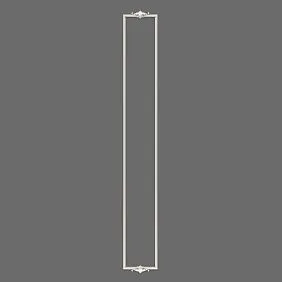
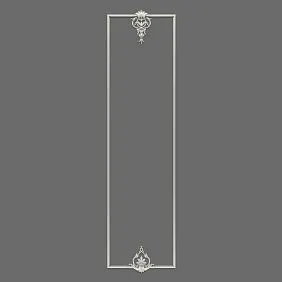
What is a decorative polyurethane panel
Let's clarify the terminology right away, because confusion often arises here.




Panel as a concept, not as a slab
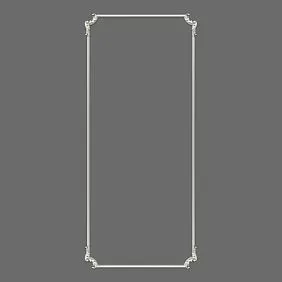
Decorative wall panels polyurethane — are not monolithic slabs that need to be leaned against the wall. They are composite wall compositions: a frame contour made of molding, corner elements, ornamental overlays in the center or corners, optionally — a horizontal molding belt dividing the panel into fields.
The result on the wall is visually perceived as a panel. In fact, it is a system of elements glued directly onto the wall. The wall does not change, deepen, or build up. Polyurethane elements lie on its surface in a thin layer — from 10 to 30 mm deep — and create relief.
Polyurethane wall panelsare used in:
-
living rooms — wall behind the sofa, TV area, fireplace wall;
-
bedrooms — headboard area, walls next to bedside tables;
-
hallways and corridors — rhythmic panels along the long wall, vertical elements on the partitions;
-
studies — wall behind the desk;
-
foyers and formal areas — accent walls with a pronounced architectural character.
Our factory also produces:
What a polyurethane wall panel consists of
Stucco wall panels — a combination of several types of elements:
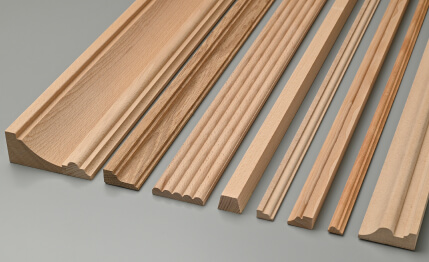
Molding — a profiled strip forming the frame outline. Horizontal and vertical segments create the basis of the panel.
Corner inserts are elements at the intersection points of horizontal and vertical moldings. They can be geometric (in a minimalist style) or ornamental (with a floral or classic motif).
Central overlay is an ornamental element in the central field of the panel. Medallion, cartouche, rosette, geometric insert — depending on the collection.
Additional elements are a horizontal belt inside the panel, vertical posts, corner rosettes, ornamental friezes along the top or bottom horizontal line.
The combination of these elements is the decorative panel. One ready-made set = one such panel.
Get Consultation
Dimensions and Proportions
polyurethane wall panelsdepending on the format, they are:
-
horizontal — wider than tall; for the wall behind the sofa, TV area;
-
vertical — taller than wide; for piers, areas next to a mirror;
-
square — approximately equal sides; as a standalone accent element.
Width of a standard wall panel: 60–120 cm. Height: 50–110 cm. For tall rooms — up to 150 cm in height.
Why polyurethane is convenient for decorative panels
This is not a matter of taste — it's a matter of practice. Let's break it down point by point.
Lightness
Polyurethane Items weigh 8–12 times less than a plaster counterpart. A polyurethane molding frame 100×80 cm weighs 300–500 g. The same one in plaster weighs 3–5 kg. Mounting adhesive without dowels holds the polyurethane element securely. Plaster requires mechanical fastening.
For installation on a drywall wall or facade panel — only polyurethane. Plaster cannot be attached to thin bases without the risk of pulling out the fasteners.
Ease of Installation
decorative polyurethane elements are mounted with mounting adhesive. Tools: fine-tooth hacksaw (or miter saw), level, tape measure, mounting adhesive. No drilling, chiseling, or hiring craftsmen needed. One person installs one panel in 30–40 minutes.
Paintability
polyurethane wall decor can be painted with any acrylic paint. You can paint it to match the wall — the panel will "dissolve" into the architecture while retaining the relief. You can choose a contrasting shade — a white panel on a dark wall, cream on gray. You can repaint it in a year if the interior concept changes.
Durability
Polyurethane does not swell from humidity, does not crack with temperature changes, and does not deform over time. Service life — decades without loss of aesthetic qualities.
Compatibility with moldings and cornices
polyurethane wall moldings from the same collection organically complement wall panels. A horizontal molding belt along the entire wall + panels in certain areas = a cohesive decorative system. Baseboard, ceiling cornice, moldings, and wall panels — all in a unified style.
Ready-made kit or individual elements: what to choose
One of the most practical questions. The answer depends on the task.
Arguments in favor of a ready-made kit
Ready-made molded decor kits— the right choice in most cases:
Consistency of elements. One kit includes molding, corner inserts, and a central overlay. All are designed together. The scale of the corner insert matches the width of the molding. The ornament of the central overlay follows the same language as the corner elements.
Clarity of the final result. The buyer sees the kit composition description and can visualize the final panel. When selecting individually, the result is unknown until installation.
Ease of calculation. Need three panels for a wall — three kits. No need to calculate the linear footage of molding, number of corner inserts, and overlays separately.
Repeatability. Three identical kits = three identical panels. This is critical for rhythmic series.
Speed. From order to installation — minimal path. No need to browse the catalog searching for compatible elements.
Decorative wall panel kit— optimal choice for: private buyers, designers with standard projects, construction teams who need predictable results.
When selecting individual elements
Individual selection from polyurethane wall moldings and individual overlays is justified if:
-
Non-standard sizes that do not match ready-made kits are needed.
-
A very large panel is required — wider or taller than the standard composition.
-
A unique layout is being designed — several horizontal belts, nested frames, asymmetric system.
-
The designer is working on a custom order requiring precise size matching.
In this case: molding by linear meter + corner inserts from polyurethane molding decoration + overlays from the same style series + if necessary Decor for Moldingat intersection points.
What types of decorative wall panels are there
Four main formats — each for its own task.
Frame panels from moldings
A classic decorative panel is a rectangular molding contour with corner inserts. Horizontal and vertical molding segments form a frame. Corner elements at intersection points complete the contour and add an ornamental accent.
Molding frames on the wall— the most common type of wall panels. They work equally well in neoclassicism, modern classicism, and soft minimalism.
Decorative panel from moldingsin the basic version — it's four molding segments + four corner elements. In the extended version — plus a central overlay, plus a horizontal belt dividing the panel into two fields.
Ready-made molding frames for the wallfrom the «Neoclassic Light» collection (CPU-2-*) — the most popular format for city apartments. Thin profile, neat corner inserts, delicate relief. Works on walls 2.5–2.7 m high and does not overload the space.
polyurethane wall moldingsfor frame panels — a linear material that, with precise cutting and neat joining, gives a flawless frame with perfect corners.
Vertical decorative panels
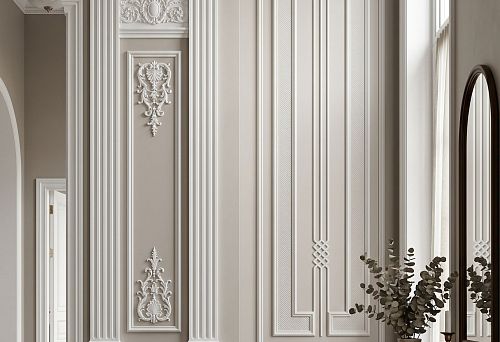
Vertical panel — a composition elongated in height. The width is 2.5–4 times less than the height. This is an architectural post, a decorative pilaster, a vertical accent.
Vertical decorative panel ideal for:
-
spaces between doorways (width 30–70 cm);
-
areas near a mirror or console;
-
entrance area design;
-
high walls that need to be "enlivened" vertically.
Decorating a narrow pier in vertical format — a vertical framed panel or a single post with an ornamental overlay in the center. Width: 40–55% of the pier width. Height: 60–80% of the working wall height.
vertical wall decor from "Neoclassic" (CPU-1-) — for spacious hallways and high corridors. From "Neoclassic Light" (CPU-2-) — for standard apartment piers.
Panels with stucco decor and overlays
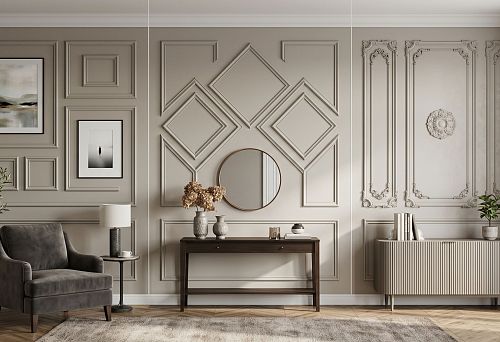
A richer format: the frame contour is complemented by rich ornamental overlays, medallions, cartouches, and friezes. This is the territory of "Versailles Light" and full "Neoclassicism."
Stucco wall panelswith developed ornamentation are used in:
-
formal living rooms and halls;
-
classic studies;
-
master bedrooms in classic style;
-
banquet halls and representative spaces.
Polyurethane wall panelis the most complex format, where the central overlay occupies a significant area of the field and itself serves as a decorative statement: a floral garland, a cartouche with ribbons, a heraldic medallion.
Decorative wall elementsthe composition of such panels includes ornamental overlays of various scales: from large central elements (20–40 cm) to miniature corner ones (5–10 cm).
Laconic panels for modern interiors
The opposite of rich ornamentation —minimalist decorative panels. The thinnest profile. No ornamentation. Only geometry.
Wall panel «Japandi» — that's exactly this format. One clean rectangular frame with geometric corner inserts, painted to match the wall. In evening light — a soft relief. In daylight — a barely noticeable texture. This is «nothing extra» in its most architectural embodiment.
Modern wall decor in a minimalist style — for bedrooms in a neutral palette, studies with monastic austerity, living rooms where the main decorative elements are textiles and live plants, not ornamentation on the walls.
Where to use decorative polyurethane panels
Now to specific scenarios — with real examples and parameters.
In the living room
Living room — the main «stage» of the living space. The wall in the living room must hold the accent — and a decorative panel works here stronger than any other solution.
Wall behind the sofa.Decorative panels for the living roomin the format of one large frame or two symmetrical ones — behind the sofa this is a textbook solution.Molding panel behind the sofacreates a "niche" for the sofa: it becomes integrated into the architectural context.
Size for the wall behind the sofa: panel width — 60–75% of the sofa width. If the sofa is 220 cm — one panel 130–165 cm wide. Or two panels of 80 cm each symmetrically.
TV zone.Decorative panels for the TV zone— a frame system around the screen and cabinet. A molding contour covering the entire width of the TV zone creates the effect of a built-in niche. The TV no longer "hangs" on the wall — it is built into the architecture.
Parameter: width of the molding frame around the TV — 20–30 cm wider than the screen on each side. Height — from the cabinet level to a point 30–40 cm above the top edge of the TV.
Fireplace zone. The molding panel above the fireplace is a continuation of the portal's architectural theme. One frame across the entire width of the zone or a "frame within a frame" with an ornamental medallion at the top.
Wall with a painting. A molding panel surrounding the painting outside its original frame creates a "gallery" feel. Especially effective for large canvases.
In the bedroom
In the bedroom, the decorative panel serves as a "frame" for the bed — while simultaneously reducing the visual pressure of the large empty wall behind the headboard.
Decorative panels for the bedroom — two fundamental formats:
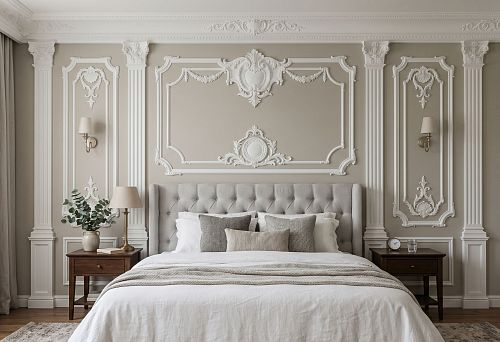
Panel at the headboard.Decorative panel at the headboard of the bed covers the wall behind the bed: one wide horizontal frame with a width comparable to the bed, or a system of two vertical frames on either side of the headboard. The first option is for beds with a high headboard, which itself is an accent. The second is for beds with a low or no headboard.
Size for the bedroom: panel width — 80–100% of the bed width (including bedside tables). Height — 50–70 cm with a ceiling of 2.6 m, 65–85 cm with a ceiling of 2.8 m.
Calm panel in the color of the wall."Neoclassical Light" for bedroom wallsor"Japandi", painted in the color of the wall — a monochrome relief. It creates texture without creating visual noise. For the bedroom, this is ideal: the feeling of an "expensive interior" without irritating ornamentation.
A decorative panel in the bedroom pairs well with bedside sconces: the sconces are either placed inside the molding frame or on either side of it — and then the light illuminates the relief of the decor.
In the hallway and corridor
The hallway and corridor are spaces where decorative panels work through system and rhythm.
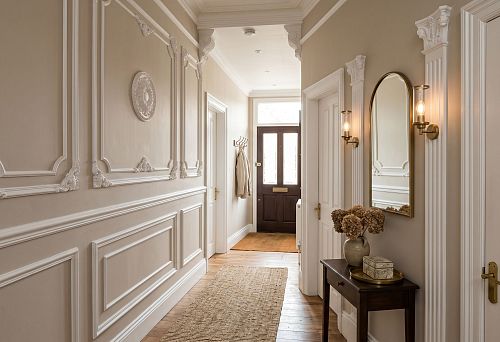
Vertical panels between doors.Decorative panels for the hallwayin a vertical format — for the piers between doorways. One narrow vertical element on each pier. The piers become the corridor's "pilasters."
Rhythmic panels along a long wall. Three to five identical panels at equal intervals along a long corridor — a system that turns a "tube" into an enfilade. The eye moves from panel to panel.
Decorating the mirror area.Decorative panels in the corridoron either side of the mirror — an architectural frame without a physical frame. Two vertical elements from the"Neoclassic" setcreate a "built-in" mirror.
Narrow wall decor.Decor of a narrow wallIn the hallway — a laconic vertical panel from "Neoclassic Light" or "Japandi", painted to match the wall. This works even in very tight spaces — with a wall width from 30 cm.
How to choose the style of a decorative panel
Style is not about "like/dislike". It's about matching the overall language of the interior. Let's look at four collections with practical recommendations.
Neoclassicism
Architecturality. Symmetry. Medium or wide profile. Ornamental corner inserts with floral or geometric motifs. Central overlay — a medallion or cartouche.
Wall panel in neoclassical style — for rooms with historical references in the finish. Classic parquet, ceiling cornices with profile, doors with architraves, furniture on legs — this is the context where a neoclassical decorative panel sounds organic.
Neoclassical decorative panels from CPU-1-2 or CPU-1-3 — the optimal format for most living spaces. CPU-1-4 and CPU-1-5 — for more formal areas.
Color: white on a white wall — architectural monochrome. Cream on a warm gray wall — delicate contrast. Color matching the wall — architectural texture without contrast.
Neoclassic Light
Thin profile 25–40 mm. Delicate corner inserts. Minimal or absent central ornament. This is "Neoclassical" multiplied by a restraint factor.
Light decorative wall panels from "Neoclassical Light" — the most popular choice for a modern Russian apartment. Suitable for any room with a ceiling height of 2.5–2.7 m. Does not require "classical" furniture — works in a modern interior as well.
"Neoclassic Light" — wall decor CPU-2-1 — CPU-2-5: five levels of saturation from absolute minimum to moderate classic. CPU-2-2 — the universal "golden mean".
Modern panels from moldings painted "in wall color" — monochrome texture for bedrooms, studies, and any rooms where silence is important.
Japandi
The most restrained language in the assortment. Profile: 15–25 mm. Corners: geometric, without ornament. Central overlay: absent or geometric.
Wall panel «Japandi» — for interiors where "nothing extra" is a principle, not a coincidence. Linen, birch, natural stone, matte surfaces — and the finest molding frames.
Wall decor "Japandi" CPU-3-1 — CPU-3-6. Painting: strictly in wall color. No contrast — only relief. One element — one frame — one thought.
minimalist decorative panels — the main choice for architects and designers working in modern aesthetics.
Versailles Light
Opposite pole. Floral ornament. Double contours. Rich corner inserts. Central medallions. This is expensive, expressive, and ceremonial.
Classic decorative wall panelsfrom "Versailles Light" require an appropriate context. A spacious hall. A high ceiling (from 2.9 m). Furniture with historical references. Parquet flooring with a pattern. Quality textiles. Without this context, "Versailles Light" looks excessive.
"Versailles Light" — wall decorCPU-4-1 — CPU-4-5. CPU-4-2 and CPU-4-3 are the most commonly used in residential interiors. CPU-4-5 is for formal areas.
Decorative panels in classic stylefrom "Versailles Light" are especially good in tandem with ceiling cornices from the same collection and classic baseboards with a profile.
How to calculate a decorative panel for a wall
Calculation is 50% of success. Wrong proportions ruin even the most expensive collection.
Calculation algorithm — step by step
Step 1: Measure the wall. The width of the wall from corner to corner or from opening to opening. The height from floor to ceiling. Record the location of the baseboard, cornice, sockets, switches, sconces, furniture.
Step 2: Define the "working" area. The working area is the space between the top edge of the baseboard and the bottom edge of the ceiling cornice. This is where the decorative panel is placed.
Step 3: Determine the number of panels. One panel — for an accent wall. Two symmetrical panels — for walls with a central element. A series — for long walls.
Step 4: Calculate the panel width. One panel: 55–70% of the wall width. Two: 28–35% each with a 12–18% gap in the center. Three: 20–25% each with equal gaps.
Minimum panel width is 40 cm. A width smaller than this mark — the panel looks like a "narrow craft" rather than an architectural element.
Step 5: Calculate the panel height. Bottom offset from the top edge of the baseboard: 25–35 cm. Top offset from the bottom edge of the cornice: 20–30 cm. Total: panel height = working wall height − 45–65 cm.
For a ceiling of 2.6 m: working height ~230 cm, panel ~170–185 cm. But this is the maximum "from baseboard to cornice" — most decorative panels occupy 40–60% of the working wall height. Bottom horizontal: 35–40 cm from the floor. Top horizontal: 100–130 cm from the floor (for horizontal formats) or 160–180 cm (for vertical ones).
Step 6: Draw a diagram.Diagram of a panel made from moldings at a scale of 1:20 — a mandatory step. Draw the wall, place furniture, outlets, sconces. Draw the panel to scale. Check: nothing overlaps, gaps are equal, proportions are correct.
Table of approximate decorative panel sizes
| Ceiling Height | Working height | Panel height | Panel width (for one) |
|---|---|---|---|
| 2.5 m | ~210 cm | 45–60 cm | 55–70% of wall width |
| 2.6 m | ~225 cm | 55–70 cm | 55–70% of wall width |
| 2.7 m | ~235 cm | 60–80 cm | 55–70% of wall width |
| 2.8 m | ~245 cm | 65–85 cm | 55–72% of wall width |
| 3.0 m | ~265 cm | 75–100 cm | 55–72% of wall width |
Mistakes when choosing decorative panels
A detailed analysis of the most common miscalculations.
Mistake 1: The panel is too small for the wall
A decorative panel 50 cm wide on a 3.5 m wide wall looks like a sticker, not an architectural element. For a wide wall — either one large panel or three to four repeating ones. A single small panel — only if the wall is physically small (up to 1.5 m).
Mistake 2: Moldings do not match the style
polyurethane decorative wall panels"Versailles Light" next to IKEA furniture looks unserious. Or "Japandi" in an apartment with heavy classic cornices — a stylistic violation. The decor style should match the overall style of the space.
Mistake 3: No layout scheme
"We'll put it as it goes" — doesn't work.How to calculate wall decorWithout a scheme, it's impossible to predict the result. A scheme before installation is the only insurance against rework.
Mistake 4: The panel conflicts with furniture
The lower horizontal molding behind the sofa at a height of 20 cm from the floor — the sofa will cover it. Decoration must be planned considering furniture height: the lower horizontal should be at least 5 cm above the back of the sofa or console.
Mistake 5: Sockets and switches are not accounted for
A molding frame that a socket 'fits into' is a classic mistake. Before installation, a scheme marking all technical elements is mandatory. If a socket falls within the decoration area — either shift the decoration or move the socket.
Mistake 6: Too much ornament in a small room
'Versailles Light' in a 12 m² room is visual overload. For small spaces — 'Neoclassic Light' or 'Japandi'. Rich ornament requires space to 'breathe'.
Mistake 7: Buying individual elements without understanding the final composition
'I bought molding and corner inserts — I'll figure it out later' leads to incompatible elements, incorrect proportions, and wasted rework.Ready-made molding framesthe finished kit insures against this.
A complete practical guide to working with the material:installing polyurethane moldingandinstallation of polyurethane molding.
Where to buy decorative polyurethane wall panels
STAVROS — the full range for any format and style:
polyurethane decorative wall panels — wall decor section.
decorative wall panels — all collections and formats.
Ready-made molded decor kits — system sets for quick installation.
wall decor set — CPU collections from minimalist to grand.
polyurethane wall moldings— profiles for frame systems.
Molding frames on the wall — ready-made frame systems.
molded decoration made of polyurethane — overlays, medallions, corner elements.
decorative polyurethane elements — ornamental components for enriching panels.
Decor for Molding— insert elements to enrich the profile.
Set of stucco decor "Neoclassic"— for classic interiors.
"Neoclassic Light" — wall decor— for modern apartments.
"Japandi" decor set— for minimalist spaces.
"Versailles Light" stucco decor set— for formal and classic areas.
FAQ: Answers to popular questions
Are decorative polyurethane panels the same as MDF panels?
No. MDF panels are monolithic slabs mounted as cladding. Polyurethane decorative panels are composite wall compositions made of moldings, overlays, and corner inserts glued to the wall. They weigh many times less and do not require load-bearing structures.
Can decorative panels be mounted on wallpaper?
Yes. The adhesive is applied to the polyurethane element and pressed against the wallpaper. The wallpaper must be glued tightly, without air bubbles. Ideally, mount on a painted wall, then glue the wallpaper around the decor.
What glue to use?
Mounting adhesive based on acrylic or polyurethane — "Liquid Nails", "Moment Montage", or similar. Do not use: silicone (does not hold), PVA (not suitable for polyurethane), epoxy compounds (too rigid).
Can polyurethane panels be painted?
Yes. Any acrylic paint. Priming before painting is recommended but not necessary if the paint has good adhesion. One or two coats of finish paint.
How long do decorative polyurethane panels last?
Almost indefinitely with proper installation. Polyurethane does not rot, deform, or crack. The only threat is mechanical damage (impact). If damaged, the element is removed and replaced.
Are decorative wall panels different from ceiling decor?
Yes. Wall panels are horizontal or vertical format, with a richer relief and ornament oriented to the human eye level (1.2–1.7 m). Ceiling decor is flat or low-relief, oriented for a vertical upward gaze.
How much does it cost to install one decorative panel?
Self-installation: zero labor costs (only glue and tools). Installation by a professional: 30–60 minutes per panel. Polyurethane is a material for DIY work. Professional installation is only needed for complex layouts or finishing formal areas.