










































































Article Contents:
- What is vertical wall decor
- Vertical wall composition as an architectural gesture
- Material: why polyurethane is optimal for vertical decor
- Where to use vertical polyurethane decor
- Pier between doors
- Wall next to a mirror or console
- Narrow wall in a hallway
- High wall in a living room or bedroom
- Ready-made kit or individual moldings: what to choose
- When a ready-made kit is better
- When it makes sense to select individual moldings
- How to choose vertical decor to match your interior style
- Neoclassicism
- Neoclassic Light
- Jatoba
- Versailles Light
- How to calculate vertical decor for a wall
- Step 1: Measure the wall height and mark zones
- Step 2: Determine the width of the wall section and the allowable element width
- Step 3: Mark obstacles
- Step 4: Determine the number of elements
- Step 5: Calculate the number of elements for each kit
- What to pair with vertical decor
- With moldings and horizontal bands
- With decorative overlays
- With sconces and wall lighting
- With mirrors and paintings
- With baseboards and ceiling cornices
- Mistakes when choosing vertical decor
- Mistake 1: Too wide a set for a narrow wall
- Mistake 2: Ignoring ceiling height
- Mistake 3: Decor too close to the baseboard
- Mistake 4: Switches and sconces not accounted for
- Mistake 5: Mixing stucco styles
- Mistake 6: A single element where a pair is needed
- Error 7: Purchase without layout scheme
- Error 8: Active ornament in a small hallway
- Where to buy vertical wall decor made of polyurethane
- FAQ: Answers to Popular Questions
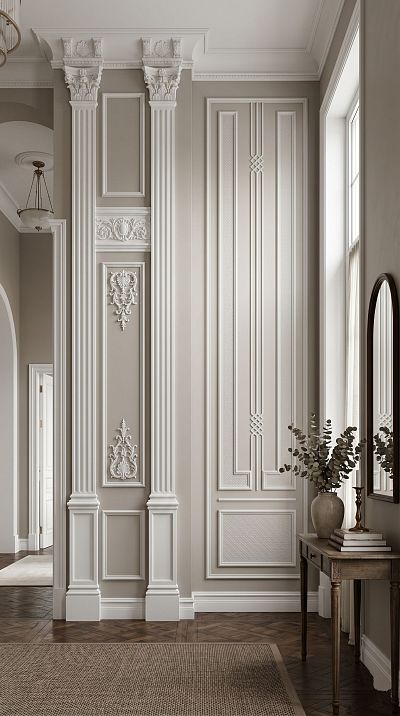
There is a special category of walls that defy ordinary solutions. Narrow piers between doors are too thin for a horizontal frame. Long hallway walls are too monotonous for a single accent element. High living room walls are too bulky to leave empty and too complex to fill with just a painting. It is for these cases that there is vertical wall decor — an architectural tool that works where everything else fails.
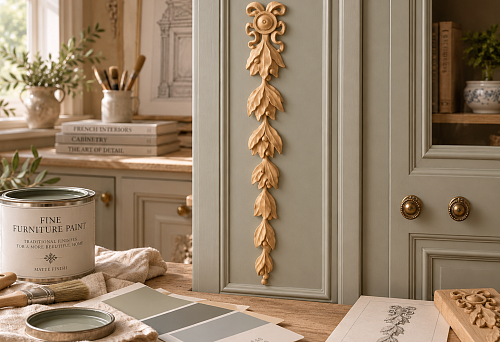
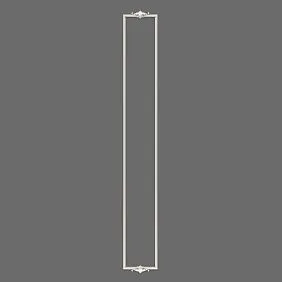
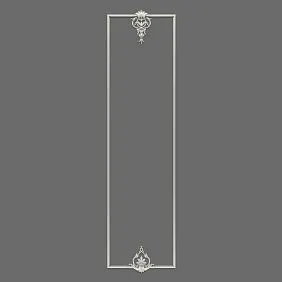
Vertical wall decor made of polyurethane is not a vertically hung painting or a random sticker. It is a well-thought-out wall system: molding posts, ornamental overlays, corner inserts, and vertical frame elements that visually elongate the wall, organize the space, and create a sense of architectural completeness where there was once just a surface.
Ready-made molded decor kits in a vertical format is a turnkey solution for piers, narrow zones, and high walls. One set — one decorative post. Several sets — a systematic rhythm along the wall. No need to select parts independently, no risk of element incompatibility.


What is vertical wall decor
Let's start with a definition — clear and practical. Because "vertical decor" is a broad concept, and it is understood differently.




Wall vertical composition as an architectural gesture
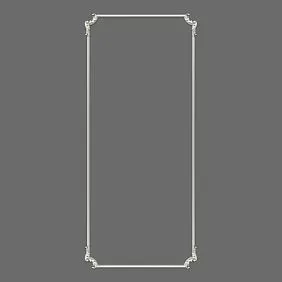
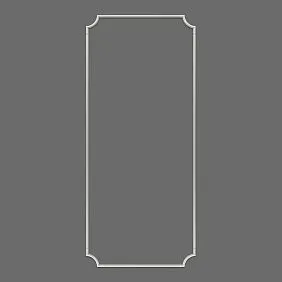
Vertical stucco on the wallis a decorative system elongated in height, consisting of one or more elements: molding posts, central ornamental overlays, corner inserts at the top and bottom, decorative pilasters, or stylized columns. It can be completely laconic — two posts on the sides and an overlay in the center — or more elaborate, with a developed ornamental top and bottom base.
The fundamental difference between vertical decor and a frame system: a frame is a closed rectangle, a vertical composition is an open vertical axis. The frame emphasizes the "field" on the wall. The vertical element emphasizes height, direction, and upward movement of the gaze.
Vertical moldings on the wallin a vertical system are the side posts that set the width and clear boundaries of the composition. Depending on the collection, the profile of the posts can be thin (20–30 mm, "Japandi"), medium (40–55 mm, "Neoclassic Light"), or elaborate (60–80 mm, "Neoclassic", "Versailles Light").
Decorative wall compositionin a vertical format is always about working with proportion. The width of the element should be 2.5–4 times less than its height. Only then does the composition read as a "vertical," not as a "wide frame."
Our factory also produces:



Material: why polyurethane is optimal for vertical decor
Polyurethane stucco decor is lightweight (density 150–200 g/dm³), moisture-resistant, and flexible. These properties are especially important for vertical installation: a long element on glue must hold securely and not press on the joint with its weight. A gypsum analog of the same size would weigh 8–12 times more and would require mechanical fastening.
molded decoration made of polyurethaneis installed with mounting glue without dowels or drilling. It is cut with a hacksaw or utility knife. It is painted with any acrylic paint. It does not crack during seasonal changes in humidity and temperature. After 20 years, it looks the same as on the first day — if not deliberately destroyed.
Get Consultation
Where to use vertical polyurethane decor
Let's move on to specific scenarios. This is where the article should answer the reader's real question: "Is this suitable for my wall?"
Pier between doors
Let's start with the most common and most "awkward" case. The pier between two doorways is a narrow vertical section ranging from 25 to 80 cm wide. A horizontal frame panel won't fit there — it's too wide. A large decorative overlay looks cluttered. Leaving it empty is unattractive.
Decorating the pierusing a vertical set is one of the few ways to make a narrow area expressive without overloading it. A vertical post or narrow frame panel 60–100 cm high, placed in the center of the pier, turns the "passage" into an architectural accent.
Wall decor between doorsis built according to the following logic:
-
Pier up to 35 cm wide: one vertical overlay in the center, without molding posts.
-
Pier 35–55 cm: narrow vertical frame with a 5–8 cm offset from the door casings.
-
Pier 55–80 cm: vertical set with side posts and a central ornamental insert.
Set of stucco decor for a pierIt is important to select taking into account door trims. The trim is a visible element, and if the gap between it and the molding is less than 3–4 cm, the gap looks random. Either the molding is flush with the trim (with a 1 cm gap and sealant), or the indentation is from 8 cm — avoid intermediate solutions.
Important: on the pier, you always need to mark the switch in advance. It often sits exactly where you want to place the decor. Solution: bypass the switch with a molding frame — it ends up inside the decorative field. Or shift the decor to the side, leaving the switch in a neutral zone.
Wall next to a mirror or console
Entry area, hall, hallway — there is almost always a mirror here. And almost always next to the mirror there is a wall that people don't know how to decorate.
Decor of the wall by the mirroris one of the most rewarding scenarios for a vertical set. Two symmetrical vertical elements on the sides of the mirror create an architectural frame — without a physical frame around the mirror itself. The mirror appears 'built-in' to the decorative system, although physically it remains simply hung.
Vertical decor in the hallwayin this format is especially good for several reasons:
-
The mirror is always viewed up close — the quality of installation and details is especially noticeable here.
-
Lighting in the hallway is usually side-mounted (sconces) — and vertical relief shows up well in such light.
-
The symmetry of two vertical elements plus a mirror creates a "scene" — a complete composition.
If the mirror is complemented by a console underneath, vertical posts on either side of the "mirror + console" pair form a visual opening: a built-in niche without drywall. This is a powerful design technique for a standard hallway.
Narrow wall in the corridor
A long corridor is not only a long wall but also a series of narrow vertical "slots" between doors. Each such slot is a potential zone for vertical decor.
Decor of a narrow wallin the corridor is built through rhythm. One vertical element is not yet rhythm. Two is already a hint. Three or four is a system that organizes a long space.
Vertical decor in the corridorof identical sets, repeated at equal intervals along the wall, is a classic solution. The eye moves along a row of vertical elements, like along an arcade or colonnade. The corridor ceases to be a "tube" and turns into an enfilade.
Moldings in the corridoras side posts for vertical elements is both an economical and visually precise technique. A thin profile of 30–40 mm painted to match the wall is almost invisible in daylight but creates a soft relief in evening light — exactly what a corridor needs.
Additionally: for a long corridor, vertical molding posts can be connected with a horizontal belt at a height of 120–130 cm — creating a full horizontal-vertical grid. This is no longer just individual accents, but a cohesive decorative system.
High wall in a living room or bedroom
High walls are a separate topic. A ceiling of 3.0–3.5 m creates proportions where standard frame panels look small. The wall "presses" not from above, but from below: a large empty space above the decor makes it disproportionate.
Decorating a high wall is solved through vertical elements that "hold" the height. A vertical post or vertical frame 120–150 cm high next to a sofa or bed is a visual counterbalance to the large empty space above.
Vertical decor in the bedroom works especially well in the headboard area. Two symmetrical vertical sets on either side of the bed, 100–130 cm high, connect the bed to the wall — turning furniture and architecture into a unified scene.
Decorating a wall pier in the living room on a high wall can also work as a single element — if the living room is spacious and the wall pier is symmetrically positioned relative to the room's axis. One tall vertical set in the center of the wall is an architectural "column" without a column. Expressive, concise, expensive.
For walls higher than 3.5 m, a two-level vertical system can be used: a lower set (height 100–120 cm) + a horizontal molding belt + an upper decorative element (50–70 cm) under the ceiling cornice. This fills the entire wall height systematically, not chaotically.
Ready-made kit or individual moldings: what to choose
A practical question. An honest answer.
When a ready-made kit is better
Ready-made molded decor kits— the choice for those who want results without deep immersion in the topic.
Arguments in favor of the kit:
-
All elements are designed in a unified style and scale — no "corner insert doesn't match the profile."
-
The kit's composition is known — you can accurately calculate the cost and quantity.
-
The kit is repeatable: ordered three identical ones — got three identical decorative posts without deviations.
-
No risk of error with profile width or ornament scale.
-
Installation is easier: the layout is already known from the kit's composition.
Vertical decor set — the optimal choice for: repeated piers in a hallway, symmetrical decor on both sides of a mirror, standard decoration of several rooms in one style.
When it makes sense to select individual moldings
Individual selection — for non-standard sizes and non-standard tasks. If the pier is 42 cm wide with a ceiling height of 2.85 m, a ready-made set may not fit the desired proportions. Then: molding of the required profile by linear meter + separate corner inserts + central overlay from polyurethane molding decoration.
But it is important: when selecting independently, you need to check the compatibility of elements by style and scale.Decor for Molding — insert ornamental elements that complement the molding profile — this is an additional tool for an individual solution. They allow enriching a thin profile without changing the molding itself.
Conclusion: for serial use and quick results — ready-made wall decor set. For a precisely matched non-standard size — individual assembly from linear molding and separate elements.
How to choose vertical decor for interior style
Four collections — four fundamentally different languages. Choosing a style is not an aesthetic whim; it is a match with the overall language of the interior.
Neoclassicism
Neoclassicism is a style where the architectural quality of the space is more important than decorative richness. Moldings read clearly. Ornament is present but does not overpower the geometry. Symmetry is mandatory.
Vertical decor in neoclassicism — these are vertical posts of medium or wide profile with neat corner elements and a central ornamental overlay. Post width: 45–65 mm. Set height: 70–110 cm depending on ceiling height.
Neoclassical wall decor from the CPU-1-* collection works well in hallways with ceilings from 2.7 m, in living rooms with classic or neoclassical furniture, in halls and studies with symmetrical layouts.
Set of stucco decor "Neoclassic" in vertical application — two symmetrical posts on either side of a mirror or three repeating sets along a long corridor wall. Color: white on a white wall (architectural minimalism) or a color matching the wall plus a slightly richer shade inside the set.
Pairs with:ceiling cornices made of polyurethane, profiled baseboards, classic door casings, furniture with legs.
Neoclassic Light
If "Neoclassic" is the language of a formal interior, then "Neoclassic Light" is the language of a modern apartment that wants to be a little more than just an apartment.
"Neoclassic Light" — wall decor — thin profile 25–40 mm, delicate corner inserts, minimal ornament or its complete absence. This is an "almost frame" — it exists but requires no explanation.
Light vertical decor from "Neoclassic Light" — the most popular choice for: a standard apartment with a ceiling of 2.5–2.7 m, a narrow corridor, a small hallway, a modern bedroom.
CPU-2-1 — CPU-2-5 — five formats in this collection. CPU-2-1: absolute minimum, one thin post without ornament. CPU-2-3: post with delicate corner inserts and a small central overlay. CPU-2-5: richness bordering on the senior collection, for those who want "Neoclassic Light with character".
Modern vertical decor made of polyurethane painted "in wall color" — the main technique for a city apartment. The wall is dusty white — the moldings are dusty white. The wall is gray-beige — the moldings are the same shade. The relief is only visible in oblique light. This is modern minimalism with architectural texture.
Japandi
Japandi — an interior style where every element is chosen intentionally and carries a function. There are no random details. There is almost no ornament. The form speaks for itself.
Wall decor "Japandi" — these are the thinnest molding posts with a clean rectangular or slightly beveled profile. No floral ornament. Corner elements are simple, geometric. Everything matches natural materials: linen, birch, gray stone.
Minimalist vertical decor from the "Japandi" collection — CPU-3-* — for bedrooms with laconic furniture, for hallways in minimalism, for studies with a view of nature. One vertical element on the wall section — and no other decor nearby. This style requires the courage to remove the excess.
Vertical decor "Japandi"Combines with: raw wood, natural textiles, matte surfaces, neutral palette. Contraindicated: ornamental stucco, gilding, complex cornice profiles.
A separate technique: a vertical "Japandi" molding as a divider between zones — without any corner or overlay. Just one vertical 20 mm strip painted on the wall in relief. This is "nothing extra."
Versailles Light
Versailles Light — for those building a space with a statement. Not "decor," but "architecture." Floral ornament, developed corner inserts, double posts, central medallion, rich relief.
"Versailles Light" — wall decorIn vertical application, it is not one set on a pier, but a system. In a spacious hall or formal living room, vertical "Versailles Light" posts with full-size corner inserts and central medallions create the feel of an interior with history.
Classic vertical decorFrom CPU-4-* — five formats from moderately expressive to formal. CPU-4-3 and CPU-4-4 are the most popular for residential interiors. CPU-4-5 — for halls and formal areas with ceilings from 3.2 m.
Decorative wall postsFrom "Versailles Light" require an appropriate context: furniture with patina or gilding, textured fabrics, neutral warm wall tones, quality flooring. Without this context, "Versailles Light" looks like theatrical props.
How to calculate vertical decor for a wall
Vertical decor is calculated by height, not width. The logic is the opposite of the frame system.
Step 1: Measure the wall height and mark the zones
Full height from floor to ceiling. Minus baseboard (8–15 cm). Minus ceiling cornice (5–12 cm). The remaining "working" height is the zone where vertical decor is placed.
Leave indents at the top and bottom: from the top edge of the baseboard — at least 20 cm, optimally 25–35 cm. From the bottom edge of the cornice — at least 15 cm, optimally 20–30 cm.
Total: height of the vertical element = working wall height minus total indents at the top and bottom.
For a ceiling of 2.6 m: working height ~230 cm, indents 25 + 20 = 45 cm, element height ~185 cm. But this is the maximum — in reality, for most apartment interiors, sets are used with a height of 60–100 cm, placed in the visual center of the wall, not from baseboard to cornice.
Step 2: Determine the width of the wall section and the allowable width of the element
Narrow wall decor setIt is selected as follows: width of the vertical set = 40–55% of the wall section width. For a wall section of 45 cm — a set 18–25 cm wide. For a wall section of 60 cm — 25–33 cm. For a wall section of 80 cm — 32–44 cm.
Width of the molding post in this case: 3–8% of the wall section width. Wall section 50 cm — post 20–30 mm. Wall section 80 cm — post 30–45 mm.
Step 3: Mark obstacles
Switches, sockets, sconces — everything needs to be marked on the diagram before purchase. The vertical element should not cover functional devices. If the switch is in the center of the wall section — either the decor is shifted, or the switch is moved (difficult and expensive), or the decor is built around the switch (more troublesome, but architecturally interesting).
Step 4: Determine the number of elements
-
1 wall section — 1 or 2 vertical elements (single accent or symmetrical pair).
-
Long wall with multiple sections — identical elements on each section.
-
High wall without sections — a series of identical vertical sets at equal intervals.
Vertical decor layout on the wall be sure to draw it on paper at a scale of 1:20 before purchasing. Vertical decor is about line and proportion. A mistake in proportion is immediately visible.
Step 5: Calculate the number of elements for each set
A standard vertical set includes:
-
2 vertical posts (molding by linear foot or pre-cut pieces);
-
2 top corner inserts (horizontal-vertical intersections);
-
2 bottom corner inserts;
-
1 central ornamental overlay;
-
Optional: additional overlays along the vertical axis.
For custom assembly: molding is taken with a 10–15% allowance for trimming.
What to pair with vertical decor
Vertical decor is part of a broader system. Let's consider what goes together and what does not.
With moldings and horizontal bands
Moldings made of polyurethanein horizontal application complement vertical posts well. A horizontal band at a height of 110–130 cm, intersecting vertical posts, creates a grid — restrained and architectural. Intersections are enhanced withdecor for moldings— corner inserts or ornamental elements at intersection points.
With decorative overlays
decorative polyurethane elements— central medallions, ornamental overlays, corner rosettes — enhance vertical decor. Rule: the ornamental accent is placed in the upper third of the vertical element — where the eye stops first.
molded decoration made of polyurethane...as a corner element at the endpoint of a vertical post is a classic technique. The post is "closed" with a corner trim at the top and bottom — and transforms from a linear molding into an architectural element.
With sconces and wall lighting
Vertical posts on either side of a wall sconce are one of the best scenarios. The sconce appears "built into" the decorative system: light illuminates the relief of the posts, shadows create volume. This works especially effectively in hallways and bedrooms.
Rule: the axis of the sconce should align with the axis of the vertical system or be exactly between two symmetrical posts. A sconce offset relative to the decor is a symmetry violation that "grates on the eye."
With mirrors and paintings
Vertical decor frames a mirror or painting. Two symmetrical vertical elements on the sides — an architectural frame. One vertical element below the mirror (underneath it) — a pedestal.
A mirror inside a vertical molding frame is an even more precise technique. The molding frame is installed first, the mirror inside it. The adhesive behind the mirror holds it to the wall, the molding frames it.
With baseboards and crown moldings
Vertical posts should visually "echo" the profile of the baseboard and crown molding. Thin baseboard + thin crown molding = thin vertical posts. Rich baseboard + massive crown molding = wide posts.
If the baseboard and crown molding are made of polyurethane —Moldings made of polyurethanefrom the same collection for horizontal and vertical application — this is a system solution.
Errors when choosing vertical decor
Practical block — specific errors with explanation of consequences.
Error 1: Too wide set for a narrow wall section
A vertical set 40 cm wide on a wall section 45 cm wide — cramped, disproportionate. The width of the set should be at most 55% of the wall section width. For a 45 cm section — no wider than 25 cm.
Mistake 2: Ignoring ceiling height
vertical wall decor is selected considering the ceiling. A set 120 cm high under a 2.5 m ceiling will take up almost half the working wall height. Too much. The optimum for 2.5 m — set height 55–70 cm.
Error 3: Decor too close to the baseboard
The bottom point of the vertical element is 3 cm above the baseboard — looks 'pressed' into the floor. Minimum distance from the top edge of the baseboard — 25 cm. Optimal: bottom horizontal line at a height of 35–40 cm from the floor.
Error 4: Switches and sconces not accounted for
The most common mistake in the hallway. The switch is exactly where the central overlay should be. Solution: always start the project by marking all technical elements on the wall diagram.
Error 5: Mixing stucco styles
Decorating the pier"Versailles Light" next to a cornice from "Japandi" is a stylistic conflict. Everything should be from the same collection or at least from the same "family" (classic or minimalism).
Error 6: A single element where a pair is needed
One vertical stand next to a mirror looks random. The mirror is "unframed," the stand is "unmotivated." A symmetrical pair is always better than a single element in areas with an axial object (mirror, bed, painting, sconce).
Error 7: Buying without a layout diagram
Set of stucco decor for a pierBought "by eye," and it turned out the height doesn't fit the specific wall section, the width is larger than expected. A scaled layout diagram is a mandatory tool. An hour spent before purchase = saved money and nerves after.
Error 8: Active ornament in a small hallway
"Versailles Light" in a hallway 90 cm wide is visual overload. A small space requires a delicate solution: "Neoclassic Light" or "Japandi." Rich decor is for spacious rooms.
All technical installation details:installing polyurethane moldingandinstallation of polyurethane molding.
Where to buy vertical wall decor made of polyurethane
STAVROS — full range for all scenarios:
vertical wall decor— wall-mounted CPU kits of all collections.
Vertical wall decor made of polyurethane— lightweight, durable, requiring no special tools for installation.
Decorating a narrow pier— vertical kits for areas between doors and near the mirror.
Set of stucco decor for a pier— ready-made solution, composition is coordinated.
Ready-made molded decor kits— for hallway, corridor, living room, bedroom.
Polyurethane wall decor— the entire section of wall decor.
polyurethane wall moldings— profiles for vertical posts and horizontal belts.
decorative polyurethane elements— overlays, medallions, corner inserts to complement vertical systems.
molded decoration made of polyurethane— ornamental elements to enrich vertical compositions.
Decor for Molding— insert ornamental elements to enrich the molding profile.
Set of stucco decor "Neoclassic"— for classic and neoclassical interiors.
"Neoclassic Light" — wall decor— a universal choice for a modern apartment.
"Japandi" decor set— for minimalist spaces.
"Versailles Light" stucco decor set— for spacious formal areas.
FAQ: Answers to popular questions
Can vertical decor be used in a bathroom?
Yes. Polyurethane is moisture-resistant. But: the mounting adhesive must be waterproof, joints treated with acrylic sealant, and paint must be moisture-resistant. In a bathroom, vertical decor works well on the wall opposite the entrance or on the sides of the mirror.
How to attach vertical polyurethane decor?
Mounting adhesive for polyurethane (like liquid nails) + temporary fixation with tape for 30–60 minutes until set. For elements longer than 80 cm, additionally use 2–3 decorative screws with countersunk heads, which are later filled with putty.
What color to choose for vertical decor?
In 80% of cases, the same shade as the wall, or one shade lighter/darker. A contrasting color (e.g., dark decor on a light wall) is a strong accent and requires confidence in the decision.
Do I need to prime the surface before installation?
Yes. A clean, primed, dry wall is the key to reliable adhesive adhesion. Without primer, the glue may not "grip" on a loose or dirty surface.
What should I use to cut polyurethane molding?
A fine-tooth hacksaw, miter saw, or a sharp knife + metal ruler. For a 45° cut, use a miter box or miter saw set to 45°. Uneven cuts can be smoothed with fine sandpaper.
Can I repaint already installed vertical decor?
Yes. Polyurethane can be painted any color with acrylic paint without special preparation. One coat of primer + two coats of finish paint. Repainting does not damage or deform the material.
How long does it take to install one vertical set?
Preparation and marking: 15–20 minutes. Applying glue and installation: 10–15 minutes. Fixation and waiting: 30–60 minutes. Puttying joints and painting: another 1–2 hours including drying time. Total: one set takes 2–3 hours of work.