








































Article Contents:
- What are molding frames on the wall
- A decorative architectural system, not just a frame
- Moldings as a building material for the frame
- Why it's more convenient to buy a ready-made set of frames rather than selecting elements separately
- Consistency is the main argument
- Predictability of the result
- Saving time and intellectual resources
- Convenience of repeating a series
- What types of molding frames exist
- One large frame on an accent wall
- Two symmetrical frames
- Series of frames on a long wall
- Vertical frames for narrow wall sections
- Where to use ready-made molding frames
- In the living room
- In the bedroom
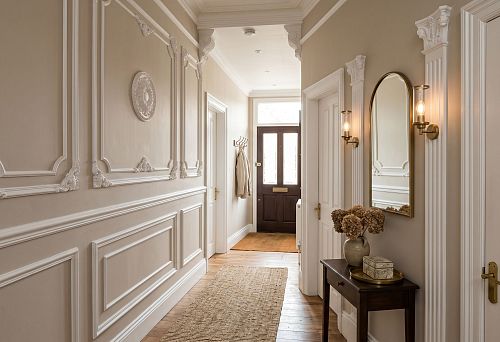
- In the hallway and corridor
- How to choose the style of molding frames
- Neoclassicism
- Neoclassic Light
- Jatoba
- Versailles Light
- How to calculate the size of molding frames
- Step 1: Measure the wall
- Step 2: Determine the number of frames
- Step 3: Calculate the width of the frames
- Step 4: Calculate the height of the frames
- Step 5: Check on the diagram
- Step 6: Calculate the number of elements
- What to combine molding frames with
- With stucco decor and ornamental overlays
- With decor for moldings
- With decorative wall elements
- With wallpaper inside the frame
- With sconces and wall lighting
- Mistakes when choosing molding frames
- Mistake 1: Frames are too small
- Mistake 2: Furniture and ceiling height not considered
- Error 3: Too close to the baseboard
- Error 4: Different profiles without a common logic
- Error 5: Mixing styles in one space
- Error 6: Without a layout scheme
- Error 7: Choosing individual elements instead of a ready-made set
- Where to buy ready-made molding frames for the wall
- FAQ: Answers to Popular Questions
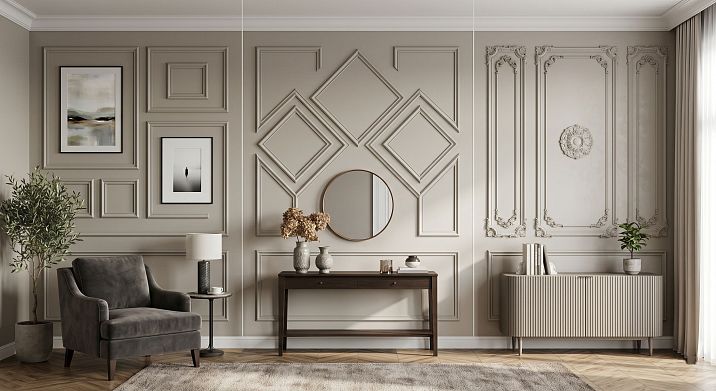
A molding frame on the wall is not just decor. It is an architectural tool that works on three levels simultaneously: it visually structures the space, adds depth to a flat surface, and creates a sense of a thoughtful, finished interior. That is why this technique is one of the most sought-after in modern design, from neoclassical living rooms to minimalist bedrooms in the Japandi style.
The question is not whether molding frames are needed. The question is how to choose the right format, collection, and size so that the result meets expectations. This is where the difficulties begin: moldings come in dozens of profiles, corner inserts come in different types, and ornamental overlays are a separate story.
Ready-made molding frames for the wallin the format of collection kits made of polyurethane remove this complexity. The kit composition is formed: moldings of the desired profile, corner elements, ornamental overlays — all in a single style. One purchase, one collection, one result.


What are molding frames on the wall
Before choosing a set, it is important to understand what exactly we call a "molding frame" and why this technique works so consistently in a variety of interiors.




A decorative architectural system, not just a frame
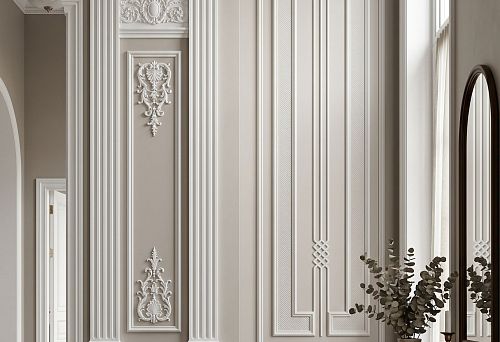
Molding frames on the wall— these are rectangular or vertical contours formed by molding profiles, with corner elements at intersection points and ornamental inserts in the center or corners. They create the effect of an architectural wall panel — without real panels, without drywall niches, without altering the wall structure.
The space inside the frame is perceived as a separate "field" — with a different depth, a different meaning. It is not just a rectangle: it is an architectural gesture that highlights an area, emphasizes a focal point, and creates order on the wall.
Decorative wall framesare used in:
-
living rooms (wall behind the sofa, TV area, fireplace area);
-
bedrooms (headboard area, symmetrical panels behind the bed);
-
hallways and corridors (rhythmic series on a long wall, vertical accents on partitions);
-
offices (wall behind the desk or bookshelves);
-
dining rooms (wall with a sideboard or serving table).
Our factory also produces:


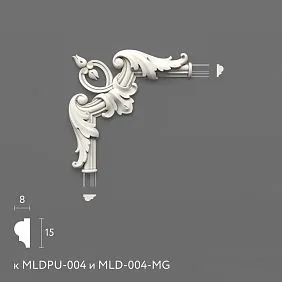


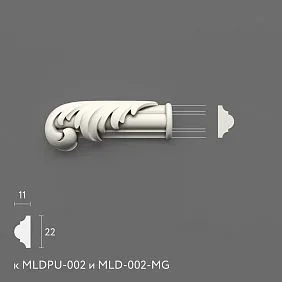

Moldings as a building material for frames
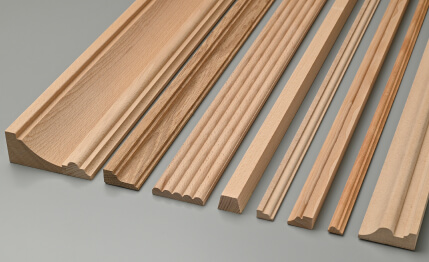
Wall frame moldings are horizontal and vertical segments of molding profile connected at a right angle. The molding itself is a profiled strip with a specific cross-section: flat, convex, with a groove, with an ornament. It is the profile that determines the character of the frame.
Thin flat profile 20–30 mm — for Japandi and minimalist interiors. Medium width profile 40–55 mm with a slight relief — for "Neoclassic Light" and modern classic. Wide rich profile 60–80 mm with ornament — for "Neoclassic" and "Versailles Light".
polyurethane wall moldings are lightweight, durable, and require no special tools for installation. They are cut with a miter saw, attached with mounting glue, and are not afraid of humidity and temperature changes.
Get Consultation
Why it is more convenient to buy a ready-made set of frames rather than selecting elements separately
Here is an honest answer to the question that every second buyer of moldings asks: why pay for a set if you can buy molding by the linear meter and select the rest yourself?
Consistency is the main argument
inready-made sets of stucco decorthe elements are designed together. The width of the molding profile, the scale of the corner insert, the size of the ornamental overlay — everything is calculated to work together. The «Versailles Light» corner insert will not look right with the «Japandi» molding — different language. Within a single set, such a contradiction is by definition absent.
A buyer who independently assembles a system from different items risks getting a disproportionate frame: corners that are too wide with a thin molding, or corner elements whose ornament conflicts with the profile.
Predictability of the result
Set of molding framesis a known result. The composition of the set is published in the catalog. The buyer sees exactly what is included in the set and can evaluate the final look of the panel before purchase. Independent assembly is an experiment whose result is unknown until installation.
Saving time and intellectual resources
Independent selection: study the molding catalog, choose a profile, find compatible corner inserts, determine if central ornamental elements are needed, check if they match in style. This is work that requires design knowledge.
set of stucco decoreliminates all of this. The buyer's task: choose a collection (style) and format (panel size). Everything else is already decided.
Convenience of repeating a series
If you need a series of identical frames on a long wall or in several rooms —wall decor setensures the identity of each element. Ordered the required number of identical sets — received the system.
When selecting independently, reproducing exactly the same proportion of corner insert and molding a second time is a task with multiple variables. With a set — just repeat the order.
What types of molding frames are there
Four basic formats, each with its own logic of application.
One large frame on an accent wall
One central frame occupying the main area of the wall. This is the most monumental and expressive option — the "main statement" on the wall.
Accent wall with moldingsin the format of one large frame — for the wall behind the sofa, fireplace wall, central wall in a spacious hallway, study wall. Frame dimensions: 60–75% of the wall width and 45–60% of its height.
Inside the large frame you can add:
-
an ornamental overlay or medallion in the center;
-
horizontal molding belt dividing the frame into two fields;
-
an additional smaller inner frame — "frame within a frame."
Finished composition of moldingsin this format — the most expressive solution for a formal living room, study, or hall. Especially organic in "Neoclassic" (CPU-1-3, CPU-1-4) and "Versailles Light" (CPU-4-2, CPU-4-3).
Wall decor with moldingsin the format of one large frame — the easiest to install and the most impressive in result. Four molding segments + four corner elements + a central overlay — a complete architectural panel.
Two symmetrical frames
Two identical frames located on either side of the central axis of the wall. The space between the frames is a visual axis along which a mirror, sconce, painting, or symmetrical decorative elements are placed.
Symmetrical frames of moldings— the most commonly used format for walls in residential interiors. It works everywhere: in the living room (frames on either side of a mirror or TV), in the bedroom (frames on either side of the headboard), in the hallway (frames on either side of the main mirror).
Principle of symmetry: the distance from the edge of the frame to the central axis of the wall is the same on both sides. The distance between frames is 30–50 cm depending on the total width of the wall. The frames do not "stick together" — there should be a readable gap between them.
Molding frames in the living roomin a symmetrical format — the standard for neoclassical and classical interiors. "Neoclassic Light" (CPU-2-2 or CPU-2-3) is a universal choice for most apartment living rooms.
Series of frames on the long wall
Three, four, or five identical frames spaced evenly along the long wall. A rhythmic system that turns a monotonous long surface into an architectural row.
Molding frames in the hallwayin a rhythmic series — the most powerful technique for a long space. The eye moves from frame to frame, the space is "divided" into readable segments. The hallway ceases to be a monotonous tube.
Series parameters:
-
number of frames: 3 for walls up to 4 m, 4–5 for walls 4–6 m;
-
width of each frame: 50–65 cm for a standard hallway;
-
interval between frames: 30–45 cm;
-
all frames are strictly identical, from one set.
Decorating a long wall with moldingsin a rhythmic series — this is what designers call "wall rhythm". Not an ornament, not a painting — but an architectural rhythm. It is this that creates the feeling of an "expensive" space.
Vertical frames for narrow piers
Vertical frames — rectangles elongated in height — for piers 25–60 cm wide. Where a horizontal frame does not fit in width, a vertical frame works perfectly.
Vertical frames from moldingsare used on piers between doorways, next to a wardrobe, console, or entrance door. They create a vertical accent — and at the same time visually "stretch" the space in height.
Decor of a narrow wall sectionin a vertical format — the only correct solution for hallways with many doors. Width of the vertical frame: 40–55% of the pier width. Height: 60–80% of the wall height.
Where to use ready-made frames from moldings
Moving on to specific application scenarios — with clear recommendations for each type of room.
In the living room
Living room — a space where molding frames are most widely used. Here are several strong scenarios.
The wall behind the sofa — the main accent wall in most living rooms. One large frame or two symmetrical ones on either side of the central axis.Decorating the wall behind the sofa — a classic application of a molding frame system. The sofa sits in the "niche" formed by the frame panel, making the area architecturally distinct.
TV zone — the screen in a frame. A molding contour around the TV with a 20–30 cm gap on each side creates the effect of a "built-in" screen. Additionally, vertical frame panels on the sides of the TV niche.
Fireplace zone — if the living room has a fireplace, a molding frame system above the mantel completes the architectural scene. One wide frame across the entire zone or a "frame within a frame" with an ornamental medallion at the top.
Zone with a painting or mirror — a molding frame surrounding the mirror or painting outside its original frame creates a "picture gallery" on one wall. A wall with several artworks, each inscribed in a molding rectangle, is a gallery solution.
Molding frames in the living room from "Neoclassic" (CPU-1-2, CPU-1-3) — for a classic or neoclassical living room with a ceiling of 2.8–3.0 m. From "Neoclassic Light" — for a modern living room with a ceiling of 2.6–2.7 m.
In the bedroom
In the bedroom, molding frames serve a different function than in the living room. Here, it's not an "accent" but a "framing." An architectural backdrop for the bed.
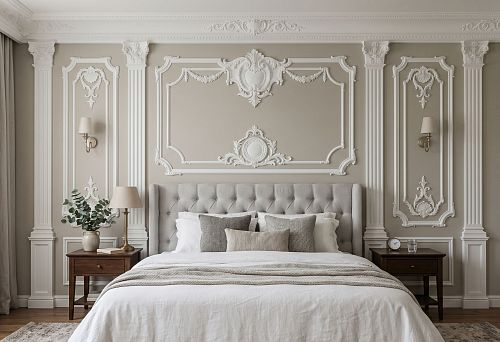
Frames at the head of the bed — one frame or two symmetrical rectangles on either side of the headboard.Molding frames in the bedroomcreate a "niche" behind the bed — visually, without physical recess into the wall.
Decorative panel behind the bed — an expanded version: one wide frame covering the entire headboard area from nightstand to nightstand, with a horizontal molding band inside dividing the panel into two fields.
Calm relief in the color of the wall —"Neoclassical Light" for bedroom wallsordecor in the "Japandi" style, painted in the color of the wall — monochrome relief without visual noise. For a bedroom where peace and quiet are important, it's an ideal solution.
Symmetry with bedside sconces — frames frame the sconces from the outside, or the sconces are placed inside the frame as an element of a lit architectural panel. This creates the feeling of a "backlit niche."
In the hallway and corridor
Hallway and corridor — spaces where molding frames work through rhythm and verticality.
Rhythmic frames on the long wall — a series of identical frame panels. Three to five repetitions create a "passage between columns" — in the most literal sense: the eye moves along the wall following the rhythm, and the space feels organized.
Vertical frames between doors —molding frames in the hallwayin a vertical format on the piers between doorways. One narrow pier — one vertical frame. Decor that takes up minimal space but works maximally for the architectural feel of the space.
Zone with a mirror —Moldings in the hallwayon the sides of the mirror create a "showcase" frame: the mirror looks built-in, not "hung." Two symmetrical vertical elements plus a horizontal band above the mirror — a complete entry composition.
Set of stucco decor "Neoclassic" — for a spacious hallway or foyer with a ceiling from 2.8 m. "Neoclassic Light" — for a standard apartment hallway. Both options provide a neat frame system with a good architectural feel.
How to choose the style of molding frames
The style of frames is not just "like/dislike." It is a match with the style of the entire interior. Let's break down four collections.
Neoclassicism
Molding frames in neoclassical style — this is a medium or wide profile with a clear relief, ornamental corner inserts with a floral or geometric motif, possibly a central overlay with a medallion.
Neoclassical wall frames give a feeling of a "luxurious interior." They are not aggressive and do not "shout" — they confidently present themselves. This is the language of architecture, not decoration in the everyday sense.
Wall decor in neoclassical style from sets CPU-1-1 to CPU-1-5: each level is a degree of saturation from laconic (CPU-1-1) to grand (CPU-1-5). For most residential interiors — CPU-1-2 or CPU-1-3.
Pairs with: classic and neoclassical furniture, parquet, wall painting in neutral tones, mirrors in carved frames, cornices with profile.
Neoclassic Light
“Neoclassic Light” — wall decor — this is a thin profile, delicate corner inserts, minimal ornament. A light frame that architecturally organizes the wall without making a loud statement.
This is the most versatile collection for a modern apartment. CPU-2-1 to CPU-2-5 — five formats from very laconic to moderately saturated. For apartments with a ceiling of 2.5–2.7 m and modern furniture — CPU-2-1 or CPU-2-2.
Lightweight frames from moldingsfrom "Neoclassic Light" painted to match the wall — almost invisible in bright light, but create a soft relief in evening lighting. Calm, unpretentious, architectural.
Modern frames on the wallfrom "Neoclassic Light" — a universal choice for those who want results without the risk of overdoing it.
Japandi
If you ask a designer how to make a wall look "expensive" in a minimalist interior — they will say: frames from moldings, painted to match the wall, without ornamentation, with clean geometry of corners.
Frames from moldings in the "Japandi" style— that's exactly it. The thinnest profile. Geometric corner elements. No floral or classical ornamentation. Only a straight line and a right angle.
Wall decor "Japandi"(CPU-3-1 — CPU-3-6) — for interiors where every item is chosen intentionally. Linen, wood, natural stone, matte metal — and the thinnest molding frames in the wall color.
Minimalist frames from moldings — it's "everything and nothing" in one solution. The wall looks organized — but the decor is not the first thing you mention when describing the room.
Versailles Light
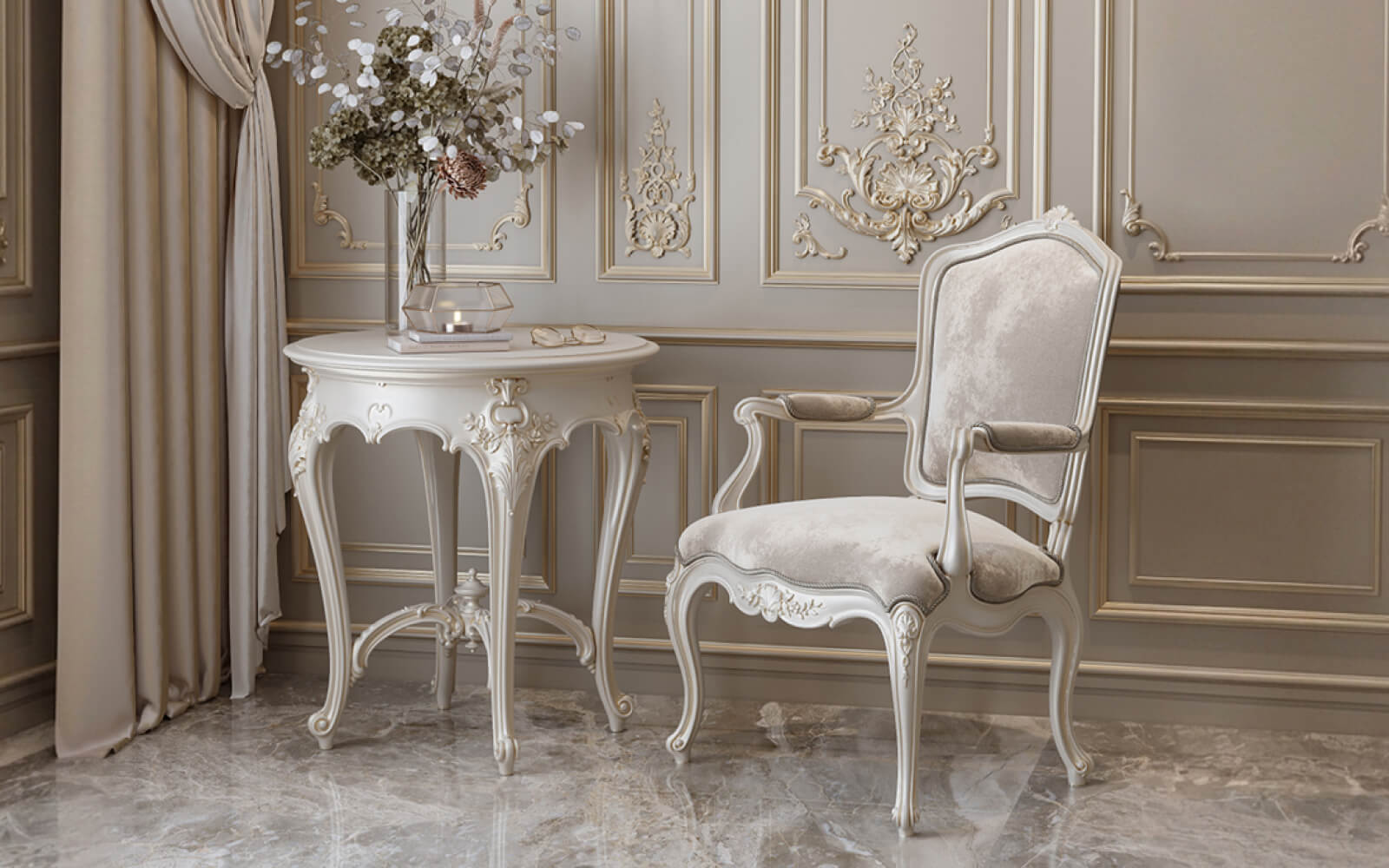
Classic frames from moldings from "Versailles Light" — for those who have chosen grandeur. Floral ornament, double frames, rich corner inserts, expressive central medallion.
"Versailles Light" — wall decor (CPU-4-1 — CPU-4-5) — a collection that creates a space with history. Not "antique style," but with a sense of tradition. Ideal in a spacious hall, formal living room, classic dining room, master bedroom.
classic wall decor from "Versailles Light" requires an appropriate context: furniture with historical references, natural materials, warm neutral tones, quality textiles. Without this context, "Versailles Light" looks alien — too lavish for a modern space.
How to calculate the size of frames from moldings
Calculation is half the success. Frames with well-proportioned dimensions look beautiful. Disproportionate frames are the main reason for disappointment with the result.
Step 1: Measure the wall
Exact wall width from corner to corner (or to the opening). Exact height from floor to ceiling. Record the location of the baseboard, ceiling cornice, sockets, switches, and sconces.
Step 2: Determine the number of frames
One frame — for an accent wall. Two symmetrical frames — for a wall with a central element (mirror, sconce, TV). A series — for a long wall.
Rule: an odd number of frames creates a "main center" — the middle frame is accent. An even number — symmetry without a center, the space is divided equally.
Step 3: Calculate the width of the frames
For one frame: 55–70% of the wall width.
For two symmetrical frames: each frame — 30–35% of the wall width, the interval between them — 15–20% of the width.
For a series of three frames: each frame — 20–25% of the wall width, intervals are equal.
Important: the width of the frame should not be less than 40 cm — otherwise the frame looks "small" and not serious.
Step 4: Calculate the height of the frames
Rule: frame height = from the bottom horizontal (25–35 cm from the baseboard) to the top horizontal (20–30 cm from the cornice). For a ceiling of 2.6 m — frame height 50–65 cm. For 2.8 m — 60–75 cm. For 3.0 m — 70–90 cm.
Step 5: Check on the diagram
Diagram of molding frames on the wallat a scale of 1:20 — a mandatory tool. Draw the wall, apply the frames to scale. Check: frames do not overlap the baseboard, do not cover switches, distances between frames are equal.
Step 6: Calculate the number of elements
For each frame: 2 horizontal molding segments (frame width) + 2 vertical (frame height) + 4 corner elements + 1 central overlay (optional).
For a series of 4 frames: 8 horizontal segments + 8 vertical + 16 corner inserts. Molding is taken with a margin of 10–15% for trimming.
What to combine molding frames with
Molding frames are a system element. They work together with other decorative and functional interior elements.
With stucco decor and ornamental overlays
molded decoration made of polyurethane— corner elements, central medallions, ornamental inserts — enhance the molding frame. The frame becomes a panel, the panel becomes an architectural scene.
Combination rule: the ornament of the stucco decor should be of the same style as the molding profile. "Neoclassical" + neoclassical corner elements. "Japandi" + geometric inserts. Mixing ornaments is a mistake.
With molding decor
Decor for Molding— insert ornamental elements placed in the molding groove or flush with it. This is an additional level of detail: the molding gets an ornamental accent without a central overlay.
For a series of frames on a long wall, decor for moldings at the intersection points of horizontal and vertical elements is a subtle technique that makes the system richer. An unobtrusive accent that is "read" upon closer inspection.
With decorative elements on the wall
decorative polyurethane elements— independent overlays that are not part of the frame system but complement it. A medallion in the central field of the wall between two frames. Vertical overlays under the frame (in the lower field). Ornamental elements above the frame (in the upper field under the cornice).
With wallpaper inside the frame
One of the most popular techniques: the wall is painted in a solid color, molding frames are glued onto the paint, and inside the frame is a fragment of wallpaper of a different color or texture. The frame literally "frames" the wallpaper like a picture.
This works if the wallpaper and paint match in tone (wallpaper slightly more saturated) or contrast — a light wall + a dark accent inside the frame. In this case, the molding is a clear boundary between the two finishes.
With sconces and wall lighting
Sconces inside the molding frame or on its sides are light architecture. Light limited by the frame system creates a "glowing panel." It is especially effective in the bedroom and hallway — areas where wall lighting is standard.
Mistakes when choosing molding frames
A specific analysis of typical miscalculations — with an explanation of cause and effect.
Mistake 1: Frames too small
A 40×30 cm frame on a 2.7 m high wall is a decorative sticker, not an architectural element. Frames should match the scale of the wall. The minimum frame height for a standard apartment is 50 cm, optimal is 60–75 cm.
Mistake 2: Furniture and ceiling height not considered
Molding frames on the wallare calculated considering furniture. The lower horizontal of the frame should be above the top edge of the attached shelf or console. The upper horizontal — considering the ceiling cornice. A frame that "goes" under the cornice or "sits" on the baseboard is disproportionate.
Mistake 3: Too close to the baseboard
The lower horizontal of the frame 3–5 cm above the baseboard looks "pressed" into the floor. The minimum indentation from the top edge of the baseboard is 20 cm. Optimal is 25–35 cm.
Mistake 4: Different profiles without a common logic
Horizontal molding from one SKU, corner inserts from another, central overlay from a third — visual chaos.wall decor setsolves this problem because all elements are from a single design.
Mistake 5: Mixing styles in one space
"Neoclassic" in the living room + "Japandi" in the hallway, which is visible from the living room through an open doorway — a stylistic conflict. If the rooms are visually connected — one collection for everything.
Mistake 6: No layout diagram
"I'll buy it, see how it fits" — doesn't work for frame systems.Wall decor with moldingsrequires preliminary design. Without a diagram — the frames will end up in the wrong place, and rework will cost more than a correct calculation from the start.
Mistake 7: Choosing individual elements instead of a ready-made kit
Molding lengths + corner inserts of a "similar" profile + a "suitable" overlay — three different SKUs with no guaranteed compatibility. Result: corner inserts are larger than expected, the molding profile doesn't match in relief.Ready-made molded decor kitsinsure against this risk.
Complete practical guide to installation:installing polyurethane moldingandinstallation of polyurethane molding.
Where to buy ready-made molding frames for the wall
STAVROS — the full choice for any task:
Ready-made molding frames for the wall — section of wall stucco decor.
Molding frames on the wall — collection CPU sets.
Set of molding frames — system sets of all collections.
Ready-made molded decor kits — for quick and predictable installation.
polyurethane wall moldings— profiles for linear application.
Polyurethane molding — buy — wide selection of profiles by width and style.
molded decoration made of polyurethane— corner inserts, overlays, ornamental elements.
decorative polyurethane elements— to complement frame systems.
Decor for Molding— insert ornamental elements.
Set of stucco decor "Neoclassic"— for classic and neoclassical walls.
“Neoclassic Light” — wall decor— a universal choice for an apartment.
Decor set “Japandi”— for a minimalist interior.
Versailles Light stucco decoration set— for a formal classic wall.
FAQ: Answers to popular questions
Can you make frames from moldings on a wall with wallpaper?
Yes. Moldings are attached over wallpaper using mounting adhesive. The wallpaper must be firmly glued. Installation — after the wallpaper has completely dried (at least 48 hours). One popular technique: a molding frame on wallpaper, with a painted field of a different color inside the frame. For this, the frame is mounted on a bare wall, then paint is applied inside it — and only then is the wallpaper glued up to the edge of the molding.
How much molding is needed for one frame measuring 80×60 cm?
(80 + 60) × 2 = 280 cm = 2.8 linear meters. Plus a 15% allowance for cutting corners = 3.2 linear meters. Plus 4 corner inserts.
How to paint molding frames to match the wall color?
Acrylic matte paint, the same shade as the wall. Apply with a brush over the molding and 1–2 cm onto the wall (for a clean edge). Apply a second coat after the first has dried. Result: a monochrome architectural frame.
Can molding frames be used in a bathroom or toilet?
Polyurethane is moisture-resistant — so technically it is possible. But it is important to use moisture-resistant mounting adhesive and treat all joints with acrylic sealant. Frames in the bathroom must be painted with waterproof paint.
What is better: to buy a ready-made kit or order moldings by the linear meter?
For a one-time task (one frame of a specific size that matches a kit size) — a kit. For a non-standard size or for a long rhythmic series where a specific linear footage is needed — molding by the meter plus separate corner inserts. This is cheaper but requires precise compatibility calculation.
How to make a straight molding corner?
Cutting at 45° using a miter box or miter saw. Two pieces of molding with identical 45° cuts are joined at a right angle. After installation, the joint is sealed with acrylic sealant and painted over. A detailed guide is in the manual forinstalling polyurethane molding.