Article Contents:
- When you need door decor: honest reasons
- The door doesn't match the interior
- Want to achieve a paneled door look
- Restoration and renovation of an old door
- Desire to make each door unique
- Upgrading the door class without replacement
- Which wooden elements are suitable for door decor: a complete toolkit
- Wooden Panels
- Wooden moldings
- Wooden layout
- Carved appliqués and decorative elements
- Wooden rosettes
- Door handles
- How door decor differs from casing: the fundamental difference
- Door moldings: how to turn a smooth panel into framed classic
- Principle of panel division
- How to create a 'miter' or use rosettes
- Choosing a door molding profile
- The 'double frame' system
- Carved door overlays: when and how to use carving
- Classic interior and neoclassicism
- Country house
- Office
- How to position a carved overlay
- Wooden rosettes and small accents: point decor that changes everything
- Corner rosettes in a frame scheme
- Central rosette as the main element
- Molding intersections
- Overlay elements along the horizontal belt
- Handle as part of door decor: why you can't ignore it
- Wooden handle
- Metal handle with wooden decor
- Coordinating the handle with trim and baseboard
- Handle size proportional to the door
- Door decor for painting: a unified look that always works
- Why painting works
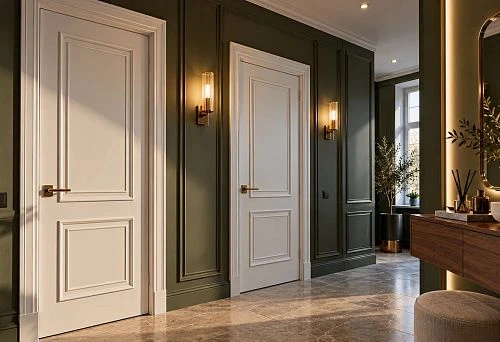
- White door with moldings
- Gray and anthracite door
- How to properly prepare elements for painting
- Decorating an old door: how to refresh without replacement
- Assessing the condition of the door leaf
- Decor scheme: first paper, then wood
- Surface Preparation
- Installation of Elements
- Final coating
- Mistakes when choosing door decor: breakdown of each
- Practical example: how to decorate a standard interior door
- Where to buy decor for an interior door: assortment and related categories
- FAQ: Answers to Popular Questions
- About the manufacturer
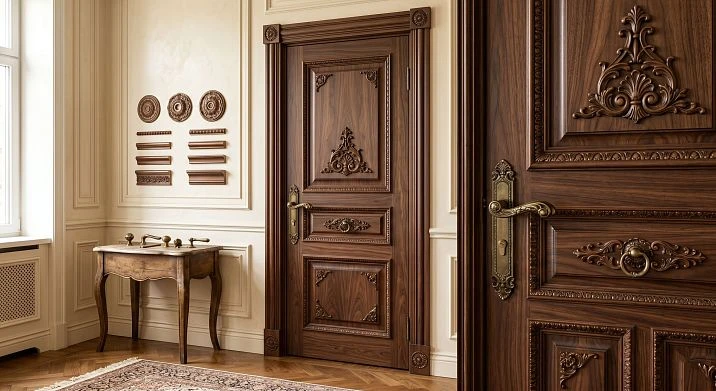
Take a look at your interior doors. Honestly. What do you see? If it's a flat panel without character — smooth, faceless, identical in every opening — then you've probably already thought about how to change it. Replacing all doors is costly and time-consuming. But there is another way: decorating doors with wooden elements — overlays, moldings, rosettes, trims, and a properly selected handle. This transforms an ordinary panel into a classic, expressive, visually rich door — without replacement and without expensive renovation.
Decorating an interior door with wooden elements is a separate design task that fundamentally differs from choosing a ready-made carved door. Here you work with an existing panel: you add wooden overlays, moldings, decorative rosettes, corner accents, and handles to it, creating the look of a classic, paneled, or unique custom door. It is affordable, practical, and yields a result that is indistinguishable from a door originally manufactured with decor.
This article is a comprehensive guide to decorating interior doors with wood: which elements to use, how to create a scheme, what to consider during installation, and what mistakes to avoid. Read carefully — each section is written with results in mind, not generalities.
When interior door decor is needed: honest reasons
Before discussing what exactly to put on the door, let's understand why this need arises. There are several reasons, and each requires its own approach.




The door does not match the interior
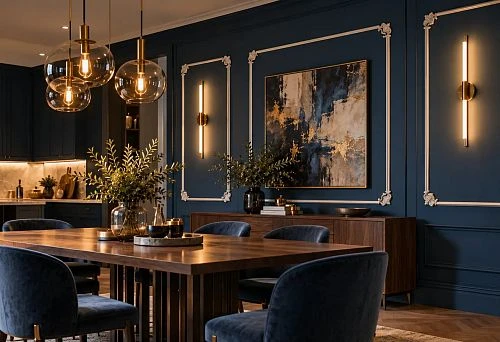
You have created a classic interior: stucco on the ceiling, Wooden moldings on the walls, wooden furniture with carved decor, Wooden casings on the openings — and an old smooth door from the Soviet past or a budget renovation. The dissonance is obvious. The task of the decor is to "upgrade" the door to the level of the interior without changing the panel.
Our factory also produces:
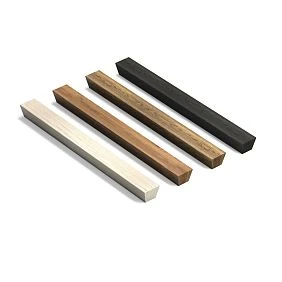
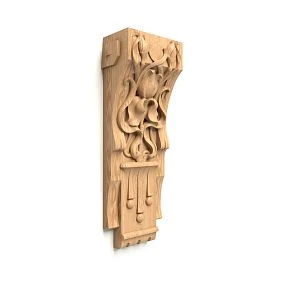
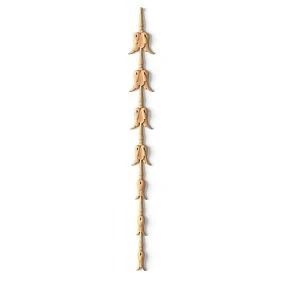
I want to get the look of a paneled door
A paneled door is a classic: several rectangular "frames" of different sizes on the surface of the panel, creating structure and depth. Making such a door from solid wood is expensive. But the same effect is achieved using moldings for the door и wooden molding, glued according to a pattern onto a smooth panel.
Get Consultation
Restoration and renewal of an old door
An old door with scratches, scuffs, outdated appearance. Remove it, sand the panel, add wooden overlays, repaint everything in a single color — and the door looks like new. This is many times cheaper and faster than replacement.
Desire to make each door unique
There are four doors in the apartment, all identical. Boring. Add a delicate ornament to the bedroom door, a stricter frame scheme to the study door, wide moldings with rosettes in the corners to the living room door — and each door begins to tell its own story.
Upgrading a door class without replacement
A budget door made of laminated MDF can look significantly more expensive with the right decor. This is not deception — it is understanding what creates an "expensive" look. The answer: a frame structure, decorative details, a quality handle, and a unified finish.
Which wooden elements are suitable for door decor: a complete set of tools
wooden door decor — this is not a single element, but a system. Let's break down each type.
Wooden overlays
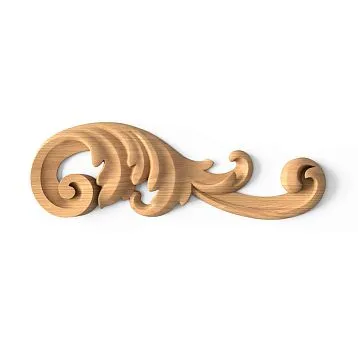
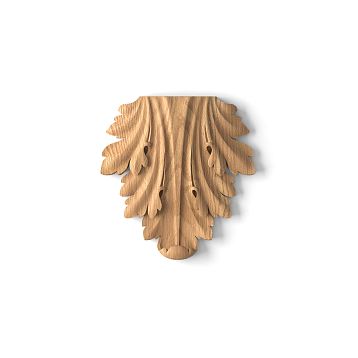
Wooden overlays for furniture and doors — these are three-dimensional decorative elements that are glued to the surface of the panel. They can be:
-
Rectangular or square — to create a central accent.
-
Shaped with a relief ornament — for a classic or baroque style.
-
Corner — for framing the corners of a frame composition.
-
With floral or geometric ornament — for thematic decor.
The overlay is glued to the base: assembly adhesive or PVA with pressure. After applying the coating, it looks like an integral part of the door — no seams or installation marks.
Wooden moldings
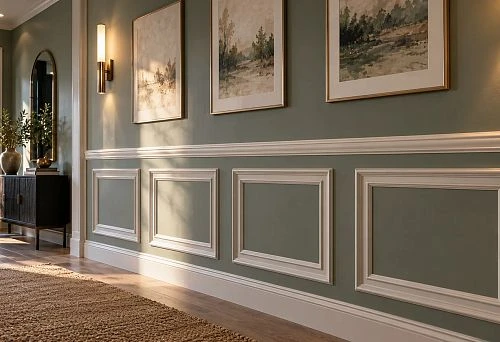
Wooden moldings A linear structure is created on the door leaf: horizontal and vertical strips that divide the leaf into "panels." This is the most common way to add a classic frame structure to the door leaf.
The door molding should be thin — 6–12 mm in thickness — so as not to overload the surface. Width — 15–35 mm, depending on the scale of the leaf. Profile — with a slight bevel or rounding to create a light shadow.
Wooden layout
wooden floor used to create a "frame" pattern on the leaf: four strips form a rectangle, creating the illusion of a frame facade. The layout is wider than the molding — 20–40 mm — and gives a more "weighty," more expressive line. Works well on wide, tall door leaves.
Carved overlays and decorative elements
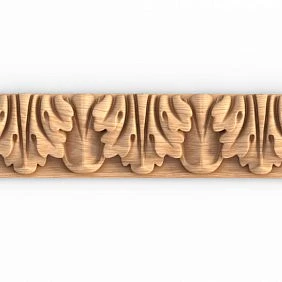
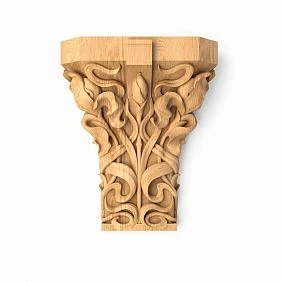
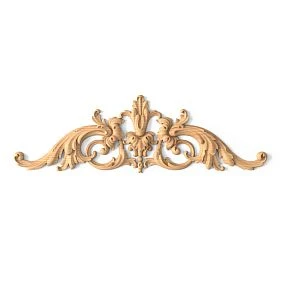
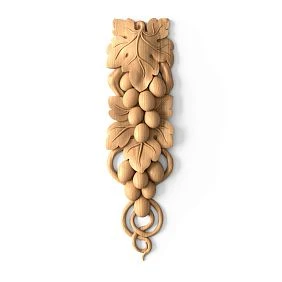
Carved wooden decoration in the form of overlay elements — this is the highest level of door decor. Carved flowers, leaves, cartouches, mascaron, ornamental strips — all of this can be added to the door leaf as a point accent or as part of an ornamental system.
A carved overlay requires stylistic justification: it must be coordinated with plinth, baseboards, and the overall decor of the room. In a minimalist interior, a carved element will look alien. In a classic one — organic.
Wooden rosettes
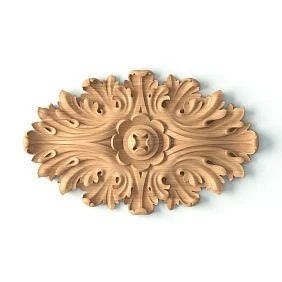
Rosettes are small square or round decorative overlay elements. They are used:
-
In the corners of frame compositions made of moldings (instead of a miter joint).
-
In the center of large panels as a point accent.
-
At intersections of molding lines.
-
As an independent decorative accent in the center of the door.
A rosette in the corner of the frame is both a decorative and technical solution: the moldings join in the rosette at 90°, which is easier than miter cutting and looks more beautiful in the interior.
Door handles
Wooden handles — the most important element of door decor, which is often underestimated. The handle is what you touch every day. It should be comfortable, beautiful, and consistent with the door decor. A wooden handle matching the door leaf completes the look of a "classic wooden door." A metal handle on wooden decor is possible but requires careful selection of style and color of the hardware.
How door decor differs from casing: the fundamental difference
This question arises regularly — and it's important to answer it precisely.
Wooden casings work around the door: they frame the doorway, cover the gap between the frame and the wall, and create a "frame" around the opening in the wall plane. The casing is an architectural element of the doorway.
Door leaf decor works on the door itself: overlays, moldings, rosettes, handles are attached directly to the leaf. They transform the door from within — adding relief, structure, and character.
These are two different tasks that do not replace each other — they complement each other. A properly decorated door has both a well-thought-out casing and expressive leaf decor. Only then does the door look like a single whole — from the opening to the handle.
The difference is clear:
| Element | Where it works | Task |
|---|---|---|
| Casing | Around the opening, on the wall | Close the gap, frame the opening |
| Molding/overlay on the door | On the door leaf | Create relief, structure, decor |
| Handle | On the leaf | Function + final decorative accent |
Door moldings: how to turn a smooth panel into framed classics
Moldings are the most versatile and affordable tool for decorating a door panel. Let's break down the technology and logic of creating framed compositions.
The principle of dividing the panel
Standard door panel — 2000 × 800 mm. Task: divide it into visually balanced "panels" using of wooden moldings.
Classic scheme: two "panels" in height. The top one — about 2/3 of the panel height, the bottom one — 1/3. The width of the "panel" — the entire width of the panel minus equal margins from the edges.
More detailed scheme: three "panels". The top one — a small horizontal "frieze panel", the middle one — the main vertical one, the bottom one — a "base". This is an exact reproduction of a classic three-section door.
How to create a "miter" or use rosettes
When creating a frame scheme, the corners of the moldings are joined in one of two ways:
-
Mitered (45°) — moldings are cut at 45° and meet at the corner point. Requires precise cutting and careful installation.
-
Through a rosette — a decorative rosette is installed in each corner of the frame, the moldings butt into it at 90°. This is technically simpler and visually more beautiful.
The second method is preferable for most DIY projects: sockets hide cutting inaccuracies and add a decorative accent.
Choosing a door molding profile
For the door leaf, choose a shaped molding with a shallow relief: a slight rounding or bevel. A deep, complex profile on a thin door will look heavy. The optimal height of the profile above the door surface is 5–10 mm. This is enough to create an expressive shadow.
Door molding width: 15–25 mm for compact 'frames', 25–35 mm for wide, 'weighty' lines in a classic style.
'Double frame' system
An advanced technique: two moldings parallel with a gap of 5–8 mm create a 'double frame' — a more complex and expressive pattern. This is an accurate reproduction of a classic door with double profiles — an expensive, refined detail that is very easy to create using applied moldings.
Carved door overlays: when and how to use carving
Carved wooden doors are expensive. But you can achieve their look for a reasonable price using applied carved elements. The question is when it is appropriate and how to do it correctly.
Classic interior and neoclassicism
In a classic interior with white walls, stucco, wooden furniture with carved wooden decor — a carved door overlay is organic. It is part of the room's ornamental system: carving on furniture, carving on doors, carving on decorative elements.
A carved overlay in the center of the door — a cartouche, medallion, or floral rosette — is a classic technique used in interiors since the 18th century. One well-chosen carved element in the center of the door leaf creates the image of a "designer" door.
Country house
In a country house with wooden walls or an interior in the Russian style, carving on the door is appropriate and desirable. A carved ornament with plant motifs, geometric patterns, or thematic symbols supports the overall atmosphere of the home.
Office
The study door is an exit from the public space of the house into the private, "working" area. In a study with dark wood, bookshelves, and a stately setting, a carved overlay adds "weight" and seriousness. A central carved medallion on a dark oak door is a classic image.
How to position the carved overlay
There are several placement options:
-
Center of the leaf — one large carved element (medallion, cartouche, rosette). Maximum emphasis.
-
Upper third — carved element above the center. The door "looks" upward, creating a sense of height.
-
In the corners of frames — small corner carved elements in each corner of the molding "frame." Delicate and refined.
-
Horizontal strip — carved insert between the upper and lower "panel." Divides the leaf and adds an ornamental belt.
Wooden rosettes and small accents: point decor that changes everything
Rosettes are an underrated tool. A small round or square element in the right place creates the feeling that the door was custom-made by a professional carpenter.
Corner rosettes in a frame scheme
This has been mentioned, but it's important to repeat: a corner rosette in every corner of the molding 'frame' not only simplifies installation but also makes the corners more elegant. A simple square rosette with or without a small ornament is a delicate accent.
Central rosette as the main element
When the frame scheme is already created with moldings, the central rosette in the 'panel' becomes the semantic center of the entire composition. It is the 'eye' of the door — the point that draws attention.
For the central rosette, choose a larger element than the corner ones: a diameter of 80–120 mm creates sufficient visual emphasis without overloading the door leaf.
Molding intersections
If moldings intersect (horizontal and vertical) — a rosette is installed at the intersection point. This solves the technical issue (how to design the intersection) and adds a decorative element.
Overlay elements along the horizontal belt
On some classic doors, between the upper and lower 'zones,' there is a horizontal strip of alternating small overlay rosettes or ornamental elements. This is the 'belt' of the door — a delicate detail found in expensive classic doors.
Using ready-made wooden appliqués such a belt is assembled without complex work: elements of the same size are mounted with equal spacing along a horizontal line. The distance between elements is equal to the width of the element itself, or a multiple of it.
The handle as part of door decor: why you can't ignore it
The handle is the final touch. And the most tangible, literally: it is touched every day. Choosing a handle should be as deliberate as choosing moldings and overlays.
Wooden handle
Wooden handles — an obvious choice for a door with wooden decor. A handle made of the same wood and with the same finish creates complete material consistency: the door leaf, decor, and handle are one whole.
A wooden handle on a classic door with moldings is elegant and organic. It 'completes' the look in a way that a metal handle never will.
Metal handle with wooden decor
If a metal handle is chosen, the tone of the metal is important. Classic gold or bronze color — for classic and neoclassical interiors. Matte silver or black metal — for modern classic and neoclassical in cool tones. A chrome handle on a warm wooden door is a mismatch that is difficult to 'justify' stylistically.
Coordinating the handle with the architraves and baseboard
If Wooden casings on a dark walnut opening, the handle should be of the same wood species with the same tint. If the architraves are white for enamel, use a white handle or a metal one with gold. This is the rule of coordinating 'everything with everything.'
Handle size proportional to the door
A small, neat handle on a wide, imposing door with large moldings is a scale mismatch. The handle should be proportionate to the door. For tall doors in a country house or hall, use a longer and larger handle. For standard interior doors, use a medium size.
Door decor for painting: a unified look that always works
This is one of the most commercially strong scenarios. Cheap laminated door + applied moldings + rosettes + proper painting = a result indistinguishable from a door manufactured with a frame structure in factory conditions.
Why painting works
When all elements—door leaf, moldings, overlays, inserts—are painted in a single color, seams and joints disappear. The eye does not look for connection lines. Only the structure is visible: frames, relief, shadows—and a single color plane. This is exactly how factory-painted doors with frame design look.
White door with moldings
A white door with white moldings is a classic of Provence style, French country, neoclassicism. It looks elegant, light, and 'expensive.' White enamel hides all installation flaws and levels out differences in the textures of the leaf and applied elements.
Gray and anthracite door
A dark gray or anthracite door with moldings is a modern interpretation of the classics. A very popular technique in recent years: black or anthracite doors with white walls and white decor create a graphic contrast that reads very expressively.
How to properly prepare elements for painting
All wooden elements — overlays, moldings, trims — need to be primed before installation on the door. Primer closes the pores, creating an even base for enamel. After installation — final painting. When using oak under light enamel — an insulating primer that neutralizes tannins. For beech — regular acrylic primer.
Sequence: prime elements → install on door → putty joints → sanding → final enamel. Two coats of enamel are the minimum for a quality result.
Decorating an old door: how to update without replacement
An old door is not a death sentence. It's an opportunity. Let's break down the full cycle of updating a door leaf with wooden elements.
Assessing the condition of the leaf
First of all — assess the condition. If the leaf is strong, without cracks or delamination — it can be decorated. If there are deep damages, veneer delamination, or critical deformations — only replacement.
Scratches, scuffs, outdated color, peeling coating — all of this is eliminated by sanding and a new coating. After priming and painting, the surface becomes uniform, and decor can be attached to it.
Decor scheme: first paper, then wood
Draw a diagram on paper to scale. Mark the door leaf in full size — with a pencil, measuring all distances. Check symmetry: a ruler and a level are your main tools. Only after approving the diagram — cut and install the elements.
The most common mistake when decorating an old door is to start gluing "by eye." The result: crooked lines, asymmetrical "frames" that cannot be fixed without complete dismantling.
Surface preparation
Remove the door from its hinges. Clean off the old coating: strip down to a clean surface — by sanding, stripping, or mechanically. Level the surface: fill in depressions, sand to a smooth plane. Prime. Only after this — install the decor.
Installation of elements
Glue — PVA wood glue or construction adhesive. For moldings — finishing nails (brads) without heads. Press, hold. Fill joints, sand. Prime again. Paint.
Final coating
Two or three coats of enamel with intermediate sanding. Matte finish — for modern classics. Semi-gloss — for traditional classics. Glossy — for formal doors.
Mistakes when choosing door decor: breakdown of each
These mistakes occur constantly in practice. Each one is the result of either haste or insufficient understanding of decorating principles.
Buying elements without a diagram. This is mistake number one. Without a well-thought-out diagram of element placement on the leaf, you will get a random set of parts, not a well-designed decor. The diagram is the first step, purchase is the second.
Mixing different carving styles. Baroque cartouche + geometric corner overlays + rosettes with Russian ornament — this is stylistic chaos. All carved and decorative elements must be from the same ornamental family.
Placing overly large overlays on a narrow door leaf. A central carved element with a diameter of 200 mm on a door leaf 600 mm wide is an overload. The scale of the overlay should be proportional to the scale of the leaf.
Not considering the door thickness. Overlays that are too thick (more than 15–20 mm) on a thin leaf (MDF 40 mm) can cause problems when opening and closing the door — if it catches the casing or frame. Choose overlays and moldings taking into account the gap between the leaf and the opening.
Forgetting about the handle. A door with beautiful leaf decor and a random handle is an unfinished look. The handle is part of the decor system, not something "that came to hand."
Not linking the door decor with the casings. The decor of the leaf and Casings the opening should be coordinated: in material, tone, and style. Dark moldings on the leaf and light casings on the opening — a conflict that is immediately visible.
Not planning the painting in advance. If the door will be painted in a single color — choose elements from materials that accept paint well (beech). If for tinting — wood with an expressive texture is needed (oak, ash). This cannot be decided after installation.
Breaking symmetry. Asymmetrical placement of "frames" on the leaf creates a feeling of error. Always check symmetry on the diagram and on the marked leaf — horizontally and vertically.
Practical example: how to decorate a standard interior door
For clarity — a specific example of decorating a standard door 2000 × 800 mm.
Concept: a white door in a neoclassical style with two vertical "panels" and corner rosettes.
Scheme: indentation from the edges of the canvas — 60 mm. Inside — one rectangular "frame" made of molding, 1700 mm high and 680 mm wide. At the corners of the frame — square rosettes 50 × 50 mm.
Elements:
-
Molding: shaped, width 20 mm, profile height 8 mm, beech. Calculation: frame perimeter (1700 + 680) × 2 = 4760 mm ≈ 5 linear meters with a margin.
-
Rosettes: 4 pieces, square, 50 × 50 mm.
-
Coating: white matte enamel.
Installation sequence: marking → cutting molding at 90° (butts against the rosette) → gluing rosettes → gluing molding with pressing → finishing nails for fixation → puttying joints → sanding → primer → two coats of enamel.
Result: a door indistinguishable from a factory paneled door, made without complex equipment from ready-made elements.
Where to buy decor for an interior door: assortment and related categories
Buy door decor correctly means choosing a supplier who has a complete system of elements: moldings, overlays, rosettes, inserts, and handles. Only this way can material unity and style consistency be ensured.
In the Stavros catalog — Carved wooden decoration for doors and furniture, Wooden Inlays, Wooden moldings, wooden floor, Wooden handles и Wooden casings. And for those who want to see how wooden elements work in a finished solution — the section carved wooden doors. All elements are made of solid wood, with matching profiles and the ability to choose the wood species.
FAQ: Answers to popular questions
What can be used to decorate an interior door?
Wooden moldings, carved overlays, decorative rosettes, layout for frame design, and a wooden handle. All elements are mounted on the door leaf and create the look of a classic or designer door.
Which wooden elements are suitable for door decoration?
Moldings (for linear frames), carved overlays (for point accents), rosettes (for corners and center), layout (for wide frame lines), handles (to complete the look).
Can a smooth door be made to look like a paneled one?
Yes. Four strips of molding with corner rosettes form a 'frame' on a smooth leaf. After painting in a single color, the door is visually indistinguishable from a framed one.
How does door decor differ from a casing?
The casing frames the opening around the door. The decor works on the door leaf itself: moldings, overlays, rosettes change the appearance of the door itself, not its framing.
Are moldings suitable for a door leaf?
Yes. Thin shaped moldings 15–35 mm wide are glued to the panel and create a frame structure. The profile height is no more than 10 mm.
Can wooden door overlays be painted?
Yes. Beech or sanded solid wood overlays are primed and painted in any color. A uniform coating of the panel and overlays creates a cohesive look.
How to choose carved decor for a door?
According to the interior style. Classic and neoclassical — floral and ornamental motifs. Russian style — geometric patterns and symbolic motifs. Modern classic style — laconic carved medallions.
Which handles suit a decorated door?
A wooden handle matching the panel is an organic choice. A metal handle — with a warm tone (gold, bronze) for classics or with matte metal for modern classics.
How not to overload a door with decorative elements?
Follow the principle of 'less, but more precise.' One well-thought-out frame scheme + a central accent is better than many random elements. Symmetry and proportions are the main criteria.
Where to buy wooden decor for a door?
In the STAVROS catalog: Carved wooden decoration, Wooden Inlays, Moldings и Handles with delivery across all of Russia.
About the manufacturer
STAVROS is a Russian manufacturer of wooden products for furniture, doors, and interiors. The assortment includes a complete decorative system for interior doors: Carved wooden decoration, Wooden Inlays, Moldings, wooden floor, Handles и Casings. If you want to buy decor for a door made of solid wood and create a door with character — STAVROS offers everything you need with Contact us to confirm shipping to your destination.