



























Article Contents:
- Four corners set the look, but do not describe all the cabinet work
- MN-144 in the order card: three sizes, two wood species, and one recognizable shape
- The cabriole is designed for load, but that does not cancel the dresser calculation
- When four MN-144s may be enough
- When you need to check hidden intermediate support
- A fifth decorative cabriole is not an automatic answer
- Where the hidden support should stand
- Under the central partition
- Under the most loaded section
- Under a longitudinal beam or internal frame
- Between two central sections
- Not under the bottom of the box
- Not in the floor plinth area
- Oak
- Oak
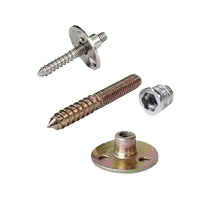
- Stud/self-tapping screw M8 × 60
- FUR-001
- FUR-012
- FUR-021
- FUR-027
- Compact or structurally rigid dresser
- Long or heavily loaded dresser
- Why the price of four legs does not equal the price of a finished cabriole-leg dresser
- Mistake 1. Choosing the quantity only by appearance
- Mistake 2. Assuming that any wide dresser needs a fifth leg
- Mistake 3. Placing the fifth MN-144 in the geometric center
- Mistake 4. Ordering five decorative legs for strength
- Mistake 5. Not accounting for the weight of the contents
- Mistake 6. Not accounting for a heavy top
- Mistake 7. Checking only the bottom plate
- Mistake 8. Mistaking the strength of a leg for the strength of the entire piece of furniture
- Mistake 9. Choosing the height based on a photo
- Mistake 10. Adding the lid twice
- Mistake 11. Ordering four legs with different finishes
- Mistake 12. Ordering oak legs one at a time
- Mistake 13. Choosing beech under a clear finish, expecting an oak grain pattern
- Mistake 14. Mistaking re-gluing for enamel as a ready-made paint finish
- Mistake 15. Mistaking "Prestige" for a ready-made varnish
- Mistake 16. Buying FUR-001 and FUR-012 at the same time without a project
- Error 17. Screwing a stud into a weak edge of the slab
- Error 18. Not checking the distance to the guides
- Error 19. Choosing the central support of "approximately the same height"
- Error 20. Forgetting the thickness of the support plate
- Error 21. Using different support plates on corner legs
- Error 22. Not taking the carpet into account
- Error 23. Not checking the floor
- Error 24. Placing support under a thin decorative panel
- Error 25. Making a hidden support visible from the front
- Error 26. Forgetting the baseboard behind the dresser
- Error 27. Not checking the extended drawers
- Error 28. Not providing protection against tipping over
- Error 29. Moving a heavy dresser by the body with a jerk
- Error 30. Considering the felt glider eternal
- Error 31. Painting the legs after installation without protecting the floor
- Error 32. Installing ready-made oak legs in random order
- Error 33. Mixing sizes 200 and 240 mm
- Error 34. Not saving the drawing
- Error 35. Buying only legs without the full set
- Secure the body
- Determine the visible layout
- Check the need for hidden support
- Select the size
- Select material
- Choose the preparation
- Approve the fasteners
- Choose the support feet
- Add the finishing
- Check the delivery
- How many MN-144 do I need for one dresser?
- Does any wide dresser need a fifth leg?
- Can I place the fifth MN-144 in the center?
- Why doesn't the central support necessarily have to be exactly in the middle?
- What should I check in the bottom panel?
- Do I need to know the maximum load of the drawers?
- Does a heavy tabletop have an effect?
- Is MN-144 suitable for a dresser without a crossbar?
- What sizes of MN-144 are available?
- What number shows the height?
- How to calculate the full height of a dresser?
- What to choose: 200 or 240 mm?
- When to choose 270 mm?
- Can a hidden support have a height of 270 mm?
- How to make hidden support unnoticeable?
- How many hidden supports are needed?
- Can an adjustable internal support be used?
- What happens if the central support is shorter?
- What happens if it is longer?
- Do glides affect the height calculation?
- Which glides does the card recommend?
- Can I install FUR-021 on two legs and FUR-027 on the other two?
- What is the difference between FUR-001 and FUR-012?
- Do I need to buy both sets?
- Can I screw the stud directly into the bottom?
- What wood species is MN-144 made from?
- What to choose for white enamel?
- What to choose for visible texture?
- Can beech be tinted?
- What is the difference between "Standard" and "Prestige"?
- Is "Prestige" a ready-made finish?
- Can I order two "Standard" legs and two "Prestige" legs?
- Do I need to order all four oak legs at the same time?
- Can I use MN-144 on an old dresser?
- Is an additional frame needed when converting?
- Does drawer extension affect stability?
- Does the dresser need to be secured to the wall?
- Can a heavy dresser be moved on felt glides?
- How to calculate the cost of four MN-144s?
- Should a fifth MN-144 be added to the cart just in case?
- Where can I see other legs for the dresser?
- Can MN-144 be ordered with Contact us to confirm shipping to your destination.?
- What should be sent to the manager before ordering?
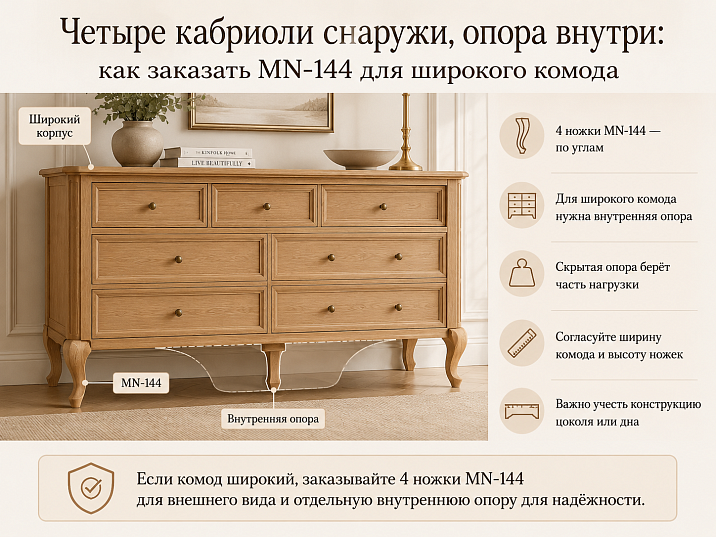
A wide dresser on four carved cabriole legs looks assembled: identical S-shaped legs stand at the corners, the body seems raised above the floor, and all the furniture's weight visually goes into four expressive supports. This is exactly the image the buyer sees in the sketch. But the finished dresser has a second, invisible layer of challenge—structural. Are four corner legs enough if the body is long, the bottom panel works over a large span, and the drawers will be filled with dishes, linens, books, or other heavy items?
The answer cannot be given from a single photo and cannot be reduced to the rule "a wide dresser always needs a fifth leg." Four MN-144s handle the external silhouette and transfer load in the corner zones. Additional hidden support is needed only when the body's construction requires it: the material and thickness of the bottom, the distance between supports, the presence of central partitions, the location of heavy sections, the method of joining parts, and the expected load. Sometimes four cabrioles work in a properly calculated structure without an intermediate point. Sometimes a long bottom panel needs not a fifth decorative leg, but one or more inconspicuous supports under the partitions.
Therefore, the request to buy legs for a dresser begins not with the quantity in the cart, but with reading the furniture drawing. The buyer needs to choose four identical MN-144s with a height of 200, 240, or 270 mm, determine the material—beech or oak—agree on the quality of sanding, check the mounting zones, and select the fasteners. As a separate line, the designer decides whether internal support is required. Its shape can be simpler because it is hidden under the body and does not participate in the decorative rhythm.
Before buy MN-144 legs, it is useful to split the order into two parts. The first is visible: four cabrioles of the same height, wood species, lamination, and sanding quality. The second is structural: the bottom assembly of the dresser, fasteners, floor glides, and, if the body calculation requires it, a hidden intermediate support. This logic helps preserve a beautiful facade and not shift onto the decorative legs the task that the entire furniture structure should solve.

Four corners set the image, but do not describe all the work of the body
The dresser stands on the floor not as separate parts, but as a whole system. The weight of the top, sides, back panel, drawers, and contents passes through the vertical and horizontal elements of the body, then transfers to the bottom belt, fasteners, and supports. If the load path is built correctly, the furniture maintains its geometry. If a long bottom panel remains without sufficient support, it can act as a bridge between the outer legs.
MN-144s are installed at the corners primarily because that is where the side panels and the bottom assembly meet. This placement supports the outer contour and highlights the shape of the cabriole. But the middle of a long body can be far from the outer supports. It is precisely this span that needs to be assessed before ordering.
The buyer often asks the question too late: "Can we just add a fifth leg in the center?" First, one should ask differently: which element of the body should receive support, and where does the load actually come? If there is a central vertical partition inside the dresser, a logical place for a support could be the area directly under it. If a heavy section is shifted to the left, the geometric center of the bottom does not necessarily coincide with the most loaded area. If the structure has a reinforced plinth, frame, or longitudinal beam, the intermediate support must work together with that assembly, not touch a random thin panel.
Therefore, the decorative scheme "four identical cabrioles" remains unchanged, while the hidden scheme can be different:
-
one central support under the partition;
-
two internal supports under two loaded zones;
-
support bar or structural plinth;
-
internal frame distributing forces;
-
adjustable hidden support, if provided by the design;
-
no additional support when the rigidity of the body and four corner joints is sufficient.
No option should be assigned based solely on the word "wide". Length matters, but it is not the only parameter.
MN-144 in the order card: three sizes, two wood species, and one recognizable shape
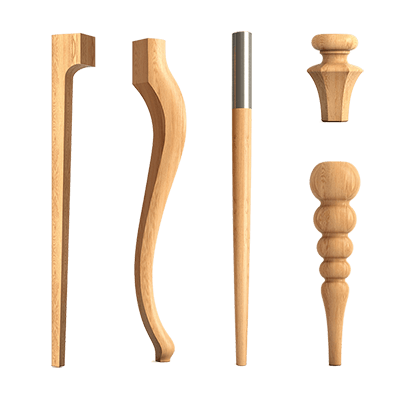
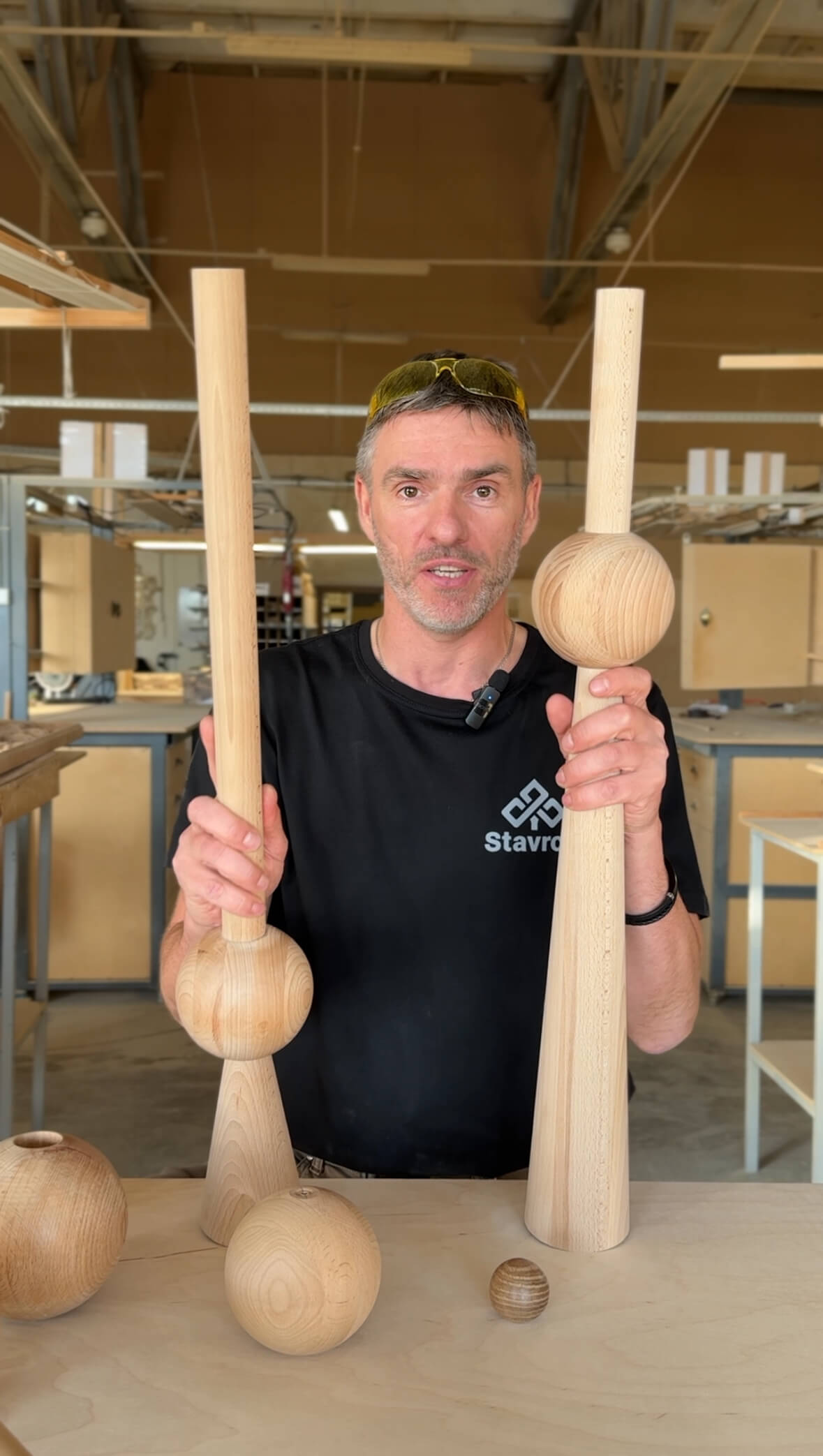
MN-144 is a carved cabriole furniture leg made of solid wood. Its S-shaped silhouette with a double curve belongs to neoclassical plasticity, but it can also work in a modern interior if the dresser body remains minimalist. The card offers three size options, each in beech and oak.
| Parameter | Confirmed options | What does this change in the project |
|---|---|---|
| Article number | MN-144 | All four visible legs are ordered under one article number |
| Shape | Carved cabriole, S-shaped double curve | The leg forms a noticeable outer silhouette |
| Size A × E | 200 × 70 mm | The lowest of the three options |
| Size A × E | 240 × 75 mm | Medium option in height and size |
| Size A × E | 270 × 85 mm | The tallest and largest modification |
| Material | Beech | Suitable for a project with opaque finish or another agreed system |
| Material | Oak | Chosen when pronounced texture and semi-transparent finish are important |
| Sanding quality | "Standard" | Machine preparation; the scope of further work is accounted for in the estimate |
| Sanding quality | «Prestige» | More detailed manual surface preparation |
| Re-gluing | Under enamel or under tinting in available combinations | The option is associated with the future finish |
| Application | Dressers, sideboards, cabinets, and other furniture | Fit is checked against the specific cabinet body |
| Fastening from the card recommendations | Stud/screw M8 × 60, FUR-001, FUR-012 | The choice depends on the lower furniture unit |
| Pads from card recommendations | FUR-021 or FUR-027 | Type is linked to gender and method of movement |
| Price | Depends on size, material, and quality of preparation | The article uses the set formula, not a fixed amount |
The entry 200 × 70, 240 × 75, or 270 × 85 mm should be read according to the card drawing as size A × E. The height for calculating overall furniture is the first number: 200, 240, or 270 mm. The second parameter helps check scale, seating area, and proportions. Before manufacturing the body, the craftsman must download the current drawing and transfer to the working documentation not only the height, but also the upper part of the leg, the mounting axis, and the actual contour.
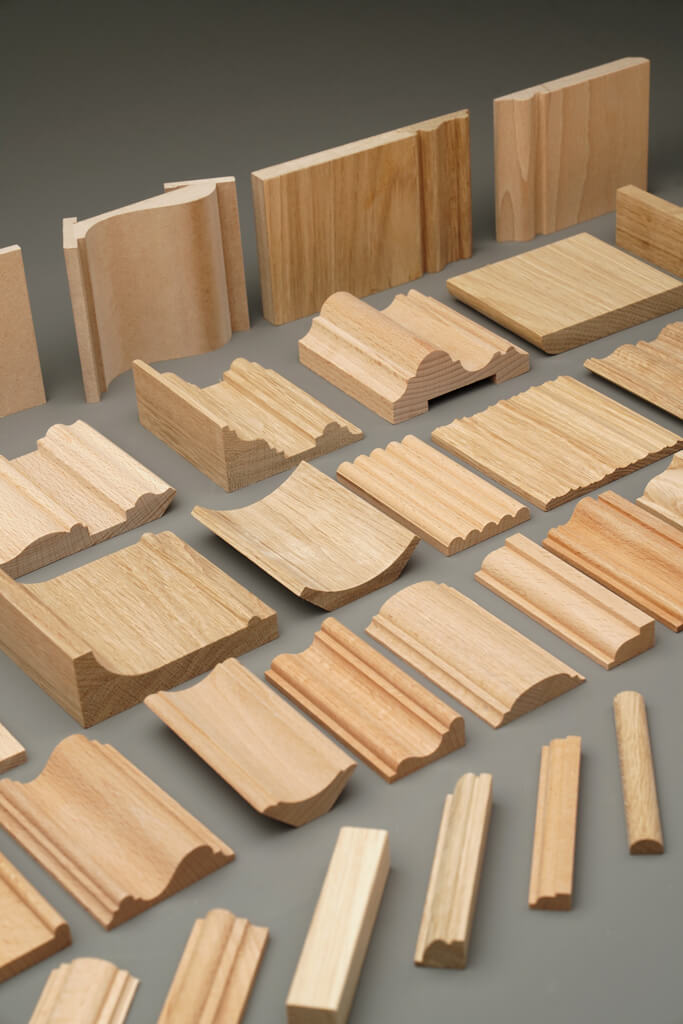
Our factory also produces:



Cabriole is designed for load, but this does not cancel the dresser calculation
The MN-144 description specifies use in frameless constructions and orientation toward high loads. This is an important characteristic of the model itself: the buyer is considering not a fragile decorative hanger, but a full-fledged furniture support. However, the strength of an individual leg does not answer the question about deflection of the bottom panel between four points.
Imagine a rigid heavy body. Each corner cabriole can reliably transmit vertical force to the floor. But if between the left and right supports there remains a long section of the bottom without a partition or frame, the weak point will be not the leg, but the horizontal element. Adding more massive cabrioles does not always solve this problem: the load must still reach the corners through the bottom panel.
There is also the opposite situation. A compact dresser has a short span, rigid sides, a central partition, a properly assembled lower belt, and moderate loading. A fifth support here may be unnecessary, interfere with cleaning, or create a new point where the furniture starts to wobble on uneven floors.
Therefore, the phrase "MN-144 is designed for high loads" refers to the support itself and its correct mounting. It is not a ready-made permission for any width, mass, or construction of the dresser.
Get Consultation
When four MN-144 units may be sufficient
Four corner cabrioles are considered a full-fledged scheme when the body is designed for this type of support. The solution is confirmed by a drawing, not just by appearance.
Signs that favor four supports:
-
the dresser has a relatively small span between the left and right support points;
-
the lower part is made as a rigid frame, reinforced belt, or other calculated structure;
-
the side walls transfer the load directly to the leg zones;
-
the central elements of the body do not create a separate heavy point in the middle;
-
the material and thickness of the bottom correspond to the distance between supports;
-
the drawers are not designed for extremely heavy contents;
-
the back wall and internal partitions are included in the spatial rigidity;
-
the leg attachment works not in the thin edge, but in a prepared seating zone;
-
furniture does not receive an additional heavy stone or other material countertop without recalculation;
-
the designer confirmed there is no risk of deflection in the lower assembly.
No single sign alone gives a definitive answer. For example, a short body may have a weak bottom panel, while a long one may have a rigid internal frame. The combination of parameters matters.
When you need to check hidden intermediate support
Additional support becomes a subject of calculation if the structure creates a long or heavily loaded section between the outermost cabriole legs.
Reasons to stop the order and hand the drawing to the designer:
-
the body is noticeably elongated horizontally;
-
the bottom panel has a large free span;
-
in the center there is a vertical partition that transfers the weight of the boxes downward;
-
heavy sections are located closer to the middle;
-
the dresser is intended for books, dishes, collections, or other dense contents;
-
a massive top is planned on top;
-
heavy equipment is placed on the dresser;
-
the drawers have great depth and extend far forward;
-
the lower belt already showed deflection on a similar model;
-
the body is designed without a stretcher and without an additional frame;
-
the legs are extended far to the corners, increasing the distance between them;
-
the floor allows point adjustment of hidden support;
-
The cabinet manufacturer cannot confirm operation on only four corner points.
In this block, you cannot use the universal formula "after such a width, a fifth leg is needed." Without data on material, thickness, joints, and load, such a figure would be made up.
The fifth decorative cabriole leg is not an automatic answer
The buyer sees four MN-144 at the corners and imagines a fifth identical leg in the center. Structurally, this is only possible in a specially designed scheme, but more often the hidden support does not have to repeat the carved silhouette.
The fifth MN-144 may have practical issues:
-
The S-shaped leg will be partially visible from the front or side;
-
the wide carved contour will take up space under the bottom plate;
-
the central cabriole leg may not align with the partition;
-
it is harder to maintain the exact total height of five wooden elements;
-
on an uneven floor, one of the five points may not touch the surface;
-
An extra decorative detail will increase the cost without solving the weak point of the body;
-
The direction of the bend will have to be coordinated with the four corner legs;
-
The middle of the dresser will visually become heavier.
The hidden support is selected based on function. It must take the load from the required body element, not spoil the silhouette, not interfere with the baseboard, cleaning, and drawer movement. Sometimes it is one simple support. Sometimes it is two. Sometimes it is better to reinforce the body itself so that a separate fifth leg is not needed.
The main principle: four MN-144 remain a decorative set, and the internal support is designed as part of the frame.
Where the hidden support should be placed
The geometric center of the dresser seems like an obvious place, but it is only a starting point. The actual position is determined by the load path.
Under the central partition
If the partition divides the body into two sections and takes the weight of the guides, drawers, or shelves, support under its lower end creates a clear vertical path: partition — lower node — support — floor.
Under the most loaded section
A dresser may have wide central drawers and narrow side ones. Then the mass is distributed unevenly. The support is placed where it actually reduces the working span.
Under a longitudinal beam or internal frame
If the structure has a lower structural rail, the support must connect to it, not press against a thin decorative panel.
Between two central sections
For very long furniture, a single point may not be enough. The designer can split the span with two hidden supports. Their number cannot be assigned without calculation.
Not under the drawer bottom
The support must work with the body, not touch a moving part. The internal layout and the travel of the guides need to be checked.
Not in the floor plinth area
If the dresser stands close to the wall, the hidden support must not press against the plinth or hang above the floor. The rear setback is taken into account on the plan.
Equal height of supports: the hidden part must not shift the load
Corner MN-144 and internal support must work in the same support plane. Even a small error changes the behavior of the furniture.
If the hidden support is shorter, it does not touch the floor and does not take load until deflection occurs. The dresser externally stands on four cabriole legs, while the central part remains a decorative safeguard without real work.
If the hidden support is longer, the body first rests on it. The corner legs are unloaded, one or more may hang, and the furniture starts to wobble. Tightening the fasteners does not fix the floor geometry.
Therefore, the project provides for:
-
exact dimension from the bottom plane of the body to the floor;
-
thickness of glides on all supports;
-
possible adjustment of the hidden part;
-
actual floor flatness;
-
sequence of final installation;
-
contact check after loading drawers;
-
access to adjustment, if it is used.
You cannot add glides only to the four visible legs and forget that they increased the height of the support plane. Hidden support must account for the same level.
Four or five points on an uneven floor
Four points are easier to level than five: any slight floor unevenness is more noticeable with an additional support. But this is not an argument against hidden support when the cabinet needs it. It is an argument for well-thought-out adjustment and precise assembly.
Before installation, check:
-
floor unevenness across the entire dresser area;
-
position of each corner leg;
-
location of internal support;
-
thickness of the floor covering;
-
carpet, if the furniture partially stands on it;
-
transition between two floor materials;
-
possible shrinkage of the soft covering;
-
access to the glides.
The dresser must not simultaneously stand with two legs on parquet and a hidden support on a thick carpet without height calculation.
How to choose MN-144 with a height of 200, 240, or 270 mm
The article's topic is not limited to height, but the size still affects stability, the final top mark, and the layout of the bottom drawer. All four visible cabriole legs are selected in the same modification.
Basic formula:
The total height of the dresser = body height + MN-144 height + top cover thickness, if it is not included in the body height.
This clarification is mandatory. In one drawing, the body height already includes the cover; in another, it shows only the box. Double addition will cause an error.
| MN-144 option | What to check before purchase | Practical perception |
|---|---|---|
| 200 × 70 mm | Final height, gap to the floor, bottom drawer, baseboard height | The dresser looks more stable and closer to the floor |
| 240 × 75 mm | The proportion of the body, the position of the center of gravity, access for cleaning | A medium-scale cabriole noticeably lifts the furniture |
| 270 × 85 mm | Stability of a tall body, the fastening unit, drawer extension, protection against tipping | The leg becomes a strong element of the silhouette |
The size cannot be chosen based on the principle 'the higher, the more beautiful.' When the height increases, not only the appearance changes. The body rises, the center of gravity of the furniture relative to the floor becomes higher, and the bending moment in the upper leg attachment under lateral impact may change. That is why the 270 mm option requires particularly careful coordination with the lower unit.
MN-144 200 mm: when a low cabriole works more convincingly
The 200 × 70 mm option suits a dresser that needs to be given the character of a cabriole without turning the legs into a dominant tier.
It is reasonable to consider it when:
-
the body is already tall enough;
-
the lid should remain at a convenient mark;
-
the bottom drawer is located close to the base;
-
the furniture stands under a mirror or picture with limited distance;
-
a moderate clearance above the floor is required;
-
the chest is wide, and visual stability is more important than emphasized lightness;
-
the baseboard should not be fully exposed behind the furniture;
-
the hidden support should remain unnoticeable.
Calculation example. A body without a separate lid has a height of 680 mm, the lid is 30 mm:
680 + 200 + 30 = 910 mm.
If 680 mm already includes the lid, the result will be:
680 + 200 = 880 mm.
The difference shows why the specification must accurately describe the original height.
For a wide dresser, a 200-millimeter cabriole may look more compact than a 270-millimeter one. But the final decision is made based on the facade layout: the height of the legs is compared with the height of the plinth area, drawers, handles, and top.
MN-144 240 mm: the medium option requires more than medium attention
The size 240 × 75 mm is often perceived as a compromise between the two extreme options. This attitude is dangerous: the average height does not make the leg universal.
This option is suitable when:
-
the body needs a noticeable lift above the floor;
-
200 mm looks too heavy;
-
270 mm excessively increases the overall height;
-
the bottom line of the facades should rise above a high plinth;
-
cleaning under the furniture is planned;
-
the room's proportions allow for a lighter silhouette;
-
the design of the lower unit is calculated for the corresponding height.
Example. Body 650 mm and lid 35 mm:
650 + 240 + 35 = 925 mm.
Before placing the order, this mark must be compared with the windowsill, switches, mirror, door handles, and other furniture. The dresser does not exist separately from the room.
MN-144 270 mm: a high support enhances both the beauty and the requirements
The 270 × 85 mm option makes the cabriole an independent part of the composition. The curve is better visible, a large gap appears between the floor and the body, and the dresser seems lighter. At the same time, the stability requirements increase.
Need to check:
-
the full height of the furniture;
-
the ratio of leg height to body height;
-
depth of the chest of drawers;
-
extension of upper and lower drawers;
-
position of heavy items;
-
method of attachment to the lower unit;
-
protection of a tall or narrow body from tipping over;
-
distance between corner supports;
-
operation of hidden support;
-
possibility of cleaning without hitting carved details.
A high cabriole is especially expressive on a wide low body. But if the chest itself is narrow in depth and tall, increasing the support tier may worsen the feeling of stability. Here a drawing with a side view is needed, not just the front.
Height of hidden support at different MN-144
Internal support must match the selected leg option and the entire lower assembly. You cannot buy four MN-144 legs with a height of 240 mm and then take a random central support "approximately 240 mm."
The actual size of the hidden part depends on:
-
its mounting points;
-
the thickness of the bottom plate;
-
the presence of a recessed frame;
-
the mounting plate;
-
the foot pad;
-
the adjustment mechanism;
-
the floor level;
-
possible decorative folding of the cabinet body.
If corner cabriole legs are attached to massive corner blocks, and the hidden support is attached to the bottom plane, the lengths of the parts may differ even at the same floor mark. Therefore, the specification specifies not just the support height, but two control planes: the attachment point and the floor contact level.
Beech under enamel and oak under tinting: the choice of material is related to the finish
MN-144 is available in beech and oak. The material is chosen simultaneously for all four visible legs.
Beech
Beech is logical to consider for opaque enamel, when the furniture color is set by the coating, and the natural grain should not be the main feature. The option of re-gluing under enamel may have differences in lamellas by shade and texture, which are covered by the opaque finish.
Beech cabriole legs are suitable for:
-
white, gray, blue, or colored dresser;
-
furniture with patina over an opaque base;
-
projects where the legs are painted together with the body;
-
series of items in one RAL or another agreed color;
-
situations where the shape of the carving is important, not the grain of the wood.
Oak
Oak is chosen when the wood texture should remain visible. Tinting can change the shade, but it does not turn the natural pattern into a uniform print.
For a set of four oak MN-144 legs, you need:
-
order the legs at the same time;
-
choose one re-gluing;
-
choose the same sanding quality;
-
lay out the parts before finishing;
-
distribute the pattern across the front and back corners;
-
perform a test tinting;
-
coordinate the color with the body and the lid.
A buyer who wants to compare wood species and blanks for finishing can buy wooden legs for furniture after checking dimensions, sanding, and available finishing options.
Why four visible legs are ordered in one batch
Even with opaque painting, completeness matters. Four cabrioles must match in geometry, height, and surface preparation. For oak, visual texture matching is added.
Ordering simultaneously helps:
-
get one size;
-
avoid mixing "Standard" and "Prestige";
-
keep the same re-gluing;
-
distribute the wood before installation;
-
perform finishing in one cycle;
-
avoid repeated delivery;
-
leave the option to choose the best pair for the front side;
-
prepare identical mounting holes.
If one leg is damaged before installation, it is better to agree on a replacement before painting the entire set. Reordering after the finish is complete may require a new color match.
"Standard" or "Prestige": what changes in the estimate
The card offers two qualities of sanding. They should not be perceived as a "bad" and "good" product; the level of preparation before finishing differs.
"Standard" is chosen when the workshop is ready to perform additional processing and has included it in the technology. "Prestige" reduces the amount of manual preparation of a complex carved surface, but after installation and work with the fastening, control is still required.
For four cabriole legs, not only the price of the product is compared:
Cost of "Standard" preparation = price of four legs + finishing work + consumables + time.
Cost of "Prestige" = price of four legs + control preparation + finish.
The choice depends on the workshop. If the dresser is made by a professional shop with its own sanding, "Standard" may be convenient. For a small project where you don't want to spend a long time manually finishing a complex S-shaped carving, "Prestige" can shorten the preparation stage.
All four legs must have the same quality. The mixing is visible after painting by the different surface reaction and detailing.
MN-144 mounting: the card offers options, the design chooses one
The recommendations for MN-144 specify the stud/screw M8 × 60, the FUR-001 kit, and the FUR-012 kit. This does not mean that the buyer should add all options to the cart at the same time.
Stud/screw M8 × 60
Such an element is involved in connecting the leg to the mating part. The mounting holes, depth, and material of the assembly are checked against the drawing and instructions.
FUR-001
The kit includes a stud M8 × 60 and a metal insert. It suits the scheme where the mating threaded part is installed into a prepared base. The thickness and density of the lower assembly must allow such a fit.
FUR-012
The kit includes a round mounting plate and a stud M8 × 60. The plate changes the way force is transferred and requires space for attachment to the body.
Choosing between FUR-001 and FUR-012 based only on price is not possible. The designer checks:
-
material of the bottom plate;
-
thickness of the mounting block;
-
direction of fibers;
-
distance to the edge;
-
tool access;
-
connection detachability;
-
support node area;
-
ability to hide the plate;
-
position of drawers and guides;
-
loads when moving furniture.
For a complete order, it is convenient buy furniture hardware after approval of the working connection. The category helps to assemble fasteners and support feet, but does not replace the drawing.
Fastening of four corner legs and hidden support may differ
The internal support does not have to be attached in the same way as MN-144. The parts have different shapes, mounting zones, and tasks.
For example:
-
The connectors are joined through bushings in the corner blocks;
-
The hidden support is attached to the central frame;
-
The corner legs are removable for transport;
-
The internal support is adjustable after installation;
-
Visible parts have feet of one type, the hidden one has a different contact with the floor.
The support level remains the same. The completeness is described separately for each type of support.
Foot FUR-021 or FUR-027: floor protection also changes the height
The card recommends two options.
FUR-021
A round foot with a diameter of 19 mm is attached with a self-tapping screw. It is considered when a compact rigid contact point is needed and the selected type suits the floor and the leg design.
FUR-027
A felt foot with a diameter of 24 mm helps to make softer contact with the floor covering and facilitates careful movement of furniture. Felt requires condition monitoring: contaminated material can retain abrasive particles.
Before choosing, check:
-
parquet, engineered wood, tile, or other flooring;
-
whether the dresser will be moved;
-
diameter of the lower part of MN-144;
-
screw installation location;
-
the thickness of the base plate;
-
presence of a carpet;
-
uniformity of all four points;
-
combination with hidden support.
The foot is not a small detail at the end of the order. It affects the support height and contact with the floor.
Two ready-made configuration scenarios
Compact or structurally rigid dresser
Order composition:
-
4 × MN-144 of the same size;
-
one material;
-
one re-gluing;
-
one sanding quality;
-
4 sets of selected fasteners;
-
4 support feet;
-
finishing materials;
-
Delivery.
This scheme is applied only after confirming that four corner points are sufficient for the body.
Long or heavily loaded dresser
Order composition:
-
4 × MN-144 of the same size;
-
hidden central or intermediate support for the project;
-
fasteners for four cabriole legs;
-
separate fastening for internal support;
-
floor glides for visible legs;
-
support element for hidden part;
-
finishing materials;
-
Delivery.
Internal support is not added automatically as a fifth MN-144. Its dimensions, number, and position are fixed by the designer.
| Composition | Compact rigid body | Wide or heavy body |
|---|---|---|
| Visible MN-144 | 4 pcs. | 4 pcs. |
| Hidden support | Not required after calculation | 1 or several per project |
| Fastener MN-144 | 4 identical sets | 4 identical sets |
| Hidden support fastener | No | Separate item |
| Floor protectors | 4 pcs. | 4 pcs. plus solution for internal support |
| Deflection check | Required | Required |
| Floor check | Required | Especially important for multiple points |
| External silhouette | Four cabinet hinges | The same four cabinet hinges |
Formula for the cost of the set without obsolete price
The price of MN-144 depends on size, material, and quality of polishing, so the amount should not be fixed in the article.
Working formula:
**4 × current price of the selected MN-144
-
cost of hidden support, if provided
-
fasteners for four cabinet hinges
-
fasteners for internal support
-
thrust bearings
-
materials for preparation and finish
-
packaging and delivery
= cost of the complete solution.**
If beech and oak are compared, the calculation is done with two separate carts. You cannot change only the price of the legs and keep the same cost of the finish: the finishing technology may differ.
Why the price of four legs is not equal to the price of a finished dresser on cabriole legs
Additionally, the estimate includes:
-
reinforcement of the lower joint;
-
drilling and installation;
-
template;
-
thread treatment;
-
painting or tinting;
-
protective finish;
-
floor protectors;
-
adjustment;
-
transportation of long body;
-
wall anchoring of furniture, if provided by design.
The buyer gets an honest comparison only after the full set.
What to buy together with MN-144
| What to add | Why | For which scenario | What to Check |
|---|---|---|---|
| Four MN-144 | Form a visible set of convertibles | Any dresser on this model | One size, material, and finish |
| Stud/self-tapping screw M8 × 60 | Involved in fastening | According to the approved assembly | Depth and seating position |
| FUR-001 | Stud and threaded insert | Connection via threaded insert | Thickness and material of the base |
| FUR-012 | Plate and stud | Mounting via round plate | Area and access to fasteners |
| FUR-021 | Rigid round foot | Suitable hard floor | Diameter and height |
| FUR-027 | Felt glider | Delicate floor covering | Contamination, wear, and thickness |
| Hidden support | Reduces the span of the lower node | Long or heavy body | Position under the structural element |
| Finishing materials | Create a common finish | Beech for enamel or oak for tinting | Compatibility of the entire system |
| Reserve finish sample | Allows you to check the color | Before painting the four legs | The same material and preparation |
| Delivery | Delivers the entire set in one batch | Any removed order | Packaging of carved elements |
The list does not mean that every item is needed at the same time. FUR-001 and FUR-012 are alternative solutions depending on the design.
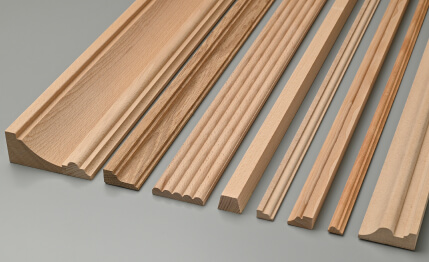
Unified room finish: when a wooden baseboard is appropriate
A cabriole-legged dresser does not necessarily have to match the floor trim. But in a classic, neoclassical, or solid wood interior, the wood species and finish may be repeated.
If MN-144 and the cabinet are painted or tinted together with other room elements, you can in advance buy wooden skirting board in the appropriate wood species or under an agreed finish. This choice is useful not for a formal match of catalog sections, but for a unified color test: the legs, baseboard, and trim are compared under the same lighting.
At the same time, the practical connection needs to be checked. A high baseboard behind the dresser affects the distance from the furniture to the wall, and therefore the position of the rear legs and hidden support.
How to distinguish MN-144 from a random cabriole
The word "cabriole" describes a general type of curved leg, but does not guarantee matching dimensions and fit.
MN-144 differs:
-
a specific article number;
-
three confirmed variants A × E;
-
an S-shape with a double curve;
-
beech and oak materials;
-
sanding options;
-
a specific upper seating zone;
-
with recommendations for fittings;
-
with an available technical drawing.
A random cabriole leg of similar height may have a different top width, mounting axis, bend direction, or contact area. You cannot replace one leg in a set with a different article just because both are called carved.
If MN-144 does not fit in height or scale, it is better buy furniture legs to choose a different model and recalculate the entire set than to mix three identical supports with one similar one.
How not to confuse a decorative cabriole leg and a central supportPractical scenario: a dresser for a TV or equipment
The equipment adds constant load on top and shifts the center of gravity. Cables, ventilation, and pull-out sections complicate the internal layout.
The hidden support must not block cable entries or ventilation openings. Its position is tied to the internal frame. The height of MN-144 is chosen so that the screen and equipment are at the desired level.
Practical scenario: restoration of an old cabinet
The customer wants to remove the short straight legs and install MN-144. Here you cannot simply replace four parts.
First, check:
- condition of the bottom plate;
- old holes;
- cracks;
- presence of corner blocks;
- material thickness;
- deformation of the body;
- floor geometry;
- total height after replacement;
- stability;
- central deflection.
Old furniture could rest on a solid plinth. After switching to four point cabriole legs, the load path changes. The carcass may need a new internal frame or hidden support.
Practical scenario: furniture series
One dresser, two nightstands, and a console are styled with identical cabriole legs. The items have different sizes and loads.
You cannot automatically place four MN-144 on each item without individual calculation. The external shape repeats, but:
- the dresser may need hidden support;
- the nightstands do not;
- the console requires stability check against the wall;
- the leg height may change the working height of each item;
- the number of fasteners is calculated separately.
For the series, it is important to check in advance for identical options of material, size, sanding, and re-gluing.
Specification for ordering four MN-144
Example without price fixation:
Carved furniture leg MN-144 — 4 pcs.
- size A × E: 240 × 75 mm;
- material: beech;
- sanding quality: "Prestige";
- gluing: for enamel;
- purpose: wide dresser;
- finish color: according to approved sample;
- mounting: FUR-001 or FUR-012 after design approval;
- floor protector: FUR-021 or FUR-027 after floor selection;
- location: four corners of the body;
- hidden support: separate position on the design drawing;
- number of hidden supports: after calculation of the lower node;
- delivery: in one batch;
- drawing MN-144: attached to the working documentation.
For oak, the material, re-gluing, and finish system change. The number of visible cabrioles remains four.
Specification of hidden support
Even if a specific model has not yet been selected, the task specifies:
- the structural element of the body that needs to be supported;
- the coordinate in width and depth;
- the distance from the attachment point to the floor;
- required adjustment;
- access to adjustment;
- type of contact with the floor;
- acceptable visibility;
- method of connection to the frame or partition;
- compatibility with the baseboard;
- no conflict with drawers;
- operation after full loading.
Such a list is more useful than the phrase "add a fifth leg."
Mistakes due to which four beautiful cabriole legs do not save a dresser
Mistake 1. Choosing the quantity only by appearance
On the facade, you always want to see four legs. The construction may require hidden support.
Solution: separate the decorative and structural schemes.
Mistake 2. Thinking that any wide dresser needs a fifth leg
Width without material, thickness, and internal frame proves nothing.
Solution: assess the load path.
Mistake 3. Placing the fifth MN-144 in the geometric center
It may not align with the partition and remain useless.
Solution: position the support under the structural element.
Mistake 4. Ordering five decorative legs for the sake of strength
A fifth cabriolet increases the price and can ruin the silhouette.
Solution: choose a functional hidden support.
Mistake 5. Not accounting for the weight of the contents
An empty dresser passes the fitting, but when filled, it behaves differently.
Solution: set a calculated load.
Mistake 6. Not accounting for a heavy top
Stone or another massive material significantly changes the load.
Solution: include the top in the project before choosing supports.
Mistake 7. Checking only the bottom panel
Partitions, the back panel, and the frame also contribute to rigidity.
Solution: analyze the entire corpus.
Error 8. Mistaking the strength of a leg for the strength of the entire piece of furniture
Even a strong support does not prevent the sagging of a weak span.
Solution: check the bottom joint.
Error 9. Choosing the height based on a photo
The proportions and overall height turn out to be different.
Solution: a front view drawing with dimensions.
Error 10. Adding the top twice
The height of the body may already include the top piece.
Solution: label the composition of the original size.
Error 11. Ordering four legs of different preparation
Mixing "Standard" and "Prestige" complicates finishing.
Solution: one configuration per set.
Error 12. Ordering oak legs one by one
Grain and tone may differ.
Solution: order the set in one batch.
Error 13. Choosing beech under a clear finish, expecting oak grain
Wood species have different character.
Solution: choose material based on the final look.
Error 14. Considering re-gluing under enamel as ready paint
The legs require finishing touches.
Solution: include enamel in the estimate.
Mistake 15. Considering 'Prestige' as ready-made varnish
This is the quality of sanding, not a finish coating.
Solution: plan the finishing.
Mistake 16. Buying FUR-001 and FUR-012 simultaneously without a project
The kits address different mounting schemes.
Solution: choose the assembly according to the cabinet.
Mistake 17. Screwing a stud into a weak edge of the panel
The connection does not receive sufficient support.
Solution: provide a landing block.
Error 18. Not checking the distance to the guides
The fastener conflicts with the drawer.
Solution: bottom and inside view.
Error 19. Choosing a central support of "approximately the same height"
The furniture wobbles or the support does not work.
Solution: a single support plane.
Error 20. Forgetting the thickness of the foot pad
Four MN-144 become higher than the hidden support.
Solution: take into account the entire set of parts.
Error 21. Installing different glides on corner legs
The points get different heights and sliding.
Solution: one type for four cabriole legs.
Error 22. Not accounting for the carpet
The hidden support and legs stand at different levels.
Solution: floor covering plan.
Error 23. Not checking the floor
The fifth point causes rocking.
Solution: adjustment and control during installation.
Error 24. Placing support under a thin decorative panel
It does not transfer the load correctly.
Solution: connection to the frame or partition.
Error 25. Making the hidden support visible from the front
The external composition of convertibles is disrupted.
Solution: check sight lines.
Error 26. Forgetting the baseboard behind the dresser
The rear support hits the profile or the furniture moves away from the wall.
Solution: room plan.
Error 27. Not checking extended drawers
The center of gravity shifts forward.
Solution: assess stability in the working position.
Error 28. Not providing protection against tipping over
A tall cabinet on 270-millimeter legs requires a separate assessment.
Solution: follow the project for safe furniture anchoring.
Error 29. Moving a heavy dresser by the body with a jerk
Lateral forces are transmitted to the leg attachments.
Solution: unloading and the intended method of moving.
Error 30. Considering the felt foot pad to be eternal
It wears out and collects dirt.
Solution: regular inspection.
Error 31. Painting legs after installation without protecting the floor
The complex carved shape makes neat work difficult.
Solution: determine the finishing cycle in advance.
Error 32. Installing ready-made oak legs in random order
Front cabriole legs can differ sharply in pattern.
Solution: lay out the set before attaching.
Error 33. Mixing sizes 200 and 240 mm
Even one different leg disrupts the plane.
Solution: check the marking of all four.
Error 34. Not saving the drawing
The master marks the mounting from memory.
Solution: attach the file to the specification.
Error 35. Buy only legs without the full set.
There is no fastening, support pads, or materials at the site.
Solution: basket according to the list.
When MN-144 is truly suitable for a wide dresser.
The model is appropriate if:
- a pronounced S-shaped cabriole leg is needed;
- the body allows a frame-less support scheme;
- the top joint of the leg fits into the prepared area;
- height 200, 240 or 270 mm corresponds to the overall furniture;
- four corner supports create the desired silhouette;
- internal support can be hidden;
- beech or oak suit the future finish;
- fastening is approved before ordering;
- floor and glides are taken into account;
- the dresser load is known;
- the designer checked the lower clearance;
- all four legs are ordered as one set.
When it is better to choose a different model or a different body
MN-144 may not be suitable if:
- The S-shaped curve conflicts with the furniture style;
- The upper seating area does not fit;
- The body is too narrow for the scale of the cabriole legs;
- A height of 200 mm already raises the furniture excessively;
- The 270 mm option worsens stability;
- The lower joint cannot be reinforced;
- The guides overlap the mounting;
- The furniture must stand flush against the high baseboard;
- An adjustable visible support is required;
- The design assumes a solid plinth;
- A finished painted leg is needed, not a blank;
- Four carved details make the facade overloaded.
In the selection, you can buy legs for a dresser Of a different shape and height, if MN-144 fails the design check.
How to order MN-144 from STAVROS
Secure the body
Width, depth, height, bottom material, internal partitions, and expected load are needed.
Determine the visible pattern
For a classic exterior design, four identical cabriole legs are ordered.
Check the need for hidden support
The designer decides on the lower assembly. Do not add a fifth MN-144 automatically.
Select size
Compare 200 × 70, 240 × 75, and 270 × 85 mm by overall height and stability.
Choose the material
Beech — for a project with opaque finish; oak — when the texture remains visible.
Select preparation
All four legs must be "Standard" or "Prestige".
Confirm fasteners
Determine whether FUR-001, FUR-012, or a separate stud fits the working joint.
Select floor glides
FUR-021 or FUR-027 are matched with the floor and planned movement.
Add finish
The cart includes primer, enamel, tinting, or another approved finish.
Check delivery
It is better to order the four carved legs and hardware in one batch. Shipping and packaging terms are clarified when placing the order.
After this preparation, you can reopen the card and order MN-144 legs in the exact configuration.
Frequently asked questions about MN-144 for a wide dresser
How many MN-144 legs are needed for one dresser?
For a visible corner set, four identical MN-144 legs are ordered. Additional internal support is considered separately and does not have to be a fifth cabriole leg.
Does any wide dresser need a fifth leg?
No. The need depends on the bottom construction, span, partitions, and load. There is no universal width after which a fifth support is mandatory.
Can a fifth MN-144 be placed in the center?
Only according to a specially designed project. More often, the central support has a simpler hidden form and is placed under the power element.
Why doesn't the central support necessarily stand exactly in the middle?
The load can come to a partition or a heavy section offset relative to the geometric center.
What should be checked in the bottom panel?
Material, thickness, distance between corner supports, connection to side panels, presence of a frame, and central deflection.
Is it necessary to know the maximum load of the drawers?
Yes. An empty dresser and fully filled furniture create different loads on the bottom assembly.
Does a heavy tabletop have an effect?
Yes. Its mass is included in the calculation of the body and stability.
Is MN-144 suitable for a frameless dresser?
The card indicates use in frameless constructions, but the fit and rigidity of a specific cabinet still need to be checked.
What sizes of MN-144 are available?
200 × 70, 240 × 75, and 270 × 85 mm in terms of A × E dimensions.
Which number indicates the height?
The first number: 200, 240, or 270 mm. The full drawing should be verified in the card.
How to calculate the total height of a dresser?
Add the cabinet height, leg height, and top thickness, if the top is not included in the cabinet size.
Which to choose: 200 or 240 mm?
200 mm gives a lower and more stable silhouette; 240 mm lifts the cabinet more. The choice depends on the overall height and proportion.
When to choose 270 mm?
When a high cabriolet matches the design, and the construction and stability are confirmed by the drawing.
Can a hidden support have a height of 270 mm?
Its actual size is determined by the attachment point and the overall support plane. It does not have to numerically match the height of MN-144 if it is mounted at a different level.
How to make a hidden support unnoticeable?
Place it deeper under the body, connect it to a partition or frame, and check sight lines from the front and side.
How many hidden supports are needed?
One, several, or none — based on the body calculation. The quantity cannot be determined only by the length of the dresser.
Can an adjustable internal support be used?
Yes, if it is provided for in the project, withstands the required load, and is accessible for adjustment.
What happens if the central support is shorter?
She won't take the load until the bottom deflects.
What happens if it's longer?
The dresser may rest on the center point and rock, while the corner legs partially unload.
Do glides affect the height calculation?
Yes. Their thickness changes the floor contact level.
Which glides does the card recommend?
FUR-021 and felt FUR-027. The choice depends on the floor and usage.
Can I put FUR-021 on two legs and FUR-027 on the other two?
You shouldn't. Different glides may vary in height and slip. All four corner cabrioles are fitted identically.
What's the difference between FUR-001 and FUR-012?
FUR-001 uses a stud and a bushing, FUR-012 uses a stud and a round mounting plate. The suitable option is chosen based on the lower node.
Do I need to buy both sets?
No. These are alternative schemes if the project does not require otherwise.
Can the stud be screwed directly into the bottom?
Only if the structure, thickness, and material of the seating area allow it. The decision is confirmed by the master.
What wood species are used for MN-144?
made of beech and oak.
What to choose for white enamel?
Usually beech with cross-lamination for enamel is considered, but the final finishing system is agreed with the furniture manufacturer.
What should I choose for visible texture?
Oak with a tinting option.
Can beech be tinted?
Technically, the finish depends on the selected blank and system, but for a pronounced oak texture, oak is specifically required.
What is the difference between "Standard" and "Prestige"?
These are sanding levels. "Standard" involves machine preparation, "Prestige" involves more detailed manual work.
Is "Prestige" a ready-made coating?
No. After preparation, the selected finish is required.
Can I order two "Standard" legs and two "Prestige" legs?
You should not do this for one dresser. The set must have the same preparation.
Do I need to order all four oak legs at the same time?
It is advisable. This makes it easier to distribute the texture and achieve a uniform finish.
Can MN-144 be used on an old dresser?
It is possible after checking the bottom panel, old fastening, overall height, and stability. Replacing the plinth with four legs changes how the body works.
Is an additional frame needed during the conversion?
Sometimes yes. It depends on the condition and construction of the old body.
Does pulling out the drawers affect stability?
Yes. Open and loaded drawers shift the center of gravity forward.
Do I need to secure the dresser to the wall?
The solution depends on height, depth, loading, and construction. For a tall or potentially unstable body, secure attachment is provided according to the design.
Can a heavy dresser be moved on felt glides?
Felt makes careful movement easier, but heavy furniture should be unloaded and moved in a way that does not create lateral stress on the legs.
How to calculate the cost of four MN-144s?
Multiply the current price of the selected configuration by four and add fasteners, glides, finish, hidden support if needed, and delivery.
Should I add a fifth MN-144 to the cart just in case?
No. First, the hidden support structure is determined. An extra cabriole may not be needed.
Where can I see other legs for the dresser?
In a separate selection of supports for dressers, cabinets, and nightstands.
Can I order MN-144 with Contact us to confirm shipping to your destination.?
Delivery terms are available on the STAVROS website and are calculated for a specific order.
What should I send to the manager before ordering?
The dresser size, drawing of the lower assembly, selected height, material, sanding, finish, quantity, and list of required hardware.
Four MN-144 should remain a visible set, and strength should be a property of the entire furniture piece.
A wide dresser does not become reliable just because each individual cabriole looks massive. Nor does it become weak just because four legs are visible from the outside. The solution lies inside the body: in the lower frame, bottom thickness, partitions, placement of heavy drawers, and the span length between support points.
A correct order preserves a clean composition. At the corners stand four identical MN-144 — 200, 240, or 270 mm, made of beech or oak, with the same sanding quality and under a unified finish. Under the bottom, if confirmed by the project, hidden support works. It does not have to repeat the carved shape and should not appear in the center just for the number 'five'.
Before placing the order in the cart, seven items must be confirmed: the size of the cabrioles, the full height of the dresser, material, sanding, mounting scheme, type of glides, and the need for intermediate support. After that, the cost of the set is calculated, not the price of four individual items.
STAVROS allows you to assemble an order in one system: select MN-144, compare other legs for dressers, choose FUR-001 or FUR-012, add FUR-021 or FUR-027, and coordinate delivery. This approach keeps beauty on the outside, structural work on the inside, and gives the buyer not a random set of parts, but a clear support scheme for a specific dresser.