























Article Contents:
- First, answer the main question: does the mirror even need a frame?
- A frame and a border are not always the same thing
- The larger the mirror, the more carefully you should increase the width of the decor
- Confirmed parameters of KPU-071
- A narrow frame keeps the mirror's surface as the main element
- The ornament compensates for the small width
- Small width is useful where there is little free wall around the mirror
- Don't evaluate only one angle
- For a very large mirror, 22 mm may be too delicate
- Option without a noticeable offset
- Option with a slight offset along the wall
- Large offset
- Corners change the actual cutting layout
- Plank No. 1
- Plank No. 2
- Plank No. 3
- It is better to make the joint part of the scheme
- Symmetry is especially useful on the top side
- 45° connection
- Straight joint
- Decorative corner as a separate idea
- Monochrome helps connect the mirror with wall moldings
- The more active the ornament, the more careful with an additional color
- Painted wall
- Decorative Plaster
- Panel or furniture surface
- Label each section
- Center of the side
- Two symmetrical segments around the central fragment
- Offset joint
- Count only the mirror area
- Divide the perimeter by two and immediately order the resulting quantity
- Forget about the indentation from the mirror
- Not take into account sides longer than 2000 mm
- Consider leftovers completely interchangeable
- KPU-071 and baguette
- KPU-071 and smooth molding
- KPU-071 and separate overlay
- KPU-071 and wall decor
- Mirror 800 × 1800 mm in the hallway
- Mirror 1200 × 2000 mm
- Mirror 2400 × 1600 mm
- Round or oval mirror
- Buy KPU-071 before measuring
- Calculate only the perimeter
- Calling KPU-071 a molding and expecting a different profile
- Not trying the 22 mm width on a large mirror
- Starting to cut without an angle diagram
- Making a random joint on a side longer than 2 m
- Trying to cover a wide technical zone with a narrow profile
- Adding too much extra decor
- Ignoring the 11 mm depth
- Choosing a contrasting color without a mockup
- Using one calculation for multiple mirrors of different sizes
- Ordering slats only by total meters without distributing segments
- Making a decision on the installation method without checking the base
- Can I install a KPU-071 mirror that is already installed?
- What is the size of KPU-071?
- Is the length of one KPU-071 strip really 2 meters?
- How to calculate KPU-071 for a rectangular mirror?
- Why can't I just divide the perimeter by two meters?
- How much KPU-071 is needed for a mirror 800 × 1800 mm?
- How much linear footage is required for a mirror 1200 × 2000 mm?
- What to do if the side of the mirror is longer than 2000 mm?
- Is it mandatory to make 45° angles?
- Can I use a straight joint in the corner?
- Is KPU-071 a baguette?
- Is KPU-071 a molding?
- Would a width of 22 mm be too small for a large mirror?
- Can the effect be enhanced by installing two rows of KPU-071?
- Can a small gap be left between the mirror and the frame?
- Which is better — a frame flush with the mirror or with a gap?
- Do I need to remove the mirror before framing?
- Can KPU-071 be glued directly to the mirror?
- What kind of glue is needed for KPU-071?
- Can KPU-071 be painted?
- Is it better to paint the frame the color of the wall or make it contrasting?
- Can KPU-071 be used in a hallway?
- Will KPU-071 suit a mirror above a dresser?
- Can other wall decor be added nearby?
- How to understand if a regular molding is needed instead of KPU-071?
- Do I need to buy a spare slat?
- Where to buy decorative trim KPU-071?
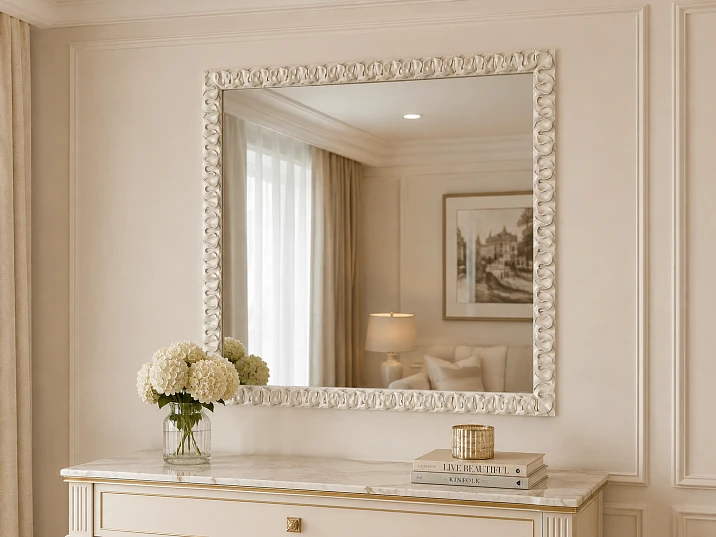
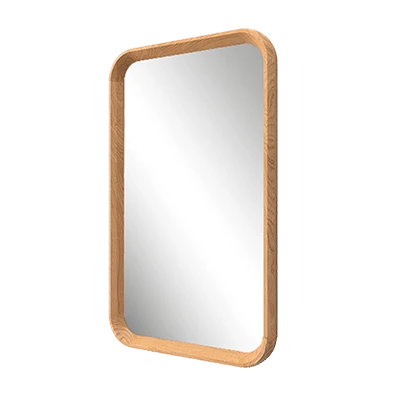
A large mirror can be correctly chosen in size, evenly installed, and work well in the interior, but still look as if the wall decoration is unfinished. This effect is especially noticeable with a large rectangular mirror panel: the reflective surface occupies a significant area, and there is no line around the perimeter that separates the mirror from the wall and makes it an independent part of the interior. A quite practical question arises: is a full massive frame needed after installation, or can a lighter decorative framing of the mirror be done without replacing the mirror itself?
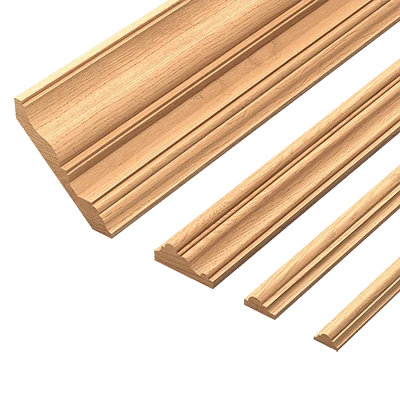
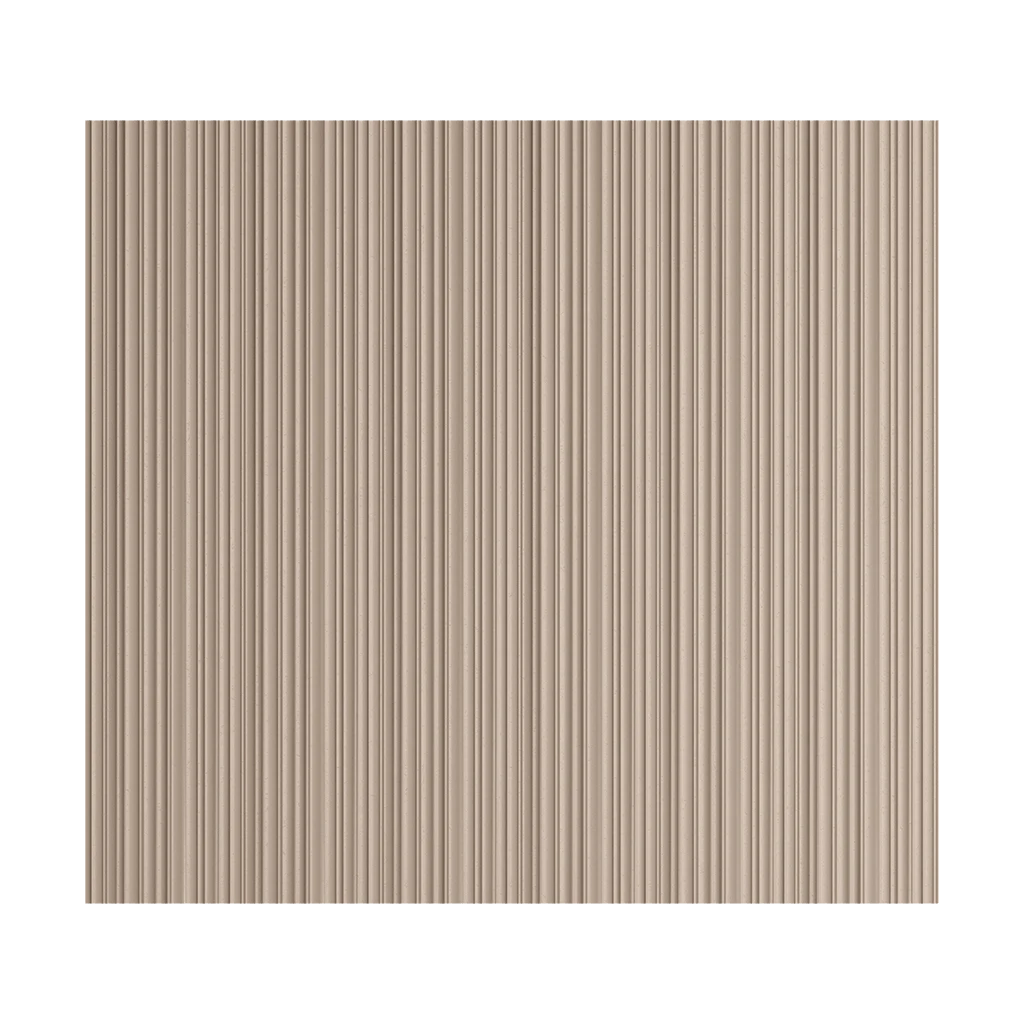
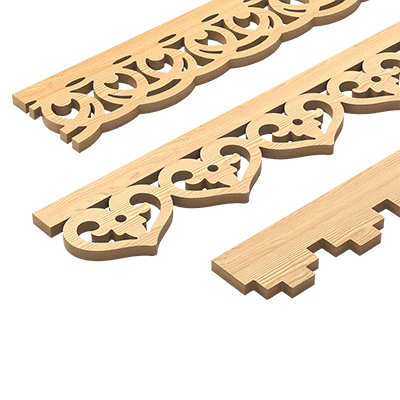
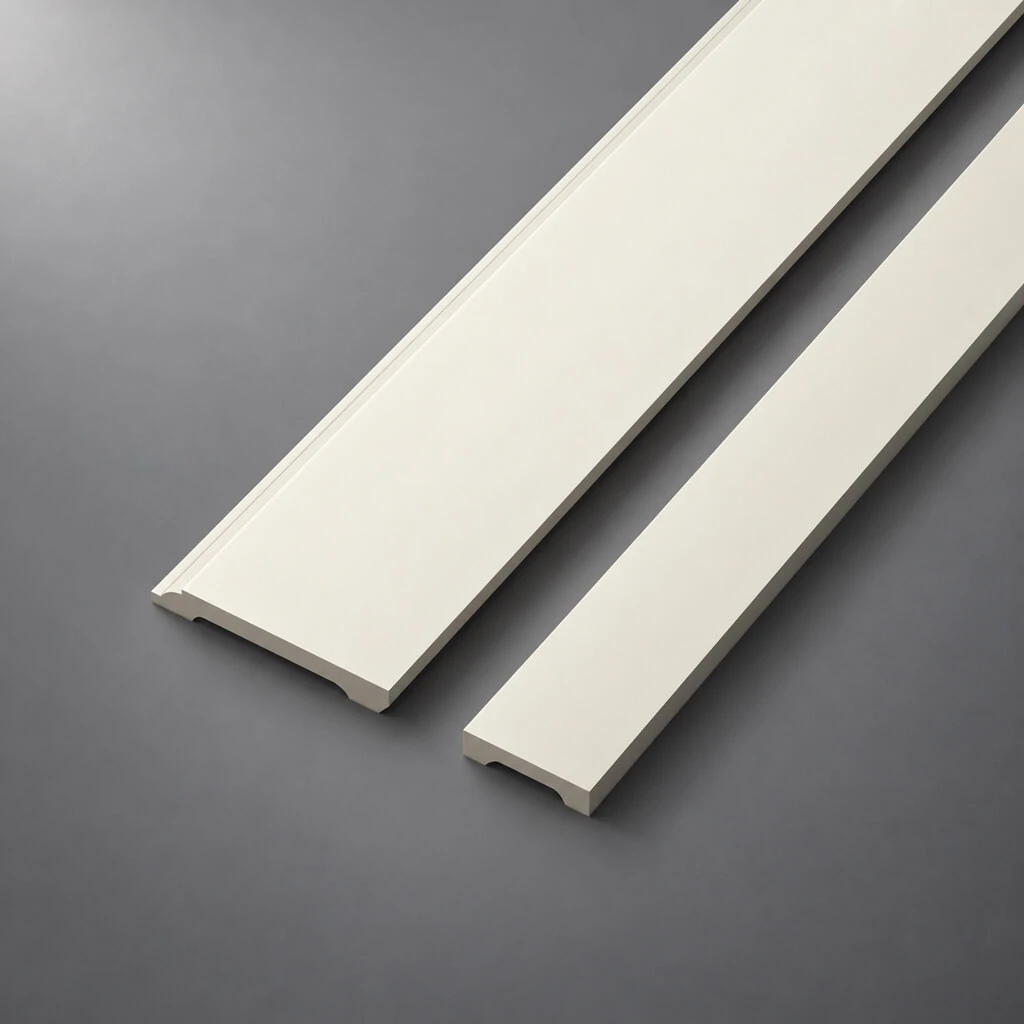
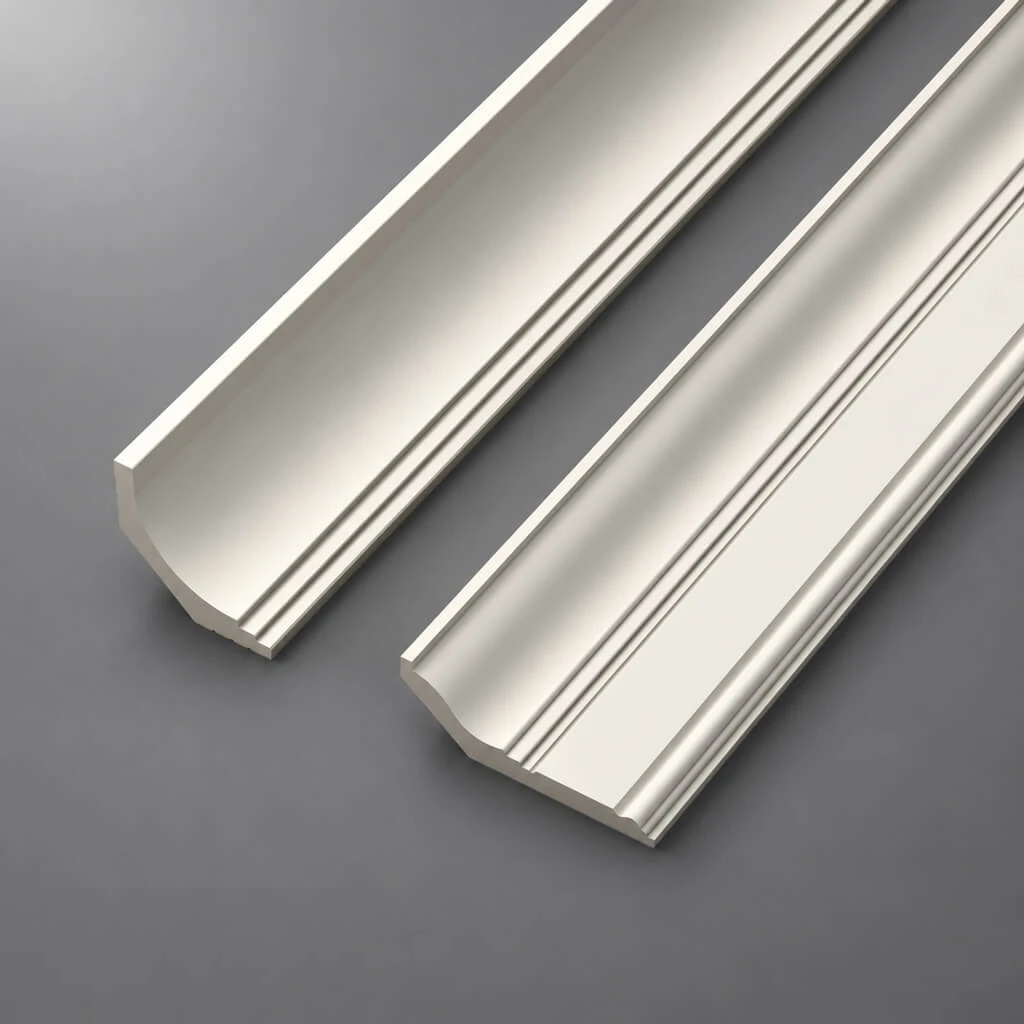
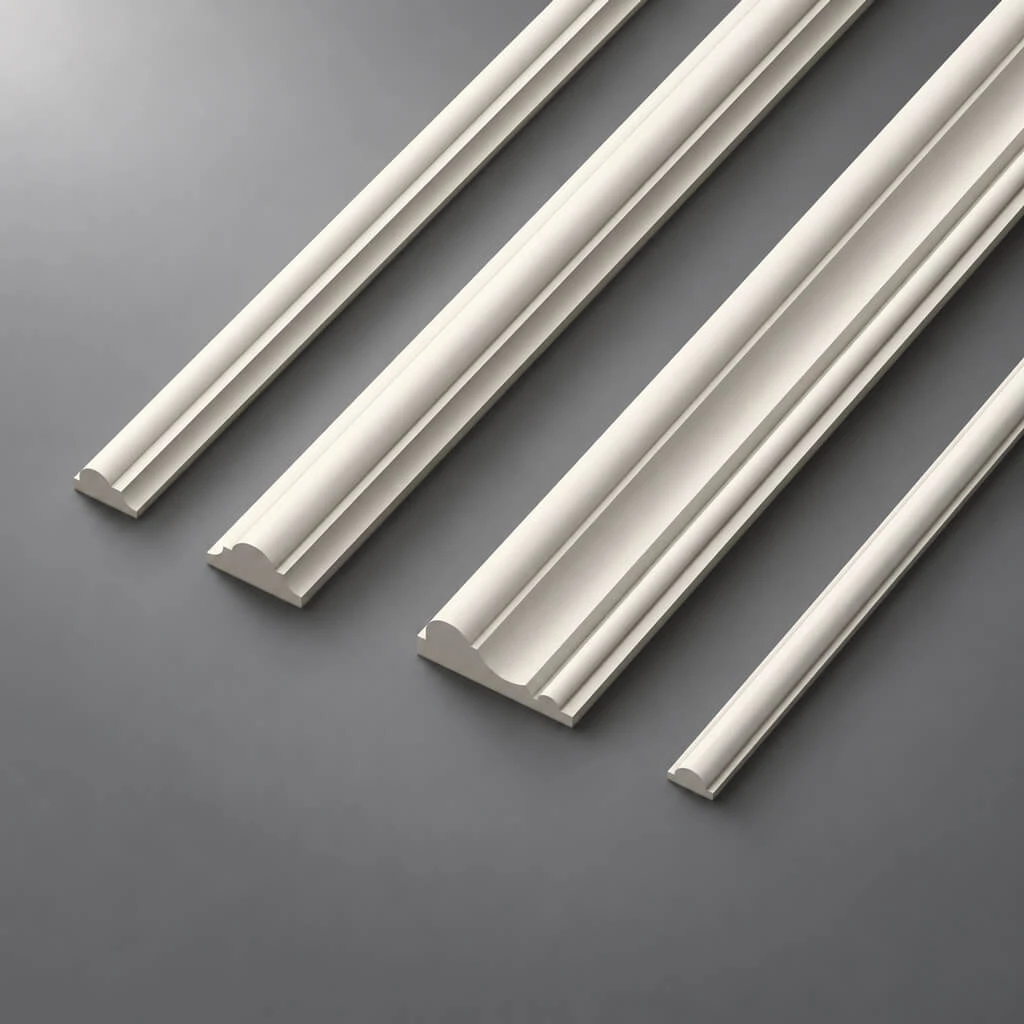
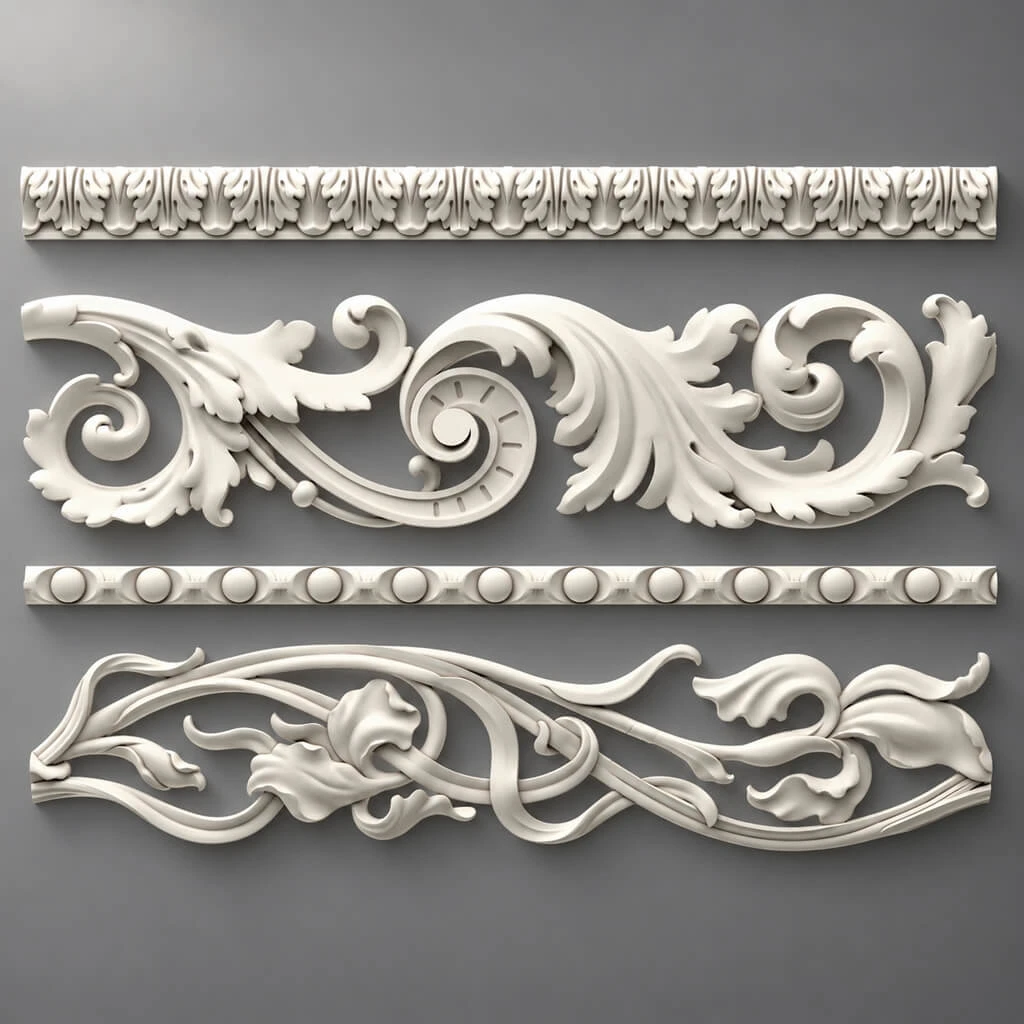
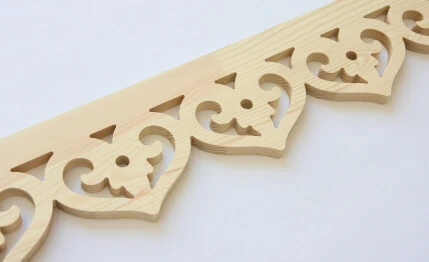
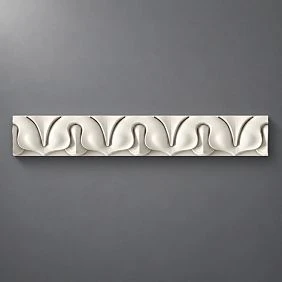
One option is to use decorative trim KPU-071 made of polyurethane. This is not a baguette frame in the traditional sense, not a separate overlay, and not a regular smooth molding. KPU-071 is a narrow decorative trim measuring 22 × 11 × 2000 mm, which allows you to assemble a thin ornamental line around an already installed mirror and preserve the visual lightness of a large reflective surface.
The width of 22 mm is especially interesting here. A large mirror itself already has a strong visual presence. If you surround it with a too massive frame, the proportions can change dramatically: instead of a large mirror panel, the interior begins to perceive primarily the heavy framing. A narrow carved polyurethane trim works differently. It marks the boundary, adds pattern and relief, but does not have to take away a significant part of the attention from the mirror.
There is another reason to consider this method specifically after installing the mirror. The buyer no longer needs to choose a new mirror block with a factory frame. The task has become focused: measure the existing panel, understand where decor can be installed, calculate the total length of the four sides, resolve the issue with corners, and only then order the required number of two-meter KPU-071 pieces.
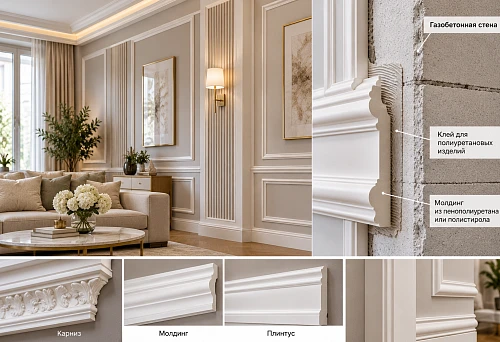
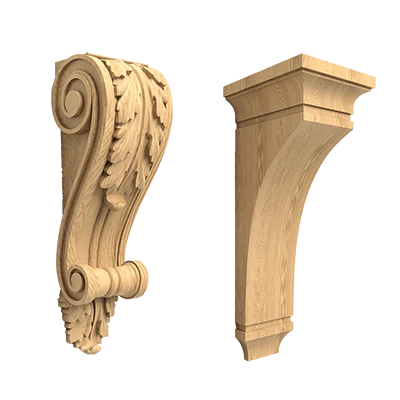
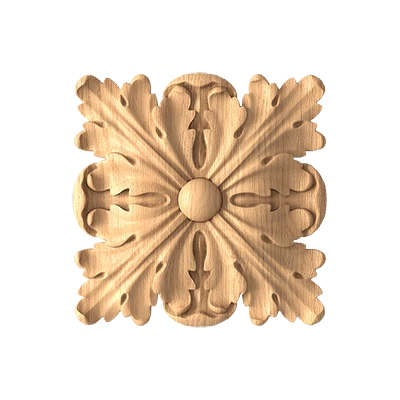
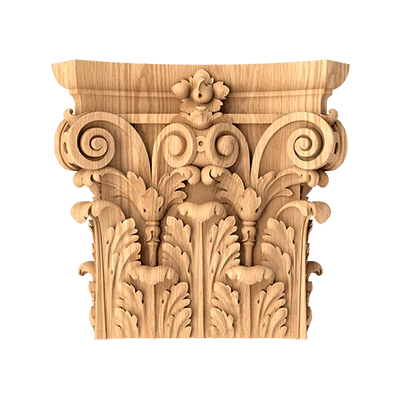
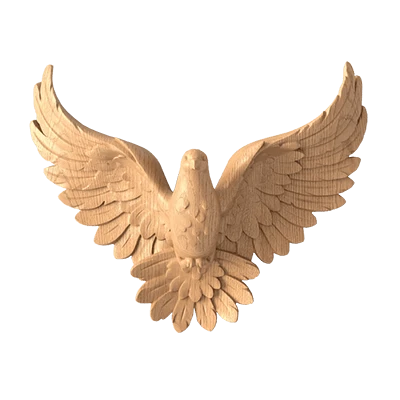
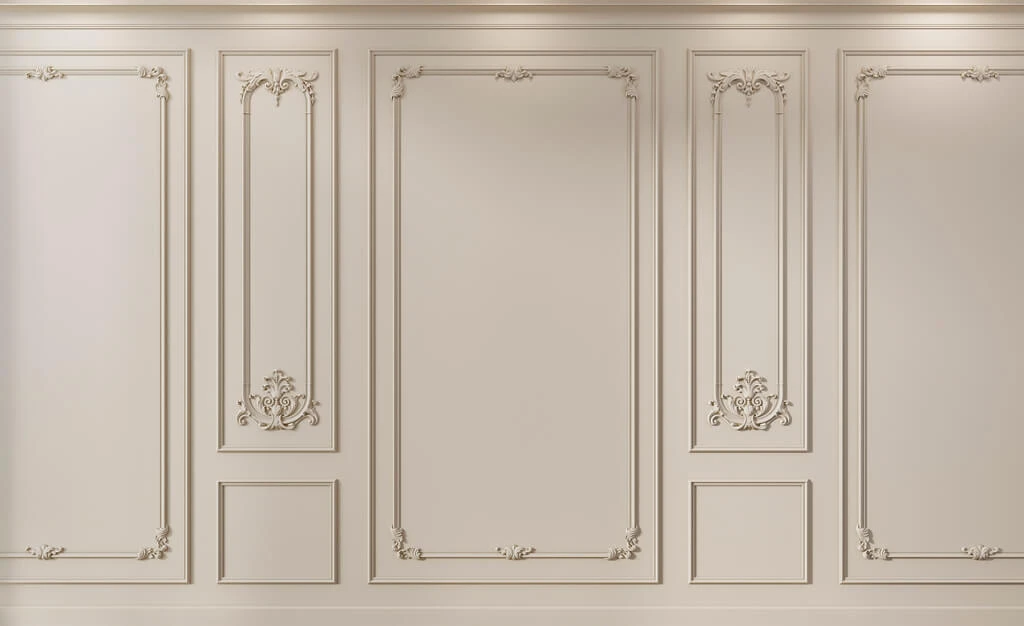
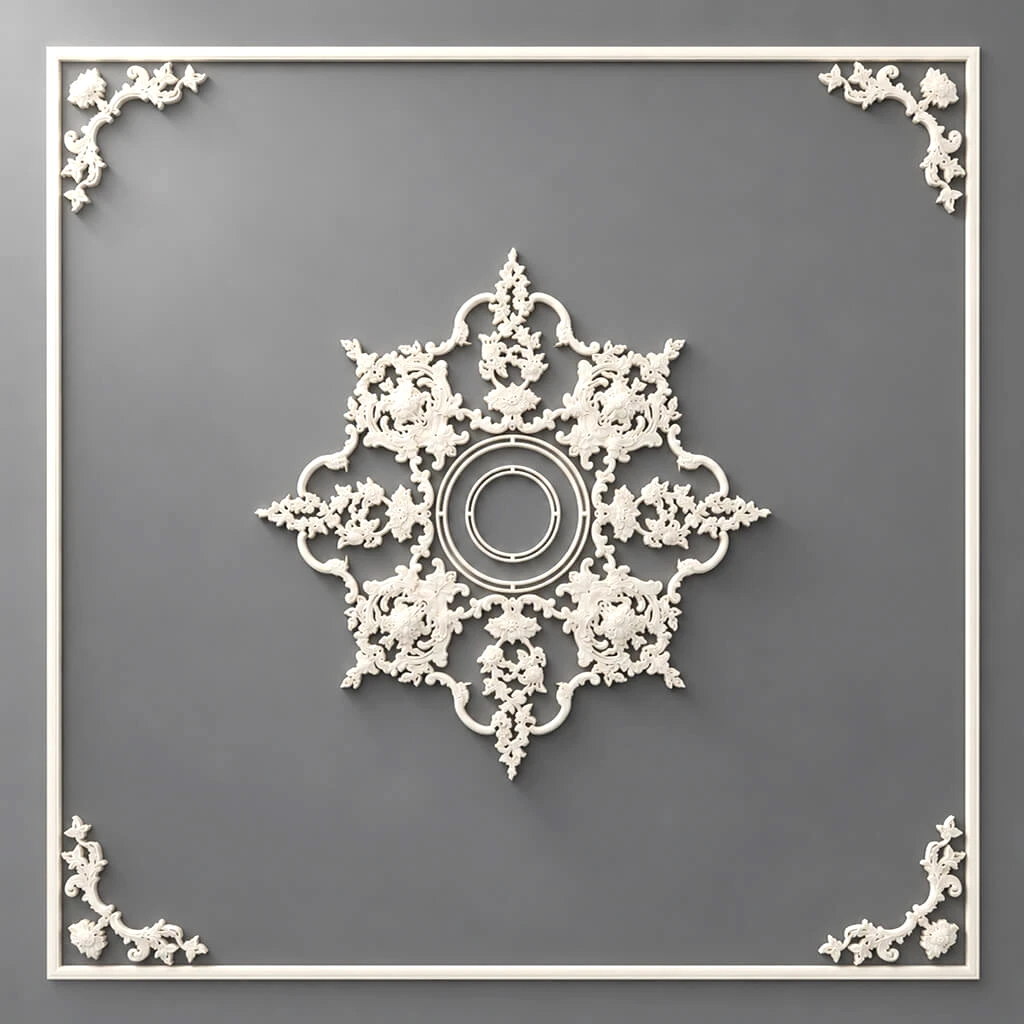
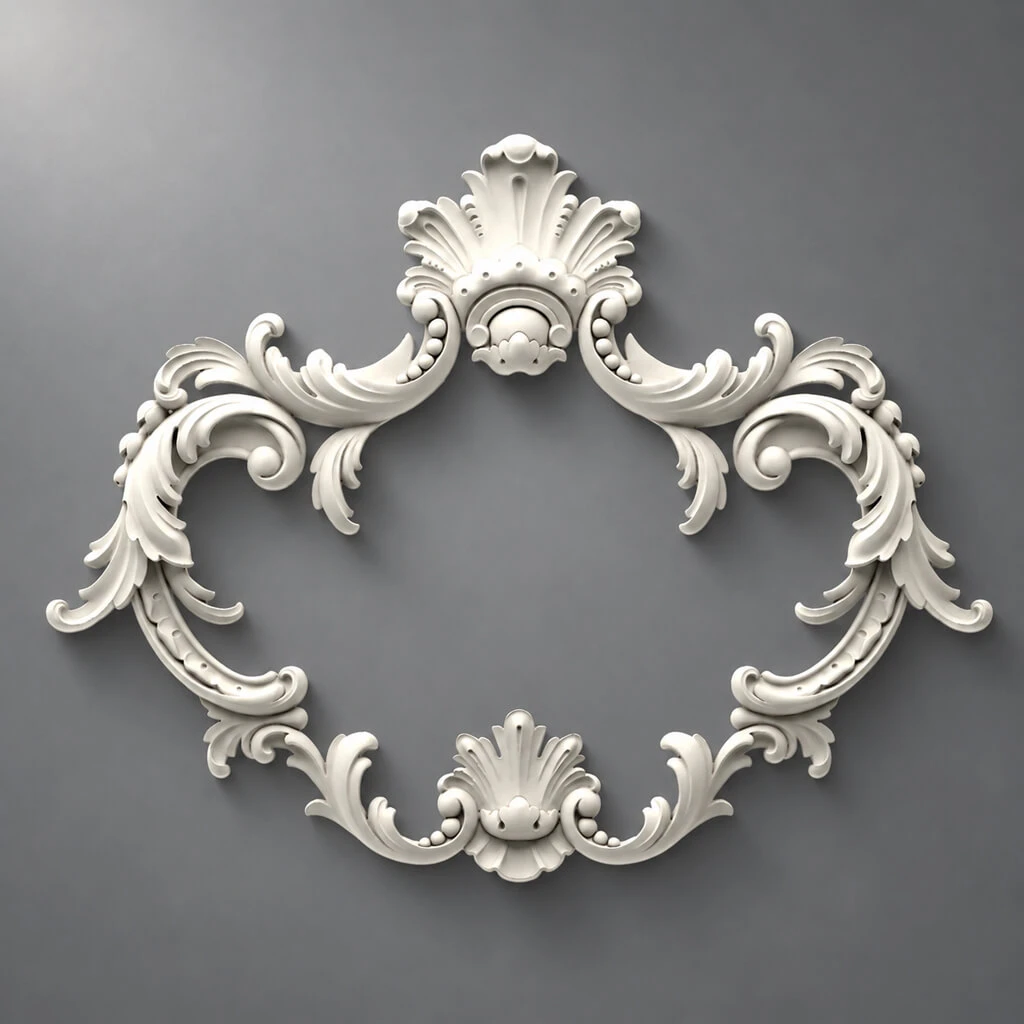
If you are not yet sure which type of decorative element is needed around the mirror, you can first compare options and You can buy ready-made stucco matching the Baroque style. Calculate the quantity: linear meters of cornices and moldings, number of rosettes, pilasters, consoles, corner elements. Add a ten to fifteen percent allowance for trimming. after choosing the appropriate type of product. When you need a linear ornamental element specifically, it makes sense to go to the section where you can buy decorative polyurethane molding and compare KPU-071 with other solutions in this product group.
But the situation in question has a fundamental limitation: it should not be turned into a universal master class on making any frame for any mirror. Here we are talking about a specific scenario — a large mirror is already hanging, a heavy separate frame is not required, and around the panel you want a thin carved framing made from ready-made decorative molding KPU-071.
First, answer the main question: does the mirror need a frame at all?
A large mirror without a frame does not necessarily look unfinished. In a minimalist interior, the clean edge of the reflective panel can be an intentional part of the design. Therefore, starting to buy decorative molding just because "a mirror should have a frame" is wrong.
Look at the mirror from the point in the room where it is most often seen.
Is there a feeling that the boundary between the mirror surface and the wall is too sharp or, on the contrary, not pronounced enough? Does the large panel seem accidentally attached to the surface? Are there moldings, decorative stucco, carved furniture elements, or other details on adjacent walls, next to which a completely smooth mirror looks too austere?
If the problem is indeed noticeable, framing the perimeter makes sense.
At the same time, it is not necessary to immediately move to a heavy frame structure. Often the interior lacks not a wide frame, but a thin decorative line that gathers the mirror surface around the perimeter.
It is in this role that KPU-071 is most interesting.
Frame and edging are not always the same thing
In everyday speech, any decoration around a mirror is called a frame. But when choosing a product, it is useful to distinguish between two scenarios.
The first is that the mirror should receive a distinct standalone frame with noticeable width, its own mass, and strong decorative presence.
The second is that you only need to outline the existing mirror with a narrow relief strip, without creating the feeling of a massive separate object.
KPU-071 corresponds more to the second approach.
The width of 22 mm allows for a relatively thin decorative line around the perimeter. With a large mirror size, it reads as a neat edge finish rather than a dominant part of the structure.
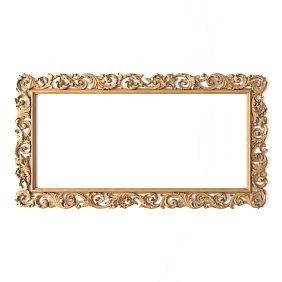
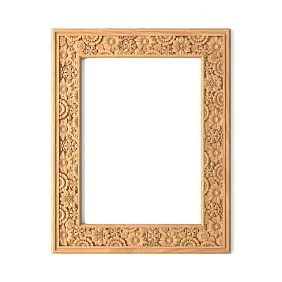
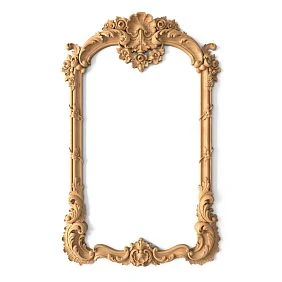
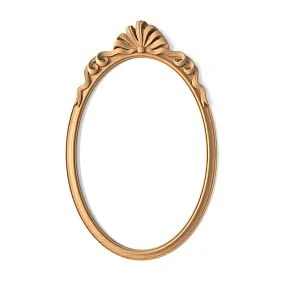
Our factory also produces:
The larger the mirror, the more carefully you should increase the width of the decor
There is a common mistake: a large mirror is automatically surrounded by the largest possible frame.
But a large object already has its own scale.
Imagine a mirror almost as tall as a person. Its reflective surface is the main element. A very wide frame can significantly reduce the visually perceived area of the mirror and change the character of the wall.
Narrow decor around the mirror allows you to preserve the feeling of a large surface while adding completeness to it.
This does not mean that 22 mm will suit any mirror. On a particularly large canvas, KPU-071 may turn out to be too delicate. But this needs to be determined not by a general rule, but through a simple fitting of the actual width.
Get Consultation
KPU-071 is precisely decorative molding, and this affects the project
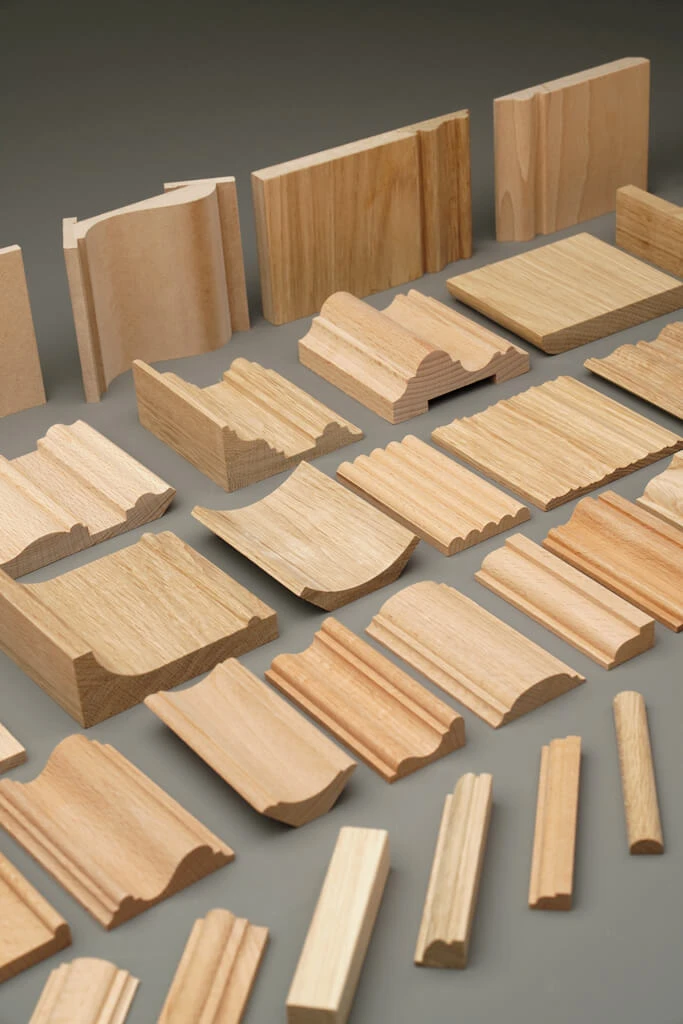
When a buyer looks for molding around a mirror, search results and catalogs may offer moldings, baguettes, baseboards, overlays, corner elements, and decorative molding. Externally, some products look similar, but the purpose of the composition is different.
KPU-071 should be perceived precisely as a linear decorative element.
Its confirmed size:
22 × 11 × 2000 mm.
That is, one piece has a length of 2 m.
For framing a mirror, this immediately shifts the choice from the realm of abstract design to a clear calculation. You know the size of the molding, can measure the four sides of the mirror, and determine in advance how many two-meter elements will be needed.
Buy decorative molding KPU-071 reasonably after such a calculation, rather than just based on a photo of the ornament.
Confirmed parameters for KPU-071
| Parameter | Value | What this means for mirror decoration |
|---|---|---|
| Product type | decorative linear molding | Used as extended linear decor |
| Article number | KPU-071 | Check the product by this designation before ordering |
| Material | Polyurethane | Both sides of the frame are assembled from one type of decorative element |
| Width | 22 мм | The framing turns out to be relatively narrow |
| Depth | 11 мм | The molding has a pronounced volume relative to the plane |
| Length of one part | 2000 мм | The quantity is calculated based on side lengths and the cutting pattern |
| Article scenario | Framing for an already installed large mirror | There is no need to replace the mirror itself just for a decorative frame |
| Product card | Order KPU-071 22 × 11 × 2000 mm | Before ordering, you need to determine the number of two-meter parts |
Note what is not in the table. Unconfirmed adhesive properties, specific fixing technology, color of the finished product, completeness with mounting materials, or delivery conditions are intentionally not specified here. These parameters cannot be invented. Before work, they must be verified against the specific project and the current product card.
Why a width of 22 mm can be a strong point for a large mirror
Twenty-two millimeters is just over two centimeters.
On a single strip, this width may seem small. But around the mirror, it is not one short part that works, but a closed perimeter. The line repeats at the top, bottom, and on both vertical sides.
As a result, even a narrow profile creates a clearly readable frame geometry.
A narrow frame keeps the mirror surface as the main element.
This is fundamental for large mirrors.
A person usually chooses a large mirror not to then visually "eat" it with a wide frame. They need a large reflective surface, light, perspective, and a sense of space.
Thin decorative polyurethane molding can add relief without changing the mirror's main role.
The ornament compensates for the small width.
If it were a completely smooth strip 22 mm wide, the effect would be more graphic and calm.
KPU-071 is interesting precisely as decorative molding. The embossed pattern creates a play of light and shadow, so visual expressiveness is determined not only by physical width.
As a result, the frame can look more refined than a simple smooth profile of the same dimensions.
A small width is useful where there is little free wall space around the mirror.
After installation, the mirror sometimes ends up quite close to outlets, switches, furniture, trim, or a wall corner.
A wide frame simply doesn't fit compositionally in such a case.
The twenty-two-millimeter line requires less space. However, you still need to measure the free area in advance.
Will KPU-071 suit your mirror: checking without buying
You don't need a complex sketch for this.
Make a paper strip 22 mm wide.
The length isn't critical—40–60 cm is enough to understand the scale. Apply the strip to the edge of the mirror or to the wall directly next to it in the place where the decorative molding is intended.
Look at it from several distances.
Up close, you assess the proportion with the mirror edge and the wall.
From a distance of two to three meters—how well the frame line reads at all.
From a distant point in the room — does it not visually disappear?
Do not evaluate only one corner
A short strip in the corner almost always seems less noticeable than a full perimeter.
Therefore, it is useful to temporarily mark the frame with painter's tape of the appropriate width around a significant part of the mirror. It is not necessary to cover the entire surface — the top side and one vertical are enough.
This makes it much easier to understand the future proportion.
For a very large mirror, 22 mm may be too delicate
This is a normal result of the fitting.
If the mirror occupies almost the entire wall and the interior requires a powerful architectural framing, KPU-071 may not provide the needed scale.
There is no need to try to fix this by installing two parallel rows without a preliminary compositional reason. It is better to compare another type of profile.
If you want a calm line without a pronounced carved pattern, it makes sense buy polyurethane moldings and match them with decorative molding by width, surface character, and overall task.
Where exactly should the frame go: on the mirror itself or around it on the wall
This is one of the main questions to resolve before calculating the quantity of KPU-071.
An already installed mirror can have various structural situations.
In one case, the edge of the mirror panel and the wall allow the decorative line to be considered directly next to the mirror.
In another, there are mounting features, gaps, protrusions, or other limitations between the mirror and the wall.
In a third, the buyer wants to visually enlarge the frame and place it not right at the edge, but with a slight offset around the mirror on the wall.
There is no universal answer here.
Option without a noticeable offset
The molding is visually perceived as a direct framing of the mirror surface.
This approach creates a compact assembled frame.
But before choosing, it is necessary to check the edge construction and the possibility of safely placing the decorative element without interfering with the mirror mounting mechanism.
Option with a small offset from the wall
Then the mirror and the frame become two concentric rectangles.
A thin strip of wall appears between them.
This technique can make the composition lighter, but requires particularly precise marking. If the offsets differ on different sides, the error is immediately noticeable.
Large offset
This is no longer so much a mirror frame as an independent wall composition around it.
Here, the perimeter length increases noticeably, and the calculation based on the mirror's own size becomes incorrect.
Therefore, before purchasing KPU-071, the first step is to determine not only the width and height of the mirror, but also the actual dimensions of the line along which the molding will run.
How to measure a mirror for calculating decorative molding
Four values are needed, even if the mirror seems perfectly rectangular:
-
top horizontal side;
-
bottom horizontal side;
-
left vertical;
-
right vertical.
Why can't you just measure the width and height once?
Because the actual installation is already done. The wall surface, mirror position, and existing edges may have slight differences. The calculation should ideally be based on the actual structure, not the nominal size from an old order.
If the top and bottom match, and the verticals are the same, you can then use the regular perimeter formula.
For a rectangle:
P = 2 × (width + height).
But this is only the first stage.
The number of two-meter parts is also determined by the cutting pattern.
Why simply dividing the perimeter by 2 meters is sometimes not enough
Let's imagine a frame with a perimeter of 6 m.
It might seem that three KPU-071 strips of 2 m each are enough.
Sometimes that is the case.
But if each side requires a separate solid piece, the side dimensions may be distributed across the two-meter strips poorly.
For example, two verticals of 1.9 m each and two horizontals of 1.1 m each.
Total length:
1.9 + 1.9 + 1.1 + 1.1 = 6 m.
Three two-meter strips give exactly 6 m.
But after two 1.9 m sections from the first two pieces, only 0.1 m remains from each. The third two-meter plank will not yield two whole 1.1 m sections.
Therefore, if whole sides are required, a fourth piece will be needed, or additional joints will have to be designed.
This is why decorative molding for a mirror frame is calculated not only in meters but also with a cutting plan.
Example calculation for a mirror 800 × 1800 mm
Let's take the proposed scenario: a mirror 800 mm wide and 1800 mm high.
If the molding runs directly along the perimeter without additional enlargement of the frame dimensions, the nominal length is:
800 + 800 + 1800 + 1800 = 5200 mm.
Or:
5.2 m.
One KPU-071 plank has a length of 2000 mm.
By pure linear footage:
5,2 ÷ 2 = 2,6.
Rounding up gives a minimum of 3 planks.
Now we check the cutting layout.
From the first two-meter piece, you can get one vertical 1800 mm.
From the second, you get the second vertical 1800 mm.
The third plank, 2000 mm long, allows you to get two horizontal sections of 800 mm each:
800 + 800 = 1600 mm.
By pure geometry, three two-meter elements can cover such a perimeter.
But this does not mean that you should unconditionally order exactly three pieces.
Corners change the actual cutting layout
If a method with a corner cut is chosen, the final length and cutting point depend on how exactly the profile is positioned relative to the mirror.
In addition, decorative molding has a pattern. It is necessary to assess how the ornament will meet at the corners and whether a specific layout will require additional allowance.
Therefore, for a mirror of 800 × 1800 mm, three strips are the mathematical minimum according to a simple cutting map, and the final quantity is determined after resolving corners, molding placement, and joint requirements.
This is much more useful than the advice "take such and such percentage of allowance" without knowing the project.
How to build a cutting map before ordering
Take a sheet of paper and write down the length of all four sections.
For example:
-
left vertical — 1800 mm;
-
right vertical — 1800 mm;
-
top — 800 mm;
-
bottom — 800 mm.
Now draw rectangles 2000 mm long — each represents one KPU-071 piece.
Distribute the required segments.
Strip No. 1
1800 mm for the first vertical.
Remainder — 200 mm.
Strip No. 2
1800 mm for the second vertical.
Remainder — 200 mm.
Strip No. 3
800 mm for the top.
800 mm for the bottom.
Remains 400 mm.
This rough cutting plan shows that the length problem is solved with three strips.
After that, you need to enter the angle type into the scheme and make sure that the nominal dimensions of the segments actually correspond to the cutting line.
What happens if the mirror is wider than two meters
Here a completely different task appears.
Suppose the top side of the mirror is 2400 mm.
One KPU-071 part 2000 mm long physically will not cover it entirely.
This means a intermediate joint appears on the horizontal.
And this joint needs to be designed in advance.
You should not start installation from one corner and then discover a short piece in a random place at the end.
It is better to make the joint part of the scheme
On the long side, different compositional approaches are possible.
You can place the connection in the center.
It can be placed at another point if the pattern of the molding matches better that way.
But the decision depends on the specific ornament of KPU-071 and the nature of the joint, so a universal point cannot be assigned in advance.
The main rule is simpler: the joint of the long side should appear on the drawing before purchase and cutting, not arise from a random leftover.
Symmetry is especially useful on the upper side.
The upper horizontal of the large mirror is in a clearly visible area.
If two sections need to be joined, a visually organized joint is usually perceived as neater than a random short piece at one of the corners.
But the actual decision is made after fitting the pattern.
The four corners are the main risk zone in carved framing.
On a smooth profile, a small error can sometimes be easier to hide with finishing.
With carved molding, the mismatch is more noticeable because the eye sees not only the edge line but also the ornament.
Therefore, the angles need to be thought out in advance.
45° joint
For rectangular frames, this is a familiar geometric scheme: two slats meet with diagonal cuts.
But the presence of a decorative pattern adds a new criterion — the ornament must look neat at the joint.
One cannot rely solely on the fact that the angle of the wall and mirror is 90°, and therefore “we automatically cut at 45° and the matter is closed.”
A trial assembly is needed.
Straight joint
In some compositions, another joint option may be considered, where one section meets another without a classic diagonal angle.
But this method noticeably changes the appearance of the frame and must match the profile pattern.
Therefore, it cannot be universally recommended as simpler.
Decorative corner as a separate idea
Sometimes a customer wants to move away from cutting an ornament and add separate decorative elements to the four corners.
This is already a more complex composition.
If the task goes beyond a single frame, you can explore Polyurethane wall decor and assess whether the mirror needs additional wall-mounted details.
But they should not be added just to mask a poorly designed corner. First, the basic geometry of KPU-071 needs to be resolved.
Carved molding or regular molding: an honest comparison
Not every mirror needs an ornament.
Sometimes the interior only requires a strict thin line.
In that case, the carved KPU-071 may be too active, while a smooth polyurethane molding might be more precise in style.
| Criterion | KPU-071 | Smooth molding |
|---|---|---|
| Character of the design | Ornamental, relief | Calmer and more geometric |
| Width of the considered KPU-071 | 22 мм | Depends on the selected model |
| Main visual effect | Pattern around the entire perimeter | Clear frame line |
| Approach to the large mirror | Light carved framing | Laconic architectural framing |
| Where it is especially appropriate | Where the interior supports decorative molding | Where a restrained outline is needed |
| What to compare before buying | Ornament scale, width, joints | Width, profile, general character of the line |
| Category | decorative polyurethane molding | buy polyurethane moldings |
The difference here is not about "which is prettier."
KPU-071 makes sense to choose when the carved frame itself is part of the idea.
If you want the frame to almost disappear and work only as a clean border, it is worth comparing moldings.
KPU-071 should not be called a baguette
This is important not out of love for terminology, but for correct buyer expectations.
The word "baguette" is associated by many with a ready-made or assembled frame of a certain visual scale, often quite wide.
KPU-071 is a decorative polyurethane molding.
When the buyer understands the type of product, it is easier for them to correctly assess:
-
width 22 mm;
-
length 2000 mm;
-
the need to calculate several slats;
-
possible joints;
-
method of constructing corners;
-
the role of KPU-071 specifically as linear ornamental decor.
This protects against disappointment when a person expects a massive finished frame but orders narrow molding.
When framing is better done in the color of the wall
A monochromatic scheme allows the relief to be shown more strongly than color contrast.
If KPU-071 and the surrounding surface are close in tone, the frame is read through light and shadow. The ornament is present but does not turn into a sharp boundary.
For a large mirror, this can be especially successful: the reflection remains the main focus, and the decorative molding works more softly.
However, one cannot automatically claim that any specific finish composition is suitable for polyurethane and the existing wall. Material compatibility must be checked before work.
Monotony helps connect the mirror with wall moldings
If the wall already has molded frames painted together with the surface, a similar approach around the mirror can incorporate it into the overall architectural pattern of the room.
At the same time, KPU-071 does not necessarily have to match the width of other profiles. It can play the role of a thinner ornamental line.
When contrasting framing is justified
Contrast turns the frame from a background detail into an independent graphic element.
The narrow width of 22 mm in this case no longer seems so delicate, because the color strengthens the boundary.
This option may be suitable if the mirror should become the center of the wall.
But there is a risk: carved pattern plus strong color contrast gives double expressiveness.
Before making a final decision, it is useful to simulate the future color with a paper or painter's tape of the corresponding tone.
The more active the ornament, the more careful you should be with an additional color.
If the interior already contains several contrasting lines, handles, lamps, and furniture details, a separate bright frame can create extra visual noise.
In such a case, a calm finish may better reveal the relief of KPU-071 itself.
Mirror in the hallway: why 22 mm is often worth at least trying on.
In the hallway, large mirrors often have an elongated vertical shape.
Nearby there are doors, cabinets, consoles, and panels.
A massive frame can make a small space visually heavier.
A narrow decorative molding around the mirror allows you to mark the perimeter without taking up much wall space.
But in the hallway there is a separate practical issue: the viewing distance can be small.
A person stands close to the mirror, so the carved pattern is especially visible. This means that even 22 mm can produce a sufficiently pronounced effect.
Large mirror in the bedroom
In the bedroom, the mirror often coexists with a dresser, vanity table, wardrobe, or upholstered furniture.
If the furniture has decorative facades, a smooth rectangular mirror may be perceived as too neutral.
KPU-071 allows adding a related decorative motif without installing a massive frame.
The option where the frame itself remains relatively thin and does not compete with the furniture is especially interesting.
Mirror above a console or dresser
Here, the connection between the lower item and the upper mirror is important.
If the dresser or console has pronounced decor, the molding around the mirror can support their style.
But the frame size cannot be determined only by the furniture.
First, the mirror is calculated, then the overall vertical composition is assessed:
furniture → distance to the mirror → mirror → framing.
If the upper part of the wall turns out to be too busy, it is better to leave the frame thin.
Mirror in the living room as part of a large wall composition
Here, KPU-071 can be considered not in isolation, but alongside other decorative lines.
For example, the mirror is located within a large wall field.
In this case, a narrow carved perimeter defines the mirror itself, while larger wall elements work on the scale of the entire wall.
To develop such a system, one can Buy polyurethane wall decor, but only after the role of each level is understood.
A mistake is to surround the KPU-071 mirror with a frame, then add another frame, and then several overlays just because the wall is large.
The size of the wall itself does not require a large amount of ornament.
What not to do from scratch if you have a ready-made KPU-071
Decorating the mirror yourself does not mean that you need to manually create the carved pattern itself.
This is where ready-made decorative molding changes the nature of the task.
The buyer does not need to cut out a repeating ornament by hand, try to achieve the same pattern on four sides, or assemble a carved strip from many separate small overlays.
KPU-071 already provides a ready-made extended decorative form.
It remains to solve more practical tasks:
-
measure the line of the future frame;
-
calculate the number of two-meter pieces;
-
create a cutting map;
-
think through the angles;
-
determine the long sides where a joint will be needed;
-
check the base;
-
choose the finish;
-
perform a preliminary layout.
This is what distinguishes using ready-made molding from trying to "do everything yourself from scratch."
If a different character of ornament is needed, it is wiser to compare Carved polyurethane molding, than to try to rework an unsuitable profile by hand.
Do you need to first remove an already installed mirror
The very fact that the mirror is already installed does not automatically imply either the need for removal or the possibility of leaving everything as is.
This depends on the specific design.
You need to understand:
-
how the mirror is secured;
-
how accessible the surface is around the perimeter;
-
whether there is a workspace for marking and installation;
-
whether the fasteners are covered;
-
which section of the wall or other base is used for the trim;
-
whether the decorative element will create obstacles for mirror maintenance.
If the design allows finishing the perimeter without interfering with the fastening, that is a strong point of the "mirror already hanging" scenario.
But one cannot give universal advice to remove or not remove the mirror without seeing the specific installation.
Mounting on the wall around the mirror or on another surface: what to check
The main thing is to separate the confirmed parameters of KPU-071 from the conditions of a specific object.
We know the size and material of the trim.
But we don't automatically know:
-
the material of your wall;
-
the type of its finish;
-
the method of attaching the mirror;
-
the distance from the mirror to the base;
-
the selected adhesive system;
-
the condition of the surface.
Therefore, installation begins not with buying random glue, but with checking the base.
Painted wall
You need to assess the condition of the coating and its ability to withstand the upcoming installation.
The entire system cannot be considered durable just because the top layer of paint looks neat.
Decorative plaster
The textured surface affects the contact of the trim with the base.
Installation conditions need to be checked separately.
Panel or furniture surface
If the mirror is built into a separate panel, the base may differ from the wall.
Compatibility check is required again.
Thus, the very idea of KPU-071 is universal as decorative, but the method of fixation is determined by the specific surface.
How to prepare a dry layout before final installation
Do not start from a corner or move around the perimeter "as it happens."
First, lay out all calculated pieces without final fixation.
If the mirror is large, you can do a trial fit in sections.
Check:
-
whether the total length matches;
-
where the intermediate joints are;
-
how the pattern looks in the corners;
-
whether there is any too-short filler piece;
-
whether the joints are symmetrically placed;
-
whether the frame width matches the overall scale of the mirror.
Sign each section
Simple system:
-
T — top;
-
B — bottom;
-
L — left side;
-
R — right side.
If the long side consists of several parts, add a number.
For example:
B-1, B-2.
Such marking reduces the risk of confusing already fitted elements.
How to determine where to make the joint on the long side
If the side is less than or equal to the length of one part and the chosen cutting scheme allows using a solid section, the question disappears.
If the side is longer than 2000 mm, a joint is inevitable.
Then you need to decide where it will be least random.
Center of the side
Symmetric variant.
It is easily controlled geometrically and can look intentional.
Two symmetric segments around the central fragment
With a very long length, a more complex layout is possible.
But for it, the KPU-071 pattern needs to be especially carefully evaluated.
Offset joint
Can be used if the ornament or placement of other wall elements makes it less noticeable.
But the offset must have a reason.
The worst option is a short remainder near one corner just because the plank ended that way.
Do you need to leave a reserve of KPU-071
The concept of "reserve" in decorative molding cannot be reduced to a universal percentage.
The reasons for additional consumption vary:
-
corner cutting;
-
pattern matching;
-
intermediate connections;
-
test cuts;
-
specific layout scheme;
-
the need to have a single piece for a certain side.
Therefore, the best way to determine the quantity is to first map out all the segments and place them on two-meter planks.
After that, you can see how close the calculation is to the limit.
If three planks are used almost without waste and any error would make the layout impossible, the decision to add an extra piece is made deliberately.
What not to do when calculating
Only count the mirror area
The area in square meters does not determine the amount of linear footage.
You need the perimeter.
Divide the perimeter by two and immediately order the resulting quantity
You need to check the cutting of the sides.
Forgetting about the offset from the mirror
If the frame does not run along the very edge, its dimensions increase.
Do not account for sides longer than 2000 mm
They will require an additional connection.
Consider remnants fully interchangeable
A short remnant won't help if you need a long solid side.
When one KPU-071 is sufficient
There are mirrors for which a thin carved frame is quite enough.
Signs of such a situation:
-
the mirror already has a good scale;
-
the wall does not require a complex multi-level composition;
-
KPU-071 reads well from a normal viewing point;
-
there is enough free space around;
-
the ornament supports the interior;
-
after a trial layout, the mirror looks finished.
In this case, adding extra overlays and wall decor is not required.
A self-sufficient frame often looks more convincing than a set of elements added just to fill space.
When KPU-071 is better complemented with wall decor
Additional composition may be justified if the mirror occupies only one part of a large wall.
For example, a system of panels or decorative fields is already being built around it.
Then Buy polyurethane wall decor it makes sense not for thickening the frame itself, but for decorating adjacent areas.
Roles are better separated:
-
KPU-071 — mirror border;
-
wall decor — wall finishing;
-
moldings — geometric structure, if provided by the project.
When each element has a function, the composition remains readable.
When KPU-071 turns out to be too narrow
Do not hide the product's limitation.
Width of 22 mm is a strong point for light framing, but it becomes a limitation if the interior needs a massive frame.
KPU-071 may seem too thin when:
-
the mirror takes up almost the entire wall;
-
a large massive piece of furniture is matched with the mirror;
-
the room has a very high ceiling and large architectural decor;
-
the frame should be the main decorative object;
-
it is required to hide a significant width technical zone along the edge of the mirror;
-
from a distant viewpoint, the 22 mm line is almost invisible.
In such a situation, it is better to honestly compare other profiles rather than try to force the narrow KPU-071 to perform a role that is not typical for it.
When it is more reasonable to choose a smooth molding instead of KPU-071
There are interiors where carving
This table should not be perceived as a mandatory set.
If only a neat frame is required, it is enough to correctly calculate KPU-071. Additional selling makes sense only when the additional element truly improves a specific wall.
How not to confuse KPU-071 with similar types of decor
It is important for the buyer to check not only the article number, but also the type of product.
KPU-071 and baguette
KPU-071 is a decorative molding.
You should not expect from it the visual scale of a wide baguette.
KPU-071 and smooth molding
Both types of products are linear, but the surface character and decorative role differ.
KPU-071 is chosen for its ornament.
KPU-071 and separate overlay
An overlay is a local decorative element.
The molding creates an extended line.
For a closed frame, the linear format is fundamentally more convenient.
KPU-071 and wall decor
Wall elements can complement the mirror, but by themselves they do not replace the molding if a continuous frame line is required.
Practical scenarios: which solution to choose
Mirror 800 × 1800 mm in the hallway
The initial calculation gives 5.2 m of perimeter.
According to a simple cutting plan, three two-meter pieces can be considered, but before ordering, you need to decide on the corners and check the actual line of the frame placement.
Mirror 1200 × 2000 mm
Perimeter:
2 × (1200 + 2000) = 6400 mm.
Based on the length alone, at least four planks of 2000 mm will be needed, since three would give only 6000 mm.
But then the cutting layout is checked again.
Two verticals of 2000 mm use two pieces completely.
Two horizontals of 1200 mm will require two more strips if the sides must be solid.
In total, four pieces look logical already according to the cutting map.
Mirror 2400 × 1600 mm
Perimeter:
2 × (2400 + 1600) = 8000 mm.
The net length equals four two-meter strips.
But two horizontals of 2400 mm cannot be made solid from a 2000 mm strip.
Intermediate connections will be needed.
It is precisely in such sizes that simply dividing the perimeter by the product length stops providing a sufficient answer.
Round or oval mirror
Here you can no longer automatically transfer the logic of a rectangular frame.
KPU-071 is considered as a straight linear molding, and the possibility of using it in a curved shape cannot be invented without confirmed data.
Therefore, this article is primarily devoted to framing with straight sections.
Mistakes that turn a good idea into a sloppy frame
Buy KPU-071 before measuring
The length of one piece is known — 2000 mm.
But without the frame dimensions, the number of planks is unknown.
Calculate only the perimeter
Meterage is the first step.
The second is cutting along individual sides.
Calling KPU-071 a molding and expecting a different profile
You need to understand in advance that a decorative trim with a width of 22 mm has been chosen.
Do not try the 22 mm width on a large mirror
On one panel this width looks neat, on another it looks too thin.
Start cutting without a corner diagram
Four corners determine the appearance of the entire frame.
Make a random joint on a side longer than 2 m
The connection point must be planned.
Trying to cover a wide technical zone with a narrow profile
22 mm have a specific physical size.
If a large strip needs to be covered, KPU-071 may not be suitable.
Adding too much additional decor
Carved molding already creates an ornament around the entire perimeter.
Ignore the 11 mm depth
The frame is not flat. Its volume must be considered relative to the mirror and adjacent elements.
Choosing a contrasting color without a mockup
Contrast noticeably enhances even a narrow frame.
Using one calculation for multiple mirrors of different sizes
Each mirror requires its own cutting map.
Order planks only by total meters without distribution of segments
This is especially dangerous if there are sides about two meters long.
Deciding on the installation method without checking the base
The conditions of a specific wall are unknown from a single product card.
When KPU-071 really suits your project
It is worth considering this trim if several conditions match.
The mirror is already installed and we don't want to change it.
A massive ready-made frame is not needed.
Carved, not completely smooth, framing is required.
The 22 mm width looks sufficient after trying it on.
Straight sides allow for a clear cutting layout.
There is the possibility to place a decorative element around the perimeter without conflicting with the existing mirror mounting and adjacent parts.
The interior supports decorative molding.
In this case Buy decorative molding KPU-071 It can already be seen as a consciously chosen material for a specific frame, rather than a random decorative strip.
When it is better to stop and choose another option
KPU-071 should not be purchased if, after trying it on, it becomes clear that the 22 mm width almost disappears against the background of a huge mirror.
It should not be chosen either when the interior requires a strictly smooth frame.
It is not suitable for a task where the decorative profile needs to cover an area significantly wider than its own size.
One cannot count on curved application without confirmation.
And one should not complicate an already good-looking frameless mirror just because there is the possibility to add molding.
A good choice sometimes consists in refusing an extra detail.
How to order KPU-071 in the required quantity on STAVROS
Purchasing for a frame should start with a small specification.
Write down:
- mirror size;
- actual size of the future framing line;
- length of each side;
- number of sides longer than 2000 mm;
- intended joint locations;
- angle diagram;
- cutting layout for two-meter pieces;
- final quantity of KPU-071.
After that, you can open the product card and Order KPU-071 22 × 11 × 2000 mm.
If at the mock-up stage it turns out that a different scale or pattern is needed, it is better to return to the category and buy decorative polyurethane molding only after comparing the options.
This order is much more reasonable than first buying several strips and then trying to adapt them to the existing mirror.
FAQ: questions about KPU-071 and carved mirror framing
Can KPU-071 be used to frame a mirror that is already installed?
This scenario is possible if the structure of the existing mirror and the surface around it allow placing decorative molding without compromising the mounting. Before ordering, you need to inspect the perimeter and determine the actual installation line.
What is the size of KPU-071?
The confirmed size of the decorative molding KPU-071 is 22 × 11 × 2000 mm.
Is the length of one KPU-071 strip really 2 meters?
Yes, the confirmed length of one piece is 2000 mm, that is, 2 m. The number of elements is calculated based on this value.
How to calculate KPU-071 for a rectangular mirror?
First, add the lengths of the four sides or calculate the perimeter using the formula 2 × (width + height). After that, be sure to distribute the individual sides across the two-meter planks and check the cutting map.
Why can't you simply divide the perimeter by two meters?
Because the required segments may not fit into the planks without additional joints. The total length is sometimes mathematically sufficient, but not enough for the required solid sides.
How many KPU-071 are needed for a mirror of 800 × 1800 mm?
The nominal perimeter of such a mirror is 5.2 m. In a simple scheme, two pieces can be used for the verticals of 1800 mm each, and from the third you can get two horizontals of 800 mm each. Therefore, three planks are the mathematical minimum for this layout, but the final quantity must be determined after resolving the corners and the actual frame line.
How much trim will be needed for a mirror of 1200 × 2000 mm?
The nominal perimeter is 6.4 m. Two verticals of 2000 mm each will take two whole planks, and two horizontals of 1200 mm each will require two more. In this simple scheme, you get four two-meter pieces, but the actual cutting again depends on the corners.
What to do if the side of the mirror is longer than 2000 mm?
You will need to plan an intermediate connection for several sections. Its location is best determined before cutting and purchasing, taking into account the symmetry and pattern of KPU-071.
Is it mandatory to make 45° angles?
This method is typical for rectangular frames, but it cannot automatically be assigned as the only possible one for any project. You need to check the shape of the molding, the pattern, and the desired joint appearance on a test layout.
Can a straight joint be used in the corner?
It can be considered as a separate composition option, but it is noticeably different visually from a diagonal connection. The decision should be made after a trial fitting, not out of a desire to simplify the cutting.
Is KPU-071 a baguette?
No. In this article, KPU-071 is considered specifically as a decorative polyurethane molding with dimensions of 22 × 11 × 2000 mm. You should not expect it to have the visual scale of a massive baguette.
Is KPU-071 a molding?
It is more correct to use the product name — decorative molding KPU-071. If you need a smooth profile without a pronounced ornament, you can separately buy polyurethane moldings.
Won't the 22 mm width be too small for a large mirror?
Maybe, if the mirror is very large and the interior requires a massive architectural frame. Therefore, before purchasing, you should make a paper or painter's tape strip 22 mm wide and look at it from the usual viewing point.
Can the effect be enhanced by installing two rows of KPU-071?
Technically, you should not invent such a scheme without a specific project. Two parallel rows greatly change the frame pattern. If one profile is insufficient in scale, it is better to first compare other types of moldings or trims.
Is it possible to leave a small gap between the mirror and the frame?
Compositionally, this option is possible if the wall and mirror construction allows it. But then you need to calculate the perimeter based on the dimensions of the future frame, not the mirror itself.
What is better — a frame flush with the mirror or with a gap?
This depends on the construction and design. A tight frame looks more cohesive, a small gap creates an additional layer of wall between the mirror and the frame. Both options should first be checked with markings.
Do I need to remove the mirror before framing?
There is no universal answer. The decision depends on the mirror mounting method, surface access, and the planned placement of KPU-071. You should not dismantle or, conversely, leave the mirror in place based only on general recommendations.
Can KPU-071 be glued directly to the mirror?
A specific possibility and method of fixation cannot be determined without assessing the base and a confirmed mounting system. The article does not replace checking material compatibility on site.
What adhesive is needed for KPU-071?
Using a random adhesive name without confirmed data would be incorrect. The mounting compound should be selected considering polyurethane and the specific base on which the trim is installed.
Can KPU-071 be painted?
Future finishing should be planned together with the overall color scheme, but specific compatibility of paint and varnish materials should be checked before application. Not every compound can be recommended remotely.
Is it better to paint the frame in the wall color or make it contrasting?
Both approaches are possible as a design idea. In the wall color, the relief and light-shadow work more strongly; a contrasting frame becomes more noticeable as a graphic border. Before final finishing, it is useful to make a color mockup.
Can KPU-071 be used in a hallway?
Yes, it can be considered for decorative framing of a mirror in a hallway if the dimensions, style, and conditions of the specific location are suitable. It is especially important to check the 22 mm width from the actual viewing distance.
Will KPU-071 suit a mirror above a dresser?
It may work if the ornament matches the furniture and the frame maintains the correct scale relative to the mirror. Here, it's useful to evaluate the dresser, mirror, and framing as one vertical composition.
Can you add other wall decor nearby?
You can develop the wall composition if it's really needed. For such a task, you can Buy polyurethane wall decor, but additional elements should not turn a neat frame into an overloaded surface.
How to understand if a regular molding is needed instead of KPU-071?
If you like the idea of a thin frame, but the carved pattern seems too active, compare KPU-071 with smooth profiles. Molding is better for a calm, geometric line; KPU-071 is for ornamental framing.
Do I need to buy a spare strip?
The decision is made after the cutting plan. If the calculation uses almost the entire length of the parts, there are complex angles, or pattern matching is required, an extra strip may be justified. A universal percentage of reserve without a project is better not to set.
Where to buy decorative molding KPU-071?
You can Buy decorative molding KPU-071 after measuring the mirror and calculating the required number of two-meter pieces.
From the installed mirror to the finished framing: a sensible order of decisions
When the mirror is already hanging on the wall, there is no need to start the interior from scratch. It is not necessary to replace the panel with a model with a factory frame, order a heavy baguette, or try to cut out a complex ornament yourself.
It is much more productive to first determine what exactly the existing mirror is missing.
If the only problem is that a large mirror surface looks unfinished and needs a thin decorative contour, KPU-071 deserves a try. Its size of 22 × 11 × 2000 mm allows you to build a relatively light carved frame and at the same time accurately calculate the purchase in advance.
Start not with the catalog, but with the mirror.
Measure it.
Determine the actual line of the future frame.
Make a strip 22 mm wide and assess the scale.
Decide whether KPU-071 runs directly next to the mirror or with an offset.
Map out the four sides.
Mark sections longer than 2000 mm.
Think through the corners and intermediate joints.
Only after this does it become clear how many strips are needed and whether this molding truly matches the interior.
If KPU-071 seems too ornate, compare Moldings made of polyurethane. If, on the contrary, you want to extend the design across the entire wall, you can look at Polyurethane wall decor. And if the task remains exactly as it was formulated at the beginning — a thin carved frame for a large, already installed mirror — the central product remains decorative molding KPU-071.
With STAVROS, the key principle in this purchase is mindful selection: not taking decorative molding of an "approximately suitable length," but first linking the product to the actual dimensions of the mirror. KPU-071 is sold in two-meter pieces, so the buyer can calculate the perimeter, cutting plan, and number of strips in advance, check the 22 mm width directly on the wall, and only then move from idea to order.
It is this approach that makes the framing neat. Not the amount of carving, not the maximum frame width, and not an attempt to fill every free centimeter, but the right proportion between the large mirror, the thin line of KPU-071, and the entire wall. When these three scales are aligned, an already installed frameless mirror can be turned into a finished interior detail without replacing the mirror glass itself and without heavy decorative surroundings.