


































Article Contents:
- Wooden capital KL-003.01: which base to order for a white background
- Which leaves will be golden: marking the capital before finishing
- "Gold color" in the request: effect separately, material separately
- Sample of a two-tone capital: checking next to the facade
- Two capitals for the cabinet: transferring the solution to the second piece
- "Standard" or "Prestige": comparing the remaining work
- Price of capitals and price of the white-gold result
- Before installation: agreeing on the seam and finishing
- How to order KL-003.01: for the seller — specification, for the finisher — map
- Questions before purchasing capitals for two-color finishing
- Can golden leaves be approved based on a photo only?
- Will a sample on a smaller KL-003.01 fit?
- Do the leaves need to match the color of the cabinet handles?
- What to do if the first capital was liked, but the material was replaced?
- Is it mandatory to buy a third capital for color matching?
- Can two capitals be handed over to my finisher?
- Who fixes an accidental golden mark on a white background?
- When can the result be finally accepted?

The white cabinet has already been chosen, and its top you want to make more expressive: place two carved capitals and highlight several leaves in a golden color. Here it's easy to order the wrong result. For one craftsman, "a little gold" means thin strokes on the protrusions, for another — fully painted leaves, for a third — a golden patina across the entire relief.
First, a wooden base is selected and color zones are marked, then a coating sample is accepted, and only after that is the finish repeated on the second piece. According to this sequence, one can buy a wooden capital KL-003.01 for a specific cabinet, without mixing the product price with payment for artistic work.
Let's consider an order for two capitals with a white background and limited golden accents. This is a project for future furniture, not a ready-made white-and-gold set from a catalog. If the placement of parts on the cabinet has not yet been verified, or the contractor cannot show an agreed sample, launching the final finish is premature.

Wooden capital KL-003.01: which base to order for a white background
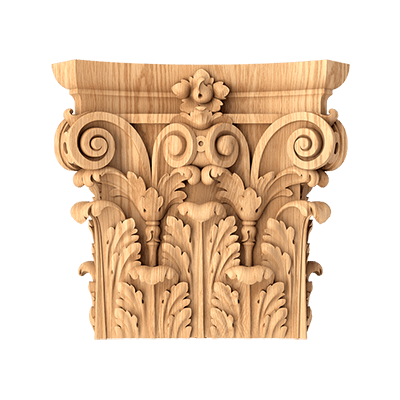
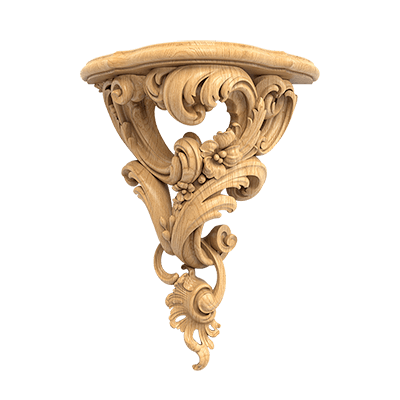
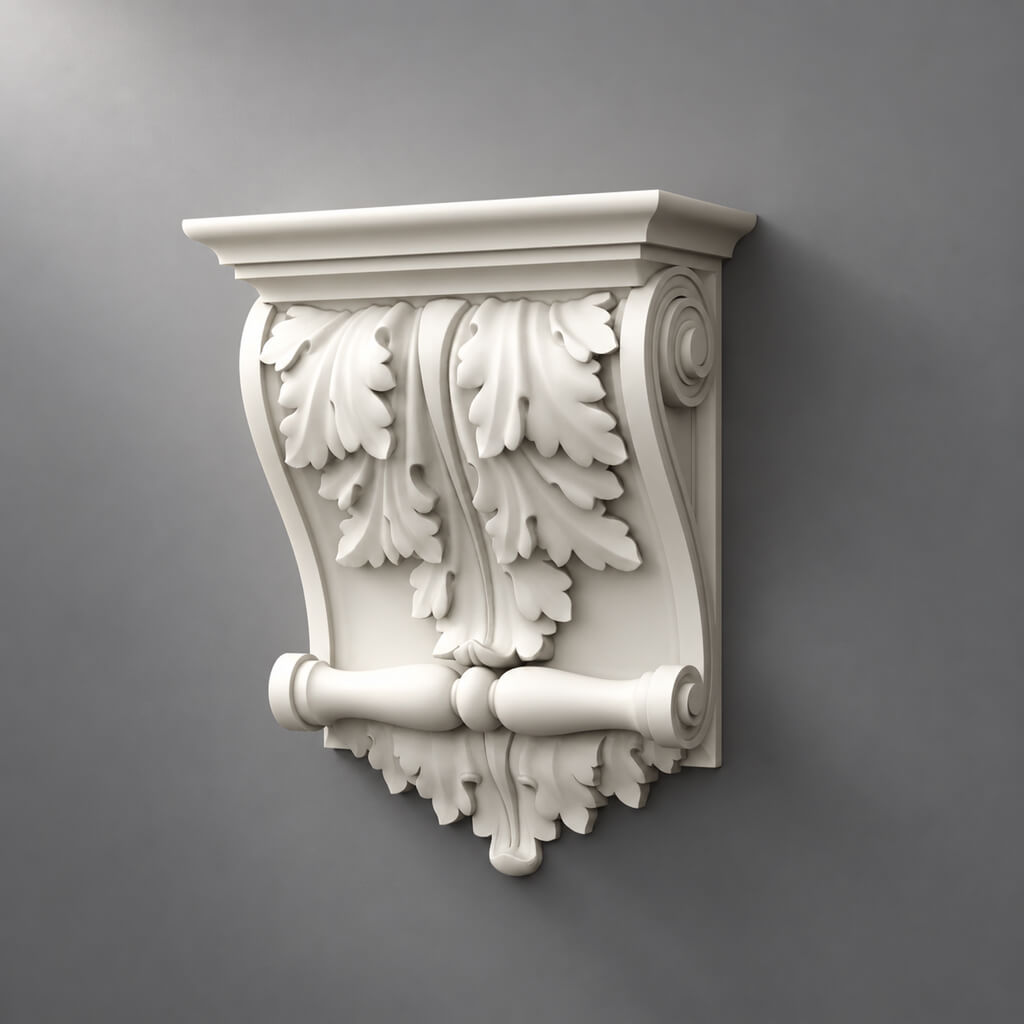
KL-003.01 is available in beech and oak, seven size variants, with "Standard" and "Prestige" sanding. For a working example, we'll take 146 × 180 × 62 × 29 × 97 mm. This is the A × B × C × F × G designation from the trade table. It defines the selected product, but by itself does not confirm the fit on a furniture post.
Before purchasing, the furniture maker must match the part with the cabinet frame: check the installation location, the interface with the upper horizontal element, the fixed base, and the movement of the adjacent door. The width of the mounting area cannot be assigned by simply subtracting numbers from the dimension line. Such a decision requires a drawing or an agreed check of the actual product.
In our example, the initial configuration for discussion is beech, the selected size, "Prestige", and an agreed grade of lamination for enamel. Oak remains an alternative, but switching to it requires new approval of the base and estimate. An already accepted sample on a different material should not be automatically applied to a modified order.
"For enamel" is a grade of lamination, not applied white paint. This is a blank for subsequent opaque finishing. "Prestige" describes the sanding and also does not set a color. Therefore, in the request, the wood finish is recorded separately, and the requirements for the future coating are recorded separately.
If the model does not fit in dimensions or interface, it is more reasonable to first buy a wooden capital than paying for complex finishing of a deliberately unsuitable part. Color will not fix geometry, and a ready-made coating will complicate subsequent fitting.
Which leaves will be golden: marking the capital before finishing
The finishing map starts with an image of exactly KL-003.01 of the required size. A photo of a real specimen or an accurate image of the selected version will do. A picture of a similar capital cannot be used: the craftsman must unambiguously find each marked fragment on his part.
Save a separate copy of the photo without markings. On the working copy, highlight the boundaries of the golden areas without covering the entire pattern with marks. One arrow with the word "gold" is ambiguous: it may point to the top of the leaf, its central part, or the entire surface. For a complex boundary, an enlarged fragment and a short explanation will be needed.
It is convenient to introduce three designations. They relate to the task, not to the factory marking of the capital.
| Designation | What we mark | How we formulate the solution |
|---|---|---|
| B — white background | Visible surfaces retaining the main color | White according to the accepted facade sample; unmarked decorative areas remain white |
| Z — golden accents | Specific fragments of selected leaves | Boundaries by map; transition character by pattern |
| T — technical zones | Contact points, joints, and possible finishing touches | Finishing is determined by the finisher and installer; the golden accent is not automatically transferred here |
Each golden zone can be assigned a number: Z1, Z2, and so on according to the actual pattern. For each, specify whether the color ends on the front surface or continues onto the visible side edge. The latter is especially noticeable when viewing the cabinet from the side: a frontal photo does not show such a transition.
Compare two options on the same cabinet layout. In the first, small fragments of leaves are highlighted; in the second, wider areas of the same elements. Only the color distribution changes; the position of the capitals and the rest of the decor remain the same. This makes it easier to understand the reason for the difference than comparing two completely different visualizations.
Add an example of a specific entry to the boundaries: "Z1 — only the area inside the outline in the enlarged photo; the adjacent recess belongs to B; the color does not continue onto the side edge." This is a sample wording, not a description of a pre-selected KL-003.01 leaf. Another area may have a different solution, but it must be equally specific.
Do not limit yourself to a filled frontal photo if the cabinet is visible from the side aisle. Create a second view and link the same zone numbers between images. If an area is marked in gold on one view and white on another, resolve the contradiction before submitting the task.
One option is approved. Wishes like "like the first one, but richer, roughly like the second one" leave too much room for guesswork for the contractor. The approved map needs a date and version number, and previous variants should be marked as canceled. The color scheme fixes the placement of accents but does not yet show the actual gloss of the coating.
Our factory also produces:



"Gold color" in the request: effect separately, material separately
A golden hue does not indicate which material produced it. Coloring with a metallized compound and working with sheet decorative material are different tasks. Any golden coating cannot automatically be called gold leaf, and the word "gilding" without clarification is insufficient for comparing proposals.
Ask the craftsman to separate the description of the result from the technology. The first part needs the shade, gloss, nature of the transition to white, and relation to the already selected hardware. The second part needs the specific materials and operations proposed to achieve this look. The buyer approves the visual result, and the contractor confirms the suitability of the entire system for the chosen wooden substrate.
For example, the entry "golden areas per sample, without intentional darkening of white recesses" is much more precise than the phrase "white with gold patina." It does not assign technology instead of the craftsman, but it excludes the aging effect where the customer wanted a clean white background.
It is not necessary to independently choose the number of layers or a mandatory final varnish. Curing times, component compatibility, the possibility of subsequent recoating, and readiness for packaging are established according to the documentation of the applied system. Even an identically named shade does not make different materials interchangeable.
After agreeing on the technology, you can buy materials for finishing a wooden capital, after checking specific items with the contractor. Do not assemble the set in advance based only on label colors. The presence of a finishing materials section does not mean it contains everything needed for any gilding method.
Get Consultation
Sample of a two-color capital: checking next to the facade
A flat board is useful for the initial selection of white and golden shades. However, it cannot be used to check where the accent on the leaf ends, how clearly the transition reads, and how the white recess looks next to the painted protrusion. For final approval, a relief matching the order and the same surface preparation are needed.
The sample is evaluated next to the actual cabinet facade. An already selected handle or other visible hardware should also be placed nearby, but it is not necessary to achieve the same color for all metal and decorative elements. A harmonious combination is required, not a match based on the word "gold" in the names.
Look at the finish from the front, from the side, and from the usual spot in the room. Provide for the working lighting of the future cabinet. If the lighting is not yet determined, do not accept the gloss only under the workshop lamp: the final light remains an unresolved condition of the project.
It is convenient to formulate the criteria before making the sample, so that acceptance does not turn into a dispute about taste.
| Check | What we accept | What requires refinement or a separate decision |
|---|---|---|
| White next to the facade | Harmonious ratio of shade and gloss | A difference that the customer did not accept |
| Map of golden zones | Only the marked fragments are colored | Additional sheet or missing section |
| Transition between colors | Edge character matches the sample | Random continuation of accent onto white area |
| Angled view | Consistent side surfaces and reflections | Undiscussed golden edge or overly noticeable glare |
| Completed system | Result of all intended operations shown | Proposed to accept intermediate layer as final appearance |
In the sample decision, separate accepted and rejected parameters. Writing "color matches, gloss to change" does not yet allow repeating the entire result on K2. After adjustment, show the finished version and note which version it replaces. This preserves a successful shade and does not lose the surface remark in the overall correspondence.
Keep the overall photo and close-ups of the accepted part, but also retain the physical sample itself. Photos help locate agreed areas; they do not replace live surface comparison.
If after review you want to add gold, first change the map and check the new version. If the expressiveness is already sufficient in white, the gold stage can be omitted. And when the ornament itself is unsatisfactory, it is better to buy carved wooden decor to try a different pattern before launching expensive finishing, rather than trying to change the impression with increasingly broad accents.
Two capitals for the cabinet: transferring the solution to the second part
Mark the installation locations of K1 and K2 and label them on the cabinet layout. These are design designations for two items of the same article, not factory versions "left" and "right".
Before repeating the finish, compare the corresponding relief areas on both parts. Do not mechanically mirror the photo horizontally for a nice pair: a mirrored image does not confirm the existence of a mirrored commercial version. The craftsman must see the actual second capital and understand which zones repeat and which require a separate note due to their position on the furniture.
The first accepted part becomes the reference for the second. After completing K2, examine both side by side and in the intended orientation. If one seems noticeably brighter, first compare them under identical conditions: swap their positions with the same lighting. This check helps separate the impression from the room placement from a possible difference in the finish itself. This is a comparison method, not a promise of identical appearance from any angle.
For handcrafted work, agree on the repetition of color distribution, transition character, and overall impression. The phrase "completely identical down to the finest stroke" without an accepted reference does not help evaluate the result.
The first suitable sample is included in the final two capitals. If K1 is installed on the cabinet after approval, only one K2 remains to be prepared. The third wooden part is needed only when the trial specimen is truly expendable and cannot be incorporated into the furniture.
For the selected beech "Prestige," two bases cost 25,280 ₽. Purchasing an additional identical base for a separate expendable sample increases the cost of wooden parts by 12,640 ₽, up to 37,920 ₽. This is a condition of the specific testing scheme, not a mandatory payment for color approval; the work on the sample is billed separately.
"Standard" or "Prestige": comparing the remaining work
With STAVROS, "Prestige" includes detailed manual sanding, including hard-to-reach areas. This matters for complex relief, but does not eliminate the operations required for the chosen white and gold coating system. Before ordering, it is useful to compare sanding and the grade of re-lamination: these parameters are responsible for different properties of the base.
Ask one contractor to calculate two options for the same result. The first uses "Standard" and includes all the preparation volume he needs. The second uses "Prestige" and only the operations that remain after such factory processing. The color zone map, sample, number of parts, and acceptance criteria remain unchanged.
For the beech of the considered size, the price difference is:
12,640 − 9,520 = 3,120 ₽ per capital.
3,120 × 2 = 6,240 ₽ for two capitals.
Let us denote the cost of necessary preparation for a pair of "Standard" as Ps, and for a pair of "Prestige" as Pp. With all other expenses being equal, the sums 19,040 + Ps and 25,280 + Pp are compared.
If the difference Ps − Pp exceeds 6,240 ₽, the "Prestige" option will be cheaper in terms of the sum of the base and this preparation. If they are equal, the costs will coincide. If the difference is smaller, "Standard" will remain cheaper for these two items. This is an arithmetic boundary, not an estimate of the actual workshop work.
When choosing between beech and oak for a fully opaque background, ask the craftsman a separate question: whether he needs a specific wood species for the accepted technology and texture. The mere desire to get white capitals with golden leaves does not automatically require the most expensive execution. Comparison makes sense only after confirming the result on the corresponding base, not by the price of the wood without subsequent work.
From the calculation, it cannot be concluded that one option is always better. The contractor must still confirm the achievability of the required quality, the available timeframe, and the scope of operations. The phrase "we'll pay extra for sanding later" precisely prevents comparing two purchases in advance.
The price of capitals and the price of the white-golden result
For the size 146 × 180 × 62 × 29 × 97 mm, the prices from the product table as of September 6, 2026, look like this. The last column is the calculation for two separate items, not the cost of a finished furniture set.
| Execution KL-003.01 | One capital | Two capitals |
|---|---|---|
| Beech, "Standard" | 9 520 ₽ | 19 040 ₽ |
| Beech, "Prestige" | 12 640 ₽ | 25 280 ₽ |
| Oak, "Standard" | 12 110 ₽ | 24 220 ₽ |
| Oak, "Prestige" | 14 760 ₽ | 29 520 ₽ |
For a full budget, to the selected line add preparation, sample approval, white coating, work with gilded areas, planned finish of the coating, installation, packaging, and transportation. Unknown amounts are requested from the relevant contractor, not replaced with an approximate price of "painting one part."
Separate the preparation of the wooden surface and the creation of the color sample. If the craftsman has already included part of the operations in the comprehensive price, they should not be added again as a separate line. Similarly, a suitable K1 should not be simultaneously counted as an installed capital and as an additional wooden base.
The cost of gilded areas cannot be reliably determined only by their proportion in a photo. Proposals should be compared on a single map: which fragments are decorated, what boundaries are needed, how many approvals are provided, and what is considered completed work. Otherwise, a lower price may refer to a significantly simpler task.
In STAVROS general terms, coloring is indicated for product orders from 150,000 ₽. This does not confirm the execution of such a two-color composition. For a separate order of two capitals, the contractor and finishing cost are agreed separately; there is no need to purchase unnecessary items just to reach the threshold.
Before payment, check payment and delivery terms for capitals and the entire order path. Shipping unpainted parts to the workshop and transporting finished capitals to the site may be two separate stages. The estimate must clearly show both recipients and both shipments if this route is chosen. The current execution price is re-verified before placing the order.
Before installation: we agree on the seam and finishing
Technical zones T are determined together with the furniture maker before the final coating. The specification marks contact surfaces, joint position, visible seam, and areas where access to fastening will be required. The designation T does not mean "leave the entire back side unfinished": the required condition of each surface depends on the adopted joint.
General tips for finishing wooden decor Preparation and installation are distinguished. However, they do not confirm the suitability of any adhesive for a specific facade and do not replace the furniture maker's decision. The capital in the cabinet in question is a decorative element, not a support for a heavy upper structure assigned without calculation.
If the marked golden fragment comes close to the future seam, ask the craftsmen to disassemble that specific area during the fitting. It is necessary to understand whether access for fastening and touch-up will remain without interfering with the already accepted color boundary. A potential conflict is resolved by changing the work sequence or an agreed map, not by randomly expanding the golden zone after assembly.
The visible joint is discussed with particular attention. If local finishing after installation is planned for it, the contractor, materials, and scope of work are determined in advance. You cannot first completely finish a complex coating and then leave the installer an undefined task like "touch up to match."
It is convenient to write the sequence directly in the order: acceptance of wooden parts, fit check, sample approval, completion of the pair, packaging, installation, and the specified final fitting. The specific order of finishing relative to assembly is confirmed by the craftsmen: it may differ for different joints.
Finished surfaces are photographed before being handed over to the next contractor. The packaging method and the moment when the coating already allows packaging and transport are determined by the finisher, taking into account the materials used. Installation should not be scheduled based on the date of applying the last coat until the readiness of the parts for the next stage is confirmed.
How to order KL-003.01: to the seller — specification, to the finisher — card
The seller needs a product line without ambiguous words like "two gold capitals." For a working example, it looks like this:
KL-003.01 / 146 × 180 × 62 × 29 × 97 mm, A × B × C × F × G / beech / "Prestige" / agreed grade of lamination for enamel / 2 pieces.
Please confirm the selected version, configuration, price, readiness time, packaging, and delivery to the address: _____. Recipient: _____. The items are intended for separate two-color finishing; the finished white-gold coating is not included in the product line.
The applicability of the size to the cabinet is confirmed before payment, and the condition of the received parts and fit — before irreversible work. If one K1 is purchased first, the remaining one piece is specified in a subsequent order, preserving the parameters of the agreed version.
The finisher is given a different task:
Two capitals K1 and K2 for the white cabinet. Map B/G/T: version _____, date _____. White background — according to the facade sample _____. Golden effect and transition character — according to the accepted sample _____. Materials and operations — according to the agreed proposal _____.
First present K1; after its acceptance, perform K2. The suitable first part is included in the set. Check the pair together. Work in technical areas, installation order, and seam finishing must be coordinated with the furniture maker _____. Cost, deadlines, number of included adjustments, and the procedure for transferring parts must be fixed before work begins.
The schedule is also divided into separate events: base readiness, its receipt, presentation of K1, customer response, completion of K2, readiness for transportation, and installation. The time for sending the sample and approval does not disappear from the schedule just because it is not painting. The installation date is set after confirming the entire sequence; a universal deadline for such an individual order is not pre-filled.
If the solution changes to a fully gilded capital, the card, sample, and cost are re-approved. This is a different scope of finishing, even if the article number and quantity of items remain the same.
When the base is suitable, the card is defined, and the contractor has confirmed the work, you can choose execution KL-003.01 and calculate the order. The purchase of wood and the order of coating remain clear separate parts of one project.
Questions before purchasing capitals for two-color finishing
Can gilded leaves be approved based on a photo only?
A photo is convenient for approving their placement. For accepting the shade and gloss, a physical sample is needed. For remote orders, it is decided in advance how the customer will receive it and who stores the accepted reference until the work on the pair is completed.
Will a sample on a smaller KL-003.01 be suitable?
It can help pre-select the color, but does not replace the map of the required size. After changing the scale, the boundaries of accents and the perception of relief should be re-checked. Transferring the finish to another size should be a separate approved decision.
Do the colors of the cabinet handles need to be repeated on the leaves?
No, such a requirement does not arise automatically. A close shade or an intentional difference can be approved. Real samples are compared side by side, and the task specifies whether a match or only a coordinated combination is required.
What to do if the first capital was liked, but the material was replaced?
Do not consider the previous sample as final for the new base. The contractor checks the finish on the changed material and confirms its repetition. It is especially undesirable to change the wood after starting work on the second piece without discussing the fate of the first.
Is it mandatory to buy a third capital for color matching?
No. You can plan the first one as an installation sample and finish the second after approval. But before tests, you need to decide whether the trial piece will remain suitable for furniture. The expendable specimen is accounted for separately only when truly necessary.
Can two capitals be handed over to your finisher?
Yes, the project can be organized with an independent workshop. Confirm in advance its agreement to accept the items, check the base, and perform the required finish. The workshop address and the responsible recipient must be known before shipment, not after the cargo arrives.
Who fixes an accidental golden mark on a white background?
Before handover for installation, such work is coordinated with the coating contractor. The correction method depends on the materials and stage of readiness; accidental touch-up with another white compound is not a pre-approved solution. After correction, the entire affected area is checked.
When can the result be finally accepted?
A pair is accepted after all specified finishing operations, and installed decor — after agreed installation adjustments. Both the overall appearance of the cabinet and the marked nearby areas are checked. The criteria remain the same ones by which the sample was approved, and do not appear anew at handover.