








































































Article Contents:
- Wholesale balusters: why it's not just "a lot of pieces"
- When wholesale purchase of balusters is justified
- Staircase to the second floor in a private house
- Staircase with multiple flights
- Staircase workshop
- Terrace and porch
- Serial construction project
- How to calculate the number of balusters: without extra math
- Step 1: Measure all flights and landings
- Step 2: Determine the spacing between balusters
- Step 3: Lay in stock
- Example calculation
- Turned, carved, flat: which baluster shape to choose
- Turned balusters
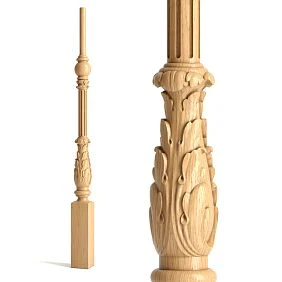
- Carved newels
- Flat balusters
- Comparison table of baluster types
- Baluster material: what the choice depends on
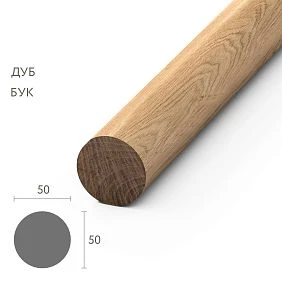
- Oak
- Oak
- Spruce and pine
- Ash
- Baluster height: how to choose the right size
- Standard railing height
- Balusters on a sloping flight
- Standard Heights
- Balusters for a staircase workshop: B2B logic
- What matters to a workshop when purchasing balusters
- What stock to keep in the workshop warehouse
- Balusters for a private home: when aesthetics matter, not just price
- Staircase as the center of the interior
- Connection of balusters with other staircase elements
- Classic or modern staircase
- Balusters for terrace and porch: facade scenario
- What distinguishes outdoor balusters
- Choosing material for outdoor use
- Protective coating
- Flat balusters for the facade
- Handrails, posts, finials: a set, not a collection of parts
- Handrails
- Staircase posts
- Handrails
- Mistakes when buying balusters: to avoid rework
- What to check before ordering: a complete checklist
- FAQ: answers to the most common questions
- Can I buy wooden balusters wholesale?
- How to calculate the number of balusters for a staircase?
- What is better: carved or turned balusters?
- Can wooden balusters be used outdoors?
- What to buy together with balusters?
- How to attach wooden balusters?
- How many balusters are needed for a standard staircase?
- About the Company STAVROS
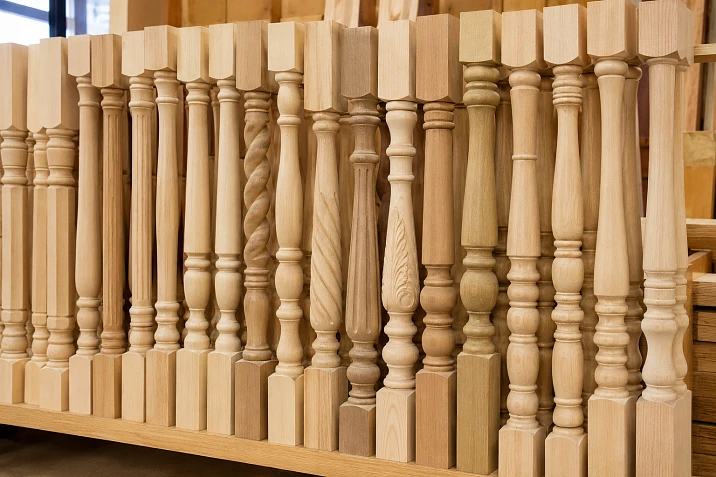
A staircase is not just a way to get from one floor to another. It is the first thing a guest sees when entering a home. It is the architectural center of the hallway or foyer. It is a structure that is touched by hands every day — and that is why every detail must be in its place. Balusters for staircase — it is not a background element. It is the rhythm of the railing, its character, and its safety. And when you need not one, but twenty, thirty, or even a hundred identical balusters — the question of choice becomes a task that needs to be solved systematically.
View wooden balusters and staircase components STAVROS — turned, carved, flat, made of beech and oak, for interior use and facade.
Balusters wholesale: why it is not just "many pieces"
When they say "buy balusters wholesale" — they mean not only volume. The wholesale approach means unity: one batch, one geometry, one material, one tint. Only then does the railing look like a finished structure, not a set of similar but still different elements.
The difference between balusters from different batches — even of the same model — can be insignificant. A slightly different shade of wood, a minor discrepancy in the turning pattern, micron differences in sizes. On one element, it is unnoticeable. On thirty in a row — it catches the eye.
That is why experienced staircase workshops, builders, and designers working with wooden stairs always order wooden balusters wholesale in one batch. This is not saving on price — it is saving on rework.




When wholesale purchase of balusters is justified
There are several clear scenarios where buying balusters in one large batch is the only correct approach.
Our factory also produces:
Staircase to the second floor in a private house
A standard flight of 14–16 steps with two balusters per step requires 28 to 32 balusters for the main flight alone. Plus the landing, plus the railing along the wall on the second-floor gallery — and the total easily reaches 50–70 pieces.
Ordering balusters in batches of 10 at different times is a mistake that costs dearly.
Get Consultation
Staircase with multiple flights
A cottage with a staircase of three flights, intermediate landings, and railing along the second-floor gallery — that is already 80–120 balusters or more. For such projects, wholesale purchase wooden balusters — it's not a matter of choice, but a technical necessity.
Staircase Workshop
A workshop that produces 2–3 staircases per month must keep popular baluster models in stock at all times. Otherwise, every order turns into a wait for delivery. Having a stock of turned and carved balusters in several sizes allows the workshop to work without downtime and offer clients ready-made solutions "with a show", rather than from a catalog picture.
Terrace and porch
A 6×4 meter terrace with railing around the perimeter requires 40 to 60 balusters depending on the spacing. A porch with two flights and railings on both sides adds another 20–30 pieces. balusters for terrace and porches require special attention to the material and coating — more on this below.
Serial construction project
A cottage community, block section, serial project of country houses — here balusters are bought by the hundreds. For such projects, not only price and quantity matter, but also the guarantee of repeatability: each subsequent batch must be identical to the previous one.
How to calculate the number of balusters: without unnecessary math
Calculating balusters is three steps. Simple, but requires attention.
Step 1: Measure all spans and platforms
Take a tape measure and sequentially measure:
-
The length of each flight of stairs along the inclined plane (not the horizontal projection)
-
The length of railings on landings between flights
-
The length of railings along the gallery or handrails on the second floor
-
The length of railings on the porch or terrace, if they are included in the project
Sum all the values — this is the total length of the railing in meters.
More details about norms and calculations — in the article how to calculate the distance between balusters.
Step 2: Determine the spacing between balusters
The pitch is the distance between the axes of two adjacent balusters. The standard range is from 100 to 150 mm in the clear (the distance between balusters in the clear, without their own cross-section).
For residential buildings, building codes recommend that the gap between balusters should not exceed 150 mm — this eliminates the possibility of a child slipping through the gap. With a baluster cross-section of 45×45 mm and a gap of 150 mm, the pitch is about 195 mm. With a cross-section of 40×40 mm and a gap of 120 mm, it is about 160 mm.
Practical rule: for every meter of fencing with a step of 150–160 mm — 6–7 balusters. With a step of 180–200 mm — 5–6 balusters.
Step 3: Add a reserve
Always add 5–10% reserve to the calculated quantity. The reserve is needed for:
-
Trimming balusters to height on inclined flights (every second baluster may require individual trimming from below)
-
Replacement in case of chipping, cracking, or installation defect
-
Possible future modifications (adding a fence section, repairs)
For workshops — reserve 15–20%, because baluster models change, and finding identical ones in a year will be more difficult.
Example calculation
Staircase in a two-story house:
-
Two flights of 4.5 meters each = 9 m
-
Intermediate landing 1.8 m
-
Second floor gallery 5 m
-
Total: 15.8 m
With a step of 6 balusters per meter: 15.8 × 6 = 95 balusters. With a 10% reserve — 105 pieces.
Turned, carved, flat: which baluster shape to choose
The shape of the baluster determines the character of the entire staircase. This is the first visual decision made when designing the railing.
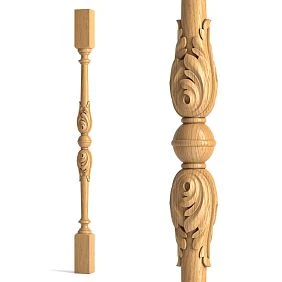
Turned balusters
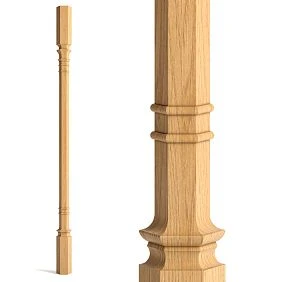
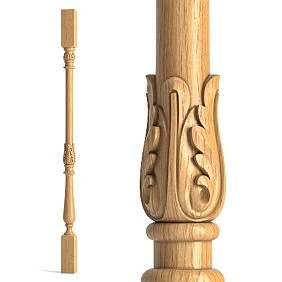
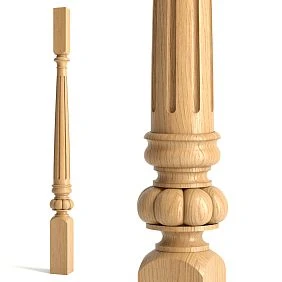
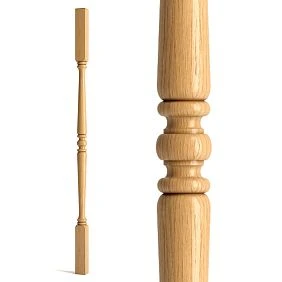
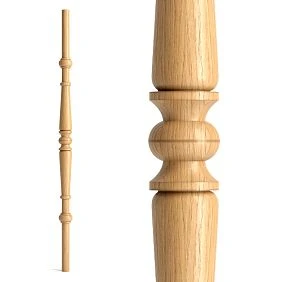
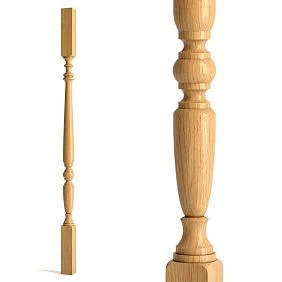
turned balusters — the most common type. They are made on a lathe, and it is the turning pattern that determines their appearance: alternating balls, spindles, discs, cylinders, and cones along the entire length of the element.
A turned baluster is versatile. It pairs well with wooden steps, handrails, posts, and most interior styles: classic, country, neoclassical, country house, suburban cottage.
The size range of turned balusters is wide: cross-section from 35×35 mm to 80×80 mm, height — from 850 mm to 1200 mm. For standard residential staircases, a cross-section of 40×40 or 45×45 mm with a height of 900–950 mm is most often chosen.
The turning pattern can be:
-
Simple — a small number of elements, a calm rhythm. Universal, does not overload.
-
Medium — a richer pattern with pronounced balls and discs. For interiors with moderate decor.
-
Complex — a rich rhythm, detailed craftsmanship. For classic and grand staircases.
Carved balusters
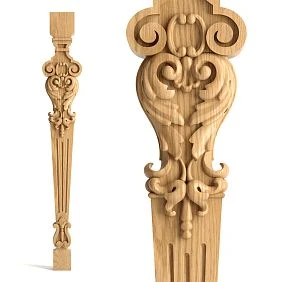
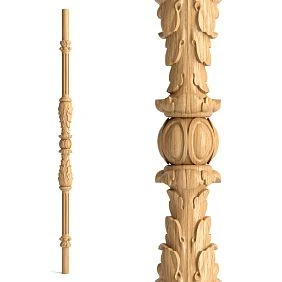
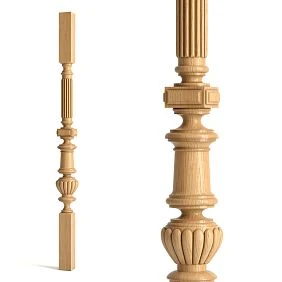
carved balusters — these are elements that combine turning with hand or router carving. The body of the baluster features ornamental decor: leaves, braiding, laurel motifs, geometric elements.
A carved baluster is a choice for those who want a staircase as a work of art. The grand hall of a country house, a classic living room with high ceilings, an interior in a historical style — here carved balusters create a sense of expensive handcraftsmanship.
The cost of carved balusters is higher than turned ones — this is a result of the more complex technological process. But the result matches the investment: such a staircase becomes the center of the home.
When ordering carved balusters in bulk, the uniformity of the batch is especially important: the carving pattern on each baluster must be identical. This is a requirement for the supplier, not the buyer — but it needs to be clarified in advance.
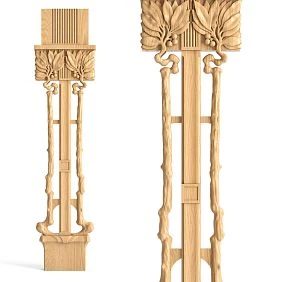
Flat balusters
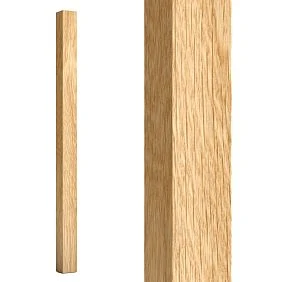
Flat balusters are made from a board or panel with a figured cutout along the contour. Unlike turned and carved ones, they have a flat profile — like a frame part of furniture.
A flat baluster is a choice for facade and terrace railings, where a voluminous turned shape is excessive. Flat balusters are also used in interior solutions where the staircase should look light and airy — due to the cutout contour, an openwork panel effect is created.
For facade railings, flat balusters are often cut from thick board (35–50 mm) with an ornamental silhouette: diamonds, leaves, arches. This is a traditional element of wooden architecture that works well on the porch and verandas of wooden houses.
Comparison table of baluster types
| Type | Production | Decorative element | Application | Price |
|---|---|---|---|---|
| Turned | Lathe | Geometric shapes | Interior, any style | Medium |
| Carved | Lathe + milling/threading | Ornamental | Classic, formal | Above average |
| Flat | Milling machine | Silhouette | Facade, terrace, light interior | Medium |
| Combined | Lathe + handcrafted | Complex hybrid | Author's projects | High |
Baluster material: what the choice depends on
Baluster material is not just about aesthetics. It's about strength, dimensional stability, ability to hold coating, and behavior under changing humidity.
Beech
Beech is one of the best materials for wooden balusters. Hard, dense, with a uniform fine-grained structure. Beech is excellent for turning and milling — the pattern comes out clear, with sharp edges and correct curves.
For balusters to be painted, beech is the first choice. Its surface after sanding is perfectly smooth, enamel lays evenly and without pores. White, gray, cream balusters are almost always beech.
Beech under varnish is also good, although its texture is less expressive than oak. For classic interiors where a clean white ensemble is important, beech under white enamel is an impeccable solution.
Oak
Oak is massive, with expressive texture and large open pores. Oak balusters create a feeling of solidity and weight — in a good sense. An oak staircase looks expensive and reliable.
Wooden balusters, made from oak, are best revealed under an oil or varnish coating that emphasizes the texture. Dark oak in a living room with parquet of the same species is a cohesive design solution where the balusters become part of a unified wooden ensemble.
Oak is more expensive than beech — and that's normal. Oak balusters for a representative staircase are an investment that pays off.
Spruce and pine
Softwood species are an affordable budget option. Pine and spruce are softer than hardwoods, less resistant to mechanical stress, and over time produce resin stains on the coating surface. For secondary staircases (to the garage, attic, or a second floor in a country house) — it's acceptable. For a residential staircase in a cottage — it's better to choose hardwoods.
Exception: for facade and outdoor structures, pine with proper protective coating works well — especially Siberian larch, which surpasses all European softwoods in moisture resistance.
Ash
Ash is light, durable, with an expressive striped texture. In a light oil coating — a delicate Scandinavian shade. Ash works well in modern and neoclassical interiors with a light palette. For turned balusters in a minimalist interior — one of the best choices.
Baluster height: how to choose the right size
Baluster height is a parameter determined by the height of the staircase railing. And there are clear guidelines here.
Standard railing height
The minimum railing height for residential staircases in a private house is 900 mm. For staircases in public buildings and when the height exceeds 3 m — 1000 mm or more. A height of 1000–1100 mm is considered comfortable for most adults.
Railing height = baluster height + thickness of the lower mounting part + handrail height.
If the handrail has a height of 45–50 mm, and the baluster is mounted with a dowel or screw through the lower end into the step — the working height of the baluster should be 50–80 mm less than the railing height.
For details on mounting methods — see the article How to install wooden balusters.
Balusters on a sloping flight
On a sloping flight, balusters are installed vertically, but the steps are sloped. This means that the bottom end of each baluster needs to be cut at an angle corresponding to the slope of the flight (usually 27–35°). During installation, each baluster is cut individually or special angled support shoes are used.
When calculating the length of balusters for a sloping flight, it must be taken into account that the cut removes part of the length. A 950 mm baluster after cutting on a flight with a 30° slope loses about 20–30 mm. This needs to be factored into the calculation.
Standard heights
The most common standard baluster heights:
-
850 mm — for railings 900 mm high (low baseboard + thin handrail)
-
900 mm — universal height for most residential stairs
-
950 mm — for railings 1000 mm
-
1050–1100 mm — for railings 1100 mm and second-floor galleries
Balusters for a staircase workshop: B2B logic
A workshop that makes wooden stairs is a special buyer. Its task is not just to buy balusters, but to ensure stable production with repeatable results.
What is important for a workshop when purchasing balusters
Repeatability. The same model must be available after three months, after a year. The workshop cannot use a model that the manufacturer discontinues at its own discretion.
Dimensional accuracy. A cross-section of 45×45 mm must be exactly 45×45 mm — with a tolerance of ±1 mm. A deviation of ±3–4 mm means problems with installing dowels, fitting into handrail grooves, and maintaining uniform railing spacing.
Uniformity of pattern. All balusters in one batch must be identical in turning pattern. Even small discrepancies in the placement of balls and discs are noticeable when the balusters are lined up.
Compatibility with components. Balusters must fit the handrails for the staircase — in terms of the top end cross-section and groove width. Standard: baluster cross-section = handrail groove width ± 1 mm.
Availability in stock. The workshop cannot wait three weeks for production. Popular models must be in stock — immediately, upon ordering.
Ability to purchase additional units. If one baluster breaks during installation or an extra section is needed, it should be possible to purchase two or three pieces of the same series without delay.
What stock to keep in the workshop's warehouse
For a workshop making 2–3 staircases per month, a reasonable warehouse stock is 100–150 balusters of two to three popular models, plus 20–30 pieces of rare models taken for specific orders.
Pillars, handrails, Newel posts and other staircase components are purchased for a specific object — they are harder to store and take up more space.
Balusters for a private home: when aesthetics matter, not just price
A private client thinks differently than a workshop. They don't need series repeatability — they need the beauty of a specific staircase in their specific home.
Staircase as the center of the interior
In a country house or cottage, the staircase is the main architectural element of the first floor. It determines the first impression a guest gets and how comfortable the feeling inside the house will be.
wooden balusters for staircase in this context — is not just a railing. It is a rhythmic ornament that repeats along the entire length of the flight. Thirty identical turned oak balusters with an oil finish — this is a visually rhythmic, calm, breathing structure.
Connection of balusters with other staircase elements
A baluster does not exist in isolation. It is always next to:
-
Handrail — it lies on top and sets the overall tone of the railing
-
Staircase posts — they stand at the beginning and end of the flight and create a "frame"
-
Post caps — they complete the vertical of the post and echo the shape of the balusters
-
Steps — the material and color of the steps should match the balusters
The unity of all these elements is the key to the staircase looking as if created by one craftsman, rather than assembled from different sources.
Classic or modern staircase
For a classic interior in a country house — turned or carved balusters made of oak with dark tinting. They create a sense of historical solidity.
For a modern minimalist home — turned balusters with a simple pattern made of ash or beech under white enamel or light oil. They provide airiness and do not overload the space.
For a country or Scandinavian style cottage — pine or spruce with simple turning under oil or birch-like tinting. A light, warm, cozy result.
Balusters for terrace and porch: facade scenario
Outdoor balusters are a different story. Here, not only aesthetics and shape matter, but also resistance to atmospheric influences.
What distinguishes outdoor balusters
Wooden balusters outdoors are exposed to:
-
Direct exposure to moisture (rain, snow, thawing)
-
Temperature fluctuations from −30 to +35°C
-
Ultraviolet radiation
-
Fungus and mold due to insufficient ventilation
All of this requires the right choice of material and mandatory protective coating.
Choosing material for outdoor use
Scots pine — affordable and acceptable, but requires more thorough protective treatment. Prone to resin exudation and surface cracks.
Larch — the best choice for outdoor wooden structures in the Russian climate. Dense, resinous, resistant to moisture and rot. Larch works well both in turned balusters and in flat facade elements.
Oak — durable, but requires high-quality coating, otherwise it darkens and cracks. For outdoor use, oak is good where balusters are protected by the porch roof or terrace canopy.
Protective Coating
For outdoor balusters, the following are used:
-
Alkyd oils and impregnations — penetrate the wood structure, protect against moisture from within
-
Facade varnishes — form a hard film, but require renewal every 3–5 years
-
Facade paints — completely cover the texture, but provide reliable protection
Important rule: the bottom end of the baluster is the most vulnerable spot. That's where water lingers the longest. The bottom ends of balusters must be treated especially thoroughly before installation: several layers of impregnation, possibly an epoxy plug.
Flat balusters for the facade
On the facade, porch, and open terrace Flat balusters are often preferable to voluminous ones. The reason is maintenance. A flat baluster has no recesses or grooves where water accumulates and where it's harder to reach with a brush when renewing the coating. Maintaining a flat element is significantly easier.
Handrails, posts, finials: a set, not a collection of parts
A baluster is a link in a chain. By itself, it doesn't solve anything. A staircase railing is a system, and all its elements must be compatible.
Handrails
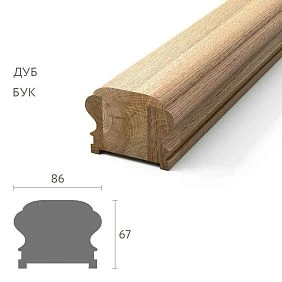
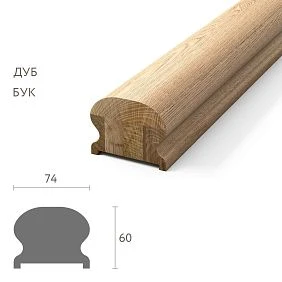
the handrails for the staircase — a horizontal element that sits on the top ends of balusters and rests on posts. Critical parameter: the width of the groove in the lower part of the handrail must match the cross-section of the baluster.
A standard handrail has a groove width of 40 mm — for a baluster with a cross-section of 40×40 mm. A handrail with a 45 mm groove — for a baluster of 45×45 mm. Mismatch leads to wobbling or impossibility of installation.
When ordering balusters wholesale, handrails are always selected simultaneously — to ensure compatibility.
Staircase posts
Wooden posts for the staircase — these are supporting vertical elements that stand at the beginning and end of each flight, on intermediate landings, and at points where the railing changes direction. They bear the load from the handrail and create visual "anchors" for the railing.
The post must be made of the same material and wood species as the balusters. The cross-section of the post is significantly larger: typically 100×100 mm, 120×120 mm, or 80×80 mm depending on the load and style.
The shape of the post echoes the shape of the balusters — it can be smooth, with a profiled lower band, or with volumetric decor. But the post is always larger and more substantial than the baluster: it sets the scale, and the balusters follow it.
Finials
Finials for posts — these are decorative top finishes on a post. The finial is the final accent: a sphere, pyramid, vase, or beveled prism. Without a finial, the post looks unfinished.
The finial must match the diameter of the post and the style of the staircase. For a classic staircase — a sphere or vase-shaped form. For a modern one — a geometric pyramid or beveled cube.
Mistakes when buying balusters: to avoid rework
A list of mistakes that occur regularly. Knowing them means not repeating them.
Mistake 1: buying balusters individually from different batches. Different batches mean different wood shades and possible differences in grain. This is immediately noticeable on the assembled railing.
Mistake 2: not accounting for a reserve. Buying exactly as many as calculated is a mistake. A 10% reserve is not wastefulness, but insurance.
Error 3: not checking height and cross-section. Ordering balusters "approximately 90 cm" and getting 850 mm elements instead of the required 950 mm is a real scenario. Always specify exact parameters.
Error 4: choosing balusters separately from handrails. Mismatch between baluster cross-section and handrail groove means installation is impossible. Both elements must be ordered together or compatibility checked in advance.
Error 5: not considering the style of posts. Turned balusters paired with smooth square posts create a stylistic dissonance. All railing elements should "speak" the same language.
Error 6: choosing too thin balusters for a massive staircase. A wide staircase with oak steps 50 mm thick and balusters with a 35×35 mm cross-section is a visual mismatch. The baluster should be proportional to the step and handrail.
Error 7: using interior balusters outdoors without protection. Interior balusters are not designed for outdoor use. Without special coating, they deform and darken within one season.
Error 8: mixing different shapes on the same railing. Several turned balusters of different designs on one flight is eclecticism without design logic. One flight — one model.
Error 9: not checking the evenness and quality of each element before installation. Even in a quality batch, there may be several balusters with defects: cracks, chips, geometric deviations. Check each one before installation — it will be harder later.
Error 10: forgetting about the bottom cut on the flight. Balusters on an inclined flight need to be cut at an angle from the bottom. If this is not taken into account when ordering, the elements will be shorter than needed after cutting.
What to check before ordering: a complete checklist
-
Number of balusters — calculated plus 10% reserve
-
Where will they be placed — indoors or outdoors (porch, terrace)
-
Fence height — required baluster height considering handrail and fastening
-
Spacing between balusters — based on a gap of 100–150 mm
-
Cutting on the flight — is it needed and at what angle
-
Baluster shape — turned, carved, flat, combined
-
Material — beech, oak, ash, larch (for outdoors)
-
Cross-section — 40×40, 45×45 or other; compatibility with handrail
-
Compatibility with handrail — handrail groove width equals baluster cross-section
-
Compatibility with posts — same wood species and style
-
Are finials needed — to finish the posts
-
Coating — varnish, oil, paint, tint, outdoor impregnation
-
Delivery in one batch — important for wholesale orders
FAQ: answers to the most common questions
Can I buy wooden balusters wholesale?
Yes. Buy balusters wholesale convenient for staircase workshops, construction sites and private customers with large volumes. Wholesale purchase in one batch guarantees uniformity of pattern, size and shade of all elements.
How to calculate the number of balusters for a staircase?
Measure the total length of the railing (flights, landings, gallery). Multiply by the number of balusters per linear meter (6–7 pieces with a step of 150–160 mm). Add 10% reserve. Detailed calculation — in the article how to calculate the distance between balusters.
What is better: carved or turned balusters?
turned balusters more versatile — they suit most styles and price segments. carved balusters create a more expensive and expressive railing, work better in classic and formal interiors.
Can wooden balusters be used outdoors?
Yes, if you choose the right material (larch, oak) and apply a quality outdoor coating — impregnation, facade oil or paint. Pay special attention to protecting the bottom ends where moisture accumulates.
What to buy together with balusters?
For a complete railing you need: the handrails for the staircase, wooden posts, Finials for postsfasteners (dowels, screws, brackets). All elements from the same series and same wood species.
How to attach wooden balusters?
Main methods: dowel into the end of the baluster + glue, screw through the base, metal tenon with support shoe. Details in the article How to install wooden balusters.
How many balusters are needed for a standard staircase?
For a two-flight staircase in a cottage with a second-floor gallery — typically from 60 to 120 balusters depending on flight length, landings, and spacing.
About the company STAVROS
STAVROS — Russian manufacturer of wooden products from natural solid wood for stairs, interiors, and facades. The STAVROS catalog offers a full range staircase components: Turned balusters, Carved и Flat, handrails, posts, Newel posts and other elements for wooden staircases of any complexity.
STAVROS works with both private customers and staircase workshops, construction companies, and designers. Wholesale orders — with a guarantee of batch uniformity in geometry, grain, and shade. All products are made from verified solid wood, with the option to choose species and profile.
If you need Buy wooden balusters for a staircase, terrace, or porch — one piece or a batch of a hundred elements — the STAVROS catalog offers solutions with a responsible approach to the quality of each product.