























Article Contents:
- Why wood species matters for balusters
- Beech: strength, density, neat appearance
- Physical properties of beech
- Appearance of a beech baluster
- Beech in production: technological advantages
- Who beech balusters are suitable for
- Oak: premium look and high durability
- Physical properties of oak
- Appearance of an oak baluster
- Oak and age: why it only gets better
- Who oak balusters are suitable for
- Ash: elasticity and modern character
- Properties of ash
- Ash in interior design
- Pine and other conifers: when it is appropriate
- An honest assessment of pine
- When pine is justified
- How wood species affects price
- Price hierarchy of wood species
- What determines the price of a baluster
- Wooden balusters price: market benchmarks
- Which balusters are best for a classic staircase
- Beech for classic style
- Oak for classic style
- Carved and turned-carved balusters
- Which balusters to choose for a modern interior
- Beech for a modern staircase
- Ash for a modern staircase
- Oak for a contemporary interior
- How to combine balusters with handrails and posts
- Same wood species — basic rule
- Stylistic coordination
- The role of pillars in the rock ensemble
- Painting, tinting, varnish: what to consider in advance
- Oil: for open texture
- Varnish: for protection and gloss
- Tinting: stain and oil-wax with pigment
- White paint: specifics by wood species
- Birch: an underestimated alternative
- How to choose and buy wooden balusters
- What to look for when buying
- Complete order: the right approach
- Comparative table of wood species for balusters
- STAVROS: solid wood balusters with quality guarantee
- Frequently Asked Questions
- Which balusters are better — beech or oak?
- Can beech balusters be used in damp rooms?
- How many balusters are needed per meter of staircase?
- Do balusters need to be coated before installation?
- What wood should balusters be made of for a seasonal country house?
- Where to buy beech and oak balusters with delivery?
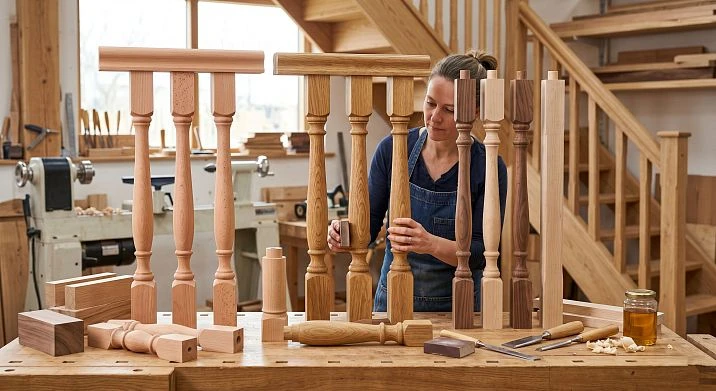
When it comes to a wooden staircase, the first question usually concerns shape: turned or carved, classic or strict. But there is a more fundamental question that many put off and often regret: what type of wood should the balusters be made of? Because the wood species is not just about aesthetics. It is about strength, service life, behavior under load, reaction to humidity, and finally, how the baluster will look a year after purchase and ten years later.
Wooden balusters — these are not just vertical railing posts. These are products that experience load every day: hands lean on them, children hang on them, furniture hits them when being moved. A correctly chosen wood species means balusters that will withstand all this and remain beautiful. The wrong species means cracks, darkening, deformation, and the thought 'I should have chosen something else.'
Let's break down the most popular options: beech, oak, and other solid wood species. Honestly, to the point, with specific recommendations.
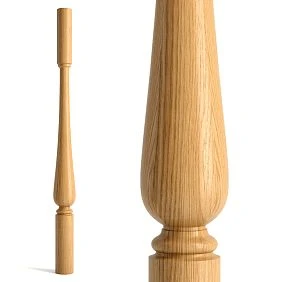
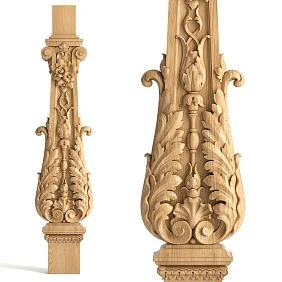
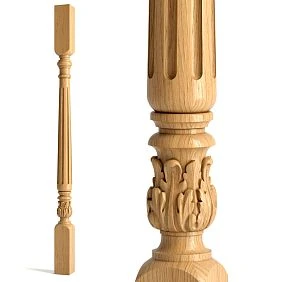
Why wood species matters for balusters
Consider this: a baluster is a small element. Height 900–1000 mm, cross-section 40–50 mm. It would seem the loads on it are small. Why think about the wood species?
In reality, a baluster works under very unfavorable conditions. It stands vertically, fixed at one end to the string or step, and at the other end to the handrail. Under lateral load (and a person, grabbing the railing, creates exactly a lateral load), the baluster works in bending. The denser and stronger the wood, the better it resists this load.
Furthermore, a staircase in a house is an area with variable humidity. You bring in a flower pot, wipe the steps with a wet cloth, open a window on a rainy day — the microclimate around the staircase is constantly changing. Soft wood species in such conditions begin to 'work' — swell and shrink, which over time leads to gaps in joints and loss of geometry.
And finally — appearance. Different wood species have different textures, different colors, different abilities to accept stain and varnish. Beech balusters and oak balusters, with the same shape and size, will look different — and this is fundamentally important for the final appearance of the staircase.
Beech: strength, density, neat appearance
Beech is one of the most popular species for production wooden balusters in Russia. And this is not a market accident, but a pattern of technical characteristics.
Our factory also produces:
Physical properties of beech
Beech is a hardwood with a density of about 680–750 kg/m³ (in dried condition). It is a medium-priced hard wood. On the Janka hardness scale, beech significantly surpasses pine and is practically not inferior to ash.
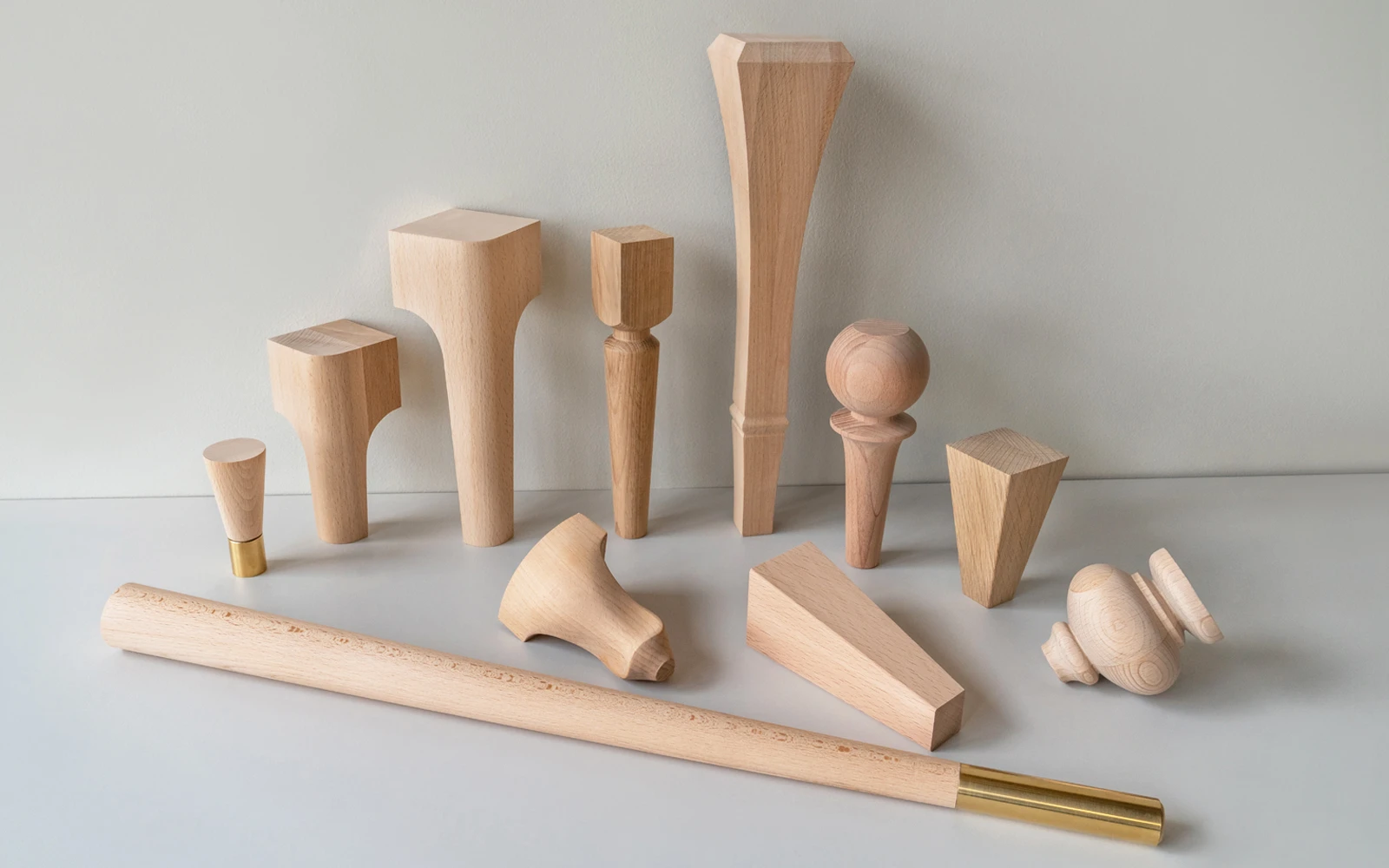
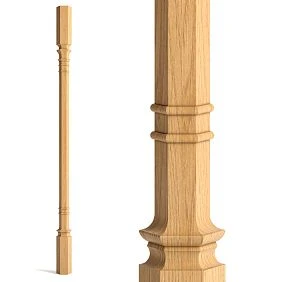
The structure of beech is homogeneous, fine-pored. This makes it ideal for turning: the profile is clear, the edges are sharp, the relief is detailed. Beech balusters after processing, they have a smooth, almost silky surface — minimal pores that need puttying or priming.
Get Consultation
Appearance of a beech baluster
Beech color is light cream, almost white with a slight pinkish tint. The texture is fine, weakly expressed. This is both an advantage and a limitation.
Advantage: beech accepts any tinting perfectly. Want an imitation of dark walnut? Apply the appropriate stain — and the beech will evenly color to the desired shade. Want white matte balusters? Beech under white paint looks perfect — without protruding spots and knots. Want a golden-brown "oak-like" finish? Beech in this tone looks organic and convincing.
Limitation: the natural texture of beech is modest. If you want the natural wood grain to be visible and read as an independent value — beech is not the best choice for clear varnish. Its natural color is neutral, almost featureless. The beauty of beech lies in its shape, not its texture.
Beech in production: technological advantages
Beech turns, mills, and cuts excellently. That is why it is used to produce both beech balusters for stairs with a classic turned profile, and more complex milled and carved products.
Beech glues well, sands easily, and holds fasteners stably. The only nuance: beech is more hygroscopic than oak — it reacts more actively to changes in humidity. This means that drying of beech must be professional, and storage of products — in a room with normal humidity.
Who are beech balusters suitable for
-
For those planning to paint balusters in a specific color (white, cream, walnut, wenge)
-
For classic staircases with turned profiles
-
For interiors where a neat, neutral wooden surface is needed
-
For projects with a medium budget for wooden elements
Oak: premium appearance and high wear resistance
Oak is a different story. If beech is the workhorse of staircase decor, then oak is a thoroughbred horse with character. More expensive, more demanding in processing and installation, but giving a result that cannot be confused with anything else.
Physical properties of oak
The density of oak is 680–750 kg/m³, which is comparable to beech. But the hardness of oak on the Janka scale is somewhat higher. The main difference is the structure: oak has large pores and a pronounced ring structure, which creates that very textured, "living" texture for which it is chosen.
Oak contains a significant amount of tannins — they give it natural resistance to moisture, fungi, and insects. This makes Oak balusters less sensitive to changes in microclimate than beech counterparts.
Appearance of an oak baluster
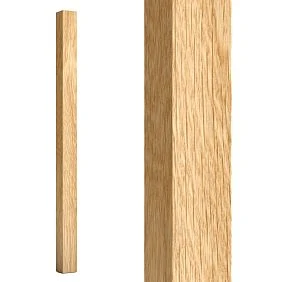
Oak color ranges from light honey to golden brown with gray-brown shades depending on the growing area and treatment. The texture is expressive, with a clear pattern of annual rings, large pores, and beautiful radial spots on radial cuts.
It is this texture that makes Buy oak balusters the right choice for those who want to apply clear varnish or oil. Under a transparent coating, an oak baluster reveals all the natural beauty of the wood: deep tone, contrasting pattern, and a three-dimensional surface relief.
Oak also behaves well under tinting, but with a different nuance: large pores can create unevenness when applying thick paint. Therefore, painting oak in an opaque color requires careful priming with pore filling.
Oak and age: why it only gets better
An interesting feature of oak: over time, it darkens and acquires a richer, more noble tone. Oak balusters coated with oil become deeper and more expressive after 5–7 years. This is a species that 'ages' beautifully — unlike pine, which yellows unevenly.
Who are oak balusters suitable for
-
For premium staircases with an open wood texture
-
For interiors where wood is the main material: parquet, wooden panels, solid wood furniture
-
For those who choose oil finish
-
For country houses with permanent residence and variable climate
-
For projects where long-term perspective matters: oak serves for decades without loss of quality
Ash: resilience and modern character
Ash often remains in the shadow of oak and beech — undeservedly. It is a species with outstanding mechanical characteristics and aesthetics that perfectly fits into modern interiors.
Properties of ash
Ash is one of the most resilient and hard deciduous species in Russia. Its density is 650–700 kg/m³, but the main advantage is the high modulus of elasticity. Ash bends well without breaking and works excellently in bending. For balusters that experience lateral load, this is a particularly valuable property.
The structure of ash is coarse-porous, with clearly defined rings and straight fibers. The texture is expressive, lighter than oak, with thin contrasting lines. The color ranges from white-gray to light brown with a golden tint.
Ash in the interior
Ash is a species for modern classics and Scandinavian style. Its light texture with an expressive pattern under transparent oil creates the effect of "living" wood with a light, airy character. This is not heavy oak monumentality, but rather elegant graphic quality.
Ash balusters pair well with light wood floors, white furniture, and metal accents. For those building a staircase in neoclassical or contemporary classic style with wooden elements — ash deserves serious consideration.
Pine and other conifers: when it is appropriate
Pine is the most common and most affordable wood species in Russia. Buy beech balusters or oak is more expensive than similar products made of pine. But does this mean that pine balusters are a bad choice?
An honest assessment of pine
Pine is a soft coniferous wood. Density — 450–550 kg/m³, which is half that of oak. It scratches easily, dents upon impact, and poorly holds sharp edges of carved profiles. A pine baluster with fine ornamentation will look worn after a year of active use.
Another drawback of pine is resin pockets and knots. They create unevenness when painting: resinous areas repel paint and show through the coating. A special insulating primer is required.
Finally, pine actively reacts to humidity: it swells, shrinks, and creates stress in joints. After a few years, the tenons of the balusters in the handrail grooves may start to loosen.
When pine is justified
Pine is appropriate for:
-
Temporary or budget solutions (e.g., in a house under construction where the staircase will be replaced later)
-
Country houses with seasonal occupancy and undemanding interiors
-
Decorative balusters that do not bear serious operational load (e.g., porch railings with infrequent use)
For a constantly used staircase in a residential house, pine is not the best choice. Saving on wood species results in repair and replacement costs after a few years.
How wood species affects the price
Money is always a specific matter. Let's break down the pricing logic to understand what exactly you are paying for when choosing a particular species.
Price hierarchy of species
| Species | Relative price | Hardness | Service life |
|---|---|---|---|
| Spruce | 1× (base) | Low | 10–15 years |
| Birch | 1,2–1,4× | Medium | 15–20 years |
| Beech | 1,5–2× | High | 25–35 years |
| Ash | 1,8–2,2× | Very High | 30–40 years |
| Oak | 2,2–3× | Very High | More than 50 years |
Oak is about 2.5–3 times more expensive than pine. But if you recalculate the cost over the service life, oak balusters turn out to be more cost-effective. Pine balusters in a residential house may need replacement after 10–15 years. Oak ones last 50 years without loss of quality.
What determines the price of a baluster
Wood species. Main factor: the cost per cubic meter of oak in Russia is significantly higher than that of pine or birch.
Shape and processing complexity. A simple turned baluster of one diameter — minimum price. Carved wooden balusters With hand-carved or machine-carved ornament — significantly more expensive, as they require more time and specialized equipment.
Size. A 900 mm baluster and a 1200 mm baluster — different material consumption, different price. A 40×40 mm and 60×60 mm baluster — also different consumption.
Surface treatment degree. A baluster "for finishing" (only sanded) is cheaper than a baluster with factory oil or varnish coating.
Balusters price: market benchmarks
Approximate prices for turned balusters in Russia:
| Species | Section | Height 900 mm | Height 1200 mm |
|---|---|---|---|
| Spruce | 40×40 | 200–350 RUB/piece | 280–450 RUB/piece |
| Birch | 40×40 | 280–420 RUB/piece | 350–550 RUB/piece |
| Beech | 40×40 | 400–650 RUB/piece | 550–850 RUB/piece |
| Ash | 45×45 | 550–800 RUB/piece | 700–1000 RUB/piece |
| Oak | 45×45 | 700–1100 RUB/piece | 900–1400 RUB/piece |
For a staircase with 20 balusters, the difference between pine and oak will be 10,000–15,000 rubles. This is real money, but in terms of quality and durability, it is a justified investment.
Which balusters are best for a classic staircase
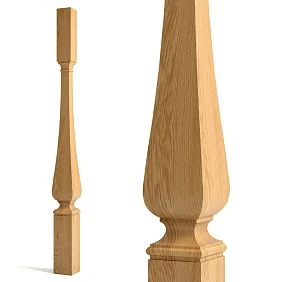
A classic staircase features a turned profile, smooth lines, and a traditional shape with necks, rollers, and heels. It appeals to architectural classics and requires a material that supports this image.
Beech for classics
Buy beech balusters for a classic staircase is the right choice if you plan to tint or paint. Beech holds the profile clearly: rollers are even, necks are smooth, ends are without chips. When tinted to look like walnut or wenge, beech balusters look convincing and elegant.
For white classic staircases — in Provence, country, or Scandinavian classic style — beech under white paint gives an ideal result. Even surface, no protruding knots, good adhesion with paint.
Oak for classics
Oak in a classic interior is the highest level. beech balusters for stairs can imitate expensive species. Oak imitates nothing. Oak is oak: its own texture, its own color, its own character.
Under clear oil or varnish, an oak baluster with a classic turned profile is a work where form and material work in unison. Particularly expressive are Carved wooden balusters made of oak: carving on the large-pored structure results in a natural roughness that adds character to the product.
Carved and turned-carved balusters
For formal classical staircases, there is a special category. Turned-carved balusters combine a lathe-turned base with hand-carved or milled decorative elements. Such balusters made of oak or beech are the pinnacle of wooden staircase decor.
Which balusters to choose for a modern interior
A modern interior is not necessarily metal and glass. It can also be wood, but in a strict, geometric, laconic form. square balusters for stairs — of rectangular or square cross-section with longitudinal grooves and clean edges — this is a modern wooden language for a modern interior.
Beech for a modern staircase
In a modern interior, beech shows its main trump card: neutrality. A square milled baluster made of beech under white or light gray paint is pure geometry. Neither the texture nor the color of the wood competes with the shape. This is a conceptually precise solution for a minimalist interior.
Ash for a modern staircase
Ash is an ideal wood species for Scandinavian and modern classic styles. The light, expressive texture under clear oil creates that 'living' but orderly image of wood that is so in demand in design today. Square milled ash balusters with longitudinal grooves are modern, beautiful, and durable.
Oak for a contemporary interior
Oak in a modern interior is a bold statement, a strong design move. Square oak balusters with an open texture under matte oil, surrounded by white walls and light parquet, create that very 'warm modern' look that dominates interior design today.
How to combine balusters with handrails and posts
Wood species is a system. You cannot choose balusters made of beech, a handrail made of pine, and posts made of oak. More precisely, you can — but the result will be predictably unsuccessful.
Single wood species — the basic rule
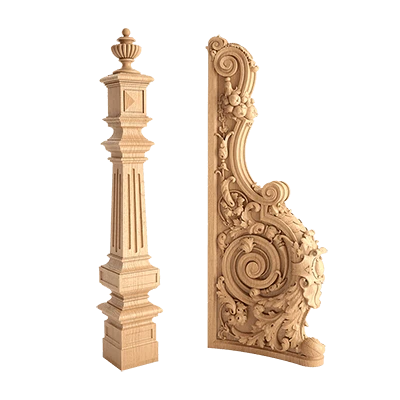
All load-bearing and visible wooden elements of the railing — balusters, handrail, Carved wooden posts — must be made of the same wood species. This is not just aesthetics — it is technology: different species have different shrinkage and different expansion when humidity changes. Mixing species in one connection node (for example, a tenon of a beech baluster in a groove of an oak handrail) creates prerequisites for the appearance of play.
Stylistic coordination
The choice of baluster shape should be consistent with the shape of the handrail and posts.
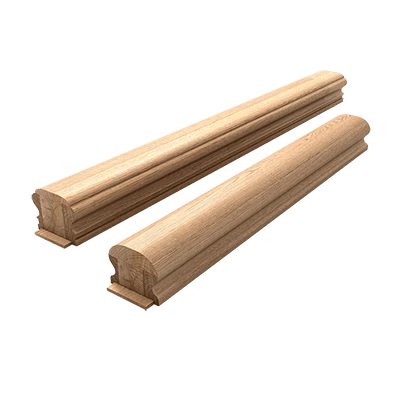
Turned round balusters → round or D-shaped handrail → turned or turned-carved posts.
Square milled balusters → rectangular handrail with clear edges → square posts with geometric chamfers.
Carved balusters → shaped handrail with ornamental profile → carved wooden balusters with rich decoration.
The role of posts in the baluster assembly
Posts made of the same wood as the balusters is a given. But there is another important point: posts typically have a larger cross-section and, consequently, a more pronounced texture. In oak, large pores are especially noticeable on the end and wide side surfaces of the post. When staining, this creates a slightly darker tone for the posts compared to the balusters (due to greater absorption of the stain in the pores).
This is normal and expected — but it must be considered when choosing the final finish.
Painting, staining, varnish: what to consider in advance
The final finishing of balusters is a decision made before purchase, not after installation. Because the choice of finish determines the choice of wood species, and sometimes the shape of the baluster.
Oil: for an open texture
Oil finish (linseed, tung, Danish oil, oil with wax) is the best choice for oak and ash. Oil penetrates the wood structure, nourishes the fibers, and does not create a film on the surface. The result is a matte, tactilely pleasant surface through which the wood grain is fully visible.
Pros of oil: easy to refresh, does not crack, breathable coating. Cons: requires periodic renewal (every 1–3 years depending on wear), less water-resistant than varnish.
For beech, oil is also used, but the result is less expressive: the neutral texture of beech under oil looks like 'just wood' without characteristic beauty.
Varnish: for protection and gloss
Lacquer coating (polyurethane, alkyd, water-based acrylic varnish) creates a protective film on the surface. This provides maximum protection against mechanical damage, moisture, and dirt.
For beech, lacquer works well: the smooth surface easily accepts the coating, and the gloss is even. For oak, lacquer creates a more "glassy" effect, which some consider overly artificial for a natural material. Matte lacquer is a more delicate alternative for oak.
Toning: stain and pigmented oil-wax
Stain (water-based or alcohol-based) is applied before the final coating and changes the wood's color. Important: on beech and ash, stain applies more evenly than on oak due to their more uniform structure. On oak, large pores absorb stain more actively — the tone will be slightly uneven, which, however, looks natural.
Pigmented oils (oil with color pigment) are the most modern option. They simultaneously tone and impregnate the wood, providing a restrained matte color without a film.
White paint: specifics by wood species
For white opaque painting, the best choice is beech. Its neutral surface ensures an even coating without protruding resin spots (as with pine) and without pronounced pore structure (as with oak). Beech under white paint is an ideal combination. Oak under white paint requires mandatory priming with a pore filler, otherwise the porosity shows through the paint.
Birch: an underestimated alternative
Birch is used less frequently than oak and beech in the production of staircase elements — and undeservedly so. It is a worthy wood species with a number of practical advantages.
The density of birch is 600–650 kg/m³, which is higher than pine and comparable to the lower limit of beech. Hardness is sufficient for moderately loaded staircases. Texture is fine, uniform, light with a creamy-gray tint.
The main advantage of birch is its good workability at a relatively low cost. Birch turns and sands excellently, and takes stain evenly. In terms of price, it occupies an intermediate position between pine and beech.
The main disadvantage of birch is its tendency to rot in high humidity. For interior staircases in heated homes, this is not a problem, but for open porches and stairs with direct contact with moisture, birch is not the best choice.
How to choose and Buy wooden balusters
Once the species is chosen, the shape is determined, and the quantity is calculated, the moment of purchase arrives. And here it is important not just to find the right item in the catalog, but also to ensure the quality of the specific batch.
What to look for when purchasing
Wood moisture content. This is a key parameter. Wooden balusters must be made from kiln-dried wood with a moisture content of 8–12%. Raw or under-dried balusters guarantee deformation after installation. Moisture content can be checked with a moisture meter, and when buying online, demand a certificate or quality passport.
Geometry. Take a baluster and look along its axis, as you would check the straightness of a pipe. A quality baluster is straight along its entire length, without propeller-like twisting. A twisted baluster will not fit evenly into the handrail groove.
Quality of sanding. Run your palm over the surface of the baluster. A well-finished product is smooth, without snags or waviness from the lathe tool. A rough surface indicates incomplete sanding and will require additional work before applying the coating.
Cleanliness of tenons. The top and bottom tenons must be of precise diameter and length. Check their fit in the handrail groove and stringer. Even a 1–2 mm mismatch creates a problem during installation.
Knots and defects. Small healthy knots in beech or oak are normal and do not affect strength. Through cracks, rot, or blue stain (a sign of fungus) are grounds for rejecting the batch.
Complete order: the right approach
Buy custom wooden balusters in a set with handrails and posts means ensuring compatibility of all elements guaranteed. A manufacturer that produces a complete system of stair components coordinates the dimensions of tenons, grooves, thicknesses, and styles within their assortment.
This saves your time, eliminates the need to check compatibility yourself, and gives confidence in the result.
Comparative table of wood species for balusters
| Criterion | Pine | Birch | Beech | Ash | Oak |
|---|---|---|---|---|---|
| Hardness | Low | Medium | High | Very High | Very High |
| Moisture resistance | Low | Low | Medium | High | Very High |
| Turning quality | Average | Good | Excellent | Good | Good |
| Texture | Weak | Neutral | Neutral | Expressive | Very expressive |
| Staining | Non-uniform | Good | Good | Good | Good |
| For white paint | Poor | Good | Excellent | Good | Requires primer |
| For oil | Weak | Satisfactory | Good | Excellent | Excellent |
| Price | Low | Below average | Medium | Above average | High |
| Service life | 10–15 years | 15–20 years | 25–35 years | 30–40 years | More than 50 years |
STAVROS: solid wood balusters with quality guarantee
Quality beech balusters for stairs and oak is not only the right wood species but also the right manufacturer. Because the same wood species in different hands gives completely different results.
STAVROS is a Russian manufacturer of solid wood products, specializing in components for wooden stairs. The company's production program includes balusters made of beech, oak, ash and other species, handrails, Carved wooden posts and all necessary components for installation.
All STAVROS products are made from kiln-dried wood with controlled humidity. Turning and milling are performed on professional equipment with multi-stage geometry control. Surface sanding is done to a final smoothness, ready for any coating.
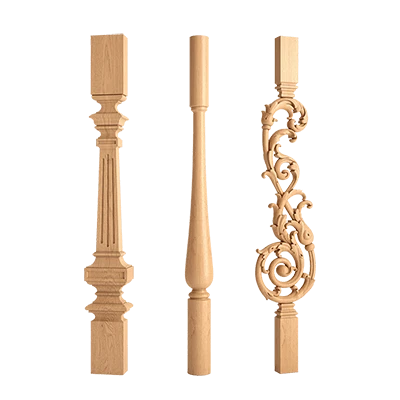
The STAVROS catalog offers a full range of shapes: from delicate turned balusters of classic profile to of square balusters for staircases for modern interiors and of carved wooden balusters for formal classic staircases.
Buy oak balusters Choosing STAVROS means getting products with predictable quality, precise dimensions, and stylistic compatibility within a single production program. Order online with Contact us to confirm shipping to your destination. For construction companies and carpentry workshops — wholesale terms and constant warehouse availability.
Trust STAVROS — and your staircase will get balusters worthy of your home.
Frequently asked questions
Which balusters are better — beech or oak?
It depends on the task. If you need painting in an opaque color — beech is better: smooth surface, excellent adhesion. If an open wood texture under oil or varnish is important — oak is unrivaled. In terms of strength and durability, oak slightly surpasses beech.
Can beech balusters be used in damp rooms?
Beech is moderately moisture resistant. For stairs in normally heated houses — yes. For open porches, damp rooms without ventilation — no. In such conditions, oak or ash with oil impregnation is better.
How many balusters are needed per meter of staircase?
With a pitch of 165 mm on centers (section 45 mm + gap 120 mm) — about 6 balusters per linear meter.
Do balusters need to be coated before installation?
Professionals recommend applying the first coat before installation — especially on hard-to-reach areas (tenons, the lower part of the baluster near the step). After installation — a finishing coat over the entire surface.
What wood should balusters be made of for a seasonal dacha?
For a seasonal dacha with normal heating in winter — beech with a lacquer coating or pine with high-quality oil impregnation. For an open porch — oak or ash with oil.
Where to buy beech and oak balusters with delivery?
In the STAVROS catalog — a full range of balusters from different wood species with Contact us to confirm shipping to your destination. Constant warehouse stock, precise dimensions, professional consultation on selection.