






























Article Contents:
- How porch balusters differ from balusters for indoor stairs
- Enemy number one: moisture
- Enemy number two: ultraviolet
- Enemy number three: freeze-thaw cycling
- Enemy number four: biological aggressors
- What this means for the buyer
- Where wooden balusters are used outdoors: five scenarios
- Porch of the entrance group
- Open terrace
- Open veranda
- Wooden house balcony
- Outdoor staircase in the garden or by the pool
- Which balusters to choose for the porch: shape and character of the entrance area
- Turned balusters for the porch
- Flat balusters for the porch
- Square balusters for the porch
- Carved balusters for the porch
- How to choose: three questions
- How to choose wood for outdoor balusters: a discussion about material
- Oak: the king of outdoor wood
- Beech: for enclosed and semi-enclosed areas
- Solid wood vs. glued panels
- Workpiece moisture: a critical parameter
- Wood selection matrix for outdoor use
- Railings, posts, and balusters for the porch: why buy as a set
- Three arguments in favor of ordering a set
- What posts are needed for the porch and outdoor staircase
- Dimensions of support posts for the porch
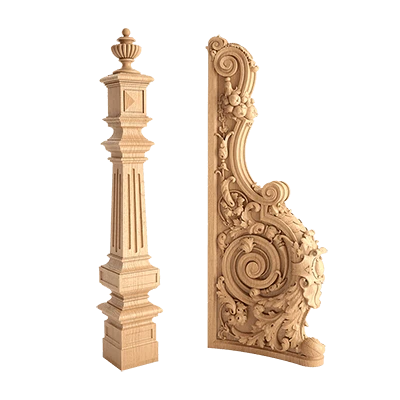
- Decorative carved porch columns
- Columns on the landing and at the turn
- Outdoor column mounting
- How to calculate the number of balusters for a porch: step-by-step method
- Step one: measuring the railing
- Step two: choosing the spacing
- Step 3: calculating the quantity
- Step four: summing by zones
- Step five: reserve
- Summary table for a standard porch
- Price of balusters for a porch and outdoor staircase
- What determines the cost
- Estimated prices (2026)
- Full budget for porch railing
- Protecting wooden balusters outdoors: what, how, and when
- Stage one: antiseptic impregnation
- Stage two: topcoat
- When to paint: before or after installation?
- Maintenance frequency
- Installing balusters on a porch: key differences from indoor installation
- Attachment to outdoor steps
- Gap between the base of the baluster and the step
- Handrail mounting for outdoor use
- Mistakes when buying balusters for a porch: seven cases from practice
- Mistake one: buying "interior" balusters for outdoor use
- Mistake two: not ordering posts in the same order
- Mistake three: ignoring protective coating
- Mistake four: not accounting for the platform and side railings
- Mistake five: skimping on posts
- Mistake six: choosing a pattern without considering cleaning and maintenance
- Mistake seven: buying without a spare
- Where to buy wooden balusters for a porch and outdoor staircase
- STAVROS: wooden balusters and railings for porch, terrace and outdoor stairs
- Frequently Asked Questions
- Which balusters are best to buy for a porch?
- Can indoor balusters be used outdoors?
- What to buy together with balusters for a porch?
- Which balusters are best for a wooden porch: flat or carved?
- How often should the coating on porch balusters be renewed?
- Where to buy wooden balusters for a porch with delivery?
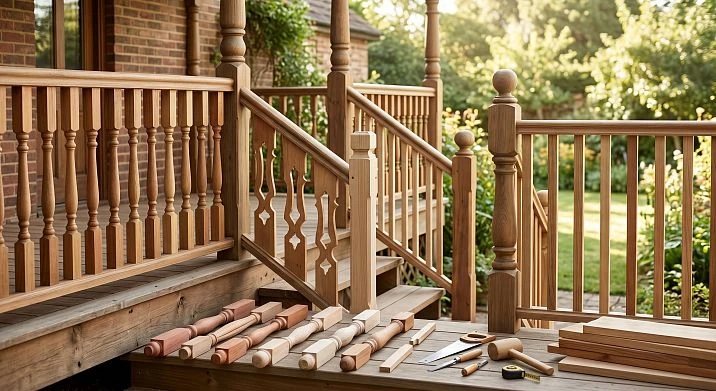
The porch is the face of the house. It is here that the guest forms a first impression: without even crossing the threshold, they already read the owner's character from the shape of the steps, from the pattern of the railing, from how the posts stand and what silhouette the balusters have. A wooden porch with a properly selected railing is not just safety for the entrance area, it is an architectural statement.
The challenge of choosing balusters for a porch is fundamentally different from the task of choosing balusters for an internal staircase. Outdoors, different laws apply: moisture, frost, ultraviolet light, mechanical stress during cleaning, and temperature fluctuations between seasons. You can't just choose "pretty" ones—you need to choose ones that will withstand it. And still remain beautiful after five, ten, twenty years.
This article is a complete guide to choosing and buying wooden balusters for the entrance area: porch, outdoor staircase, terrace, veranda, and balcony.
How porch balusters differ from balusters for internal staircases
A question many ask too late—after the purchase. It seems that a baluster is a baluster. Wood is wood. But the difference between outdoor and indoor use is enormous.
Enemy number one: moisture
Rain, melting snow, fog, dew. Wood outdoors operates in conditions of constantly changing humidity: it absorbs water during precipitation, releases it in the sun. This "movement" of wood—swelling and shrinking—creates internal stresses that, without proper coating, lead to cracking, delamination, and deformation.
A baluster without protective coating outdoors begins to deteriorate after just one season. This is not an exaggeration—it's the physics of wood.
Our factory also produces:


Enemy two: ultraviolet
Sunlight destroys lignin, the binding substance of wood's cellular structure. Untreated wood exposed to the sun turns gray, becomes brittle and fibrous. This is called "photodegradation." UV protection is a mandatory component of any coating for outdoor wood.
Get Consultation
Enemy three: freeze-thaw cycling
Water that gets into microcracks of unprotected wood expands when it freezes. Each freeze-thaw cycle widens the cracks and destroys the structure. After a few winters, a baluster without proper coating looks like a board thrown under a fence.
Enemy four: biological aggressors
Mold, fungus, insects. Outdoors, they are much more active than indoors. Antiseptic impregnation for exterior use is not an option, but a necessity.
What follows from this for the buyer
Buying balusters for an outdoor staircase means choosing with three mandatory conditions in mind:
-
The right wood species
-
Proper processing before and after installation
-
Proper fastening that prevents moisture accumulation in connection points
Where wooden balusters are used outdoors: five scenarios
Entrance group porch
The most obvious and most responsible place. The porch railing experiences mechanical loads daily: people hold onto it, lean on it when climbing. Reliability requirements here are maximum. Plus, it's the first thing everyone sees when approaching the house.
Buy wooden balusters for the porch — means thinking about beauty and strength simultaneously: compromise is unacceptable here.
Open terrace
The space near the house that opens into the garden. The terrace railing is both perimeter safety and visual design of the relaxation area. Here wooden balusters for terrace serve a dual function: they enclose the space and define its character.
Feature: a terrace is often open to the sky or has a partial canopy. The degree of protection depends on how exposed the railing is to precipitation.
Open veranda
Unlike a terrace, a veranda usually has a roof and is partially or fully glazed. The veranda railing is protected from direct precipitation, but humidity and condensation still have an effect. The same requirements apply to a veranda as to open areas, but the coating can be less intensive.
Buy flat balusters for terrace — for creating a decorative railing with a repeating pattern characteristic of country architecture.
Balcony of a wooden house
A wooden balcony is an area visible from the outside. The shape of the balusters, the rhythm of the railing, the style of the handrail — all of this is read from the street as part of the house facade. Wooden balcony railings require special attention to the ends of the balusters: they absorb moisture first.
buy flat balusters for balcony — for a balcony with a decorative carved pattern that creates a characteristic facade image.
Outdoor staircase in the garden or by the pool
Level changes in the landscape often require stairs: to a recreation area, to a pool, to an elevated gazebo. The railing of such stairs is designed in line with the overall landscape design of the site and can be either strictly geometric or decorative.
Which balusters to choose for the porch: shape and character of the entrance area
The shape of the baluster is the language your porch speaks. Let's break down each type.
Turned balusters for the porch
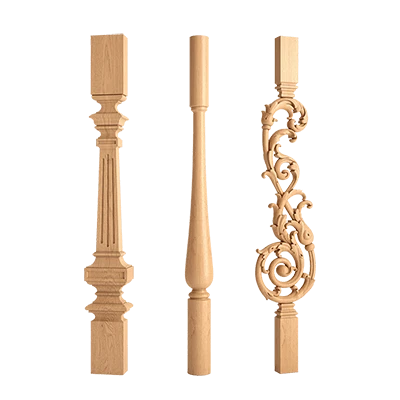
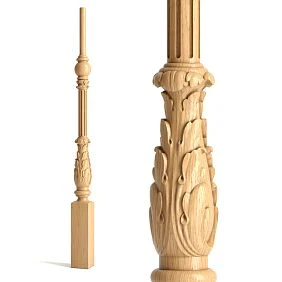
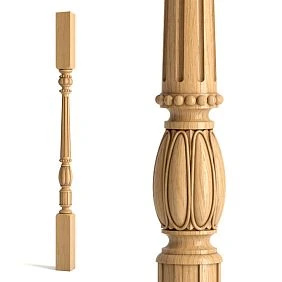
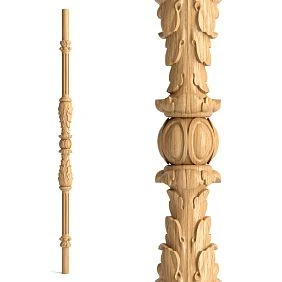
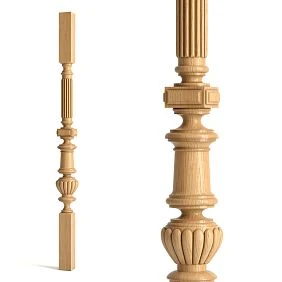
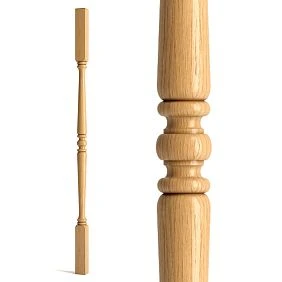
Classic. A rounded profile with alternating thickenings and narrowings. For a porch in traditional Russian, classical, or rustic style, this is an organic choice. Such balusters pair well with carved architraves, cornices, and gables.
Buy wooden balusters in a turned design — for a porch with rich decor and a saturated style.
Flat balusters for the porch
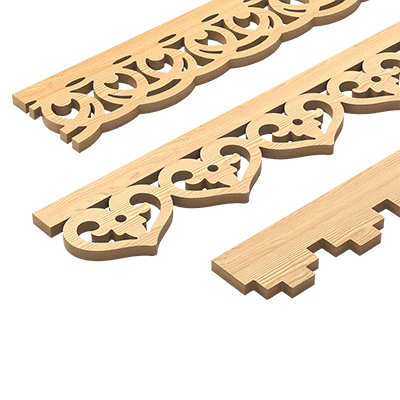
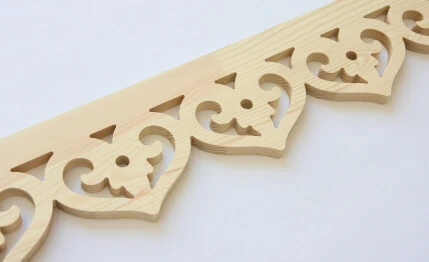
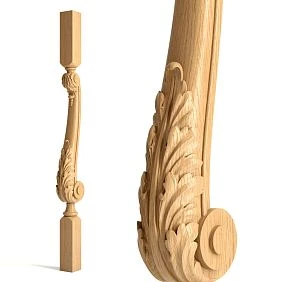
Silhouette balusters, cut from a board, with decorative cutouts. Their strength lies in the rhythmic pattern created by a row of flat balusters: almost like wooden lace along the entrance area. They work well on verandas, in country and Provence decorative styles.
Buy flat baluster — for a railing with a soft ornamental pattern that does not overload the entrance area.
Square balusters for the porch
Strict, geometric. Rectangular cross-section, clear edges, minimal decor. For modern houses with laconic architecture, for timber houses, for minimalist facades. square balusters for stairs on the porch they create a strict, confident image, without unnecessary words.
Carved balusters for the porch
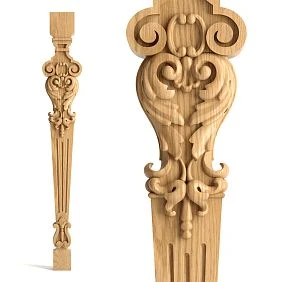
Maximum level of decorativeness. Carving on the body of the baluster — ornaments, leaves, geometric motifs. For a porch in the teremok style, in a classic country style, for houses with carved elements across the entire facade. Buy carved wooden balusters — this is an investment in the decorative image of the porch, which will impress guests.
How to choose: three questions
First question: what style is the house facade made in? Balusters should emphasize this style, not contrast with it.
Second question: how exposed is the railing to precipitation? The more complex the pattern, the more places for moisture to accumulate. For fully open areas — simpler shapes, easier to maintain.
Third question: what is more important — decor or clean lines? This is a personal choice, but it should be a conscious one.
How to choose wood for outdoor balusters: a conversation about material
For outdoor use, the wood species is not just about aesthetics, it's about durability.
Oak: the king of street trees
Oak has natural resistance to moisture due to its high content of tannins. They create a natural barrier in the wood structure against water and biological aggressors. Oak density is 720–800 kg/m³. It is a heavy, dense wood with a distinct beautiful grain.
Buy oak balusters for a porch — it's an investment for decades. Oak treated with oil or wax for exterior use ages gracefully: it darkens, gains depth, and becomes only more expressive.
A feature of oak outdoors: iron fasteners in contact with wet oak cause black spots due to the reaction of tannins with iron. Use galvanized or stainless steel fasteners.
Beech: for enclosed and semi-enclosed areas
Beech is less resistant to direct moisture than oak. On an open porch without a canopy, beech will require more intensive care and frequent coating renewal. However, for a veranda, glazed balcony, or porch with a roof, beech is quite suitable: a high-quality coating in several layers will reliably protect it.
The main advantage of beech is its uniform structure, which accepts paint excellently. White balusters on a country-style porch are most often beech under white enamel.
Buy beech balusters For a porch with a canopy or for a veranda — the optimal choice in terms of price/quality/aesthetics.
Solid wood vs. glued panels
Buy solid wood balusters means choosing a solid workpiece without gluing. For outdoor use, this is more important than for interiors: glue joints with constant wetting and drying are potential delamination zones. Solid wood behaves as a single element.
Workpiece moisture: a critical parameter
Kiln drying to 8–12% is a mandatory requirement for outdoor use. A baluster that ends up outdoors with a moisture content of 20% will dry right at the installation site: cracks will appear, tenons will open, and the coating will peel off at deformation points. Check the moisture content when ordering.
Wood selection matrix for outdoor use
| Place of application | Recommended Wood Species | Finish |
|---|---|---|
| Open porch without canopy | Oak | Oil/wax for exterior use |
| Porch with canopy | Oak or beech | Oil or enamel for exterior use |
| Open terrace | Oak | Oil with UV filter |
| Glazed veranda | Beech or oak | Enamel or varnish for wet rooms |
| Wooden balcony | Oak | Oil or weather-resistant varnish |
| Outdoor garden staircase | Oak | Oil or impregnation for exterior wood |
Railings, posts and balusters for the porch: why buy as a set
This principle is always important — but for the porch it is especially important.
Three arguments in favor of ordering as a set
First argument: unified style. The porch reads as one object. If the balusters are carved, the posts are smooth square prisms, and the handrail is a rounded D-profile, the railing will look like it was assembled from whatever was available. Stylistic inconsistency is especially noticeable outdoors: there are no curtains or carpets to soften the dissonance.
Second argument: technical compatibility. The handrail groove for the baluster tenon, mounting holes, post height — everything must match. Dimensions vary between manufacturers. Ordering from one source guarantees everything will fit together.
Third argument: one batch, one moisture content, one tone. Balusters from the same batch under coating will give the same tone. Posts from another batch may give a different shade — especially under oil and varnish. On a sunny porch, this will be noticeable.
Buy balusters and posts for a wooden staircase in one order — a rule that eliminates problems after installation.
What posts are needed for a porch and outdoor staircase
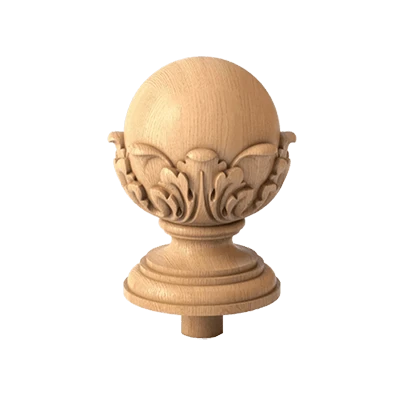
Support posts bear the main load of the entire railing. On the porch, they are especially noticeable — often rising above the handrail, ending with a finial or decorative element.
Dimensions of support posts for a porch
Standard cross-sections: 100×100, 120×120, 150×150 mm. For a private house porch with 2–4 steps — 100×100 or 120×120 mm. For a grand porch with massive posts supporting a roof — 150×150 mm and larger.
Post height: working height of the railing (900–1,000 mm) + length of the mounting tenon or anchor assembly at the bottom (80–120 mm) + height of the finial at the top (100–250 mm).
Decorative carved posts for a porch
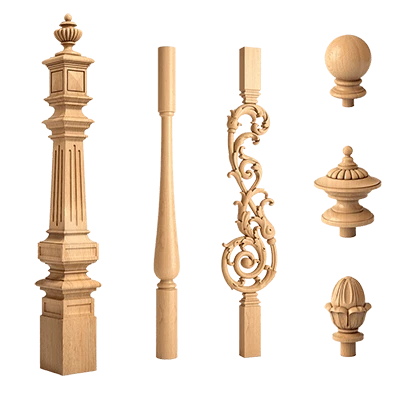
For a porch in a decorative style — carved wooden posts with ornamental elements: relief carving, profiled moldings, decorative bands. Such a post is itself an architectural element, not just a support.
Posts on the landing and at the turn
A two-flight porch or a porch with a landing requires corner and intermediate columns. The corner column bears an increased load from two adjacent spans of the railing — its cross-section must be at least 120×120 mm.
Wooden stair posts — in the catalog with several options of shapes and sizes, compatible with different types of balusters.
Mounting posts outdoors
Outdoors, posts are fastened especially securely — an M12–M16 anchor bolt into a concrete base or into a wooden step through a metal mounting sleeve. Connection to the ground via a sleeve is preferable to direct burying: the wood does not contact the soil and does not rot from below.
How to calculate the number of balusters for a porch: step-by-step method
Step one: measuring the railing
Three zones are measured:
-
Each flight of stairs horizontally (from the axis of the lower column to the axis of the upper one)
-
The landing (if any) along the length of the railing
-
Additional railings (sides of the terrace, parapets)
Step two: choosing the step
Spacing along axes = width (diameter) of the baluster + clear gap.
Recommended clear gap for an outdoor porch: 100–130 mm. This is not only about safety — the gap sets the rhythm of the railing.
Example: baluster diameter 45 mm, gap 120 mm → step along axes 165 mm.
Step three: calculating the quantity
N = (zone length / step along axes) − 1
Example: flight 2,600 mm, spacing 165 mm:
N = (2,600 / 165) − 1 = 15.7 − 1 ≈ 15 balusters.
Adjust the step to get a whole number: 2,600 / 16 = 162.5 mm — take step as 162 mm.
Step four: summation by zones
The balusters of all flights, landings and additional zones are added together. This is the total calculated quantity.
Step five: reserve
For a porch, the reserve is 15%, not 10%. Reason: trimming of edge balusters, non-standard flight angles, possible marking errors when working outdoors with uneven bases.
Summary table for a standard porch
| Zone | Length | Step | Balusters | 15% margin | Total |
|---|---|---|---|---|---|
| Porch flight | 2,400 mm | 162 мм | 14 | 3 | 17 |
| Landing (one side) | 1 500 mm | 162 мм | 8 | 2 | 10 |
| Second flight | 2,400 mm | 162 мм | 14 | 3 | 17 |
| TOTAL | 36 | 8 | 44 |
Price of balusters for porch and outdoor stairs
What determines the cost
Wood species is the main pricing factor. Buy oak balusters for a porch will cost more than similar beech products — a difference of 40–80% depending on size. But for outdoor use, oak is not an "overpayment" but a wise investment.
Shape and complexity — a simple turned baluster is cheaper than a carved one with similar dimensions. Carving adds 30–60% to the price.
Size — height and cross-section directly affect material consumption. An oak baluster 60×60×1000 mm costs several times more than a beech baluster 40×40×900 mm.
Order volume — a batch of 30–40 pieces gives a significantly better price than buying 5–10 pieces.
Presence of protective coating — balusters with factory antiseptic impregnation or primer are more expensive than untreated ones, but this saves time and money on separate material purchases.
Approximate prices (2026)
| Type | Species | Size | Price per piece |
|---|---|---|---|
| Turned | Beech | 40 mm, 900 mm | 320–480 rub. |
| Turned | Oak | 45 mm, 900 mm | 580–850 rub. |
| Square | Beech | 45×45, 900 mm | 380–560 rub. |
| Square | Oak | 50×50, 900 mm | 680–1,000 rub. |
| Flat | Beech | 90×28, 900 mm | 380–560 rub. |
| Carved | Oak | 45 mm, 900 mm | 850–1,400 RUB |
For a porch with 44 medium-sized oak balusters: 25,000–45,000 rubles. The amount is realistic — and it pays off with service life: with proper care, an oak porch railing lasts 30–40 years.
Total budget for porch railing
Balusters are only part of the expenses. The full set includes:
-
Balusters (estimated quantity + reserve)
-
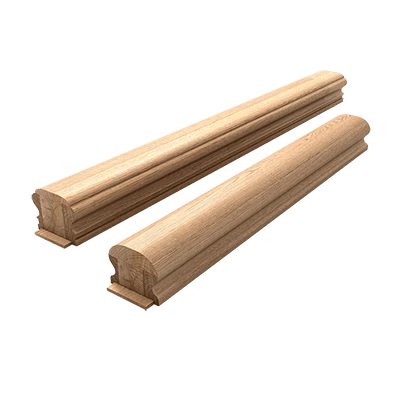
Handrails (length of all flights + 10% for trimming)
-
Support posts (2 per flight + corner posts)
-
Post finials
-
Fastening studs M12, anchors, screws, glue
-
Protective coating: antiseptic, oil or enamel for exterior use
Staircase Components for Sale in one order — the optimal strategy both in price and logistics.
Protecting wooden balusters outdoors: what, how and when
The section that is skipped — and later regretted.
Stage one: antiseptic impregnation
Done before installation and before the final coating. The antiseptic penetrates the wood structure, creating bioprotection against mold, fungus, and blue stain. Special attention to the ends: they are impregnated with a double amount of the compound, because the ends absorb moisture most intensively.
Composition: water-soluble antiseptic for exterior use. Application: brush, 2–3 coats with drying between coats.
Stage two: final coating
The choice of final coating depends on the wood species and the desired result:
Oil for exterior use — for oak. Penetrates the wood, does not create a film that could peel off. Requires renewal every 1–2 years — but the process itself is simple: wipe the surface with a new layer of oil. Preserves and highlights the texture.
Weather-resistant varnish — creates a protective film. Lasts longer than oil without renewal, but if damaged, requires complete sanding and reapplication.
Enamel for exterior use — for painting. Applied in 2–3 layers. For beech under white paint — ideal. Renewed every 3–5 years.
Tinting antiseptic impregnation — simultaneously protects and colors the wood in the desired shade. Easy to apply, suitable for regular renewal.
When to paint: before installation or after?
The correct answer is partially before, partially after. The ends and fastening areas are treated with antiseptic before installation without fail. The final coating is applied after installation to the entire assembled system, so that there are no gaps in the coating at the joints.
Maintenance frequency
-
Oil: renewal every 1–2 years, before winter or after it
-
Varnish: inspection once a year, restoration of chips as needed, complete renewal every 5–7 years
-
Enamel: full renewal every 3–5 years
Installing balusters on a porch: key differences from indoor installation
Attachment to outdoor steps
Porch steps are most often made of concrete (faced with wood or tiles) or solid wooden boards. In both cases, the baluster is fastened using an anchor stud.
For wooden steps: M10×180 mm stud, depth 80–100 mm. For concrete steps (through a wooden overlay): chemical anchor or expansion anchor M12×150 mm, followed by stud installation.
Gap between the base of the baluster and the step
When installing outdoors, the baluster must not be placed flush against a horizontal surface without a gap. The minimum gap is 3–5 mm for water drainage. Otherwise, moisture will accumulate under the base of the baluster, leading to end rot. The gap is covered with a decorative trim that slopes away from the baluster.
Attaching the handrail for outdoor use
The handrail outdoors is a high-load area. The tenon of the baluster in the handrail groove is secured not only with glue but also with an additional concealed self-tapping screw 5×70 mm. The glue must be specialized for outdoor use, waterproof: D3 or D4 according to classification.
Full breakdown of the technology — in the article about installing wooden railings and balusters.
Mistakes when buying balusters for a porch: seven cases from practice
Mistake one: buying "interior" balusters for outdoor use
Beautiful, but designed for dry indoor air. Moisture content during production is 12%, but without protective coating and antiseptic. On the porch after one season — cracks, blue stain, swollen tenons. Rule: for outdoor use — only species and coatings suitable for exterior application.
Mistake two: not ordering posts in the same order
Balusters were ordered. Posts were planned to be bought "later" or "from the same place." As a result — posts of a different material, different cross-section, different shade. Rule: posts and balusters — one order.
Mistake three: ignoring protective coating
'We'll install it, then paint it.' Installation is complete, ends are not sealed, balusters are exposed. First rain — moisture in the ends. First frost — cracks. Rule: antiseptic impregnation of ends — before installation, mandatory.
Mistake four: not accounting for the platform and side railings
Only the stair flight is calculated. The porch platform, side railings — not included in the calculation. You have to buy more, but a new batch has a different shade. Rule: calculate all railing zones, including the platform and side parapets.
Mistake five: saving on posts
They install posts from the lower price segment, without proper cross-section. After a year, the post starts to wobble — and the entire handrail loosens with it. Rule: a post on the porch — 120×120 mm minimum, from the same wood species, with a reliable anchor base.
Mistake six: choosing a design without considering cleaning and maintenance
A carved baluster with deep cuts and ornamentation outdoors: dirt, leaves, and moisture will accumulate in these recesses. It's difficult to clean, and inconvenient to renew the coating. Rule: for open areas without a canopy — simpler shapes that are easier to maintain.
Mistake seven: buying without a reserve
Ordered exactly according to the calculation. During installation, one baluster broke, one didn't fit the angle of cut. They buy more — but that item is temporarily out of stock, and installation stops for two weeks. Rule: a 15% reserve for outdoor use is the minimum.
Where to buy wooden balusters for a porch and outdoor staircase
A specialized supplier is not someone who "also has balusters." It is someone who:
-
Produces balusters for the porch considering outdoor use — wood species, moisture content, treatment
-
Has several forms: Buy flat balusters, square, turned, carved — all in one catalog
-
Offers posts, handrails, and components in coordinated sizes
-
Advises on coating selection for specific operating conditions
-
Maintains a constant warehouse stock so the entire set comes from one batch
Ask the right questions:
-
What is the moisture content of this batch of balusters?
-
Are they compatible with your posts in terms of fastening dimensions?
-
What coating do you recommend for an open porch in the Northwestern climate?
The answers will show the seller's level of competence.
Buy wooden balusters for a porch with quality guarantee and kit compatibility — in the catalog with a full range of shapes and wood species.
Wooden baluster for stairs, porch — filter by parameters, with consultation on quantity calculation and pillar selection.
STAVROS: wooden balusters and railings for porch, terrace and outdoor stairs
STAVROS is a Russian manufacturer of solid wood products, specializing in stair and railing components. The baluster line includes all main types: turned, square, flat, and carved — made of beech and oak, kiln-dried, moisture content 8–12%.
For porch and outdoor use, STAVROS offers:
-
wooden balusters for stairs buy — turned, square, flat and carved in a single catalog with wood type and dimensions specified
-
Buy carved wooden balusters — for a decorative porch with rich ornamentation
-
Wooden stair posts — in sizes compatible with balusters, in several decor options
-
Staircase Components for Sale — the entire set in one order: balusters, posts, handrails, overlays, fasteners
Constant warehouse availability. Consultation on calculating the set for your porch. Delivery across all of Russia.
STAVROS is when your porch says exactly what you want it to say about you.
Frequently asked questions
Which balusters are best to buy for a porch?
For an open porch without a canopy — oak balusters of any shape with oil or weather-resistant coating. For a porch with a canopy — oak or beech under enamel or varnish for exterior use. Shape — according to the style of the house: turned for classic, square for minimalism, flat for country, carved for decorative facades.
Can interior balusters be used outdoors?
Technically, yes, but with proper preparation: antiseptic impregnation of the ends and entire surface, application of a protective coating for exterior use. Without these measures, the baluster will deteriorate within 1–2 seasons.
What to buy together with balusters for a porch?
Handrail, support posts (2 per flight + corner posts), M10–M12 threaded rods, stainless steel or galvanized screws, waterproof glue D3/D4, antiseptic, and finish coating for exterior use. The entire set from one manufacturer.
Which balusters are better for a wooden porch: flat or carved?
Flat ones are for a light decorative railing with a cut-out pattern, well-suited for verandas and terraces in a country style. Carved ones are for richer decoration, for houses with cut-out facade ornaments. Both options are good with proper care.
How often should the coating on porch balusters be renewed?
With oil coating — once every 1–2 years. With varnish — full repair every 5–7 years. With enamel — renewal every 3–5 years. Regular inspection before winter allows you to identify coating damage and fix it before freezing.
Where to buy wooden balusters for a porch with delivery?
In the STAVROS catalog — a full range of balusters of all shapes made of beech and oak with constant warehouse availability and Contact us to confirm shipping to your destination. Consultation on selecting a set — upon order.